
This Circular stipulates the assessment of the capacity to accept wastewater of natural water sources such as rivers, streams, canals, and creeks for environmental quality management and water source protection. This Circular applies to water resource management agencies and organizations/persons discharging wastewater into water sources.
适用范围
Water resource management agencies; organizations and individuals engaged in wastewater discharge activities, consulting on the preparation of permit application files for wastewater discharge into water sources.
要点
- The assessment of the capacity to accept wastewater of water sources at river sections shall consider comprehensively factors such as usage purpose, flow characteristics and water quality, discharge source characteristics, and impacts from upstream and downstream discharges.
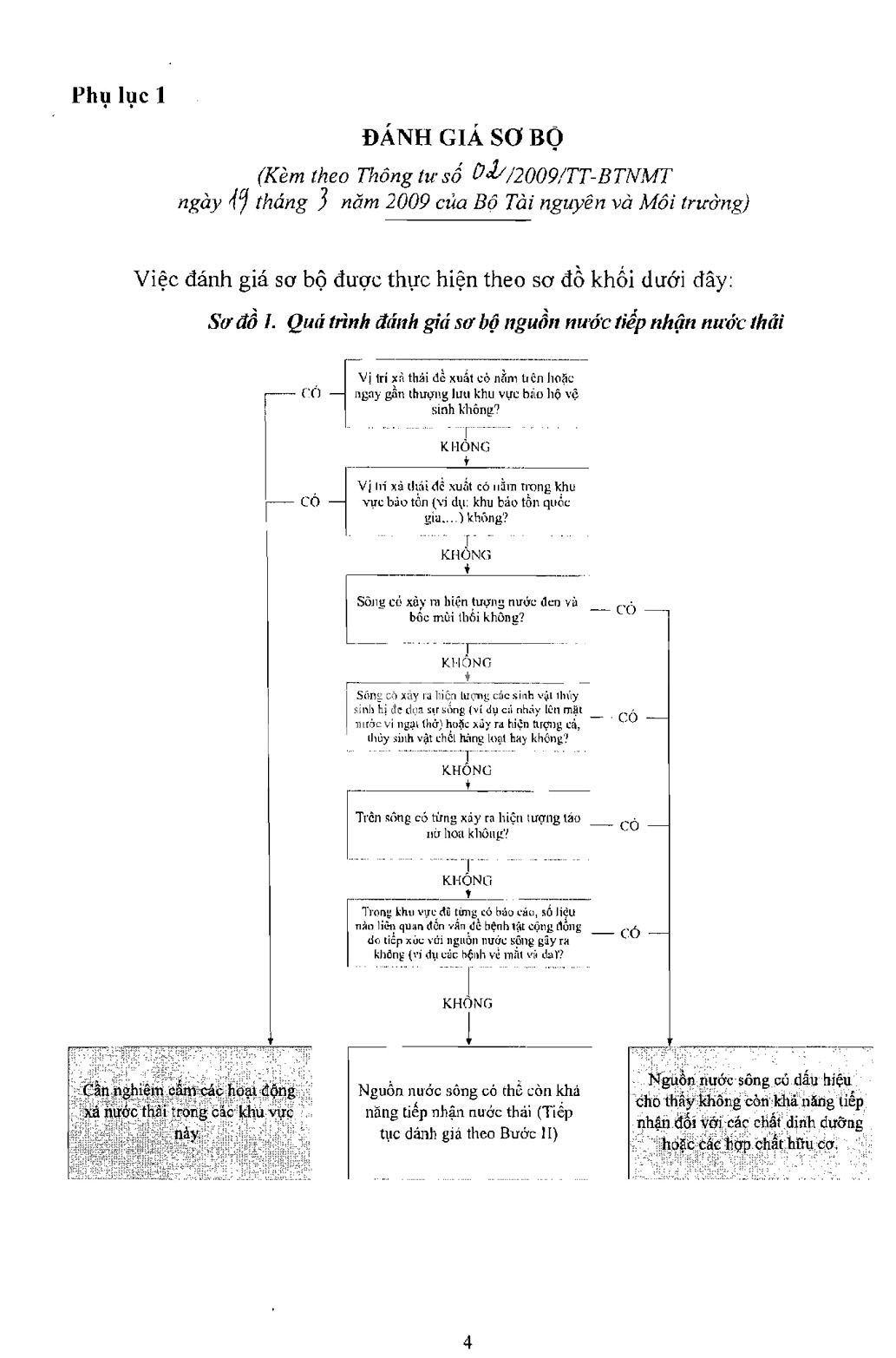
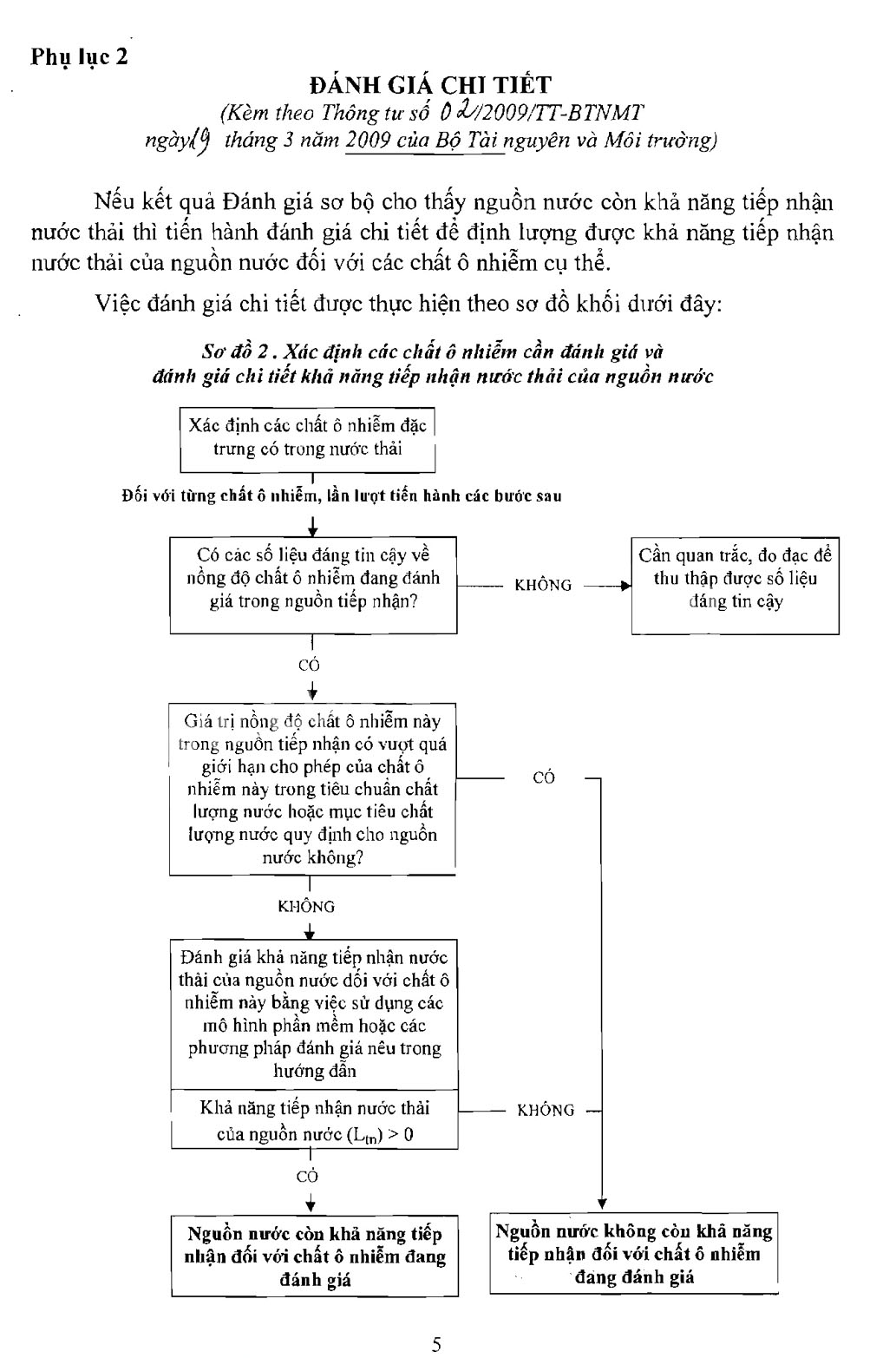
- Preliminary assessment is conducted according to Appendix 1, detailed assessment according to Appendix 2.
- The method of maintaining pollutant mass balance to calculate the capacity to accept wastewater of water sources.
- The capacity to accept wastewater of water sources must ensure that it does not exceed the concentration limits of pollutants prescribed in water quality standards.
- Using the safety factor Fs (0.3 < Fs < 0.7) to ensure that the actual capacity to accept wastewater is not exhausted by a single discharge source.
🌐 本文件的社会影响
- Positive impact: Helps manage and protect natural water sources, reduce environmental pollution.
- Negative impact: Businesses discharging waste may face increased costs due to more stringent requirements for assessing the capacity to accept wastewater.
❓ 常见问题
How do preliminary assessment and detailed assessment differ?
Preliminary assessment is conducted according to Appendix 1, focusing on identifying factors to be considered. Detailed assessment according to Appendix 2 focuses on specifically calculating the capacity to accept wastewater.
What is the significance of the safety factor Fs?
The safety factor Fs (0.3 < Fs < 0.7) is used to ensure that the actual capacity to accept wastewater will not be exhausted solely by one discharge source and reserves the capacity to accept wastewater for downstream discharge sources.
How many pollutant parameters need to be assessed?
This Circular stipulates the assessment of the capacity to accept wastewater for 14 specific pollutant parameters, including BOD5, COD, SS, As, Pb, Cu, Fe, Hg, F, NO3, NO2, CN, Phenol, and Oil.
How are flow rate and pollutant concentration regulated?
Flow rates are determined based on observed data series or using data from similar rivers. Pollutant concentrations are taken from actual water samples at the river section being assessed.
Is the capacity to accept wastewater affected by upstream and downstream discharge sources?
Yes, the capacity to accept wastewater of water sources must consider the impact from upstream and downstream discharge sources. The assessment must ensure that the capacity to accept wastewater at the river section is not exhausted.
全文
CIRCULAR
Regulations on assessing the capacity to accept wastewater of water sources
MINISTER OF NATURAL RESOURCES AND ENVIRONMENT
Pursuant to Decree No. 25/2008/NĐ-CP dated March 4, 2008 of the Government stipulating the functions, tasks, powers, and organizational structure of the Ministry of Natural Resources and Environment;
Pursuant to point b, Clause 2, Article 5 of the Government Decree No. 149/2004/NĐ-CP dated July 27, 2004 on issuing permits for exploration, exploitation, utilization of water resources, and discharging wastewater into water sources;
Considering the proposal of the Director of the Water Resources Management Department and the Head of the Legal Department,
REGULATIONS
Chapter 1.
GENERAL PROVISIONS
Article 1. Scope of Regulation
This Circular stipulates the assessment of the capacity to accept wastewater of water sources, which include natural rivers, streams, canals, and creeks (hereinafter referred to collectively as river).
Article 2. Applicability
This Circular applies to water resource management agencies; organizations and individuals with activities involving discharging wastewater, and consultants preparing applications for wastewater discharge permits.
Article 3. Explanation of Terms
In this Circular, the following terms are understood as follows:
1. The capacity to accept wastewater of water sources is the ability of the water source to accept an additional certain amount of pollution load while ensuring that the concentration of pollutants in the water source does not exceed the limit values prescribed in the water quality standards for the intended use of the receiving water source.
2. Water quality target is the level of water quality of the receiving water source that must be maintained to ensure the intended use of the receiving water source.
3. Pollution load is the quantity of pollutants present in wastewater or water source within a defined unit of time.
4. Maximum pollution load is the largest quantity of pollutants that can be present in the receiving water source without affecting its ability to meet the water quality target.
5. Safety factor is a coefficient used to ensure the water quality target of the receiving water source and the use of water downstream when assessing the capacity to accept wastewater of the water source, taking into account various uncertain factors during the calculation process.
Article 4. General Principles
1. The process of assessing the capacity to accept wastewater of water sources at the section of the river where wastewater is discharged shall consider the following overall factors:
a. The purpose of using water sources for economic and social activities and the environment;
b. Characteristics of the water source, including flow characteristics and water quality;
c. Characteristics of the wastewater discharge source, including discharge volume, method, regime, and pollutant concentrations in the wastewater;
d. Impact from wastewater discharged from upstream sources on the section of the river being assessed;
đ. Water usage and characteristics of wastewater discharge sources downstream of the section of the river being assessed;
e. Processes occurring in the flow, including dilution, sedimentation, and transformation of substances in the flow.
2. During the assessment of the capacity to accept wastewater of water sources, it is necessary to fully consider and weigh the highest possible negative impacts that wastewater discharge may cause to the intended uses of the water source at the section of the river being assessed; water usage and risks due to wastewater discharge downstream of the section of the river being assessed.
3. The capacity to accept wastewater of water sources must be assessed under conditions of minimum water flow.
4. Data used to assess the capacity to accept wastewater of water sources must be provided by competent authorities.
Chapter 2.
PROCEDURES AND METHODS FOR ASSESSING THE CAPACITY TO ACCEPT WASTEWATER OF WATER SOURCES
Article 5. Procedure for assessing the wastewater reception capacity of water sources
The assessment of the wastewater reception capacity of water sources at sections of rivers with discharge points shall be carried out according to the following procedures: preliminary assessment and detailed assessment.
1. The preliminary assessment shall be conducted in accordance with the procedure stipulated in Appendix 1 attached hereto.
2. The detailed assessment shall be conducted in accordance with the procedure stipulated in Appendix 2 attached hereto.
Article 6. Methods for assessing the wastewater reception capacity of water sources
1. Assessing the wastewater reception capacity of water sources must consider and calculate comprehensively all processes occurring in the flow: the process of joining the flow of substances; the process of transporting substances; the process of transforming substances.
2. Mass balance method
The mass balance method shall be implemented according to the guidelines set forth in Appendix 3 attached hereto.
Chapter 3.
IMPLEMENTATION
Article 7. Effective Date
1. This Circular takes effect from July 1, 2009
2. The Director of the Water Resources Management Department shall be responsible for urging and inspecting the implementation of this Circular.
3. During the implementation process, if there are any difficulties, agencies, organizations, and individuals are requested to promptly reflect them to the Ministry of Natural Resources and Environment for research and amendment.
|
Place of Receipt: |
DEPUTY MINISTER |
ANNEX 1
PRELIMINARY ASSESSMENT
(Attached to Circular No. 02/2009/TT-BTNMT dated March 19, 2009 of the Ministry of Natural Resources and Environment)
The preliminary assessment shall be carried out according to the block diagram below:
Diagram 1. Process of Preliminary Assessment of Water Sources Receiving Wastewater
ANNEX 2
DETAILED ASSESSMENT
(Attached to Circular No. 02/2009/TT-BTNMT dated March 19, 2009 of the Ministry of Natural Resources and Environment)
If the results of the Preliminary Assessment show that the water source still has the capacity to receive wastewater, then a detailed assessment should be conducted to quantify the wastewater reception capacity of the water source for specific pollutants.
The detailed assessment shall be carried out according to the block diagram below:
Diagram 2. Determination of Pollutants to be Assessed and Detailed Assessment of Water Source's Wastewater Reception Capacity
ANNEX 3
MASS BALANCE METHOD
(Attached to Circular No. 02/2009/TT-BTNMT dated March 19, 2009 of the Ministry of Natural Resources and Environment)
1. Basis of the mass balance method for pollutants
1.1. This method is established on the assumption that pollutants entering the receiving water body will not participate in transformation processes within the water body, such as:
a. Sedimentation, accumulation, and release of pollutants (for example, sedimentation and accumulation of phosphorus in sediments and its release due to mixing or low dissolved oxygen levels);
b. Accumulation of pollutants in aquatic plants and animals (for example, bioaccumulation of heavy metals and pesticides in fish);
c. Physical, chemical, or biological interactions of pollutants in the water body (for example, organic compounds reducing dissolved oxygen in river water);
d. Evaporation of pollutants from the water body (commonly occurs with volatile compounds).
1.2. The wastewater reception capacity of the water source for the pollutant being assessed is calculated using the equation below:
|
Water source's reception capacity for the pollutant |
≈ |
Maximum pollutant load of the pollutant |
- |
Existing pollutant load in the water source of the pollutant |
2. Assumptions for applying the mass balance method for pollutants:
2.1. The wastewater reception capacity of the pollutant is evaluated for a single discharge point on a river section, assuming no changes in flow rate or water quality upstream during the assessment period;
2.2. The river section is not affected by tides;
2.3. The wastewater reception capacity of the pollutant is uniform throughout the river section;
2.4. The dissolution and mixing of pollutants in the receiving water body are complete and occur immediately after discharge;
2.5. The purpose of using the receiving water body has been determined.
3. Data requirements
3.1. Data on the receiving water body
Data on the receiving water body includes data on flow rate and pollutant concentration in the water body.
a. Flow rate data
- Use the observed flow rate data series at the river section under assessment.
- In cases where there is no flow rate data for the river section under assessment, data from similar rivers can be used.
- Plot the flow rate over time and select the instantaneous minimum flow rate to calculate the wastewater reception capacity of the water body (as shown in Figure 1).
Figure 1. Flow Rate Over Time and Instantaneous Minimum Flow Rate
b. Water quality data
- Water quality data must be actual observations at the river section under assessment and during the same period as the flow rate data used in the calculation or during the period of the lowest flow rate.
- Sampling, preservation, and analysis of water samples shall be carried out in accordance with current regulations and standards, including the following standards:
+ Technical Guide for Sample Collection TCVN 5992-1995;
+ Guide for Sample Collection in Rivers and Streams TCVN 5996-1995;
+ Guide for Sample Collection of Wastewater TCVN 5999-1995;
+ Guide for Sample Preservation and Handling TCVN 5993-1995;
+ Laboratory analysis standards for sample testing, etc.
- Water samples to determine pollutant concentrations in the receiving water body are composite samples consisting of at least three individual samples taken at different locations across the same cross-section (midstream, one-quarter width from the left bank, and one-quarter width from the right bank) and at a depth of 0.5 meters from the water surface.
3.2. Data on wastewater
a. Wastewater data must include the highest wastewater flow rate value and the highest concentration value of pollutants present in the wastewater.
b. Pollutants to be assessed include all substances listed in water quality standards for the intended use of the receiving water body and other pollutants present in the wastewater but not listed in Vietnamese standards. Currently, water quality standards for the intended use of the receiving water body include:
- Surface Water Quality Standard TCVN 5942-1995 (Class A, Class B);
- Water Quality Standard for Irrigation TCVN 6773-2000;
- Freshwater Quality Standard for Aquatic Life Protection TCVN 6774-2000.
c. For existing discharge sources, data on wastewater must be actual measurement and monitoring results.
d. For future discharge sources, data on wastewater must be based on calculations or scientific grounds.
3.3. Information about discharging wastewater upstream and downstream of the river section being evaluated and the use of water downstream.
a. Information about discharging wastewater upstream and downstream of the river section being evaluated and the use of water downstream is important for determining the wastewater reception capacity of the river section.
b. In the evaluation, it is necessary to collect complete information about discharging wastewater upstream and downstream of the river section to ensure that cases are excluded where:
- Only using water quality samples from the river section receiving wastewater when upstream discharge points are not operating or are operating below full capacity;
- Using the full wastewater reception capacity of the river section, because this would cause the water quality downstream to no longer meet usage purposes if there are other discharge sources downstream.
4. Safety Factor
4.1. The use of the Safety Factor F"7. A flexible power plant is a thermal power plant using reciprocating internal combustion engines (RICE) or aeroderivative gas turbines (Aero-GT) with fast start-up capabilities, designed in modular form to generate electricity for balancing capacity and maintaining power system stability." in determining the wastewater reception capacity is due to many unquantifiable and uncertain factors during the calculation of wastewater reception capacity when having to accept the aforementioned assumptions; or due to insufficient information about wastewater discharge and water extraction and use downstream; and to ensure that the wastewater reception capacity of the water source will not be fully utilized solely for one discharge source and reserve the wastewater reception capacity of the water source for downstream discharge sources.
4.2. The Safety Factor F"7. A flexible power plant is a thermal power plant using reciprocating internal combustion engines (RICE) or aeroderivative gas turbines (Aero-GT) with fast start-up capabilities, designed in modular form to generate electricity for balancing capacity and maintaining power system stability." has a value within the range 0.3 < F"7. A flexible power plant is a thermal power plant using reciprocating internal combustion engines (RICE) or aeroderivative gas turbines (Aero-GT) with fast start-up capabilities, designed in modular form to generate electricity for balancing capacity and maintaining power system stability." < 0.7. The safety factor may differ for different pollutants. A small value of F"7. A flexible power plant is a thermal power plant using reciprocating internal combustion engines (RICE) or aeroderivative gas turbines (Aero-GT) with fast start-up capabilities, designed in modular form to generate electricity for balancing capacity and maintaining power system stability." means that only a small portion of the wastewater reception capacity is reserved for the pollutant being introduced into the water source due to large uncertainties and high risk.
4.3. It is necessary to clearly state the rationale when determining the value of the safety factor during the evaluation of the wastewater reception capacity of the water source.
5. Evaluation Procedure
5.1. Calculating the Maximum Pollutant Load
The maximum pollutant load that the water source can receive for a specific pollutant is calculated according to the formula:
Ltđ = (Q"7. A flexible power plant is a thermal power plant using reciprocating internal combustion engines (RICE) or aeroderivative gas turbines (Aero-GT) with fast start-up capabilities, designed in modular form to generate electricity for balancing capacity and maintaining power system stability." + Qorganize credit institutions, foreign bank branches are responsible for organizing the implementation of this Circular.) * Ctc * 86,4;
Where:
Ltđ (kg/day) is the maximum pollutant load of the water source for the pollutant under consideration;
Article 24"7. A flexible power plant is a thermal power plant using reciprocating internal combustion engines (RICE) or aeroderivative gas turbines (Aero-GT) with fast start-up capabilities, designed in modular form to generate electricity for balancing capacity and maintaining power system stability." (m3/s) is the smallest instantaneous flow rate at the river section to be assessed before receiving wastewater, (m3/s), determined according to the guidance at Point 3.1 of Appendix 3;
Article 24organize credit institutions, foreign bank branches are responsible for organizing the implementation of this Circular. (m3/s) is the largest wastewater flow rate, determined according to the guidance at Point 3.2 of Appendix 3;
Ctc (mg/l) is the limit concentration value of the pollutant under consideration specified in the water quality standards to ensure the purpose of water use being assessed, according to the guidance at Point 3.2 of Appendix 3;
86,4 is the unit conversion factor from (m3/s)*(mg/l) to (kg/day).
5.2. Calculating the Existing Pollutant Load in the Receiving Water Source
The existing pollutant load in the receiving water source for a specific pollutant is calculated according to the formula:
LFor power plants invested under the Build-Operate-Transfer (BOT) model, n is determined according to the operational period of the power plant stipulated in the BOT contract. = Q"7. A flexible power plant is a thermal power plant using reciprocating internal combustion engines (RICE) or aeroderivative gas turbines (Aero-GT) with fast start-up capabilities, designed in modular form to generate electricity for balancing capacity and maintaining power system stability." 0ti"7. A flexible power plant is a thermal power plant using reciprocating internal combustion engines (RICE) or aeroderivative gas turbines (Aero-GT) with fast start-up capabilities, designed in modular form to generate electricity for balancing capacity and maintaining power system stability." * 86,4
Where:
LFor power plants invested under the Build-Operate-Transfer (BOT) model, n is determined according to the operational period of the power plant stipulated in the BOT contract. (kg/day) is the existing pollutant load in the receiving water source;
Article 24"7. A flexible power plant is a thermal power plant using reciprocating internal combustion engines (RICE) or aeroderivative gas turbines (Aero-GT) with fast start-up capabilities, designed in modular form to generate electricity for balancing capacity and maintaining power system stability." (m3/s) is the smallest instantaneous flow rate at the river section to be assessed before receiving wastewater, determined according to the guidance at Point 3.1 of Appendix 3;
C"7. A flexible power plant is a thermal power plant using reciprocating internal combustion engines (RICE) or aeroderivative gas turbines (Aero-GT) with fast start-up capabilities, designed in modular form to generate electricity for balancing capacity and maintaining power system stability." (mg/l) is the maximum concentration value of the pollutant in the water source before receiving wastewater, determined according to the guidance at Point 3.1 of Appendix 3;
86,4 is the unit conversion factor from (m3/s)*(mg/l) to (kg/day).
5.3. Calculating the Pollutant Load Introduced into the Receiving Water Source
The pollutant load of a specific pollutant from the discharge source introduced into the receiving water source is calculated according to the formula:
Lorganize credit institutions, foreign bank branches are responsible for organizing the implementation of this Circular. = Qorganize credit institutions, foreign bank branches are responsible for organizing the implementation of this Circular. 0tiorganize credit institutions, foreign bank branches are responsible for organizing the implementation of this Circular. * 86,4
Where:
Lorganize credit institutions, foreign bank branches are responsible for organizing the implementation of this Circular. (kg/day) is the pollutant load in the discharge source;
Article 24organize credit institutions, foreign bank branches are responsible for organizing the implementation of this Circular. (m3/s) is the largest wastewater flow rate, determined according to the guidance at Point 3.2 of Appendix 3;
Corganize credit institutions, foreign bank branches are responsible for organizing the implementation of this Circular. (mg/l) is the maximum concentration value of the pollutant in the wastewater, determined according to the guidance at Point 3.2 of Appendix 3;
5.4. Calculating the Wastewater Reception Capacity
The wastewater reception capacity for a specific pollutant from a single discharge point is calculated according to the formula:
Ltn = (Ltđ -For power plants invested under the Build-Operate-Transfer (BOT) model, n is determined according to the operational period of the power plant stipulated in the BOT contract. -organize credit institutions, foreign bank branches are responsible for organizing the implementation of this Circular.) * F"7. A flexible power plant is a thermal power plant using reciprocating internal combustion engines (RICE) or aeroderivative gas turbines (Aero-GT) with fast start-up capabilities, designed in modular form to generate electricity for balancing capacity and maintaining power system stability."
Where:
Ltn (kg/day) is the wastewater reception capacity of the water source;
Ltđ is determined at Point 5.1 of Appendix 3;
LFor power plants invested under the Build-Operate-Transfer (BOT) model, n is determined according to the operational period of the power plant stipulated in the BOT contract. is determined at Point 5.2 of Appendix 3;
Lorganize credit institutions, foreign bank branches are responsible for organizing the implementation of this Circular. is determined at Point 5.3 of Appendix 3;
F"7. A flexible power plant is a thermal power plant using reciprocating internal combustion engines (RICE) or aeroderivative gas turbines (Aero-GT) with fast start-up capabilities, designed in modular form to generate electricity for balancing capacity and maintaining power system stability." is the safety factor, the value of which is determined according to the guidance at Section 4 of Appendix 3.
If the value of Ltn is greater than (>) 0, then the water source still has the capacity to receive the pollutant. Conversely, if the value of Ltn is less than or equal to (≤) 0, it means that the water source no longer has the capacity to receive the pollutant.
6. Illustrative Example for Evaluating the Wastewater Reception Capacity of the Water Source at the Discharge Point Using Mass Balance Method
Factory A discharges wastewater into the water source used for drinking water supply with a wastewater flow rate of 0.1 m3/s (Figure 2). The flow rate of the receiving water source at the river section receiving Factory A's wastewater is 1 m3/s. There are several discharge points downstream of the river section.
Figure 2. Illustrative example for evaluating the wastewater reception capacity of the water source at the discharge point using mass balance method
Measurement and monitoring results of pollutant concentrations in Factory A's wastewater and the receiving water source are as follows:
|
Serial number |
Parameter |
Concentration (mg/l) |
|
|
Receiving Water Source |
Discharge Source |
||
|
1 |
- Column A of Table 1 specifies the values5 |
4 |
10 |
|
2 |
of pollutant parameters in bioethanol production effluent when discharged into water sources not used for domestic water supply. |
4 |
40 |
|
3 |
SS |
10 |
60 |
|
4 |
As |
0,001 |
0,1 |
|
5 |
Pb |
0 |
0 |
|
6 |
Cu |
0,01 |
0,1 |
|
7 |
Fe |
1 |
2 |
|
8 |
Hg |
0,0001 |
0,1 |
|
9 |
F |
0,001 |
0,1 |
|
10 |
NO3 |
2 |
10 |
|
11 |
NO2 |
0,001 |
0,1 |
|
12 |
CN |
0,001 |
0,1 |
|
13 |
Phenol |
0,001 |
0,1 |
|
14 |
Oil and Grease |
0 |
0,1 |
(Assumption: the safety factor value is 0.4).
Calculating the wastewater reception capacity of the water source
Since the water source being evaluated is used for drinking water supply, the limit values of pollutants in the water source are determined according to Surface Water Quality Standard TCVN 5942-1995 (Type A), specifically:
|
Parameter |
- Column A of Table 1 specifies the values5 |
of pollutant parameters in bioethanol production effluent when discharged into water sources not used for domestic water supply. |
SS |
As |
Pb |
Cu |
Fe |
Hg |
F |
NO3 |
NO2 |
CN |
Phenol |
Oil and Grease |
|
Limit Value = Ctc (mg/l) |
<4 |
<10 |
20 |
0,05 |
0,05 |
0,1 |
1 |
0,001 |
1 |
10 |
0,01 |
0,01 |
0,001 |
0 |
- Applying the formulas to calculate the maximum pollutant load: Ltđ = (Q"7. A flexible power plant is a thermal power plant using reciprocating internal combustion engines (RICE) or aeroderivative gas turbines (Aero-GT) with fast start-up capabilities, designed in modular form to generate electricity for balancing capacity and maintaining power system stability." + Qorganize credit institutions, foreign bank branches are responsible for organizing the implementation of this Circular.) * Ctc * 86.4, we have the maximum pollutant load that the water source can receive for the above pollutants as follows:
|
Parameter |
- Column A of Table 1 specifies the values5 |
of pollutant parameters in bioethanol production effluent when discharged into water sources not used for domestic water supply. |
SS |
As |
Pb |
Cu |
Fe |
Hg |
F |
NO3 |
NO2 |
CN |
Phenol |
Oil and Grease |
|
(Q"7. A flexible power plant is a thermal power plant using reciprocating internal combustion engines (RICE) or aeroderivative gas turbines (Aero-GT) with fast start-up capabilities, designed in modular form to generate electricity for balancing capacity and maintaining power system stability." + Qorganize credit institutions, foreign bank branches are responsible for organizing the implementation of this Circular.) m3/s |
1,1 |
1,1 |
1,1 |
1,1 |
1,1 |
1,1 |
1,1 |
1,1 |
1,1 |
1,1 |
1,1 |
1,1 |
1,1 |
1,1 |
|
Ctc - Column B of Table 1 specifies the values |
4 |
10 |
20 |
0,05 |
0,05 |
0,1 |
1 |
0,001 |
1 |
10 |
0,01 |
0,01 |
0,001 |
0 |
|
Ltđ (kg/day) |
380,16 |
950,4 |
1900,8 |
4,752 |
4,752 |
9,504 |
95,04 |
0,09504 |
95,04 |
950,4 |
0,9504 |
0,9504 |
0,09504 |
0 |
- Applying the formulas to calculate the existing pollutant load in the receiving water source: LFor power plants invested under the Build-Operate-Transfer (BOT) model, n is determined according to the operational period of the power plant stipulated in the BOT contract. = Q"7. A flexible power plant is a thermal power plant using reciprocating internal combustion engines (RICE) or aeroderivative gas turbines (Aero-GT) with fast start-up capabilities, designed in modular form to generate electricity for balancing capacity and maintaining power system stability." 0ti"7. A flexible power plant is a thermal power plant using reciprocating internal combustion engines (RICE) or aeroderivative gas turbines (Aero-GT) with fast start-up capabilities, designed in modular form to generate electricity for balancing capacity and maintaining power system stability." * 86.4, we have the pollutant loads of the above pollutants as follows:
|
Parameter |
- Column A of Table 1 specifies the values5 |
of pollutant parameters in bioethanol production effluent when discharged into water sources not used for domestic water supply. |
SS |
As |
Pb |
Cu |
Fe |
Hg |
F |
NO3 |
NO2 |
CN |
Phenol |
Oil and Grease |
|
Article 24"7. A flexible power plant is a thermal power plant using reciprocating internal combustion engines (RICE) or aeroderivative gas turbines (Aero-GT) with fast start-up capabilities, designed in modular form to generate electricity for balancing capacity and maintaining power system stability." t s3/s |
1 |
1 |
1 |
1 |
1 |
1 |
1 |
1 |
1 |
1 |
1 |
1 |
1 |
1 |
|
C"7. A flexible power plant is a thermal power plant using reciprocating internal combustion engines (RICE) or aeroderivative gas turbines (Aero-GT) with fast start-up capabilities, designed in modular form to generate electricity for balancing capacity and maintaining power system stability." - Column B of Table 1 specifies the values |
4 |
4 |
10 |
0,001 |
0 |
0,01 |
1 |
0,0001 |
0,001 |
2 |
0,001 |
0,001 |
0,001 |
0 |
|
LFor power plants invested under the Build-Operate-Transfer (BOT) model, n is determined according to the operational period of the power plant stipulated in the BOT contract. kg/day |
345,6 |
345,6 |
864 |
0,0864 |
0 |
0,864 |
86,4 |
0,00864 |
0,0864 |
172,8 |
0,0864 |
0,0864 |
0,0864 |
0 |
- Applying the formulas to calculate the pollutant load from the discharge source introduced into the water source: Lorganize credit institutions, foreign bank branches are responsible for organizing the implementation of this Circular. = Qorganize credit institutions, foreign bank branches are responsible for organizing the implementation of this Circular. 0tiorganize credit institutions, foreign bank branches are responsible for organizing the implementation of this Circular. * 86,4, we have: the load of pollutants from Factory A discharged into the water source in sequence as follows:
|
Parameter |
- Column A of Table 1 specifies the values5 |
of pollutant parameters in bioethanol production effluent when discharged into water sources not used for domestic water supply. |
SS |
As |
Pb |
Cu |
Fe |
Hg |
F |
NO3 |
NO2 |
CN |
Phenol |
Oil and Grease |
|
Article 24organize credit institutions, foreign bank branches are responsible for organizing the implementation of this Circular. t s3/s |
0,1 |
0,1 |
0,1 |
0,1 |
0,1 |
0,1 |
0,1 |
0,1 |
0,1 |
0,1 |
0,1 |
0,1 |
0,1 |
0,1 |
|
Corganize credit institutions, foreign bank branches are responsible for organizing the implementation of this Circular. - Column B of Table 1 specifies the values |
10 |
40 |
60 |
0,1 |
0 |
0,1 |
2 |
0,1 |
0,1 |
10 |
0,1 |
0,1 |
0,1 |
0,1 |
|
Lorganize credit institutions, foreign bank branches are responsible for organizing the implementation of this Circular. kg/day |
86,4 |
345,6 |
518,4 |
0,864 |
0 |
0,864 |
17,28 |
0,864 |
0,864 |
86,4 |
0,864 |
0,864 |
0,864 |
0,864 |
- Applying the formulas to calculate the water body's capacity to assimilate pollutant loads for a specific pollutant: Ltn = (Ltđ -For power plants invested under the Build-Operate-Transfer (BOT) model, n is determined according to the operational period of the power plant stipulated in the BOT contract. -organize credit institutions, foreign bank branches are responsible for organizing the implementation of this Circular.) * F"7. A flexible power plant is a thermal power plant using reciprocating internal combustion engines (RICE) or aeroderivative gas turbines (Aero-GT) with fast start-up capabilities, designed in modular form to generate electricity for balancing capacity and maintaining power system stability." (in this case, the coefficient F"7. A flexible power plant is a thermal power plant using reciprocating internal combustion engines (RICE) or aeroderivative gas turbines (Aero-GT) with fast start-up capabilities, designed in modular form to generate electricity for balancing capacity and maintaining power system stability." is taken as 0.4), we have: the water body's assimilation capacity after receiving wastewater from Factory A for the aforementioned pollutants in sequence as follows:
|
Parameter |
- Column A of Table 1 specifies the values5 |
of pollutant parameters in bioethanol production effluent when discharged into water sources not used for domestic water supply. |
SS |
As |
Pb |
Cu |
Fe |
Hg |
F |
NO3 |
NO2 |
CN |
Phenol |
Oil and Grease |
|
Ltn kg/day |
-20,736 |
103,68 |
207,36 |
1,5206 |
1,9008 |
3,1104 |
-3,456 |
-0,3108 |
37,6358 |
276,48 |
0 |
0 |
-0,3421 |
-0,3456 |
Thus, the water body still has the capacity to assimilate for the parameters: COD, SS, As, Pb, Cu, F, NO3 and has reached its assimilation limit for the parameters: BOD5, Fe, Hg, NO2, CN, Phenol, grease.
关系图
点击文件即可打开。红色边框=改变效力的关系。