
Circular No. 11/2023/TT-BYT provides detailed regulations on the implementation of smoke-free areas and the awarding of the Smoke-Free Environment Award, including contents such as scope of application, responsibilities of related organizations and individuals; prohibitory signs for smoking; criteria for evaluating smoke-free areas; procedures for awarding prizes and sample proposal and achievement report documents.
适用范围
This Circular applies to organizations and individuals related to the implementation of smoke-free areas and the awarding of the Smoke-Free Environment Award as prescribed by the Law on Prevention and Control of Harmful Effects of Tobacco.
要点
- Regulations on prohibitory signs for smoking
- Criteria for evaluating smoke-free areas
- Procedures for awarding prizes
- Sample proposal and achievement report documents
- Responsibilities of related organizations and individuals
🌐 本文件的社会影响
- Enhance awareness of the harmful effects of smoking
- Encourage the implementation of smoke-free areas
- Build a safe smoke-free environment for the community
❓ 常见问题
When does this Circular take effect?
Circular No. 11/2023/TT-BYT takes effect from August 1, 2023.
Which organizations and individuals are primarily responsible for implementing this Circular?
The Department of Medical Examination and Treatment is the main unit for monitoring, inspecting, and urging the implementation of this Circular. The Director of the Ministry's Office, the Inspector General of the Ministry, the Heads of Departments and Bureaus under the Ministry of Health, the Directors of Provincial Health Services under central cities, and related organizations and individuals are responsible for enforcing this Circular.
What sign models are specified in Appendix No. 1 of this Circular?
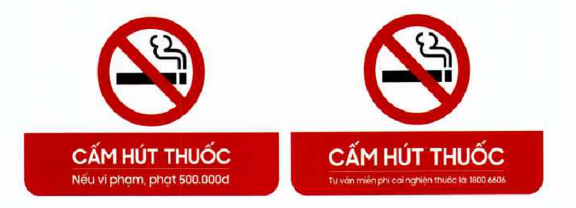
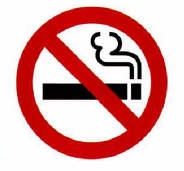
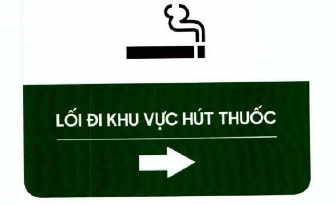
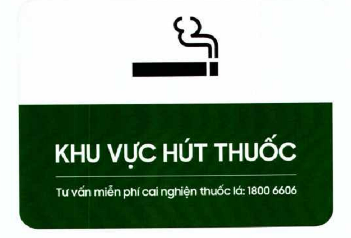
Appendix No. 1 includes the following sign models: Model No. 1 - No Smoking Sign; Model No. 2 - No Smoking Symbol; Model No. 3 - Sign indicating the designated smoking area; Model No. 4 - Sign 'Smoking Area'.
全文
|
MINISTRY OF HEALTH |
SOCIALIST REPUBLIC OF VIET NAM |
|
NUMBER: 11/2023/TT-BYT |
HA NOI, May 11, 2023 |
CIRCULAR
REGULATIONS ON THE IMPLEMENTATION OF SMOKE-FREE AREAS AND THE AWARDS FOR TOBACCO-FREE ENVIRONMENTS
On the basis of Law on Prevention and Control of Harmful Effects of Tobacco Products dated June 18, 2012;
On the basis of Education Law dated June 14, 2019;
On the basis of Law on Competition and Rewards dated November 26, 2003; Law Amending and Supplementing Certain Provisions of the Law on Competition and Rewards dated June 14, 2005 and Law Amending and Supplementing Certain Provisions of the Law on Competition and Rewards dated November 16, 2013;
On the basis of Decree No. 77/2013/NĐ-CP dated July 17, 2013 of the Government detailing the implementation of the Law on Prevention and Control of Harmful Effects of Tobacco Products regarding certain measures to prevent and control harmful effects of tobacco products;
On the basis of Decree No. 95/2022/NĐ-CP dated November 15, 2022 of the Government stipulating the functions, tasks, powers, and organizational structure of the Ministry of Health;
On the basis of Decision No. 47/2013/QĐ-TTg dated July 29, 2013 of the Prime Minister stipulating the establishment and approval of the Charter for the Organization and Operation of the Fund for Prevention and Control of Harmful Effects of Tobacco Products;
Pursuant to the proposal of the Director of the Legal Department and the Director of the Medical Examination and Treatment Management Department;
The Minister of Health issues this Circular regulating the implementation of smoke-free areas and the awards for tobacco-free environments.
PART I
GENERAL PROVISIONS
Article 1. Scope of Regulation
Article 1. This Circular regulates the organization and implementation of smoke-free areas as stipulated in Clauses 2, 3, 4, and 5 of this Circular; principles, criteria, procedures for awarding the Tobacco-Free Environment Award, and the responsibilities of relevant agencies, organizations, and individuals.
Article 2. Smoke-free areas inside buildings and within their premises include:
a) Healthcare facilities;
b) Educational institutions;
c) Facilities exclusively for children's care, nurturing, play, and entertainment;
d) Areas with high fire and explosion risks as specified in Appendix II of the List of Premises with Fire and Explosion Hazards issued together with Decree No. 136/2020/NĐ-CP dated November 24, 2020 of the Government detailing certain provisions and measures to implement the Law on Fire Prevention and Combating and the Law Amending and Supplementing Certain Provisions of the Law on Fire Prevention and Combating.
Article 3. Smoke-free areas inside buildings include:
a) Indoor workplaces of administrative state agencies, public service units, enterprises, political organizations, political-social organizations, social organizations, occupational social organizations, and other agencies, organizations, and units, except for the areas specified in Clause 2 and Clause 5 of this Article;
b) Indoor areas of public places: food service establishments, entertainment service establishments, railway stations, bus terminals, religious and belief sites, conference centers, shopping malls, markets, theaters, cultural houses, cinemas, circus venues, clubs, sports arenas, stadiums, community houses, and common living areas of apartment complexes and other public places, except for the areas specified in Clause 2 and Clause 5 of this Article.
Article 4. Public transportation vehicles are completely smoke-free:
a) Cars;
b) Airplanes;
c) Trains.
Article 5. Smoke-free areas inside buildings but may have designated smoking areas include:
a) Airport isolation zones;
b) Bars, karaoke lounges, nightclubs;
c) Hotels, guesthouses, hostels, resorts, and other tourist accommodation facilities;
d) Public transportation vessels such as ships and trains.
Article 2. Applicability
This Circular applies to agencies, organizations, and individuals related to the implementation of smoke-free areas and the awarding of the Tobacco-Free Environment Award.
Chapter II
IMPLEMENTATION
SMOKE-FREE AREAS
Article 3. General requirements for all smoke-free areas
1. A sign or lettering or symbol with the message prohibiting smoking (hereinafter referred to as "sign") shall be placed, printed, or arranged (hereinafter collectively referred to as "placed"). Agencies, organizations, and individuals may refer to Model 1 and Model 2 in Appendix 1 issued together with this Circular.
2. The sign must meet the following requirements:
a) The message is clear, easy to understand, and concise;
b) The material of the sign is durable and resistant to fading; signs placed outdoors must withstand external environmental impacts;
c) The size and font of the sign are appropriate for its location and space; bold letters that are easy to read; contrasting colors between the text and symbols and the background color;
d) For public places where there is insufficient lighting, reflective or illuminated signs or other suitable forms must be used to ensure visibility.
3. The placement of signs must meet the following requirements:
a) The distance between signs is appropriate for the scale and space of each location;
b) Signs should be placed in easily observable locations, high-traffic areas, entrances to premises, outdoor parking areas; for indoor areas, at entrance doors, foyers, reception areas, waiting areas, stairwell floors, elevators, covered walkways, parking garages, and restrooms.
4. There shall be no ashtrays, smoking utensils, cigarette butts, or ashes in smoke-free areas.
Article 4. Specific requirements for completely smoke-free indoor areas and within premises
1. Signs must be placed in the premises area.
2. Locations specified in point a, Clause 2, Article 1 of this Circular: At least signs must be placed in examination rooms, patient rooms, cafeterias, dining halls.
3. Locations specified in point b, Clause 2, Article 1 of this Circular: At least signs must be placed in auditoriums, meeting rooms, offices, classrooms, security areas, libraries, multi-purpose rooms, cafeterias, dining halls, dormitory areas, and half-day boarding areas.
4. Locations specified in point c, Clause 2, Article 1 of this Circular: At least signs must be placed in meeting rooms, common activity rooms, dining halls, resting areas, and other necessary areas with children.
5. Locations specified in point d, Clause 2, Article 1 of this Circular: Signs must be placed in areas containing fire hazards.
Article 5. Specific requirements for completely smoke-free indoor areas
1. Locations specified in Clause 3, Article 1 of this Circular: At least signs must be placed in offices, auditoriums, meeting rooms, security areas, cafeterias, dining halls.
2. In cases where these locations have outdoor areas where smoking is permitted, the designated smoking areas must be far from entrances, emergency exits, and windows to ensure that smoke does not affect these areas.
Article 6. Specific requirements for completely smoke-free public transportation vehicles
Signs must be placed in positions visible to passengers inside the vehicle, near the driver's cabin, and at entry and exit points.
Article 7. Specific requirements for indoor areas that allow designated smoking areas
1. Signs indicating directions to the designated smoking areas must be provided. Agencies, organizations, and individuals may refer to Sign Model 3 in Appendix 1 issued together with this Circular.
2. Designated smoking areas must meet the following requirements:
a) Signs indicating the smoking area must be provided. Agencies, organizations, and individuals may refer to Sign Model 4 in Appendix 1 issued together with this Circular;
b) Smoking rooms must be separate, with independent ventilation; they must not open to or exhaust air into non-smoking rooms or shared corridors;
c) Ash receptacles must be provided;
d) Fire prevention and firefighting equipment must comply with relevant laws on fire prevention and firefighting.
3. Hotels, guesthouses, hostels, resorts, and other tourist accommodation facilities:
a) At least signs must be placed in lobbies, reception desks, common areas, and guest rooms;
b) Designated smoking areas (if any): must not be located in common lobbies and must not be used as accommodations for non-smokers.
4. Ships: Designated smoking areas must be located on the deck or in separate rooms that meet the requirements set out in Clause 2 of this Article.
5. Trains: Designated smoking areas should be located at the end of train cars and must not be located in areas connecting two passenger cars.
Chapter III
CONSIDERATION OF AWARDS FOR TOBACCO-FREE ENVIRONMENTS
Article 8. Non-Tobacco Environment Award
1. The Non-Tobacco Environment Award (hereinafter referred to as the Award) shall be presented to organizations and individuals whose tobacco-free premises meet the standards specified in Article 11 of this Circular and have been selected by the Award Review Board at the provincial health department or the Ministry of Health (hereinafter collectively referred to as the Award Review Board).
2. The Minister of Health shall decide to present the Award based on the recommendation of the Award Review Board at the Ministry of Health (hereinafter referred to as the Central Review Board).
3. The Award shall be organized and presented every two years (hereinafter referred to as the award period) and shall be valid during that period.
Article 9. Principles for Award Presentation
1. Accurate compliance with the objects, criteria, and procedures stipulated in this Circular.
2. Accuracy, transparency, fairness, secret ballot, and decision-making by majority vote.
3. No proposal for the presentation of the Award shall be made to organizations and individuals who are currently under investigation by competent authorities for disciplinary action, legal violations, prosecution, trial, inspection, or verification of complaints or reports.
4. Each Award is associated with a specific type of premises.
In cases where an organization or individual has multiple premises of the same type that meet the standards, only one Award will be presented for those premises. If an organization or individual has multiple premises meeting the standards but of different types, each type of premises will receive one Award.
5. No more than thirty Awards shall be presented in each award period. Depending on the actual conditions of each award period, the Central Review Board shall determine the number of Awards allocated to each type of premises.
Article 10. Award Benefits
1. The benefits of the Award include:
a) An Award certificate issued by the Minister of Health;
b) A trophy (memorial item) of the Award;
c) A monetary prize as prescribed;
2. Organizations and individuals receiving the Award have the right to retain, display, and use the Award certificate and trophy for promotion and communication through mass media.
Article 11. Criteria for Award Presentation
1. Criteria for Award Presentation:
a) Meeting the requirements for organizing tobacco-free premises as stipulated in Chapter II of this Circular;
b) Adhering to the provisions set out in Clauses 1, 2, 3, 4, and 5 of Article 25 of this Circular;
c) Not engaging in smoking activities at tobacco-free premises;
d) Not conducting tobacco advertising, promotion, or direct marketing to consumers in any form; not selling tobacco products at premises specified in Clauses 2, 3, 4, and 5 of Article 1 of this Circular, except duty-free shops in airport isolation areas;
đ) Not accepting financial support from tobacco production and trading enterprises as prescribed by the Tobacco Control Law.
2. Priority criteria for Award Presentation:
a) Having recognized initiatives for preventing and controlling the harmful effects of tobacco;
b) Being commended by competent authorities for effectively implementing regulations on preventing and controlling the harmful effects of tobacco, with priority given according to the level of commendation;
c) Allocating unit funds or securing financial support for implementing smoke-free environment regulations (excluding funds from the Tobacco Harm Prevention Fund);
d) Using cameras to detect smoking activities at premises where smoking is prohibited;
đ) Having counseling rooms or regularly organizing counseling and support services for tobacco cessation;
e) Providing educational materials and messages promoting tobacco cessation. Displaying posters, brochures, or other promotional materials about the harmful effects of tobacco in visible locations within tobacco-free premises.
3. The evaluation period for the criteria for Award Presentation shall be calculated over a continuous two-year period up to the time of presentation.
Article 12. Award Granting Council
1. The Award Granting Council shall be organized into two levels: the Council at the Department of Health and the Council at the Ministry of Health.
2. The permanent unit of the Council at the Department of Health is the specialized unit assigned by the Director of the Department of Health.
3. The permanent unit of the Council at the Ministry of Health is the Fund for Tobacco Control.
Article 13. Council at the Department of Health
1. Composition of the Council at the Department of Health:
The Council at the Department of Health consists of from seven to nine members appointed by the Director of the Department through a Decision, including:
a) The Chairman of the Council is a representative of the leadership of the Department of Health of the province or centrally-administered city;
b) The Vice-Chairman of the Council is the leader of the unit responsible for competition and reward work within the Department of Health of the province or centrally-administered city;
c) Members of the Council may invite representatives from the following agencies and units: the Inspectorate of the Department of Health, the Department of Education and Training; the Department of Information and Communications; the Department of Culture, Sports and Tourism/the Department of Tourism, and other members decided by the Director of the Department.
2. The Council has a Secretariat to assist its operations, decided by the Director of the Department of Health. The leader of the Provincial Center for Disease Control is the Head of the Secretariat.
3. Tasks of the Council at the Department of Health:
a) Review applications, select, and propose awarding the Prize to eligible units;
b) Be responsible for the proposal to grant the award; implement the granting process at the Department of Health level.
Article 14. Council at the Ministry of Health
1. Composition of the Council at the Ministry of Health:
The Council at the Ministry of Health consists of from nine to eleven members established by the Minister of Health through a Decision, including:
a) The Chairman of the Council is a Deputy Minister of Health;
b) The Vice-Chairman of the Council is the leader of the Department of Medical Examination and Treatment and the leader of the Cadre and Civil Servant Affairs Department;
c) Members of the Council may invite representatives from the following agencies and units: the Ministry of Education and Training; the Ministry of Culture, Sports and Tourism; the Ministry of Public Security; the Legal Affairs Department, the Inspectorate of the Ministry of Health, and other related agencies.
2. The Secretariat assisting the Council includes representatives from some units under the Ministry: the Cadre and Civil Servant Affairs Department, the Legal Affairs Department, the Inspectorate of the Ministry of Health, and the Fund for Tobacco Control (the Management Agency, Supervisory Board), decided by the Chairman of the Council.
3. Tasks of the Council at the Ministry of Health:
a) Review applications, select, and propose awarding the Prize to organizations and individuals meeting the conditions proposed by the Councils at the Departments of Health;
b) Be responsible for organizing the awarding process.
Article 15. Application Documents for Award Consideration
1. Application Documents at the Department of Health Level:
a) A document proposing a list of organizations and individuals effectively implementing regulations on smoke-free areas, recommended by the unit advising on tobacco harm reduction within the Department of Health, along with the achievements of the organizations and individuals whose smoke-free areas are proposed for award consideration according to the model specified in Appendix No. 3 issued together with this Circular;
b) Proof provided by the organizations and individuals with smoke-free areas that they meet the requirements and standards (if applicable); evidence of innovation; awards received; other documents and materials (if applicable).
2. Application Documents at the Ministry of Health Level:
a) A document from the Department of Health proposing the award;
b) A list of units proposed for award consideration;
c) Minutes of the Council meeting at the Department of Health;
d) Materials specified in Clause 1 of this Article.
3. Individuals and organizations preparing application documents are responsible for the accuracy of the submitted documents and materials.
Article 16. Procedure for nominating and preparing documents
1. Before January 15 of the year of awarding the Award:
a) Ministries, sectors, central agencies propose, announce, and coordinate with units that have successfully created smoke-free environments to complete and submit their documents to the Department of Health of the province or centrally governed city where the unit is located;
b) Departments, sectors, agencies under the provinces or centrally governed cities announce, propose, compile lists, and coordinate with units that have successfully created smoke-free environments to complete and submit their documents to the Department of Health.
2. Before March 1 of the year of awarding the Award, the Standing Office of the Provincial Health Department's Council compiles and submits to the Provincial Health Department's Council for selection.
Each Department of Health may nominate one (1) unit for each type of location specified in Clauses 2, 3, 4, and 5 of Article 1 of this Circular.
3. Before April 1 of the year of awarding the Award, the Department of Health sends the documents to the Ministry of Health's Council (through the Fund for Prevention and Control of Tobacco Hazards).
Article 17. Selection procedure at the Provincial Health Department's Council
1. The Secretariat of the Provincial Health Department's Council compiles all documents and presents them to the Council for review, examination, and evaluation.
2. The Council is responsible for reviewing the documents submitted by the Secretariat and presenting them to the competent authority within fifteen (15) days from the date of receiving all documents as stipulated.
3. The Council convenes to review and vote on the documents meeting the criteria. In case a member of the Council is absent, opinions are collected through ballots. Units receiving ninety percent (90%) or more votes of agreement from the total number of Council members as decided shall be included in the list to be submitted to the Ministry of Health's Council.
4. The Secretariat is responsible for recording the minutes of the Council meetings, completing procedures for the Standing Council to present to the Ministry of Health's Council. The Secretariat is responsible for the accuracy of compiling the documents.
Article 18. Selection procedure at the Ministry of Health's Council
1. The Secretariat compiles all documents and reviews them, presenting them to the Council for examination.
2. Within twenty (20) days from the date of receipt of the documents presented by the Secretariat, the Council convenes to review and vote on the documents meeting the criteria. In case a member of the Council is absent, opinions are collected through ballots. Units receiving ninety percent (90%) or more votes of agreement from the total number of Council members as decided shall be included in the list to be submitted to the Minister of Health for consideration and decision.
If more than thirty (30) units meet the criteria, the Council will base its decision on the priority criteria specified in Clause 2 of Article 11 of this Circular.
3. The Secretariat is responsible for recording the minutes of the Council meetings, completing procedures for the Standing Council to present to the Minister of Health for consideration and signing the Decision to award the Smoke-Free Environment Award. The Secretariat is responsible for the accuracy of compiling the documents.
Article 19. Announcing and Organizing the Award Ceremony
1. After the Minister of Health issues the decision to award the Award, the Standing Council submits to the Minister of Health (through the Cadres and Civil Servants Department) for consideration and decision regarding the organization of the Award announcement and presentation ceremony.
2. The Award announcement and presentation ceremony is organized during World No Tobacco Day (May 31) and National No Tobacco Week (from May 25 to May 31).
3. The Award presentation ceremony is solemn, economical, and effective.
4. The Award is widely publicized through mass media.
5. The Ministry of Health announces the list of organizations and individuals awarded the Award on the Ministry of Health's electronic portal and introduces the award-winning organizations and individuals to relevant agencies, organizations, and associations for promotion and publicity.
Article 20. Budget and Content for the Examination and Awarding of the Prize
1. The budget for the examination and awarding of the Prize shall be allocated from the funds of the Tobacco Control Fund as stipulated in point b, Clause 2, Article 29 of the Law on Prevention and Control of Harmful Effects of Tobacco; Point e, Clause 2, Article 11 of Circular No. 45/2014/TT-BTC dated April 16, 2014 issued by the Ministry of Finance guiding the collection, payment of mandatory contributions, financial management systems, and accounting procedures for the Tobacco Control Fund, and other lawful sources as prescribed by law.
2. The use of the budget must comply with regulations.
3. The Tobacco Control Fund shall base on the actual situation of the year for awarding the Prize to establish the expenditure level for the examination and awarding of the Prize and submit it to the Management Board for decision according to the provisions for each expenditure item:
a) Developing and implementing the examination plan of the Board;
b) Reviewing the application files for awarding;
c) Organizing Board meetings;
d) Announcing information about the examination through mass media;
đ) Expenditure for promotional activities, introducing the prize, and awarding;
e) Holding press conferences about the examination results;
g) Organizing the Award Ceremony;
h) Printing and photographing materials for the examination: printing certificates; purchasing certificate frames; making award emblems (memorial items);
i) Prizes for organizations awarded the title;
k) Travel and accommodation expenses for a representative of the organization receiving the award during the award ceremony;
l) Other activities as prescribed.
Article 21. Recovery, Revocation of the Prize, Handling Complaints and Accusations
1. In cases where violations are discovered during the process of awarding the Prize or the awarded unit does not meet the prescribed standards, depending on the nature and degree of violation, the Health Department Council will recommend the Ministry of Health Council to examine and submit to the Minister of Health for recovery of the Prize or revocation of the awarding result.
2. All complaints and accusations during the awarding process and after the awarding of the Prize shall be resolved in accordance with the law.
Chapter IV
RESPONSIBILITIES FOR IMPLEMENTATION
Article 22. Responsibilities of Provincial People's Committees under the Central Government
1. Direct the implementation of this Circular at the local level.
2. Direct and organize inspection, supervision, and handling of violations of laws regarding the implementation of smoking prohibition regulations.
3. Annually report the results of implementing smoking prohibition regulations at the local level in the general report on tobacco control work sent to the Ministry of Health for consolidation and reporting to the Government as prescribed.
Article 23. Responsibilities of Units under the Ministry of Health
1. The Department of Medical Examination and Treatment:
a) Organize professional training and communication education on the implementation of smoking prohibition regulations;
b) Inspect, supervise, propose commendation, and handle violations of laws regarding the implementation of smoking prohibition regulations within their authority;
c) Summarize and periodically report on the implementation of smoking prohibition regulations at designated locations as prescribed by law on tobacco control;
2. The Cadre and Civil Servant Department shall guide professional matters related to the examination and awarding of the Smoke-Free Environment Prize.
3. The Preventive Medicine Department shall organize, guide, and integrate the implementation of smoking prohibition regulations into the prevention of non-communicable disease risk factors.
4. The Environmental Health Management Department shall organize, guide, and integrate the implementation of smoking prohibition regulations into school health work, green, clean, beautiful healthcare facilities, and other appropriate activities in the field of environmental health.
5. The Inspectorate General:
a) Organize professional training and instruction on inspection and administrative penalties for smoking prohibition regulations;
b) Inspect, supervise, and handle violations of laws regarding the implementation of smoking prohibition regulations.
6. The Legal Affairs Department shall participate in legal awareness campaigns, monitor law enforcement regarding smoking prohibition regulations.
7. The Tobacco Control Fund:
a) Support units in implementing smoking prohibition regulations in accordance with the Fund's functions and responsibilities;
b) Serve as the permanent body of the Ministry of Health's Council for examining and awarding the Prize; guide the implementation of the awarding process; develop the budget regulation for the Prize for approval by the competent authority; coordinate with relevant agencies and organizations to organize the awarding of the Prize;
c) Organize information dissemination, promotion, publicity, advertising, and introduction of the Prize;
d) Study and support initiatives for installing signs at smoke-free environment sites that meet criteria.
Article 24. Responsibilities of the Department of Health
1. Advise the provincial People's Committee to organize the implementation of this Circular at the local level.
2. Guide, organize the implementation, inspect, supervise, and handle violations in the implementation of this Circular for units under its management authority.
3. Organize the awarding of the Award at the Department-level Council.
4. Organize information dissemination, communication, promotion, publicity, advertising, and introduction about the Award.
Article 25. Responsibilities of the Head of Smoke-Free Areas
1. Incorporate the prohibition on smoking into internal regulations or integrate it into general internal regulations of the unit, including provisions on commendation, rewards, and handling of legal violations.
2. Assign tasks to individuals or departments responsible for urging, inspecting, and handling legal violations according to the unit’s internal regulations regarding the implementation of smoke-free areas.
3. Organize the dissemination and implementation of awareness among employees of the establishment; remind visitors to the area about the prohibition on smoking.
4. Direct the placement of signs in managed areas and periodically check and replace damaged signs. Provide ashtrays and other receptacles for cigarette butts and ashes in designated outdoor smoking areas.
5. Reward, discipline, and handle violations related to the implementation of smoke-free areas according to the law. Record administrative violations within their authority (if applicable) for punishment according to the law or recommend relevant authorities to impose administrative penalties.
6. Encourage the installation of cameras to detect violations and apply internal sanctions due to smoking in accordance with the law.
7. Encourage the complete ban on smoking or the allocation of separate outdoor areas away from crowded places for public venues that allow designated smoking areas.
Chapter V
IMPLEMENTING PROVISIONS
Article 26. Effective date
This Circular takes effect from August 1, 2023
Article 27. Cross-referencing Provisions
In case the referenced documents in this Circular are replaced or amended, they shall be implemented according to the replacing or amended documents.
Article 28. Responsibility for Implementation
1. The Department of Medical Examination and Treatment is responsible for coordinating oversight, inspection, and urging the implementation of this Circular.
2. The Heads of the Ministry's Office, the Inspector General of the Ministry, the Directors of Departments and Bureaus under the Ministry of Health, the Directors of Provincial Health Departments, and organizations and individuals related to this matter are responsible for implementing this Circular.
During the implementation process, if there are difficulties or obstacles, agencies, organizations, and individuals should report to the Ministry of Health for consideration and resolution./.
|
Place of Receipt: |
DEPUTY MINISTER |
ANNEX NO. 1
(Issued together with Circular No. 11/2023/TT-BYT dated May 11, 2023 of the Minister of Health)
Model Number 1: No Smoking Sign
Model Number 2: No Smoking Symbol
Model Number 3: Sign Directing to Designated Smoking Area
Model Number 4: "Smoking Area" Sign
ANNEX NUMBER 2
(Issued together with Circular No. 11/2023/TT-BYT dated May 11, 2023 of the Minister of Health)
Model Number 1: Certificate of the Smoke-Free Environment Award
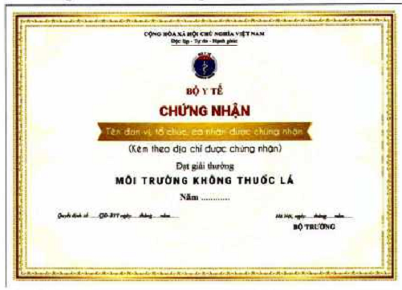
(The back of the certificate lists the organizations and individuals who have been commended)
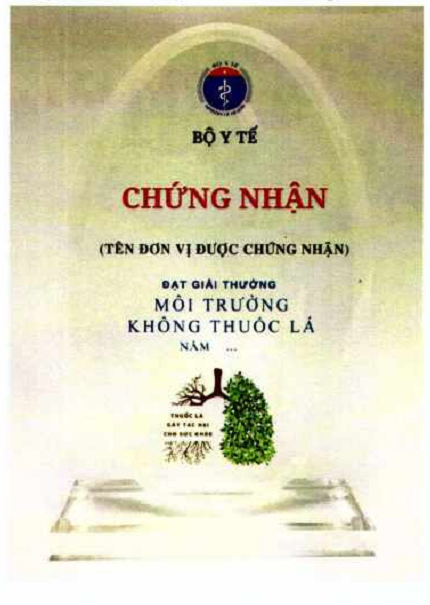
Model Number 2: Emblem (souvenir) of the Award
ANNEX NUMBER 3
MODEL DOCUMENT FOR PROPOSAL AND REPORT OF ACHIEVEMENTS OF THE UNIT APPLYING FOR THE SMOKING-FREE ENVIRONMENT AWARD
(Issued together with Circular No. 11/2023/TT-BYT dated May 11, 2023 of the Minister of Health)
|
PROPOSING UNIT |
SOCIALIST REPUBLIC OF VIET NAM |
|
No.: /BC-... |
..., date ... |
PROPOSAL AND REPORT OF ACHIEVEMENTS
Proposal for the Smoke-Free Environment Award
PART I
LIST OF UNITS APPLYING FOR THE AWARD:
1. ……………………
2. ……………………
|
HEAD OF THE PROPOSING UNIT |
PART II
ACHIEVEMENTS OF THE PROPOSED UNIT
I- OVERVIEW OF THE UNIT'S CHARACTERISTICS AND SITUATION
1. Name of the unit and location applying for the award
2. Brief history of establishment, organizational structure, total number of staff, and activities of the unit.
II- ACHIEVEMENTS ACHIEVED
1. Report on outstanding achievements according to the criteria for smoke-free areas and other criteria.
2. Supporting documents and evidence.
|
HEAD OF THE ORGANIZATION/ |
Note:
(1) Place name.
原始文件(PDF)
关系图
点击文件即可打开。红色边框=改变效力的关系。