
This Circular stipulates the standards for the technical classification of pilots and flight crew members in the Vietnam People's Army. Specifically as follows:
Scope of application
Deputy Chief of General Staff - Commander of the Air Defense-Air Force Service - Heads of agencies, units, and individuals related to this matter
Key points
- This Circular stipulates the standards for the technical classification of pilots and flight crew members in the Vietnam People's Army.
- This Circular replaces Circular No. 85/2013/TT-BQP dated July 15, 2013, issued by the Minister of National Defense on Technical Classification Standards for Pilots and Flight Crew Members in the Vietnam People's Army.
- This Circular takes effect from January 1, 2021.
- The technical classification standards are detailed for each type of aircraft and the positions of pilots and flight crew members.
- Regulations on organizing the Examination Board and the Appraisal Board to implement technical classification work.
- This Circular also stipulates the model of technical classification badges for pilots and flight crew members and certificates of technical classification for pilots and flight crew members.
🌐 Social impact of this document
- Enhance the professional qualifications of pilots and flight crew members in the military.
- Ensure technical standards for training, advanced training, and combat readiness.
❓ Frequently asked questions
Which circular does this Circular replace?
Circular No. 85/2013/TT-BQP dated July 15, 2013, issued by the Minister of National Defense on Technical Classification Standards for Pilots and Flight Crew Members in the Vietnam People's Army.
When does this Circular take effect?
This Circular takes effect from January 1, 2021.
Full text
|
MINISTRY OF NATIONAL DEFENSE |
SOCIALIST REPUBLIC OF VIET NAM |
|
Number: 120/2020/TT-BQP |
Hanoi, October 6, 2020 |
CIRCULAR
REGULATIONS ON THE TECHNICAL RANKING OF PILOTS AND CREW MEMBERS IN THE PEOPLE'S ARMY OF VIETNAM
Based on Decree No. 164/2017/NĐ-CP dated December 30, 2017, of the Government stipulating the functions, tasks, powers, and organizational structure of the Ministry of National Defense;
At the proposal of the General Staff of the People's Army of Vietnam;
The Minister of National Defense issues this Circular on the technical ranking of pilots and crew members in the People's Army of Vietnam.
PART I
GENERAL PROVISIONS
Article 1. Scope of Regulation
1. This Circular stipulates on ranking; ranking criteria; promotion, retention, suspension, demotion; symbols and certificates for technical ranking of pilots and crew members in the military.
2. The ranking criteria prescribed in this Circular are the minimum standards to be achieved when ranking pilots and crew members in the military.
Article 2. Applicability
1. Officers and professional soldiers in the People's Army of Vietnam performing tasks of controlling military aircraft and other tasks in the air according to the design capabilities of military aircraft (hereinafter referred to collectively as pilots and crew members).
2. Agencies, units, and individuals involved in the technical ranking of pilots and crew members in the People's Army of Vietnam.
Article 3. Explanation of Terms
1. Military Pilot is the person directly controlling or participating in controlling military aircraft in the air. Types and capabilities of aircraft include fighter pilots, fighter-bomber pilots, bomber pilots (strike aircraft), reconnaissance patrol pilots, transport pilots, helicopter pilots, test pilots.
2. Chief Pilot (applicable to aircraft and helicopters with crew) is the person commanding the crew, directly controlling the aircraft, helicopter in the air, and responsible for the entire outcome of the flight.
3. Co-Pilot (applicable to aircraft with crew) is the person assisting the chief pilot, participating in controlling the aircraft in the air when assigned by the chief pilot.
4. Flight Instructor (applicable to the Air Force Officer School) and Flight Teacher (applicable to combat units) is the person teaching students and pilots during training flights, recovery flights, type conversion flights, or new flying lessons; is the person conducting flight checks for pilots and student pilots according to combat training syllabi (training syllabi) or directives from superiors and is responsible for the results and safety of the flight.
5. Airborne Navigator is the person continuously determining the position of the aircraft, helicopter according to the flight direction, speed, altitude, specified coordinates to guide the takeoff, landing, and flight along routes to various locations, areas, targets, airports, landing zones according to assigned tasks.
6. Dual-Control Pilot (co-pilot navigator) is the person performing airborne navigation duties and directly controlling the aircraft, helicopter in the air when assigned by the chief pilot.
7. Airborne Mechanic is the person responsible for aviation technology; directly checking and refueling various types of oil onto the aircraft, helicopter; inspecting and observing the operating conditions of engines and the continuous operation of control systems and navigation equipment; using loading belts, cargo doors, bomb release mechanisms; using winches, cargo cranes, lifting people from the ground or water onto the helicopter; working with the crew to handle any technical malfunctions that arise during the flight.
8. Airborne Reconnaissance Patrol Officer is the person directly controlling the maritime surveillance system on the aircraft to perform airborne reconnaissance patrols according to their responsibilities as guided by the reconnaissance equipment usage manual and pilot's handbook, coordinating with the crew to carry out the reconnaissance patrol mission.
9. Crew is a group of people who control and participate in executing tasks in the air according to the design capabilities of the aircraft, helicopter. The crew consists of the chief pilot, co-pilot, and crew members as specified for each type of aircraft, helicopter.
10. Crew Member is a group of people directly performing tasks in the air according to the design capabilities of the aircraft, helicopter, including: Airborne Navigator, Airborne Mechanic, Airborne Communicator, Airborne Reconnaissance Patrol Officer, and other specialized personnel on the aircraft, helicopter.
11. Accumulated Flying Hours is the total flying hours of pilots and crew members calculated according to the regulations of the Ministry of National Defense on all types of military aircraft flown.
12. Accumulated Flying Hours on the Current Aircraft Type is the flying hours of pilots and crew members calculated according to the regulations of the Ministry of National Defense on the current type of military aircraft being flown.
13. Annual Flying Hours Compared to Targets is the flying hours of pilots and crew members calculated according to the regulations of the Ministry of National Defense on the current type of military aircraft achieved in the year compared to the allocated flying hour targets.
Chapter II
TECHNICAL RANKING OF PILOTS AND CREW MEMBERS
Article 4. Granting technical ranks to military pilots and crew members
1. Military pilots who are not officers, professional soldiers, non-commissioned officers, or enlisted personnel (hereinafter collectively referred to as military personnel) have completed the military pilot training program and been issued certificates by the competent authority but have not yet met the classification standards specified in Chapter III of this Circular.
2. Military crew members who are not military personnel have completed the military crew member training program, been authorized by the competent authority to perform duties according to their responsibilities, but have not yet met the classification standards specified in Chapter III of this Circular.
3. Military pilots and crew members specified in Clause 1 and 2 of this Article who meet the classification standards specified in Chapter III of this Circular shall be reviewed and decided to grant corresponding technical ranks from low to high in the order of Rank 3, Rank 2, and Rank 1.
Article 5. Classification of technical ranks for military pilots
1. Classification of technical ranks for pilots (lead pilot, co-pilot):
a) Military pilot (lead pilot, co-pilot) Rank 3;
b) Military pilot (lead pilot, co-pilot) Rank 2;
c) Military pilot (lead pilot, co-pilot) Rank 1.
2. Classification of technical ranks for pilots兼任领航员:
a) Military飞行员兼领航员Rank 3;
b) Military飞行员兼领航员Rank 2;
c) Military飞行员兼领航员Rank 1。
3. Classification of technical ranks for flight instructor pilots:
a) Military飞行教官飞行员Rank 3;
b) Military飞行教官飞行员Rank 2;
c) Military飞行教官飞行员Rank 1。
Article 6. Classification of technical ranks for military crew members
1. Classification of technical ranks for air navigation:
a) Military空中导航员Rank 3;
b) Military空中导航员Rank 2;
c) Military空中导航员Rank 1。
2. Classification of technical ranks for air mechanics:
a) Military空中机械师Rank 3;
b) Military空中机械师Rank 2;
c) Military空中机械师Rank 1。
3. Classification of technical ranks for aerial reconnaissance and surveillance:
a) Military空中侦察巡逻员Rank 3;
b) Military空中侦察巡逻员Rank 2;
c) Military空中侦察巡逻员Rank 1。
4. For other crew members, classification shall be made according to their job titles and work on aircraft or helicopters based on the provisions of Clauses 1, 2, and 3 of this Article, from low to high in the order of Rank 3, Rank 2, and Rank 1.
Chapter III
TECHNICAL RANK CLASSIFICATION STANDARDS FOR MILITARY PILOTS AND CREW MEMBERS
Section 1.
TECHNICAL RANK CLASSIFICATION STANDARDS FOR MILITARY JET PILOTS
Article 7. Standards for military jet pilots at Rank 3
1. Technical flying, navigation, and combat application skills:
a) They are military jet pilots without rank;
b) They have been examined and approved to fly technical flying, navigation, and combat application courses suitable for the capabilities of the aircraft according to the combat training curriculum and Flight Regulations issued by the competent authority, meeting the requirements of combat readiness under simple and complex weather conditions during the day (or night flights over distant seas).
2. Flying hour standards:
a) Accumulated flying hours for fighter pilots and fighter-bomber pilots ≥ 400 hours, for multi-role fighter pilots ≥ 450 hours;
b) Accumulated flying hours on the current aircraft for transitioning pilots ≥ 50 hours.
Article 8. Standards for Military Pilots of Grade 2 for Jet Aircraft
1. Technical flying, navigation, and combat application skills:
a) They are military pilots of Grade 3 for jet aircraft;
b) They have been examined and approved according to the provisions of point b, Clause 1, Article 7 of this Circular under simple weather conditions during the day, complex weather conditions during the day (or daytime flights over distant seas) and simple weather conditions at night.
2. Flying hour standards:
a) Accumulated flight hours for fighter pilots and fighter-bomber pilots shall be ≥ 550 hours, for multi-role fighter pilots ≥ 650 hours;
b) Accumulated flight hours on the current aircraft for pilots changing categories shall be ≥ 80 hours.
Article 9. Standards for Military Pilots of Grade 1 for Jet Aircraft
1. Technical flying, navigation, and combat application skills:
a) They are military pilots of Grade 2 for jet aircraft;
b) They have been examined and approved according to the provisions of point b, Clause 1, Article 7 of this Circular under simple weather conditions during the day, complex weather conditions during the day (or daytime flights over distant seas), simple weather conditions at night and complex weather conditions at night (or nighttime flights over the sea).
2. Flying hour standards:
a) Accumulated flight hours for fighter pilots and fighter-bomber pilots shall be ≥ 750 hours, for multi-role fighter pilots ≥ 850 hours;
b) Accumulated flight hours on the current aircraft for pilots changing categories shall be ≥ 120 hours.
Section 2.
STANDARDS FOR CLASSIFICATION OF SKILLS OF PILOTS AND CREW MEMBERS OF TRANSPORT AND SURVEILLANCE AIRCRAFT
Article 10. Standards for Military Pilots of Grade 3 for Transport and Surveillance Aircraft (Chief Pilot, Co-Pilot, and Air Navigator)
1. Technical flying skills, navigation skills, and ability to perform tasks:
a) They are chief pilots, co-pilots, and air navigators of Military Grade 3 for transport and surveillance aircraft without classification;
b) They have been examined and approved according to the provisions of point b, Clause 1, Article 7 of this Circular under simple weather conditions during the day, complex weather conditions during the day.
2. Flying hour standards:
a) Accumulated flight hours shall be ≥ 400 hours;
b) Accumulated flying hours on the current aircraft for transitioning pilots ≥ 50 hours.
Article 11. Standards for Military Pilots of Grade 2 for Transport and Surveillance Aircraft (Chief Pilot, Co-Pilot, and Air Navigator)
1. Technical flying skills, navigation skills, and ability to perform tasks:
a) They have been promoted to Chief Pilots, Co-Pilots, and Air Navigators of Military Grade 3 for transport and surveillance aircraft;
b) They have been examined and approved according to the provisions of point b, Clause 1, Article 7 of this Circular under simple weather conditions during the day, complex weather conditions during the day, simple weather conditions at night.
2. Flying hour standards:
a) Accumulated flight hours shall be ≥ 700 hours;
b) Accumulated flight hours on the current aircraft for pilots changing categories shall be ≥ 80 hours.
Article 12. Standards for Military Pilots of Grade 1 for Transport and Surveillance Aircraft (Chief Pilot, Co-Pilot, and Air Navigator)
1. Technical flying skills, navigation skills, and ability to perform tasks:
a) They have been promoted to Chief Pilots, Co-Pilots, and Air Navigators of Military Grade 2 for transport and surveillance aircraft;
b) They have been examined and approved according to the provisions of point b, Clause 1, Article 7 of this Circular under simple weather conditions during the day, complex weather conditions during the day, simple weather conditions at night, complex weather conditions at night.
2. Flying hour standards:
a) Accumulated flight hours shall be ≥ 900 hours;
b) Accumulated flight hours on the current aircraft for pilots changing categories shall be ≥ 120 hours.
Article 13. Standards for Military Air Mechanics and Air Reconnaissance Personnel of Grade 3 for Transport and Surveillance Aircraft
1. Aviation technical usage skills and ability to perform tasks:
a) They are air mechanics and air reconnaissance personnel of Military Grade 3 for transport and surveillance aircraft without classification;
b) They perform assigned duties in accordance with the provisions of point b, Clause 1, Article 10 of this Circular.
2. Flying hour standards:
a) Accumulated flight hours for air mechanics shall be ≥ 550 hours, for air reconnaissance personnel ≥ 400 hours;
b) Accumulated flight hours on the current aircraft for crew members changing categories shall be ≥ 100 hours.
Article 14. Technical standards for military aerial mechanical equipment, reconnaissance and surveillance aircraft at level 2 transport and reconnaissance aircraft
1. Aviation technical usage skills and ability to perform tasks:
a) Is aerial mechanical equipment, reconnaissance and surveillance military equipment at level 3;
b) Performs tasks according to assigned responsibilities in conjunction with the contents prescribed in point b, Clause 1, Article 11 of this Circular.
2. Flying hour standards:
a) Accumulated flight hours for aerial mechanical equipment ≥ 700 hours, for aerial reconnaissance ≥ 650 hours;
b) Accumulated flight hours on operational aircraft for crew members changing types ≥ 150 hours.
Article 15. Technical standards for military aerial mechanical equipment, reconnaissance and surveillance aircraft at level 1 transport and reconnaissance aircraft
1. Aviation technical usage skills and ability to perform tasks:
a) Is aerial mechanical equipment, reconnaissance and surveillance military equipment at level 2;
b) Performs tasks according to assigned responsibilities in conjunction with the contents prescribed in point b, Clause 1, Article 12 of this Circular.
2. Flying hour standards:
a) Accumulated flight hours for aerial mechanical equipment ≥ 900 hours, for aerial reconnaissance ≥ 850 hours;
b) Accumulated flight hours on operational aircraft for crew members changing types ≥ 200 hours.
Section 3.
TECHNICAL CLASSIFICATION STANDARDS FOR PILOTS AND CREW MEMBERS OF HELICOPTERS
Article 16. Standards for main pilots, co-pilots and air navigators of military helicopters at level 3
1. Technical flying skills, navigation skills, and ability to perform tasks:
a) They are chief pilots, co-pilots, and air navigators of Military Grade 3 for transport and surveillance aircraft without classification;
b) They have been examined and approved according to the provisions of point b, Clause 1, Article 7 of this Circular under simple weather conditions during the day, complex weather conditions during the day.
2. Flying hour standards:
a) Accumulated flight hours shall be ≥ 400 hours;
b) Accumulated flight hours on operational helicopters for main pilots, co-pilots and air navigators changing types ≥ 50 hours.
Article 17. Standards for main pilots, co-pilots and air navigators of military helicopters at level 2
1. Technical flying skills, navigation skills, and ability to perform tasks:
a) Is main pilot, co-pilot and air navigator of military helicopters at level 3;
b) Has been examined and approved according to the provisions in point b, Clause 1, Article 7 of this Circular under simple weather conditions during the day, complex weather conditions during the day, and simple weather conditions at night.
2. Flying hour standards:
a) Accumulated flight hours ≥ 600 hours;
b) Accumulated flight hours on operational helicopters for main pilots, co-pilots and air navigators changing types ≥ 80 hours.
Article 18. Standards for main pilots, co-pilots and air navigators of military helicopters at level 1
1. Technical flying skills, navigation skills, and ability to perform tasks:
a) Is main pilot, co-pilot and air navigator of military helicopters at level 2;
b) Has been examined and approved according to the provisions in point b, Clause 1, Article 7 of this Circular under simple weather conditions during the day, complex weather conditions during the day, simple weather conditions at night, and complex weather conditions at night.
2. Flying hour standards:
a) Accumulated flight hours ≥ 800 hours;
b) Accumulated flight hours on operational helicopters for main pilots, co-pilots and air navigators changing types ≥ 120 hours.
Article 19. Standards for aerial mechanical equipment of military helicopters at level 3
1. Aviation technical usage skills and ability to perform tasks:
a) Is non-rated aerial mechanical equipment of military helicopters;
b) Performs tasks according to assigned responsibilities in conjunction with the contents prescribed in point b, Clause 1, Article 16 of this Circular.
2. Flying hour standards:
a) Accumulated flight hours ≥ 550 hours (for aerial mechanical equipment of military helicopters at the Air Force Officer School ≥ 650 hours);
b) Accumulated flight hours on operational helicopters for crew members changing types ≥ 100 hours.
Article 20. Standards for aerial mechanical equipment of military helicopters at level 2
1. Aviation technical usage skills and ability to perform tasks:
a) Is aerial mechanical equipment of military helicopters at level 3;
b) Performs tasks according to assigned responsibilities in conjunction with the contents prescribed in point b, Clause 1, Article 17 of this Circular.
2. Flying hour standards:
a) Accumulated flight hours ≥ 750 hours (for aerial mechanical equipment of military helicopters at the Air Force Officer School ≥ 850 hours);
b) Accumulated flight hours on operational helicopters for crew members changing types ≥ 150 hours.
Article 21. Criteria for Military Helicopter Mechanic Level 1
1. Aviation technical usage skills and ability to perform tasks:
a) Is a Military Helicopter Mechanic Level 2;
b) Performs tasks according to assigned responsibilities in conjunction with the contents stipulated in point b, Clause 1, Article 18 of this Circular.
2. Flying hour standards:
a) Accumulated flight hours ≥ 950 hours (for Military Helicopter Mechanic at Air Force Officer School ≥ 1150 hours);
b) Accumulated flight hours on the helicopter currently flying for the crew member changing categories ≥ 180 hours.
Section 4.
CRITERIA FOR CLASSIFICATION OF TECHNICAL PILOTS AND INSTRUCTORS
Article 22. Criteria for Military Flight Instructor Pilots, Chief Pilot Instructors, Dual-Control Instructor Pilots, and Military Airborne Navigator Instructors Level 3
1. Technical flying skills, navigation skills, and ability to perform tasks:
a) Is a Military Flight Instructor Pilot, Chief Pilot Instructor, Dual-Control Instructor Pilot, and Military Airborne Navigator Instructor without classification;
b) Has been approved to teach 100% of the flight subjects in the training syllabus for students;
c) Has been examined and approved to perform duties, fly technical piloting, navigation, combat application subjects suitable to the aircraft's capabilities according to the combat training curriculum, flight regulations issued by the competent authority, meeting the requirements for training, advanced training, and combat readiness;
d) Has taught student pilots from four courses and has at least seven student pilots who have graduated.
2. Flying hour standards:
a) Accumulated flight hours for jet aircraft instructor pilot ≥ 550 hours; for basic aircraft instructor pilot, chief pilot instructor, dual-control instructor pilot, airborne navigator ≥ 600 hours;
b) Accumulated flight hours on the aircraft currently flying for the pilot, crew member changing categories ≥ 50 hours.
Article 23. Criteria for Military Flight Instructor Pilots, Chief Pilot Instructors, Dual-Control Instructor Pilots, and Military Airborne Navigator Instructors Level 2
1. Technical flying skills, navigation skills, and ability to perform tasks:
a) Is a Military Flight Instructor Pilot, Chief Pilot Instructor, Dual-Control Instructor Pilot, and Military Airborne Navigator Instructor Level 3;
b) Has been examined and approved to perform duties, approved as a flight instructor for the subjects specified in point c, Clause 1, Article 22 of this Circular;
c) Has taught student pilots from seven courses and has at least eleven to thirteen student pilots who have graduated.
2. Flying hour standards:
a) Accumulated flight hours for jet aircraft instructor pilot ≥ 800 hours; for basic aircraft instructor pilot, chief pilot instructor, dual-control instructor pilot, airborne navigator ≥ 850 hours;
b) Accumulated flight hours on the aircraft currently flying for the pilot, crew member changing categories ≥ 80 hours.
Article 24. Criteria for Military Flight Instructor Pilots, Chief Pilot Instructors, Dual-Control Instructor Pilots, and Military Airborne Navigator Instructors Level 1
1. Technical flying skills, navigation skills, and ability to perform tasks:
a) Is a Military Flight Instructor Pilot, Chief Pilot Instructor, Dual-Control Instructor Pilot, and Military Airborne Navigator Instructor Level 2;
b) Has been examined and approved to perform duties, approved as a flight instructor for the subjects specified in point c, Clause 1, Article 22 of this Circular;
c) Has taught student pilots from nine courses and has at least fourteen to seventeen student pilots who have graduated.
2. Flying hour standards:
a) Accumulated flight hours for jet aircraft instructor pilot ≥ 1100 hours; for basic aircraft instructor pilot, chief pilot instructor, dual-control instructor pilot, airborne navigator ≥ 1150 hours;
b) Accumulated flight hours on the aircraft currently flying for the pilot, crew member changing categories ≥ 120 hours.
Chapter IV
RANKING, MAINTAINING, UPGRADING, AND DEMOTING TECHNICAL LEVELS
PILOTS, CREW MEMBERS
Article 25. Granting technical ranks to pilots and flight crew members
1. Pilots and flight crew members shall be granted technical ranks annually when meeting the following conditions:
a) Meeting the classification standards prescribed in Chapter III of this Circular;
b) Achieving at least 80% of the annual flight hour quota;
c) Not causing any threat to flight safety or flight accidents during the year;
d) Classification examination results: Each theoretical subject score must be good or higher (for granting rank 1, each subject score must be 7.5 or higher on a scale of 10, with an average score of excellent). Parachute training (if applicable) must be good or higher. Physical fitness training must be good or higher. Political awareness and discipline training must be good. Flight practice must be good or higher for rank 2 and rank 3; must be excellent for rank 1.
2. Each pilot and flight crew member can only be granted a technical rank once a year and cannot skip ranks.
Article 26. Maintaining technical ranks of pilots and flight crew members
Pilots and flight crew members who have been classified shall maintain their ranks annually if they meet the following requirements:
1. For military pilots and flight crew members of rank 1:
a) Completing tasks in the year: Training flight hour quota must reach at least 60%; mission flight hour quota must reach at least 60%;
b) Not causing more than one instance of flight safety threat due to personal reasons;
c) Classification examination results: General theory must score good; parachute training (if applicable) must score good; physical fitness training must score good; political awareness and discipline training must be good; flight practice must score good.
2. For military pilots and flight crew members of rank 2:
a) Not meeting the criteria for rank 1;
b) Completing tasks in the year: Training flight hour quota must reach at least 70%; mission flight hour quota must reach at least 70%;
c) Not causing more than one instance of flight safety threat due to personal reasons;
d) Classification examination results: General theory must score good; parachute training (if applicable) must score good; physical fitness training must score good; political awareness and discipline training must be good; flight practice must score good.
3. For military pilots and flight crew members of rank 3:
a) Not meeting the criteria for rank 2;
b) Completing tasks in the year: Training flight hour quota must reach at least 80%; mission flight hour quota must reach at least 80%;
c) Not causing more than one instance of flight safety threat due to personal reasons;
d) Classification examination results: General theory must score good; parachute training (if applicable) must score good; physical fitness training must score good; political awareness and discipline training must be good; flight practice must score good.
Article 27. Suspension of technical ranks of pilots and flight crew members
Pilots and flight crew members who have been classified shall be suspended from their technical ranks annually as follows:
1. Pilots and flight crew members who do not meet the conditions for maintaining their ranks as stipulated in Article 26 of this Circular. The suspension period is one year starting from the effective date of the suspension decision.
2. Pilots and flight crew members attending training at domestic and foreign academies and schools shall be suspended from their technical ranks during the study period. After returning to the unit, they will be suspended for an additional one year starting from the effective date of the suspension decision.
3. Military flight instructors transferring back to combat units from academies and schools, Binh đoàn 18 shall be allowed to suspend their rank 3 for one year; rank 2 for two years; and rank 1 for three years starting from the effective date of the transfer decision.
4. Pilots transferred or appointed to academies and schools, Binh đoàn 18 from combat units shall be allowed to suspend their rank 3 for one year; rank 2 for two years; and rank 1 for three years starting from the effective date of the transfer or appointment decision (excluding the number of training courses and graduated students).
5. Pilots and flight crew members working in the Air Defense - Air Force Corps, Navy Corps, Coast Guard Command, Binh đoàn 18, academies, schools, and Ministry of National Defense agencies shall be suspended from their technical ranks (these individuals may retain their ranks if they participate in flight practices during the year).
6. Pilots and flight crew members who switch to flying different types of aircraft or helicopters, or become primary pilots, shall be allowed to suspend their technical ranks for two years for rank 3; three years for rank 2; and four years for rank 1 starting from the effective date of the type change decision.
Article 28. Demotion of pilot and crew technical levels
1. Demotion of pilot and crew technical levels shall be carried out in the following cases:
a) Demote one level for pilots and crew members who personally cause serious flight safety threats or accidents;
b) Demote one level for military flight instructor pilots whose trainees under their direct supervision cause serious flight safety threats or accidents (during solo release flights);
c) Demote one level for pilots and crew members who have exceeded the retention period specified in Clause 1, Clause 2 of Article 27 of this Circular and do not meet the conditions to retain the level specified in Article 26 of this Circular;
d) Demote to the corresponding level in the standard for pilots and crew members who have exceeded the retention period specified in Clause 3, Clause 4, Clause 6 of Article 27 of this Circular and do not meet the classification criteria specified in Chapter III of this Circular.
2. For cases where pilots and crew members cause serious flight safety threats or accidents. When the conclusion of the Flight Safety Threat Investigation Board or Accident Investigation Board becomes effective, the Standing Board for Classification has a document proposing:
a) The Chief of General Staff of the Vietnam People's Army demotes from Level 1 to Level 2 for pilots, flight instructors, and pilots兼任领航员。
b) The Commander of the Air Defense-Air Force Military Region, the Commander of the Navy Military Region, the Commander of the Coast Guard, and the Commander of the 18th Corps demote one level for the remaining flight technical levels。
Article 29. Authority to decide on granting, retaining, extending, and demoting pilot and crew technical levels
1. The Chief of General Staff of the Vietnam People's Army decides on granting Level 1 for pilots, flight instructors, and pilots兼任领航员。
2. The Commanders of the Air Defense-Air Force Military Region, the Navy Military Region, the Coast Guard, and the 18th Corps decide on granting Levels 2 and 3 for pilots, flight instructors, and pilots兼任领航员;decide on granting air navigation, aircraft maintenance, and aerial reconnaissance technical levels。
3. The Commanders of the Air Defense-Air Force Military Region, the Navy Military Region, the Coast Guard, and the 18th Corps decide on retaining and extending pilot and crew member levels。
4. The authority that grants a level also has the authority to demote that level。
Chapter V
BADGE AND CERTIFICATE OF TECHNICAL LEVEL
PILOTS, CREW MEMBERS
Article 30. Badge of pilot and crew member technical level
1. The badge of pilot and crew member technical level shall be implemented according to the Regulations on Military Unit Management of the Vietnam People's Army and the regulations of the Ministry of National Defense。
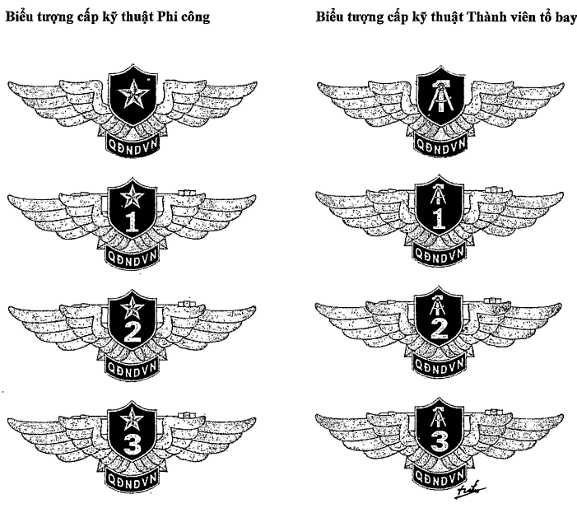
2. Sample of the pilot technical level badge: made of metal; size 80mm x 25mm x 07mm; shape of a yellow swallowtail wing, shield in the center, five-pointed yellow star; yellow serial number indicating the pilot's technical level; below is the abbreviated text "QĐNDVN"。
3. Sample of the crew member technical level badge: similar to the pilot badge, only replacing the star with a hammer and compass。
4. The sample of the pilot and crew member technical level badge is stipulated in Appendix I issued together with this Circular。
5. The pilot and crew member technical level badge is worn on regular uniforms。
Article 31. Pilot Technical Rating Certificate and Crew Member Technical Rating Certificate
1. Authority to issue Pilot Technical Rating Certificate and Crew Member Technical Rating Certificate
a) The General Chief of Staff of the Vietnam People's Army approves the list, the Commander of the Air Defense-Air Force Corps, the Commander of the Navy Corps, the Commander of the Coast Guard, and the Commander of the 18th Group sign the Pilot Military Technical Rating Certificate Level 1 for pilots, flight instructors, and pilots兼任领航员。
b) The Commander of the Air Defense-Air Force Corps, the Commander of the Navy Corps, the Commander of the Coast Guard, and the Commander of the 18th Group sign the Pilot Military Technical Rating Certificate Levels 2 and 3 for pilots, flight instructors, and pilots兼任领航员,and the Crew Member Military Technical Rating Certificate Levels 1, 2, and 3。
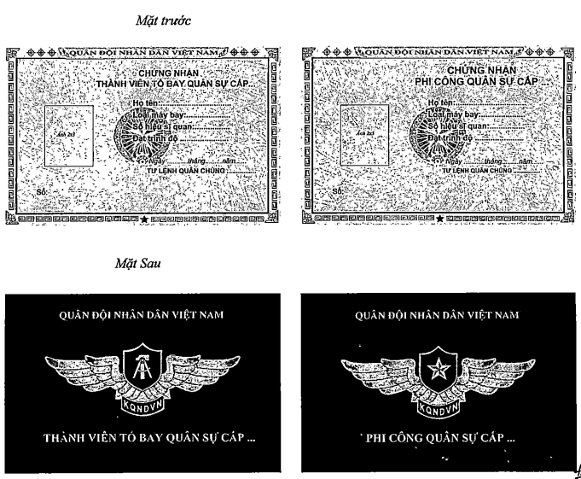
2. Sample of Pilot Technical Rating Certificate and Crew Member Technical Rating Certificate
a) The certificate is rectangular with dimensions of 85mm x 55mm, except for the Pilot Military Technical Rating Certificate Level 1 which is enlarged to A5 size; it is produced on paper material.
b) Presentation technique:
Front side: In the center is the Emblem, with a patterned background, embossed in blue, from top to bottom is the title "VIETNAM PEOPLE'S ARMY" (in red, size 8 bold, font Times New Roman). Below is a red line of text, size 12 bold, font Times New Roman:
"CERTIFICATE"
"MILITARY PILOT TECHNICAL RATING LEVEL 1 (LEVEL 2, LEVEL 3)"
"CERTIFICATE"
"MILITARY CREW MEMBER TECHNICAL RATING LEVEL 1 (LEVEL 2, LEVEL 3)"
From top to bottom on the left is the photo of the certificate holder, on the right are the lines of text: Name; Aircraft Type; Officer Number; Achieved Pilot Skill Level (aircraft maintenance; aerial reconnaissance;...) military technical rating level 1 (level 2, level 3), (size 8, font Times New Roman); ..., day..., month..., year... (size 6 italic, font Times New Roman); authorized person signs and stamps (size 8 bold, font Times New Roman);
Back side is red, from top to bottom is a line of text "VIETNAM PEOPLE'S ARMY" (size 11 bold, font Times New Roman). Below is the corresponding pilot or crew member rating emblem. Under the emblem is the line of text "MILITARY PILOT TECHNICAL RATING LEVEL 1 (LEVEL 2, LEVEL 3), MILITARY CREW MEMBER TECHNICAL RATING LEVEL 1 (LEVEL 2, LEVEL 3)" (size 11 bold, font Times New Roman);
c) The sample of Pilot Technical Rating Certificate and Crew Member Technical Rating Certificate is specified in Appendix II issued together with this Circular.
Chapter VI
IMPLEMENTATION
Article 32. General Staff Headquarters
1. Direct subordinate agencies to review the proposals of the Air Defense-Air Force Corps, the Navy Corps, the Coast Guard Command, and the 18th Group, and submit to the General Chief of Staff for promotion, demotion of pilot technical ratings, flight instructor pilots, and pilot兼任领航员的军事技术等级一级。
2. Inspect and audit the technical classification of pilots and crew members in the Vietnam People's Army.
Article 33. Air Defense-Air Force Corps
1. Establish a Review Board and an Examination Board; organize technical classification for each pilot and crew member on each type of aircraft under management.
2. Standardize flight hours and examination subjects, approve piloting, navigation, combat application skills suitable to the capabilities of each type of aircraft, according to each technical level of pilots and crew members, meeting training, education improvement requirements, and combat readiness.
Article 34. Naval Military Branch, Coast Guard Command, 18th Engineering Corps
Establish a Technical Inspection Council and a Technical Classification Council; organize technical classification for each pilot and crew member on each type of aircraft under their management.
Article 35. Technical Inspection Council and Technical Classification Council for pilots and crew members
1. The Technical Inspection Council for pilots and crew members (hereinafter referred to as the Technical Inspection Council) shall be established at the Air Defense-Air Force Military Branch, Naval Military Branch, Coast Guard Command, 18th Engineering Corps, equivalent divisions and regiments; the Technical Inspection Council shall advise the unit commander on technical inspection and classification work for pilots and crew members.
2. The Technical Classification Council for pilots and crew members (hereinafter referred to as the Technical Classification Council) shall be established at the Air Defense-Air Force Military Branch, Naval Military Branch, Coast Guard Command, 18th Engineering Corps, equivalent divisions and regiments; the Technical Classification Council shall advise the unit commander on technical classification, retention, storage, and demotion of pilots and crew members.
3. The Council consists of: Chairman of the Council; Vice-Chairman of the Council; Secretary of the Council; Council members are competent officers from relevant agencies to assist the Council in performing its tasks.
4. The Chairman of the Council issues regulations, inspection content, evaluation criteria, and working methods.
5. The Chairman of the Council works according to the majority principle; the meeting of the Council must have at least two-thirds of the members present.
6. The General Staff of the Air Defense-Air Force Military Branch, the General Staff of the Naval Military Branch, the General Staff of the Coast Guard Command, and the Training Department of the 18th Engineering Corps are the Standing Bodies of the Council, responsible for advising the Council on technical inspection and classification work for pilots and crew members.
Chapter VII
IMPLEMENTING PROVISIONS
Article 36. Effective Date
This Circular takes effect from January 1, 2021, and replaces Circular No. 85/2013/TT-BQP dated July 15, 2013, issued by the Minister of National Defense on Technical Classification Standards for Pilots and Crew Members in the Vietnam People's Army.
Article 37. Responsibility for Implementation
The Chief of General Staff, Commander of the Air Defense-Air Force Military Branch, Heads of relevant agencies and individuals are responsible for implementing this Circular./.
|
Place of Receipt: |
DEPUTY MINISTER |
ANNEX I
TECHNICAL RATING BADGE FOR PILOTS AND CREW MEMBERS
(Annexed to Circular No. 120/2020/TT-BQP dated October 6, 2020, issued by the Minister of National Defense)
ANNEX II
CERTIFICATE OF TECHNICAL RATING FOR PILOTS AND CREW MEMBERS
(Annexed to Circular No. 120/2020/TT-BQP dated October 6, 2020, issued by the Minister of National Defense)
Original document (PDF)
Download
Relations map
Click a document to open. A red border = a relation that changes validity.
Translations
This document is available in the following languages: