
This Circular details the procedures for refunding value added tax (VAT) to specific entities and cases such as investment enterprises, projects using non-repayable ODA capital, humanitarian aid, and foreigners carrying goods out of Vietnam. It also provides regulations on adjusting VAT when enterprises change ownership, dissolve, or cease operations.
적용 범위
This Circular applies to businesses subject to VAT under the deduction method and organizations and individuals related to VAT refunds in Vietnam.
핵심 사항
- Refunding VAT for investment projects: Enterprises in the investment phase that have not commenced production and business activities but must dissolve or cease operations shall not adjust the declared, deducted, or refunded VAT.
- Refunding VAT for projects using non-repayable ODA capital and humanitarian aid: The program or project owner or main contractor shall be refunded the VAT paid for goods and services purchased in Vietnam for use in the program or project.
- Refunding VAT for foreigners carrying goods out of Vietnam: Foreigners holding passports or entry permits issued by foreign competent authorities shall be refunded VAT when carrying goods purchased in Vietnam upon departure.
- thaydoihoatdongkinhdoanhcanxemthemtrongquyddinhmoi
- This new Circular requires businesses to pay attention and accurately declare and adjust VAT when there are changes in their business activities such as changing ownership, dissolving, or ceasing operations. At the same time, for projects using non-repayable ODA capital and humanitarian aid, it is necessary to ensure proper management and use of funds according to regulations to enjoy VAT refund benefits.
🌐 이 문서의 사회적 영향
- This Circular facilitates conditions for businesses during the investment phase, projects using non-repayable ODA capital, and humanitarian aid. It also supports foreigners carrying goods when departing from Vietnam.
❓ 자주 묻는 질문
Must businesses adjust the declared, deducted, or refunded VAT during the investment phase before commencing production and business activities?
No, businesses do not need to adjust this VAT when dissolving or ceasing operations.
Which entities are eligible for VAT refund benefits for projects using non-repayable ODA capital and humanitarian aid?
The program or project owner or main contractor is eligible for these benefits.
전문
| MINISTRY OF FINANCE |
SOCIALIST REPUBLIC OF VIET NAM Independence - Freedom - Happiness |
| Number: 130/2016/TT-BTC | Hanoi, August 12, 2016 |
CIRCULAR
Detailed guidance on Decree No. 100/2016/NĐ-CP dated July 1, 2016 of the Governmentetermining on the detailed implementation of the Law amending and supplementing certain articles of the Value Added Tax Law, the Special Consumption Tax Law, and the Tax Administration Law, and amending certain provisions of tax circulars
Pursuant to the Tax Administration Law No. 78/2006/QH11 and Law No. 21/2012/QH13 amending and supplementing certain articles of the Tax Administration Law;
Pursuant to the Value Added Tax Law No. 13/2008/QH12 and Law No. 31/2013/QH13 amending and supplementing certain articles of the Value Added Tax Law;
Pursuant to Law No. 106/2016/QH13 amending and supplementing certain articles of the Value Added Tax Law, the Special Consumption Tax Law, and the Tax Administration Law;
Pursuant to the Corporate Income Tax Law No. 14/2008/QH12 and Law No. 32/2013/QH13 amending and supplementing certain articles of the Corporate Income Tax Law;
Pursuant to Decree No. 83/2013/NĐ-CP dated July 22, 2013 of the Government detailing the implementation of certain articles of the Tax Administration Law and the Law amending and supplementing certain articles of the Tax Administration Law;
Pursuant to Decree No. 218/2013/NĐ-CP dated December 26, 2013 of the Government detailing and guiding the implementation of certain provisions of the Law on Corporate Income Tax;
Pursuant to Decree No. 100/2016/NĐ-CP dated July 1, 2016 of the Government detailing the implementation of the Law amending and supplementing certain articles of the Value Added Tax Law, the Special Consumption Tax Law, and the Tax Administration Law;
Pursuant to Decree No. 215/2013/NĐ-CP dated December 23, 2013, promulgated by the Government stipulating the functions, tasks, powers, and organizational structure of the Ministry of Finance;
At the proposal of the Director General of the State Revenue Administration,
The Minister of Finance issues this Circular guiding the implementation of Decree No. 100/2016/NĐ-CP dated July 1, 2016 of the Governmentetermining on the detailed implementation of the Law amending and supplementing certain articles of the Value Added Tax Law, the Special Consumption Tax Law, and the Tax Administration Law, and amending certain provisions of tax circulars as follows:
a) Amending and supplementing Point c Clause 2 as follows:
a) Amend and supplement Clause 9 of Article 4 as follows:
"9. Health services, veterinary services, including medical examination, treatment, prevention for humans and animals, family planning services, health rehabilitation services, functional recovery services for patients, elderly care, disability care; patient transportation, rental of hospital rooms and beds from healthcare facilities; testing, imaging, blood and blood products used for patients.
Elderly care and disability care include medical care, nutrition, and organizing cultural, sports, entertainment, physiotherapy, and functional recovery activities for the elderly and people with disabilities.
In cases where the package of medical treatment services (as prescribed by the Ministry of Health) includes the use of medicine, the revenue from medicines included in the medical treatment service package also falls within the scope of non-VAT taxable goods."
b) Amend and supplement Clause 16 of Article 4 as follows:
"16. Public passenger transport includes public passenger transport by bus, electric vehicle (including tram) along routes within the province, within urban areas, and nearby inter-provincial routes as stipulated by laws on transport."
c) Amend and supplement Clause 23 of Article 4 as follows:
"23. Export products are natural resources, minerals that have not been processed into other products or have been processed into other products but the total value of natural resources, minerals plus energy costs account for 51% or more of the production cost of the product processed from natural resources, minerals; export products are goods processed from natural resources, minerals with the total value of natural resources, minerals plus energy costs accounting for 51% or more of the production cost of the product processed from natural resources, minerals.
a) Natural resources, minerals are domestic-origin natural resources, minerals including: Metal minerals; non-metal minerals; crude oil; natural gas; coalbed methane.
b) The determination of the proportion of the value of natural resources, minerals and energy costs in the production cost is carried out according to the formula:
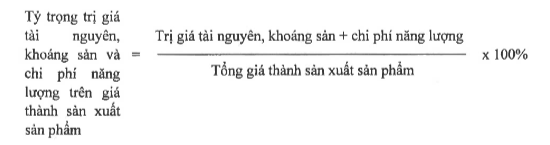
Where:
The value of natural resources, minerals is the inventory cost of natural resources, minerals put into processing; for directly extracted natural resources, minerals, it is the direct and indirect extraction costs; for purchased natural resources, minerals for processing, it is the actual purchase price plus the cost of putting natural resources, minerals into processing.
Energy costs include: fuel, electricity, thermal energy.
The value of natural resources, minerals and energy costs are determined according to the accounting records consistent with the Product Cost Calculation Summary Table.
Production cost of the product includes: Direct material costs, direct labor costs, and common production costs. Indirect costs such as sales expenses, management expenses, financial expenses, and other costs are not included in the production cost of the product.
The determination of the value of natural resources, minerals, energy costs, and production cost of the product is based on the previous year's settlement report; in case the enterprise has just been established and does not have a previous year's settlement report, it is based on the investment plan.
c) Enterprises producing products that are natural resources, minerals (including both direct extraction or purchase for processing) with the total value of natural resources, minerals plus energy costs accounting for 51% or more of the production cost of the product processed from natural resources, minerals when exporting shall be exempt from VAT.
In cases where enterprises do not export but sell to other enterprises for export, the enterprise purchasing these goods for export must declare VAT as if they were similar products produced and exported directly by the enterprise and must pay export duties as prescribed."
2. Amend and supplement Clause 3 of Article 9 as follows:
"3. Cases not subject to the 0% tax rate include:
- Reinsurance abroad; technology transfer, intellectual property rights transfer abroad; capital transfer, credit provision, securities investment abroad; derivative financial services; outbound postal, telecommunications services (including postal and telecommunications services provided to organizations and individuals in non-tariff zones; providing mobile phone recharge cards with serial numbers and denominations taken out of the country or brought into non-tariff zones); export products that are natural resources and minerals as specified in Clause 23, Article 4 of this Circular; imported tobacco, alcohol, beer subsequently exported; goods and services provided to individuals not registered for business in non-tariff zones, except for other cases as prescribed by the Government.
Imported tobacco, alcohol, beer subsequently exported shall not be subject to output VAT when exported but the input VAT cannot be deducted.
- Fuel sold to businesses' motor vehicles operating within non-tariff zones purchased domestically;
- Motor vehicles sold to organizations and individuals within non-tariff zones;
- Services provided by businesses to organizations and individuals within non-tariff zones including: renting houses, conference halls, offices, hotels, warehouses; transportation services for workers; catering services (excluding industrial meal service provision and catering services within non-tariff zones);
- Services supplied in Vietnam for organizations and individuals outside the country which are not eligible for a zero percent tax rate include:
+ Sports competitions, artistic performances, cultural, entertainment, conference, hotel, training, advertising, travel agency services;
+ Online payment services;
+ Services provided in conjunction with the sale, distribution, consumption of products and goods in Vietnam.”
3. Amend and supplement Article 18 as follows:
"1. Businesses subject to VAT under the deduction method shall be entitled to deduct any remaining input VAT not deducted in the month (for monthly declaration) or quarter (for quarterly declaration) in the following period.
In case a business has remaining input VAT arising before July 2016 (for monthly declaration) or before the third quarter of 2016 (for quarterly declaration) that meets the conditions for refunding VAT according to Clause 1, Article 18 of Circular No. 219/2013/TT-BTC, the tax authority shall process the refund in accordance with the provisions of the law.
Example: Business A declares VAT quarterly. At the end of the third quarter of 2016, it has 80 million VND of remaining input VAT. Business A can deduct this amount in the fourth quarter of 2016. If there is still remaining input VAT in the fourth quarter of 2016, the first quarter of 2017, and the second quarter of 2017, Business A will carry forward the remaining input VAT to continue deducting in the third quarter of 2017 and subsequent periods.
2. New businesses established from registered investment projects, registered to pay VAT under the deduction method, or oil and gas exploration and development projects still in the investment phase and not yet operational, if the investment period is one year or more, may be refunded VAT on goods and services used for investment annually, except as specified in Point c, Clause 3 of this Article. If the cumulative VAT paid on goods and services purchased for investment exceeds 300 million VND, then the VAT can be refunded.
3. Refund of VAT for investment projects
a) Businesses currently operating and subject to VAT under the deduction method with ongoing investment projects (excluding those specified in Point c, Clause 3 of this Article and excluding construction projects intended for sale or lease without forming fixed assets) in the same province or city must declare separately for the investment project and must transfer the input VAT of the investment project to offset against the declared VAT of ongoing production and business activities. The maximum amount of transferred input VAT of the investment project equals the VAT payable of the ongoing production and business activities of the business in the period.
After offsetting, if the remaining input VAT of the investment project is 300 million VND or more, the VAT can be refunded for the investment project.
After offsetting, if the remaining input VAT of the investment project is less than 300 million VND, it will be carried forward to the next period's input VAT of the investment project.
Example: Company A, headquartered in Hanoi, had an investment project in Hanoi in July 2016, which was in the investment phase. In August 2016, the input VAT of the investment project was 500 million VND, and the VAT payable of ongoing production and business activities was 900 million VND. Company A offsets 500 million VND of input VAT of the investment project against the VAT payable of ongoing production and business activities (900 million VND). Therefore, the VAT payable by Company A in August 2016 is 400 million VND.
Example: Company B, headquartered in Hai Phong, had an investment project in Hai Phong in July 2016, which was in the investment phase. In August 2016, the input VAT of the investment project was 500 million VND, and the VAT payable of ongoing production and business activities was 200 million VND. Company B offsets 200 million VND of input VAT of the investment project against the VAT payable of ongoing production and business activities (200 million VND). Thus, in August 2016, Company B has 300 million VND of remaining input VAT of the investment project. Company B is eligible for a VAT refund for the investment project.
Example: Company C has its headquarters in Ho Chi Minh City. In July 2016, the company had an investment project in Ho Chi Minh City, which was in the investment phase. Company C declared separately the VAT input tax of this investment project. In August 2016, the VAT input tax of the investment project was 500 million VND; the VAT payable for ongoing business operations was 300 million VND. Therefore, Company C must offset 300 million VND of the VAT input tax of the investment project against the VAT payable for ongoing business operations (300 million VND). Thus, in the August 2016 tax period, Company C still has 200 million VND of the VAT input tax of the investment project that has not been fully deducted. Since Company C does not qualify for VAT refund for the investment project, it transfers 200 million VND to the VAT input tax of the investment project for the September 2016 declaration period.
Example: Company D has its headquarters in Da Nang. In July 2016, the company had an investment project in Da Nang, which was in the investment phase. Company D declared separately the VAT input tax of this investment project. In August 2016, the VAT input tax of the investment project was 500 million VND; the undeducted VAT of ongoing business operations was 100 million VND. Therefore, in the August 2016 tax period, the 500 million VND of the VAT input tax of the investment project qualifies for VAT refund for the investment project, while the undeducted VAT of ongoing business operations (100 million VND) will be deducted in the September 2016 tax period.
b) In the case where a business entity currently operating under the VAT deduction method has a new investment project (except for cases specified in point c Clause 3 of this Article and excluding construction projects intended for sale or lease without forming fixed assets) located in a different province or centrally-administered city from the location of its main office, and the project is in the investment phase but has not commenced operations, registered for business, or registered for tax, the business entity shall declare separately the VAT input tax for the investment project and simultaneously transfer the VAT input tax of the investment project to offset against the VAT declaration of ongoing business operations. The maximum amount of transferred VAT input tax of the investment project cannot exceed the VAT payable of the ongoing business operations during the tax period of the business entity.
If, after offsetting, the undeducted VAT input tax of the new investment project exceeds 300 million VND, then the VAT input tax of the investment project can be refunded.
If, after offsetting, the undeducted VAT input tax of the new investment project is less than 300 million VND, then it should be carried forward to the VAT input tax of the investment project for the next declaration period.
In the case where a business entity establishes Project Management Boards or branches in other provinces or centrally-administered cities from the location of its main office to directly manage one or more investment projects in multiple locations; if these Project Management Boards or branches have seals as prescribed by law, maintain accounting books and records as required by law, have bank accounts, and have registered for tax and obtained tax registration numbers, they must declare taxes and apply for VAT refunds independently with the local tax authority. When the investment project to establish a business entity is completed and all necessary business registration and tax payment procedures are finalized, the business entity as the investor must consolidate the generated VAT, the refunded VAT, and the undeducted VAT of the investment project to hand over to the newly established business entity for it to declare and pay taxes.
An investment project eligible for VAT refund as stipulated in Clause 2 and Clause 3 of this Article is an investment project as defined by laws on investment.
Example: Company A has its headquarters in Hanoi. In July 2016, the company had a new investment project in Hung Yen, which was in the investment phase but had not commenced operations, registered for business, or registered for tax. Company A declared separately the VAT input tax of this investment project in Hanoi on the VAT declaration form for investment projects. In August 2016, the VAT input tax of the investment project was 500 million VND; the VAT payable for ongoing business operations was 900 million VND. Therefore, Company A must offset 500 million VND of the VAT input tax of the investment project against the VAT payable for ongoing business operations (900 million VND). Thus, in the August 2016 tax period, Company A still needs to pay 400 million VND.
Example: Company B has its headquarters in Hai Phong. In July 2016, the company had a new investment project in Thai Binh, which was in the investment phase but had not commenced operations, registered for business, or registered for tax. Company B declared separately the VAT input tax of this investment project in Hai Phong on the VAT declaration form for investment projects. In August 2016, the VAT input tax of the investment project was 500 million VND; the VAT payable for ongoing business operations was 200 million VND. Therefore, Company B must offset 200 million VND of the VAT input tax of the investment project against the VAT payable for ongoing business operations (200 million VND). Thus, in the August 2016 tax period, Company B still has 300 million VND of the VAT input tax of the new investment project that has not been fully deducted. Company B qualifies for VAT refund for the investment project.
Example: Company C has its headquarters in Ho Chi Minh City. In July 2016, the company had a new investment project in Dong Nai. The project was still in the investment phase, not yet operational, not registered for business, and not registered for tax. Company C declared separately the VAT input tax of this investment project at Ho Chi Minh City on the VAT declaration form for investment projects. In August 2016, the VAT input tax of the investment project was 500 million VND; the VAT payable from ongoing production and business activities was 300 million VND. Therefore, Company C must offset 300 million VND of the VAT input tax of the investment project against the VAT payable from ongoing production and business activities (300 million VND). Thus, in the August 2016 tax period, Company C has 200 million VND of the VAT input tax of the new investment project that has not been fully deducted. Since Company C does not qualify for VAT refund for the investment project, it transfers 200 million VND to the VAT input tax of the investment project for the September 2016 declaration period.
Example: Company D has its headquarters in Da Nang City. In July 2016, the company had a new investment project in Quang Nam Province. The project was still in the investment phase, not yet operational, not registered for business, and not registered for tax. Company D declared separately the VAT input tax of this investment project at Da Nang City on the VAT declaration form for investment projects. In August 2016, the VAT input tax of the investment project was 500 million VND; the VAT not yet deducted from ongoing production and business activities was 100 million VND. Therefore, in the August 2016 tax period, the VAT input tax of the investment project (500 million VND) qualifies for VAT refund for the investment project, while the VAT not yet deducted from ongoing production and business activities (100 million VND) will be deducted in the September 2016 tax period.
c) Business entities that are not eligible for VAT refunds but can carry forward the undeducted VAT of the investment project to the next period according to the Investment Law include:
c.1) Investment projects of business entities that have not contributed the full charter capital as registered under the law. Applications for VAT refunds for investment projects submitted from July 1, 2016, by business entities that have not contributed the full charter capital as required by law up to the date of submission shall not be eligible for VAT refunds.
c.2) Investment projects of business entities in industries or trades requiring conditions when they have not met the required operating conditions as stipulated by the Investment Law. These are investment projects of business entities in industries or trades requiring conditions but the business entity has not obtained a business license for such industries or trades; has not received a certificate of compliance with conditions for such industries or trades; has not received a document from a competent state agency allowing investment in such industries or trades; or has not met the conditions for conducting conditional business without a formal approval document as required by the Investment Law.
c.3) Investment projects of business entities in industries or trades requiring conditions that fail to maintain the required operating conditions during operation. These are investment projects of business entities in industries or trades requiring conditions but during operation, the business entity has had its business license for such industries or trades revoked; has had its certificate of compliance with conditions for such industries or trades revoked; has had its document from a competent state agency regarding investment in such industries or trades revoked; or during operation, the business entity has failed to meet the conditions for conducting conditional business as required by the Investment Law. The time point for disqualification from VAT refunds is calculated from the time the business entity has had one of the aforementioned documents revoked or from the time a competent state agency discovers that the business entity does not meet the conditions for conditional business.
c.4) Investment projects exploiting natural resources or minerals licensed from July 1, 2016, or investment projects producing goods where the total value of natural resources or minerals plus energy costs constitutes 51% or more of the product cost according to the investment project. The determination of natural resources or minerals, their value, and the time point for determining their value and energy costs shall be carried out in accordance with Clause 23, Article 4 of this Circular.
4. Refund of VAT for exported goods and services
a) Business entities in a month (for monthly declarations) or quarter (for quarterly declarations) with exported goods and services having undeducted VAT input tax of 300 million VND or more are eligible for monthly or quarterly VAT refunds; if the undeducted VAT input tax is less than 300 million VND in a month or quarter, it can be deducted in the following month or quarter.
When a business entity has both exported goods and services and domestic sales in a month/quarter, the business entity must separately account for the VAT input tax used for the production and business of exported goods and services. If separate accounting is not possible, the VAT input tax of exported goods and services is determined based on the ratio between the revenue from exported goods and services and the total revenue from goods and services in the VAT declarations from the period immediately following the last refund period to the current refund request period.
The input VAT on goods and services for export (including the separately recorded input VAT and the allocated input VAT as mentioned above) if, after offsetting against the VAT payable on goods and services consumed domestically, there remains an amount of VND 300 million or more, then the business entity shall be entitled to claim a refund of VAT for exported goods and services. The amount of VAT refunded for exported goods and services shall not exceed the revenue from exported goods and services multiplied by 10%.
The entities eligible for VAT refunds in certain export cases are as follows: In the case of consignment exports, it is the entity with consigned goods for export; in the case of processing and transferring, it is the entity that has signed an export processing contract with foreign parties; for goods exported for construction projects abroad, it is the enterprise exporting goods and materials for such projects; for goods exported for immediate re-export, it is the business entity exporting such goods.
b) Business entities shall not be entitled to claim a refund of VAT in the following cases: goods imported and then exported, goods exported without complying with the export procedures at customs areas as stipulated in the Law on Customs, Decree No. 01/2015/NĐ-CP dated January 2, 2015 detailing the scope of customs operations, responsibilities for cooperation in preventing smuggling and illegal transportation of goods across borders, and other guiding documents.
Example: Company A imports 500 air conditioners from Japan and has paid VAT at the import stage. Afterward, Company A exports these 500 air conditioners to Cambodia. Company A does not need to calculate output VAT, and the VAT paid at the import stage for these 500 air conditioners and the input VAT for transportation and storage services cannot be refunded but can be deducted.
Example: Company B, a limited liability company engaged in production and trade, exports cassava starch to China via informal border crossings which are not within the customs operation area. Therefore, Company B is not entitled to claim a refund of VAT for the exported cassava starch.
c) The tax authority shall first process the VAT refund and then conduct inspections for taxpayers producing goods for export who have not been penalized for smuggling, illegal transportation of goods across borders, tax evasion, tax fraud, or commercial fraud over the past two consecutive years; taxpayers who are not classified as high-risk according to the Law on Tax Administration and its implementing regulations.
Example: In September 2016, Company C applied for a VAT refund for goods exported to Hong Kong. In June 2015, Company C was penalized for tax evasion. The tax authority will inspect before processing the VAT refund application of Company C.
5. Business entities subject to the VAT deduction method shall be entitled to claim a refund of VAT when transferring ownership, restructuring enterprises, merging, consolidating, splitting, dissolving, going bankrupt, ceasing operations, and having excess VAT paid or unutilized input VAT.
Business entities during the investment phase that have not commenced production and business activities but must dissolve, go bankrupt, or cease operations without generating output VAT from their main business activities as per the investment project shall not need to adjust the previously declared, deducted, or refunded VAT. The business entity must notify the direct tax management agency about the dissolution, bankruptcy, or cessation of operations as required.
In the event that a business entity completes all legal procedures for dissolution or bankruptcy as prescribed by law, the VAT already refunded shall be handled according to the laws on dissolution, bankruptcy, and tax administration; the VAT not yet refunded shall not be processed for refund.
If a business entity ceases operations and does not generate output VAT from its main business activities, it must repay the refunded VAT to the state budget. If there is a sale of assets subject to VAT, there is no need to adjust the corresponding input VAT of the sold assets.
Example: In 2015, Enterprise A was in the investment phase and had not commenced production and business activities. Enterprise A incurred input VAT of VND 700 million in August 2015, which was refunded by the tax authority. Due to difficulties, in February 2016, Enterprise A decided to dissolve and notified the tax authority of this decision. Before completing the legal procedures for formal dissolution in October 2016, the tax authority did not reclaim the refunded VAT. Twenty days before Enterprise A completed the legal procedures for formal dissolution, it sold one asset that had been invested in. Enterprise A did not need to adjust the corresponding input VAT of the sold asset (the VAT that had been refunded). For unsold assets, Enterprise A must declare adjustments to repay the refunded VAT.
6. Refund of VAT for programs and projects using official development assistance (ODA) non-repayable funds or non-repayable aid, humanitarian aid.
a) For projects using non-repayable ODA funds: the program or project sponsor, the main contractor, or the organization designated by the foreign donor country to manage the program or project shall be entitled to a refund of VAT paid on goods and services purchased in Vietnam for use in the program or project.
b) Organizations in Vietnam using foreign organizations' or individuals' humanitarian aid funds to purchase goods and services for non-repayable aid or humanitarian aid programs in Vietnam shall be entitled to a refund of VAT paid on those goods and services.
Example: The Red Cross receives financial aid from an international organization to purchase humanitarian goods worth 200 million VND for people in provinces affected by natural disasters. The value of the purchased goods before tax is 200 million VND, with VAT being 20 million VND. The Red Cross will be refunded the VAT according to regulations, which is 20 million VND. Refunds of VAT paid for programs and projects using non-repayable official development assistance (ODA) funds shall be carried out in accordance with the guidelines of the Ministry of Finance.
7. Subjects entitled to diplomatic privileges and immunities under the law on diplomatic privileges and immunities who purchase goods and services in Vietnam for their own use shall be refunded the VAT amount stated on the VAT invoice or payment receipt showing the price including VAT.
8. Foreign individuals and overseas Vietnamese residents holding passports or entry permits issued by foreign competent authorities shall be refunded VAT on goods purchased in Vietnam that they carry when leaving the country. The refund of VAT shall be implemented in accordance with the guidelines of the Ministry of Finance regarding the refund of VAT on goods purchased by foreign individuals and overseas Vietnamese residents in Vietnam and carried when leaving the country.
9. Businesses with a decision on tax refund issued by a competent authority in accordance with the law and cases of VAT refund under international treaties to which the Socialist Republic of Vietnam is a party."
1. Amend and supplement Clause 1, Clause 2 of Article 5 as follows:
"The taxable value for special consumption tax of goods and services is the selling price of goods and service supply prices of production and business establishments not including special consumption tax, environmental protection tax (if applicable), and VAT, specifically determined as follows:"
1. For domestically produced goods and imported goods, it is the price at which the production establishment or import establishment sells. In cases where the selling price of the production establishment or import establishment does not follow the usual market transaction price, the tax authority shall determine the tax according to the provisions of the Law on Tax Administration. The taxable value for special consumption tax is determined as follows:
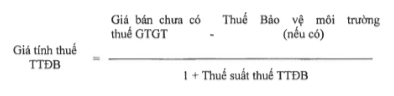
Among them, the selling price without VAT is determined according to the provisions of the law on VAT, and the environmental protection tax is determined according to the provisions of the law on environmental protection tax.
a) In cases where the production establishment or import establishment subject to special consumption tax sells goods through affiliated establishments under dependent accounting, the price serving as the basis for calculating the special consumption tax is the price at which the dependent accounting establishment sells. If the production establishment or import establishment sells goods through agents at the price stipulated by the production establishment or import establishment and only receives commission, then the selling price serving as the basis for determining the taxable value for special consumption tax is the price stipulated by the production establishment or import establishment, excluding commission.
b) In cases where goods subject to special consumption tax are sold to commercial businesses that have parent-subsidiary relationships or are subsidiaries within the same parent company as the production establishment or import establishment, or commercial businesses that have associated relationships, the selling price serving as the basis for determining the taxable value for special consumption tax shall not be lower than 7% of the average monthly price of commercial businesses purchasing directly from the production establishment or import establishment.
In cases where the production establishment or import establishment establishes multiple intermediary commercial establishments with parent-subsidiary relationships or subsidiaries within the same parent company or associated relationships, the selling price serving as the basis for determining the taxable value for special consumption tax shall not be lower than 7% of the average monthly price of these commercial establishments selling to commercial businesses without parent-subsidiary relationships or subsidiaries within the same parent company or associated relationships with the production establishment or import establishment. For automobiles, the average selling price of commercial businesses for comparison purposes is the price of the vehicle excluding additional equipment and parts installed according to customer requirements.
The production establishment, import establishment, and commercial business with associated relationships as provided herein shall be when one enterprise directly or indirectly holds at least 20% of the capital investment of the other enterprise.
In cases where the selling price serving as the basis for determining the taxable value for special consumption tax of the production establishment or import establishment selling goods subject to special consumption tax is lower than 7% of the average price of commercial businesses selling, the taxable value for special consumption tax is the price determined by the tax authority according to the provisions of the law on tax administration.
Example: Company B Beer is the owner of the brand B beer, selling raw materials for producing brand B beer to its member units of Company B Beer.
Production units sell brand B beer products to Company B Beer Limited Liability Trading Corporation, a subsidiary of Company B Beer.
Company B Beer Limited Liability Trading Corporation sells brand B beer products to regional trading joint-stock companies, subsidiaries of Company B Beer Limited Liability Trading Corporation.
Regional trading joint-stock companies enter into contracts to sell brand B beer products to first-level distributors (without parent-subsidiary relationships with Company B Beer, Company B Beer Limited Liability Trading Corporation, regional trading joint-stock companies); first-level distributors sell brand B beer products to second-level distributors, restaurants, consumers...
The production establishment must calculate, declare, and pay the special consumption tax based on the selling price of the production establishment but not lower than 7% of the average monthly selling price of the same type of product sold by regional trading joint-stock companies.
2. For imported goods at the import stage, the taxable value for special consumption tax is determined as follows:
Taxable price for special consumption tax = Import tax value + Import tax.
The tax value for import duties shall be determined in accordance with the provisions of the Law on Export Duties and Import Duties. In cases where imported goods are exempted or reduced from import duties, the tax value does not include the amount of import duty that is exempted or reduced.
2. Amend and supplement Clause 4, Clause 5 of Article 5 as follows:
"4. For processed goods, the tax value is the taxable value of the goods sold by the entity outsourcing processing or the selling price of similar products at the same time without VAT and environmental protection tax (if applicable).
In case the entity outsourcing processing sells the goods to a trading business entity, the tax value for special consumption tax shall be determined according to the guidance provided in Point b, Clause 1 of this Article.
5. For goods produced under a joint business arrangement between a production entity and a brand or technology owning entity, the basis for calculating special consumption tax is the selling price without VAT and environmental protection tax (if applicable) of the brand or technology owning entity. In case the production entity produces goods under a license and transfers them to a branch or representative office of a foreign company in Vietnam for sale, the tax value for special consumption tax is the selling price of the branch or representative office of the foreign company in Vietnam.
In case these entities sell goods to a trading business entity, the tax value shall be determined according to the guidance provided in Point b, Clause 1 of this Article.
3. Amending and supplementing Clause 1 of Article 6 as follows:
"1. Implement the provisions stipulated in Clause 4, Article 1 of Law No. 70/2014/QH13 dated November 26, 2014 amending and supplementing certain articles of the Special Consumption Tax Law, Clause 2, Article 2 of Law No. 106/2016/QH13 dated April 6, 2016 amending and supplementing certain articles of the Value Added Tax Law, Special Consumption Tax Law, and Tax Administration Law, and Article 5 of Decree No. 108/2015/NĐ-CP dated October 28, 2015 issued by the Government.
In case a business entity imports automobiles before July 1, 2016 but sells them from July 1, 2016 onwards, when selling, the business entity must declare and pay special consumption tax according to the tax rate specified in Law No. 106/2016/QH13 amending and supplementing certain articles of the Value Added Tax Law, Special Consumption Tax Law, and Tax Administration Law.
4. Amend the first paragraph of Clause 2, Article 8 as follows:
"2. The taxpayer of special consumption tax for imported goods subject to special consumption tax may deduct the amount of special consumption tax already paid at the import stage when determining the amount of special consumption tax payable upon domestic sales. The deductible amount of special consumption tax corresponds to the special consumption tax of imported goods subject to special consumption tax sold domestically and can only be deducted up to the corresponding amount of special consumption tax calculated at the domestic sales stage. In exceptional cases where the full amount of special consumption tax cannot be deducted due to force majeure, the taxpayer may record it as an expense for corporate income tax purposes.
1. Amend Point a, Clause 2, Article 32 as follows:
"a) The taxpayer must pay late payment interest on the amount of tax paid gradually at a rate of 0.03% per day.
2. Amend Point b.2, Clause 2, Article 32 as follows:
"b.2) Pay on behalf of the taxpayer in case the taxpayer fails to pay the gradually payable tax within the deadline each month, including: the amount of tax payable gradually and the late payment interest at a rate of 0.03% per day.
3. Amend and supplement Clause 2, Article 34 as follows:
"2. Calculation of late payment interest on tax arrears
a) For tax arrears arising from July 1, 2016 onwards, the late payment interest is calculated at a rate of 0.03% per day based on the amount of overdue tax.
b) For tax arrears arising before July 1, 2016 but still unpaid as of July 1, 2016, the calculation is as follows: before January 1, 2015, calculate late payment interest according to the Tax Administration Law No. 78/2006/QH11, the Law amending and supplementing certain articles of the Tax Administration Law No. 21/2012/QH13, from January 1, 2015, calculate late payment interest according to the Law amending and supplementing certain tax laws No. 71/2014/QH13, from July 1, 2016, calculate late payment interest at a rate of 0.03% per day.
Example: Taxpayer B owes 100 million VND in VAT for the August 2014 tax declaration (the declaration was submitted on time to the tax authority), the latest payment date being September 22, 2014 (as September 20 and 21 were holidays). On August 20, 2016, the taxpayer paid this amount into the state budget, the number of days of delay is counted from September 23, 2014 to August 20, 2016, the amount of late payment interest payable is 34.08 million VND. Specifically as follows:
- Before January 1, 2015, the late payment interest is calculated as follows:
+ From September 23, 2014 to December 21, 2014, the number of delayed days is 90 days: 100 million VND x 0.05% x 90 days = 4.5 million VND.
+ From December 22, 2014 to December 31, 2014, the number of delayed days is 10 days: 100 million VND x 0.07% x 10 days = 0.7 million VND.
- From January 1, 2015 to June 30, 2016, the number of delayed days is 547 days: 100 million VND x 0.05% x 547 days = 27.35 million VND.
- From July 1, 2016 to August 20, 2016, the number of delayed days is 51 days: 100 million VND x 0.03% x 51 days = 1.53 million VND.
c) The number of days of delayed tax payment (including public holidays and weekends as prescribed by law) is counted from the day following the last day of the tax payment deadline, the extended tax payment deadline as prescribed by tax laws, or the tax payment deadline stated in the notice or decision on administrative violation handling issued by the tax authority or other competent authorities, to the day the taxpayer pays the tax into the state budget.
Example: Taxpayer C owes 50 million VND in VAT, with a payment deadline of August 20, 2013. On August 26, 2013, the taxpayer paid this amount into the state budget. The number of delayed days is 6 days, counted from August 21, 2013 to August 26, 2013.
Example: Taxpayer D was decided by the tax authority to extend the deadline for paying Value Added Tax (VAT) of 50 million VND, with the original due date being May 20, 2014, and the extended period from May 21, 2014, to November 20, 2014. On November 21, 2014, the taxpayer paid 50 million VND into the state budget. The number of days overdue for payment is 01 day (November 21, 2014).
Example: The tax authority conducts a tax inspection on Taxpayer E. On April 15, 2014, the tax authority issued a decision to handle violations of tax laws amounting to 500 million VND, with the latest deadline for payment being May 14, 2014. On May 30, 2014, the taxpayer paid 500 million VND into the state budget. The number of days overdue for payment is 16 days, calculated from May 15, 2014, to May 30, 2014.
d) In cases where the tax authority enforces compulsory measures by seizing assets and selling seized assets at auction to recover tax debts, the taxpayer will be charged late payment interest from the day following the last day of the tax payment deadline; the extended tax payment deadline as stipulated by tax laws; the tax payment deadline recorded in the notification or decision of the tax authority or competent authority until the day the tax authority issues the asset seizure record.
If the authorized authority responsible for selling assets at auction has transferred ownership rights to the buyer according to the law but has not paid the tax into the State Budget, then the authorized authority responsible for selling assets at auction must pay late payment interest from the day following the transfer of ownership rights until the day the tax is paid into the State Budget.
Late payment shall not be counted during the time required to carry out auction procedures as prescribed by law.
e) In cases where taxpayers underreport taxes for periods prior to July 1, 2016, but discovered after July 1, 2016, through inspections or audits by competent state agencies or self-discovered by the taxpayer, late payment interest shall be applied at a rate of 0.05% per day (or the applicable rate as prescribed by legal documents at different times) from the day the tax should have been paid according to the law until June 30, 2016, and at a rate of 0.03% per day on the underreported tax amount from July 1, 2016, until the day the taxpayer pays the tax into the state budget.
Article 4. Supplement Clause 10 to Article 10 of Circular No. 153/2011/TT-BTC dated November 11, 2011, of the Ministry of Finance guiding non-agricultural land use tax as follows:
"10. Exemption from non-agricultural land use tax for households and individuals whose annual non-agricultural land use tax payable (after deducting any exempted or reduced amounts as provided by the Law on Non-Agricultural Land Use Tax and related guiding documents) is fifty thousand dong or less. In cases where households and individuals own multiple plots of land within a province or centrally-administered city, the exemption from non-agricultural land use tax as provided in this Article shall be based on the total tax payable for all plots of land. The procedures and formalities for exempting non-agricultural land use tax as provided in this Article shall be implemented in accordance with Circular No. 153/2011/TT-BTC.
For households and individuals who meet the conditions for exemption from non-agricultural land use tax as guided by this Circular but have already paid the tax into the State Budget, the tax authority shall process refunds in accordance with the Law on Tax Administration and related guiding documents."
"a1) For the period from 2009 to 2013, enterprises during their production and business operations that use the basic depreciation fund for fixed assets of the enterprise; use post-tax profits for reinvestment; use capital within the scope of investment already registered with the competent state management agency to regularly supplement machinery and equipment without increasing production and business capacity according to the registered business plan or approved plan shall not be required to expand investment."
Article 6. Effectiveness
This Circular takes effect from the date the Law No. 106/2016/QH13 amending and supplementing certain articles of the Value Added Tax Law, Special Consumption Tax Law, and Tax Administration Law and Decree No. 100/2016/NĐ-CP dated July 1, 2016, of the Government detailing the implementation of the Law amending and supplementing certain articles of the Value Added Tax Law, Special Consumption Tax Law, and Tax Administration Law take effect, except for Clause 2 of this Circular.
Article 4 of this Circular applies from the tax year 2016.
Article 7. Responsibility for Implementation
The People's Committees of provinces and centrally governed cities shall direct relevant agencies to implement in accordance with the provisions of the Government and the guidance of the Ministry of Finance.
2. Tax authorities at all levels shall be responsible for disseminating and guiding organizations and individuals to implement the contents of this Circular.
3. Organizations and individuals subject to the regulations of this Circular shall comply with the guidance provided in this Circular.
During the implementation process, if there are difficulties, organizations and individuals are requested to promptly reflect to the Ministry of Finance for research and resolution./.
DEPUTY MINISTER
원본 문서(PDF)
관계도
문서를 클릭하면 열립니다. 빨간 테두리=효력을 변경하는 관계.
번역본
이 문서는 다음 언어로 제공됩니다: