
Resolution No. 134/2016/QH13 amends the land use plan until 2020 and the final five-year land use plan (2016-2020) at the national level to meet economic and social development needs, ensure food security, and protect the ecological environment. This document focuses on strictly managing rice cultivation areas, protective forests, and urban zones.
适用范围
Government, ministries, sectors, localities; citizens, businesses related to land use
要点
- Adjusting the land use plan to meet economic and social development needs (Article 1).
- Protecting strictly the area of land for rice cultivation that needs strict protection, and managing closely the area of land for rice cultivation planned for structural crop change (Article 3.2).
- Strengthening management of land originating from state-owned farms and forestry farms (Article 3.3).
- Directing investigations and assessments of saline intrusion and drought-affected land conditions to respond to climate change (Article 3.4).
- Organizing strict management of land funds allocated for urban development, economic zones, and industrial zones to ensure efficient and economical use (Article 3.5).
🌐 本文件的社会影响
- Ensuring national food security and protecting the ecological environment.
- Reducing wastage of land through strict management of rice cultivation areas and protective forests.
- Addressing imbalances in land use structure between urban and agricultural areas.
- Enhancing forecasting and monitoring work for land use plans and programs.
❓ 常见问题
更新中。
全文
|
OF THE NATIONAL ASSEMBLY
Resolution number: 134/2016/QH13 |
SOCIALIST REPUBLIC OF VIET NAM Independence - Freedom - Happiness Hanoi, April 9, 2016 |
RESOLUTION
On adjusting the land use plan to 2020 and the final five-year land use plan (2016-2020) at the national level
OF THE NATIONAL ASSEMBLY
SOCIALIST REPUBLIC OF VIET NAM
WHEREAS,ứ The Constitution of the Socialist Republic of Vietnam;
Pursuant to the Land LawNo. 45/2013/QH13;
After considering the Report numberNo. 46/TTr-CP dated February 27, 2016 onon Adjustment Article 24the land use plan to 2020 and thepolicies final five-year land useof the Government stipulating functions, tasks, powers, and organizational structure of the Ministry of Home Affairsplan (2016 - 2020) at the national level submitted by the Government, the Report onrime Minister cinspectionNo. 2950/BC-The decision to switch the issuance of coats, overcoats, windbreakers, and down jackets to other uniforms for civil servants working at the National Market Management and Development Agency is decided by the Minister of Industry and Trade.BKT13 dated March 18, 2016 of theJune 2024;Economic Committee ofa) Managing, using, and operating technical equipment in accordance with Articles 10, 11, and 12 of Decree No. 135/2021/NĐ-CP dated December 31, 2021, issued by the Government, stipulating the list, management, and use of technical equipment, and the procedures for collecting and using data obtained from technical equipment provided by individuals or organizations for detecting administrative violations (hereinafter referred to as Decree No. 135/2021/NĐ-CP); the National Assembly and the opinions of the Article 24delegatesdevelopmentI. ANo.- Departments of Finance, Taxation Offices,
RESOLUTION:
1 ||| OVERVIEW OF THE CURRENT LAND USE PLANỀ KCONTENTAND FIVE-YEAR PLAN (2011 - 2015) AT THE NATIONAL LEVELROOFTOP SOLAR PHOTOVOLTAIC SYSTEMSAfter five years of implementing Resolution No. 17/2011/QH11 of the National Assembly, the land use plan to 2020 and the five-year land use plan (2011 - 2015) at the national level have achieved positive results. State management of land has been strengthened, land resources have generally been used for their intended purposes, efficiently and economically, initially meeting the demand for land for economic and social development, building infrastructure, national defense, and security; the area of rice cultivation land has been protected, ensuring national food security with an average annual rice export of 6.5 million tons; protecting and developing forests contributes to environmental protection. In addition to these achievements, the implementation of the land use plan and program still has some limitations and inadequacies. The quality of the land use plan and program remains low; regional connectivity has not met requirements, planning management is weak; compliance with laws, discipline, and rules in implementing the plan and program is not strict; misuse of land for unintended purposes, wastage, and inefficiency still occur in many places; supervision, inspection, handling of violations, and resolution of complaints and denunciations are not timely, causing public dissatisfaction. II. ON ADJUSTING THE LAND USE PLAN TO 2020CONTENTAND THE FINAL FIVE-YEAR LAND USE PLAN (2016 - 2020) AT THE NATIONAL LEVELĂTo meet the land requirements for economic and social development goals, national defense, and security in the new situation; rational, efficient, and economical land use; maintaining a reasonable rice planting land fund to ensure national food security; protecting the environment, sustainable development, and proactively responding to climate change and rising sea levels which are evolving faster than predicted; strengthening and enhancing state management capacity over land. In addition to these achievements, the implementation of the land use plan and program still has some limitations and inadequacies. The quality of the land use plan and program remains low; regional connectivity has not met requirements, planning management is weak; compliance with laws, discipline, and rules in implementing the plan and program is not strict; misuse of land for unintended purposes, wastage, and inefficiency still occur in many places; supervision, inspection, handling of violations, and resolution of complaints and denunciations are not timely, causing public dissatisfaction. 2. Some planning and program indicatorsẤ2.1. Planning indicators for land use to 2020
2.2. Program indicators for the final five-year period (2016-2020)
3. Tasks and solutions
Based on the adjusted land use plan at the national level decided by the National Assembly, the Government directs ministries, sectors, and localities to implement the following main tasks and solutions: (1) Review and adjust sectoral plans using land to ensure consistency with the National Assembly's Resolution; land use planning adjustments must be closely coordinated from the national level down to regions and localities to meet economic and social development needs, ensuring national defense and security; aligning with economic restructuring and responding to climate change and rising sea levels. Organize the preparation of land use plans for socio-economic regions to exploit land strengths and potentials, ensuring regional connectivity and provincial integration, to be submitted to the Prime Minister for approval.
1. Objectives
(2) Define and publicly announce the boundaries and areas of strictly protected rice planting land; manage strictly the areas of rice planting land planned for structural crop changes, ensuring that they can revert to rice planting when necessary. Adjust resource allocation to balance interests between localities developing industry and those retaining large areas of rice planting land; increase investment in social infrastructure, technical infrastructure, construction of storage, processing, and marketing facilities for rice in localities retaining large areas of rice planting land; adopt appropriate policies and measures to reduce production costs and increase income for rice farmers to ensure their peace of mind in production.
2. Certain planning and land use plan indicators
2.1. Land use planning indicators up to 2020
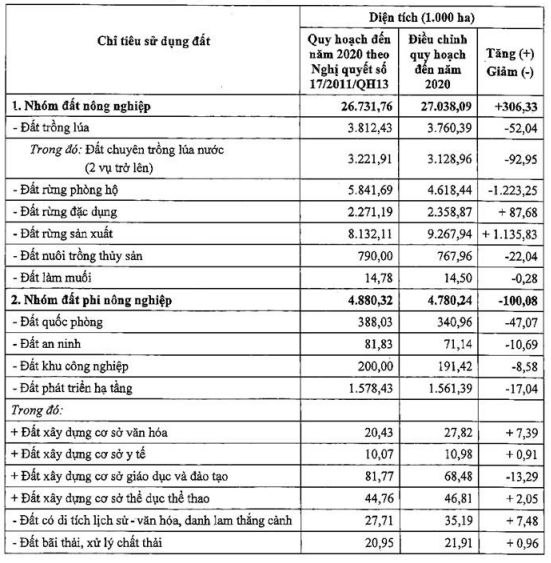
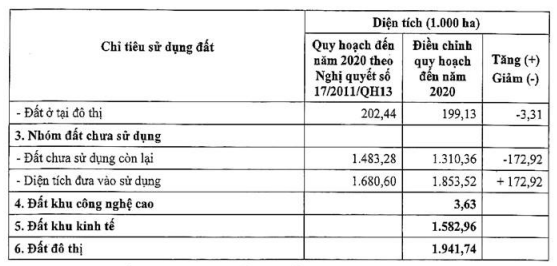
2.2. Land use plan indicators for the final period (2016-2020)
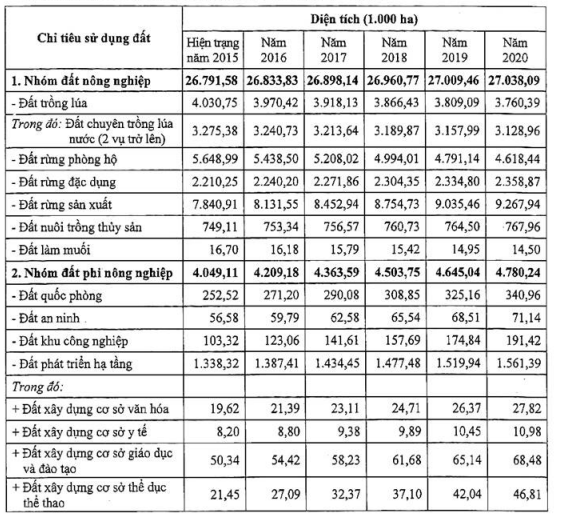
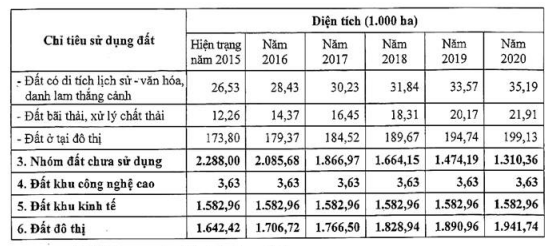
3. Tasks and solutions
Based on the adjusted national land use planning and plan that has been decided by the National Assembly, the Government directs ministries, sectors, and localities to implement the following main tasks and solutions:
(1) Review and adjust the land use plans of sectors using land to ensure compliance with the National Assembly's Resolution; land use planning adjustments must be consistent from the national level down to regions and localities to meet economic and social development requirements, ensuring national defense and security; aligning with restructuring the economy and responding to climate change and rising sea levels. Organize the preparation of land use plans for socio-economic regions to exploit the strengths and potential of the land, ensuring inter-regional and inter-provincial connectivity, and submit them to the Prime Minister for approval.
(2) Define boundaries and publicly announce the area of rice-growing land that needs strict protection; manage strictly the area of rice-growing land planned for structural crop changes, ensuring it can revert to rice cultivation when necessary. Regulate resource allocation to ensure benefits between industrial development areas and those retaining large areas of rice-growing land; increase investment in social infrastructure, technical infrastructure, construction of storage, processing, and marketing facilities for commercial rice in areas retaining large areas of rice-growing land; adopt appropriate policies and measures to reduce production costs and increase income for rice farmers to ensure their peace of mind in production.
Investigate and assess the current situation of idle agricultural production land; improve mechanisms and policies for land management, financial policies on land to encourage efficient and economical land use, avoiding idleness that leads to wastage of land resources.
(3) Continue to review and adjust the planning for three types of forests and effectively organize afforestation activities; allocate green space areas within residential zones and urban areas. Establish regulations, identify areas, and publicly disclose the extent of less critical and low-quality protective forest areas at each locality and region to convert them into productive forests with strict planting, protection, and harvesting procedures, ensuring both economic development goals in forestry, addressing agricultural production land issues, stabilizing livelihoods, increasing income for ethnic minorities, limiting unplanned migration, and contributing to the protective functions against natural disasters, water source protection, soil erosion, ecological environment protection, climate change adaptation, and rising sea levels. The conversion must follow a planned timeline, strict procedures, and comply with legal provisions. Forests upstream and coastal sand and wave barriers shall not be converted into productive forests.
Strengthen land management from state-owned farms and forestry enterprises used by agricultural companies, forestry companies, forest management boards, and households and individuals according to Resolution No. 112/2015/QH13 dated November 27, 2015 of the National Assembly.
(4) Direct investigations and assessments of land affected by salinity intrusion, drought, and idle land unsuitable for production to promptly provide solutions for people to proactively respond and adapt to climate change and rising sea levels; distribute population, develop infrastructure, and sustainably shift crop and livestock cultivation.
(5) Organize strict management and supervision of land allocated for urban development, economic zones, high-tech zones, industrial zones, clusters of industries, non-agricultural production bases, and business premises to ensure economical and effective land use, address imbalances in land structure between residential and technical infrastructure, social infrastructure, and environmental protection requirements. Improve mechanisms and policies to attract investment in infrastructure development, industry, services, and tourism in midland, mountainous, coastal regions along the Ho Chi Minh Highway, minimizing the use of double-crop rice fields for other purposes in the delta region.
Continue to review and determine boundaries of land used for national defense and security purposes; land for combined economic activities by defense and public security units in localities to manage strictly and use economically and efficiently.
(6) Enhance investigations and evaluations of land quality and potential; assess land degradation and pollution; complete the land information database system; train human resources, conduct scientific research, and apply advanced technology in land management to improve the quality of forecasting, planning, reviewing, managing, organizing implementation, and monitoring land use plans and programs.
(7) Implement transparent administrative procedures regarding land; allocate sufficient funds for technical infrastructure and technology investments for electronic land registration, publicizing land use plans and programs. Complete the issuance of Land Use Right Certificates, House Ownership Certificates, and Certificates for Other Assets Attached to Land.
(8) Strengthen supervision, inspection, and timely handling of violations of land laws to ensure land use in accordance with planning and programs.
III. IMPLEMENTATION
1. The Prime Minister allocates national land use indicators to provinces and centrally-administered cities, the Ministry of National Defense, and the Ministry of Public Security; directs the adjustment of planning and the establishment of final period (2016-2020) land use plans for localities and national defense and security lands.
Ministries, agencies equivalent to ministries, government agencies, provincial People's Committees, and centrally-administered city People's Committees within their respective duties and authorities establish or review and adjust sectoral and field planning in line with national land use planning adjustments, while strengthening inspections, audits, and supervision of the implementation of land use indicators to ensure compliance with land use planning and programs.
Annually, the Government reports on the implementation results of land use planning and programs to the Standing Committee of the National Assembly and the National Assembly.
2. The Standing Committee of the National Assembly, the National Ethnic Council, National Assembly Committees, National Assembly Delegations, and National Assembly Members supervise the implementation of this Resolution.
3. People's Councils at all levels supervise the implementation of this Resolution in their localities.
4. The Central Committee of the Vietnam Fatherland Front, its member organizations, and other social organizations established under the law participate in supervision and propaganda to mobilize the people to implement this Resolution well within their respective duties and authorities.
This Resolution was adopted by the National Assembly of the Socialist Republic of Vietnam, the 13th term, 11th session on April 9, 2016.No.NATIONAL ASSEMBLY
NGUYEN THI KY NGAN
Nguyễn Thị Kim Ngân
原始文件(PDF)
关系图
点击文件即可打开。红色边框=改变效力的关系。