
This Circular stipulates the content, methods, and procedures for researching non-residential electricity loads in the Vietnamese power system. It includes determining load sample models based on the load band separation method according to power level or energy consumption (DALENUIUS-HODGES), calculating the size of load sample models according to the standard distribution function, and using estimation methods such as unit mean (MPU) and separation ratio (SR).
Đối tượng áp dụng
Organizations and individuals involved in researching and managing non-residential electricity loads in the Vietnamese power system.
Các điểm cốt lõi
- The load band separation method according to power level or energy consumption (DALENUIUS-HODGES)
- Calculating the size of load sample models according to the standard distribution function
- The unit mean (MPU) and separation ratio (SR) estimation methods to determine the number of load sample models for each load band.
- These methods ensure accuracy in researching and managing non-residential electricity loads, thereby supporting the efficient operation of the national power system.
- Appendix 2 provides detailed formulas for calculating the size of load sample models according to the standard distribution function and the unit mean (MPU) method.
🌐 Tác động xã hội từ văn bản này
- Enhancing the efficiency of power system management
- Minimizing the risk of safety issues in power supply
- Supporting sustainable development of the energy sector
❓ Câu hỏi thường gặp
What is the DALENUIUS-HODGES method used for?
To determine optimal break points in the range of power level or energy consumption variation of a group of electricity loads, thus separating them into bands according to energy consumption levels.
When is the formula for calculating the size of load sample models according to the standard distribution function used?
When it is assumed that electricity loads follow a normal distribution function with the variable being annual energy consumption.
What are the unit mean (MPU) and separation ratio (SR) methods used for?
To determine the number of load sample models for each load band using hourly average energy data of electricity loads within the band.
Toàn văn
|
MINISTRY OF INDUSTRY AND TRADE |
SOCIALIST REPUBLIC OF VIET NAM |
|
Number: 19/2017/TT-BCT |
Hanoi, September 29, 2017 |
CIRCULAR
REGULATIONS ON CONTENT, METHODS AND PROCEDURES FOR IMPLEMENTING ELECTRIC LOAD RESEARCH
Decree No. 98/2017/NĐ-CP dated August 18, 2017 of the Government stipulating functions, tasks, powers, and organizational structure of the Ministry of Industry and Trade;
On the basis of Law on Electricity dated December 3, 2004 and Law Amending and Supplementing Certain Provisions of the Law on Electricity dated November 20, 2012;
Decree No. 137/2013/NĐ-CP dated October 21, 2013 of the Government detailing implementation of certain provisions of Law on Electricity and Law Amending and Supplementing Certain Provisions of the Law on Electricity;
At the proposal of the Director of the Electricity Regulatory Authority,
The Minister of Industry and Trade issues this Circular to regulate the content, methods, and procedures for implementing electric load research.
PART I
GENERAL PROVISIONS
Article 1. Scope of Regulation
This Circular regulates the content, methods, and procedures for implementing electric load research of the power system.
Article 2. Applicability
This Circular applies to the following subjects:
1. Vietnam Electricity Corporation.
2. Distribution electricity units.
MECHANISMS AND POLICIES REGARDING THE PRICE OF AUCTION SERVICES FOR ASSETS THAT MUST BE SOLD THROUGH AUCTIONS AS PRESCRIBED BY LAW
Article 3. Explanation of Terms
Strategic multi-purpose hydropower plant
1. Load curve is a diagram showing the characteristics of electricity consumption over time of the power system, load components, load groups, and sub-groups of loads.
2. Actual load curve is a load curve constructed based on data collected and calculated from load samples.
3. Typical load curve is a load curve of a typical day for a week, month, or year.
4. Standardized unit load curve is a load curve expressed in relative values, converted according to the total commercial energy in the load research cycle.
5. Load research database is a set of data containing information about load samples, metered electricity consumption data of load samples and the power system, and results of load curve calculations.
6. Load range is a collection of loads within the same power capacity or electricity consumption range in each load group or sub-group of loads.
7. Load demand forecasting ; is the activity of calculating, estimating, and evaluating the growth trend, growth rate, and demand for electricity loads supplied from the power system in the short term, medium term, and long term.
8. Distribution electricity unit is an electricity entity licensed to operate in the distribution and retail electricity sectors, including:
a) State Corporation of Electricity;
b) Provincial Power Corporation under the Central Power Corporation (hereinafter referred to as Provincial Power Corporation).
9. Load sample is a load with a characteristic consumption pattern for a load group, calculated using probability theory with calculation reliability and margin error within permissible limits.
10. Typical day is a day selected with a characteristic consumption pattern of loads during a specific period. A typical day includes a typical working day, weekend day (Saturday, Sunday), holiday (if any) for a year, month, and week.
11. Load research is the activity of collecting, analyzing, and evaluating the consumption characteristics of loads, including trends, behavior, consumption habits, and contribution to the system load curve of each load component, load group, sub-group of loads, and electricity users.
12. Load group is a collection of loads with similar consumption characteristics, belonging to load components, detailed in Appendix 1 issued together with this Circular.
13. Non-residential load is a load belonging to the Industrial - Construction, Commerce - Services, Agriculture - Forestry - Fisheries, Restaurant - Hotel, and other activities load components.
14. Residential load is a load belonging to the Domestic load component.
15. Sub-group of loads is a collection of loads with similar consumption characteristics, belonging to load groups detailed in
Appendix 1 issued together with this Circular.
16. Metered data is the value of electrical energy measured from the meter, calculated electrical energy, or estimated electrical energy based on metered data for delivery and payment purposes.
17. Load component is a load classified according to the consumption structure, including: Industrial - Construction, Commerce - Services, Agriculture - Forestry - Fisheries, Domestic, Restaurant - Hotel, and other activities.
Article 4. Content of electricity load research
Electricity load research includes the following main tasks:
1. Designing and selecting electricity load samples.
2. Collecting and calibrating data on electricity consumption of electricity load samples.
3. Building and analyzing electricity load curves for subgroups, groups, and components of electricity loads.
4. Forecasting electricity load curves.
Article 5. Application of results from electricity load research
1. Establishing and proposing appropriate electricity tariff structures for different categories of electricity consumers.
2. Evaluating potential, building, and implementing demand management programs, energy efficiency and conservation programs.
3. Supporting the forecasting of electricity load requirements to serve system operation, electricity market activities, and grid development plans to meet electricity load demands.
Chapter II
PROCEDURE FOR SELECTING ELECTRICITY LOAD SAMPLES
Section 1. SELECTING NON-RESIDENTIAL ELECTRICITY LOAD SAMPLES
Article 6. Procedure for selecting non-residential electricity load samples
1. Analyzing and classifying non-residential electricity loads.
2. Determining target variables for calculating sample selection of non-residential electricity loads.
3. Analyzing and separating load ranges.
4. Calculating the number of non-residential electricity load samples.
5. Selecting non-residential electricity load samples. In cases where non-residential electricity loads are equipped with remote metering devices, the Distribution Unit uses these data for calculation and sample selection.
Article 7. Analysis and classification of non-residential electricity loads
1. Factors to be considered when conducting analysis and classification of non-residential electricity loads include:
a) Characteristics of subgroups, groups, and components of electricity loads;
b) Voltage level of connection for electricity loads;
c) Geographic, seasonal, and weather factors;
d) Other necessary information specific to each group and subgroup of electricity loads.
2. The process of classifying non-residential electricity loads includes:
a) Classifying electricity loads according to subgroups, groups, and components of electricity loads;
b) Classifying electricity loads within subgroups and groups based on voltage levels, geographic areas, seasons, and other characteristic factors (if applicable);
c) A list of components of electricity loads is established in accordance with Appendix 1 issued together with this Circular;
d) A list of groups and subgroups of electricity loads for load research purposes is selected by Vietnam Electricity Corporation based on the current status of the power system, infrastructure, load structure, and guidelines set out in Appendix 1 issued together with this Circular.
3. Establishing lists of subgroups, groups, and components of non-residential electricity loads in accordance with Clause 1 and Clause 2 of this Article.
Article 8. Determining target variables for calculating the selection of non-residential electricity load samples
1. Target variables are parameters reflecting the characteristics of electricity consumption of each subgroup and group of non-residential electricity loads used in calculating standard deviation and the minimum number of non-residential electricity load samples.
2. Target variables are selected based on one of the following parameters:
a) Load capacity at the maximum power point in the year for the power system;
b) Load capacity at peak morning or evening hours on days with maximum power in the year for the power system;
c) Time-of-use (TOU) electricity consumption;
d) Annual electricity consumption of non-residential electricity loads.
Article 9. Analysis and Segmentation of Electrical Load Bands Based on Target Variables
The analysis and segmentation of electrical load bands based on target variables for each sub-group of electrical loads and non-residential electrical load groups shall be carried out as follows:
1. Determine the quantity and evaluate the weight, scale of power consumption or energy consumption for each sub-group of electrical loads and non-residential electrical load groups.
2. Use the Dalenius-Hodges method to construct a distribution chart of electrical loads based on power consumption or energy consumption, determine the optimal breakpoint for segmenting power consumption or energy consumption. Details of the Dalenius-Hodges method are specified in Appendix 2 issued together with this Circular.
3. The results of the analysis and segmentation of power consumption or energy consumption for each sub-group of electrical loads and non-residential electrical load groups must include:
a) The number of bands and the number of electrical loads within each electrical load band;
b) The average value of power consumption or energy consumption for each electrical load band;
c) The standard deviation of each electrical load band.
Article 10. Calculation of the Number of Non-Residential Electrical Load Samples
The calculation of the number of non-residential electrical load samples for each electrical load band shall be carried out according to the following steps:
1. Determine the criteria for selecting electrical load samples for load research.
2. Exclude electrical load bands whose total power consumption or energy consumption is less than 1% of the total power consumption or energy consumption of a sub-group of electrical loads or an electrical load group.
3. Select one of the methods for calculating the number of electrical load samples for the remaining electrical load bands. The calculation methods include:
a) The normal distribution function method;
b) The mean per unit (MPU) method;
c) The separate ratio (SR) method;
d) The combined ratio (CR) method.
Details of the methods for calculating the number of electrical load samples corresponding to each electrical load band are specified in Appendix 2 issued together with this Circular.
4. Determine the reliability value and margin of error for calculating the number of electrical load samples.
5. Calculate the number of electrical load samples for each electrical load band.
6. Compile and create a statistical table of the number of electrical load samples within each sub-group of electrical loads, electrical load group, and load component.
Article 11. Responsibilities of Units in Selecting Non-Residential Electrical Load Samples
1. Vietnam Electricity Corporation has the responsibility:
a) Annually review and improve the criteria for selecting non-residential electrical load samples applicable to all Distribution Units and report to the Electricity Regulatory Authority;
b) Determine the technical characteristics of the data collection equipment and manage and supervise the investment and installation of equipment for non-residential electrical load samples to conduct load research nationwide;
c) Issue a list of electrical load groups and sub-groups of electrical loads as stipulated in Point d Clause 2 Article 7 of this Circular for Distribution Units to uniformly implement nationwide.
2. Electricity Corporation has the responsibility:
a) Based on the criteria for selecting non-residential electrical load samples, the list of electrical load groups and sub-groups of electrical loads prescribed in Clause 1 of this Article, carry out calculations, selection, and management of the number of non-residential electrical load samples within its jurisdiction;
b) Allocate the number of non-residential electrical load samples to Provincial Electricity Companies (if any) within its jurisdiction;
c) Create a list of non-residential electrical load samples within its jurisdiction, including information such as name of load, address, voltage level, load band, sub-group of electrical loads, electrical load group, load component;
d) Create a backup list of non-residential electrical load samples in case of replacement;
e) Invest in and install equipment for collecting electricity consumption data of non-residential electrical load samples to conduct load research within its jurisdiction.
3. Provincial Electricity Company has the responsibility:
a) Create a list of non-residential electrical load samples within its jurisdiction according to the number of samples allocated by the Electricity Corporation, including information such as name of load, address, voltage level, load band, sub-group of electrical loads, electrical load group, load component;
b) Create a backup list of non-residential electrical load samples in case of replacement;
c) Invest in and install equipment for collecting electricity consumption data of non-residential electrical load samples to conduct load research within its jurisdiction.
Section 2. SELECTION OF ELECTRICITY DEMAND SAMPLES FOR DOMESTIC USE
Article 12. Calculation and Selection of Electricity Demand Samples for Domestic Use
1. The factors to be considered when calculating and classifying groups of domestic electricity demand include:
a) Geographic factors (region, area);
b) Distribution by area (rural, urban);
c) Weather factors (season);
d) Level of electrification and household electricity consumption, or other characteristic factors within each group of domestic electricity demand.
2. The process of calculating and classifying domestic electricity demand shall be carried out in the following order:
a) Classify groups of domestic electricity demand according to rural and urban areas to distinguish levels of electrification and household electricity consumption based on the current retail electricity price structure;
b) Select the number of domestic electricity demand samples that ensure representativeness for each group of domestic electricity demand;
c) Prepare a List of selected domestic electricity demand samples including: Name of electricity demand, address, group of electricity demand, components of electricity demand;
d) Prepare a backup list of domestic electricity demand samples for replacement if necessary.
Article 13. Responsibilities of Units in Selecting Domestic Electricity Demand Samples
1. The electricity distribution unit is responsible for:
a) Calculating, designing, and preparing a List of domestic electricity demand samples within its management scope as stipulated in Article 12 of this Circular;
b) Implementing investment and installation of data collection equipment for domestic electricity demand samples within its management scope;
c) Managing and supervising data collection equipment for domestic electricity demand samples;
d) Summarizing domestic electricity demand samples within its management scope;
e) Reporting and providing the List of domestic electricity demand samples within its management scope at different levels to the National Power Corporation or Vietnam Electricity Group.
a) Compiling the list of power plants providing ancillary services according to the transmission system regulations and the national black start and system recovery regulations issued by the Ministry of Industry and Trade;
a) Summarizing domestic electricity demand samples nationwide;
b) Determining technical characteristics of the system of equipment to conduct electricity load research and manage and supervise investment and installation of data collection equipment for domestic electricity demand samples nationwide.
Chapter III
PROCEDURE FOR DATA COLLECTION, ADJUSTMENT, CONSTRUCTION, ANALYSIS AND FORECASTING OF LOAD CURVES
Section 1. DATA COLLECTION AND ADJUSTMENT
Article 14. Collection of Data from Domestic Electricity Demand Samples
The electricity distribution unit is responsible for collecting daily data from domestic electricity demand samples selected according to a 30-minute measurement cycle.
Article 15. Method for Identifying Errors in Data from Domestic Electricity Demand Samples
1. Check from the start time of the data reading period to the end time of the data reading period.
2. Check for electricity energy data with a value of zero ("0").
3. Check the status report (identify suspicious items requiring verification).
4. Compare the total electricity energy value over the measurement cycle of the electricity demand with the monthly metered commercial electricity energy total.
5. Compare the metered data value with the consumption threshold of the domestic electricity demand sample.
6. Compare with the previous month's or the same month last year's commercial electricity energy data.
7. Compare with the previous month's or the same month last year's peak electricity demand data.
8. Check the load factor.
Article 16. Calibration and Estimation of Load Measurement Data of Sample Loads
1. Calibration and estimation of load measurement data of sample loads shall be carried out when it is determined that the collected measurement data is erroneous according to the provisions of Article 15 of this Circular.
2. Based on the identified error in the load measurement data of sample loads, depending on the type of error in the data, one of the following calibration and estimation methods for measurement data shall be used:
a) Linear Interpolation: Interpolating from the characteristic consumption trend curve;
b) Similar Day: Using similar day data from the current week or previous week;
c) Automatic Estimation: Used in cases where data is missing for no more than seven days;
d) Visual Inspection of Graphs: Knowing the incorrect data and deciding on the estimated data;
đ) Manual Calibration Estimation: Used when data is missing for more than seven days;
e) Calibration Estimation of Average Values of Weeks of Reference Day: Based on data from the four most recent weeks.
3. The load measurement data of sample loads after calibration and estimation must be stored to establish the Research Load Database.
Article 17. Responsibilities of Units in Collecting and Calibrating Measurement Data
1. The electricity distribution unit is responsible for:
a) Collecting, calibrating measurement data of sample loads and managing, storing measurement data of sample loads and the Research Load Database within their management scope;
b) Transmitting calibrated measurement data of sample loads to the Electricity Corporation or Vietnam Electricity Group at the appropriate level to build the Research Load Database of the Electricity Corporation and the nation.
2. The Vietnam Electricity Group is responsible for managing and storing the National Research Load Database, ensuring that System Operation Units and Electricity Market Units, Distribution Units have access to and can use this database.
Section 2. CONSTRUCTION AND ANALYSIS OF LOAD CURVES
Article 18. Methods for Constructing Load Curves
Construction of load curves in load research is carried out by combining the two methods Bottom-Up and Top-Down, specifically as follows:
1. The Bottom-Up method is the main method for conducting load research: Past measurement data and electricity consumption of sample loads are collected and aggregated as input data to construct load curves for sample loads, load groups, load components, and the power system.
2. The Top-Down method is used to support verification and calibration of the results of constructing load curves using the Bottom-Up method, taking into account factors related to economic and social development: Past measurement data and electricity consumption of the power system and loads are collected for comparison and calibration of the results of constructing load curves for the power system, load components, load groups, and subgroups constructed through the Bottom-Up load research method.
Article 19. Construction of Standardized Unit Load Curves
1. Standardized unit load curves (monthly, annual) of subgroups, groups, and components of loads are constructed by calculating and aggregating standardized unit load curves (monthly, annual) of corresponding individual sample loads.
2. The process of constructing standardized unit load curves (monthly, annual) of subgroups, groups, and components of loads is carried out as follows:
a) Step 1: Construct standardized unit load curves (monthly, annual) of each individual sample load by dividing the load curve of the sample load from the collected measurement data by the commercial energy of the sample load for the month, year;
b) Step 2: Construct standardized unit load curves (monthly, annual) of each subgroup of loads by averaging the standardized unit load curves (monthly, annual) of sample loads belonging to the subgroup;
c) Step 3: Construct standardized unit load curves (monthly, annual) of each group of loads by averaging the standardized unit load curves (monthly, annual) of subgroups belonging to the group;
d) Step 4: Construct standardized unit load curves (monthly, annual) of each component of loads by averaging the standardized unit load curves (monthly, annual) of groups belonging to the component;
đ) Step 5: Construct standardized unit load curves (monthly, annual) of Distribution Units, Regional Power Systems, and National Power Systems by averaging the standardized unit load curves (monthly, annual) of components corresponding to the scope of Distribution Units, Regional Power Systems, and National Power Systems.
3. The Vietnam Electricity Group, Distribution Units are responsible for storing standardized unit load curves (monthly, annual) of subgroups, groups, components of loads, and of Distribution Units, Regional Power Systems, and National Power Systems in the Research Load Database.
Article 20. Construction of actual electricity load curves
1. The actual electricity load curve (monthly, annual) of a sub-group of electricity loads is constructed by multiplying the normalized average electricity load curve (monthly, annual) with the commercial electricity consumption data (monthly, annual) of the corresponding sub-group of electricity loads.
2. The actual electricity load curve (monthly, annual) of a group of electricity loads is constructed by summing the actual electricity load curves (monthly, annual) of the sub-groups of electricity loads within that group.
3. The actual electricity load curve (monthly, annual) of a component of electricity loads is constructed by summing the actual electricity load curves (monthly, annual) of the groups of electricity loads within that component.
4. The actual electricity load curve (monthly, annual) of the Distribution Unit, regional power system, and national power system is constructed by summing the actual electricity load curves (monthly, annual) of the components of electricity loads within the scope of the Distribution Unit, regional power system, and national power system.
5. The Vietnam Electricity Group and the Distribution Units are responsible for storing the actual electricity load curves (monthly, annual) of sub-groups of electricity loads, groups of electricity loads, components of electricity loads, and of the Distribution Units, regional power systems, and national power systems in the research load database.
Article 21. Construction of typical electricity load curves
1. The typical electricity load curve of a working day (monthly, annual) of a sub-group of electricity loads, group of electricity loads, component of electricity loads, and of the Distribution Unit, regional power system, and national power system is constructed by averaging the actual electricity load curves of working days (monthly, annual) of the sub-groups of electricity loads, groups of electricity loads, components of electricity loads, and of the Distribution Units, regional power systems, and national power systems.
2. The typical electricity load curve of a holiday or public holiday (monthly, annual) of a sub-group of electricity loads, group of electricity loads, component of electricity loads, and of the Distribution Unit, regional power system, and national power system is constructed by averaging the actual electricity load curves of holidays or public holidays (monthly, annual) of the sub-groups of electricity loads, groups of electricity loads, components of electricity loads, and of the Distribution Units, regional power systems, and national power systems.
Article 22. Analysis of electricity load curves
1. Summarize the results of calculating and constructing the normalized average unit electricity load curve, actual electricity load curve, and typical electricity load curve (monthly, annual) of sub-groups of electricity loads, groups of electricity loads, components of electricity loads, and of the Distribution Units, regional power systems, and national power systems as stipulated in Articles 19, 20, and 21 of this Circular.
2. Compare and cross-reference the results of constructing the electricity load curves of the Distribution Units, regional power systems, and national power systems as stipulated in Clause 1 of this Article with the electricity load curves of the Distribution Units, regional power systems, and national power systems constructed using top-down methods to adjust the results of constructing the electricity load curves in load research appropriately.
3. Analyze and evaluate the growth rate of commercial electricity consumption of the Distribution Units, regional power systems, and national power systems in detail according to sub-groups of electricity loads, groups of electricity loads, and components of electricity loads compared to the previous year.
4. Evaluate the trend of change in the electricity load curves of sub-groups of electricity loads, groups of electricity loads, and components of electricity loads that have a high proportion of electricity consumption or a high growth rate.
5. Evaluate the impact of sub-groups of electricity loads, groups of electricity loads, and components of electricity loads participating in the maximum and minimum capacity of the Distribution Units, regional power systems, and national power systems including: frequency of peak occurrence, changes in maximum capacity, contribution ratio to maximum and minimum capacity. Compare with the actual electricity load curves of the Distribution Units, regional power systems, and regional power systems.
6. Changes in the electricity load curves (load factor and simultaneity factor) of sub-groups of electricity loads, groups of electricity loads, and components of electricity loads over time.
7. Analyze the correlation between the trend of change in the electricity load curves of sub-groups of electricity loads, groups of electricity loads, and components of electricity loads with the structure of electricity sales prices, temperature trends, weather conditions, regional characteristics, economic and social development indicators, and other factors related to business operations.
Article 23. Responsibilities of Units in Building and Analyzing Electricity Load Diagrams
1. The electricity distribution unit shall be responsible for building and analyzing electricity load diagrams (monthly, annually) within its management scope in accordance with Articles 19, 20, 21, and 22 of this Circular.
2. The Vietnam Electricity Corporation shall be responsible for building and analyzing electricity load diagrams (monthly, annually) of the national power system and three regions in accordance with Articles 19, 20, 21, and 22 of this Circular.
Section 3. FORECASTING ELECTRICITY LOAD DIAGRAMS
Article 24. Methods for Forecasting Electricity Load Diagrams
Combining top-down and bottom-up methods to forecast trends in electricity load diagrams, specifically as follows:
1. The top-down method is used to forecast trends in electricity load diagrams (monthly, annually) of the national power system, regional power systems, and electricity distribution units, specifically:
a) Using past data series of electricity load diagrams to forecast trends in electricity load diagrams;
b) Adjusting the results of forecasting trends in electricity load diagrams appropriately when considering the impact of weather factors, economic growth rates, population, and elasticity coefficients.
2. The bottom-up method is used to forecast trends in electricity load diagrams for each sub-group of electricity loads, groups of electricity loads, and components of electricity loads of electricity distribution units, regional power systems, and the national power system, specifically:
a) Forecasting the growth in electricity sales for each sub-group of electricity loads, groups of electricity loads, and components of electricity loads (monthly, annually), taking into account the following factors: The emergence of new electricity loads, the development and integration of distributed renewable energy sources among electricity consumers, load growth rates, socio-economic development conditions, production situations, the modernization speed of electrical equipment, energy-saving measures and demand-side management programs applied;
b) Based on the results of constructing standardized unit electricity load diagrams (monthly, annually) and forecasting electricity sales growth (monthly, annually) to forecast trends in electricity load diagrams (monthly, annually) for each sub-group of electricity loads, groups of electricity loads, and components of electricity loads of electricity distribution units, regional power systems, and the national power system.
3. Comparing the results of forecasting trends in electricity load diagrams from the two aforementioned methods within corresponding scopes to analyze and determine appropriate forecasting trends in electricity load diagrams (monthly, annually).
Article 25. Content of Forecasting Electricity Load Diagrams
1. Analyze and evaluate the trend of load growth of electricity distribution units and the entire national power system in detail according to sub-groups of electricity loads, groups of electricity loads, and components of electricity loads compared to the previous year.
2. Evaluate the trend changes in electricity load diagrams of sub-groups of electricity loads, groups of electricity loads, and components of electricity loads that have a high proportion of electricity consumption or a high growth rate.
3. Analyze changes in electricity load diagrams of sub-groups of electricity loads, groups of electricity loads, and components of electricity loads over time.
4. Analyze the correlation between the trend changes in electricity load diagrams of sub-groups of electricity loads, groups of electricity loads, and components of electricity loads with the structure of electricity tariff schedules, temperature fluctuations, socio-economic development indicators, and other factors related to business operations.
Article 26. Responsibilities of units in load profile forecasting
1. Electricity distribution units shall be responsible for forecasting the load profile diagram (monthly, annually) of the power system within their management scope to serve load forecasting, prepare plans for operating the electricity distribution system, establish electricity tariff schedules, and implement demand management programs.
2. The Vietnam Electricity Corporation shall be responsible for forecasting the annual load profile diagram of the power system in regions and nationwide to serve the establishment of electricity tariff schedules and the implementation of demand management programs.
Chapter IV
LOAD RESEARCH REPORT
Before February 1st each year, the Vietnam Electricity Corporation shall be responsible for reporting to the Electricity Regulatory Authority the results of evaluating sample load profiles to serve the research of the previous year's load and adjustments for the current year, including the following contents:
1. Reviewing and perfecting the criteria for selecting non-residential load profile samples.
2. Calculation, design, and selection work of load profile samples.
3. Evaluation of changes (if any) in the number of non-residential load profile samples compared to the previous year for subgroups, groups, and components of loads.
4. Evaluation of the list of non-residential load profile samples established by electricity distribution units against the criteria for selecting non-residential load profile samples.
5. List of load groups and subgroups conducting load research.
The Vietnam Electricity Corporation and the Electricity Corporation shall be responsible for:
1. Regularly before February 1st each year, report to the Electricity Regulatory Authority the results of analyzing the previous year's load profile diagrams with the main contents as follows:
a) Evaluation of the results of collecting and adjusting measurement data of load profile samples within the management scope and nationwide;
b) Results of constructing and analyzing load profile diagrams of subgroups, groups, components of loads, and systems under the management scope, three regions, and nationwide as stipulated in Article 22 of this Circular.
2. Regularly before July 15th each year, report to the Electricity Regulatory Authority the results of analyzing the first six months' load profile diagrams with the main contents as follows:
a) Evaluation of the results of collecting and adjusting measurement data of load profile samples within the management scope and nationwide;
b) Results of constructing and analyzing monthly load profile diagrams and summarizing the analysis of the first six months' load profile diagrams of subgroups, groups, components of loads, and systems under the management scope, three regions, and nationwide as stipulated in Article 22 of this Circular.
Before September 1st each year, the Vietnam Electricity Corporation and the Electricity Corporation shall be responsible for reporting to the Electricity Regulatory Authority the results of forecasting load profile diagrams within the management scope, three regions, and nationwide as stipulated in Article 25 of this Circular.
Chapter V
IMPLEMENTATION
Article 30. Implementation
1. The Electricity Regulatory Authority shall be responsible for guiding and inspecting the implementation of this Circular.
a) Compiling the list of power plants providing ancillary services according to the transmission system regulations and the national black start and system recovery regulations issued by the Ministry of Industry and Trade;
a) Directing electricity distribution units to implement this Circular;
b) Within two months from the date of issuance of this Circular, the Vietnam Electricity Corporation shall be responsible for establishing criteria for selecting non-residential load profile samples and reporting to the Electricity Regulatory Authority for common application by electricity distribution units implementing load research from 2018;
c) Within six months from the date of issuance of this Circular, the Vietnam Electricity Corporation shall be responsible for organizing the development and submitting to the Electricity Regulatory Authority for promulgation of procedures to guide the implementation of this Circular, including:
- Procedures for guiding the sequence of selecting load profile samples;
- Procedures for confirming, adjusting, and estimating measurement data of load profile samples;
- Procedures for analyzing and forecasting load profile diagrams;
d) Organizing training, reasonably arranging human resources, and equipping hardware, software, and infrastructure to serve load research.
Article 31. Effective Date
1. This Circular takes effect from November 16, 2017. Circular No. 33/2011/TT-BCT dated September 6, 2011, of the Minister of Industry and Trade prescribing the content, methods, procedures, and formalities for load research ceases to be effective from the date this Circular takes effect.
2. During the implementation of this Circular, if there are any issues encountered, relevant units shall report to the Electricity Regulatory Authority for study, proposal, and submission to the Ministry of Industry and Trade for appropriate amendments and supplements to this Circular.
|
|
THE MINISTER |
ANNEX 1
ELECTRICITY LOAD COMPONENTS, LOAD GROUPS, AND LOAD SUBGROUPS
(Annexed to Circular No. 19/2017/TT-BCT dated September 29, 2017, of the Minister of Industry and Trade prescribing the content, methods, procedures for load research)
|
Electricity Load Components |
Load Groups |
Load Subgroups |
|
I. Agriculture - Forestry - Fisheries |
Agriculture - Forestry - Fisheries |
1. Irrigation, drainage, water regulation, flood control for agricultural production,... |
|
2. Electricity supplied to forestry including: - Forestry production facilities. - Processing activities dependent on the forestry industry: Planting and caring for forests, encircling and protecting forests. - Extraction of forest products: Logging, bamboo, reed, and other forest products,... |
||
|
3. Electricity supplied to fisheries including: Electricity used for fishing, aquaculture, and related service activities. |
||
|
II. Industry - Construction |
1. Mining |
1. Coal mining. |
|
2. Crude oil, natural gas extraction, and service activities supporting oil and gas extraction. |
||
|
3. Uranium, thorium ore, and metal ore extraction. |
||
|
4. Extraction of stone, sand, gravel, clay, kaolin, chemical minerals, fertilizer minerals, salt,... |
||
|
2. Processing |
1. Food production includes: Meat processing and preservation, seafood and meat products, seafood products; Processing of vegetables, spices, condiments, sauces, vinegar, food enzymes; Production of animal and vegetable oils; Grinding, production of flour and flour products: rice noodles, cakes, pasta, vermicelli...; Other food processing: butter, milk, cakes, candies, sugar, cocoa, chocolate, tea, coffee; Production of livestock, poultry, and aquaculture feed; Processing of infant food; Specialized food processing for patients... |
|
|
2. Beverage production: alcohol, beer, mineral water, various soft drinks. |
||
|
3. Tobacco product production: cigarettes, pipe tobacco. |
||
|
4. Fiber production, textile weaving, and finishing of textile products, production of woven and knitted goods. |
||
|
5. Garment production, dyeing and leather processing (clothing). |
||
|
6. Leather tanning, production of suitcases, handbags, saddles, and shoes. |
||
|
7. Wood processing and production of wood, bamboo, rattan products, production of straw and woven material products. |
||
|
8. Paper production and paper products. |
||
|
9. Publishing, printing, and duplication of various cultural products such as music tapes and discs. |
||
|
3. Chemicals |
1. Coal production, refined petroleum products, and nuclear fuel. |
|
|
2. Chemical products, fertilizers, pesticides, other agricultural chemicals; Production of paints, varnish, ink, chalk; Pharmaceutical production, chemical drugs, and herbal medicines; Cosmetics, soap, cleaning agents, and hygiene products. |
||
|
3. Rubber and plastic product production. |
||
|
4. Production of non-metallic mineral products. |
1. Non-metallic mineral product production: glass, glass products, ceramics, porcelain, refractory materials, bricks, cement, lime, mortar, concrete, and other cement products, sand shaping and finishing, natural or artificial grinding powder, bitumen, asphalt, ground limestone, polishing powder, natural or artificial abrasive grains; asbestos product production. |
|
|
2. Metal scrap recycling and non-metallic waste recycling. |
||
|
5. Metal production |
1. Metal production: iron, steel, colored metals, precious metals, iron casting, steel casting, colored metal casting. |
|
|
2. Metal product production. |
||
|
6. Machinery and equipment manufacturing |
1. Manufacturing of machinery and office equipment for production and office activities: engines, turbines, office equipment, computers. |
|
|
2. Electrical equipment, wire, battery, accumulator, electric lamp, and lighting equipment production. |
||
|
3. Radio, television, communication equipment, and electronic component production. |
||
|
4. Household appliance production and assembly: electric fans, irons, washing machines, refrigerators... |
||
|
5. Medical instrument, precision tool, optical instrument, and watch production. |
||
|
6. Motor vehicle, trailer production; bicycle, motorcycle production; road, waterway, railway, and air transport vehicle production and repair. |
||
|
7. Furniture and other product production (musical instruments, sports equipment, toys). |
||
|
7. Gas and water supply and distribution |
1. Centralized gas production and distribution. |
|
|
2. Gas production and pipeline fuel distribution. |
||
|
3. Water extraction, filtration, and distribution. |
||
|
8. Construction |
1. Land leveling. |
|
|
2. Construction. |
||
|
3. Equipment installation. |
||
|
9. Other activities |
Other industrial production activities. |
|
|
III. Trade - Services |
1. Wholesale, retail, and repair shops |
1. Shopping centers, wholesale and retail stores. |
|
2. Repair and maintenance centers for consumer goods. |
||
|
2. Office/Bank |
1. Banking, insurance, credit business operations. |
|
|
2. Transaction offices/representatives of domestic and foreign enterprises. |
||
|
IV. Residential |
1. Urban residential |
Electricity consumption for urban household residents. |
|
2. Rural residential |
Electricity consumption for rural, mountainous, island, remote area household residents. |
|
|
V. Restaurants - Hotels |
1. Restaurants |
Eating and drinking establishments, refreshment shops. |
|
2. Hotels, tourist facilities |
1. Hotels. |
|
|
2. Tourist villages, holiday villas, vacation apartments. |
||
|
3. Guesthouses: Houses with rooms for tourists to rent. |
||
|
4. Other tourist accommodation facilities. |
||
|
VI. Other Activities |
1. Notary offices |
1. Electricity supplied to Party, State agencies, and domestic organizations including: Party and State agencies, armed forces, mass organizations, and domestic associations from central to local levels. |
|
2. Embassies, United Nations organizations, foreign representative offices in Vietnam. |
||
|
3. Electricity supplied to enterprise and public institution offices including: Electricity supplied for office activities of enterprises and public institutions (excluding cultural, hospital, and school activities). |
||
|
2. Schools |
1. Electricity used in kindergartens, primary and secondary schools, vocational schools, high schools, universities, and other training institutions. |
|
|
2. Electricity used in scientific research institute activities. |
||
|
3. Hospitals |
Hospitals, health stations, medical centers, convalescent homes, old-age homes, orphanages. |
|
|
4. Street lighting |
1. Electricity supplied for public lighting and other public activities including: Public street lighting and electricity supplied for other non-commercial public activities. |
|
|
2. Electricity used in traffic control activities. |
||
|
3. Electricity supplied to warehouses and storage areas. |
||
|
5. Electric public transportation vehicles |
Electricity supplied to electric-powered public transportation vehicles. |
|
|
6. Other activities |
Other social activities. |
ANNEX 2
METHOD FOR DESIGNING ELECTRICITY NON-RESIDENTIAL LOAD SAMPLING
(Annexed to Circular No. 19/2017/TT-BCT dated September 29, 2017, of the Minister of Industry and Trade prescribing the content, methods, procedures for load research)
1. Method for separating electricity load bands based on power level or energy consumption (DALENUIUS-HODGES)
a) The DALENUIUS-HODGES method is a technique for determining optimal breakpoints in the range of power or energy consumption variation of a group of electricity loads to separate them into bands based on energy consumption levels.
b) Calculation formula for the frequency of occurrence of sample groups:
Where:
- CSqF1: Cumulative square root of the frequency of occurrence of group 1;
- N1: Number of points in group 1;
- Width1: Value range width of group 1 (this value can be selected)
Subsequent values are calculated using the formula
Where:
- NFor coal-fired thermal power plants where the enterprise holds 100% of the registered capital and uses 100% of its own capital to invest in the project approved by the competent authority, E is determined as 100%;: Number of points in group d;
- WidthFor coal-fired thermal power plants where the enterprise holds 100% of the registered capital and uses 100% of its own capital to invest in the project approved by the competent authority, E is determined as 100%;: Value range width of group d.
2. Method for calculating the size of electricity load samples according to the standard distribution function
a) The method for calculating the size of the representative load sample according to the standard distribution function is used to determine the minimum number of representative load samples for each load range (classified by load range) and to aggregate the minimum number of representative load samples for each specific load group and industry sector;
b) Assuming that the loads use electricity distributed according to the standard distribution function with the variable being the total annual electricity consumption, the minimum number of representative load samples is determined according to the following formula:
Where:
n: The minimum number of representative load samples.
E: Margin of error, which is the maximum difference between the average value µ and the sample average value. .
δx: Standard deviation of the random variable X.
: Critical value at the level
of the standard distribution, where α = 1 - Confidence level
N: Total number of loads in the electricity consumption range of the load group.
Standard deviation δx is a quantity used to assess the degree of dispersion of the values of a random variable, calculated according to the following formula:
Where:
Dx: Variance or mean square deviation of the random variable X.
EX: Expectation or average value of the random variable X.
EX2: Average of the square X, calculated based on the percentage of commercial electricity of the loads in the electricity consumption range of the industry sector.
3. Mean Per Unit Method (MPU).
The Mean Per Unit Method (MPU - mean per unit) is a method for calculating the number of representative load samples for each load range using the hourly average electricity consumption data of the loads within the range.
Group estimation (MPU)
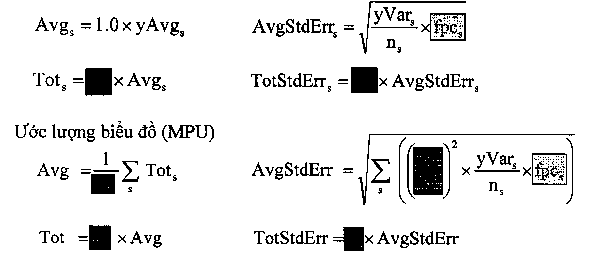
Where:
- s: Load range;
- c: Representative load sample;
- y: Target variable (kWh);
- x: Auxiliary variable (monthly commercial electricity).
4. Separate Ratio Method (SR - Seperate Ratio)
An auxiliary variable is something known for all cases in the set. In load surveys, auxiliary variables include:
- Annual production;
- Seasonal production;
- Demand for measured classes.
Ratio methods use aggregated data and representative load sample data for auxiliary variables to increase accuracy. This approach is effective when the target variable and auxiliary variable have a strong correlation.
Independent of the variable used in the design of the sample, the variable used in the expansion is usually monthly business production or monthly calendar production. There are two types of expansion methods as follows:
- Separate Ratio (SR) uses monthly production values for each load group.
- Combined Ratio (CR) uses monthly production values for the class.
Typically, the combined ratio expansion method is used because the aggregated production is only available at the class level and not at the load group level.
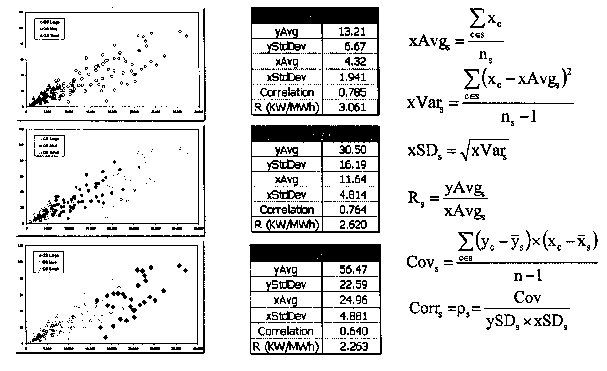
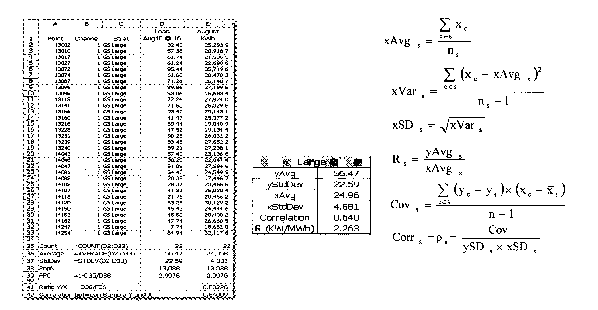
Estimations
Customer group estimation (SR)
|
|
|
|
|
AvgCLASS MONOCOTYLEDON= kCLASS MONOCOTYLEDON x yAvgCLASS MONOCOTYLEDON |
|
|
|
TotCLASS MONOCOTYLEDON = NCLASS MONOCOTYLEDON x AvgCLASS MONOCOTYLEDON |
AvgStdErrCLASS MONOCOTYLEDON = NCLASS MONOCOTYLEDON x AvgStdErrCLASS MONOCOTYLEDON |
Chart estimation (SR)
|
|
|
|
Tot = N x Avg |
TotStdErr = N x AvgStdErr |
5. Combined Ratio Method (CR - Combined Ratio)
Customer group estimation (CR)
|
AvgCLASS MONOCOTYLEDON = k x yAvgCLASS MONOCOTYLEDON |
|
|
TotCLASS MONOCOTYLEDON = N x AvgCLASS MONOCOTYLEDON |
|
|
TotStdErrCLASS MONOCOTYLEDON = NCLASS MONOCOTYLEDON x AvgStdErrCLASS MONOCOTYLEDON |
Chart estimation (CR)
|
|
|
|
|
|
|
|
|
Tot = N x Avg |
TotStdErr = N x AvgStdErr |
|
|
CR factor |
CR ratio |
|
k is the ratio between the total aggregated production and the MPU estimate of the aggregated production. k is used to estimate the average and total KW values. It adjusts the difference in size (KWH) between the sampled customers and the aggregate. |
R is the sample estimate of the full ratio KW/KWh. It is the ratio between the MPU estimate for KW and the MPU estimate for the aggregate KWH. R is used to estimate variances and standard errors. |
Văn bản gốc (PDF)
Bản đồ quan hệ
Bấm vào một văn bản để mở. Viền đỏ = quan hệ làm thay đổi hiệu lực.