
Circular No. 19/2024/TT-BTTTT stipulates the National Technical Regulation on Specific Absorption Rate for handheld and body-worn radio equipment, applicable to agencies, organizations, and individuals producing, importing, trading, and operating such equipment. The SAR limit is defined from 30 MHz to 6 GHz, with a maximum of 2 W/kg over 10 grams of tissue and 4 W/kg for limbs.
Scope of application
Agencies, organizations, and individuals producing, importing, trading, and operating handheld and body-worn radio equipment in Vietnam.
Key points
- Handheld and body-worn radio equipment must comply with the SAR limit from 30 MHz to 6 GHz (2 W/kg over 10 grams of tissue, 4 W/kg for limbs).
- The SAR limit applies to heads, trunks, and limbs.
- The method for measuring SAR is specified according to IEC 62209-1528:2020.
- Effective implementation date is February 15, 2025.
- Implementation timeline starts July 1, 2026 for land mobile phones, and July 1, 2027 for other products.
🌐 Social impact of this document
- Positive impact: Protecting public health by limiting energy absorption from radio equipment.
- Negative impact: Increased production and import costs due to compliance with new technical regulations.
❓ Frequently asked questions
What devices does the SAR limit apply to?
The SAR limit applies to handheld and body-worn radio equipment, with a maximum of 2 W/kg over 10 grams of tissue and 4 W/kg for limbs.
When does this Circular take effect?
This Circular takes effect from February 15, 2025.
What is the application timeline for specific products?
Land mobile phones start applying from July 1, 2026, and other products from July 1, 2027.
Which devices must comply?
Handheld and body-worn radio equipment such as mobile phones, DECT, laptops, tablets must comply with this regulation.
What standard is the SAR measurement method based on?
The method for measuring SAR is specified according to IEC 62209-1528:2020.
Full text
CIRCULAR
Issuing "National Technical Regulation on Specific Absorption Rate for Hand-held and Body-worn Wireless Communication Devices"Pursuant to the Radio Frequency Law dated November 23, 2009 and the Law Amending and Supplementing Certain Provisions of the Radio Frequency Law dated November 9, 2022;
Pursuant to the Law on Standards and Technical Regulations dated June 29, 2006;
Pursuant to the Law on Telecommunications dated November 24, 2023;
Pursuant to Decree No. 78/2018/NĐ-CP dated May 16, 2018 of the Government amending and supplementing certain provisions of Decree No. 127/2007/NĐ-CP dated August 1, 2007 of the Government detailing the implementation of certain provisions of the Standardization and Technical Regulation Law;
WHEREAS, Decree No. 127/2007/NĐ-CP dated August 1, 2007 of the Government detailing and guiding the implementation of certain provisions of the Law on Technical Standards and Regulations;
The Minister of Information and Communications issues this Circular stipulating the National Technical Regulation on Specific Absorption Rate for Hand-held and Body-worn Wireless Communication Devices.
Pursuant to Decree No. 48/2022/NĐ-CP dated July 26, 2022 of the Government stipulating the functions, tasks, powers, and organizational structure of the Ministry of Information and Communications;
Pursuant to the proposal of the Director of the Science and Technology Department,
Along with this Circular, the National Technical Regulation on Specific Absorption Rate for Hand-held and Body-worn Wireless Communication Devices (QCVN 134:2024/BTTTT) is issued.
Article 1. From July 1, 2026, terrestrial mobile phones must comply with QCVN 134:2024/BTTTT before entering the market.
Article 2. Effective Date
This Circular takes effect from February 15, 2025.
Article 3. Implementation Schedule
From July 1, 2027, products and goods within the scope regulated by QCVN 134:2024/BTTTT must comply with QCVN 134:2024/BTTTT before entering the market.
From February 15, 2025, QCVN 134:2024/BTTTT shall be applied in conformity testing and certification.
The Heads of the Office, Department of Science and Technology, Heads of agencies and units under the Ministry of Information and Communications, Directors of Provincial Departments of Information and Communications, and relevant organizations and individuals are responsible for implementing this Circular.
Article 4. Organization of Implementation
- Official Gazette, Government Portal;
|
Place of Receipt: - Prime Minister, Deputy Prime Ministers (for circulation); - Ministries, agencies equivalent to ministries, and government agencies; - Provincial and municipal People's Committees directly under the central government; - Provincial Departments of Information and Communications; - Legal Documents Supervision Bureau (Ministry of Justice); QCVN 134:2024/BTTTT - Ministry of Information and Communications: Ministers, Deputy Ministers, departments and units under the Ministry, the Ministry's electronic portal; - To be filed: VT, KHCN (250). |
THE MINISTER (Signed) Nguyen Manh Hung |

NATIONAL TECHNICAL REGULATION ON SPECIFIC ABSORPTION RATES FOR HAND-HELD AND BODY-WORN WIRELESS COMMUNICATION DEVICES
HANOI - 2024
National technical regulation
1.1. Scope...5
1.2. Applicability...5
Table of Contents
Chapter 1. GENERAL PROVISIONS......................................................................................................... 5
1.3. Referenced Documents...5
1.4. Definitions...5
1.5. Symbols and Abbreviations...8
2. TECHNICAL REQUIREMENTS...9
3. MEASUREMENT METHODS...9
3.1. Overview...9
3.2. Test Preparation...9
3.3. Necessary Tests to Conduct...10
3.4. Testing Procedure...10
3.5. Data Processing...10
3.6. Average SAR Value Over Time Period...11
3.7. Testing Using Sensors...11
3.8. SAR Calibration...11
3.9. Shortening Testing Time Methods...12
4. MANAGEMENT REQUIREMENTS...12
5. RESPONSIBILITIES OF ORGANIZATIONS AND INDIVIDUALS...13
6. IMPLEMENTATION ORGANIZATION...13
Appendix A (Requirements) Requirements for Testing Equipment...14
Appendix B (Reference) Requirements for Test Result Reports...15
Appendix C (Reference) Measurement Uncertainty...16
Appendix D (Reference) Evaluation and Testing Flowchart...17
Appendix E (Requirements) Harmonized System Codes for Hand-held and Body-worn Wireless Communication Devices...18
References...20
QCVN 134:2024/BTTTT was drafted by the Radio Frequency Management Agency, reviewed by the Department of Science and Technology, appraised by the Ministry of Science and Technology, and promulgated by the Minister of Information and Communications through Circular No. 19/2024/TT-BTTTT dated December 31, 2024.
ON SPECIFIC ABSORPTION RATE FOR HAND-HELD AND BODY-WORN WIRELESS COMMUNICATION DEVICES
|
Foreword National technical regulation
|
AMENDMENT 1:2025 QCVN 07:2023/BXD 1.1. Scope
This standard specifies limits and measurement methods for specific absorption rates for radio frequency devices with equivalent isotropic radiated power greater than 20 mW designed by manufacturers to be used at distances less than 200 mm from humans.1.1. Scope...5
Chapter 1. GENERAL PROVISIONS
This standard does not apply to implanted medical devices.
Harmonized System codes as specified in Appendix E.
This technical regulation applies to domestic and foreign organizations, institutions, and individuals engaged in production, importation, business operations, and exploitation of devices within the scope of this technical regulation on the territory of Vietnam.
IEC 62209-1528:2020 Measurement procedure for the assessment of specific absorption rate of human exposure to radio frequency fields from hand-held and body-worn wireless communication devices - Human models, instrumentation and procedures (Frequency range of 4 MHz to 10 GHz).
1.2. Applicability
ICNIRP Guidelines for limiting exposure to time-varying electric, magnetic, and electromagnetic fields (up to 300 GHz), 2020.
1.3. Referenced Documents
1.4.1. Accessory
An optional component or attachment that can be used with the device under test (DUT).
1.4. Terms and Definitions
NOTE 1: Accessories used to hold, attach, or wear or carry the device, as well as for other specific purposes on the user's body (such as belt clips, wrist straps, or any type of body strap or neck strap). NOTE 2: Electronic accessories to perform specific tasks or provide additional features (e.g., GPS modules, peripheral printers, MP3 players, cameras, observation devices).
NOTE 3: Electronic accessories providing audio or video input/output (e.g., headphones, microphones, cameras).
NOTE 4: Accessories enhancing the RF signal strength of the device (e.g., main antennas, replacement antennas, or auxiliary antennas).
NOTE 5: Batteries and related DC power sources.
NOTE 6: Combinations of accessories, where two or more of the above accessories are combined into a single unit.
1.4.2. Basic Limit
Limit of human exposure to time-varying electric, magnetic, and electromagnetic fields measured inside the body, based on adverse health effects.
NOTE 1: Within the scope of this document, the physical quantity used as the basic limit is the specific absorption rate (SAR).
1.4.3. Body-worn Device A device containing one or more wireless transmitters or transceivers placed near a person’s body or limbs (excluding the head) using wearable accessories to support intended activities.
NOTE 1: This document uses the term body-worn interchangeably with the term worn-on-body, used in previous versions.
1.4.4. Radio Frequency Channel
RF channel (body-worn device)
A device containing one or more wireless transmitters or transceivers placed near the body or limbs (excluding the head) of a person through accessories worn to support activities according to its intended use.
NOTE 1: This document uses the term "worn on the body" interchangeably with the term "attached to the body," as used in previous versions.
1.4.4. Radio frequency band (channel)
RF channel
The frequency band for transmission is specifically divided according to the operational parameters of a single wireless technology.
NOTE 1: The number of RF channels and corresponding channel bandwidth may differ between different wireless technologies.
In this document, SAR measurements are conducted at specific channels; for example, high-frequency channels, mid-frequency channels, and low-frequency channels within the transmission band.
1.4.5. Conservative Exposure (conservative exposure)
The estimated value of psSAR, including the measured uncertainty specified in this document, reflects a higher result than the expected value obtained at the head or body of most users during intended use of the wireless device.
1.4.6. Device Under Test (DUT)
DUT
The equipment containing one or more wireless transmitters or transceivers is tested according to the methods outlined in this document.
NOTE 1: The device under test may be further classified as wearable devices, body-worn devices, desk-top devices, face-up devices, hand-held devices, wrist-worn devices, clothing-integrated devices, or generic devices.
1.4.7. Fast SAR Testing (Fast SAR Testing)
Utilizing special techniques, methods, or algorithms to reduce SAR measurement time compared to full SAR testing.
NOTE 1: Type 1 fast SAR testing uses hardware compliant with all requirements of this document for full SAR testing. However, it employs faster inspection methods than those required for full SAR testing.
NOTE 2: Type 2 fast SAR testing uses hardware and testing procedures that do not comply with the requirements of this document for full SAR testing.
1.4.8. Full SAR Testing (Full SAR Testing)
Using specific methods, procedures, and hardware fully complying with all requirements stipulated in this document, except those specified in 3.9.2.
1.4.9. Head-Mounted Device (Head-Mounted Device)
Equipment containing one or more wireless transmitters or transceivers placed near the head or neck of a person via an accessory, to support its intended use.
NOTE 1: This definition does not include handheld devices.
1.4.10. Intended Use (Intended Use)
Conditions of use for which the product is designed to fully utilize its available functions, according to technical specifications, instructions, and information provided by the manufacturer in the user manual.
1.4.11. Limb-Worn Device (Limb-Worn Device)
Equipment containing one or more wireless transmitters or transceivers, intended to be worn on the arm or leg of the user while transmitting.
NOTE 1: Types of limb-worn devices include wrist-worn, ankle-worn, and forearm-worn devices. Some regulatory scopes specify different requirements for limb-worn devices located away from the wrist or ankle.
1.4.12. Measurement Uncertainty (Measurement Uncertainty)
1.4.12.1. Uncertainty Evaluation (Uncertainty Evaluation)
<Type A> evaluates uncertainty through statistical analysis of measurement series (measurements).
<Type B> evaluates uncertainty through methods other than statistical analysis of measurement series (measurements).
1.4.12.2. Standard Uncertainty (Standard Uncertainty)
The standard deviation estimate of the measurement result, calculated as the positive square root of the estimated variance.
1.4.12.3. Combined Uncertainty (Combined Uncertainty)
The standard deviation estimate of the measurement result obtained by combining the standard measurement uncertainties of both Type A and Type B evaluations using the common method of "root sum square" to combine the standard deviations obtained by taking the positive square root of the estimated variances.
1.4.12.4. Expanded Uncertainty (Expanded Uncertainty)
A quantity defining a range around the measurement result that can reasonably be expected to encompass most of the distribution of values that could be attributed to the measurand.
1.4.13. Primary Peak SAR Value (Primary Peak SAR Value)
The largest interpolated SAR value determined in a swept-volume measurement.
1.4.14. Secondary Peak SAR Value (Secondary Peak SAR Value)
In a swept-volume measurement, the maximum interpolated SAR value smaller than the primary peak SAR value.
1.4.15. Spatial-Average Peak SAR (Peak Spatial-Average SAR)
psSAR
The peak SAR value calculated as an average over a volume based on a defined average mass. For example, any 1g or 10g cube of tissue.
NOTE 1: In this document, the terms psSAR (on 1g or 10g) and the terms 1g SAR and 10g SAR are used interchangeably.
1.4.16. Phantom (Phantom)
A physical model equivalent to the human body, including dielectric materials similar to tissue as specified in this document.
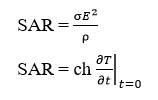
1.4.17. Specific Absorption Rate (Specific Absorption Rate)
The rate at which energy is absorbed by the human body when exposed to radiofrequency electromagnetic fields.
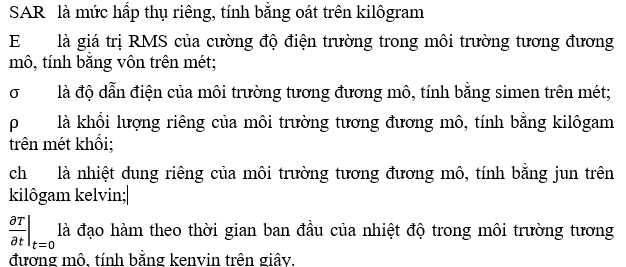
NOTE 1: SAR in a tissue-equivalent environment can be determined by the rate of temperature increase or by measuring the E-field, according to the following formulas:
Where:
1.4.18. Test Configuration (Test Configuration)
A set of DUT parameters applicable for SAR measurement, including the position of the DUT on the phantom, the usage configuration of the DUT (e.g., antenna position), and operating mode.
1.4.19. Time-Period Averaged SAR (Time-Period Averaged SAR)
TPAS
SAR averaged over a defined period when applying power control algorithms.
1.4.20. Time-Averaged SAR (Time-Averaged SAR)
SAR measured over a sufficiently long integration time to ensure stable results regarding power factor and other signal modulation characteristics.
1.4.21. Generic Device (Generic Device)
Equipment not classified under any specific device category.
1.4.22. Hand-Held Device (Hand-Held Device)
Hand-held equipment operated on the user's hand at a distance greater than 200mm from the head or torso during intended use.
1.4.23. Handset (Handset)
Wireless communication devices designed to be held in hand and operate near the ear, including audio output or headphones and audio input or microphones, and containing a radio transmitter and receiver.
1.5. Symbols and Abbreviations
1.5.1. Physical Quantities
|
Code |
Quantity |
Unit |
Unit symbol |
|
|
E |
Electric field intensity |
volt per meter |
V/m |
|
|
f |
Frequency |
hertz |
Hz |
|
|
ρ |
Density |
newton |
kg.m3 |
|
|
µ |
Permeability |
henry kg/m |
H/m |
|
|
ch |
Specific heat capacity |
joule per kilogram kelvin |
J/(kg K) |
|
|
ε |
Permittivity |
farad per meter kg/m |
F/m |
|
|
SAR |
Specific Absorption Rate |
watt per kilogram |
W/kg |
|
|
T |
Salinity |
kelvin |
K |
|
|
λ |
Wavelength |
meter |
m |
|
NOTE: In this document, temperature is determined in degrees Celsius, calculated as: T (°C) = T(K) – 273,15 K.
1.5.2. Constants
ε0 |
Permittivity of free space |
8,854 × 10−12 F/m |
|
µ° |
Permeability of free space |
4π × 10−7 H/m |
1.5.3. Abbreviations
|
DUT |
Device under test |
Test sample (Device Under Test) |
|
E-field |
Electric field strength |
Electric field E |
|
H-field |
Magnetic field strength |
Magnetic field H |
|
ICES |
International Committee on Electromagnetic Safety |
International Electromagnetic Safety Committee |
|
ICNIRP |
International Commission on Non-Ionizing Radiation Protection |
International Commission on Non-Ionizing Radiation Protection |
|
psSAR |
Peak spatial-average SAR |
Spatial average peak SAR |
|
RF |
Radio frequency |
Radio Frequency |
|
SAR |
Specific absorption rate |
Specific Absorption Rate |
Chapter 2. TECHNICAL PROVISIONS
Limits for specific absorption rate (SAR) are specified in the table below:
|
Frequency |
Limit |
|
|
Head, trunk |
Limbs |
|
|
30 MHz to 6 GHz |
2 W/kg averaged over 10g tissue |
4 W/kg averaged over 10g tissue |
3. MEASUREMENT METHODS
3.1. Overview
Compliance with requirement 7.1 of IEC 62209-1528:2020.
3.2. Test Preparation
3.2.1. Tissue simulating phantom and system
Compliance with requirement 7.2.1 of IEC 62209-1528:2020.
3.2.2. Wireless connections with the test sample
Compliance with requirement 7.2.2 of IEC 62209-1528:2020.
3.2.3. Operating mode of the test sample
Compliance with requirement 7.2.3 of IEC 62209-1528:2020.
3.2.4. Positioning of the test sample
Compliance with requirement 7.2.4 of IEC 62209-1528:2020, except sub-clause 7.2.4.1.2.
The following provision replaces sub-clause 7.2.4.1.2: The distance between the device under test (DUT) and the flat phantom model is ≤ 5 mm when evaluating SAR for the trunk part and the distance between the test sample (EUT) and the flat phantom model is 0 mm when evaluating SAR for the limb part.
3.2.5. Antenna configuration
Compliance with requirement 7.2.5 of IEC 62209-1528:2020.
3.2.6. Options and accessories
Compliance with requirement 7.2.6 of IEC 62209-1528:2020.
3.2.7. Test samples and coefficients
Compliance with requirement 7.2.7 of IEC 62209-1528:2020.
3.2.8. Operating frequency of the test sample
Compliance with requirement 7.2.8 of IEC 62209-1528:2020.
3.3. Tests to be conducted
3.3.1. Overview
Compliance with requirement 7.3.1 of IEC 62209-1528:2020.
3.3.2. Basic tests
Compliance with requirement 7.3.2 of IEC 62209-1528:2020.
3.4. Testing procedures
3.4.1. Overview
Compliance with requirement 7.4.1 of IEC 62209-1528:2020.
3.4.2. Full SAR testing procedure
Compliance with requirement 7.4.2 of IEC 62209-1528:2020.
3.4.3. Scanning test
Compliance with requirement 7.4.3 of IEC 62209-1528:2020.
3.4.4. Testing when the test sample has multiple antennas or multiple transmitters
Compliance with requirement 7.4.4 of IEC 62209-1528:2020.
3.5. Data processing
3.5.1. Interpolation method
Compliance with requirement 7.5.1 of IEC 62209-1528:2020.
3.5.2. Extrapolation method
Compliance with requirement 7.5.2 of IEC 62209-1528:2020.
3.5.3. Determination of average mass
Compliance with requirement 7.5.3 of IEC 62209-1528:2020.
3.5.4. Determination of maximum value
Compliance with requirement 7.5.4 of IEC 62209-1528:2020.
3.6. Average SAR value over time period
3.6.1. Overview
Compliance with requirement 7.6.1 of IEC 62209-1528:2020.
3.6.2. Power dissipation
Compliance with requirement 7.6.2 of IEC 62209-1528:2020.
3.6.3. Test configurations
Compliance with requirement 7.6.3 of IEC 62209-1528:2020.
3.6.4. Absorption conditions and test positions
Compliance with requirement 7.6.4 of IEC 62209-1528:2020.
3.6.5. Average SAR over time period with simultaneous transmission
Compliance with requirement 7.6.5 of IEC 62209-1528:2020.
3.6.6. Evaluation of emission factor
Compliance with requirement 7.6.6 of IEC 62209-1528:2020.
3.6.7. SAR testing
Compliance with requirement 7.6.7 of IEC 62209-1528:2020.
3.6.8. Measurement uncertainty with average SAR testing over time period
Compliance with requirement 7.6.8 of IEC 62209-1528:2020.
3.7. Testing using sensors
3.7.1. Overview
Compliance with requirement 7.7.1 of IEC 62209-1528:2020.
3.7.2. Determination of sensor activation distance
Compliance with requirement 7.7.2 of IEC 62209-1528:2020.
3.7.3. Determination of sensor operating range
Compliance with requirement 7.7.3 of IEC 62209-1528:2020.
3.7.4. SAR testing using sensors
Compliance with requirement 7.7.4 of IEC 62209-1528:2020.
3.8. SAR value calibration
3.8.1. Overview
Compliance with requirement 7.8.1 of IEC 62209-1528:2020.
3.8.2. SAR calibration formula
Compliance with requirement 7.8.2 of IEC 62209-1528:2020.
3.8.3. Uncertainty of the calibration formula
Compliance with requirement 7.8.3 of IEC 62209-1528:2020.
3.9. Shortening test time methods
3.9.1. Overview
Apply one of two testing methods to shorten test time.
Compliance with requirement 7.9.1 of IEC 62209-1528:2020.
3.9.2 Fast SAR testing
Compliance with requirement 7.9.2 of IEC 62209-1528:2020.
3.9.3 Reduced SAR testing
Compliance with requirement 7.9.3 of IEC 62209-1528:2020.
Chapter 4. MANAGEMENT PROVISIONS
4.1. Radio devices within the scope of regulation in Article 1.1 must comply with technical regulations in this Standard.
4.2. Conformity assessment and declaration for equipment within the scope of this standard, conformity assessment methods according to Clause 4.6 and current regulations.
4.3. Measuring instruments, equipment, and testing facilities for conformity assessment: Comply with legal provisions on measurement and product quality.
4.4. Land mobile phones (see Appendix E) must declare conformity based on certification results from a certification body designated by the Ministry of Information and Communications.
4.5. Wireless telephone extension devices of the DECT type, laptops, tablets (see Appendix E) must declare conformity based on self-assessment results of organizations or individuals based on testing results.
4.6. Conformity assessment methods
4.6.1. Conformity assessment is carried out according to the following methods: Method 1, Method 5, and Method 7 as stipulated in Circular No. 28/2012/TT-BKHCN and amendments, supplements, and replacements to Circular No. 28/2012/TT-BKHCN.
- Method 1: Typical sample testing.
Apply to issue a Certificate of Conformity for products and goods produced in production lines that already have a certificate of a quality management system (ISO 9001 or equivalent).
- Method 5: Typical sample testing and production process evaluation; monitoring through production site or market sampling combined with production process evaluation.
Apply to issue the Certificate of Compliance for products and goods produced on a production line without a certificate of quality management system certification (ISO 9001 or equivalent) but with production processes and quality monitoring that ensure quality for evaluation.
- Method 7: Batch product testing and evaluation.
Apply to issue the Certificate of Compliance for products and goods that cannot be applied according to Method 1 or Method 5.
4.6.2. The method of conformity assessment must be clearly recorded on the certificate of compliance with technical standards.
The Telecommunications Administration, the Radio, Television and Electronic Information Administration, and Provincial Departments of Information and Communications have the responsibility to guide and manage organizations and enterprises to implement these Standards.
Organizations and individuals related have the responsibility to implement regulations on conformity certification and declaration of conformity for equipment within the scope of this Standard and are subject to inspection by state management agencies in accordance with current regulations.
6. IMPLEMENTATION ORGANIZATION
6.1. The Telecommunications Administration, the Radio Frequency Management Agency, and Provincial Departments of Information and Communications have the responsibility to organize guidance on implementing the management of radio equipment under this Standard.
6.2. In cases where the provisions set forth in this Standard are changed, supplemented, or replaced, they shall be implemented according to the new document.
6.3. During the implementation of this standard, if there are arising issues or difficulties, organizations and individuals concerned shall report in writing to the Ministry of Information and Communications (Science and Technology Department) for guidance and resolution./.
ANNEX A
Product Name, Goods According to QCVN
Requirements for testing equipment
A.1. General requirements
Comply with requirement 6.1 of IEC 62209-1528:2020.
A.2. Technical parameters of the model
Comply with requirement 6.2 of IEC 62209-1528:2020.
A.3. Impact of hand on SAR at head
Comply with requirement 6.3 of IEC 62209-1528:2020.
A.4. Requirements for scanning systems
Comply with requirement 6.4 of IEC 62209-1528:2020.
A.5. Technical parameters of the mounting device
Comply with requirement 6.5 of IEC 62209-1528:2020.
A.6. Parameters of the result recording device
Comply with requirement 6.6 of IEC 62209-1528:2020.
Provisions on the HS Code of Terrestrial Mobile Radio Equipment and Terrestrial Radio Relay Equipment
(For reference)
Requirements for test results reports
B.1. General requirements
Comply with requirement 9.1 of IEC 62209-1528:2020.
B.2. Contents required in test results reports
Comply with requirement 9.2 of IEC 62209-1528:2020.
Appendix C
(Reference)
Uncertainty of measurement
C.1. Overview
Comply with requirement 8.1 of IEC 62209-1528:2020.
C.2. Requirements for evaluating uncertainty of measurement
Comply with requirement 8.2 of IEC 62209-1528:2020.
C.3. Models for evaluating uncertainty of measurement
Comply with requirement 8.3 of IEC 62209-1528:2020.
C.4. Factors affecting uncertainty of measurement
Comply with requirement 8.4 of IEC 62209-1528:2020.
Appendix D
(For reference)
Flowchart for evaluation and testing
Comply with requirement 5 of IEC 62209-1528:2020.
Appendix E
Product Name, Goods According to QCVN
HS Code of handheld and body-worn radio equipment
|
No. |
Terrestrial Mobile Radio Equipment with Integrated Antennas Used for Analog Voice Communication |
Carnidazole |
(a) |
|
01
|
Land mobile telephone |
8517.13.00 8517.14.00 |
Land mobile telephone using E-UTRA (4G) technology and may integrate one or more of the following functions: - Mobile terminal W-CDMA FDD (3G); - Fifth generation mobile terminal (5G); - Broadband data transmission operating in the 2.4 GHz band; - 5 GHz radio access; - Short-range radio transmitter/receiver with isotropic radiated power greater than 20 mW. |
|
8517.13.00 8517.14.00 |
Land mobile telephone using fifth generation mobile information technology (5G) with or without integration of one or more of the following functions: - Land mobile terminal; - Broadband data transmission operating in the 2.4 GHz band; - 5 GHz radio access; - Short-range radio transmitter/receiver with isotropic radiated power greater than 20 mW. |
||
|
02 |
Cordless mobile radio telephone equipment of the DECT type (only applicable to sub-units) |
8517.11.00 |
Cordless telephone set including a base station (Base Station) equipped with one or several cordless extension telephones (sub-units) using DECT technology. The mobile units (sub-units) connect to the fixed network through the base station (Base Station) which is a fixed telephone connected to the fixed network.
|
|
03 |
Laptop computer |
8471.30.20 |
Laptop with integrated one or more of the following functions: - Broadband data transmission operating in the 2.4 GHz band; - 5 GHz radio access; - Land mobile terminal; - Fifth generation mobile terminal (5G); - Short-range radio transmitter/receiver with isotropic radiated power greater than 20 mW. |
|
04 |
Tablet computer |
8471.30.90 |
Tablet including at least one central processing unit, a keyboard, and a display (excluding laptop, notebook, subnotebook), with integrated one or more of the following functions: - Land mobile terminal; - Fifth generation mobile terminal (5G); - Broadband data transmission operating in the 2.4 GHz band; - 5 GHz radio access; - Short-range radio transmitter/receiver with isotropic radiated power greater than 20 mW. |
Bibliography
[1] IEC 62209-1528:2020 Measurement procedure for the assessment of specific absorption rate of human exposure to radio frequency fields from hand-held and body-worn wireless communication devices - Human models, instrumentation and procedures (Frequency range of 4 MHz to 10 GHz).
[2] ICNIRP Guidelines for limiting exposure to time-varying electric, magnetic, and electromagnetic fields (up to 300 GHz), 2020.
Original document (PDF)
Relations map
Click a document to open. A red border = a relation that changes validity.
Translations
This document is available in the following languages: