
This Circular provides detailed guidance on the management of special consumption tax (SCT) collection and refund, reduction of SCT for domestic businesses as well as imported goods. This Circular takes effect from January 1, 2016 and replaces Circular No. 05/2012/TT-BTC.
Scope of application
Domestic businesses and organizations, individuals related to the importation of goods subject to SCT.
Key points
- Guidance on the objects subject to SCT.
- Regulations on the method of calculating SCT.
- Guidance on deducting SCT when producing and selling goods domestically.
- Guidance on refunding and reducing SCT.
- Requirements for filing and procedures for declaring and paying SCT.
🌐 Social impact of this document
- Enhancing effective and transparent management of SCT collection.
- Reducing tax evasion and fraud in this field.
- Providing a clear legal basis for refunding and reducing SCT.
❓ Frequently asked questions
Which circular does this circular replace?
This Circular replaces Circular No. 05/2012/TT-BTC dated January 5, 2012 of the Ministry of Finance.
When does this Circular take effect?
This Circular takes effect from January 1, 2016.
Full text
| MINISTRY OF FINANCE |
SOCIALIST REPUBLIC OF VIET NAM Independence - Freedom - Happiness |
| Number: 195/2015/TT-BTC | Hanoi, November 24, 2015 |
CIRCULAR
Guidelines for implementing Decree No. 108/2015/NĐ-CP dated October 28, 2015 of the Government detailing and guiding the implementation of certain provisions of the Special Consumption Tax Law and the Law Amending and Supplementing Certain Provisions of the Special Consumption Tax Law.
Pursuant to the Special Consumption Tax Law No. 27/2008/QH12 dated November 14, 2008; Law No. 70/2014/QH13 dated November 26, 2014 amending and supplementing certain provisions of the Special Consumption Tax Law;
Pursuant to the Tax Administration Law No. 78/2006/QH11 dated November 29, 2006; Law No. 21/2012/QH13 dated November 20, 2012 amending and supplementing certain provisions of the Tax Administration Law;
Pursuant to Law No. 71/2014/QH13 dated November 26, 2014 of the National Assembly amending and supplementing certain provisions of tax laws;
Pursuant to Decree No. 108/2015/NĐ-CP dated October 28, 2015 of the Government detailing and guiding the implementation of certain provisions of the Special Consumption Tax Law and the Law Amending and Supplementing Certain Provisions of the Special Consumption Tax Law;
Pursuant to Decree No. 215/2013/NĐ-CP dated December 23, 2013 of the Government stipulating the functions, tasks, powers, and organizational structure of the Ministry of Finance;
Considering the proposal of the Director General of the State Tax总局副局长的提议,财政部部长发布关于修改和补充2013年12月31日财政部第215/2013/TT-BTC号通知有关强制执行行政决定的若干条款的通知如下:
The Minister of Finance hereby issues guidelines for implementing Decree No. 108/2015/NĐ-CP dated October 28, 2015 of the Government as follows:
PART I
GENERAL PROVISIONS
Article 1. Scope of Regulation
These Circulars guide the implementation of Decree No. 108/2015/NĐ-CP dated October 28, 2015 of the Government detailing and guiding the implementation of certain provisions of the Special Consumption Tax Law and the Law Amending and Supplementing Certain Provisions of the Special Consumption Tax Law.
Article 2. Taxable Objects
The objects subject to special consumption tax (SCT) shall be implemented in accordance with Article 2 of the Special Consumption Tax Law No. 27/2008/QH12 dated November 14, 2008, Clause 1 of Article 1 of the Law Amending and Supplementing Certain Provisions of the Special Consumption Tax Law No. 70/2014/QH13 dated November 26, 2014, and Article 2 of Decree No. 108/2015/NĐ-CP dated October 28, 2015 of the Government detailing and guiding the implementation of certain provisions of the Special Consumption Tax Law and the Law Amending and Supplementing Certain Provisions of the Special Consumption Tax Law.
For air conditioning units with a capacity of up to 90,000 BTU, which are subject to SCT: if the production facility sells or the import facility imports separately each component (the outdoor unit or indoor unit), then the goods sold or imported (outdoor unit, indoor unit) still fall within the scope of SCT as with complete products (complete air conditioning units).
1. For imported goods exempt from special consumption tax as specified in Point a, Clause 2, Article 3 of the Special Consumption Tax Law, including:
Goods specified in Article 2 of this Circular are not subject to SCT in the following cases:
1. Goods produced or processed directly for export or sold, entrusted to other trading enterprises for export, including:
1.1. Goods directly exported abroad by production or processing facilities, including goods sold or processed for export processing zones, except passenger cars under 24 seats sold to export processing zones.
- Export sales invoice or payment receipt for processing fees.
- Export declaration form confirmed by customs authorities regarding the exported goods.
- Bank payment vouchers.
Export declaration form.
Bank payment voucher.
Bank transfer is the process of transferring funds from the importer's account to the exporter's account at the bank according to payment methods agreed upon in the contract and bank regulations. A bank payment voucher is a document issued by the exporter's bank confirming receipt of funds from the importer's account. In case of deferred payment, there must be an agreement recorded in the export contract, and at the time of payment, the trading enterprise must provide a bank payment voucher. In the case of entrusted export, the entrusted export enterprise must settle payments overseas through a bank.
1.2. Production facilities producing goods subject to SCT, if temporarily exported and re-imported under temporary export and re-import permits, during the period exempt from export tax and import tax according to the prescribed regime, when re-imported, they are not subject to SCT, but when the production facility sells these goods, it must pay SCT.
1.3. Goods produced and sold or entrusted to trading enterprises for export under economic contracts.
Production facilities with goods that do not have to pay SCT as stipulated herein must have documentation proving that the goods have actually been exported as follows:
- Purchase and sale contract for export goods or entrustment export contract between the production facility and the export trading enterprise for entrusted export.
- Sales invoice, consignment export delivery note.
- Liquidation record (full or partial liquidation) of the purchase and sale contract for export goods or entrustment export contract clearly stating the following contents:
Name, quantity, type, item, selling price of the goods actually exported; payment method; amount and number, date of bank payment voucher for export goods from the foreign buyer to the exporting enterprise; amount and number, date of payment voucher between the production facility and the exporting enterprise or the consignment export enterprise; number, date of the export contract, copy of the customs declaration for exported goods.
For goods purchased or consigned for export by the exporting enterprise but not exported and instead consumed domestically, the exporting enterprise must declare and pay SCT on these goods when they are sold domestically.
1.4. Goods taken out of the country for sale at overseas trade fairs.
Enterprises with goods taken out of the country for sale at overseas trade fairs must have the following procedures:
- Invitation letter or registration form for participation in overseas trade fairs.
- Export declaration form confirmed by the customs authority regarding the exported goods.
- List of goods sold at trade fairs.
- Payment vouchers for goods sold at trade fairs; in case of cash sales exceeding the specified limit, they must report to the customs authority and provide proof of depositing money into the bank according to current regulations.
2. Goods imported in the following cases:
2.1. Humanitarian aid, non-repayable aid; gifts and donations, including:
a) Humanitarian aid and non-repayable aid, including imported goods funded by non-repayable aid approved by competent authorities; humanitarian assistance and emergency relief aimed at mitigating the consequences of war, natural disasters, and epidemics.
b) Gifts from organizations and individuals abroad to state agencies, political organizations, socio-political organizations, socio-professional organizations, social organizations, socio-professional organizations, and people's armed units.
a) Goods transported from the exporting country to the importing country through Vietnamese ports without undergoing import procedures in Vietnam and without undergoing export procedures out of Vietnam;
2.2. Goods in transit or passing through Vietnam’s border gates, goods for transshipment, including:
a) Goods transported from the exporting country to the importing country through a Vietnamese border gate without undergoing import procedures in Vietnam and without undergoing export procedures out of Vietnam.
b) Goods transported from the exporting country to the importing country through a Vietnamese border gate and placed in a bonded warehouse without undergoing import procedures in Vietnam and without undergoing export procedures out of Vietnam.
c) Goods in transit or passing through Vietnam’s border gates based on agreements signed between the Government of Vietnam and foreign governments or between authorized agencies or representatives of the Governments of Vietnam and foreign countries.
4. For automobiles specified in Clause 4, Article 3 of the Special Consumption Tax Law, these are types designed by manufacturers for use as ambulances, prisoner transport vehicles, funeral cars; vehicles designed to accommodate both seating and standing passengers up to 24 persons; automobiles running in amusement parks, sports venues without registration and participation in traffic, and specialized vehicles, unregistered and non-participating in traffic vehicles, which are specifically defined by the Ministry of Finance in coordination with relevant ministries and agencies.
2.3. Temporarily imported goods for re-exportation, if actually re-exported within the period exempt from import duties under the laws on export and import taxes, shall not be subject to excise tax corresponding to the quantity of goods actually re-exported.
Temporarily exported goods for re-importation, if actually re-imported within the period exempt from export duties under the laws on export and import taxes, shall not be subject to excise tax corresponding to the quantity of goods actually re-imported.
2.4. Temporarily imported goods for trade fairs and exhibitions, if actually re-exported within the period exempt from import duties according to the prescribed regulations.
If the organization or individual does not re-export temporarily imported goods beyond the exhibition period, they must declare and pay the excise tax; if they fail to declare and are discovered during inspection, in addition to being required to pay back the excise tax, they will also be subject to penalties as stipulated by law.
2.5. Equipment and personal items of foreign organizations and individuals according to diplomatic immunity standards as provided for by the laws on diplomatic immunity.
2.6. Personal items carried by individuals when entering or leaving Vietnam through Vietnamese border gates within the duty-free allowance for personal luggage.
2.7. Imported goods sold duty-free at tax-free shops as provided for by law.
3. Goods imported from abroad into non-tariff zones, goods from domestic sales into non-tariff zones and only used within such zones, goods traded between non-tariff zones, except for two types of goods: goods brought into non-tariff zones with resident populations, without hard barriers, and passenger cars with fewer than 24 seats.
The documentation, procedures, and authority for not collecting excise tax for cases specified in Clause 2 and Clause 3 of this Article shall be implemented as provided for in the regulations on not collecting taxes and exempting import duties under the laws on export and import taxes.
Importers of goods that are exempt from excise tax upon importation as provided for in Clause 2 and Clause 3 of this Article, if used for other purposes, must declare and pay the import excise tax to the customs authorities in accordance with the guidelines issued by the Ministry of Finance regarding customs procedures; customs supervision and inspection; export and import taxes, and tax management for export and import goods.
4. Aircraft and yachts used for commercial cargo and passenger transportation, tourism business operations, and aircraft used for security and defense purposes.
In the case where aircraft and yachts exempt from excise tax are subsequently not used for commercial cargo and passenger transportation, tourism business operations, and security and defense purposes, they shall be subject to excise tax.
Businesses importing aircraft and yachts for the aforementioned purpose change must declare and pay the excise tax to the customs authorities in accordance with the guidelines issued by the Ministry of Finance regarding customs procedures; customs supervision and inspection; export and import taxes, and tax management for export and import goods.
Businesses producing aircraft and yachts for the aforementioned purpose change must declare and pay the excise tax based on the residual value after deducting depreciation as prescribed to the directly managing tax authority.
5. For vehicles specified in Clause 4 of Article 3 of the Special Consumption Tax Law, these include ambulances, prisoner transport vehicles, funeral vehicles; frequency monitoring vehicles; armored vehicles with elevators; mobile television vehicles; vehicles designed for both seating and standing passengers carrying 24 or more people; vehicles operating in amusement parks, entertainment, sports areas without registration and participation in traffic, and specialized vehicles, unregistered and non-participating in traffic vehicles, which the Ministry of Finance will provide specific guidance in coordination with relevant ministries and agencies.
Businesses importing vehicles designed solely for operation in amusement parks, entertainment, sports areas without registration and participation in traffic, which are exempt from excise tax as provided for in Clause 5 of this Article, must present to the customs office opening the import declaration the following documents and procedures:
- A copy of the Business Registration Certificate proving the importer has the function of operating amusement parks, entertainment, and sports areas (signed and stamped by the importer).
- The importer must clearly indicate on the Import Declaration Form: "vehicles designed and manufactured exclusively for operation in amusement parks, entertainment, and sports areas without registration and participation in traffic." The importer bears responsibility for the accuracy of the import documents.
The customs office where the importer registers to open the import declaration form will inspect the goods and not collect excise tax on the aforementioned goods, and will not issue an Import Confirmation Certificate to the importer.
In the case where automobiles designed solely for use within amusement parks, entertainment areas, or sports venues are not registered for circulation and do not participate in traffic, they are exempt from excise tax. If the importing entity has completed import procedures in accordance with the guidance provided in Clause 5 of this Article with the customs authority, and if the purpose of use changes from that at the time of importation, and the vehicle is no longer used within amusement parks, entertainment areas, or sports venues and falls under the category subject to excise tax, then the importing entity must declare and pay the excise tax to the customs authority following the guidelines issued by the Ministry of Finance regarding customs procedures; customs supervision; export duties, import duties, and tax management for exported and imported goods. If the importing entity does not report to the customs authority handling the import procedures to pay the excise tax due to a change in the purpose of use from the time of importation, the importing entity will be subject to penalties as stipulated by the Law on Tax Administration and its implementing regulations.
6. Air conditioners with a capacity of up to 90,000 BTU, as designed by the manufacturer for installation on transportation vehicles, including automobiles, railway carriages, ships, boats, and aircraft.
In cases where a business entity imports, entrusts the importation of central air conditioning systems exceeding 90,000 BTU, or enters into a contract with a domestic contractor for the provision of central air conditioning systems exceeding 90,000 BTU, and the delivery depends on the progress of construction (the system is imported in multiple shipments), such that each individual shipment of components like the outdoor unit or indoor unit does not need to be subject to excise tax, the documents required to be submitted to the customs authority include:
- Import contract (in the case of entrusted importation, an additional entrusted import contract must also be included) or purchase contract (original or certified copy stamped by the importing enterprise) for the central air conditioning system with the domestic contractor; the contract must specify that this is a complete system with a capacity exceeding 90,000 BTU being imported as a whole according to the manufacturer's standards, accompanied by a list detailing the quantities of imported components.
- Diagram of the central air conditioning system connection confirmed by the importing entity and the contractor (if there is a contractor).
- Inspection certificate regarding the capacity and integrity of the imported equipment, as well as the separate parts (outdoor unit, indoor unit) or groups of separate parts of the equipment that cannot operate independently, issued by an authorized inspection agency.
In cases where individual separated parts or some separated parts can be assembled into a complete air conditioner with a capacity of up to 90,000 BTU capable of operating independently without connecting to the system, each part must still be subject to excise tax.
- A commitment letter from the importing business entity regarding the proper use of imported goods and their responsibility before the law for their commitments.
Based on the documents presented by the business entity, the customs authority shall establish a tracking and offset record as per Appendix I attached to this Circular to manage the process.
Article 4. Taxpayers
1. The taxpayer of the excise tax is an organization or individual engaged in the production, importation of goods, and provision of services subject to excise tax, including:
1.1. Business organizations established and registered for business operations in accordance with the Enterprise Law, State-Owned Enterprise Law (now the Enterprise Law) and the Cooperative Law.
1.2. Economic organizations of political organizations, political-social organizations, social organizations, occupational social organizations, political-social-occupational organizations, people's armed forces units, public service organizations, and other organizations.
1.3. Foreign-invested enterprises and foreign parties participating in joint ventures under the Law on Investment by Foreign Investors in Vietnam (now the Investment Law); foreign organizations and individuals conducting business activities in Vietnam but not establishing a legal entity in Vietnam.
1.4. Individuals, households, independent traders, and other entities engaged in production, business, and importation.
2. When a business entity exporting purchases excisable goods from a producer for export but fails to export them and instead sells them domestically, the exporting business entity becomes the taxpayer of the excise tax. Upon selling the goods, the exporting business entity must declare and pay the full amount of excise tax.
Chapter II
BASIS FOR TAXATION
Article 5. Special Consumption Tax Base Price
The special consumption tax base price for goods and services is the selling price of goods and service supply prices of production and business establishments not including special consumption tax, environmental protection tax (if applicable), and value-added tax, which are determined specifically as follows:
1. For imported goods (excluding gasoline types) sold by business establishments importing them and domestic-produced goods, the special consumption tax base price is determined as follows:

The selling price excluding value-added tax is determined according to the provisions of the Law on Value-Added Tax, and the environmental protection tax is determined according to the provisions of the Law on Environmental Protection Tax.
a) In cases where the importing establishment subject to special consumption tax (excluding gasoline types) sells goods through subordinate establishments under dependent accounting, the price serving as the basis for calculating the special consumption tax is the price sold by the subordinate establishment under dependent accounting. For the importing establishment (excluding the establishment importing gasoline types) selling goods through agents at the price set by the establishment and only receiving commission, the price serving as the basis for determining the special consumption tax base price is the selling price set by the importing establishment, production establishment without deducting commission.
b) In cases where the importing establishment subject to special consumption tax (excluding cars under 24 seats and gasoline types) sells goods to trading businesses, and the production establishment subject to special consumption tax (excluding cars under 24 seats) sells goods to trading businesses, the price serving as the basis for calculating the special consumption tax is the selling price of the importing establishment, production establishment selling the taxable goods but it must not be lower than 7% compared to the average selling price in the month of the same type of product sold by trading businesses.
If the selling price of the importing establishment subject to special consumption tax (excluding cars under 24 seats and gasoline types) and the selling price of the production establishment subject to special consumption tax (excluding cars under 24 seats) is lower than 7% compared to the average selling price in the month of the same type of product sold by trading businesses, then the special consumption tax base price is the price set by the tax authority according to the regulations on tax management.
The trading business referred to in this point is an establishment that does not have a parent company, subsidiary relationship, or a subsidiary within the same parent company with the importing establishment, production establishment, and is the first entity in the commercial circulation phase that has a purchase and sale contract with the production establishment, importing establishment, or has a purchase and sale contract with the parent company, subsidiary, or subsidiary within the same parent company with the importing establishment, production establishment subject to special consumption tax. The parent company, subsidiary relationship is determined according to the provisions of the Enterprise Law.
Example 1: Beer Company B is the unit owning the Beer B brand, selling raw materials to units producing Beer B products.
Production units sell Beer B products to Beer B Trading Limited Liability Company, a subsidiary of Beer Company B.
Beer B Trading Limited Liability Company sells Beer B products to Regional Trading Joint Stock Companies, subsidiaries of Beer B Trading Limited Liability Company.
Regional Trading Joint Stock Companies enter into sales contracts with Level 1 distributors (without a parent company, subsidiary relationship with Beer Company B, Beer B Trading Limited Liability Company, and Regional Trading Joint Stock Companies); Level 1 distributors sell Beer B products to Level 2 distributors, restaurants, consumers...
The production establishment calculates, declares, and pays the special consumption tax based on the selling price of Regional Trading Joint Stock Companies but it must not be lower than 7% compared to the average selling price in the month of the same type of product sold by Level 1 distributors.
Example 2: Beer Company X is the unit owning the Beer X brand. According to the business cooperation contract, Beer Company X holds the production technology, sells raw materials, bottle caps, labels to beer production units, and the beer production units resell Beer X products to Beer Company X.
Beer Company X resells Beer X products to Beer X Trading Limited Liability Company, a subsidiary of Beer Company X.
- For Beer X cans and bottles, Beer X Trading Limited Liability Company enters into sales contracts with Level 1 distributors (without a parent company, subsidiary relationship with Beer Company X, Beer X Trading Limited Liability Company), Level 1 distributors sell Beer X products to Level 2 distributors, restaurants, consumers...
For Beer X cans and bottles, the production establishment calculates, declares, and pays the special consumption tax based on the selling price of Beer X Trading Limited Liability Company but it must not be lower than 7% compared to the average selling price in the month of the same type of product sold by Level 1 distributors.
- For Beer X draft, Beer X Trading Limited Liability Company resells to Beer X Trading Joint Stock Company (a subsidiary of Beer Company X), Beer X Trading Joint Stock Company enters into sales contracts with independent trading distributors.
For Beer X draft, the production establishment calculates, declares, and pays the special consumption tax based on the selling price of Beer X Trading Joint Stock Company but it must not be lower than 7% compared to the average selling price in the month of the same type of product sold by these independent trading distributors.
c) In cases where the importing establishment, production establishment, and assembly establishment of cars under 24 seats sell goods to trading businesses:
For the importing establishment of cars under 24 seats, the price serving as the basis for calculating the special consumption tax is the selling price of the importing establishment but it must not be lower than 105% of the import cost of the car. The import cost of the car includes: the price for calculating import tax plus (+) import tax (if applicable) plus (+) special consumption tax at the import stage. If the selling price of the importing establishment of cars under 24 seats is lower than 105% of the import cost of the car, then the special consumption tax base price is the price set by the tax authority according to the regulations on tax management.
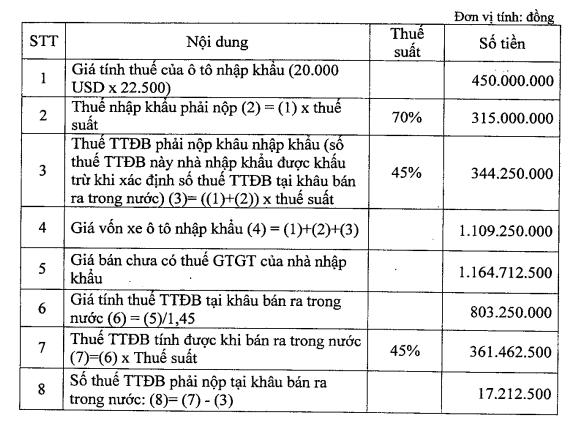
Example 3: An imported car has a CIF price of 20,000 USD; the import tax rate for this model is 70%; the special consumption tax rate is 45%; assuming the exchange rate for calculating import tax at the time of import is 22,500 VND/USD. The selling price excluding VAT recorded on the invoice of the importer is 1,164,712,500 VND. Therefore, the special consumption tax of the importing establishment when selling the car is as follows:
Example 4: Assuming the same conditions as in Example 3, but the sale price without VAT recorded on the importer's invoice is 1,100,000,000 VND. In this case, the sale price basis for calculating the special consumption tax of the importing entity without VAT is lower than 105% of the cost price of imported vehicles. Therefore, the tax authority will determine the sale price of the importing entity according to the provisions of the Law on Tax Administration.
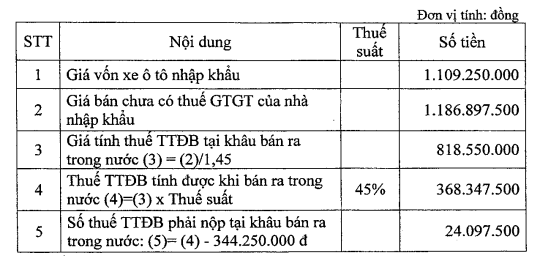
Example 5: Assuming the same conditions as in Example 3, but the sale price without VAT recorded on the invoice of the importing entity is 1,186,897,500 VND (higher than 105% of the cost price of imported vehicles). Thus, the amount of special consumption tax of the importing entity when selling cars is as follows:
For automobile manufacturing and assembly entities with less than 24 seats, the price basis for calculating the special consumption tax is the sale price in the month of the same type of product produced by the entity, but it must not be lower than 7% compared to the average sale price of commercial trading entities selling out. The average sale price of commercial trading entities for comparison purposes is the car sale price excluding additional equipment and parts installed by the commercial trading entity at the customer's request. If the sale price of automobile manufacturing and assembly entities with less than 24 seats is lower than 7% compared to the average sale price in the month of the same type of product sold by commercial trading entities, then the tax calculation price is determined by the tax authority according to the regulations of the Law on Tax Administration.
2. For imported goods at the import stage, the price basis for calculating the special consumption tax is determined as follows:
Taxable value for special consumption tax = Taxable value for import tax + Import tax.
The import tax price is determined according to the provisions of the Law on Export Tax and Import Tax. In cases where imported goods are exempted or reduced from import tax, the tax price does not include the amount of import tax that is exempted or reduced.
3. For goods subject to special consumption tax, the price basis for calculating the special consumption tax is the price without VAT, environmental protection tax (if applicable), without special consumption tax, and does not exclude packaging value.
For bottled beer, if there is a deposit on the bottle, quarterly, the production entity and the customer settle the deposit amount corresponding to the number of bottles not returned. The deposit amount must be included in the revenue for calculating the special consumption tax.
Example 6: For canned beer, in 2016, the sale price of 1 liter of canned beer without VAT was 21,000 VND, with a special consumption tax rate of 55% for beer, the tax calculation price is determined as follows:

Example 7: In Quarter 11/2016, the sale price of a crate of Hanoi bottled beer without VAT was 124,000 VND/crate, the tax calculation price is determined as follows:

Example 8: In Quarter III/2016, Company A sold 1,000 bottles of beer to Customer B and collected a deposit of 1,200 VND per bottle. The total deposit collected was 1,200,000 VND. At the end of the quarter, Company A and Customer B settled accounts: 800 bottles were recovered, and 200 bottles were not recovered. Based on the number of bottles recovered, Company A refunded 960,000 VND to Customer B, and the deposit corresponding to the unrecovered bottles was 240,000 VND (200 bottles x 1,200 VND/bottle). Company A must include this amount in its revenue for calculating the special consumption tax.
4. For processed goods, the price basis for calculating the special consumption tax is the sale price of the goods sold by the processing entity or the sale price of similar or equivalent products at the same time without VAT, environmental protection tax (if applicable), and without special consumption tax.
In cases where the processing entity sells goods to commercial trading entities, the price basis for calculating the special consumption tax is determined according to the guidance provided in point b and point c of Clause 1 of this Article.
5. For goods produced under a business cooperation model between a production entity and a user or owner of the brand (trademark) and production technology, the price basis for calculating the special consumption tax is the sale price without VAT and environmental protection tax (if applicable) of the user or owner of the brand and production technology. In cases where the production entity sells goods to branches or representatives of foreign companies in Vietnam for domestic consumption based on a franchise agreement and technology transfer, the price basis for calculating the special consumption tax is the sale price of the branch or representative of the foreign company in Vietnam.
In cases where these entities sell goods to commercial trading entities, the price basis for calculating the tax is determined according to the guidance provided in point b and point c of Clause 1 of this Article.
6. For goods sold on credit or deferred payment terms, the price basis for calculating the special consumption tax is the sale price without VAT, environmental protection tax (if applicable), and without special consumption tax of goods sold in a lump sum payment, excluding interest on credit or deferred payments.
7. For goods and services used for exchange, internal consumption, gifts, donations, or promotions, the price basis for calculating the special consumption tax is the price of similar or equivalent goods and services at the time these activities occur.
8. For export trading entities purchasing goods subject to special consumption tax from production entities for export but not exporting them domestically, the price basis for calculating the special consumption tax in this case is the sale price without special consumption tax, environmental protection tax (if applicable), and without VAT, specifically determined as follows:
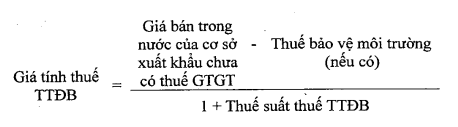
In cases where the export trading entity declares a sale price (including VAT, environmental protection tax (if applicable), and special consumption tax) as the basis for determining the price basis for calculating the special consumption tax, which is lower than 7% compared to the market sale price, the price basis for calculating the special consumption tax is determined by the tax authority according to the provisions of the Law on Tax Administration and implementing guidelines.
9. For services, the price basis for calculating the special consumption tax is the service supply price of the business entity without VAT and without special consumption tax, determined as follows:

The service revenue without value added tax serving as the basis for determining the taxable value for special consumption tax for certain services is specified as follows:
a) For golf business (including golf practice field business), the turnover not including VAT is from selling membership cards, selling golf play tickets, including money from selling practice play tickets, greenkeeping fees, rental car (buggy) services and caddy services during play, deposit (if any) and other revenues related to golf play paid by golf players or members to the golf business operator. In case the deposit is refunded to the depositor, the operator will be refunded the tax already paid by deducting it from the amount due for the next period; if not deducted, the refund will be made according to regulations. If the golf business operator also engages in other goods and services not subject to special consumption tax such as hotels, food and beverage sales, merchandise sales, or games, these goods and services shall not be subject to special consumption tax.
Example 9: If a golf business operator organizes hotel, food and beverage, merchandise sales, or games not subject to special consumption tax, these goods and services shall not be subject to special consumption tax.
b) For casino and electronic gaming machines with prizes, the basis for determining the taxable turnover for special consumption tax is the turnover from casino and electronic gaming machine operations after deducting prize payouts to customers, i.e., the amount received (excluding VAT) exchanged for customers before playing at the exchange counter or game table/machine minus the amount returned to customers.
c) For betting operations, the basis for determining the taxable turnover for special consumption tax is the turnover from selling betting tickets after deducting (minus) prize payouts to customers (excluding VAT), excluding ticket sales revenue for entry to entertainment events linked to betting activities.
d) For nightclub, massage, and karaoke businesses, the basis for determining the taxable turnover for special consumption tax is the turnover from nightclub, massage, and karaoke operations (excluding VAT), including turnover from food and beverage services and other accompanying services (for example: bathing, steam baths in massage facilities).
Example 10: The turnover from nightclub operations (including food and beverage service turnover) of Business Operator A in the tax period is 100,000,000 VND.

e) For lottery business, the basis for determining the taxable turnover for special consumption tax is the turnover from selling various types of permitted lottery tickets (turnover excluding VAT).
10. The taxable turnover for goods and services specified in Clauses 1 to 9 of this Article includes additional charges outside the sale price of goods or service provision price (if any) that the production and business operator enjoys. For tobacco products, the taxable turnover includes mandatory contributions and support funds stipulated in the Law on Prevention and Control of Harmful Effects of Tobacco.
The taxable turnover is calculated in Vietnamese Dong. Where taxpayers generate turnover in foreign currency, they must convert it to Vietnamese Dong based on the actual transaction exchange rate as prescribed by the Law on Tax Administration and implementing guidelines.
For imported goods: the conversion of the exchange rate between Vietnamese Dong and foreign currency used to determine the customs value for taxation is carried out in accordance with the provisions of the Law on Export Duties and Import Duties.
11. In cases where the production and business operator does not comply with or complies inadequately with invoice and record-keeping regulations, the tax authority will base the determination of turnover on the actual production and business situation according to the Law on Tax Administration and calculate the special consumption tax payable.
12. The time of determining the special consumption tax is as follows:
- For goods: the time of generating turnover for goods is the time when ownership or usage rights are transferred to the buyer, regardless of whether payment has been received or not.
- For services: the time of generating turnover is the time of completing service provision or issuing an invoice for service provision, regardless of whether payment has been received or not.
- For imported goods, it is the time of registering the customs declaration form.
13. Production and import operators, service providers subject to special consumption tax must comply with accounting, invoicing, and documentation regulations when buying, selling goods, providing services, and transporting goods as prescribed by law.
When a production operator sells goods or delivers them to branches, dependent facilities, or agents, invoices must be issued. In cases where branches or stores located within the same province or city as the production facility or goods transferred to warehouses, the operator may use internal dispatch orders accompanied by internal movement orders.
Producers of goods subject to special consumption tax who use product trademarks must register trademark samples in accordance with regulations.
Article 6. Tax Rate for Special Consumption Tax
1. Implement according to the provisions of Clause 4, Article 1 of Law No. 70/2014/QH13 dated November 26, 2014 amending and supplementing certain articles of the Special Consumption Tax Law, and Article 5 of Decree No. 108/2015/NĐ-CP dated October 28, 2015 of the Government.
2. In cases where a production facility produces multiple types of goods and provides multiple types of services subject to special consumption tax at different rates, it must declare and pay the special consumption tax separately for each rate applicable to each type of goods or service; if the production facility cannot determine the tax rate for each type of goods or service, it must calculate and pay the tax at the highest rate applicable to the goods or services produced or provided.
Chapter III
REFUND OF TAX, DEDUCTION OF TAX, REDUCTION OF TAX
Article 7. Refund of Tax
The taxpayer of the special consumption tax shall be entitled to a refund of taxes paid in the following cases:
1. Temporary imported goods for re-export include:
a) Goods imported and subject to special consumption tax that remain in customs warehouses and are under the supervision of customs authorities and are subsequently re-exported abroad.
b) Goods imported and subject to special consumption tax intended for delivery or sale to foreign entities through agents in Vietnam; goods imported for sale to vessels of foreign companies on international routes passing through Vietnamese ports and vessels of Vietnam on international routes as prescribed by the Government.
c) Temporary imported goods for re-export under the temporary importation for re-export trade method, upon re-export, the corresponding amount of special consumption tax paid will be refunded.
d) Goods imported and subject to special consumption tax but subsequently re-exported abroad will have the corresponding amount of special consumption tax refunded.
đ) Temporary imported goods for exhibition, product promotion, or other purposes within a specified period, which have been subject to special consumption tax, will have the tax refunded upon re-export.
e) Imported goods declared as subject to special consumption tax but actually imported in lesser quantities than declared; imported goods damaged or lost during importation with reasonable cause and subject to special consumption tax.
g) For imported goods not meeting quality or type requirements under contracts or import permits (due to errors by the foreign consignor), with certification from authorized inspection agencies and confirmation from the foreign consignor allowing importation, the customs authority will verify and confirm the special consumption tax payable. If there is an overpayment, it will be refunded; if there is an underpayment, the difference must be paid.
In cases where export back to the foreign country is permitted, the special consumption tax paid for the exported goods will be refunded.
In cases where goods are returned to the foreign party within the period when import duties are not yet payable under the prescribed regime, the customs authority will check the procedures and implement non-collection of special consumption tax in accordance with the quantity of goods returned to the foreign country.
2. Raw materials imported for the production of export goods will be refunded the special consumption tax paid corresponding to the actual quantity of raw materials used in the production of exported goods.
The refund of special consumption tax as stipulated in Clause 1 and Clause 2 of this Article shall only apply to actually exported goods, and the procedures, documents, sequence, and authority for handling the refund of special consumption tax for imported goods shall be carried out in accordance with the regulations governing the refund of import duties under the laws on export tax and import tax.
3. When a production or business entity consolidates, splits, separates, dissolves, goes bankrupt, changes ownership form, transfers, leases state-owned enterprises and has an overpayment of special consumption tax, the entity has the right to request the tax authority to refund the overpaid special consumption tax.
4. Refund of special consumption tax in the following cases:
a) Refund of tax based on the decision of the competent authority as prescribed by law.
b) Refund of tax pursuant to international treaties to which the Socialist Republic of Vietnam is a member.
c) Refund of tax in cases where the amount of special consumption tax paid exceeds the amount of special consumption tax due as prescribed.
Procedures, documents, sequence, and authority for handling the refund of special consumption tax as stipulated in Clause 3 and Clause 4 of this Article shall be implemented in accordance with the Law on Tax Administration and guiding documents.
Article 8. Tax Deduction
1. The taxpayer producing goods subject to excise tax using raw materials also subject to excise tax shall be entitled to deduct from the excise tax payable the amount of excise tax paid on imported raw materials or paid for raw materials purchased directly from domestic production units. The deductible excise tax corresponds to the excise tax of the raw materials used to produce goods sold. Any un-deducted excise tax in a period may be deducted in the following period.
For biofuel gasoline, the deductible excise tax for the tax declaration period is based on the excise tax paid or paid for one unit of raw material purchased in the immediately preceding declaration period for the production of biofuel gasoline.
Example 11: In October, Group AB imports 5,000 liters of 92RON mineral gasoline with an excise tax paid at the import stage of 5,000,000 VND and purchases 3,000 liters of 92RON mineral gasoline from Refinery D with an excise tax paid of 3,300,000 VND, blending between mineral gasoline and ethanol to store 2,000 liters of E5 gasoline.
In November, Group AB sells E5 gasoline to subsidiary companies, with a sales volume of 1,000 liters.
The proportion of 92RON mineral gasoline in biofuel gasoline is 95.06%, and the proportion of ethanol in biofuel gasoline is 4.94%.
The excise tax deduction in November is calculated as follows:
(5,000,000 VND + 3,300,000 VND) / 8,000 liters X 95.06% X 1,000 liters = 986,247 VND.
Similarly, in December, when Group AB sells E5 gasoline from the blending of October and November, the excise tax deduction is based on the excise tax paid or paid for imported mineral gasoline and purchased from Refinery D in November, applied to the entire quantity of biofuel gasoline sold in December.
2. The taxpayer paying excise tax on imported goods subject to excise tax (excluding various types of gasoline) shall be entitled to deduct the excise tax paid at the import stage when determining the excise tax payable for domestic sales. The deductible excise tax corresponds to the excise tax of the imported goods subject to excise tax sold domestically and can only be deducted up to the amount of excise tax calculated at the domestic sales stage. In exceptional cases where the excise tax cannot be fully deducted due to force majeure, the taxpayer may include it in costs for calculating corporate income tax.
Conditions for excise tax deduction are stipulated as follows:
- For the case of importing raw materials subject to excise tax for the production of goods subject to excise tax and for the case of importing goods subject to excise tax, the documentation for excise tax deduction is the payment receipt for excise tax at the import stage.
- For the case of purchasing raw materials directly from domestic producers:
+ Purchase and sale contract, which must specify that the goods are produced directly by the selling entity; Copy of the Business Registration Certificate of the selling entity (signed and stamped by the selling entity).
+ Bank payment receipt.
+ The documentation for excise tax deduction is the VAT invoice when purchasing goods, the excise tax paid by the purchasing entity when buying raw materials is determined by multiplying the taxable price by the excise tax rate; wherein:
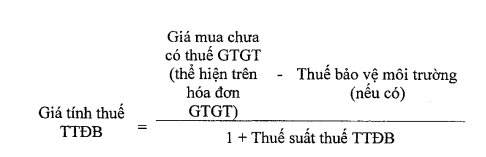
Excise tax deduction is carried out during the excise tax declaration, the excise tax payable is determined according to the following formula:
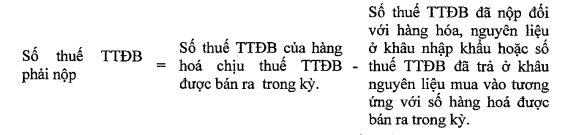
If the exact amount of excise tax paid (or paid) for the corresponding raw materials cannot be accurately determined for the products consumed in the period, it may be based on the data from the previous period to calculate the deductible excise tax, and will be adjusted according to actual figures at the end of the quarter or year. In all cases, the maximum allowable excise tax deduction does not exceed the excise tax calculated for the raw materials according to the economic and technical standards of the product. The production entity must register the economic and technical standards of the product with the direct tax management authority.
Example 12: During the tax declaration period, Entity A has the following transactions:
+ Imports 10,000 liters of distilled spirits, pays excise tax at the import stage of 250 million VND (based on the excise tax payment receipt at the import stage)
+ Withdraws 8,000 liters for production of 12,000 bottles of spirits
+ Sells 9,000 bottles of spirits, the excise tax generated from the sale of 9,000 bottles of spirits is 350 million VND.
+ The excise tax paid at the import stage for distilled spirits allocated to the 9,000 bottles of spirits sold is 150 million VND.
The amount of special consumption tax Facility A must pay during the period is:
350 million VND - 150 million VND = 200 million VND.
Example 13: During the tax declaration period, Entity B has the following transactions:
+ Imports 100 air conditioners model A with a capacity of 12,000 BTU, pays excise tax at the import stage of 100 million VND (based on the excise tax payment receipt at the import stage).
+ Sells 100 air conditioners, the excise tax generated from the domestic sale is 120 million VND.
The excise tax Entity B must pay in the period is:
120 million VND - 100 million VND = 20 million VND.
Example 14: During the tax declaration period, Entity B has the following transactions:
+ Imports 100 air conditioners model X with a capacity of 12,000 BTU, pays excise tax at the import stage of 100 million VND (based on the excise tax payment receipt at the import stage).
+ Sells 100 air conditioners, due to force majeure, the excise tax generated from the sale of 100 air conditioners is 90 million VND. Entity B is entitled to deduct the excise tax of 90 million VND. For the undeducted excise tax (10 million VND), Entity B may include it in costs for calculating corporate income tax.
For enterprises permitted to produce E5, E10 gasoline, the declaration and deduction of excise tax are conducted at the local tax office where the enterprise's headquarters is located, and any undeducted excise tax on E5, E10 gasoline in a period may be offset against the excise tax payable on other goods and services.
The taxpayer paying excise tax shall submit the Excise Tax Declaration Form No. 01/TTĐB and the Excise Tax Deduction Calculation Table (if applicable) for purchased raw materials and imported goods (Form No. 01-1/TTĐB) issued together with this Circular.
Article 9. Reduction of Tax
The reduction of special consumption tax shall be implemented in accordance with the provisions of Article 9 of the Special Consumption Tax Law No. 27/2008/QH12.
Procedures and documents for tax reduction shall be carried out in accordance with the Law on Tax Administration and guiding documents.
Chapter IV
IMPLEMENTING PROVISIONS
Article 10. Effective Date
1. This Circular takes effect from January 1, 2016.
2. This Circular replaces Circular No. 05/2012/TT-BTC dated January 5, 2012 of the Ministry of Finance guiding the implementation of Decree No. 26/2009/NĐ-CP dated March 16, 2009 and Decree No. 113/2011/NĐ-CP dated December 8, 2011 of the Government detailing certain provisions of the Special Consumption Tax Law.
Article 11. Implementation Organization
1. The Tax Authority is responsible for organizing the management of collection of special consumption tax and refunding/reducing special consumption tax for businesses.
2. The Customs Authority is responsible for organizing the management of collection of special consumption tax and refunding special consumption tax for imported goods.
3. In the course of implementation, if there are difficulties or obstacles, units and businesses are requested to report to the Ministry of Finance for timely resolution.
|
Place of Receipt: |
DEPUTY MINISTER |
Original document (PDF)
Relations map
Click a document to open. A red border = a relation that changes validity.
Translations
This document is available in the following languages: