
Circular No. 196/2011/TT-BTC guides the initial public offering and management, use of funds from the privatization of state-owned enterprises with 100% state capital being converted into joint-stock companies. This document stipulates procedures, formalities, methods for selling shares, benefits for employees, trade unions, investors, and related obligations.
适用范围
State-owned enterprises with 100% state capital converting into joint-stock companies according to Decree No. 59/2011/NĐ-CP; employees, trade unions, domestic and foreign investors.
要点
- Employees may purchase shares at a preferential price (60% of the lowest successful auction price) when the enterprise sells shares through public auctions or before that. Trade unions also have the right to purchase shares at the same preferential price.
- Privatized enterprises must open a frozen account to manage funds from privatization and complete the sale of shares within three months from the approval of the privatization plan.
- The sale of shares can be conducted through public auctions, direct negotiations, or underwritten issuance. The selling price must comply with legal provisions and not be lower than the approved starting price by the competent authority.
- A deposit of 10% of the value of purchased shares is required, which will be refunded to unsuccessful bidders or transferred to the enterprise's frozen account. Payment for purchased shares must be made within the specified period.
- After selling shares, the enterprise must determine the amount to be retained and remit it to the Fund as prescribed in Decree No. 59/2011/NĐ-CP.
🌐 本文件的社会影响
- Positive impact: Creates opportunities for employees and trade unions to purchase shares at preferential prices, contributing to personnel stability and enterprise development.
- Negative impact: The share sale process is complex, potentially imposing administrative burdens on enterprises. Privatization costs may exceed prescribed limits.
❓ 常见问题
What is the price at which employees can purchase shares?
Employees can purchase shares at a preferential price of 60% of the lowest successful auction price or 60% of the lowest negotiated price for strategic investors.
When must an enterprise open a frozen account?
Privatized enterprises must open a frozen account at a commercial bank to manage funds from privatization within 15 days from the approval of the privatization plan.
Through which methods can the sale of shares be conducted?
The sale of shares can be conducted through public auctions, direct negotiations, or underwritten issuance. Each method has specific regulations regarding the selling price and procedures.
What is the deposit amount?
The deposit amount is 10% of the value of purchased shares, which will be refunded to unsuccessful bidders or transferred to the enterprise's frozen account.
How must an enterprise handle funds from privatization after selling shares?
After selling shares, the enterprise must determine the amount to be retained and remit it to the Fund as prescribed in Decree No. 59/2011/NĐ-CP. The remaining amount will be used to cover privatization costs and support redundant employees.
全文
CIRCULAR
Guidelines for the initial public offering and management and use of funds from the equitization of state-owned enterprises with 100% state capital that are converted into joint-stock companies
the privatization of state-owned enterprises with 100% state capital a) Report to the Ministry of Natural Resources and Environment on the results of training and upgrading, including listing the teaching staff participating in teaching, evaluating the participation of trainees in the training process, the results of organizing examinations for completing the training and upgrading program on land valuation business, the issuance of Certificates and the use of Certificate codes, summarizing the feedback from trainees on the quality of the training and upgrading program on land valuation business, and other relevant matters.
converting into joint-stock companies
________________________
Pursuant to the Enterprise Law No. 60/2005/QH11 dated November 29, 2005;
Pursuant to the Decree No. 118/2008/NĐ-CP dated November 27, 2008 of the Government stipulating the functions, tasks, powers, and organizational structure of the Ministry of Finance;
Pursuant to Decree No. 59/2011/NĐ-CP dated July 18, 2011 of the Government on converting state-owned enterprises with 100% state capital into joint-stock companies; conducting initial public offerings and managing and using funds from the equitization of state-owned enterprises with 100% state capital that are converted into joint-stock companies
Ministry of Finance guiding the selling shares for the first time and managing and utilizing funds received from the privatization of state-owned enterprises that convert into joint-stock companies as follows:
Chapter I - GENERAL PROVISIONS
Article 1. Scope and Objects Regulated
This Circular guides the procedures, formalities, and methods for conducting initial public offerings and managing and using funds from the equitization of entities subject to equitization as stipulated in Article 2 of Decree No. 59/2011/NĐ-CP (hereinafter referred to as equitized enterprises).
Article 2. Interpretation of Terms
1. Auction sale of shares is a form of public sale of shares of equitized enterprises to competing bidders.
2. An unsuccessful auction sale of shares is an auction where no investor registers to participate or only one investor registers to participate.
3. Underwriting guarantee is the commitment of an underwriting organization to undertake pre-offering procedures, purchase part or all of the securities issued by the issuer to resell or buy back unsold securities from the issuer, or assist the issuer in distributing securities to the public.
4. An underwriting organization is one or a group of securities companies licensed to perform underwriting services for enterprises in accordance with laws on Securities and the securities market.
5. Organizations implementing auction sales of shares are stock exchanges, intermediary organizations (securities companies) providing auction sale services, and the Equitization Steering Committee, approved by the equitization decision-making body to conduct the initial auction sale of shares of the enterprise to investors in accordance with this Circular.
6. Deposit money is a sum of money paid in advance by a participant in the share purchase to ensure the right to purchase shares.
7. The starting price is the initial price of a share offered for sale outside the company, set by the competent authority but not lower than the par value (10,000 Vietnamese dong). The starting price for auctioned shares is determined based on the results of the enterprise valuation and the enterprise's future potential, and the retained risk reserve fund value (if any).
Chapter II - SPECIFIC PROVISIONS
SECTION I -SUBJECTS OF PURCHASE AND SHARE PRICES
Article 3. Purchasing Objects
1. Employees listed in the regular roster of the enterprise at the time of announcing the value of the equitized enterprise as stipulated in Article 48 of Decree No. 59/2011/NĐ-CP.
2. Trade unions within the equitized enterprise as stipulated in point c Clause 2 Article 36 of Decree No. 59/2011/NĐ-CP. The trade union authorizes a person with authority to carry out procedures related to purchasing shares.
3. Domestic and foreign investors as stipulated in Clause 1 and Clause 2 Article 6 of Decree No. 59/2011/NĐ-CP, including organizations and individuals (including employees of the equitized enterprise).
4. Strategic investors are domestic and foreign investors as stipulated in point a Clause 3 Article 6 of Decree No. 59/2011/NĐ-CP.
Article 4. Subjects Not Eligible to Participate in the Auction to Purchase Shares for the First Time
1. Members of the Steering Committee for Corporate Shareholding Reform of the Enterprise, except members who are representatives of the shareholding enterprise.
2. Financial intermediary organizations and individuals from these organizations involved in providing advisory services, determining the value of the enterprise, auditing financial reports, and the organization determining the value of the enterprise; except for organizations guaranteeing the issuance of shares that have not been fully distributed according to the guarantee contract.
3. Organizations implementing the auction sale of shares and individuals from these organizations related to the auction.
4. Subsidiaries, associated companies within the same Group, Corporation, and parent-child company conglomerates.
Article 5. Price of Shares Sold for the First Time
1. The price at which shares are sold to investors through the auction is the price offered by the investor at the auction and determined as the successful bid according to the auction result specified in Clause 4, Article 7 of this Circular. In cases where the shareholding reform enterprise sells shares under the guaranteed issue form, the Steering Committee for Shareholding Reform shall negotiate with the Guarantee Organization about the guaranteed price but it must not be lower than the approved starting price by the competent authority.
2. The preferential price for selling shares to employees in the shareholding reform enterprise.
a) In cases where the shareholding reform enterprise conducts a public auction before selling shares to strategic investors:
- The price for selling shares to employees is determined at 60% of the lowest successful auction price.
- The price for selling additional shares to employees as stipulated in Point a, Clause 2, Article 48 of Decree No. 59/2011/NĐ-CP is the lowest successful auction price.
b) In cases where the shareholding reform enterprise sells to strategic investors before conducting a public auction:
- The price for selling shares to employees is determined at 60% of the lowest agreed purchase price for strategic investors (in the case of negotiated sales) or 60% of the lowest successful auction price among strategic investors (in the case of auction sales).
- The price for selling additional shares to employees as stipulated in Point a, Clause 2, Article 48 of Decree No. 59/2011/NĐ-CP is the lowest successful purchase price for strategic investors in the case of negotiated sales or auction sales among strategic investors.
3. The preferential price for selling shares to trade unions at the shareholding reform enterprise.
a) In cases where the shareholding reform enterprise conducts a public auction before selling shares to strategic investors, the price for selling shares to trade unions is determined at 60% of the lowest successful auction price.
b) In cases where the shareholding reform enterprise sells to strategic investors before conducting a public auction, the price for selling shares to trade unions is determined at 60% of the lowest agreed purchase price for strategic investors or 60% of the lowest successful auction price among strategic investors.
4. The price for selling shares to strategic investors.
a) In cases where the shareholding reform enterprise sells to strategic investors before conducting a public auction:
The price for selling shares to strategic investors is the agreed purchase price by the Steering Committee for Shareholding Reform (in the case of negotiated sales) or the price offered by the strategic investor determined as the successful bid in the auction among strategic investors (in the case of auction sales among strategic investors) but it must not be lower than the approved starting price by the decision-making body for shareholding reform.
b) In cases where the shareholding reform enterprise sells to strategic investors after conducting a public auction:
The price for selling shares to strategic investors is the agreed purchase price by the Steering Committee for Shareholding Reform (in the case of negotiated sales) or the price offered by the strategic investor determined as the successful bid in the auction among strategic investors (in the case of auction sales among strategic investors) but it must not be lower than the lowest successful auction price in the public auction.
PART II - ORGANIZATION OF THE FIRST SALE OF SHARES
Article 6. Selling Shares for the First Time
1. Based on the privatization plan approved by the competent authority (as attached Appendix No. 1 to this Circular), the Privatization Steering Committee directs the enterprise being privatized to implement the first sale of shares according to the following methods: public auction; direct negotiation; underwriting issuance, ensuring compatibility with the charter capital structure of the joint-stock company. Among which:
a) The method of public auction is applied in cases where the auction is conducted to the public without distinction between institutional investors, individual investors, domestic investors, and foreign investors.
b) Direct negotiation method is applied in the following cases:
- Selling to strategic investors before or after the public auction.
- Selling to investors who participated in the auction but did not purchase all the shares as stipulated in Clause 2, Article 40 of Decree No. 59/2011/NĐ-CP.
- Selling to investors the remaining unsold shares from an unsuccessful share auction.
c) The method of underwriting issuance is applied in cases of the first sale of shares and/or selling shares to strategic investors of the joint-stock enterprise.
2. Within three months from the date the privatization plan is approved by the competent authority, the enterprise being privatized must complete the first sale of shares according to the methods that have been approved, including cases where there is a change in the method of selling shares as stipulated in Clause 3, Article 6 of this Circular.
3. In cases where it is necessary to change the method of selling shares compared to the approved plan, the Privatization Steering Committee reports to the authority deciding on privatization for consideration and decision, but not exceeding fifteen days from the date the privatization plan is approved by the competent authority.
4. Freezing Account Opening
The enterprise being privatized must open a separate account at a commercial bank to freeze the proceeds from the privatization according to the provisions of Part III of this Circular; commercial banks undergoing privatization must open a freezing account at another commercial bank. The maximum time to complete the opening of the freezing account is fifteen days from the date the privatization plan is approved by the competent authority.
5. Sale of Shares to Strategic Investors
a) Based on the scale of charter capital, the nature of business operations, and the development requirements of the enterprise, the Privatization Steering Committee establishes criteria for selecting strategic investors, to be submitted to the authority deciding on privatization for approval. The number of strategic investors purchasing shares at each privatized enterprise is determined to be a maximum of three investors.
For large enterprises with state capital over 500 billion VND (after financial processing and determining the value of the enterprise) operating in special sectors (insurance, banking, postal and telecommunications, aviation, coal mining, oil and gas, rare mineral mining) and parent companies of Groups and Corporations if it is necessary to select strategic investors beforehand, the authority deciding on privatization reports.
b) On the basis of the list of strategic investors meeting the selection criteria approved by the authority deciding on privatization, the Privatization Steering Committee builds a plan and organizes the sale of shares to strategic investors according to the following principles:
- If there are a maximum of three strategic investors registering to participate in purchasing shares, if the number of shares registered for purchase by strategic investors exceeds the number of shares sold to strategic investors, then an auction must be organized among strategic investors according to current laws; if the number of shares registered for purchase by strategic investors is equal to the number of shares sold to strategic investors, the Privatization Steering Committee will negotiate the number of shares sold and the selling price, report to the authority deciding on privatization for approval or decide according to the authorization of the authority deciding on privatization.
- If there are more than three strategic investors registering to participate in purchasing shares, the Privatization Steering Committee must establish rules for organizing an auction among strategic investors according to the principles stipulated in this Circular.
c) The selection of strategic investors through an auction must ensure the principle of choosing investors with the highest bid prices from top to bottom to meet the number of shares sold, but not exceeding three investors, and must ensure that the lowest successful bid price in the auction among strategic investors is not lower than the starting price approved by the authority deciding on privatization (in cases of selling to strategic investors before the public auction) or not lower than the lowest successful bid price in the public auction (in cases of selling to strategic investors after the public auction). Based on the results of the auction, the authority deciding on privatization approves the list of selected strategic investors.
Article 7. Public Auction Method
1. Organization of Share Auction.
a) Auction at an intermediary organization (securities company), if the value of the shares being auctioned is less than 10 billion VND (based on face value).
If there is no intermediary organization willing to conduct the share auction, the Privatization Steering Committee directly organizes the share auction at the enterprise.
b) Auction at Securities Exchanges if the value of the shares being auctioned is 10 billion VND or more (based on face value).
c) In cases where the privatized enterprise has a face value of shares being sold below 10 billion VND and wishes to conduct the auction at a Securities Exchange, the decision is made by the competent authority approving the privatization plan.
2. Preparation for Auction.
a) The entity implementing the share auction issues a Decision establishing the Share Auction Board and the Share Auction Regulations as prescribed.
b) The Privatization Steering Committee decides to publish information about the enterprise at least twenty days before organizing the auction. The content of the information about the privatized enterprise is established according to Appendix No. 2 issued together with this Circular.
For large enterprises with state capital exceeding 500 billion VND (after financial processing and determining enterprise value), operating in special sectors (insurance, banking, postal telecommunications, aviation, coal mining, oil and gas, rare mineral mining), and parent companies of Groups and Corporations, when disclosing information according to Appendix No. 2 attached to this Circular, they must include the English version.
c) The authority deciding on equitization shall examine and decide or authorize the Equitization Steering Board to decide the starting price for auctioned shares in the decision approving the equitization plan and publish the starting price together with the content of the enterprise's information disclosure.
d) The Joint-Stock Reform Steering Committee coordinates with the organization conducting the sale auction to present the company to investors (if necessary).
3. Conduct the auction.
a) Within the time limit stipulated in the Auction Sale Regulation, investors register the volume to purchase and submit the deposit as prescribed in point a, Clause 1, Article 10 of this Circular. Investors are provided with Bid Participation Forms by the Organization implementing the auction sale.
Foreign investors must comply with the provisions of Clause 2, Article 6 of Decree No. 59/2011/NĐ-CP.
b) Within the time limit stipulated in the Auction Sale Regulation, investors record their bid prices (bid prices) on the Bid Participation Form and send it to the Organization implementing the auction sale through:
- Directly submitting ballots at the enterprise (if the Equitization Steering Board organizes the auction at the enterprise); directly submitting ballots at the intermediary financial organization (if the auction is organized by the intermediary financial organization); and directly submitting ballots at the auction agents (if the auction is organized by the Stock Exchange).
- Submitting ballots via postal mail as prescribed in the Auction Regulations.
4. Determine the auction results.
a) Determining the auction results is carried out based on the principle of selecting bids from highest to lowest until the number of shares offered is fully covered but not lower than the starting price. At the lowest winning bid price, if multiple investors (including foreign investors) place the same bid price but the remaining number of shares is less than the total number of shares these investors have registered to buy at the lowest winning bid price, then the number of shares each investor can buy is determined as follows:
|
Number of shares the investor can buy |
= |
Remaining number of shares offered |
x |
Number of shares from the investor registering to buy Total number of shares registered to buy by investors |
If there is a maximum percentage limit on the number of shares that foreign investors can buy, the determination of the auction results will be carried out according to the above principle, but the number of shares foreign investors can buy shall not exceed the maximum percentage stipulated by current laws.
b) Within a maximum period of three working days from the end of the auction, based on the auction results, the Organization implementing the auction sale, the Auction Committee, representatives of the Equitization Steering Board, and representatives of the enterprise shall jointly prepare and sign the Minutes of Determination of Auction Results according to Appendix No. 3 issued along with this Circular.
c) Within a maximum period of three working days from the date of preparing the Minutes of Determination of Auction Results, the Equitization Steering Board and the Organization implementing the auction sale shall cooperate to announce the auction results and collect payment for purchased shares.
5. In case the auction sale of shares does not succeed, the Equitization Steering Board shall report to the competent authority approving the equitization plan to decide on publicly offering the unsold shares again according to the direct negotiation method prescribed in Clause 3, Article 8 of this Circular.
6. In case of violation of the Auction Sale Regulation, investors will not be refunded the deposit. Violations of the Auction Sale Regulation include: bidding below the starting price; renouncing the right to purchase shares for which they have won bids, and other cases as stipulated in the Auction Sale Regulation.
Article 8. Direct negotiation method
1. Selling shares to strategic investors.
a) Within twenty days from the date the equity privatization plan is approved by the competent authority, the Equity Privatization Steering Committee shall coordinate with the enterprise undergoing privatization to negotiate with strategic investors on the number of shares to be purchased and the share selling price, which shall be reported to the equity privatization decision-making body for approval or delegated to the Equity Privatization Steering Committee for decision within a maximum period of ten days from the date of receipt of the report from the Equity Privatization Steering Committee.
b) In cases where shares are sold to strategic investors prior to public auction, based on the results of the approved negotiations to sell shares to strategic investors, the Equity Privatization Steering Committee shall direct the enterprise and strategic investors to sign a share purchase/sale contract. The time limit for completing the signing of the contract with strategic investors through the direct negotiation method is fifteen days from the date the competent authority approves the results of the negotiations to sell shares to strategic investors.
c) In cases where shares are sold to strategic investors after public auction, based on the record confirming the auction results as stipulated in Clause 4, Article 7 of this Circular, the Equity Privatization Steering Committee shall direct the enterprise and strategic investors to sign a share purchase/sale contract within ten days from the date the record confirming the results of the public auction of shares is issued.
2. Selling shares to investors who participated in the auction for unsold shares.
a) Based on the quantity of unsold shares as specified in Clause 1, Article 40 of Decree No. 59/2011/ND-CP, the Equity Privatization Steering Committee shall direct the enterprise to prepare a list and notify investors who participated in the auction to publicly offer the remaining unsold shares within five working days from the deadline for payment as prescribed in the Auction Rules for Shares.
b) Based on the results of negotiations to sell shares with participating investors, the Equity Privatization Steering Committee shall direct the enterprise and investors to sign a share purchase/sale contract. The time limit for completing the signing of the share purchase/sale contract is fifteen days from the date the investor registers to purchase shares.
3. In case the public auction of shares does not succeed.
a) Within three working days from the deadline for registering to participate in the auction to purchase shares, the organization implementing the auction shall be responsible for notifying the Equity Privatization Steering Committee and the enterprise undergoing privatization about the unsuccessful auction. The Equity Privatization Steering Committee shall report to the competent authority that approved the privatization plan to consider and decide to adjust the initial price, but not lower than the par value, to publicly offer the remaining unsold shares of the public auction and the shares that employees and trade unions in the enterprise refuse to purchase according to the approved plan (if any) within a maximum period of twenty days from the deadline for registering to participate in the auction to purchase shares.
b) The Equity Privatization Steering Committee shall decide to announce information about the public offering of remaining shares through the direct negotiation method (including information about the privatizing enterprise as per Appendix No. 2 attached to this Circular) at least five working days before the date investors register to purchase shares.
c) Based on the results of negotiations to sell shares with investors, the Equity Privatization Steering Committee shall direct the enterprise and investors to sign a share purchase/sale contract. The time limit for completing the signing of the share purchase/sale contract is ten days from the date the investor registers to purchase shares.
4. In cases where the public offering of remaining shares through the direct negotiation method as stipulated in Clause 2 and Clause 3 of Article 8 of this Circular still fails to sell all shares, the Equity Privatization Steering Committee shall report to the competent authority that approved the privatization plan to adjust the charter capital structure to convert the enterprise from 100% state-owned to a joint-stock company before organizing the first General Meeting of Shareholders.
In cases where the enterprise implements privatization by selling part of the state capital combined with issuing additional shares or selling all state capital combined with issuing additional shares, the adjustment of the charter capital structure shall be carried out according to the principle of prioritizing the determination of the number of shares sold as the number of additional shares issued according to the approved privatization plan. In cases where the total number of shares sold (including through the public auction method) exceeds the number of additional shares issued according to the privatization plan, the excess portion shall be determined as shares sold from state capital.
Article 9. Issuance Guarantee Method
1. Within twenty days from the date the competent authority approves the shareholding restructuring plan, the Shareholding Restructuring Steering Board shall negotiate with issuance guarantee organizations regarding the number of shares, issuance guarantee price, and report to the authority deciding on shareholding restructuring for approval or delegation to the Shareholding Restructuring Steering Board to decide within ten days from the date of receiving the report from the Shareholding Restructuring Steering Board. In cases where strategic investors purchase shares after public auction, the issuance guarantee price shall not be lower than the lowest successful bid price at the public auction.
2. The Shareholding Restructuring Steering Board shall sign contracts with issuance guarantee organizations within five working days from the date of approval or delegation by the competent authority.
3. Issuance guarantee organizations shall distribute and sell the guaranteed number of shares according to the provisions of the issuance guarantee contract. In case of unsold shares, issuance guarantee organizations shall be responsible for purchasing all remaining shares at the guaranteed issuance price as stipulated in the issuance guarantee contract.
4. The issuance guarantee organization shall be entitled to receive issuance guarantee fees as agreed between the Shareholding Restructuring Steering Board and the issuance guarantee organization but not exceeding the framework prescribed by the Ministry of Finance on issuance guarantee fees. The issuance guarantee fee shall be included in the shareholding restructuring costs.
5. Upon completion of the distribution and sale of shares, the Shareholding Restructuring Steering Board shall cooperate with the enterprise and the issuance guarantee organization to review the contents of the issuance guarantee contract and liquidate the contract according to regulations.
PART III -MANAGEMENT AND USE OF FUNDS FROM SHAREHOLDING RESTRUCTURING
Article 10. Management of Deposit Money and Payment for Share Purchase
1. Management of deposit money
a) Auction sale of shares:
- Investors (including strategic investors in the case of auctions among strategic investors) shall be responsible for depositing a deposit equal to 10% of the value of the shares they intend to purchase based on the starting price into the account of the organization implementing the auction at least five working days before the auction date as stipulated in the Auction Regulations.
- Within five working days from the end of the share sale, the organization implementing the auction shall be responsible for refunding the deposit to investors who participated in the legitimate auction but did not obtain shares. Deposits that are not refunded to investors shall be transferred to the frozen account of the restructured enterprise for handling according to regulations on managing and using funds from shareholding restructuring.
b) Direct negotiation method:
- Strategic investors shall be responsible for depositing the deposit together with the registration to purchase shares into the account of the restructured enterprise. The amount of the deposit shall be determined as 10% of the value of the shares intended to be purchased based on the approved starting price (in the case of selling to strategic investors before public auction) or 10% of the value of the shares intended to be purchased based on the approved expected selling price (in the case of selling to strategic investors after public auction) but not less than the lowest successful bid price at the public auction.
- Investors who have participated in the public auction and continue to purchase unsold shares or investors who register to purchase shares after the auction without success as stipulated in Clause 3, Article 8 of this Circular, shall be responsible for depositing the deposit together with the registration to purchase shares into the account of the organization implementing the auction at 10% of the value of the shares intended to be purchased based on the approved offering price.
- Within five working days from the end of the sale of shares through direct negotiation, the restructured enterprise or the organization implementing the auction shall be responsible for refunding the deposit to investors who registered to purchase but did not successfully negotiate. The remaining amount shall be transferred to the frozen account of the restructured enterprise for handling according to regulations on managing and using funds from shareholding restructuring.
c) Guarantee issuance method:
At the time of signing the issuance guarantee contract, the issuance guarantee organization shall deposit a deposit equal to 10% of the value of the shares guaranteed in the issuance guarantee contract into the frozen account of the restructured enterprise's shareholding restructuring revenue.
2. Payment for purchasing shares:
a) Investors shall be responsible for paying the purchase price of shares according to the following provisions:
- Public auction through the organization implementing the auction (including the case of auctions among strategic investors), within ten days from the date of announcing the results of the share auction, investors must complete the purchase and transfer the purchase price of shares into the account of the organization implementing the auction according to the Auction Regulations. The organization implementing the auction shall be responsible for transferring the proceeds from the sale of shares to the frozen account of the restructured enterprise within five working days from the expiration date of the investor's payment.
- In cases where the Shareholding Restructuring Steering Board directly conducts a public auction of shares at the enterprise as stipulated in point a, Clause 1, Article 7 of this Circular, within ten days from the date of announcing the results of the share auction, investors must complete the purchase and transfer the purchase price of shares into the frozen account of the restructured enterprise.
- Direct negotiation method: Investors (including strategic investors) shall make payment for the purchase of shares within five working days from the date of signing the share purchase contract.
- Guarantee issuance method:
Within ten days from the end of the purchase and sale of shares, the issuance guarantee organization shall be responsible for completing the purchase and sale of shares and transferring the money to the frozen account of the restructured enterprise.
b) Investors who purchase shares according to the auction result or agreement, the deposit shall be deducted from the total amount due for the purchase of shares. If the deposit exceeds the amount due, the investor shall be refunded the difference within three working days from the end of the payment deadline for investors to pay for the purchase of shares.
c) If the investor fails to pay or pays insufficiently within the prescribed deadline for the amount due to purchase shares, the unpaid shares shall be considered unsold shares and shall be handled according to the provisions of Article 40 of Decree No. 59/2011/NĐ-CP.
3. Share purchases and sales are settled in Vietnamese Dong. Settlement can be made in cash or by bank transfer.
Article 11. Proceeds from Share Sale
1. Within fifteen days from the completion of the share sale, the Steering Committee for Corporate Transformation shall determine the retained proceeds and the amount to be remitted to the Fund and instruct the corporate transformation enterprise to transfer funds from the blocked account to the Fund in accordance with Clause 5 of Article 43 of Decree No. 59/2011/NĐ-CP. The Fund management agency shall notify the corporate transformation enterprise and the commercial bank where the blocked account is opened to confirm the transferred amount within a maximum of five working days.
2. The corporate transformation enterprise shall transfer the retained proceeds from the blocked account to its own account within five working days from the date of receipt of the confirmation notice from the Fund management agency for management and use in accordance with regulations. Commercial banks where the blocked account is opened shall only transfer funds from the blocked account to the enterprise's account upon confirmation by the Fund management agency.
3. Handling of proceeds from corporate transformation in specific cases:
a) In the case of selling state capital:
The proceeds from the corporate transformation of the enterprise shall be handled in accordance with Clause 1 of Article 42 of Decree No. 59/2011/NĐ-CP.
b) In the case of retaining state capital and issuing additional shares to increase the charter capital, the proceeds from the corporate transformation shall be handled as follows:
- Retain the enterprise the corresponding value of the additional issued shares based on their par value.
- The surplus capital (the difference between the proceeds from the corporate transformation and the total par value of the additional issued shares) shall be used to settle the corporate transformation costs as stipulated in Article 12 of this Circular and to support the enterprise in implementing policies for redundant workers. Any remaining amount (if any) shall be handled as provided in point b, Clause 2 of Article 42 of Decree No. 59/2011/NĐ-CP, wherein the surplus amount left with the joint-stock company from the sale of additional issued shares (denoted as A) shall be determined as follows:
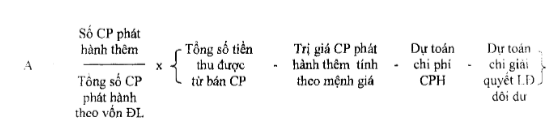
- If the surplus capital is insufficient to cover the corporate transformation costs and support the enterprise in implementing policies for redundant workers, it shall be supplemented from the Fund as provided in point b, Clause 1 of Article 42 of Decree No. 59/2011/NĐ-CP.
c) In the case of selling state capital combined with issuing additional shares, the proceeds from shareholding reform shall be handled as follows:
- Transfer to the Fund in accordance with Clause 3 of Article 21 of Decree No. 59/2011/NĐ-CP the nominal value of the state shares sold.
- Retain the enterprise the corresponding value of the additional issued shares based on their par value.
- The surplus capital (the difference between the proceeds from the corporate transformation and the total par value of the state shares sold plus the additional issued shares) shall be used to settle the corporate transformation costs as stipulated in Article 12 of this Circular and to support the enterprise in implementing policies for redundant workers. Any remaining amount (if any) shall be distributed as follows:
Retain for the enterprise in proportion to the number of additional issued shares (denoted as B), which shall be determined as follows:
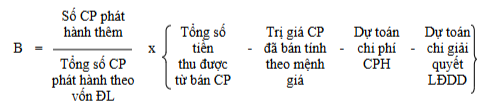
Any remaining amount (if any) shall be transferred to the Fund in accordance with Clause 3 of Article 21 of Decree No. 59/2011/NĐ-CP.
- If the surplus capital is insufficient to cover the corporate transformation costs and support the enterprise in implementing policies for redundant workers, it shall be supplemented from the Fund as provided in point b, Clause 1 of Article 42 of Decree No. 59/2011/NĐ-CP.
4. At the time when the enterprise officially becomes a joint-stock company, if there is a discrepancy in the actual value of the state capital compared to the valuation at the time of determining the enterprise's value, such discrepancy shall be handled in accordance with Clause 3 and 4 of Article 21 of Decree No. 59/2011/NĐ-CP.
5. After obtaining the business registration certificate for conversion into a joint-stock company, the transformed enterprise shall be responsible for officially determining the amounts to be paid, settling accounts for worker benefits and corporate transformation costs, and reporting these to the Steering Committee for Corporate Transformation for approval by the authority deciding on the corporate transformation, while simultaneously sending copies to the Ministry of Finance (Enterprise Financial Department).
Article 12. Costs of Shareholding Reform
1. Shareholding reform costs are expenses related to the shareholding reform of enterprises from the date of the decision on shareholding reform to the date of handover between the enterprise and the joint-stock company. These shareholding reform costs must ensure that all reasonable and valid documentation is provided according to current state regulations.
2. The General Director or Director of the enterprise decides on the content and amount of expenditure within the maximum control limit stipulated in Clause 4 of Article 12 of this Circular for implementing the shareholding reform process and bears responsibility for the legality of these expenditures.
3. Shareholding reform costs include:
a) Direct expenses at the enterprise:
- Expenses for training on shareholding reform business;
- Expenses for inventory and valuation of assets;
- Expenses for formulating the shareholding reform plan and drafting the Articles of Association. The maximum level of expenditure shall not exceed 10% of the total maximum shareholding reform cost as stipulated in Clause 4 of Article 12 of this Circular;
- Expenses for the Workers' and Staffs' Congress to implement shareholding reform;
- Expenses for promotional activities and publicizing information about the enterprise;
- Expenses for organizing the sale of shares, including: expenses for auction activities and underwriting issuance by the shareholding reform enterprise and the auction organizer or the underwriting agreement acceptor;
- Expenses for the first shareholders' meeting;
b) Fees for auditing and consulting services to determine the value of the enterprise and sell shares, decided by the authority making the shareholding reform decision or the Shareholding Reform Steering Committee (if authorized). Payment for consulting fees for selling shares is based on the contract signed between the parties and the auction results.
c) Remuneration for the Shareholding Reform Steering Committee and the Working Group.
The maximum remuneration for each member of the Shareholding Reform Steering Committee is 2,500,000 VND/person/month, and for each member of the Working Group is 1,500,000 VND/person/month.
d) Other expenses related to the shareholding reform of the enterprise, not exceeding 10% of the total maximum shareholding reform cost as stipulated in Clause 4 of Article 12 of this Circular.
4. The total maximum expenditure is determined based on the enterprise's accounting value as follows:
- Not exceeding 200 million VND for enterprises with a value below 30 billion VND.
- Not exceeding 300 million VND for enterprises with a value from 30 billion to 50 billion VND.
- Not exceeding 400 million VND for enterprises with a value above 50 billion to 100 billion VND.
- Not exceeding 500 million VND for enterprises with a value above 100 billion VND.
In cases where the enterprise applies the underwriting issuance method leading to shareholding reform costs exceeding the prescribed framework, the Shareholding Reform Steering Committee reports to the authority making the shareholding reform decision for review and approval in the shareholding reform plan.
5. In cases of full shareholding reform of State Economic Groups, State Corporations, or Parent Companies - State Economic Groups, State Corporations, the Shareholding Reform Steering Committee directs the shareholding reform enterprise to prepare a budget of costs to report to the competent authority for approval in the shareholding reform plan (including cases where the budget of shareholding reform costs exceeds the provisions of Clause 4 of Article 12 of this Circular), simultaneously sending it to the Ministry of Finance (Enterprise Financial Department) for supervision.
6. Shareholding reform costs are taken from the proceeds from the sale of shares as stipulated in Article 11 of this Circular. In cases where the enterprise applies the method of maintaining the existing state capital, issuing additional shares, or selling part of the state capital combined with issuing additional shares, if the difference from the sale of additional issued shares is insufficient to cover the shareholding reform costs, it can be supplemented from the Fund as stipulated in point b, Clause 1 of Article 42 of Decree No. 59/2011/NĐ-CP.
Chapter III -ORGANIZATION AND IMPLEMENTATION
Article 13. Responsibilities of the Steering Committee for Corporate Shareholding Reform
1. Submit to the authority deciding on corporate shareholding reform the decision on criteria for selecting strategic investors, the number of shares to be sold at auction, and the initial price.
2. Inspect and complete information related to corporate shareholding.
3. Implement public disclosure (or provide to the organization implementing the auction) full and accurate information about the enterprise before selling shares in accordance with regulations.
4. Send relevant documents related to corporate shareholding reform and the application for organizing the auction according to the model specified in Appendix No. 4 attached to this Circular, and sign a contract with the Stock Exchange or financial intermediary organizations if the auction is conducted through these organizations.
5. Coordinate with the organization implementing the auction to publicly announce to investors all information related to the enterprise and the auction not later than twenty days prior to the date of the auction.
6. Supervise the sale of shares at auction when the enterprise sells shares at stock exchanges or through intermediary organizations. Bear responsibility for the implementation of the share auction when directly organizing the auction at the enterprise in accordance with this Circular.
7. The Steering Committee for Corporate Shareholding must keep confidential the purchase prices offered by investors until the official results are announced.
8. Summarize and report the results of the share auction to the competent authority for approval of the corporate shareholding reform plan.
9. Report to the authority deciding on corporate shareholding reform for approval of the costs of corporate shareholding reform, payments to surplus labor, and the amount of proceeds from corporate shareholding reform that must be submitted, and send concurrently to the Ministry of Finance (Enterprise Financial Department).
10. The Steering Committee for Corporate Shareholding Reform shall be responsible for implementing in accordance with the provisions of this Circular. Members serving concurrently shall be responsible to the authority deciding on corporate shareholding reform regarding the tasks assigned in organizing the sale of shares, managing, and using proceeds from corporate shareholding reform.
Article 14. Responsibilities of the Enterprise Undergoing Corporate Shareholding Reform
1. Open a blocked account and manage and use proceeds from corporate shareholding reform in accordance with the provisions of this Circular.
2. Be responsible for providing full and accurate documentation and information about the enterprise (including the corporate shareholding reform plan, draft charter for the operation and activities of the joint-stock company) before selling shares in accordance with this Circular.
3. Upon completion of the corporate shareholding reform process, the enterprise must settle the costs of corporate shareholding reform and support funds for surplus labor, report to the Steering Committee for Corporate Shareholding Reform for submission to the competent authority for approval.
4. Pay proceeds from corporate shareholding reform in accordance with this Circular. In case of late payment, the enterprise undergoing corporate shareholding reform must pay additional interest as stipulated in Clause 6, Article 43 of Decree No. 59/2011/NĐ-CP.
5. When losses occur due to violations or failure to comply with the provisions of this Circular, the enterprise undergoing corporate shareholding reform and related individuals must bear responsibility for compensation in accordance with the law.
Article 15. Responsibilities of the Organization Implementing the Auction of Shares (Stock Exchange, Financial Intermediary Organization)
1. Require the enterprise to provide complete documentation and information about corporate shareholding reform in accordance with regulations.
2. Notify the Steering Committee for Corporate Shareholding Reform and the enterprise of the time and location for organizing the auction.
3. Publicly announce at the enterprise, the auction site, and on mass media (on three consecutive issues of a national newspaper and one local newspaper where the enterprise's headquarters is located) at least twenty days before the auction regarding information related to the sale of shares (Appendix No. 5 attached to this Circular).
4. Provide investors with information related to the enterprise undergoing corporate shareholding reform (Appendix No. 2 attached to this Circular), the corporate shareholding reform plan, draft charter for the operation and activities of the joint-stock company, and the application form for participating in the auction (Appendices No. 6a, 6b attached to this Circular) and other information related to the auction as prescribed.
If the disclosed information is inaccurate or misrepresented compared to the information and data provided by the Steering Committee for Corporate Shareholding Reform and the enterprise, the organization implementing the auction shall be responsible for compensation in accordance with the law.
5. Receive applications for participation in the auction, check the conditions for participating in the auction, and issue bidding tickets to qualified investors.
If an investor does not meet the conditions for participation in the auction, the organization implementing the share sale must notify and refund the deposit to the investor (if the investor has made a deposit).
6. Coordinate with related organizations and individuals to prepare minutes confirming the auction results, announce the auction results, and collect money for purchasing shares in accordance with regulations.
7. Keep confidential the bid prices of investors until the official announcement of the results. Bear responsibility for determining the auction results in accordance with regulations.
Article 16. Responsibilities of the competent authority approving the privatization plan
1. Approve the privatization plan for the sale of shares and manage and use the proceeds from privatization in accordance with this Circular.
2. Inspect and supervise the Privatization Steering Committee and the joint-stock enterprises in the implementation of the share sales according to the approved plan and manage and use the proceeds from privatization as prescribed.
3. Direct and urge enterprises undergoing privatization to remit proceeds from privatization to the Fund in accordance with Clause 3 of Article 21 of Decree No. 59/2011/NĐ-CP.
4. Approve the final accounts of privatization costs, labor surplus support funds, and the proceeds from privatization, and send them to the Ministry of Finance (Enterprise Financial Department).
Article 17. Responsibilities of the Ministry of Finance
1. Guide agencies, organizations, and joint-stock enterprises in implementing the sale of shares and managing and using the proceeds from privatization according to this Circular and related documents.
2. Inspect and supervise compliance with the provisions of this Circular and related documents in the activities of selling shares and managing and using proceeds from privatization.
3. Coordinate with relevant agencies, organizations, and enterprises undergoing privatization to address issues arising during the sale of shares and management and use of proceeds from privatization.
4. Entrust the State Securities Commission to develop and promulgate the Auction Sale Regulation for shares in accordance with the regulations.
Article 18. Responsibilities of investors
Investors participating in purchasing shares (including strategic investors) shall fulfill their responsibilities in accordance with regulations on the right to purchase shares, Auction Share Selling Regulations, and the provisions of this Circular.
Article 19. Effective Date
1. This Circular takes effect from February 15, 2012, and replaces the relevant contents of Circular No. 146/2007/TT-BTC dated December 6, 2007, issued by the Ministry of Finance guiding the implementation of certain financial issues when converting state-owned enterprises with 100% state capital into joint-stock companies in accordance with Decree No. 109/2007/NĐ-CP dated June 26, 2007, of the Government.
2. During the implementation process, if there are any difficulties, please promptly report to the Ministry of Finance for consideration and resolution./.
DEPUTY MINISTER
原始文件(PDF)
关系图
点击文件即可打开。红色边框=改变效力的关系。
译本
本文件提供以下语言版本: