
This Circular promulgates the National Technical Regulation on Food Additives - Coloring Agents, applicable to organizations and individuals importing, exporting, producing, trading, and using coloring agents. It provides detailed technical requirements, testing methods, and quality management for coloring agents.
Đối tượng áp dụng
Organizations and individuals importing, exporting, producing, trading, and using coloring agents as food additives; Relevant state management agencies.
Các điểm cốt lõi
- Organizations and individuals must declare conformity in accordance with the National Technical Regulation on coloring agents.
- Quality and hygiene safety of coloring agents must be inspected in accordance with legal provisions.
- Qualitative analysis: Solubility, characteristic reactions of potassium/sodium nitrite/nitrate, content of $KNO_2$, $NaNO_2$, $NaNO_3$.
- Quantitative analysis: Atomic absorption technique and spectroscopy method are used to determine the content of coloring agents.
- Coloring agents must be dried, purity checked (lead), and nitrite/nitrate content tested.
🌐 Tác động xã hội từ văn bản này
- To ensure food safety and product quality.
- Strengthening quality management of organizations and individuals using food additives.
- Balancing quality control and reducing the burden on businesses.
❓ Câu hỏi thường gặp
Who must declare conformity?
Organizations and individuals importing, exporting, producing, trading, and using coloring agents as food additives must declare conformity in accordance with the National Technical Regulation on coloring agents.
What are the testing methods?
Testing methods include qualitative analysis (solubility, characteristic reactions) and quantitative analysis (using atomic absorption technique and spectroscopy).
Are there requirements for the content of coloring agents?
Yes, the content of $KNO_2$ must not be less than 95%, $NaNO_2$ must not be less than 97%, and $NaNO_3$, $KNO_3$ must not be less than 99% based on dry formulation.
Are there requirements for the purity of coloring agents?
Yes, lead content in coloring agents must not exceed 2-3%, and nitrite/nitrate content also has specific limits.
When does this regulation apply?
This Circular takes effect from January 1, 2011.
Toàn văn
CIRCULAR
Issuing National Technical Regulations
Regarding food additives - Color retention agents
Pursuant to the Law on Technical Standards and Regulations dated June 29, 2006 and Decree No. 127/2007/NĐ-CP dated August 1, 2007 of the Government detailing implementation of certain provisions of the Law on Technical Standards and Regulations;
Pursuant to the Ordinance on Food Safety dated August 7, 2003 and Decree No. 163/2004/NĐ-CP dated September 7, 2004 of the Government detailing implementation of certain provisions of the Ordinance on Food Safety;
Pursuant to Decree No. 188/2007/NĐ-CP dated December 27, 2007 of the Government stipulating the functions, tasks, powers, and organizational structure of the Ministry of Health;
At the proposal of the Director of the Food Safety Agency, the Head of the Science and Training Department, and the Head of the Legal Department,
c) Enterprises may be granted permission for no more than one block out of the total three dual-frequency blocks (FDD) B
Article 1. 1. National Technical Regulation on Railway Traffic Signals, number QCVN 21:2025/BXD.
QCVN 4-5:2010/BYT - National technical regulation on food additives - Color retention agents.
Article 2. This Circular takes effect from January 1, 2011.
Article 3. The Director of the Food Safety Agency, Heads of units under the Ministry of Health, units directly under the Ministry of Health; Directors of Health Departments of provinces and centrally governed cities and relevant organizations and individuals are responsible for implementing this Circular./.
|
DEPUTY MINISTER
DEPUTY MINISTER
(Signed)
Trinh Quan Huan
|
AMENDMENT 1:2025 QCVN 07:2023/BXD
REGARDING FOOD ADDITIVES - COLOR RETENTION AGENTS
National technical regulation on Food additive - Colour retention agent
Chapter 1. GENERAL PROVISIONS
Thông tư này quy định chi tiết khoản 4 Điều 38 Luật Thủy sản số 18/2017/QH14 đã được sửa đổi, bổ sung tại điểm c khoản 21 Điều 14 Luật số 146/2025/QH15.
This standard specifies technical requirements and management regarding quality and safety for color retention agents used as food additives.
Thông tư này áp dụng đối với tổ chức, cá nhân có liên quan đến hoạt động kinh doanh đối tượng thủy sản nuôi chủ lực trên lãnh thổ Việt Nam.
This Regulation applies to:
2.1. Organizations and individuals importing, exporting, producing, trading, and using color retention agents as food additives (hereinafter referred to as organizations and individuals).
2.2. Relevant state management agencies.
In this technical regulation, the following terms and abbreviations are understood as follows:
3.1. Color retention agents are food additives used to stabilize, maintain, or enhance inherent colors in food products.
3.2. JECFA - monograph 1 - Vol. 4; JECFA monographs 1 - Combined compendium - JECFA monograph 1 - Vol. 4 (JECFA monographs 1 - Combined compendium of food additive specifications; Joint FAO/WHO expert committee on food additives; Volume 4 - Analytical methods, test procedures and laboratory solutions used by and referenced in the food additive specifications; FAO, 2006): Technical requirements for food additives, Volume 4 Analytical methods, test procedures, and laboratory solutions used (first issued) in technical requirements for food additives; compiled by JECFA; promulgated by FAO in 2006.
3.3. CAS number (Chemical Abstracts Service): Registration number of chemicals by the American Chemical Society.
3.4. TS (test solution): Test solution.
3.5. ADI (Acceptable daily intake): Acceptable daily intake.
3.6. INS (International numbering system): International numbering system for food additives.
II. TECHNICAL REQUIREMENTS, TESTING METHODS AND SAMPLING
- Technical requirements and testing methods for color retention agents are specified in the appendices accompanying this standard as follows:
1.1. Appendix 1: Technical requirements and testing methods for potassium nitrite
1.2. Appendix 2: Technical regulations and testing methods for sodium nitrate
1.3. Appendix 3: Technical regulations and testing methods for sodium nitrate
1.4. Appendix 4: Technical regulations and testing methods for potassium nitrate - Technical requirements set forth in this standard shall be tested according to JECFA monograph 1 - Vol. 4, except for some specific tests described in the appendices. Testing methods provided in this standard are not mandatory and other equivalent methods may be used.
- Sampling shall be conducted in accordance with Circular No. 16/2009/TT-BKHCN dated June 2, 2009 of the Ministry of Science and Technology on guidelines for state inspection of product quality circulating in the market and other relevant laws.
III. MANAGEMENT REQUIREMENTS
1. Declaration of Conformity
1.1. Color retention agents must be announced in compliance with the provisions of this standard.
1.2. The method, procedure, and process of conformity declaration shall be carried out in accordance with the provisions on certification of conformity, conformity declaration, and announcement of conformity promulgated together with Decision No. 24/2007/QĐ-BKHCN dated September 28, 2007 of the Minister of Science and Technology and other relevant laws.
2. Inspection of color retention agents
Quality and safety inspections of color retention agents must be conducted in accordance with the provisions of the law.
IV. RESPONSIBILITIES OF ORGANIZATIONS AND INDIVIDUALS
1. Organizations and individuals must declare conformity in compliance with the technical requirements of this standard, register the conformity declaration at the Food Safety Agency, and ensure quality and safety in accordance with the declared content.
2. Organizations and individuals are only allowed to import, export, produce, trade, and use color retention agents after completing the registration of the conformity declaration and ensuring quality, safety, and labeling in compliance with the provisions of the law.
V. IMPLEMENTATION
1. Entrust the Food Safety Agency to take the lead and coordinate with relevant functional agencies to guide the implementation and organization of this standard.
2. Based on management requirements, the Food Safety Agency has the responsibility to propose amendments and supplements to this standard to the Ministry of Health.
3. In case international guidelines on testing methods and laws cited in this regulation are amended, supplemented, or replaced, the new document shall apply.
Respectfully submitted to: The State Bank of Vietnam Branch in the Region ...
TECHNICAL REQUIREMENTS AND TESTING METHODS FOR POTASSIUM NITRITE
1. Other names, index
Potassium nitrite
INS 249
ADI = 0 - 0.06 mg/kg body weight (Not to be used in food for infants under 3 months old).
2. Definition
Chemical name: Potassium nitrite
Briefly describe technical improvements, production processes, raw materials, designs; new technology applications such as automation, digitalization, clean technology; management, marketing, distribution solutions; products winning awards or certifications related to innovation…):…CAS number: 7758-09-0
Chemical formula 2025; BASED ON THE EDUCATION LAW dated June 14, 2019;: $KNO_2$
Molecular weight: 85,10
3. Sensory characteristics
Granular or small rod-like form, white or slightly yellow. It deliquesces when exposed to air.
4. Function
Color retention agent, antimicrobial preservative.
5. Technical requirements
5.1. Qualitative analysis
Solubility: Soluble in water, slightly soluble in alcohol.
Potassium: Must exhibit characteristic reactions of potassium.
Nitrite: Must exhibit characteristic reactions of nitrite.5.2. Purity
Loss on drying
: Not more than 3.0% (on silica gel, 4 hours)Lead
: Not more than 2.0 mg/kg.5.3. Content
: Not less than 95.0% calculated on dry basis $KNO_2$6. Testing methods
6.1. Purity
Test according to the guidance at
: Not more than 2.0 mg/kg.:
-
JECFA monograph 1 - Vol. 4 Use suitable atomic absorption techniques to determine. Select sample size and sample preparation method based on the principles described in.
-
Use appropriate atomic absorption techniques to determine. Select the sample size and sample preparation method based on the principles described in Combined reagent: Dissolve 0.2 g N-(1-naphthyl)-ethylenediamine dihydrochloride in distilled water and dilute to 100 ml. Store away from light in amber glass bottles and keep refrigerated. Use suitable atomic absorption techniques to determine. Select sample size and sample preparation method based on the principles described in Part on analytical methodsequipment.
6.2 Quantification
Weigh approximately 1.0 g (accurate to mg) of the dried sample on silica gel for 4 hours, dissolve it, and dilute with distilled water to the mark in a 100 ml volumetric flask. Using a pipette, draw 10.0 ml of this solution and add it to a mixture consisting of 50.0 ml of 0.1 N potassium permanganate solution; 100 ml of distilled water and 5 ml of sulfuric acid, keeping the tip of the pipette below the surface of the mixture. Gently heat the solution to 40°C, let it stand for 5 minutes, then add 25 ml of 0.1 N oxalic acid. Heat the mixture to about 80°C and titrate with 0.1 N potassium permanganate solution. = Volume of 0.1 N potassium permanganate solution used for titration (ml) = Weight of the test sample (g)TECHNICAL REQUIREMENTS AND TESTING METHODS FOR SODIUM NITRITESodium nitriteINS 250ADI = 0 - 0.06 mg/kg body weight (Should not be used for infants under 3 months old)
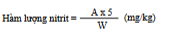
Where:
X Chemical name: Sodium nitrite
- Electronic Information Portal CAS number:
DIRECTOR OF THE STATE BANK OF VIETNAM
Formula: NaNO₂Molecular weight:
1. Other names, index
Form: White powder, granules, or small rods, translucent white or slightly yellow. It easily absorbs moisture and liquefies when exposed to air...
5 Technical requirements
: Dissolves freely in water, slightly soluble in alcohol.
2. Definition
Sodium: Must have characteristic reactions of sodium. 2025; BASED ON THE EDUCATION LAW dated June 14, 2019;Nitrite: Must have characteristic reactions of nitrite.
5.2 Purity: Not more than 0.25% (on silica gel, 4 hours): 7632-00-0
Chemical formula: : Not less than 97.0% calculated on the dry basis. Select the sample size and method of sample preparation based on the principles described in the part on analytical methods.
TECHNICAL REQUIREMENTS AND TESTING METHODS FOR SODIUM NITRATESodium nitrate; Saltpeter, Chile saltpetre, Cubic nitre, or Soda nitre: 69,00
3. Sensory characteristics
INS 251
4. Function
Color retention agent, antimicrobial preservative.
ADI = 0 – 3.7 mg/kg body weight (Should not be used for infants under 3 months old)Chemical name: Sodium nitrate
5.1. Qualitative analysis
SolubilityCAS number: 7631-99-4
Formula: NaNO₃iMolecular weight: 85.00
NitriteAppearance: Colorless, transparent crystals, or white crystalline powder or granules, liquefies when exposed to humid air.
Solubility: Easily soluble in water, slightly soluble in alcohol.Sodium: Must have characteristic reactions of sodium.
: Not more than 3.0% (on silica gelNitrate: Must have characteristic reactions of nitrate. Loss on drying: Not more than 2.0% (105°C, 4 hours)
: Not more than 2.0 mg/kg.5.3. Content
: Not less than 95.0% calculated on dry basis : Not less than 97.0% calculated on the dry basis. Select the sample size and method of sample preparation based on the principles described in the part on analytical methods.Nitrite: Not more than 30.0 mg/kg.
6.1. Purity
Test according to the guidance at
: Not more than 2.0 mg/kg.:
-
JECFA monograph 1 - Vol. 4 Use suitable atomic absorption techniques to determine. Select sample size and sample preparation method based on the principles described in.
-
Use appropriate atomic absorption techniques to determine. Select the sample size and sample preparation method based on the principles described in Lead: Not more than 2.0 mg/kg.5.3 Sodium nitrate content: Not less than 99.0% calculated on the dry basis. Use suitable atomic absorption techniques to determine. Select sample size and sample preparation method based on the principles described in 6.1 Test for purity- Follow the guidance at JECFA monograph 1 - Vol. 4.equipment.
6.2 Quantification
- Determine using suitable atomic absorption techniques for the specified content. The sample weight can be selected based on the principle of the method described in JECFA monograph 1 - Vol. 4 part on analytical methods.
Where:
X Chemical name: Sodium nitrite
- Electronic Information Portal CAS number:
Tel:
Principle:
Determined by spectrophotometric method using the reaction between nitrite, sulfanilamide, and N-(1-naphthyl)-ethylenediamine dihydrochloride to form a pink complex. Measure the absorbance of the solution at wavelength 540 nm.
1. Other names, index
Reagents.
- Sulfanilamide solution: Dissolve 2 g of sulfanilamide in 1000 ml of diluted hydrochloric acid (TS).
Combined reagent: Dissolve 0.2 g of N-(1-naphthyl)-ethylenediamine dihydrochloride in distilled water and dilute to 100 ml. Store away from light in brown glass bottles and keep refrigerated.
2. Definition
Nitrite standard: Dissolve 0.750 g of sodium nitrite (previously dried for 4 hours on silica gel) in distilled water and dilute to 1000 ml (500 μg nitrite/ml). Take 10 ml of this solution and dilute to 100 ml with distilled water (50 μg nitrite/ml). Finally, take 10 ml of this solution and dilute with distilled water to 1000 ml, yielding the working standard (0.5 μg nitrite/ml).
Procedure:
Prepare calibration curve
Sequentially take 0; 5 ml; 10 ml; 20 ml; 50 ml of the working standard solution into 100 ml volumetric flasks and dilute with distilled water to 80 ml (corresponding to 0; 2.5; 5; 10; 25 μg nitrite). Add 10 ml of sulfanilamide solution to each flask, shake well. Let stand for 3 minutes and add 1 ml of combined reagent sequentially to each flask, dilute to the mark with distilled water, shake well, and let stand for 15 minutes.
3. Sensory characteristics
Measure the absorbance of the solutions against distilled water at wavelength 540 nm using a 10 mm cuvette. Plot a calibration curve showing the dependence of absorbance on the amount of nitrite in the solution (the calibration curve must be linear).
4. Function
Color retention agent, antimicrobial preservative.
5. Technical requirements
5.1. Qualitative analysis
Conduct the test
Weigh approximately 1 g of sample (accurate to mg). Dissolve and dilute to 100 ml with distilled water. Using a pipette, draw 20 ml of the solution and add it to a 100 ml volumetric flask and dilute with distilled water to about 80 ml. Add 10 ml of sulfanilamide solution, shake well. Let stand for 3 minutes and add 1 ml of combined reagent, dilute to the mark with distilled water, shake well, and let stand for 15 minutes. Measure the absorbance of the test solution against distilled water at wavelength 540 nm using a 10 mm cuvette. Based on the calibration curve and the measured absorbance of the test solution, calculate the amount of nitrite in the test solution.
Report results
Loss on drying
A = Amount of nitrite read from the calibration curve (μg)
W = Weight of the test sample (g)
6.2 Quantification
Weigh approximately 0.4 g of dried blood sample (accurate to 0.1 mg), dissolve in 300 ml of distilled water in a 500 ml round-bottom flask. Add 3 g of Devarda's alloy powder and 15 ml of 2/5 strength sodium hydroxide solution. Fit the round-bottom flask with a reflux condenser and anti-bumping device. Let stand for about 2 hours. Add 50 ml of 0.1 N sulfuric acid solution to the receiving flask, distill and collect about 250 ml of distilled water. Titrate the excess sulfuric acid with 0.1 N sodium hydroxide solution using methyl red/methylene blue indicator (TS). Perform a blank test in the same manner as the sample and adjust the result if necessary.
6.1. Purity
Each ml of 0.1 N sulfuric acid solution is equivalent to 8.5 mg NaNO₂.
: Not more than 2.0 mg/kg.
TECHNICAL REQUIREMENTS AND TESTING METHODS FOR POTASSIUM NITRATE
INS 252
Nitrite
ADI=0-3.7 mg/kg body weight (Should not be used for infants under 3 months old).
Chemical name: Potassium nitrate
CAS number: 7757-79-1
Formula: KNO₃
Nitrite standard: Dissolve 0.750 g sodium nitrite (previously dried for 4 hours on silica gel) in distilled water and dilute to 1000 ml (500 µg nitrite/ml). Take 10 ml of this solution and dilute with distilled water to 100 ml (50 µg nitrite/ml). Finally, take 10 ml of this solution and dilute with distilled water to 1000 ml, yielding the working standard (0.5 µg nitrite/ml).
Procedure:
Construct the calibration curve
Sequentially transfer 0 ml; 5 ml; 10 ml; 20 ml; 50 ml of the working standard solution into 100 ml volumetric flasks and dilute with distilled water to 80 ml (corresponding to 0; 2.5; 5; 10; 25 µg nitrite). Add 10 ml sulfanilamide solution to each flask, shake well. Allow to stand for 3 minutes and then add 1 ml of the combined reagent sequentially to each flask, dilute to the mark with distilled water, shake well, and allow to stand for 15 minutes.
Measure the optical absorbance of the standard solutions against distilled water at a wavelength of 540 nm using a 10 mm cuvette. Construct a calibration curve representing the dependence of optical absorbance on the amount of nitrite in the solution (the calibration curve must be linear).
Conduct the test
Weigh approximately 1 g of the sample (accurate to mg). Dissolve and dilute to 100 ml with distilled water. Using a pipette, draw 20 ml of the solution, transfer it to a 100 ml volumetric flask, and dilute with distilled water to about 80 ml. Add 10 ml of sulfanilamide solution, shake well. Allow to stand for 3 minutes and then add 1 ml of the combined reagent, dilute to the mark with distilled water, shake well, and allow to stand for 15 minutes. Measure the optical absorbance of the test solution against distilled water at a wavelength of 540 nm using a 10 mm cuvette. Based on the calibration curve and the measured optical absorbance of the test solution, calculate the amount of nitrite in the test solution.
Report the results
A = Amount of nitrite read from the calibration curve (µg)
W = Weight of the test sample (g)
6.2 Quantification
Where:
Weigh approximately 0.4 g of dried blood sample (accurate to 0.1 mg), dissolve in 300 ml of distilled water in a 500 ml round-bottom flask. Add 3 g Devarda alloy powder and 15 ml of 0.2N sodium hydroxide solution. Fit the round-bottom flask with a reflux condenser and anti-splash device. Allow to stand for about 2 hours. Add 50 ml of 0.1N sulfuric acid solution to the distillation receiver, proceed with distillation and collect approximately 250 ml of distilled water. Titrate the excess sulfuric acid with 0.1N sodium hydroxide solution using methyl red/methylene blue indicator (TS). Perform a blank test in the same manner as for the test sample and adjust the results if necessary.
Each milliliter of 0.1N sulfuric acid solution is equivalent to 8.5 mg NaNO2.
TECHNICAL REQUIREMENTS AND TESTING METHODS FOR POTASSIUM NITRATE
INS 252
ADI=0-3.7 mg/kg body weight (Do not use nitrate for infants under 3 months old).
Number of Agents
Chemical name Potassium nitrate
1. Other names, index
CAS number 7757-79-1
Chemical formula KNO3
2. Definition
Weigh approximately 0.4 g (accurate to mg) of dried blood sample at 105°C for 4 hours, dissolve in 300 ml of distilled water in a 500 ml round-bottom flask. Add 3 g Devarda alloy powder and 15 ml of 0.2N sodium hydroxide solution. Fit the round-bottom flask with a reflux condenser and anti-splash device. Allow to stand for about 2 hours. Add 50 ml of 0.1N sulfuric acid solution to the distillation receiver, proceed with distillation and collect approximately 250 ml of distilled water. Titrate the excess sulfuric acid with 0.1N sodium hydroxide solution using methyl red/methylene blue indicator (TS). Perform a blank test in the same manner as for the test sample and adjust the results if necessary.
Each milliliter of 0.1N sulfuric acid solution is equivalent to 10.11 mg KNO3.
Chemical formula KNO,
Molecular weight 101.11
3. Sensory characteristics
Crystalline form: transparent prism, colorless, odorless, or white powder or granules.
4. Function
Color retention agent, antimicrobial preservative.
5. Technical requirements
5.1. Qualitative analysis
Solubility: Soluble in water, slightly soluble in alcohol.
Potassium: Must have characteristic reactions of potassium.
Report results
Loss on drying
Loss on drying: Not more than 1% (at 105°C for 4 hours)
Nitrite: Not more than 20.0 mg/kg
Lead: Not more than 2.0 mg/kg.
5.3. Content of KNO:
Not less than 99.0% calculated on the dry basis of the preparation.
6.1. Purity
Test according to the guidance at
Nitrite
ADI=0-3.7 mg/kg body weight (Should not be used for infants under 3 months old).
Determined by photometric method using the reaction between nitrite, sulfanilamide, and N-(1-naphthyl)-ethylenediamine dihydrochloride in water to form a pink complex, measuring the optical absorbance of the solution at a wavelength of 540 nm.
Test according to the guidance in JECFA Monograph 1 - Vol. 4. Use suitable atomic absorption techniques for determination. The mass of the sample can be based on the principles described in JECFA Monograph 1 - Vol. 4 section on analytical tool methods.
6.2 Quantification
Where:
Weigh approximately 0.4 g (accurate to mg) of dried blood sample at 105°C for 4 hours, dissolve in 300 ml of distilled water in a 500 ml round-bottom flask. Add 3 g of Devarda's alloy powder and 15 ml of 0.2/5 sodium hydroxide solution. Fit the round-bottom flask with a condenser and anti-blowout device. Allow to stand for about 2 hours. Add 50 ml of 0.1N sulfuric acid solution to the receiving flask, perform distillation and collect approximately 250 ml of distilled water. Titrate the excess sulfuric acid with 0.1N sodium hydroxide solution using methyl red/methylene blue indicator (TS). Perform blank tests as done for the sample and calibrate results if necessary.
Each milliliter of 0.1N sulfuric acid solution is equivalent to 8.5 mg NaNO2.
: Not more than 2.0 mg/kg.
Each ml of 0.1N sulfuric acid solution is equivalent to 10.11 mg KNO.
6.2 Quantification
Weigh approximately 0.4 g (accurate to mg) of the dried blood sample at 105°C for 4 hours, dissolve it in 300 ml of distilled water in a 500 ml flask. Add 3 g of Devada metal powder and 15 ml of sodium hydroxide solution (concentration 2/5). Fit the flask with a reflux condenser and a safety overflow device. Let it stand for about 2 hours. Add 50 ml of 0.1N sulfuric acid solution to the receiving flask, distill and collect approximately 250 ml of distilled liquid. Titrate the excess sulfuric acid with 0.1N sodium hydroxide solution using methyl red/methylene blue indicator (TS). Perform a blank test in the same manner as for the sample and calibrate the results if necessary.
Each ml of 0.1N sulfuric acid solution is equivalent to 10.11 mg KNO,.
Văn bản gốc (PDF)
Bản đồ quan hệ
Bấm vào một văn bản để mở. Viền đỏ = quan hệ làm thay đổi hiệu lực.
Bản dịch
Văn bản này có sẵn ở các ngôn ngữ sau: