
Circular No. 32/2015/TT-BTTTT promulgates the National Technical Regulation on Electromagnetic Compatibility for Short Range Radio Devices in the Frequency Band from 9 kHz to 40 GHz, applicable to agencies, organizations, and individuals producing, trading, and operating such devices in Vietnam. The regulation stipulates emission, immunity, testing conditions, quality criteria evaluation, and classification of the devices.
적용 범위
Agencies, organizations, and individuals producing, trading, and operating short range radio devices in the frequency band from 9 kHz to 40 GHz in Vietnam.
핵심 사항
- Short Range Devices (SRD) must comply with regulations on emissions and immunity within the frequency range from 9 kHz to 40 GHz.
- Emission: Comply with QCVN 18:2014/BTTTT, applying exclusion bands for transmitters operating below 30 MHz.
- Immunity: Comply with QCVN 18:2014/BTTTT, with specific requirements regarding frequency step width and testing methods.
- Testing Conditions: SRD devices are divided into three groups based on technical characteristics, specifying signal test arrangements for transmitters and receivers.
- Quality Criteria: Devices are classified into three types based on their impact on people and/or objects when not meeting electromagnetic compatibility (EMC) exposure criteria.
- Management: Organizations and individuals are responsible for implementing conformity certification and declaration for electromagnetic compatibility of SRD devices.
🌐 이 문서의 사회적 영향
- Positive Impact: Ensures safety for people and the environment when using short-range radio devices.
- Negative Impact: May impose financial burdens on businesses in complying with technical standards.
- Who benefits: Citizens, businesses producing and trading SRD devices.
- Who is affected: Organizations and individuals using or producing SRD devices.
❓ 자주 묻는 질문
To which type of equipment does this standard apply?
This standard applies to short range radio devices in the frequency band from 9 kHz to 40 GHz and related auxiliary equipment.
Are there requirements for exclusion bands?
Yes, for transmitters operating below 30 MHz, the exclusion bands are ±2 MHz (Type 1), ±3 MHz (Type 2), and ±5 MHz (Type 3).
Are there requirements for the RF signal level into the receiver?
Yes, the RF signal level into the receiver must be significantly higher than the receiver sensitivity threshold but lower than the receiver measurement sensitivity.
How many groups are SRD devices divided into under this standard?
This standard divides SRD devices into three groups based on technical characteristics: data communication, audio transmission, and other types.
Are there requirements for evaluating quality criteria for auxiliary equipment?
Yes, this standard specifies the method for evaluating quality criteria for related auxiliary equipment that is tested independently.
전문
AND COMMUNICATIONS
Independence - Freedom - Happiness
CIRCULAR
Issuing "National Technical Regulation on Electromagnetic Compatibility for Short Range Devices Operating in the Frequency Band from 9 kHz to 40 GHz"
The Minister of Information and Communications issues this Circular to stipulate the National Technical Regulation on Electromagnetic Compatibility for Short Range Devices Operating in the Frequency Band from 9 kHz to 40 GHz.
________________________
Pursuant to the Law on Standards and Technical Regulations dated June 29, 2006;
Pursuant to the Law on Telecommunications dated November 23, 2009;
WHEREAS, Decree No. 127/2007/NĐ-CP dated August 1, 2007 of the Government detailing and guiding the implementation of certain provisions of the Law on Technical Standards and Regulations;
Based on Decree No. 132/2013/ND-CP dated October 16, 2013 of the Government on the functions, tasks, powers, and organizational structure of the Ministry of Information and Communications;
Pursuant to the proposal of the Director of the Science and Technology Department,
This Circular issues the National Technical Regulation on Electromagnetic Compatibility for Short Range Devices Operating in the Frequency Band from 9 kHz to 40 GHz.
Article 1. Attached to this Circular is the National Technical Regulation on Electromagnetic Compatibility for Short Range Devices Operating in the Frequency Band from 9 kHz to 40 GHz (QCVN 96:2015/BTTTT).
Article 2. This Circular takes effect from June 1, 2016.
Article 3. The Heads of the Office, Department Heads of Science and Technology, Heads of Departments under the Ministry of Information and Communications, Directors of Provincial Departments of Information and Communications, and relevant organizations and individuals shall be responsible for implementing this Circular./.
|
THE MINISTER
(Signed)
Nguyen Bac Son
|
NATIONAL TECHNICAL REGULATION ON ELECTROMAGNETIC COMPATIBILITY FOR SHORT RANGE DEVICES OPERATING IN THE FREQUENCY BAND FROM 9kHz TO 40 GHz
National technical regulation on electromagnetic compatibility for Short Range Devices (SRD) operating on frequencies between 9 kHz and 40 GHz
Chapter 1. GENERAL PROVISIONS
1.1. Scope of Application
This regulation sets out requirements for electromagnetic compatibility (EMC) for various types of short-range devices (SRD) and related auxiliary equipment operating in the frequency band from 9 kHz to 40 GHz.
This regulation specifies testing conditions, evaluation criteria, and quality standards for short-range devices (SRD) and related auxiliary equipment.
Technical specifications related to antenna ports and emissions from enclosure ports of radio devices are not within the scope of this regulation but will be defined in corresponding product standards and regulations to effectively utilize radio frequencies.
1.2. Applicability
This technical regulation applies to domestic and foreign agencies, organizations, and individuals engaged in production, business, and exploitation of devices within the scope of this regulation on Vietnamese territory.
1.3. Referenced Documents
ITU-R Recommendation F.746-3: "Radio-frequency channel arrangements for radio-relay systems".
QCVN 55:2011/BTTTT, National Technical Regulation on Short Range Devices Operating in the Frequency Band 9 kHz - 25 MHz.
QCVN 73:2013/BTTTT, National Technical Regulation on Short Range Devices Operating in the Frequency Band 25 MHz - 1 GHz.
QCVN 74:2013/BTTTT, National Technical Regulation on Short Range Devices Operating in the Frequency Band 1 GHz - 40 GHz.
1.4. Terms and Definitions
1.4.1. Auxiliary Equipment
Equipment used in connection with receivers or transmitters.
NOTE: An item of equipment is considered auxiliary equipment when:
It is used in conjunction with a receiver or transmitter to provide additional operational and/or control functions for the radio communication equipment (for example, to extend control to another location or area), and
- It cannot be used independently to create independent usage functions of a receiver or transmitter, while
- The receiver/transmitter it connects to can perform certain operations such as transmission and/or reception without the auxiliary equipment (meaning it is not a necessary sub-component of the main equipment to maintain the basic function of the main equipment).
1.4.2. Base Station Equipment
Radio communication equipment and/or auxiliary equipment installed at a fixed location and powered directly or indirectly (that is, through the power grid or AC/DC power converter) by the power grid or local DC power network.
1.4.3. Combined Equipment
Any equipment capable of performing two or more functions. NOTE: At least one of these functions falls within the scope of the R&TTE Directive and has a radio transmission function. The result of this combination is to provide control and/or additional functions for the combined equipment.
1.4.4. Continuous Phenomenon (Continuous Interference)
Electromagnetic interference whose effects on specific equipment or installations cannot be classified among known effects.
1.4.5. Enclosure Port
The physical boundary of the equipment where electromagnetic fields can radiate and affect.
NOTE: In the case of equipment with an integral antenna, this port is not separate from the antenna port.
1.4.6. Integral Antenna
An antenna that cannot be detached during testing according to the manufacturer's declaration.
1.4.7. Mobile Equipment
A receiver, transmitter, or transceiver installed and used on a vehicle and supplied with power from the vehicle's main battery.
1.4.8. Multi-Radio Equipment
Radio equipment comprising two or more transmitters and/or receivers using different technologies that can operate simultaneously.
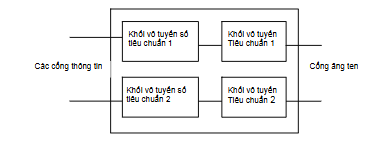
1.4.9. Operating Frequency Range
The frequency band or bands determined by the equipment under test (EUT) with its complete block configuration.
1.4.10. Port
A specific interface of the equipment (device) with an electromagnetic environment. NOTE: Any point of connection on a device used to connect cables to/from the device is considered a port (see Figure 1)
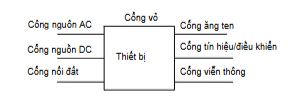
Figure 1. Ports of the equipment
1.4.11. Primary Function
The function of a device declared by the manufacturer as the primary function of the device.
1.4.12. Radio Communication Equipment
Information equipment comprising one or more transmitters and/or receivers and/or parts thereof used in fixed, mobile, or portable applications.
NOTE: The equipment may operate with auxiliary equipment, but in that case it does not depend on such equipment for its basic function.
1.4.13. Removable Antenna
An antenna that can be detached during testing according to the manufacturer's declaration.
1.4.14. Telecommunication Port
A telecommunication/network port is a point of connection for voice, data, and signaling used to link widely distributed systems through direct connections to telecommunications networks (such as public switched telephone networks, integrated services digital networks, digital leased lines, etc.), local area networks (such as Ethernet, Token Ring, etc.), and similar networks.
NOTE: Ports used to link system components (EUT) to RS 232, IEEE1284 (parallel printer), bus compliant with Appendix B, IEEE 1394 ("Fire Wire"), etc., and their appropriate use (such as the maximum cable length connected to the port) are not considered telecommunication ports under this definition.
1.4.15. Receiver
A single receiver or a receiver part of a transceiver system.
1.4.16. Transmitter
A single transmitter or a transmitter part of a transceiver system.
1.4.17. Transient phenomena
Phenomena changing between two consecutive stable states within a short period compared to the observation period.
1.4.18. Short range device (SRD)
Equipment with a range primarily or entirely emitting for purposes of warning, communication, and remote access control... Equipment using all types of modulation to transmit sound (voice/music) or data (analog/digital) or both sound (voice/music) and data (analog/digital).
1.5. Abbreviations
|
CRF |
Continuous phenomenon for receiver |
Continuous phenomena applied to Receivers |
|---|---|---|
|
is the metering cost for the year |
Continuous phenomenon for transmitter |
Continuous phenomena applied to Transmitter |
|
dB |
Decibel |
Operating frequency |
|
EMC |
ElectroMagnetic Compatibility |
ElectroMagnetic Compatibility |
|
EUT |
Equipment requiring measurement and testing |
Equipment Under Test |
|
f |
Structure |
Signal-to-noise ratio |
|
RF |
Radio Frequency |
Radio Frequency |
|
rms |
Root Mean Square |
Root Mean Square |
|
SINAD |
Ratio of (signal+noise+distortion) to (noise+distortion) |
SRD |
|
Short Range Device |
Short range equipment |
Short Range Device |
|
TR |
Receiver Spurious Emission Phenomenon |
Transient phenomena applied to Receiver |
|
No. |
Transmitter Spurious Emission Phenomenon |
Apply Table 4 of QCVN 18:2014/BTTTT for immunity testing of ports of equipment and/or related auxiliary devices. |
Chapter 2. TECHNICAL PROVISIONS
2.1. Radiation
Emission requirements comply with Section 2.1 in QCVN 18:2014/BTTTT.
For the measurement method in Sections 2.1.4 and 2.1.5 in QCVN 18:2014/BTTTT, the exclusion band for transmitters applies when the transmitter operates at frequencies below 30 MHz.
2.2. Immunity
Immunity requirements comply with Section 2.2 in QCVN 18:2014/BTTTT. In addition, there are the following requirements:
- For the test method in Section 2.2.3 in QCVN 18:2014/BTTTT. The frequency step width depends on the type of equipment:
- For Type 1 and 2 equipment, the frequency step must be 1% of the mandatory operating frequency;
- For Type 3 equipment, the frequency step must be 10% of the mandatory operating frequency.
- For the test method in Section 2.2.6 in QCVN 18:2014/BTTTT. The frequency step width depends on the type of equipment:
- For Type 1 and 2 equipment, the frequency step must be 1% of the mandatory operating frequency in the frequency range from 5 MHz to 80 MHz;
- For Type 3 equipment, the frequency step must be 10% of the mandatory operating frequency in the frequency range from 5 MHz to 80 MHz.
- For the test method in Section 2.2.8 in QCVN 18:2014/BTTTT. The evaluation criteria depend on the type of equipment.
- For the power supply drop corresponding to a 30% reduction in power supply over 10 ms for the evaluation criterion CT or CR.
- For the voltage drop corresponding to a 60% reduction in power supply over 100 ms for the evaluation criterion CT.
- For Type 1 transmitter, the evaluation criterion CT.
- For Type 2 and 3 transmitters, the evaluation criterion CT.
- For Type 1 receiver, the evaluation criterion CR.
- For Type 2 and 3 receivers, the evaluation criterion CR.
For voltage interruption in Section greater than 95% in 5000 ms, apply the evaluation criterion TT or TR.
2.3.1. General Provisions
For the purposes of this standard, test conditions in Appendix A of QCVN 18:2014/BTTTT may be applied when appropriate. This standard supplements additional provisions regarding test conditions for fixed radio transmission equipment and auxiliary equipment in fixed services.
The equipment must be tested under normal conditions corresponding to product standards and basic equipment standards, or must comply with the information provided, including the manufacturer's declaration of humidity, temperature, and power supply ranges. Testing conditions must be recorded in the testing report.
The testing configuration and operational mode of the equipment must reflect usage scenarios (operation and retransmission) during testing.
To test radiation and immunity, common modulation bands and signal arrangement methods must follow Sections 2.3.1 to 2.3.5.
If the antenna of the equipment under test (EUT) is detachable, it must be tested with the commonly used antenna, unless otherwise specified.
In this standard, SRD equipment is divided into three groups based on technical characteristics of the equipment (Table 1).
Table 1. Grouping according to technical characteristics of the equipment
|
Group |
Technical characteristics of the equipment |
|
I |
Transmitting data signals (digital or analog) |
|
II |
Transmitting sound (voice or music) |
|
III |
Other types of equipment |
2.3.2. Signal measurement arrangement
Comply with Section A.2 in QCVN 18:2014/BTTTT.
2.3.2.1. Signal arrangement at the input of the transmitter
Comply with Section A.2.1 in QCVN 18:2014/BTTTT.
The transmitter must be modulated with the common test modulation type prescribed for the type of equipment (see Section 2.3.5). If the transmitter does not have an external modulation port, direct modulation on the equipment must be used.
2.3.2.2. Signal arrangement at the output of the transmitter
Comply with Section A.2.2 in QCVN 18:2014/BTTTT.
If there are no specific regulations for each type of equipment, the required RF output signal level when transmitting must be set at the maximum RF output power for the EUT for the common modulation type, as specified in Section 2.3.5.
2.3.2.3. Signal arrangement at the input of the receiver
Comply with Section A.2.3 in QCVN 18:2014/BTTTT.
The RF signal needed to couple with the receiver must be modulated with the common test modulation signal as prescribed for the type of equipment (see Section 2.3.5).
The required RF signal level at the receiver input must be higher than the receiver sensitivity threshold but lower than the receiver's sensitivity level.
2.3.2.4. Signal arrangement at the output of the receiver
Comply with Section A.2.4 in QCVN 18:2014/BTTTT.
2.3.2.5. Test arrangement and simultaneous transmission (as a system)
Comply with Section A.2.5 in QCVN 18:2014/BTTTT.
The receiver and transmitter can be tested together to see if they are compatible. In such cases, the receiver and transmitter must be placed in the test environment and exposed simultaneously to EMC phenomena.
Instead of coupling the transmitter output signal to an external measuring device outside the test environment, this signal is coupled inside the test environment to the receiver input through an external signal attenuator of the receiver (if necessary).
2.3.3 Excluded bands
Comply with Section A.3 in QCVN 18:2014/BTTTT.
Frequencies that the SRD equipment intends to operate on must be excluded from radiation and immunity measurements.
Frequencies that the SRD transmitter intends to operate on must be excluded from radiation emission and co-channel emission measurements in transmission mode. There is no exclusion band applied for SRD receiver radiation measurements and related auxiliary equipment.
Radiation and immunity in the exclusion frequency bands are defined in Sections 2.3.3.1 and 2.3.3.2.
2.3.3.1. Exclusion frequency bands for receivers
Exclusion frequency bands for receivers (including when the receiver is part of a transceiver) intended to be used in frequency bands with channel allocation are determined as follows:
- For receivers that can only operate on one frequency and do not have a bandwidth, the lower frequency of the excluded frequency band is the lower frequency of the operating frequency channel minus the expansion value given in Table 2, the higher frequency of the excluded frequency band is the higher frequency of the operating frequency channel plus the expansion value given in Table 2. The calculation of the expansion value must be based on the operating frequency.
- For receivers that can only operate on one frequency and have a bandwidth, the lower frequency of the excluded frequency band is the lower frequency of the bandwidth minus the expansion value given in Table 2, the higher frequency of the excluded frequency band is the higher frequency of the bandwidth plus the expansion value given in Table 2. The calculation of the expansion value must be based on the center frequency of the bandwidth. However, if the bandwidth exceeds 10% of the higher frequency of the bandwidth, then the calculated expansion value must be based on 10% of the higher value of the bandwidth.
- For receivers capable of operating on multiple frequencies within a frequency band with a width less than 20% of the center frequency of the exploitation band, the lower frequency of the excluded band is the lower frequency of the operating frequency band minus the expansion value given in Table 2, the higher frequency of the excluded band is the higher frequency of the operating frequency band plus the expansion value given in Table 2. The calculation of the expansion value must be based on the center frequency of the exploitation frequency band.
- For receivers capable of operating on various frequencies within the entire frequency band, wider than the aforementioned frequency band, the immunity test must be conducted at selected frequencies. These selected frequencies must fall within three points in logarithmic scale of the frequency band. For each test frequency, the lower frequency of the excluded frequency band is the lower frequency of the test frequency channel minus the expansion value given in Table 2, the higher frequency of the excluded frequency band is the higher frequency of the test frequency channel plus the expansion value given in Table 2. The calculation of the expansion value must be based on the test frequency used.
For wideband receivers, for example, receivers operating in non-channelized frequency bands, the lower frequency of the excluded frequency band is the lower frequency of the intended exploitation band minus the expansion value given in Table 2, the higher frequency of the excluded frequency band is the higher frequency of the intended exploitation band plus the expansion value given in Table 2, or the total excluded band equals twice the receiver's operating frequency band centered around the center frequency of the intended exploitation band, but the larger value must be chosen.
Table 2. Excluded Frequency Band for SRD Equipment
Receiver Frequency f₀
Excluded Frequency Band for SRD EquipmentType 1 ReceiverType 2 ReceiverType 3 Receiver< 300 kHz f₀ ±200 kHz (1)f₀ ±300 kHz (1)f₀ ±300 kHz (1)300 kHz to < 30 MHzf₀ ±2 MHz (1)f₀ ±3 MHz (1)f₀ ±5 MHz (1)30 MHz to < 1 GHzf₀ ±10 MHz, or ±2%, whichever is greaterf₀ ±15 MHz, or ±5%, whichever is greaterf₀ ±15 MHz, or ±10%, whichever is greater 1 GHz to 2.7 GHz f₀ ±75 MHz (2)f₀ ±100 MHz (2)f₀ ±300 MHz (2)(1) Measurement shall not be performed below 150 kHz.(2) Frequencies exploited at 2.7 GHz do not require an excluded frequency band and immunity testing above 2.7 GHz is not required.
2.3.3.2. Excluded Frequency Band for Transmitters
For transmitters exploiting or intended to exploit in frequency bands with channels, the excluded frequency band must equal three times the maximum bandwidth occupied for that service, centered around the exploitation frequency.
For wideband transmitters, i.e., transmitters in non-channelized frequency bands, the excluded frequency band must equal twice the intended usage frequency band, centered around the center frequency of the exploitation frequency band.
In cases where the receiver and transmitter are tested together as a system, the excluded frequency band for the receiver and for the transmitter must be determined separately, and the larger value must be chosen.
2.3.4. Narrowband Reception Response
Follow Section A.4 in QCVN 18:2014/BTTTT
2.3.5. Normal Modulation Testing
For Group 1 equipment, the RF carrier must be modulated by a test signal representing selected information signals used. The selected test signal may contain both error separation and correction components. For transmitters without modulation inputs, the internal modulation of the equipment must be used.
For Group II equipment (audio transmission devices):
- The necessary signal into the test receiver must be established at the designated receiving frequency, modulated by a 1000 Hz sine wave audio tone with a depth of modulation of 60% of the peak modulation level of the system:
For Group III transmitters, the manufacturer must clearly specify the normal modulation type.
2.4. Evaluation criteria
2.4.1 General
Follow Section B.1 in QCVN 18:2014/BTTTT
The manufacturer must provide additional product-related information, including:
- Device sub-group classification according to Table 1 (see Section 2.3.1);
- Device classification according to the manufacturer's published classification in Table 3 (see Section 2.5.1)
Quality criteria evaluation depends on the device sub-group classification (see Section 2.3.1)
For equipment, quality criteria evaluation is based on:
- Maintaining operational function:
- The method by which lost functions can be restored
- The states of the EUT device.
Additionally:
- For Group 1 devices: it must be able to access the equipment criteria through monitoring (observation) of the receiver's reaction;
- For Group II devices: the reduction of criteria during the immunity test is indicated by the minimum SINAD value, expressed in dB;
- For Group III devices: the manufacturer must specify the method of measuring the reduction of criteria and the way to represent the measured values.
2.4.2. Equipment Capable of Providing Continuous Information Connection
Follow Section B.2 in QCVN 18:2014/BTTTT
2.4.3. Equipment Unable to Provide Continuous Information Connection
Follow Section B.3 in QCVN 18:2014/BTTTT
For equipment in Group III, the manufacturer must always specify testing methods to evaluate the actual levels of performance criteria or the reduction in performance criteria before and after exposure to electromagnetic compatibility (EMC).
2.4.4. Auxiliary Equipment
Follow Section B.4 in QCVN 18:2014/BTTTT.
2.4.5. Equipment classification
Follow Section B.5 in QCVN 18:2014/BTTTT.
2.5.1. Quality Criteria for Continuous Phenomena applicable to Transmitters (CT) and Receivers (CR)
2.5.1. Classification of SRD Equipment
According to quality criteria, SRD product families are divided into three types of equipment, each type having a series of minimum quality criteria. Such classification is based on the degree of impact on humans and/or objects when these devices operate outside the minimum quality criteria for exposure to electromagnetic compatibility (EMC).
Table 3 - Evaluation Based on Information Reception Performance
|
Type of Equipment |
Evaluation Based on Information Reception Performance |
|---|---|
|
1 |
The SRD communication environment has high reliability; systems serving humans (potentially dangerous physically to users) |
|
2 |
The SRD communication environment has moderate reliability; may cause inconvenience to users but cannot be resolved by simple measures |
|
3 |
The SRD communication environment has standard reliability; may cause inconvenience to users and can be resolved by simple measures (e.g., manual intervention) |
2.5.2. Common Quality Criteria
Quality criteria for different types of SRD equipment (see Table 3) are used in conjunction with different types of equipment before and after immunity testing as specified in the following sections:
- Quality criterion A for continuous interference immunity tests;
- Quality criterion B for intermittent interference immunity tests;
- Quality criterion for immunity tests where power supply surges exceed the time period specified in Section 2.2.
Equipment must meet the quality criteria specified in the following sections for the respective types of SRD equipment.
2.5.3. Table of Quality Criteria
Table 4. Quality Criteria
|
Type 1 Equipment |
||
|---|---|---|
|
Criteria |
During Testing |
After Testing |
|
A |
Operates as intendedNo loss of functionFor Group II equipment, signal quality must reach 12 dB SINADNo unintended response |
Operates as intendedFor Group II equipment, communication link must be maintainedNo loss of functionNo degradation in qualityNo loss of data or user-programmed functions |
|
B |
May lose one or more functionsNo unintended responses |
Operates as intendedLost functions can self-recoverNo degradation in qualityNo loss of data or user-programmed functions |
|
Type 2 Equipment |
||
|---|---|---|
|
Criteria |
During Testing |
After Testing |
|
A |
Operates as intendedNo loss of functionFor Group II equipment, signal quality must reach 12 dB SINADNo unintended response |
Operates as intendedFor Group II equipment, communication link must be maintainedNo loss of functionNo degradation in qualityNo loss of data or user-programmed functions |
|
B |
May lose one or more functionsNo unintended responses |
Operates as intendedLost functions can self-recoverNo degradation in qualityNo loss of data or user-programmed functions |
|
Type 3 Equipment |
||
|---|---|---|
|
Criteria |
During Testing |
After Testing |
|
A and B |
May lose one or more functionsNo other unintended responses |
Operates as intendedFor Group II equipment, communication link may be lost but can be recovered by the userNo degradation in qualityLost functions must self-recover |
2.5.4. Quality Criteria for Continuous Phenomena Applicable to Transmitters (CT)
For equipment in Groups I and II, including related auxiliary equipment tested independently, Section 2.5.3 regarding quality criterion A of the applicable equipment type must be applied.
For equipment in Groups II and III that require maintenance of the communication link throughout the testing process, the manufacturer must provide appropriate means to verify that the communication link is maintained during each exposure test in the series of tests.
If the EUT is a transmitter, the tests must be repeated with the EUT in standby mode and it must be confirmed that the transmission state does not operate at this time.
2.5.5. Quality Criteria for Intermittent Phenomena Applicable to Transmitters (TT)
For equipment in Groups I and II, including related auxiliary equipment tested independently, Section 2.5.3 regarding quality criterion B of the applicable equipment type must be applied, except in cases where power interruptions exceed the time period specified in Section 2.2.
For equipment in Groups II and III that require maintenance of the communication link throughout the testing process, the manufacturer must provide appropriate means to verify that the communication link is maintained during each exposure test in the series of tests.
If the EUT is a transmitter, the tests must be repeated with the EUT in standby mode and it must be confirmed that the transmission state does not operate at this time.
2.5.6. Quality Criteria for Continuous Phenomena Applicable to Receivers (CR)
For equipment in Groups I and II, including related auxiliary equipment tested independently, Section 2.5.3 regarding quality criterion A of the applicable equipment type must be applied.
For equipment in Groups II and III that require maintenance of the communication link throughout the testing process, the manufacturer must provide appropriate means to verify that the communication link is maintained during each exposure test in the series of tests.
In all conditions, if the EUT is a transceiver, unintentional emissions must not occur.
2.5.7. Quality Criteria for Intermittent Phenomena Applicable to Receivers (TR)
For equipment in Groups I and II, including related auxiliary equipment tested independently, Section 2.5.3 regarding quality criterion B of the applicable equipment type must be applied, except in cases where power interruptions exceed the time period specified in Section 2.2.
For equipment in Groups II and III that require maintenance of the communication link throughout the testing process, the manufacturer must provide appropriate means to verify that the communication link is maintained during each exposure test in the series of tests.
In all conditions, if the EUT is a transceiver, unintentional emissions must not occur.
2.5.8. Quality Criteria for Related Auxiliary Equipment Tested Independently
Follow Section C.4 in QCVN 18:2014/BTTTT.
3. MANAGEMENT PROVISIONS
Short-range radio equipment operating in the frequency range from 9 kHz to 40 GHz and related auxiliary equipment within the scope regulated under Article 1.1 must comply with the technical regulations set forth in this Standard.
4. RESPONSIBILITIES OF ORGANIZATIONS AND INDIVIDUALS
Relevant organizations and individuals are responsible for implementing conformity certification and declaration requirements for short-range radio equipment operating in the frequency range from 9 kHz to 40 GHz and are subject to inspection by government authorities according to current regulations.
Chapter 5. ORGANIZATION OF IMPLEMENTATION
5.1. The Telecommunications Authority and Provincial Departments of Information and Communications are responsible for organizing guidance and implementation of management of radio equipment in accordance with this standard.
5.2. In case the provisions stipulated in this standard are changed, supplemented, or replaced, they shall be implemented according to the new document./.
원본 문서(PDF)
다운로드
관계도
문서를 클릭하면 열립니다. 빨간 테두리=효력을 변경하는 관계.
번역본
이 문서는 다음 언어로 제공됩니다: