
This Decision issues Surveillance and Prevention Guidelines for Plague. The regulated entities include health authorities, health stations, hospitals, Institute of Hygiene and Epidemiology, Pasteur Institutes, Health Departments, and related units. The main provisions cover patient surveillance, host (rats), vector (fleas), and implementation of plague prevention measures.
Đối tượng áp dụng
Health authorities, health stations, hospitals, Institute of Hygiene and Epidemiology, Pasteur Institutes, Health Departments, and related units.
Các điểm cốt lõi
- Responsibilities for patient surveillance are delegated from commune health stations to provincial Preventive Health Centers, with regular and emergency reporting.
- Host (rat) and vector (flea) surveillance is conducted regularly at key locations, including species identification, rat abundance index, and flea infection potential.
- Plague prevention through chemical rodent and flea control, bait placement, and environmental sanitation measures.
- When an outbreak occurs, a disease control committee is established, medical staff are reinforced, quarantine zones are organized, and patients are treated.
- An outbreak is considered terminated based on no new cases for 20 days since the last patient was discharged, natural rat deaths ceasing, and negative microbiological surveillance results.
🌐 Tác động xã hội từ văn bản này
- Positive impact: Reduced risk of plague spread, community health protection.
- Negative impact: High costs for rodent and flea control, significant human and financial burden on healthcare units.
❓ Câu hỏi thường gặp
Which agencies are responsible for monitoring plague?
Commune health stations, district health centers, provincial Preventive Health Centers, and Institute of Hygiene and Epidemiology are responsible for monitoring plague according to regulations.
What are the methods for rodent and flea control?
Rodent control using chemicals such as Warfarin 0.05% or Brodifacoum 0.005 - 0.01%, Kartman baits. Flea control using residual chemicals like Permethrin 0.2g/m², Diazinon 2g/m².
When should a disease control committee be established?
The head of the health authority shall submit to the Chairman of the People's Committee at the same level to establish a disease control committee when an outbreak occurs.
What are the criteria for determining that an outbreak has ceased?
No new cases for 20 days since the last patient was discharged, no more natural rat deaths, and negative microbiological surveillance results on rats and fleas.
What are the preventive measures against plague before an outbreak occurs?
Training and community education on environmental hygiene, food management, rat trapping, and habitat destruction. Preparing stockpiles of treatment drugs, chemicals, equipment, and personnel for disease control.
Toàn văn
|
MINISTRY OF HEALTH |
SOCIALIST REPUBLIC OF VIETNAM |
|
Number: 33/2003/QÐ-BYT |
Hanoi, January 7, 2003 |
Pursuant to …;
Regarding the issuance of "Regulations on Surveillance and Prevention of Plague"
THE MINISTER OF HEALTH
- Pursuant to the Law on People's Health Protection dated July 11, 1989;
- Pursuant to Decree No. 68/CP dated October 11, 1993 of the Government stipulating the functions, tasks, powers, and organizational structure of the Ministry of Health;
- At the proposal of the Director of the Preventive Medicine Department - Ministry of Health,
Pursuant to …;
Article 1. The attached Decision hereby promulgates "Regulations on Surveillance and Prevention of Plague".
Article 2. This Decision takes effect fifteen days from the date of signature and issuance. All previous regulations that conflict with this Decision are hereby abolished.
Article 3. Gentlemen and Ladies: Heads of the Office, Inspector General, Directors of the Preventive Medicine Department, Directors of the Treatment Department - Ministry of Health, Directors of Central Institute for Hygiene and Epidemiology, Pasteur Institute of Ho Chi Minh City, Pasteur Institute of Nha Trang, West Highland Institute for Hygiene and Epidemiology, Directors of Health Departments of provinces and centrally governed cities, Heads of relevant units are responsible for implementing this Decision.
|
|
DECISION APPROVED BY THE MINISTER OF HEALTH (Signed) Nguyen Van Thuong |
REGULATIONS ON SURVEILLANCE AND PREVENTION OF PLAGUE
(Issued together with Decision No.: 33/2003/QÐ-BYT dated January 7, 2003 of the Minister of Health
I. SOME KEY CHARACTERISTICS OF THE DISEASE
1. Plague is a disease of rodents (mainly rats). The causative agent is the bacterium Yersinia pestis which can be transmitted to humans through intermediate vectors such as fleas. Plague is a highly dangerous disease subject to international quarantine. It has a severe course, high mortality rate, easily develops into large epidemics, and spreads widely. This is a locally endemic disease in Vietnam, with a focus in the West Highlands and some high-risk areas.
2. Epidemics usually develop strongly during the dry season, coinciding with the breeding season of rodents and fleas. However, outbreaks have also been recorded at other times of the year, including during the rainy season.
3. Main clinical symptoms of the disease:
The incubation period of plague ranges from 1 to 6 days, with primary pneumonic plague having a shorter incubation period of 2 to 4 days. Plague in humans includes several forms: bubonic, septicemic, pneumonic, and meningitic, with bubonic form being the most common (accounting for over 90% of cases):
3.1. Bubonic form: sudden onset, chills, fatigue, muscle pain, abdominal pain, nausea, and headache. Subsequently, the disease progresses to the full-blown stage with characteristic symptoms of infection, poisoning, and swollen lymph nodes. Lymph nodes may swell to the size of a thumb or an egg, initially painful and hard, then soften and become purulent. The bubonic form can progress to septicemia, pneumonic, or secondary meningitis.
3.2. Septicemic form: Usually secondary. The bubonic form can rapidly progress to acute septicemia with high fever (40-41°C), severe infection and poisoning, hypotension, rapid and weak pulse, agitation, mental confusion, coma, and death within 3 to 5 days if not treated promptly.
3.3. Pneumonic form: Secondary pneumonic plague is very dangerous, spreading directly through the respiratory tract from infected individuals to healthy ones, leading to primary pneumonic plague and large-scale outbreaks. Secondary pneumonic plague often follows untreated bubonic plague. Patients exhibit pulmonary symptoms until the end of the illness, with thin sputum containing blood clots, often accompanied by pleural effusion, acute pulmonary edema, and high mortality rate.
- Meningitic form: Always secondary to bubonic and septicemic forms (very rare).
4. The causative agent is the bacterium Yersinia pestis (Y. pestis) belonging to the Enterobacteriaceae family, a Gram-negative bacillus.
5. Transmission vector: The disease is directly transmitted from rodents to humans mainly through rat fleas of the species Xenopsylla cheopis, which is the main vector for plague transmission. In addition, in Vietnam, there are also species Pulex irritans and some species of Xenopsylla capable of transmitting plague.
6. Laboratory diagnosis of the causative agent involves staining specimens (Wayson stain, Giemsa stain), culturing, phage testing, and detecting antigen F1 using passive hemagglutination and antibody neutralization tests.
7. Prevention and control of plague: To date, there is no highly effective vaccine against plague, so prevention and control primarily involve surveillance of hosts, vectors, and microorganisms; early detection and timely treatment of plague patients; prophylactic treatment for those who have been exposed and are at risk of infection; rodent and flea extermination.
II. SURVEILLANCE OF PLAGUE
Includes patient surveillance, host surveillance (mainly species of the Muridae family), vector surveillance (rat fleas), the ability of hosts and vectors to carry the plague pathogen (Y. pestis), and the sensitivity of fleas to insecticides. Monitoring weather, climate, environment, and the results of proactive preventive measures.
1. Surveillance of plague patients
1.1. Regular monitoring and reporting:
a. Activities related to surveillance, statistics, and reporting of plague: Plague is one of the diseases subject to quarantine and must be closely monitored and reported promptly according to the Regulations on Border Health Quarantine.
b. Responsibilities for implementation lie with village health workers, commune health centers, district hospitals, infectious disease clinics, and departments treating infectious diseases within the healthcare system. The preventive healthcare system is responsible for managing and implementing:
- Commune health stations, town health stations, and market health stations compile, statistically report, and submit monthly reports on the number of patients examined and treated at the station based on medical records and cases reported by village health workers and private practitioners via written documentation (or telephone) when an outbreak occurs.
- County, district, city, and provincial-level health centers compile and submit urgent and regular (monthly) reports on the number of patients examined and treated at county hospitals, regional outpatient clinics, and commune/town health stations and private practitioners managed by the county, sent to the provincial preventive health center.
- The Provincial Health Prevention Center compiles and reports statistics on the number of plague patients examined and treated at the provincial hospital, and compiles reports from counties and private healthcare facilities under provincial management to send to the Institute of Hygiene and Epidemiology and Pasteur Institutes in the region. These Institutes compile these reports to submit to the Office of the Plague Control Sub-Committee and the Department of Preventive Medicine - Ministry of Health.
c. Information on plague in surveillance and regular reporting must include information on the disease situation in animals (rats) and humans, as well as patients who have been examined and treated at healthcare facilities at all levels.
- Number of cases and deaths according to clinical criteria.
- Name of locality with the disease (central level manages up to county, provincial level manages up to commune, county level manages up to village, hamlet).
- Time of occurrence of the epidemic (according to Model 1).
d. Reporting Form: includes the reporting forms currently being implemented in the surveillance system as prescribed by the Ministry of Health, such as:
- Report on the most dangerous infectious diseases subject to quarantine according to the Regulations on Border Health Quarantine.
- The form for reporting 24 notifiable infectious diseases (as used in the monthly report on infectious diseases):
+ Weekly report.
+ When there is an epidemic report, it must be reported quickly via fax, email, or telephone.
+ Simultaneously implement:
* Monthly case report form (Form 2),
* Quarterly, six-monthly, and annual report forms on activities and results of plague control and related factors such as climate and ecological environment (Form 3); Forms 2 and 3 are reported by the provincial level to the regional Institutes, which then compile and report to the Office of the Plague Control Sub-Committee and the Department of Preventive Medicine - Ministry of Health.
1.2. Targeted Surveillance:
a. Selection Points: Each plague-endemic area must have a targeted surveillance facility:
Each province selects two surveillance points: one provincial hospital and one county-level hospital (in a key county):
+ Provincial level selects one infectious disease ward of the provincial hospital.
+ County level selects one point at the county hospital or district.
b. Diagnostic Criteria for Plague in Targeted Surveillance at Hospitals: carried out according to the criteria specified in Section 3, Part II.
c. Information to be Collected: Number of cases and deaths classified by:
- Locality.
- Time.
- Results of serological testing and isolation of plague bacilli.
- Results of host surveillance, vector indices, and sensitivity of fleas to insecticides.
- Information on the results of plague control activities.
d. Reporting Form: Plague Patient Investigation Form (Form 1).
2. Host and Vector Surveillance for Plague:
This involves periodic surveillance of plague in mouse populations and fleas monthly and quarterly in key areas, prioritizing locations such as ports, airports, border crossings, food storage areas, livestock areas, markets, places where plague circulates, and adjacent or high-risk areas.
2.1. Host Surveillance for Plague (Mice):
- Determine the species composition of mice in the surveillance area.
- Monitor the abundance index (AI) of mice.
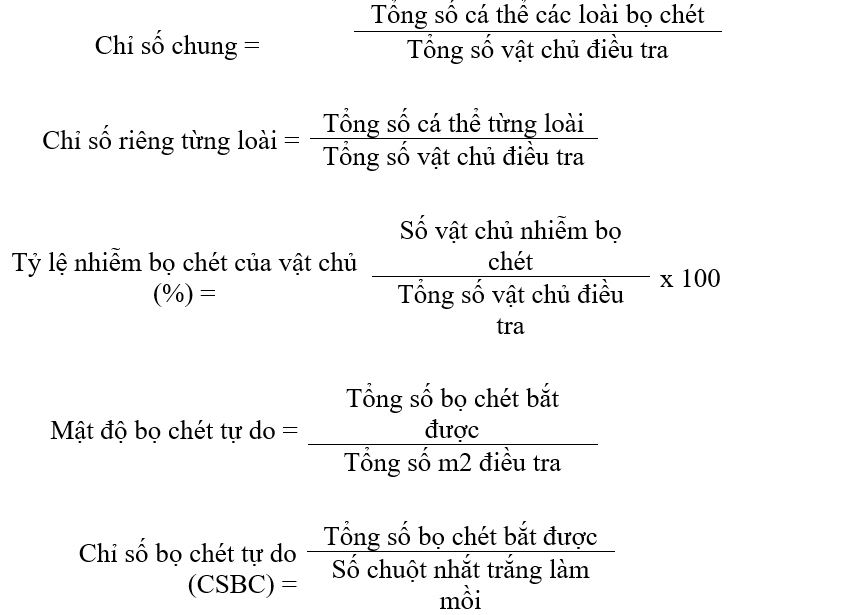
- Each surveillance point must set traps for three consecutive nights and capture a minimum of 20 mice of various species.
- An AI of mice > 7% is considered alarming, while > 15% is considered severe.
- Detect sudden and batch-wise mouse deaths, collect and isolate plague bacilli from mouse organs.
- Data collected through host surveillance are reported according to Form 4.
2.2. Vector Surveillance (Fleas):
- Determine the species composition of fleas in the area and flea indices.
- Ability to carry plague bacilli.
- Sensitivity and resistance to insecticides.
- Conduct periodic surveillance once a month.
a. Collecting Fleas Parasitizing on Mice (Trapped Mice and Naturally Dead Mice): Inspect and collect fleas parasitizing on trapped mice or naturally dead mice.
b. Collecting Free-Ranging Fleas: Collect fleas from the environment using methods such as sweeping dust from food grains and garbage into white enamel basins, capturing fleas with suction pumps. Fleas can also be collected using white rat baits or water trays (40x60 cm).
c. Surveillance Indices for Fleas:
(Focus on X. cheopis and Pulex irritans fleas, particularly X. cheopis).
(Focus on X. cheopis and Pulex irritans fleas, particularly X. cheopis).
In plague-endemic areas, if the flea index on hosts exceeds 1, it is considered dangerous; exceeding 1.5 is alarming, and over 4 is considered severe.
* Data collected through flea surveillance are recorded according to Form 4.
3. Detection and Diagnosis of Plague in Humans:
3.1. Diagnosis Based on Clinical Symptoms:
Human plague has four forms: bubonic, septicemic, pneumonic, and meningitic (bubonic form accounts for more than 90% of cases). Pneumonic and septicemic forms, as well as meningitic form, are rarely encountered and usually occur secondarily after the bubonic form.
Main symptoms of the bubonic form:
- Sudden onset with symptoms of chills, muscle pain, abdominal pain, nausea, headache, and high fever of 39-40°C,
- Pain and swelling of lymph nodes (usually solitary), enlarged, hard, and very painful, followed by softening and suppuration of the lymph nodes.
Other epidemiological manifestations:
+ Mouse plague,
+ Natural death of mice,
+ Patients typically appear seasonally in endemic and high-risk areas: (northern provinces from early February to June; central and southern provinces may occur year-round but are higher risk during dry seasons, western highlands mainly during dry seasons).
3.2. Microbiological Diagnosis of Plague: follow standard procedures for microbiological diagnosis of plague (Appendix 1).
- Specimens: lymph node aspirate, blood, serum, sputum, and organs (if the patient dies).
- Testing locally or preserving and transporting to the nearest laboratory using Cary-Blair transport medium. Microbiological test results are reported according to Form 5.
III. PREVENTION AND CONTROL OF PLAGUE:
1. Organization of Prevention and Control Before an Epidemic Occurs:
- In areas where plague is circulating and in regions at risk, continuous monitoring of plague epidemiological surveillance results is necessary to proactively prevent and control the disease.
- Training in plague prevention and control for grassroots levels and cooperative networks.
- Propagate and educate the community to properly carry out environmental sanitation work, reasonably arrange and structure housing and storage facilities, manage food supplies, feed cats, set traps, destroy rat nests, control and eliminate breeding grounds for rats, fleas; immediately report to the local health facility upon discovering unusual rat deaths. Any symptoms of fever or swollen lymph nodes must be examined and treated at a medical facility.
- Prepare a ready supply of medications, chemicals, equipment, and personnel for disease control efforts.
2.1. Rat extermination:
- Conduct mass chemical extermination only when the Flea Index (FI) is less than 1 or zero, and perform annual periodic exterminations once or twice during the rat breeding season, with specific times varying by locality. Combine rat and flea extermination using bait boxes according to the "Kartman" principle.
- Chemicals for rat extermination: Use multi-dose chemicals such as Warfarin 0.05% or Brodifacoum 0.005 - 0.01%, preferably in commercial forms like Klerat, Rat Killer, or as annually directed by the Ministry of Health. Only use rat extermination chemicals that have been registered for circulation by the Ministry of Agriculture and Rural Development (Plant Protection Department).
2.2. Flea extermination:
- Apply residual chemicals such as Permethrin 0.2g/m², Vectron 0.1 - 0.2g/m², Diazinon 2g/m², or other flea extermination chemicals registered for circulation by the Ministry of Health. Exterminate fleas at the beginning of the epidemic season in areas where epidemics occurred the previous year and regions at risk of spread.
- Place permanent Kartman bait boxes containing powdered flea extermination chemicals, which can also be combined with rat extermination chemicals as mentioned above, inside the box. Additional attractive bait for rats should be included. Regularly check and replenish the bait boxes with flea and rat extermination chemicals and bait. The duration of maintaining the permanent bait boxes depends on the Flea Index and rat density.
2. Organize prevention and control measures when an epidemic occurs:
2.1. Prevention and control:
a. Establish an epidemic control committee: The head of the health agency shall submit to the Chairman of the People's Committee at the same level to establish an epidemic control committee. The committee must regularly inspect and urge epidemic prevention and control activities, check and supplement funds, medication stockpiles, chemicals, equipment, and personnel ready to serve epidemic control at all levels.
b. Implement information and reporting systems: Report the epidemic urgently to higher-level health agencies and the Ministry of Health (Preventive Medicine Department), while strictly adhering to information and reporting regulations as stipulated by the Ministry of Health.
c. Mobilize and educate the public to participate in plague control: Report dead rats, maintain环境卫生,发现疑似鼠疫症状应立即前往医疗机构。培训干部诊断和治疗鼠疫。
2.2. Treatment:
- Increase medical staff sufficient for diagnosis and treatment of plague in key areas. Arrange for 24-hour shifts.
- Establish isolation zones, limit exchanges.
- Organize treatment areas:
+ At the grassroots level: Village health station or an isolation house.
+ At hospitals: Infectious disease department or a separate treatment room from other departments.
+ Specific treatment drugs: Streptomycin, Tetracycline, Chloramphenicol, Trimethoprim/Sulfamethoxazole.
2.3. Handling epidemic foci and surrounding areas:
a. Flea extermination:
Chemicals used in liquid form include Diazinon at a dose of 2g/m², Permethrin 50EC at a dose of 0.2g/m², Vetron 10EC at a dose of 0.1 - 0.2g/m².
Method of application: Spray residual chemicals around areas where rats die naturally, along rat paths, nests, and burrows including in thatched roofs and walls, encircle the epidemic focus with a radius of 200 meters. When a large epidemic occurs, spray the affected area and regions at risk of spread.
Scatter Diazinon powder 2% or Vectron powder 2% (Vectron 2D) in piles on rat paths, each pile measuring 15x30x0.5 cm, spaced 5-10 meters apart, and scatter the medicine into each rat nest and burrow.
Spraying equipment: Small-scale spraying uses hand pumps such as Hudson, Gloria... For wide areas, use motorized sprayers such as Fontan ULV with Ziclo 0.4 or 0.5, Mammy with Ziclo 14-15. Spray according to technical specifications, correct dosage, and concentration of chemicals.
If the Flea Index remains greater than 1 and the free flea index exceeds 1, continue spraying with chemicals after 7-10 days.
If the parasitic flea index is greater than 1 and the free flea index is less than 1, only use powdered chemicals.
b. Rat extermination:
- Do not conduct rat extermination during ongoing epidemics among rats and humans. Only exterminate rats when the Flea Index is less than 1.
- Brodifacoum, marketed as Klerat, is used in bait at a ratio of 0.005 - 0.01%, Warfarin is used in bait at a ratio of 0.05% and marketed as Rat Killer. After mass rat extermination, immediately spray flea extermination chemicals.
c. Rat and flea extermination on ships, aircraft, airports, and ports:
Use chemical fumigation methods carried out by specialized rat and insect extermination teams according to the Regulations on Frontier Health Quarantine.
2.4. Determination of the cessation of epidemic activity:
After fully implementing preventive and control measures: establishing isolation zones, treating patients, exterminating fleas, rats, and sanitizing the environment, and prophylactic treatment, determine and announce the cessation of epidemic activity based on the following criteria:
- No new cases of illness within 20 days from the last patient being discharged,
- No more natural rat deaths,
- Microbiological surveillance results on rats and fleas are negative (-).
Bản đồ quan hệ
Bấm vào một văn bản để mở. Viền đỏ = quan hệ làm thay đổi hiệu lực.