
Circular No. 34/2018/TT-BCT stipulates the determination of the volume of overburden transportation in mine exploitation. This Circular includes the following main contents:
适用范围
This Circular applies to units engaged in mine exploitation and organizations and individuals related to measurement and statistics of overburden transportation volumes in mine exploitation.
要点
- The method for determining the volume of overburden transportation for each piece of equipment according to each transport distance.
- The formula for calculating the volume of overburden transportation: Qđtb = Vtb x DLgq x L, where the symbols have the following meanings:
- Vtb: the actual volume of overburden of each piece of equipment measured.
- DLgq: the weighted average unit weight of solid rock in the mining area.
- L: length (transport distance) from the excavation point to the disposal point.
- The method for determining the actual volume of solid overburden of each piece of equipment when multiple pieces of equipment excavate and transport in the same measuring space.
- The formula for calculating the weighted average unit weight of solid rock: DLgq = Σ(DLi x VĐi) / ΣVĐi
- The method for determining the volume and weight of samples for calculating the unit weight of solid rock.
🌐 本文件的社会影响
- To provide legal grounds for units engaged in mine exploitation to measure and statistically record the volume of overburden transportation.
- Ensuring the accuracy and objectivity of data on the volume of overburden transportation.
- Creating favorable conditions for state management of mine exploitation activities.
❓ 常见问题
How is the volume of overburden transportation calculated?
The volume of overburden transportation for each piece of equipment according to each transport distance is calculated using the formula Qđtb = Vtb x DLgq x L.
How is the weighted average unit weight of solid rock determined?
DLgq = Σ(DLi x VĐi) / ΣVĐi, where DLi is the unit weight of type i solid rock and VĐi is the volume of type i solid rock.
What is the method for determining the volume of overburden when multiple pieces of equipment excavate and transport in the same measuring space?
The division of measurement volumes is directly proportional to statistical data and is calculated using the formula Vtb = (Vtkt / Vtk) x Vđ.
全文
CIRCULAR
Regulations on the acceptance and inspection of earth and rock excavation volumes in open-pit coal mining
Pursuant to Decree No. 98/2017/NĐ-CP dated August 18, 2017, of the Government stipulating the functions, tasks, powers, and organizational structure of the Ministry of Industry and Trade;
At the proposal of the Director of the Department of Oil and Gas and Coal,
The Minister of Industry and Trade issues this Circular to regulate the acceptance and inspection of earth and rock excavation volumes in open-pit coal mining.
PART I
GENERAL PROVISIONS
Article 1. Scope of Regulation
Article 1. This Circular regulates the acceptance and inspection of earth and rock excavation and transportation volumes in open-pit coal mining.
Article 2. This Circular does not apply to open-pit coal slurry mining.
Article 2. Applicability
1. Organizations and individuals engaged in open-pit coal mining (hereinafter referred to as organizations and individuals involved in coal mining).
2. Organizations and individuals related to the acceptance and inspection of earth and rock excavation and transportation volumes in open-pit coal mining.
Article 3. Explanation of Terms
1. Excavated earth and rock refers to the portion of earth and rock that must be excavated according to technical requirements for coal mining operations. The volume of excavated earth and rock is denoted as VĐ, with units measured in cubic meters (m3.
2. Unit weight of solid earth and rock is the mass of one cubic meter of earth and rock in its natural state. The unit weight of solid earth and rock is denoted as DL, with units measured in tons per cubic meter (ton/m3.
3. Expansion coefficient of earth and rock is the ratio between the volume of earth and rock when it is loosened and its volume in its natural state. The expansion coefficient of earth and rock is denoted as .
4. Model vehicle refers to the volume of earth and rock loaded onto a specific-sized truck bed according to a diagram, converted to solid form, with a mass of earth and rock consistent with the cargo capacity specified on the vehicle's certificate of technical safety and environmental protection issued by the competent authority.
5. Direct superior enterprise refers to the direct superior enterprise for an enterprise that is a subsidiary within a corporate group as defined by laws on enterprises.
Chapter II
ACCEPTANCE OF EARTH AND ROCK EXCAVATION VOLUMES
Section 1
DIVISION OF ACTUAL EXCAVATED EARTH AND ROCK AND LIMITATIONS ON POSITIONAL DEVIATIONS BETWEEN PLANNED AND ACTUAL IMPLEMENTATION
Article 4. Division of actual excavated earth and rock
Actual excavated earth and rock is divided into planned annual excavated earth and rock and unplanned annual excavated earth and rock. Planned annual excavated earth and rock is included in the actual excavation volume for acceptance, while unplanned annual excavated earth and rock is not included in the actual excavation volume for acceptance.
1. Planned annual excavated earth and rock includes:
a) Earth and rock located within the mine design approved by the competent authority and within the annual plan approved by the head of the organization or individual involved in coal mining/direct superior enterprise, which has been excavated, transported, and dumped according to regulations.
b) Earth and rock generated due to sliding and collapse during mining affecting mining layers, benches, transport routes, drainage ditches, and which must be removed to ensure production, shall be included in the actual excavation volume for the planned year. For earth and rock generated outside the mine design boundary, a separate handling plan must be established and approved by the head of the organization or individual involved in coal mining/direct superior enterprise, and it shall not be included in the mine stripping ratio.
2. Unplanned annual excavated earth and rock refers to earth and rock not covered under Clause 1 of this Article. In cases where earth and rock is excavated beyond the annual plan limit but still within the mine design boundary, it may be included in the actual excavation volume for the following year if the subsequent year's plan specifies stripping up to that limit.
3. Previously permitted temporary dumping of excavated earth and rock within the mine design boundary, which has been accepted but must be excavated, transported, and dumped at the disposal site according to the plan period, shall not be included in the mine stripping ratio and must be separately recorded and classified as soft earth and rock with low unit weight, not requiring drilling or blasting, and can only be used to calculate excavation and transportation costs.
Article 5. Limitations on the difference between actual and planned positions for determining overburden within and outside the plan
1. The actual position of permitted layers may differ from the planned layer positions for the year by ±5 m, measured from the bottom of the layer.
2. The actual position of the final layer of the mine boundary may differ from the technical boundary by ±2 m, measured from the bottom of the layer.
3. The actual position of the road lines may differ from the mine design or the annual plan by ±4 m, measured from the center of the road.
4. The actual height of the layer may differ from the planned layer height for the year by ±1.5 m.
Section 2
TIME OF ACCEPTANCE AND DOCUMENTS USED FOR CALCULATING THE QUANTITY OF OVERBURDEN EXCAVATION AND TRANSPORTATION
Article 6. Time of acceptance
1. Monthly, organizations and individuals exploiting coal must conduct acceptance of the quantity of overburden excavation and transportation carried out. The time for accepting the quantity of the previous month shall be conducted from the 1st to the 10th day of the following month. The acceptance data shall be calculated up to the last day of the month. In cases where the quantity of overburden excavation of the exploitation area ≤ 10,000 m³/month, it is allowed to measure and accept quarterly.
2. Quarterly, organizations and individuals exploiting coal base on the results of monthly acceptance of overburden excavation and transportation quantities within the quarter to compile the quarterly acceptance work. The time for compiling the quarterly acceptance work quantity of the previous quarter shall be conducted from the 1st to the 15th day of the first month of the next adjacent quarter.
3. At the end of the year, organizations and individuals exploiting coal base on the results of quarterly acceptance of overburden excavation and transportation quantities within the year to compile the annual acceptance work. The time for compiling the annual acceptance work quantity shall be conducted from the 1st to the 15th day of the first month of the following year.
Article 7. Documents used for calculating the quantity of overburden excavation and transportation
1. Mine design approved according to the provisions of the law.
2. Plan maps approved by the head of the organization or individual exploiting coal or the direct superior of the enterprise.
3. Rock mechanics documents of the mine approved by the head of the organization or individual exploiting coal or the direct superior of the enterprise for use in calculating and accepting the quantity of overburden.
a) For operating mines, rock mechanics documents of the mine must be updated when the depth of exploitation exceeds 75 m compared to the previous update.
b) For new areas of the mine put into operation in the first year and newly expanded exploitation areas, rock mechanics documents of the mine must be established based on exploration documents approved by competent authorities.
4. 3D digital maps; data from the latest monthly, quarterly, and annual measurements; paper maps signed by the heads of relevant departments and the signature and stamp of the head of the organization or individual exploiting coal.
5. Statistical data on the quantity of overburden excavation and transportation.
6. Minutes and maps to determine the haulage distance.
Article 8. Requirements for documents used for calculating the quantity of overburden excavation and transportation
1. Documents and maps used for calculating, accepting, and inspecting the quantity of overburden excavation and transportation must be established in accordance with current regulations.
2. Rock mechanics documents of the mine (represented on maps, cross-sections, descriptions...) must fully list all types of rocks, the weight of each type of rock, as well as the boundaries of each type of rock; maps and cross-sections must be drawn at the same scale as the maps for accepting the quantity of overburden excavation carried out.
3. Statistical data must comply with legal provisions on statistics.
4. It is not allowed to erase or modify documents and data used for calculating the quantity of overburden excavation and transportation.
Article 9. Requirements for Calculation Sheets and Acceptance Certificates
1. Organizations and individuals exploiting coal must have acceptance certificates for the volume of excavation and transportation of overburden and sludge (if any) for each work site according to the acceptance period. The acceptance certificate must be signed by all relevant specialized departments of the organization or individual exploiting coal and must be signed and stamped by the head of the organization or individual exploiting coal.
2. Organizations and individuals exploiting coal must have complete calculation sheets for the volume of overburden and sludge, and the volume of transported overburden for each work site and each means of transport. These calculation sheets must be signed by the person who calculates, the person who checks, and the head of the relevant specialized departments.
Article 10. Maps and Calculated Cross-sections
1. Topographic maps of the mining area must be carried out according to current standards on mine surveying.
2. Calculated cross-sections for determining the volume of overburden must be constructed using specialized software.
3. The edge error of each square cell with a side length of 100 mm on a hard paper map must not exceed ±0.2 mm.
4. On the cross-sections, coordinate axes and contour lines spaced 20 meters apart must be drawn, along with planning year boundaries and mine design limits to analyze volumes. The cross-sections need to be arranged fixedly and perpendicular to most layers.
5. The overall map for calculating the total volume of overburden throughout the mine must be updated at least once every six months.
Section 3
PRINCIPLES AND METHODS FOR DETERMINING THE VOLUME OF OVERBURDEN AND THE VOLUME OF TRANSPORTED OVERBURDEN
Article 11. Principles for Determining the Volume of Overburden
1. The volume of overburden is determined and accepted through geodetic measurement and calculation methods. Measurement data is the official data for calculating the actual volume of overburden. The measurement time for acceptance may be up to ±5 days earlier or later than the last day of the acceptance period.
2. The volume of overburden accepted for early or late measurements compared to the end period is converted from statistical data based on vehicle models multiplied by the ratio difference between measurement data and statistical data based on vehicle models of the previous month and used to add or subtract from the final acceptance measurement results.
3. The final acceptance volume of the period is equal to the total volume calculated from the initial period map to the final period map minus the already accepted volume.
4. In cases where it is impossible to determine the volume of overburden through geodetic measurement and calculation methods, it is permissible to determine it through statistical methods based on vehicle models as stipulated in Article 15 of this Circular.
The determination of the volume of overburden is carried out according to Appendix No. 1 of this Circular.
Article 12. Determination of the Volume of Overburden Using Geodetic Measurement and Calculation Methods
1. Vertical Cross-section Method Parallel to the Strike
For mines extending along strike lines, where the thickness and dip of the strata change little, and the surface is relatively flat, the vertical cross-section method parallel to the strike should be used to determine the volume of overburden. When using vertical cross-sections parallel to the strike to determine the volume of overburden, the following regulations must be followed:
a) For maps at a scale of 1/1000
- The scale of the cross-sections: Horizontal and vertical scales are both 1/1000.
- The maximum distance between cross-sections is 20 meters.
b) For maps at a scale of 1/500
- The scale of the cross-sections: Horizontal and vertical scales are both 1/500.
- The maximum distance between cross-sections is 10 meters.
In areas with folded strata or complex terrain, additional auxiliary cross-sections must be established for calculation.
c) Formula for calculating the volume (V) between two adjacent cross-sections
- When the ratio of the areas of two adjacent cross-sections (S small / S large) ≤ 2/3, use the following formula:

Where:
+ S1, S2: Areas of two adjacent cross-sections, m²2;
+ h: Distance between two cross-sections, m.
- When the ratio of the areas of two adjacent cross-sections (S small / S large) > 2/3, use the following formula:

- For peripheral blocks shaped like pyramids or wedges, use the following formula:
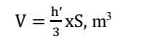
Where:
+ h': Average horizontal length of the peripheral block, m;
+ S: Area of the base, m²2.
2. Horizontal Cross-section Method
When calculating the volume of overburden using the horizontal cross-section method, the final state of the mining area at the end of the previous month and the end of the next month must be shown on the map in different colors. Calculations must be performed separately for each area, each layer, and each machine.
b) The actual height of the layer is the difference in the average elevation of all points on the bottom and top surfaces of the layer in the production area. When calculating the volume using the horizontal cross-section method, it must be done according to the provisions of point c, Clause 1 of this Article.
3. Method Using Specialized Software for Calculation
Organizations and individuals exploiting coal decide independently on the use of specialized software for calculation.
Article 13. Allocation of Overburden Excavation Volume to Construction Equipment
1. Organizations and individuals exploiting coal must organize the statistical measurement of overburden excavation and transportation volumes for each piece of equipment and each layer to allocate overburden excavation and transportation volumes to each construction equipment. The allocation of overburden excavation volume to each construction equipment must be consistent with the acceptance data of the entire layer and the whole construction site.
2. In cases where a single excavator or construction transportation equipment operates independently within a specific area, the measured and calculated geodetic volume is the volume executed by the excavator or transportation equipment during the period.
3. In cases where multiple excavators and transportation equipment work together and it is not possible to calculate individual volumes for each piece of equipment, the allocation of overburden excavation volume shall be proportional to the statistical data.
The allocation of overburden excavation volume to construction equipment shall be carried out according to Appendix No. 3 of this Circular.
Article 14. Method for Determining Sludge and Overburden Deposit Volumes in the Pit Bottom
1. The determination of the height of the sludge and overburden deposit surface when the pit bottom is still flooded shall be conducted using water depth measuring devices or by combining rulers with specialized geodetic equipment.
2. In cases where the overburden deposit in the pit bottom originates from the mine design exploitation area and must be excavated and transported during the period, the calculation and acceptance shall be carried out as for overburden in the exploitation area (it must be deducted from the execution volume of the period and can only be accepted after being excavated and transported outside the exploitation area); in cases where the origin is from outside the mine design exploitation area, the determination of the weight, calculation of the volume, and handling of sludge and overburden deposits in the pit bottom shall be carried out according to a separate plan approved by the head of the organization or individual exploiting coal or the direct superior of the enterprise.
3. The weight of sludge and overburden deposits in the pit bottom, old waste rock piles shall be directly determined on-site or reused if previously determined results are similar in nature. This determination shall be decided by the head of the organization or individual exploiting coal.
Article 15. Determination and Acceptance of Overburden Excavation Volume Using Statistical Methods
1. In cases where it is impossible to determine the overburden excavation volume using geodetic measurement and calculation methods (overburden during exploitation causes landslides affecting transport routes, drainage ditches, requiring excavation and transportation), there must be a field confirmation record signed and stamped by the heads of relevant specialized departments and approved by the head of the organization or individual exploiting coal. If the total overburden excavation volume executed in one year ≤ 10,000 m³, statistical handover data based on vehicle models may be used to determine the overburden excavation volume; in cases > 10,000 m³, the organization or individual exploiting coal must develop a handling plan and obtain approval from the direct superior of the enterprise before implementation.3 shall be permitted to use statistical data on loading and unloading according to the truck model to determine the volume of overburden; in cases exceeding 10,000 m3 then organizations and individuals exploiting coal must develop a handling plan and have it approved/submitted to the direct superior authority of the enterprise for approval before implementation.
2. In cases of force majeure (due to floods, mine flooding) where it is impossible to measure maps to determine the overburden excavation volume using geodetic measurement and calculation methods, the organization or individual exploiting coal must establish a separate plan and obtain approval from the direct superior of the enterprise before implementation.
Article 16. Determining the unit weight of each type of overburden rock mass, the average weighted unit weight of overburden rock mass, and the volume of overburden rock mass transportation
1. The unit weight of each type of overburden rock mass is determined based on the mine's geomechanical data and carried out according to Appendix 2 of this Circular.
2. The average weighted unit weight of overburden rock mass in the mining area used for calculating the volume of overburden rock mass transportation is determined based on the mine's geomechanical data and carried out according to Appendix 3 of this Circular.
3. The determination of the volume of overburden rock mass transportation is carried out according to Appendix 3 of this Circular, wherein the haulage distance of overburden rock mass is determined by direct measurement using specialized equipment at the site or determined from a map with a scale of 1/1000 or 1/500.
Chapter III
INSPECTION OF THE VOLUME OF OVERBURDEN ROCK MASS
Article 17. Inspection Time
1. Annually, the immediate superior authority of the enterprise inspects the acceptance of the volume of overburden rock mass excavation and transportation by the enterprise.
2. In cases where necessary, the immediate superior authority of the enterprise may conduct surprise inspections of the acceptance of the volume of overburden rock mass excavation and transportation by the enterprise.
3. The inspection results are confirmed by a protocol signed and stamped by all relevant parties.
Article 18. Deviation in Volume Inspection of Overburden Rock Mass
1. The permissible deviation when inspecting the acceptance of the volume of overburden rock mass by measurement methods is implemented according to the current standard on Mine Surveying.
2. When the difference between the accepted figures and the inspected figures does not exceed the permissible deviation, the accepted figures can be maintained.
3. If the difference between the accepted figures and the inspected figures exceeds the permissible deviation, the inspected figures shall be used as the official acceptance figures. If there is no agreement on the inspected figures, the organization or individual exploiting coal has the right to file a written complaint to a higher competent authority for verification. During the time that the authorities are reviewing, the accepted figures of the organization or individual exploiting coal will be temporarily used; the decision of the highest competent authority is the final decision.
Chapter IV
IMPLEMENTATION AND ENFORCEMENT PROVISIONS
Article 19. Implementation
1. The head of the organization or individual exploiting coal is responsible for:
a) Directing specialized departments to organize implementation in accordance with the provisions of this Circular, including:
- Building vehicle models, mapping open-pit areas, determining the haulage distance of overburden rock mass, calculating the volume of overburden rock mass.
- Preparing the mine's geomechanical data; determining the unit weight and volume of each type of overburden rock mass, the average weighted unit weight of overburden rock mass in the mining area, and the expansion coefficient of overburden rock mass.
- Preparing monthly, quarterly, and annual plans; calculating planned volumes of overburden rock mass; analyzing unplanned volumes at the end of the acceptance period.
- Statistics on the volume of overburden rock mass excavation and transportation; calculating and determining the actual volume of overburden rock mass transportation.
- Preserving and storing documents used for calculating, accepting, and inspecting the volume of overburden rock mass excavation and transportation in accordance with the law on archives.
b) Issuing contents, procedures, and methods for preparing geomechanical maps of the mine suitable for actual production conditions, ensuring the requirements stipulated in this Circular.
c) Being responsible for the accuracy of the documents and software used in calculating the volume of overburden rock mass excavation and transportation and the results of the acceptance of the volume of overburden rock mass excavation and transportation.
d) At least once every five years, organizing the calculation and inspection of the volume of overburden rock mass excavation and transportation; analyzing and comparing with the approved mine design to compare and verify the implementation with the design.
2. The immediate superior authority of the enterprise is responsible for:
a) Implementing the tasks prescribed in this Circular.
b) Directing and inspecting the implementation of the acceptance work of the volume of overburden rock mass excavation and transportation of subsidiary companies in accordance with this Circular.
Article 20. Effective Date
1. This Circular takes effect from November 26, 2018.
2. This Circular replaces the relevant provisions on the acceptance and inspection of the volume of overburden rock mass in Articles 2, 5, 6, 8, 9, 10, 11, 12, 13, 14, 15, 16, 17, 18, 19, 20, 21, 22, 23, 24, 26, 27, and 28 of the Regulation on the Inspection and Acceptance of the Volume of Overburden Rock Mass and Coal Production in Open-Pit Mines issued together with Decision No. 41/2002/QĐ-BCN dated October 4, 2002 of the Minister of Industry.
3. Relevant organizations and individuals shall be responsible for enforcing this Circular.
4. During the implementation process, if there are difficulties or obstacles, organizations and individuals should report to the Ministry of Industry and Trade for guidance and resolution.
| THE MINISTER
(Signed)
Tran Tuan Anh
|
ANNEX NO. 1
METHODS FOR DETERMINING THE VOLUME OF OVERBURDEN ROCK MASS
(Issued together with Circular No. 34/2018/TT-BCT dated October 11, 2018 of the Minister of Industry and Trade)
The volume of overburden rock mass executed is calculated from the initial map to the execution map according to the following formula:
Where:
- V (VND/year): is the total investment capital allocated annually for the usable area of social housing for rent, ensuring the preservation of capital, calculated according to the following formula:ASms = (TDS + 2 x ASgk) / (Number of ASs): volume of overburden rock mass and coal in solid form measured; overburden rock mass fill is converted to solid form, m3;
- V (VND/year): is the total investment capital allocated annually for the usable area of social housing for rent, ensuring the preservation of capital, calculated according to the following formula:Db: volume of overburden rock mass fill in the open-pit area on the initial map measured, m3;
- Knr: expansion coefficient of overburden rock mass fill, depending on the mechanical properties of the overburden rock mass fill and determined based on the mine's geomechanical data. For soft rock types, the expansion coefficient ranges from 1.02 to 1.15; for hard rock types, it ranges from 1.15 to 1.45; for very hard rock types, it ranges from 1.45 to 1.6.
- V (VND/year): is the total investment capital allocated annually for the usable area of social housing for rent, ensuring the preservation of capital, calculated according to the following formula:a) C: volume of coal in solid form executed measured, m3.
In cases where coal production is taken from weighing data or statistical data based on vehicle models, it is calculated according to the following formula:
+ Qa) C : volume of coal extracted obtained from weighing or statistical data based on vehicle models, tons;
+ ga) C : unit weight of coal extracted, tons/m3.
ANNEX NUMBER 2
METHODS FOR DETERMINING THE UNIT WEIGHT OF EACH TYPE OF OVERBURDEN ROCK MASS
(Issued together with Circular No. 34/2018/TT-BCT dated October 11, 2018 of the Minister of Industry and Trade)
1. The unit weight of each type of overburden rock mass (DL) is determined through field sampling tests by pit excavation method or by taking rock samples and calculated according to the following formula:
Where:
- mw: weight of overburden rock mass in the pit excavation/block, tons;
- V (VND/year): is the total investment capital allocated annually for the usable area of social housing for rent, ensuring the preservation of capital, calculated according to the following formula:h: volume of pit excavation/block, m3.
2. Sampling for testing to determine the weight of intact rock mass at the site using the pit excavation method shall be applied under conditions of soft rock and soil; the rock block sampling method shall be applied under conditions of hard rock, rock areas near the seam edges, or areas with uniform rock strata and thick layers.
2.1. Principles
a) Object of sampling: Various types of rock and soil distributed from the coal seam walls to the surface topography.
b) Sampling location: The sampling locations are specifically designed on the geological and mechanical maps of each mine. For each type of rock, the sampling locations are prioritized to be set in the middle of the rock types (which may be on the seam surface or slope, but must ensure that there is no spillage before weighing and measuring volume) and are specifically determined at the site.
c) Sampling network: Depending on the classification of the mine group in the coal exploration results report approved by the National Mineral Reserve Evaluation Council, the distance between samples along the direction is specifically determined at the site and can be adjusted by increasing or decreasing by 10% based on specific site conditions.
- Simple mine group (I): 1,000 m (+100 m).
- Relatively complex mine group (II): 500 m (+50 m).
- Complex mine group (III): 250 m (+25 m).
- Very complex mine group (IV): 125 m (+12.5 m).
d) Sample volume: Depending on actual conditions, the volume of each sample ranges from 0.5 m3 (length x width x depth: 1 m x 1 m x 0.5 m) to 1.0 m3 (length x width x depth: 1 m x 1 m x 1 m).
2.2. Equipment and Testing Devices
- Special equipment shall be used to locate the sampling points for determining the weight of intact rock mass.
- A hammer, shovel, cutter machine, excavator, jackhammer... shall be used to dig pits; containers and plastic sheets shall be used to hold rocks taken from the pits.
- A metal container with a capacity of ≥ 3 m3 shall be used to measure the volume of rock blocks; an electronic scale (certified by the competent authority according to regulations) shall be used to determine the weight of rocks; a steel tape measure shall be used to measure the dimensions of the pit.
2.3. Steps for Conducting Tests
2.3.1. Pit Excavation Method
a) Digging the pit
- Select the location and use special equipment to locate the sampling point for testing the weight of intact rock mass.
- Clean a flat area approximately 2 m x 2 m; remove all loose foreign rocks; level and smooth the surface to create a flat surface.
- Measure the dimensions of the test sample surface: Length 1 m, width 1 m; mark and define the boundaries of the test pit excavation according to the size 1m x 1m.
- Dig a square pit with dimensions 1 m x 1 m x 1 m (length x width x depth), ensuring that the pit is not dug unevenly.
- For areas near the seam edge of the mine where pit excavation construction is feasible: Take rock samples of size 1 m x 1 m x 0.5 m (the pit excavation size ensures 0.5 m3 - 1.0 m3).
b) Measuring the Volume of the Pit
Depending on specific site conditions, one of the following methods may be used to measure the volume of the pit (Vh):
- Measurement with a tape measure: Measure the area of the pit surface, between the pit and the bottom of the pit using a 5 m tape measure with a density of (0.1 - 0.15) m/measurement point. Measure height using multiple cross-sections, stringing a wire across the top of the pit and measuring height from the wire down to the bottom of the pit, with a density of (0.1 - 0.15) m/cross-section. The measurement results are recorded on a drawing.
- Water displacement method: Lay a soft plastic sheet, pour water, determine the volume of water contained in the pit... ensuring accuracy to determine the volume.
The results of measuring the volume of the pit are recorded in a table for storage. The recording table includes the following main contents: Project, project component; sample number; coordinates, sampling location; sampling depth; testing unit; testing method; testing time; parameters to determine the volume of the pit; volume of the pit.
c) Weighing the Rock and Soil
Use the weighing method to determine the weight of the rock and soil in the pit (mw). The weighing of rock and soil must meet the following requirements:
- Use an electronic scale certified by the competent authority according to regulations, ensuring technical conditions of the scale.
- The weighing process must ensure an error when weighing a single item< 0,13%.
The results of weighing the rock and soil are recorded in a table for storage. The recording table includes the following main contents: Sample number; sampling location; sampling depth; testing unit; testing method; testing time; type of rock and soil; weight of rock and soil.
2.3.2. Rock Block Sampling Method
a) Taking Rock Blocks
- Select the location and use special equipment to locate the sampling point for testing the weight of intact rock mass.
- At the sampling location, use an excavator or saw, cut, blast... to create rock blocks with dimensions corresponding to the pit volume for weighing and measuring volume.
b) Weighing the Weight of the Rock Block
Use the weighing method to determine the weight of the rock block (mw). The weighing of the rock block must meet the following requirements:
- Use an electronic scale certified by the competent authority according to regulations, ensuring technical conditions of the scale.
- The weighing process must ensure an error when weighing a single item< 0,13%.
The results of the weighing are recorded in a table for storage. The recording table includes the following main contents: Sample number; sampling location; sampling depth; testing unit; testing method; testing time; type of rock; weight of the rock block.
c) Measuring the Volume
Submerge the rock block in water until it is fully saturated (15 to 20 minutes), then proceed to measure the volume of the rock block (Vh). The volume of the rock block is determined as the space occupied by the rock block in the volume-measuring container.
The results of measuring the volume of the rock block are recorded in a table for storage. The recording table includes the following main contents: Project, project component; sample number; coordinates, sampling location; sampling depth; testing unit; testing method; testing time; volume of the rock block.
2.4. Test Result Report
The test result report includes the following main information:
2.4.1. Name of the project; project component, testing location.
2.4.2. Testing method, sample number.
2.4.3. Description of the test sample:
a) Pit excavation/sample rock block location: Coordinates, mine name; rock type name; pit excavation/sample rock block location.
b) Description of the tested rock and soil: Relative size composition of blocks and fragments; relative proportion of blocks, fragments, and fine particles.
c) Description of the pit wall/sample rock block: Rock type name; color; structure; petrographic composition; grain size; joint orientation, joint spacing; rock bedding.
2.4.4. Pit excavation drawing (for the pit excavation method): Drawing specifications should be similar to geological survey drawings. Draw one wall and the bottom (scale 1:50) showing complete rock symbols, bedding, and joints.
2.4.5. Recording tables of test results.
2.4.6. Other related information.
ANNEX NUMBER 3
METHODS FOR DETERMINING THE QUANTITY OF OVERBURDEN ROCK TRANSPORTATION
(Issued together with Circular No. 34/2018/TT-BCT dated October 11, 2018 of the Minister of Industry and Trade)
1. The quantity of overburden rock transportation of a mine is aggregated from the transportation quantities of each piece of equipment, wherein, the quantity of overburden rock transportation of each piece of equipment equals the total transportation quantity of that equipment according to each degree of transportation.
2. The quantity of overburden rock transportation of each piece of equipment according to each degree of transportation is calculated using the following formula:
Article 24đtb = Vtb x DLgq x L, tons.km
Where:
- V (VND/year): is the total investment capital allocated annually for the usable area of social housing for rent, ensuring the preservation of capital, calculated according to the following formula:tb: the volume of undisturbed overburden rock carried out by each piece of equipment according to measurement, m³3. In cases where multiple excavating and transporting equipment share the same measuring space and it is impossible to calculate the volume for each individual piece of equipment separately, the division of the measured quantity is proportional to the statistical data and is calculated according to the following formula:
+ Vđ: total volume of undisturbed rock measured, m³3;
+ Vkm/h: total volume of undisturbed rock statistically recorded, m³3;
+ Vtkt: volume of undisturbed rock excavated or transported statistically recorded of that equipment, m³3;
- DLgq: average weighted unit weight of undisturbed rock of the mining area and is calculated according to the following formula:
+ VArticle: undisturbed volume of type i rock, m³3, determined based on the initial and final implementation maps and the geomechanical map of the mine.
+ DLi: undisturbed unit weight of type i rock, tons/m³3, determined based on the geomechanical data of the mine and implemented according to Appendix No. 2 of this Circular;
+ n: number of types of rock.
- L: length (degree) of the transportation route of overburden rock from the excavation location to the disposal location, km.
关系图
点击文件即可打开。红色边框=改变效力的关系。