
This proposal aims to implement unlisted securities trading on the Hanoi Stock Exchange (HSE) with detailed procedures from preparation, registration, trading to settlement. Phase 1 focuses on research, testing, and pilot application for some public companies. Phase 2 will be rolled out after completing the plan.
적용 범위
Unlisted public companies
핵심 사항
- Implementing unlisted securities trading on the Hanoi Stock Exchange (HSE)
- Detailed procedures from preparation, registration, trading to settlement
- Phase 1: Research, testing, and pilot application
- Phase 2: Full-scale implementation after completing the plan
- Requirement to disclose information in accordance with the Securities Law
🌐 이 문서의 사회적 영향
- Enhancing transparency in unlisted securities trading
- Developing the financial market, particularly the Hanoi Stock Exchange (HSE)
- Improving management and supervision of unlisted public companies
❓ 자주 묻는 질문
What does Phase 1 include?
Phase 1 includes researching, developing detailed plans to submit to the State Securities Commission (SSC) and the Ministry for approval; coordinating operational plans with the HSE, Trading Center, Supervisory Board, and Securities Companies; purchasing equipment; adjusting and testing software systems; and piloting for some public companies.
What are the regulations regarding foreign investment ratios?
The participation ratio of foreign investors will be managed similarly to listed companies due to the management object being public companies.
Are there any disclosure requirements?
Public companies registered for trading must comply with information disclosure requirements stipulated in the Securities Law and Circular No. 38/2007/TT-BTC.
전문
|
MINISTRY OF FINANCE |
SOCIALIST REPUBLIC OF VIETNAM |
|
Number: 3567/QD-BTC |
Hanoi, November 8, 2007 |
Pursuant to …;
Regarding the approval of the organizational and transaction management plan for unlisted public companies
THE MINISTER OF FINANCE
Pursuant to Decree No. 77/2003/ND-CP dated July 1, 2003 of the Government stipulating the functions, tasks, powers, and organizational structure of the Ministry of Finance;
Pursuant to the Securities Law No. 70/2006/QH11 dated June 29, 2006;
Pursuant to Decree No. 14/2007/ND-CP dated January 19, 2007 of the Government detailing the implementation of certain provisions of the Securities Law;
At the proposal of the Chairman of the State Securities Commission,
DECISION:
Article 1Approves the Organizational and Transaction Management Plan for Unlisted Public Companies (annexed hereto).
Article 2Directs the State Securities Commission to instruct the Hanoi Stock Exchange Center and the Securities Depository Center to coordinate with relevant units to implement this plan.
Article 3This Decision takes effect from the date of signing.
Article 4The Director of the Ministry of Finance's Office, the Chairman of the State Securities Commission, the Heads of units under the Ministry of Finance, the Directors of the Hanoi Stock Exchange Center and the Securities Depository Center, and the Heads of related units are responsible for implementing this Decision.
|
Place of Receipt: |
DEPUTY MINISTER |
Using state assets at public service organizations
ORGANIZATION AND MANAGEMENT OF SECURITIES TRANSACTIONS FOR UNLISTED PUBLIC COMPANIES
(Annexed to Decision No. 3567/QD-BTC dated November 8, 2007 of the Minister of Finance)
I. LEGAL BASIS
1. Securities of public companies must be registered centrally at the Securities Depository Center (SDC) (Point 1, Article 52 of the Securities Law). 2. Securities of public companies must be centrally deposited at the SDC before transactions can be carried out (Point 1, Article 53 of the Securities Law). 3. The transfer of ownership rights over securities registered at the SDC shall be conducted through the SDC (Point 1, Article 54 of the Securities Law).
4. In cases where securities have been centrally deposited at the SDC, the transfer of ownership rights over securities becomes effective on the day the bookkeeping entry is made on the securities deposit account at the SDC (Point 2a, Article 54 of the Securities Law).
5. Securities meeting the listing criteria but not listed on the Stock Exchange/Stock Trading Center (STC) may be traded at securities companies and the results of such transactions shall be reported to the STC for settlement through the SDC (Point 4, Article 9, Decree No. 14/2007/ND-CP dated January 19, 2007).
II. IMPLEMENTATION PRINCIPLES
Securities of unlisted public companies will be centrally registered and deposited at the SDC and traded at securities companies (SCs). The results of these transactions will be consolidated through the Hanoi STC (HSTC) for settlement at the SDC.
Based on the results of trading and settlement, SCs will record increases or decreases in the number of securities on the accounts of related investors.
1. General principles:
General Model: - Securities of unlisted public companies on the Stock Exchange/STC will be registered at the SDC through SCs.
- Securities owners wishing to trade must deposit their securities with Depositary Participants and conduct transactions at SCs.
- The HSTC will establish a system to collect and consolidate information about securities transactions in the OTC market. Transactions occurring at SCs will be reported to the HSTC by the SCs. The HSTC will transmit transaction data to the SDC for processing and settlement while compiling transaction data on an electronic information website for investor use.
- The SDC will execute netting and settlement of securities and send the results to Depositary Participants for recording on the accounts of actual transaction owners.
III. DETAILED IMPLEMENTATION PLAN
1. Securities Registration
- Unlisted public companies will register their securities at the SDC through SCs acting as Depositary Participants.
- The securities registration dossier of unlisted public companies is similar to that of listed companies.
- Based on the registration dossier, the SDC will review and assign security codes. Security codes will be assigned according to the principle of non-repetition with existing listed security codes and will be uniformly used (in case the company lists on STCs).
2. Transaction Registration 2.1. Conditions for Transaction Registration.
Securities of unlisted public companies will be included in the OTC trading consolidation system of the HSTC when they meet the following criteria:
- They are public companies that have completed securities registration at the SDC.
- They are supported by at least one SC to register for trading.
2.2. Documents for Transaction Registration
- The transaction registration documents include:
+ Certificate of securities registration issued by the SDC.
+ Request for registration of trading at the HSTC submitted by the SC.
+ Other related documents.
- Within five working days from receipt of a complete and valid set of documents, the HSTC will issue a notice regarding the registration of trading and proceed to include the securities in the OTC trading system.
2.3. Conditions for Becoming a Member of the OTC Trading Consolidation System of the HSTC
Securities companies participating in trading on this system include:
- Securities companies that are already members of the HSTC.
- Securities companies licensed by the State Securities Commission to operate and to participate in trading with the HSTC, having systems connected to the HSTC.
3. Opening Accounts, Depositing, and Trading Securities
3.1. Opening Accounts
Each investor is only allowed to open one trading account at one SC to trade securities of unlisted public companies. If an investor already has a trading account for listed securities, this account will be used for trading and depositing unlisted securities. The account will be divided into two sub-accounts (listed and unlisted securities) for easier monitoring and supervision.
3.2. Depositing Securities
- Investors must deposit their securities before trading.
- The depositing of securities follows a two-tier model: investors deposit securities with Depositary Participants, who then re-deposit them at the SDC.
- After receiving approval from the SDC for depositing securities, investors can carry out buying and selling transactions through SCs and use services provided by the SDC and Depositary Participants such as depositing, withdrawing, transferring funds, pledging, and releasing pledges.
3.2. Securities Custody
- Investors must deposit securities before trading.
- Securities custody is carried out through a two-tier model: investors deposit their securities with custodians, and custodians re-deposit with central depositories.
- After being approved for securities custody by the central depository, investors can conduct buy-sell transfer transactions through securities companies and utilize services provided by the central depository and custodians such as depositing, withdrawing, transferring funds, pledging, and releasing pledges.
- Provisions on procedures for depositing, withdrawing, transferring funds, pledging, and releasing pledged securities of unlisted public companies shall be implemented in accordance with the process applicable to listed securities.
3.3. Securities Transactions
a. Provisions on Transactions
- Investors must fully collateralize 100% of securities and money. TVLK and CTCK must cooperate and jointly bear responsibility for managing investors' margin ratios.
- Trading unit: Not specified
- Quotation unit: 100 VND (for stocks) and 1 VND (for bonds)
- Par value for trading: 10,000 VND (for stocks); 100,000 VND (for bonds)
- Price fluctuation range: +20%
- Reference price: The Hanoi Stock Exchange calculates and publishes the reference price using the weighted average method.
- Execution method: Negotiation
- Execution time: Investors may negotiate transactions at any time during the day. However, the time for requesting CTCK to enter transaction results into the system is from 10:00 to 12:00 and from 13:00 to 15:00 on working days.
- Transaction fees: Set by CTCK but not exceeding the ceiling or falling below the floor set by the Ministry of Finance.
- Transaction result reports entered into the system cannot be deleted. In case of errors discovered during the entry process within the trading session, CTCK will correct the transaction report in the system according to the procedure guided by the Hanoi Stock Exchange.
- Buy/sell orders are valid for a maximum of one trading day or until executed or canceled. If changes to buy/sell order information are required, CTCK will cancel the old order and re-enter a new one.
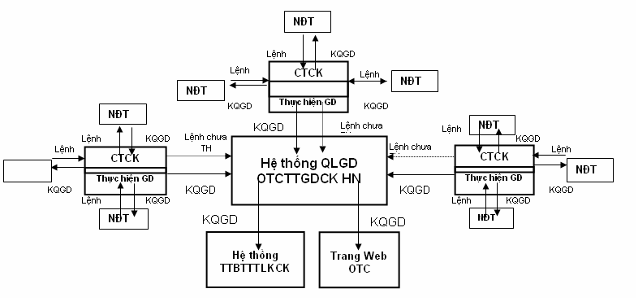
b. Procedure for Executing Transactions:
- After fully collateralizing securities/money, investors proceed to trade at CTCK:
+ With the CTCK itself (in cases where CTCK meets the demand).
+ With their own counterparties (in cases where investors can negotiate among themselves).
- In cases where CTCK cannot meet the buying/selling needs and investors cannot find counterparties, CTCK will enter customer buy/sell orders into the Hanoi Stock Exchange's system. Other CTCKs can monitor information on the Hanoi Stock Exchange's system to find counterparties to execute transactions for their clients.
- After completing the transaction, CTCKs will enter the transaction results into the Hanoi Stock Exchange's system following the procedure: the seller enters, the buyer confirms (similar to the current negotiation transaction implementation at the Hanoi Stock Exchange).
General Diagram
4. Consolidation of Transaction Information:
4.1. Implementation Principles
- CTCKs will enter the following types of information into the Hanoi Stock Exchange's OTC transaction consolidation system:
+ Transactions conducted on the same day
+ Customer buy/sell orders that have not been executed
+ Buy/sell orders of members
- The Hanoi Stock Exchange will receive data from CTCKs transferred into the system from 10:00 to 12:00 and from 13:00 to 15:00 on working days.
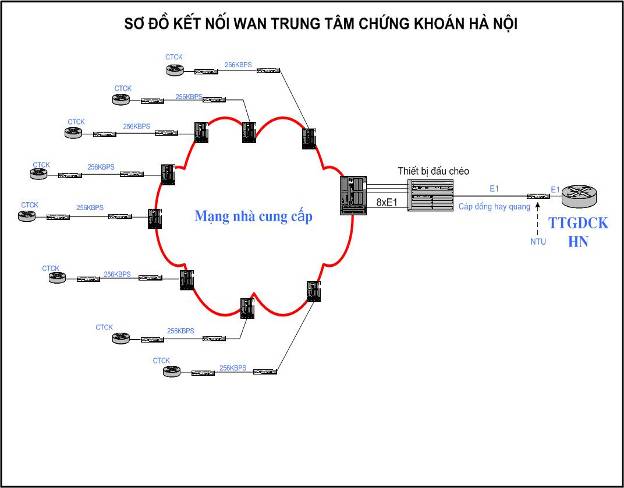
- The connection between the Hanoi Stock Exchange and CTCKs will be carried out according to the remote trading project implemented by the Hanoi Stock Exchange.
The Hanoi Stock Exchange and CTCKs will hire a common service provider. Each CTCK will have one Leased Line of 128 kbps connecting to the service provider. These Leased Lines will be aggregated into a single high-speed E1 (2 Mbps) link leading back to the Hanoi Stock Exchange. At the center, only one routing device from the service provider to the Hanoi Stock Exchange is needed.
4.2. Consolidation of Transaction Data and Transfer to TTLK
- The Hanoi Stock Exchange receives information about securities transactions conducted at CTCKs and consolidates transaction data to transfer to TTLK while uploading it to the investor information website.
- The Hanoi Stock Exchange transfers transaction data to TTLK from 15:00 to 15:30 on the trading day.
5. Settlement and Payment
5.1. Implementation Principles:
- Payment method: Multilateral net settlement.
- Payment date: T+3.
- TTLK settles transactions and pays securities through the TTLK account system and TVLK accounts opened at TTLK.
- Designated Payment Bank (DPB) pays money for securities transactions through the TTLK account system and TVLK accounts opened at DPB.
- TVLK must open a separate settlement account at DPB distinct from the listed securities settlement account to pay for unlisted securities transactions.
- DPB manages payment funds of TVLK separately: deposit account for listed securities transactions on the stock exchange/trading venue and deposit account for unlisted securities transactions.
- Transactions are settled based on the principle of simultaneous and certain payment of money and delivery of securities (DVP).
- For large lot transactions (over 100,000 shares), TVLKs are allowed to negotiate payment terms.
5.2. Implementation Process:
Day T:
- After the end of the trading day, the Hanoi Stock Exchange transfers the trading result file to TTLK.
- TTLK prints the trading result report and sends it to relevant TVLKs for verification and reconciliation.
Day T+1:
- TVLK is responsible for reconciling its transactions and sending confirmation of transactions to TTLK no later than 16:30 on T+1.
- If a member fails to send transaction confirmation to TTLK within the specified time, those transactions are considered accurate and confirmed, and the member must be responsible for any subsequent errors.
Day T+2:
- TTLK nets and prepares detailed settlement reports for TVLK. Sends reports to TVLK and DPB.
- Extracts payment data for DPB in the form of a file through the link between TTLK and DPB.
Day T+3:
- From 08:00 to 10:00: TTLK and DPB check and reconcile balances before executing securities and money transfers based on payment documents.
- From 10:00 to 15:30: Based on payment documents, DPB and TTLK execute fund and security transfers according to the multilateral net settlement process.
5.3. Handling Post-Transaction Errors or Temporary Loss of Ability to Pay Money and Securities:
a. Handling post-transaction errors or temporary loss of ability to pay
- In case of transaction errors (from day T to day T+1):
During the process of checking and verifying transaction information, if a transaction error is discovered, the Depository Participant (DP) must submit a set of documents reporting the transaction error to the Hanoi Stock Exchange and the Central Depository Corporation (CDC) no later than 16:30 on day T+1. Based on the set of documents reporting the error, the CDC will examine and decide on the cancellation of the erroneous transaction from the settlement system. The DPs where the error occurred shall be responsible for any losses arising from the transaction error as well as any damages that may occur if the CDC approves the cancellation of the transaction.
- In case of temporary inability to settle:
During the process of netting and settlement, if it is found that the DP's account does not have sufficient funds or securities to complete the settlement, the CDC will notify the DP lacking funds/securities. The DP lacking funds/securities has the obligation to identify the investor transactions leading to the lack of funds/securities and obtain confirmation from the Hanoi Stock Exchange regarding the corresponding transactions.
+ If the corresponding transactions can be identified based on the confirmation from the Hanoi Stock Exchange, the CDC will exclude these transactions from the settlement system.
+ If the corresponding transactions cannot be identified, the CDC has the right to automatically remove the transactions in the order they were entered into the system by the DP lacking funds/securities until there are sufficient funds or securities available in the account to complete the settlement.
- After removing the erroneous transactions or those temporarily unable to settle, the CDC will re-net; notify and send adjusted documents to the relevant DPs and Investor Settlement Accounts; and extract again the adjusted payment data for the Investor Settlement Accounts.
- Based on the adjusted payment documents, the relevant DPs, Investor Settlement Accounts, and the CDC will carry out fund and security transfers according to the multi-party netting procedure steps.
b. Responsibilities of Depository Participants with Erroneous Transactions or Temporary Inability to Settle
Depository Participants whose transactions are cancelled due to errors or temporary inability to settle will be subject to penalties as stipulated by the Hanoi Stock Exchange and the CDC. At the same time, based on the extent of the consequences resulting from the cancellation of the transaction, the participant whose transaction was cancelled must compensate the counterparty participant based on agreement, up to a maximum of 10% of the transaction value. This participant must bear full responsibility for any damage caused to investors due to the removal of the transaction.
6. Transfer of Ownership Rights
- For cases of buying and selling transactions at Securities Companies: Based on the results of the transaction and the netting settlement by the CDC, the DP will record increases/decreases on the accounts of related investors.
- On the second day of each week, the DP must report changes in ownership of securities of the previous week's owners to the CDC.
- The CDC will only transfer ownership rights of unregistered securities in cases of gift, donation, or inheritance. The owner of unregistered securities or a directly related person must handle the procedures for gift, donation, or inheritance at the CDC. The transfer of ownership rights will be recorded in the securities registration book at the CDC.
7. Disclosure of Information
- Public companies registered for trading are responsible for disclosing information in accordance with the provisions on information disclosure for public companies under the Securities Law.
- Public companies registered for trading must also disclose information when there are changes in company operations that may affect the price of traded securities on the market (according to Circular No. 38/2007/TT-BTC dated April 18, 2007 of the Ministry of Finance on information disclosure on the securities market).
- A securities company submitting an application to register trading for a public company's securities is responsible for coordinating with the company to ensure timely information disclosure in accordance with regulations.
- The Hanoi Stock Exchange will establish an electronic information website to compile trading information and serve the information disclosure of public companies registered for trading.
- During trading hours, information on buy and sell offers and trading results will be continuously updated on the website.
8. Management of Foreign Investment Ratios
As the management object is a public company, the participation ratio of foreign investors in principle will be managed in a manner similar to listed companies.
IV. IMPLEMENTATION SCHEDULE
Divided into two stages:
- Stage 1: Preparation Implementation
+ Conduct research and prepare detailed plans to be submitted for approval by the State Securities Commission and the Ministry.
+ The CDC and the Hanoi Stock Exchange will coordinate with DPs and Securities Companies to unify operational plans.
+ Purchase equipment to equip hardware systems.
+ Adjust and test software systems.
+ Select some public companies to apply - focusing on Securities Companies, financial organizations, insurance companies, and banks.
+ Summarize and draw lessons learned.
- Stage 2: Full-scale Application
+ Based on the experience from pilot applications, improve implementation plans.
+ Implement for all relevant public companies./.
관계도
문서를 클릭하면 열립니다. 빨간 테두리=효력을 변경하는 관계.