
This Circular guides taxes applicable to organizations and individuals conducting oil and gas exploration, development, and exploitation activities in Vietnam. It includes the determination of resource taxes, value-added tax, corporate income tax, and other related taxes in the oil and gas industry. This Circular replaces Circular No. 32/2009/TT-BTC and takes effect from April 12, 2016.
적용 범위
Organizations and individuals conducting oil and gas exploration and exploitation activities in Vietnam
핵심 사항
- Determination of resource tax on crude oil and natural gas
- Input value-added tax for oil and gas exploration, development, and field development activities
- Corporate income tax for oil and gas extraction organizations
- Other types of taxes, fees, and charges during the production and business operations of the oil and gas industry
- Effective date and application to tax periods starting from 2016
🌐 이 문서의 사회적 영향
- Strengthening tax collection management in the oil and gas industry
- Ensuring state budget revenue from oil and gas exploitation activities
- Supporting sustainable development of the oil and gas industry in Vietnam
❓ 자주 묻는 질문
When does this Circular take effect?
This Circular takes effect from April 12, 2016.
What previous regulation does this Circular replace?
This Circular replaces Circular No. 32/2009/TT-BTC of the Ministry of Finance.
전문
CIRCULAR
Guidelines for implementing tax regulations applicable to organizations and individuals conducting exploration, development, and exploitation of oil and gas activities
pursuant to the Oil Law
pursuant to the provisions of the Petroleum Law
__________________________
On the basis of Oil Law July 6, 1993, Law Amending and Supplementing Certain Provisions of the Oil Law No. 19/2000/QH10 June 9, 2000, Law Amending and Supplementing Certain Provisions of the Oil Law No. 10/2008/QH12 June 3, 2008 and guiding documents;
Based on tax laws and current guiding documents;
On the basis of LAW ON TAX ADMINISTRATION NO. 78/2006/QH11 November 29, 2006, Law Amending and Supplementing Certain Provisions of the Tax Administration Law No. 21/2012/QH13 November 20, 2012, Law No. 71/2014/QH13 November 26, 2014 amending and supplementing certain provisions of tax laws and Government Decrees detailing their implementation;
Decree No. 33/2013/NĐ-CP April 22, 2013 of the Government Issuing Model Contracts for Production Sharing Agreements;
Decree No. 215/2013/NĐ-CP dated December 23, 2013 of the Government on the functions, tasks, powers, and organizational structure of the Ministry of Finance;
At the proposal of the Director General of the State Revenue总局局长的提议;
The Minister of Finance issues this Circular to guide the implementation of tax regulations applicable to organizations and individuals conducting exploration, development, and exploitation of oil and gas activities pursuant to the Oil Law.
PART I
GENERAL PROVISIONS
Article 1. Scope of Application
Article 1. This Circular guides tax regulations applicable to: organizations and individuals (hereinafter referred to as contractors) conducting exploration, development, and exploitation of crude oil, condensate (hereinafter collectively referred to as crude oil), and natural gas, associated gas, coalbed methane (hereinafter collectively referred to as natural gas) in Vietnam pursuant to the Oil Law; and parties with related party relationships participating in oil contracts.
The related party relationships mentioned above include any of the following situations:
- One party directly or indirectly participates in the management, control, capital contribution, or investment in any form in another party;
- Both parties directly or indirectly are managed, controlled, have capital contributions, or investments in any form by another party;
- Both parties directly or indirectly participate in the management, control, capital contribution, or investment in any form in another party.
Article 2. This Circular does not apply to exploration, development, and exploitation of oil and gas activities of the Vietnam-Russia Joint Venture "Vietsovpetro" from Block 09-1 as stipulated in the 2010 Agreement and the 2013 Protocol between the Government of Vietnam and the Russian Federation, except for tax regulations on the transfer of participation rights in oil contracts as stipulated in Section 4 of this Circular.
Article 2. Taxpayer
Clause 1. The taxpayer is the contractor parties participating in oil contracts.
The taxpayer may authorize the operator, joint venture enterprise, or joint operating company to file taxes and the taxpayer shall self-implement the payment of taxes arising according to regulations; or the taxpayer may authorize the operator, joint venture enterprise, or joint operating company to file and pay taxes arising according to regulations.
Clause 2. In cases where the oil contract provides that the Vietnam Oil and Gas Group will act on behalf of the contractors to pay various taxes, the Vietnam Oil and Gas Group may authorize the operator, joint venture enterprise, or joint operating company to file taxes and the group shall self-implement the payment of taxes arising according to regulations; or the Vietnam Oil and Gas Group may authorize the operator, joint venture enterprise, or joint operating company to file and pay taxes arising according to regulations.
Clause 3. The taxpayer for the activity of transferring participation rights in oil contracts shall implement according to the guidance provided in Article 23, Section 4, Chapter II of this Circular.
Article 3. Currency for declaration and payment of taxes
1. The currency for declaration and payment of the types of taxes specified in this Circular includes mineral resources tax, export tax, corporate income tax, and transfer of interest participation contract oil and gas tax, which is US dollars.
2. In cases where crude oil and natural gas are sold on the domestic market of Vietnam with prices determined based on US dollars, the currency for tax payment shall be Vietnamese dong.
The conversion from US dollars to Vietnamese dong for calculating and paying taxes shall be carried out according to the buying rate of the transfer form of the head office of Vietnam Joint Stock Commercial Bank for Foreign Trade at the time of issuing the invoice.
3. In cases where crude oil and natural gas are sold and collected in US dollars but the taxpayer pays taxes in Vietnamese dong as prescribed by the Government, the currency for tax payment shall be Vietnamese dong.
The conversion from US dollars to Vietnamese dong for settling foreign currency obligations shall be implemented in accordance with the Law on Tax Administration, the Law Amending and Supplementing, and detailed regulations and guiding implementation documents.
Article 4. Place of tax registration, declaration, and payment
1. The place of tax registration, declaration, and payment (excluding import tax and export tax) is the local Tax Department where the operator, joint venture enterprise, or joint operating company has its headquarters or main management office.
2. For oil and gas contracts that have commenced exploitation before the issuance of this Circular, the place of declaration and payment of taxes shall be carried out according to the guidelines prior to the effective date of this Circular.
Article 5. Principles for determining the taxable price
1. For crude oil, the taxable price as stipulated in this Circular is the selling price of crude oil at the delivery point determined through arm's length transactions.
"Arm's length transaction" refers to sales on the domestic market and international markets using freely convertible currencies between willing buyers and sellers who are not related parties, excluding sales by one party to its branch, sales between governments or organizations owned by governments, exchange transactions, barter transactions, and sales not at free international market prices.
"Delivery point" is the location where crude oil comes into contact with the outer edge of the oil tanker or storage vessel used for extraction or consumption of crude oil, or other points agreed upon in the oil and gas contract where ownership of crude oil is transferred to the contracting parties.
In cases where crude oil is sold outside of arm's length transactions, the taxable price for crude oil is the average selling price of similar crude oil in the international market during the month of crude oil export. The taxpayer is responsible for providing the tax authority with information about the composition and quality of the crude oil being exploited. When necessary, the tax authority may refer to the selling price on the U.S. market (WTI), the British market (Brent), or the Singapore market (Platt's) or seek opinions from competent state agencies regarding the determination of the price of crude oil being exploited by the taxpayer.
2. For natural gas, the taxable price is the selling price of natural gas at the delivery point, determined according to the natural gas purchase and sale contract approved by the Prime Minister and consistent with the agreement in the oil and gas contract, taking into account the pricing period, market conditions, and other relevant factors (if any). When necessary, the tax authority may seek opinions from competent state agencies regarding the determination of the price of natural gas being exploited by the taxpayer.
Article 6. General Provisions
1. In cases where an organization or individual conducts exploration and exploitation activities for oil and gas under multiple oil and gas contracts, the implementation of tax regulations as guided in this Circular shall be carried out separately for each oil and gas contract.
2. Tax management guidelines not specifically provided for in this Circular shall be implemented according to current tax laws and guiding documents.
Chapter II
IMPLEMENTATION GUIDELINES FOR TAX REGULATIONS
Section 1
MINERAL RESOURCES TAX
Article 7. Taxable Objects for Mineral Resources Tax
1. The taxable objects for mineral resources tax include the entire actual production of crude oil and natural gas extracted and obtained from the area covered by the oil and gas contract, measured at the point of delivery (actual crude oil volume, actual natural gas volume).
2. In cases where the Government of Vietnam uses the associated gas of the taxpayer without exchange or sale for payment, the taxpayer is not required to pay the mineral resources tax on that associated gas.
3. In cases where during the extraction of crude oil and natural gas, the taxpayer is permitted to extract other mineral resources subject to mineral resources tax, the taxpayer shall pay the mineral resources tax for each specific case according to the provisions of the Law on Mineral Resources Tax and guiding documents.
Article 8. Period for Calculating Mineral Resources Tax
- In cases where the oil and gas contract does not have an agreement or has an agreement to follow current regulations or has an agreement to allocate actual crude oil and natural gas production into taxable crude oil and natural gas for tax purposes, which is calculated quarterly, temporarily calculated at the time of extraction, and finally adjusted after the end of the year, the tax period is the calendar year.
- In cases where the oil and gas contract has an agreement to allocate actual crude oil and natural gas production into taxable crude oil and natural gas for tax purposes, which is calculated quarterly, temporarily calculated at the time of extraction, and finally adjusted after the end of the quarter, it shall be implemented according to the agreement in the oil and gas contract (tax period quarterly).
- The first tax period begins from the first day of crude oil and natural gas extraction until the end of the calendar year or the end of the quarter.
- The last tax period begins from the first day of the calendar year or the first day of the quarter until the final day of crude oil and natural gas extraction.
Article 9. Determination of Mineral Resources Tax Payable
1. The mineral resources tax on crude oil and natural gas is determined based on the progressive rate of the average daily production of crude oil and natural gas from the total actual production of crude oil and natural gas extracted from the area covered by the oil and gas contract during each tax payment period, the tax rate of the mineral resources tax, and the number of actual days of extraction during the tax calculation period.
2. Determining the mineral resources tax payable in terms of crude oil or natural gas:

Where:
+ The average daily production of crude oil or natural gas subject to mineral resources tax during the tax calculation period is the total production of crude oil or natural gas subject to mineral resources tax extracted during the tax calculation period divided by the number of actual days of extraction during the tax calculation period.
+ The tax rate of the mineral resources tax: implemented according to the provisions of the law on mineral resources tax. In cases where the oil and gas contract was signed before July 1, 2010, and has a specific agreement on the tax rate of the mineral resources tax, it shall be implemented according to the agreement in the signed oil and gas contract.
The determination of the oil and gas projects encouraged for investment as the basis for applying the tax rate of the mineral resources tax is based on the list of oil and gas projects encouraged for investment decided by the Prime Minister.
+ The number of actual days of crude oil or natural gas extraction during the tax calculation period is the number of days conducting crude oil or natural gas extraction activities during the tax calculation period, excluding days of production stoppage throughout the contract area due to any reasons.
Example 1: Determining the mineral resources tax payable in terms of crude oil for the case of crude oil extraction (assuming quarterly):
Assuming:
+ Total production of crude oil subject to mineral resources tax extracted during the tax payment period: 12,000,000 barrels.
+ Number of production days during the tax payment period: 75 days.
+ Average daily production of crude oil subject to mineral resources tax during the tax payment period: 160,000 barrels/day (12,000,000 barrels ÷ 75 days).
+ Crude oil extracted from a contract not included in the list of encouraged investment projects (in the case of crude oil extracted from a contract included in the list of encouraged investment projects, the tax rate of the mineral resources tax applicable to encouraged investment projects shall be applied similarly).
The mineral resources tax payable in terms of crude oil during the tax payment period is determined as follows:
{(20,000 x 10%) + (30,000 x 12%) + (25,000 x 14%) + (25,000 x 19%) + (50,000 x 24%) + (10,000 x 29%)} x 75 days = 2,156,250 barrels.
Example 2: Determining the mineral resources tax payable in terms of natural gas for the case of natural gas extraction (assuming quarterly):
Assuming:
+ Total production of natural gas subject to mineral resources tax extracted during the tax payment period: 855,000,000 cubic meters.
+ Number of production days during the tax calculation period: 75 days.
+ Average daily production of natural gas subject to mineral resources tax during the tax payment period: 11,400,000 cubic meters/day (855,000,000 cubic meters ÷ 75 days).
+ Natural gas extracted from a contract not included in the list of encouraged investment projects.
The mineral resources tax payable in terms of natural gas during the tax payment period is determined as follows:
{(5,000,000 x 2%) + (5,000,000 x 5%) + (1,400,000 x 10%)} x 75 days = 36,750,000 cubic meters.
Article 10. Determination of Temporary Resource Tax
1. The resource tax shall be paid: entirely in crude oil or natural gas; or entirely in cash; or partly in cash and partly in crude oil or natural gas.
In cases where the resource tax is paid in crude oil or natural gas, the tax authority shall notify the taxpayer in writing six months in advance and provide specific guidance on declaring and paying the resource tax in crude oil or natural gas.
2. Determination of the amount of temporary resource tax:

Where:
+ Actual crude oil production sold is the crude oil subject to resource tax for each sale.
+ Actual natural gas production sold is the natural gas subject to resource tax sold monthly.
+ The taxable value for crude oil is the selling price at the delivery point based on each fair transaction sale, excluding VAT (if applicable).
+ The taxable value for natural gas is the selling price at the delivery point based on monthly sales, excluding VAT (if applicable).
In cases where the taxpayer separately lists transportation costs for natural gas on the invoice, the taxable value for natural gas is the selling price at the delivery point based on monthly sales, excluding transportation costs and VAT (if applicable).
In cases where crude oil is not sold through fair transactions, the taxable value for the resource tax is determined according to the guidance provided in Clause 1, Article 5 of this Circular.
+ The rate of temporary resource tax is determined as follows:
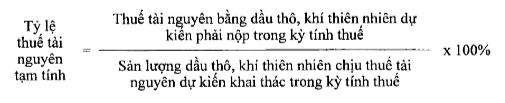
+ The estimated resource tax payable in crude oil or natural gas for the tax period is determined according to the guidance provided in Clause 2, Article 9 of this Circular, based on the expected volume of crude oil and natural gas subject to resource tax to be extracted during the tax period and the number of days expected to extract.
+ The expected volume of crude oil and natural gas subject to resource tax to be extracted during the tax period is the expected volume of crude oil and natural gas subject to resource tax to be extracted during the tax period.
3. The deadline for taxpayers to submit notifications of the provisional tax rates according to Form 01/BCTL-DK issued with this Circular is as follows:
- For oil and gas contracts that agree on a tax period annually, based on the expected volume of crude oil and natural gas to be extracted in the following year, the taxpayer must determine the provisional resource tax rate and notify the local tax authority where the tax registration is made no later than December 1st of the previous tax year.
During the tax period, if the expected volume of crude oil and natural gas to be extracted and the expected number of days to extract oil and gas in the last six months of the year change, leading to an increase or decrease in the provisional resource tax rate by 15% or more compared to the previously notified provisional resource tax rate, the taxpayer must determine and notify the new provisional resource tax rate to the tax authority no later than May 1st of that year.
- For oil and gas contracts that agree on a quarterly tax period, based on the expected volume of crude oil and natural gas to be extracted in the next quarter, the taxpayer must determine the provisional resource tax rate and notify the local tax authority where the tax registration is made no later than the first day of the month immediately preceding the next quarter.
- For oil and gas contracts that begin commercial exploitation, the taxpayer must determine and notify the provisional resource tax rate to the tax authority when submitting the provisional resource tax for the first shipments of crude oil and natural gas extracted and sold within the contract area.
Example 3: Determining the provisional resource tax rate (for annual tax periods):
- Determining the provisional resource tax rate for crude oil:
Assuming:
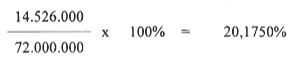
+ Total expected volume of crude oil subject to resource tax to be extracted in the year: 72,000,000 barrels.
+ Expected number of extraction days in the year: 360 days.
+ Average daily volume of crude oil subject to resource tax in the year: 200,000 barrels/day (72,000,000 barrels ÷ 360 days).
+ Estimated resource tax payable in the year (determined according to the guidance in this Circular, Article 9): 14,526,000 barrels.
The provisional resource tax rate from crude oil extraction is:
- Determining the provisional resource tax rate for natural gas:
Assuming:
+ Total expected volume of natural gas subject to resource tax to be extracted in the year: 3,960,000,000 cubic meters.
+ Expected number of extraction days in the year: 360 days.
+ Average daily volume of natural gas subject to resource tax in the year: 11,000,000 cubic meters/day (3,960,000,000 cubic meters ÷ 360 days).
+ Estimated resource tax payable in the year (determined according to the guidance in this Circular, Article 9): 162,000,000 cubic meters.
The provisional resource tax rate from natural gas extraction is:

Article 11. Settlement of Mineral Resources Tax
1. For crude oil exploitation:
a) Determining the amount of mineral resources tax payable:
a.1) Determining the mineral resources tax payable in the tax period in terms of crude oil:

a.2) Determining the ratio of mineral resources tax payable in terms of crude oil to the volume of crude oil exploited in the tax period:
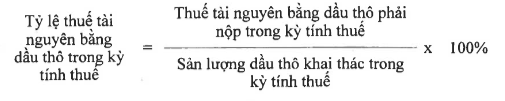
a.3) Determining the mineral resources tax payable in terms of crude oil sold in the tax period:

a.4) Determining the amount payable from selling mineral resources tax in terms of crude oil in the tax period:

Where:
+ The mineral resources tax payable in terms of crude oil sold in the tax period is determined as guided at point a.3, Clause 1, this Article;
+ The taxable value for mineral resources tax on crude oil is the weighted average price of crude oil sold at the delivery point according to fair transactions in the tax period, excluding value-added tax (if applicable).
In cases where crude oil is not sold through fair transactions, the taxable value for the resource tax is determined according to the guidance provided in Clause 1, Article 5 of this Circular.
a.5) Determining the mineral resources tax payable in terms of unsold crude oil in the tax period to serve as the basis for settling the mineral resources tax payable in terms of crude oil for the next tax period:

Example 4: Determining the taxable value for mineral resources tax:
Assuming: the volume of crude oil sold in the tax period is (4,000,000 barrels), sold in 3 lots: Lot 1 with a volume of 2,000,000 barrels, sold at 108 USD/barrel; Lot 2 with a volume of 1,000,000 barrels, sold at 120 USD/barrel; Lot 3 with a volume of 1,000,000 barrels, sold at 100 USD/barrel.

2. For natural gas exploitation:
a) Determining the amount of mineral resources tax payable:
a.1) Determining the mineral resources tax payable in terms of natural gas in the tax period:

a.2) Determining the amount payable from selling mineral resources tax in terms of natural gas in the tax period:

Where:
+ The mineral resources tax payable in terms of natural gas in the tax period is determined as guided at point a.1, Clause 2, this Article;
+ The taxable value for mineral resources tax on natural gas is the weighted average price of natural gas at the delivery point in the tax period, excluding value-added tax.
In case the taxpayer separately lists transportation costs of natural gas on the invoice, the taxable value for mineral resources tax on natural gas is the weighted average price of natural gas at the delivery point in the tax period, excluding transportation costs, value-added tax (if applicable).
Article 12. Declaration and Payment of Mineral Resources Tax for Crude Oil and Natural Gas Exploitation and Sales Activities
1. Declaration and Payment of Provisional Mineral Resources Tax:
a) Documents for declaration of provisional mineral resources tax:
- The tax declaration form for provisional mineral resources tax on oil and gas is Form 01/TAIN - DK issued together with this Circular.
- Detailed tax obligations of oil and gas contractors according to Form 01/PL-DK issued together with this Circular.
b) Deadline for declaration and payment of provisional mineral resources tax:
- Declaration of provisional mineral resources tax for crude oil exploitation and sales activities is carried out each time crude oil is sold.
The deadline for submission of the declaration and payment of provisional mineral resources tax for crude oil sold each time is no later than the 35th day from the date of crude oil sale (for both domestic sales and exports). The sale date is the completion date of crude oil delivery at the delivery point.
- Declaration of provisional mineral resources tax for natural gas exploitation and sales activities is carried out monthly.
The deadline for submission of the declaration and payment of provisional mineral resources tax for natural gas exploitation monthly is no later than the 20th day of the following month after the issuance of the sales invoice for natural gas.
2. Declaration of Settlement of Mineral Resources Tax:
a) Documents for declaration of settlement of mineral resources tax for crude oil and natural gas exploitation and sales activities:
- Form for declaration of settlement of mineral resources tax on oil and gas is Form 02/TAIN - DK issued together with this Circular.
- Detailed tax obligations of oil and gas contractors according to Form 01/PL-DK issued together with this Circular.
- Production Volume and Revenue Report for Oil and Gas Sales according to Form 02-1/PL-DK issued together with this Circular.
b) Deadline for submission of documents for declaration of settlement of mineral resources tax for crude oil and natural gas exploitation and sales activities:
- The deadline for submission of documents for declaration of settlement of mineral resources tax for crude oil and natural gas is no later than the 90th day of the following period after the occurrence of tax liability.
- No later than the 45th day from the end date of the oil and gas contract.
3. In case the last day of the declaration and payment deadline coincides with a public holiday, the last day of the deadline shall be considered as the next working day after the holiday.
Section 2
EXPORT DUTY, IMPORT DUTY
The taxpayer shall declare and pay export tax and import tax in accordance with the laws on export tax and import tax and current tax management laws. Additionally, the Ministry of Finance provides specific guidance as follows:
Article 13. Export Tax
1. Determination of provisional export tax amount:

Where:
+ The crude oil and natural gas export volume is the actual export volume of crude oil and natural gas.
+ The taxable price is the selling price of crude oil and natural gas as guided in Article 5 of this Circular.
- The provisional export tax rate is determined as follows:

Where:
+ The provisional resource tax rate for the tax period is determined as guided in Article 10 of this Circular.
+ The current export tariff rate for crude oil and natural gas. In cases where the oil and gas contract specifically agrees on the export tax rate, it shall be implemented according to the agreed export tax rate in that oil and gas contract.
Example 5: Determining the provisional export tax rate for crude oil:
Assuming:
+ The provisional resource tax rate as per the example in the above Article 10: 20.1750%.
+ The current export tariff rate for crude oil under the current import-export tariff schedule: 10%.
+ The provisional export tax rate for crude oil: 7.9825% = (100% - 20.175%) x 10%
Based on the provisional resource tax rate, the export tax rate for crude oil, the taxpayer determines the provisional export tax rate for each oil and gas contract and notifies the customs authority at the crude oil export location and the tax authority at the tax registration location along with the notification deadline for the provisional resource tax rate and the provisional corporate income tax rate.
2. In cases where the final settlement of the resource tax results in changes to the actual crude oil and natural gas production and sales volume compared to the forecasted production volume for the tax period, leading to changes in the resource tax rate, the taxpayer bases the revised export tax rate on the final settlement resource tax rate according to the principle guided in Clause 1 of Article 13 of this Circular and adjusts the declaration according to the guidance provided in the current laws on export tax, import tax, and tax administration.
If the temporarily paid export tax amount is less than the required export tax amount, the taxpayer must pay the difference between the required export tax amount based on the revised export tax rate and the temporarily applied export tax rate at the time of the final resource tax settlement, without having to pay late payment interest on this difference.
The deadline for submitting the adjusted export tax declaration form coincides with the deadline for submitting the final resource tax declaration form.
Article 14. Exemption from Import Tax
The exemption from import tax for goods imported for oil and gas exploration, development activities is carried out according to the provisions of the current laws on export tax, import tax, and tax management.
Section 3
ENTERPRISE INCOME TAX (EIT)
Article 15. Taxable Objects of Enterprise Income Tax
1. Income from crude oil and natural gas extraction activities and other directly related income is subject to enterprise income tax as guided in this Circular.
2. Income from other production and business activities and other income outside the income specified in Clause 1 of this Article (hereinafter referred to as other income) is subject to enterprise income tax according to the guidance provided in the current laws on enterprise income tax.
Article 16. Tax Period for Corporate Income Tax
1. The tax period for corporate income tax is the Gregorian year. In cases where the taxpayer applies a fiscal year different from the Gregorian year and such application has been approved by the Ministry of Finance, the tax period shall be the fiscal year.
2. The first tax period for corporate income tax shall be calculated from the date of commencing the first exploration and exploitation activities of crude oil and natural gas until the end of the Gregorian year or the end of the fiscal year.
3. The last tax period for corporate income tax shall be calculated from the beginning of the Gregorian year or the beginning of the fiscal year to the end of the oil and gas contract.
4. In cases where the first tax period and the last tax period have a duration shorter than three months, they may be combined with the next or previous tax period to form a complete tax period for corporate income tax. The first tax period or the last tax period shall not exceed fifteen months.
Article 17. Determination of Taxable Income
1. For income from crude oil and natural gas exploitation activities:

a) Revenue from crude oil and natural gas exploitation activities is the total value of the crude oil and natural gas production sold at the delivery point through fair transactions for crude oil and purchase-sale contracts for natural gas during the tax period (excluding VAT).
In cases where crude oil is sold through non-fair transactions, revenue from crude oil exploitation activities shall be determined by multiplying the volume of crude oil with the selling price as guided in Clause 1, Article 5 of this Circular.
b) Deductible and non-deductible expenses when determining taxable income:
b.1) Deductible expenses: The taxpayer may deduct these expenses from costs when determining corporate income tax (except for the expenses specified in Point b.2, Clause 1 of this Article) if they meet the following conditions:
b.1.1) Expenses actually incurred related to exploration, exploitation, and consumption of crude oil and natural gas products, including the following:
- Resource taxes, export duties, additional charges due to increases in crude oil prices, environmental protection fees (in cases where the oil and gas contract does not include environmental protection fees in the cost recovery agreement).
- Actual costs incurred related to exploration and exploitation of crude oil and natural gas that do not exceed the amount determined by multiplying the sales revenue of crude oil and natural gas by (x) the agreed cost recovery ratio in the oil and gas contract. If there is no agreement on the cost recovery ratio in the oil and gas contract, the maximum cost recovery ratio for determining deductible expenses is 35%.
In cases where the oil and gas contract stipulates that each contractor directly pays expenses for goods and services related to exploration and exploitation of crude oil and natural gas, the contractor must prepare a detailed list accompanied by copies of legitimate invoices and documents to submit to the operator, joint venture enterprise, or joint operating company for confirmation of deductible expenses and to apply deductions when determining taxable income.
b.1.2) Expenses supported by invoices and documents in accordance with the provisions of the law.
b.1.3) For invoices for goods and services purchased individually with a value of twenty million dong or more, payment must be made using non-cash payment methods as prescribed by the Corporate Income Tax Law and implementing regulations.
b.2) Non-deductible expenses when determining taxable income:
b.2.1) Excess costs recoverable beyond the agreed cost recovery ratio in the oil and gas contract. If there is no agreement on the cost recovery ratio in the oil and gas contract, excess costs over 35% are not deductible.
b.2.2) Expenses not included in allowable cost recovery under the oil and gas contract include:
- Costs incurred before the oil and gas contract becomes effective, except those agreed upon in the contract or decided by the Prime Minister;
- Various oil and gas commissions, reading and usage fees for documents, and other expenses not included in cost recovery under the oil and gas contract;
- Interest on borrowed funds used for exploration, development, and exploitation of oil and gas fields;
- Penalties and compensation payments;
- Other expenses not deductible according to the Corporate Income Tax Law and implementing regulations.
c) For income generated from the financial guarantee fund for decommissioning fixed facilities, equipment, and means (hereinafter referred to as the decommissioning fund):
c.1) Income generated from bank deposit interest of the decommissioning fund shall be taxed at the rate applicable to other income as prescribed by the Corporate Income Tax Law and implementing regulations.
c.2) In cases where the oil and gas contractor does not fully utilize the decommissioning fund, the remaining balance of the decommissioning fund shall be handled according to the Oil and Gas Law and implementing regulations. The distribution of income among the parties to the oil and gas contract shall be handled as follows:
+ If separate income can be identified, income from bank deposit interest already taxed at the rate applicable to other income does not need to be taxed again. Remaining income from the decommissioning fund shall reduce allowable cost recovery if the oil and gas contract has not yet recovered all costs, or apply the contract's tax rate if the contract has fully recovered all costs.
+ If separate income cannot be identified, it shall reduce allowable cost recovery if the oil and gas contract has not yet recovered all costs, or apply the contract's tax rate if the contract has fully recovered all costs.
d) Other income directly related to petroleum activities such as income from bank deposit interest, income from insurance compensation, income from the use or exercise of ownership rights over assets (income from port and wharf usage fees, asset liquidation) shall be recorded as deductible costs recoverable from petroleum activities.
2. For other income outside income from crude oil and natural gas extraction activities: implement in accordance with the provisions of the Law on Corporate Income Tax and guiding documents for its implementation.
Article 18. Determining the amount of corporate income tax payable
1. Determining the amount of corporate income tax payable:
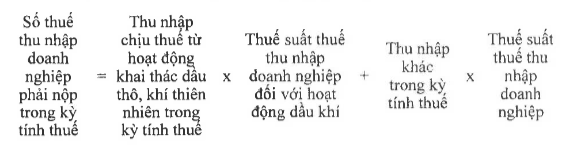
Wherein:
+ Taxable income from the period of taxation derived from crude oil and natural gas extraction activities and other income shall be determined as guided in Article 15 of this Circular.
+ The corporate income tax rate shall be implemented in accordance with the provisions of the Corporate Income Tax Law. The corporate income tax rate for petroleum activities ranges from 32% to 50%; based on the position, conditions of exploitation, and reserves of the field, the Prime Minister decides the specific tax rate applicable to each petroleum contract upon the proposal of the Minister of Finance.
In cases where the petroleum contract specifically agrees on the corporate income tax rate, it shall be implemented according to the corporate income tax rate agreed upon in that petroleum contract. If the corporate income tax policy changes to offer a more favorable tax rate than the rate agreed upon in the petroleum contract and is approved by the Prime Minister, the tax rate shall be applied according to the Prime Minister's decision.
2. In cases where the petroleum contract stipulates that each contractor separately determines the amount of corporate income tax payable, the amount of corporate income tax each contractor must pay shall be equal to the total amount of corporate income tax payable (determined as guided above) multiplied by (x) the percentage of petroleum profit of each contractor in the petroleum contract.
Article 19. Determining the provisional corporate income tax payable
Determining the provisional corporate income tax payable:

Where:
+ Revenue from selling crude oil and natural gas is the entire value of the actual volume of petroleum sold at the point of delivery in each sale transaction for crude oil or according to the natural gas purchase and sale contract for each month for natural gas (excluding VAT).
In cases where crude oil is sold not through arm's length transactions, revenue from selling crude oil shall be determined by multiplying the volume of crude oil by (x) the sales price as guided in Clause 1, Article 5 of this Circular.
+ The provisional corporate income tax rate shall be determined as guided below:

The taxpayer shall self-determine the provisional corporate income tax rate and notify the local tax authority where they are registered together with the deadline for notifying the provisional resource tax rate as stipulated in Article 10, Section 1, Chapter II of this Circular.
Example 6: Determining the provisional corporate income tax rate for crude oil extraction:
Assuming:
+ Recovery cost ratio: 35%
+ Provisional payment resource tax rate (as per the example in Article 10 above): 20.1750%
+ Provisional payment export tax rate (as per the example in Article 10 above): 7.9825%
+ Corporate income tax rate: 50%
The provisional corporate income tax rate is:
(100% - 35% - 20.1750% - 7.9825%) x 50% = 18.1413%
In cases of provisional payment of corporate income tax from natural gas extraction, the provisional corporate income tax rate shall be similarly determined as above.
Article 20. Declaration and payment of corporate income tax for crude oil exploration and production, export and sale activities
1. Declaration and provisional payment of corporate income tax:
a) The declaration of provisional corporate income tax for crude oil exploration and production, export and sale activities shall be made on a per-sale basis.
The deadline for submitting the declaration and provisional payment of corporate income tax for crude oil sales on a per-sale basis shall not exceed the thirty-fifth day from the date of crude oil sale (for both domestic crude oil sales and crude oil exports). The date of sale is the date when crude oil delivery at the point of handover is completed.
b) The declaration of provisional corporate income tax for natural gas exploration and production, export and sale activities shall be made on a monthly basis.
The deadline for submitting the declaration and provisional payment of corporate income tax for natural gas exploration and production on a monthly basis shall not exceed the twentieth day of the following month from the date of issuance of the natural gas sales invoice.
c) Documentation for the declaration of provisional corporate income tax for crude oil exploration and production, export and sale activities, and natural gas exploration and production, export and sale activities:
- The documentation for the declaration of provisional corporate income tax is the Provisional Corporate Income Tax Declaration Form for Oil and Gas according to Model No. 01/TNDN-DK issued together with this Circular.
- Detailed tax obligations of oil and gas contractors according to Form 01/PL-DK issued together with this Circular.
2. Final settlement of corporate income tax:
a) Documentation for the final declaration of corporate income tax for crude oil exploration and production, export and sale activities, and natural gas exploration and production, export and sale activities:
- The Final Corporate Income Tax Declaration Form for Oil and Gas according to Model No. 02/TNDN-DK issued together with this Circular.
- Detailed tax obligations of oil and gas contractors according to Form 01/PL-DK issued together with this Circular.
- Annual financial report or financial report up to the end of the oil and gas contract period.
b) Deadline for submitting the documentation for the final declaration of corporate income tax for crude oil exploration and production, export and sale activities, and natural gas exploration and production, export and sale activities:
- Not later than ninety days from the end of the calendar year or fiscal year.
- No later than the 45th day from the end date of the oil and gas contract.
In cases where the last day of the declaration and payment deadline coincides with a public holiday, the last day of the deadline shall be considered as the next working day after the holiday.
Section 4.
TAX ON INCOME FROM TRANSFER OF INTERESTS IN OIL AND GAS CONTRACTS
Article 21. Taxable Object
1. Transfer of interests in oil and gas contracts refers to organizations or individuals selling or transferring their investment capital (including assets and money) in oil and gas contracts, oil and gas joint ventures, or oil and gas enterprises in Vietnam, changing ownership or control of one party to the contractor, or otherwise disposing of all or part of their rights, benefits, and obligations under the oil and gas contract, oil and gas enterprise, or joint venture (the transferor) to one or more organizations or individuals (the transferee), except in cases of restructuring, internal financial reorganization of the transferor, or merger of the parent company of the transferor. The transferee assumes the rights and obligations of the contractor to conduct oil and gas exploration and production activities.
In cases where an enterprise established abroad (hereinafter referred to as a foreign enterprise) transfers shares, investment capital (including assets and money) or similar interests in another enterprise established abroad that holds direct or indirect assets or participation rights in oil and gas projects in Vietnam, thereby changing the ownership of the contractor holding participation rights in oil and gas contracts in Vietnam, such actions are also considered as the transfer of interests in oil and gas contracts. The foreign enterprise carrying out such transfers is deemed as the transferor.
Example: Company A (established under British law) has a subsidiary, Company B (established under French law). To manage oil and gas projects, Company B establishes a subsidiary, Company C, in the Netherlands, which directly participates in oil and gas projects in Vietnam. During its operations, Company A transfers its investment capital in Company B, and the transaction takes place in France. At that time, the aforementioned transaction of Company A is considered as the transfer of interests in oil and gas contracts in Vietnam, and the income generated from this transaction corresponding to the interests in oil and gas contracts in Vietnam is subject to corporate income tax.
2. Income from the transfer of interests in oil and gas contracts by the transferor to the transferee falls within the scope of corporate income tax as guided in Section 4, Chapter II of this Circular.
Article 22. Determination of Corporate Income Tax Due
1. Determination of Corporate Income Tax Due:
Corporate income tax on income from transferring participation rights in oil and gas contracts shall be determined as follows:

a) Determining taxable income:

Where:
+ The transfer price is determined as the total actual value that the transferring party receives according to the transfer contract.
In cases where the transfer contract for participation rights in oil and gas contracts stipulates payment on an installment or deferred basis, the transfer price does not include installment interest or deferred interest as specified in the transfer contract.
In cases where the transfer contract does not specify a payment price or the tax authority has grounds to determine that the payment price is not set according to market prices, the tax authority has the right to inspect and request the parties involved in the transfer to provide information related to determining the current and future value of the transferred participation rights in oil and gas contracts before the parties decide on the transfer, acceptance of the transfer, and setting the payment price of the contract based on reference to market prices, permitted selling prices to third parties, similar transfer contract selling prices, appraised values by authorized professional valuation organizations at the time of transfer (if applicable) or re-evaluating the entire value of the oil and gas contract at the time of transfer to determine the corresponding transfer price based on the ratio of transferred participation rights.
In cases where the transfer of participation rights in oil and gas contracts is carried out through the sale of shares on the securities market, the transfer price is determined as the actual selling price of the securities (matching price or agreed price) as announced by the stock exchange or securities trading center.
+ The purchase price of the transferred participation rights in oil and gas contracts (cost price): is determined based on accounting books and documents regarding allowable recovery costs of the transferring party at the time of transferring participation rights in oil and gas contracts, agreed upon in the transfer contract, after deducting recovered costs and deductions (if any), recognized by the parties involved in the oil and gas contract and the Vietnam Oil and Gas Group, and other costs related to the purchase price of the transferred participation rights but not yet counted as allowable recovery costs.
In cases where the contractor continues to transfer the participation rights in oil and gas contracts received, the purchase price of the transferred participation rights in oil and gas contracts each subsequent time is determined by adding the transfer value of the immediately preceding transfer contract to any additional recoverable costs incurred (if there is proof documentation), minus any previously recovered costs (if any).
In cases where the currency used in the accounting of the operator, joint operating company, or joint venture enterprise is US dollars according to the oil and gas contract agreement, and the contractor transfers participation rights in oil and gas contracts in foreign currency, the transfer price and the purchase price of the transferred participation rights are determined in US dollars.
In cases where the currency used in the accounting of the operator, joint operating company, or joint venture enterprise is Vietnamese Dong, the transfer price is determined in US dollars and the purchase price of the transferred participation rights is determined in US dollars. The exchange rate for converting to US dollars to determine the transfer price and the purchase price of the transferred participation rights shall be implemented in accordance with the Law on Tax Administration, the Law Amending and Supplementing, and detailed regulations and guidance documents.
+ Transfer expenses are actual expenses directly related to the transfer, based on original documents recognized by the tax authority. In cases where transfer expenses occur abroad, such original documents must be certified by a notary or independent auditor in the country where the expenses occurred, and the documents must be translated into Vietnamese (with confirmation by an authorized representative).
Transfer expenses include: costs for necessary legal procedures for the transfer; fees and taxes payable when processing the transfer; transaction, negotiation, and contract signing costs for the transfer contract, and other costs with supporting documentation.
b) Corporate Income Tax Rate:
The corporate income tax rate on income from transferring participation rights in oil and gas contracts shall be implemented in accordance with the current corporate income tax laws.
c) Exemptions and reductions of corporate income tax do not apply to income from transferring participation rights in oil and gas contracts (except in cases where the oil and gas contract provides otherwise).
2. In cases where the taxpayer has income from transferring participation rights in oil and gas contracts and the taxpayer incorrectly determines or cannot independently calculate the amount of corporate income tax due according to the guidelines in Clause 1 of this Article, the tax management authority shall determine the amount of tax due or determine each factor related to the determination of the tax due in accordance with the Law on Tax Administration.
Example 7: Enterprise A (a foreign-established enterprise) invests capital in a Vietnamese oil and gas project, then transfers all participation rights in this oil and gas project to Enterprise B (a Vietnamese or foreign-established enterprise) with a transfer value of 600 million USD, the transfer being conducted either in Vietnam or abroad. The purchase price of the participation rights in the oil and gas contract of Enterprise A (cost price) at the time of transfer is confirmed by the operator as 400 million USD, and the costs related to the transfer are 50 million USD. The corporate income tax rate is 22%. Therefore:
- The taxable income from transferring participation rights in oil and gas contracts in this case is 150 million USD (= 600 - 400 - 50).
- The corporate income tax payable by Enterprise A is 33 million USD (= 150 x 22%).
3. The determination and payment of corporate income tax on income from the transfer of participation rights in oil contracts shall be carried out in accordance with relevant tax laws and international commitments and treaties to which the Government of Vietnam has acceded.
Article 23. Declaration and Payment of Corporate Income Tax on Income from the Transfer of Participation Rights in Oil Contracts
1. The party transferring the participation rights in oil contracts shall be responsible for declaring and paying taxes on income from the transfer of participation rights in oil contracts.
In cases where the transfer results in a change of ownership of the contractor holding participation rights in oil contracts in Vietnam, the contractor named in the oil contract in Vietnam shall have the responsibility to notify the tax authority when such transfer activities occur, and declare and pay taxes on behalf of the transferring party for the income generated related to the oil contract in Vietnam according to regulations.
2. Documentation for declaration of tax on income from the transfer of participation rights in oil contracts:
- The Corporate Income Tax Declaration Form for the transfer of participation rights in oil contracts according to Model No. 03/TNDN-DK issued together with this Circular;
- A copy of the transfer contract (in English and Vietnamese translation);
- Confirmation letter from the operator, joint operating company, participating parties in the joint venture, and Vietnam Oil and Gas Group regarding the total costs borne by the transferring party corresponding to the cost price of the transferred participation rights and supporting documents;
- Original receipts of expenses related to the transfer transaction;
- For cases where the transfer results in a change of ownership of the contractor holding participation rights in oil contracts in Vietnam, foreign contractors directly involved in the oil contract in Vietnam shall have the responsibility to report and provide additional documents as follows:
+ Shareholding structure of the company before and after the transfer.
+ Financial statements for two years of the foreign enterprise and its subsidiaries/offices holding direct or indirect participation rights in oil contracts in Vietnam.
+ Asset valuation reports and other valuation documents used to determine the value of the transferred shares and overseas investment capital under the contract.
+ Reports on the tax situation of the foreign enterprise related to the transfer that changes the ownership of the contractor holding participation rights in oil contracts in Vietnam.
+ Reports on the relationship between the transferring foreign enterprise and its subsidiaries/offices holding direct or indirect participation rights in oil contracts in Vietnam concerning: capital contributions, business operations, revenue, expenses, accounts, assets, personnel, etc.
If additional documentation is required, the tax authority must notify the taxpayer within three working days from the date of receiving the documentation.
3. The deadline for submitting tax declaration documentation is ten (10) days from the date the parties sign the transfer contract related to participation rights in oil contracts, and six (06) months from the date of change in ownership of the contractor holding participation rights in oil contracts in Vietnam.
Within ten (10) working days from the date of receipt of complete documentation, the tax authority shall be responsible for reviewing, assessing, and notifying the taxpayer of the result of the verification of the documentation.
4. The latest date for tax payment is the tenth (10th) day from the date the Prime Minister approves the transfer of participation rights in oil contracts.
5. Place of submission of tax declaration documentation: at the tax authority as specified in Article 4, Chapter I of this Circular. The tax authority receiving the tax declaration documentation shall be responsible for sending one set of the tax declaration documentation to the General Department of Taxation.
Section 5.
OTHER TAXES, FEES AND CHARGES
Article 24. Types of Taxes, Fees, and Charges
During the process of production and business operations, taxpayers must pay types of taxes, fees, and charges not specifically detailed in this Circular according to the provisions of current laws and regulations on taxes, fees, and charges.
Specifically, regarding the refund of value-added tax during the exploration and development phase of oil and gas fields, the Ministry of Finance shall guide as follows: The input value-added tax of goods and services used for exploration and development activities of oil and gas fields until the first day of exploitation or production can be fully deducted. In cases where the oil and gas contract does not discover commercial oil and gas and terminates its effectiveness according to the decision of the competent authority, the input value-added tax of goods and services used for exploration and development activities of oil and gas fields will not be subject to recovery if it has already been refunded.
Chapter III
IMPLEMENTATION
Article 25. Effective Date
1. This Circular takes effect from April 12, 2016, and applies to tax periods starting from 2016 onwards, and applies to crude oil and natural gas export sales from January 1, 2016.
Repeals Circular No. 32/2009/TT-BTC dated February 19, 2009, guiding the implementation of tax regulations for organizations and individuals conducting exploration and exploitation of oil and gas as stipulated in the Petroleum Law.
Abolishes guidance on resource tax declaration, corporate income tax for oil and natural gas exploitation and sale activities under Article 24 of Circular No. 156/2013/TT-BTC dated November 6, 2013, guiding certain provisions of the Tax Administration Law; the amended Tax Administration Law; and Decree No. 83/2013/NĐ-CP dated July 22, 2013 of the Government.
From the date Circular No. 152/2015/TT-BTC dated October 2, 2015 of the Ministry of Finance comes into force until January 1, 2016, the determination of the amount of resource tax payable for newly extracted crude oil and natural gas continues to be implemented according to the guidance at Section II Part V of Circular No. 105/2010/TT-BTC dated July 23, 2010 of the Ministry of Finance.
2. Oil and gas contracts that have been granted Investment Licenses before the effective date of Petroleum Law No. 10/2008/QH12, Corporate Income Tax Law No. 14/2008/QH12, and the amended Corporate Income Tax Law No. 32/2013/QH13 continue to enjoy corporate income tax incentives specified in their Investment Licenses for the remaining period.
Taxpayers base their determination of the amount of corporate income tax exemption and reduction, provisional corporate income tax payable, and final settlement of corporate income tax on the provisions of the investment license or the Prime Minister's decision regarding the level and duration of corporate income tax exemption and reduction.
The first year with taxable income is the first tax period generating taxable income.
Exempted and reduced corporate income tax does not include other income items mentioned in Clause 2, Article 15 of this Circular.
3. Where international treaties, intergovernmental agreements, or government-backed contracts provide different tax regulations for oil and gas exploration and exploitation activities than those stipulated in this Circular, organizations and individuals conducting such activities shall comply with the tax regulations set forth in these international treaties, intergovernmental agreements, or government-backed contracts.
During implementation, any issues arising should be reported to the Ministry of Finance for timely resolution.
|
Place of Receipt: |
DEPUTY MINISTER |
원본 문서(PDF)
관계도
문서를 클릭하면 열립니다. 빨간 테두리=효력을 변경하는 관계.
번역본
이 문서는 다음 언어로 제공됩니다: