
Circular No. 39/2019/TT-BCT stipulates energy consumption standards for the sugar cane processing industry from 2025 to 2030, applicable to production facilities with a capacity of 1,000 tons of sugarcane per day or more nationwide. The Circular also specifies the method for determining energy consumption rates and the requirement to report annual energy consumption standards.
Đối tượng áp dụng
Sugar cane processing facilities with a capacity of 1,000 tons of sugarcane per day or more throughout the country; relevant agencies and organizations.
Các điểm cốt lõi
- Sugar cane processing facilities with a capacity of 1,000 tons of sugarcane per day or more must comply with energy consumption standards for each phase: before 2026 and 2031.
- Energy consumption rates are determined according to the method specified in Appendix I of this Circular, specifically for different production scales.
- Sugar cane processing facilities must report on the implementation of energy consumption standards annually.
- Propose several measures to improve energy efficiency in the sugar cane processing industry, including management and technological solutions.
- The Department of Industry and Trade is responsible for guiding and inspecting the implementation of the provisions of this Circular.
🌐 Tác động xã hội từ văn bản này
- Positive impact: Reducing energy consumption, saving production costs, and protecting the environment.
- Negative impact: May increase management burdens and investment requirements for production facilities.
❓ Câu hỏi thường gặp
What scale of sugar cane processing facilities must comply with this Circular?
Sugar cane processing facilities with a capacity of 1,000 tons of sugarcane per day or more throughout the country must comply with this Circular.
What are the energy consumption standards for the sugar cane processing industry up to the end of 2025?
The energy consumption standard ranges from 30,000 MJ/ton of product equivalent for facilities processing between 1,000 to 3,000 tons of sugarcane per day; 23,000 MJ/ton of product equivalent for facilities processing between 3,000 to 6,000 tons of sugarcane per day; and 19,000 MJ/ton of product equivalent for facilities processing over 6,000 tons of sugarcane per day.
When must sugar cane processing facilities report their energy consumption standards?
By August 15th each year, sugar cane processing facilities must report on the implementation of energy consumption standards for the period from August 1st of the previous year to July 31st of the current year.
What measures to improve energy efficiency in the sugar cane processing industry are included?
Measures include management (strengthened management, establishment of an energy management system) and technological solutions (optimization of production processes, use of energy-saving equipment).
When does this Circular take effect?
This Circular takes effect from January 14, 2020.
Toàn văn
|
MINISTRY OF INDUSTRY AND TRADE |
SOCIALIST REPUBLIC OF VIET NAM |
|
Number: 39/2019/TT-BCT |
Hanoi, November 29, 2019 |
CIRCULAR
Regulations on energy consumption standards
in the sugar cane processing industry
Pursuant to Decree No. 98/2017/NĐ-CP dated August 18, 2017, of the Government stipulating the functions, tasks, powers, and organizational structure of the Ministry of Industry and Trade;
Pursuant to the Law on Rational and Efficient Energy Use dated June 28, 2010;
Pursuant to Decree No. 21/2011/NĐ-CP dated March 29, 2011 of the Government detailing and providing implementation measures for the Law on Rational and Efficient Energy Use;
At the proposal of the Director of the Department of Energy Saving and Sustainable Development;
The Minister of Industry and Trade promulgates These Circulars regulate energy consumption standards in the sugar cane processing industry.
PART I
GENERAL PROVISIONS
Article 1. Scope of Regulation
This Circular stipulates on:
1. Energy consumption standards for the sugar cane processing industry during the period up to the end of 2025 and from 2026 to the end of 2030.
2. Methods for determining energy consumption rates in sugar cane processing facilities.
3. For chemical sugar, grape sugar, bioethanol, and other sugar products not within the scope of these Circulars.
Article 2. Applicability
1. Sugar cane processing facilities with a capacity of 1,000 tons of cane per day or more nationwide.
2. Other relevant agencies and organizations.
Article 3. Explanation of Terms
1. Specific energy consumption (SEC) is the total energy consumed calculated in Mega-joules (MJ) to produce one ton of product.
2. Energy consumption standard is the specific energy consumption rate that must be achieved corresponding to each phase as stipulated in these Circulars.
3. White sugar (RS) is refined and crystallized saccharose with a purity of no less than 99.7% as specified in TCVN 7968:2008.O Z is defined in TCVN 7968:2008 Road.
4. Refined sugar (RE) or pure sugar is saccharose refined and crystallized directly from sugar cane, raw sugar, or other materials as specified in the National Standard TCVN 6958:2001. Refined Sugar.
5. Directly consumable brown sugar is saccharose with a characteristic brown color due to molasses content. Directly consumable brown sugar is a type of unrefined or partially refined soft sugar as specified in the National Standard TCVN 7968:2008 (CODEX STAN 212:1999) describing sugar products for direct consumption without further processing.
6. Raw sugar is saccharose crystallized from partially cleaned sugarcane juice but not yet fully centrifuged or dried, characterized by saccharose crystals coated with a layer of molasses as specified in the National Standard TCVN 7968:2008. Road.
7. Equivalent product is a sugar product converted from different sugar products produced from sugarcane based on white sugar to calculate specific energy consumption per unit of product.
Chapter II
ENERGY CONSUMPTION STANDARDS AND MEASURES TO IMPROVE ENERGY USE EFFICIENCY IN THE SUGAR CANE PROCESSING INDUSTRY QUANTITY IN THE SUGAR CANE SUGAR PRODUCTION INDUSTRY
Article 4. Method for Determining Specific Energy Consumption
Specific energy consumption in the sugar cane processing industry is determined according to the method prescribed in Appendix I of these Circulars.
Article 5. Energy Consumption Standards
1. Energy consumption standards for the sugar cane processing industry until the end of 2025.
|
No. |
Production facility scale |
Unit |
Norm |
|
1 |
From 1,000 to 3,000 tons of cane per day |
MJ/ton equivalent product |
30.000 |
|
2 |
From 3,000 to 6,000 tons of cane per day |
MJ/ton equivalent product |
23.000 |
|
3 |
Over 6,000 tons of cane per day |
MJ/ton equivalent product |
19.000 |
2. Energy consumption standards for the sugar cane processing industry from 2026 to the end of 2030.
|
No. |
Production facility scale |
Unit |
Norm |
|
1 |
From 1,000 to 3,000 tons of cane per day |
MJ/ton equivalent product |
25.000 |
|
2 |
From 3,000 to 6,000 tons of cane per day |
MJ/ton equivalent product |
18.000 |
|
3 |
Over 6,000 tons of cane per day |
MJ/ton equivalent product |
17.000 |
Article 6. Requirements for Ensuring Energy Consumption Standards at Each Stage
1. The energy consumption rate of sugar cane production facilities at each stage shall not exceed the energy consumption standards prescribed in Article 5 of this Circular, specifically as follows:
a. Before January 1, 2026, sugar cane production facilities must comply with the energy consumption standards stipulated in Clause 1, Article 5 of this Circular;
b. Before January 1, 2031, sugar cane production facilities must comply with the energy consumption standards stipulated in Clause 2, Article 5 of this Circular.
2. In cases where the energy consumption rate of sugar cane production facilities exceeds the corresponding energy consumption standards for each stage, such facilities must develop and implement measures to improve energy efficiency in accordance with the requirements set forth in Article 5 of this Circular.
3. By August 15 each year, sugar cane production facilities are responsible for reporting on their compliance with energy consumption standards during the period from August 1 of the previous year to July 31 of the current year, directly in writing to the Department of Industry and Trade in their locality, in accordance with Appendix IV of this Circular.
Article 7. Some Measures to Enhance Energy Efficiency in the Sugar Cane Processing Industry
1. Management measures include:
a. Strengthening management of energy usage activities at sugar cane production facilities;
b. Establishing and maintaining energy management systems at sugar cane production facilities.
2. Technical and technological measures include:
a. Optimizing production processes;
b. Using energy-efficient equipment.
3. Encourage sugar cane production facilities to apply improvement measures to enhance energy efficiency as prescribed in Clause 1 and Clause 2 of Article 7 and Appendix II issued together with this Circular.
Chapter III
IMPLEMENTATION
Article 8. Responsibilities of the Department of Energy Saving and Sustainable Development
1. Lead and coordinate with relevant agencies to guide, inspect, and supervise the implementation of the provisions of this Circular.
2. Coordinate with local Departments of Industry and Trade to inspect the implementation of energy consumption standards and the feasibility of plans to ensure compliance with energy consumption standards according to the timeline.
3. Summarize and report to the leadership of the Ministry of Industry and Trade on the implementation of this Circular and propose legal measures for handling cases that fail to comply with the provisions of this Circular.
Article 9. Responsibilities of Provincial Departments of Industry and Trade
1. Coordinate with the Department of Energy Saving and Sustainable Development of the Ministry of Industry and Trade to guide, urge, and inspect compliance with the provisions of this Circular.
2. Annually, provide guidance, urge, and inspect reports under Appendix IV and compliance with energy consumption standards of sugar cane production facilities in the locality in accordance with the provisions of this Circular.
3. Annually, inspect the feasibility of plans to ensure compliance with energy consumption standards according to the timeline for sugar cane production facilities in the locality that have not met the energy consumption standards.
4. Summarize the annual energy consumption performance of sugar cane production facilities in the locality and submit a direct written report to the Department of Energy Saving and Sustainable Development of the Ministry of Industry and Trade before September 15 each year in accordance with Appendix III of this Circular.
Article 10. Transitional Provisions
1. Within six months from the date this Circular takes effect, sugar cane production facilities that cannot determine their energy consumption standards as prescribed by this Circular shall be responsible for installing complete energy metering devices to accurately calculate the energy consumption rate of the facility.
2. Within twelve months from the date this Circular takes effect, sugar cane production facilities that have not met the energy consumption standards prescribed in Article 5 of this Circular shall be responsible for developing plans to improve energy efficiency to meet the energy consumption standards prescribed by this Circular and report to the Department of Industry and Trade in their locality.
Article 11. Effective Date
1. This Circular takes effect from January 14, 2020.
2. During the implementation process, if there are any issues, relevant agencies, organizations, and individuals should promptly reflect them to the Ministry of Industry and Trade for research, guidance, clarification, amendment, and supplementation of this Circular./.
|
Place of Receipt: - Office of the President, National Assembly Office, Central Committee Office and Party Committees; - SUPREME PROSECUTOR'S OFFICE, SUPREME PEOPLE'S COURT; - Ministry of Justice (Legal Review Department); - Official Gazette; - State Audit Agency; - Government Electronic Portal; - Ministry of Industry and Trade Information Portal; |
THE MINISTER |
ANNEX I
METHOD FOR DETERMINING ENERGY CONSUMPTION RATES IN SUGAR CANE PRODUCTION FACILITIES
Issued together with Circular No. 39/2019/TT-BCT dated November 29, 2019, by the Minister of Industry and Trade
1. The scope of assessment includes sugar cane production facilities producing sugar products, excluding cultivation areas, planting areas, mechanical transportation means, and electricity supplied to the national grid.
2. The time frame for determining the energy consumption rate of sugar cane production facilities is from August 1 of the previous year to July 31 of the year the report is prepared.
3. Parameters for determining the energy consumption rate in sugar cane production facilities:
|
Parameter |
Meaning |
Unit |
|---|---|---|
|
EPR |
Total primary fuel |
MJ |
|
E_P |
Purchased electricity |
kWh |
|
E_S |
Sold electricity |
kWh |
|
"5. The pre-tax weighted average cost of capital i (%) is determined according to the formula below:RS |
White sugar production volume during the energy consumption rate determination period |
ton |
|
"5. The pre-tax weighted average cost of capital i (%) is determined according to the formula below:R |
Raw sugar production volume during the energy consumption rate determination period |
ton |
|
"5. The pre-tax weighted average cost of capital i (%) is determined according to the formula below:BR |
Directly consumed yellow sugar production volume during the energy consumption rate determination period |
ton |
|
"5. The pre-tax weighted average cost of capital i (%) is determined according to the formula below:RE |
Refined sugar production volume during the energy consumption rate determination period |
ton |
4. The energy consumption rate (SEC) of sugar cane production facilities in the sugar industry is determined according to Formula 1 below:
(Formula 1)


Where:
-
-
SEC: Energy Consumption Rate [MJ/ton SP]
-
EPR: Total primary fuel [MJ], calculated according to Formula 2 below:
-
(Formula 2)

Where:
-
Finternational: Quantity of primary fuel type i
-
CFinternational: Calorific value of fuel type i (Refer to Table at the end of Appendix I)
-
EE_P: Purchased electricity from the grid [MJ], calculated according to Formula 3 below:
-
EE_P = E_P * CF [MJ] (Formula 3)
Where:
-
E_P: Purchased electricity from the grid [kWh]
-
CF: Calorific value (Refer to Table at the end of Appendix I)
-
EE_SPrimary fuel for electricity sold to the grid [MJ] is determined according to Formula 4 below:
-
(Formula 4)
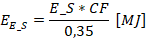
Where:
-
E_S: Electricity sold to the grid [kWh]
-
CF: Calorific value (Refer to Table at the end of Appendix I)
-
"5. The pre-tax weighted average cost of capital i (%) is determined according to the formula below:td: Total equivalent product [ton SP]. To ensure uniformity of products in comparison, sugar products (raw sugar, yellow direct consumption sugar, white sugar, and refined sugar) are converted to equivalent products according to Formula 5 below:
-
"5. The pre-tax weighted average cost of capital i (%) is determined according to the formula below:td x TRS + 0,98315*PR + PBR + 1,09685*PRE [tons] (Formula 5)
Where:
-
"5. The pre-tax weighted average cost of capital i (%) is determined according to the formula below:td: Equivalent sugar product [tons]
-
"5. The pre-tax weighted average cost of capital i (%) is determined according to the formula below:RS: White sugar product [tons]
-
"5. The pre-tax weighted average cost of capital i (%) is determined according to the formula below:R: Raw sugar product [tons]
-
"5. The pre-tax weighted average cost of capital i (%) is determined according to the formula below:BR: Yellow direct consumption sugar product [tons]
-
"5. The pre-tax weighted average cost of capital i (%) is determined according to the formula below:RE: Refined sugar product [tons]
-
0,98315: Conversion factor from raw sugar to equivalent sugar
-
1,09685: Conversion factor from refined sugar to equivalent sugar
Due to the consumption of various types of energy, these energy forms are converted according to the following factors:
Serial NumberTypeUnitCoefficientMJ/unit1ElectricalkWh3,602Coal powder type 1,2Metric tons29.3093Coal powder type 3,4Metric tons25.1224Coal powder type 5,6Metric tons20.9355Diesel oil (DO)Metric tons42.707,401000 liters36.845,606FO (Fuel Oil)Metric tons41.451,301000 liters39.357,807LPGMetric tons45.638,308Steam (6 bar)Metric tons2.755,469Steam (7 bar)Metric tons2.761,0010Steam (9 bar)Metric tons2.773,0311Steam (15 bar)Metric tons2.801,9312Steam (21 bar)Metric tons2.799,2613Steam (23 bar)Metric tons2.800,8214Steam (25 bar)Metric tons2.801,9315Steam (30 bar)Metric tons2.803,1516Steam (35 bar)Metric tons2.802,6417Steam (40 bar)Metric tons2.800,8218Steam (45 bar)Metric tons2.797,9519Steam (50 bar)Metric tons2.794,2120Steam (55 bar)Metric tons2.789,7221Steam (60 bar)Metric tons2.784.5922Steam (70 bar)Metric tons2.772,6323Steam (80 bar)Metric tons2.758,6824Steam (90 bar)Metric tons2.742.9425Steam (100 bar)Metric tons2.725,4926Steam (110 bar)Metric tons2.706,3527Steam (120 bar)Metric tons2.686,4528Sugarcane bagasseMetric tons7.464,0029Wood chipsMetric tons15.223,0030Dry rice huskMetric tons15.906,80ANNEX II
SOME SOLUTIONS TO IMPROVE ENERGY EFFICIENCY IN THE SUGAR INDUSTRY
Issued together with Circular No. 39/2019/TT-BCT dated November 29, 2019, by the Minister of Industry and Trade
-
Strengthening internal management, creating mechanisms to bind responsibility for energy conservation within factories.
-
Optimizing combustion processes in boilers through experimental work and boiler adjustment.
-
Utilizing waste heat for sugarcane bagasse drying.
-
Ensuring that energy-saving equipment in boilers operates effectively.
-
Adhering to regular maintenance procedures for boilers, inspecting insulation layers around boilers.
-
Operating steam boilers at near-rated capacity (approximately 90% of rated capacity).
-
Increasing superheated steam parameters when exiting the boiler and replacing steam-driven machinery in production lines with electric motors.
-
Reducing turbine blade corrosion to increase power generation efficiency.
-
Replacing medium-pressure turbines with back-pressure turbines equipped with steam extraction valves.
-
Optimizing the steam distribution system.
-
Optimizing technological processes during water evaporation.
-
Equipping evaporators with rational structures to save saturated steam.
-
Recirculating condensate water.
-
Increasing Brix concentration before cooking.
-
Reusing steam from multi-stage evaporators.
-
Using horizontal continuous cookers.
-
Recovering heat from sugar drying processes.
-
Automating sugar drying processes.
-
Using steam instead of hot water if heating above 95 degrees Celsius is required.04. Liquid bull semen
-
Improving air compressors.
-
Replacing DC motors with AC motors.
-
Using high-efficiency transformers.
-
Replacing standard motors with high-efficiency motors.
-
Installing variable frequency drives on motors.
-
Replacing steam turbines with electric motors for pumps and grinders.
-
Replacing lighting systems with high-efficiency ones.
-
Investing in diffusion presses instead of roller presses to minimize electricity and steam usage in pressing systems, increasing steam for power generation.
-
Investing in modern decanter centrifuges driven by variable frequency drives capable of regenerating power.
-
Investing in automated sugar refining systems without agitators, replacing traditional batch kettles with agitators.
ANNEX III
SAMPLE REPORT ON IMPLEMENTATION OF ENERGY CONSUMPTION STANDARDS IN THE SUGAR INDUSTRY
Issued together with Circular No. 39/2019/TT-BCT dated November 29, 2019, by the Minister of Industry and Trade
(For Provincial Departments of Industry and Trade)
| People's Committee... DEPARTMENT OF INDUSTRY AND TRADE |
SOCIALIST REPUBLIC OF VIET NAM Independence - Freedom - Happiness |
| Number: …… | ..., day ..., month ..., year ... |
REPORT
SITUATION OF IMPLEMENTATION OF ENERGY CONSUMPTION STANDARDS IN THE SUGAR INDUSTRY of the Minister of Labor, Invalids, and Social Affairs;
Respectfully submitted to: Department of Energy Saving and Sustainable Development, Ministry of Industry and Trade
Pursuant to Circular No. .../2019/TT-BCT dated ... month ... year 2019 of the Ministry of Industry and Trade stipulating energy consumption standards in the sugar industry, the Provincial Department of Industry and Trade... reports on the implementation of energy consumption standards in the sugar industry under its jurisdiction as follows:
- Number of sugar manufacturing facilities:...
- Number of facilities that have reported:...
- Number of facilities that have not reported:...
Where:
- Number of facilities meeting the prescribed standards:...
- Number of facilities requiring enhanced management:...
Detailed information on sugar manufacturing facilities under its jurisdiction is summarized below
Table 1. List of sugar manufacturing facilities under management
|
No. |
Name of the entity |
Tax code |
Product (Tons) |
Current reporting status |
||||
|
Raw Sugar |
Directly consumed yellow sugar |
White Sugar |
Refined Sugar |
Submitted |
Not submitted |
|||
|
1 |
|
|
|
|
|
|
|
|
|
2 |
|
|
|
|
|
|
|
|
|
… |
|
|
|
|
|
|
|
|
|
|
Total |
|
|
|||||
Table 2. Energy consumption rate of sugar manufacturing facilities that have reported
|
No. |
Name of the entity |
d.1. Amount of taxable income in Vietnam:, amended and supplemented by Decree No. 109/2025/NĐ-CP and Decree No. 193/2025/NĐ-CPProduction volume (Tof the Government stipulating functions, tasks, powers, and organizational structure of the Ministry of Home Affairs(product quantity) |
Rate Energy consumption rateMJ(per ton) |
Evaluation |
||
|
Previous Reporting Period |
Reporting period |
Achieved |
Not reached |
|||
|
1 |
|
|
|
|
|
|
|
2 |
|
|
|
|
|
|
|
… |
|
|
|
|
|
|
|
Total |
|
|
||||
Table 3. List of facilities requiring enhanced management
|
No. |
Name of the entity |
N ||||||Content requiring enhanced management |
Specific notes, if any |
||
|
Not reported |
Not reaching the prescribed level |
Other content |
|
||
|
1 |
|
|
|
|
|
|
2 |
|
|
|
|
|
|
… |
|
|
|
|
|
|
d.1. Amount of taxable income in Vietnam:, amended and supplemented by Decree No. 109/2025/NĐ-CP and Decree No. 193/2025/NĐ-CPenergy |
|
|
|
|
|
Recommendations regarding the implementation of the Circular (if any)...
|
Place of Receipt: |
REPRESENTATIVE OF THE DEPARTMENT OF INDUSTRY AND TRADE |
ANNEX IV
SAMPLE ANNUAL REPORT ON IMPLEMENTATION OF ENERGY CONSUMPTION STANDARDS
Issued together with Circular No. 39/2019/TT-BCT dated November 29, 2019, by the Minister of Industry and Trade
(For sugar manufacturing facilities)
|
Facility namein |
SOCIALIST REPUBLIC OF VIET NAM |
|
Number: …… |
…………on …… the …… year …… |
REPORT ON IMPLEMENTATION OF ENERGY CONSUMPTION STANDARDS
Respectfully submitted to: Department of Industry and Trade of province/city...
Pursuant to Circular No. .../2019/TT-BCT dated...month...year 2019 of the Minister of Industry and Trade stipulating energy consumption standards in the sugar industry, the unit...reports on the implementation of energy consumption standards at the processing site as follows:
- Facility name:...
- Address:...
- Tax code:...
The following information is compiled for the period from August 1, 20... to July 31, 20...
- General Information
Raw Materials
Ton sugarcane/year
Production volume and products
Raw Sugar
Yellow sugar
White sugar (RS)
Refined sugar (RE)
Other
Tons/year
Tons/year
Tons/year
Tons/year
Tons/year
II. Basic operational parameters
1. Boiler parameters:
|
Parameter |
Unit |
Boiler No. 1 |
Boiler No. 2 |
Boiler No. 3 |
Boiler No. 4 |
|
||| Approved Budget |
Tons/hour |
|
|
|
|
|
Actual capacity |
Tons/hour |
|
|
|
|
|
Working pressure |
Bar |
|
|
|
|
|
Outlet steam temperature |
°C |
|
|
|
|
|
Annual steam flow |
Tons steam/year |
|
|
|
|
- Steam parameters:
|
Into Turbine |
Turbine outlet |
To Technology |
|||
|
Salinity |
Pressure |
Salinity |
Pressure |
Salinity |
|
|
°C |
Bar |
°C |
Bar |
°C |
|
|
|
|
|
|
|
|
III. Energy consumption parameters:
- Fuel:
|
Bagasse consumed |
Other biomass |
FO oil |
Diesel oil (DO) |
Anthrax |
LPG/CNG |
Other |
|
Tons/year |
Tons/year |
Tons/year |
Tons/year |
Tons/year |
Tons/year |
Tons/year |
|
|
|
|
|
|
|
|
2. Electricity:
|
Generator |
Sold to grid |
Purchased from grid |
|
kWh/year |
kWh/year |
kWh/year |
|
|
|
|
IV. Consumption rate
|
Parameter |
Unit |
- The book value of the security is determined according to the Accounting System of the State Bank and the guidance document of the State Bank on the accounting treatment of foreign securities investment operations. |
|
Energy consumption rate this year |
MJ/ton SP |
|
|
Energy saved next year |
MJ |
|
|
% |
|
|
|
Projected energy consumption rate next year |
MJ/ton SP |
|
|
Comparison with the same period standard |
% |
|
V. Energy saving plan
|
Serial number |
Name of solution |
Potential energy savings |
Implementation timeline |
||||||||||||||
|
Energy |
Unit |
- The book value of the security is determined according to the Accounting System of the State Bank and the guidance document of the State Bank on the accounting treatment of foreign securities investment operations. |
Potential % |
1 |
2 |
3 |
4 |
5 |
6 |
7 |
8 |
9 |
10 |
11 |
12 |
||
|
1 |
|
|
|
|
|
|
|
|
|
|
|
|
|
|
|
|
|
|
2 |
|
|
|
|
|
|
|
|
|
|
|
|
|
|
|
|
|
|
3 |
|
|
|
|
|
|
|
|
|
|
|
|
|
|
|
|
|
|
4 |
|
|
|
|
|
|
|
|
|
|
|
|
|
|
|
|
|
|
5 |
|
|
|
|
|
|
|
|
|
|
|
|
|
|
|
|
|
|
6 |
|
|
|
|
|
|
|
|
|
|
|
|
|
|
|
|
|
|
7 |
|
|
|
|
|
|
|
|
|
|
|
|
|
|
|
|
|
|
8 |
|
|
|
|
|
|
|
|
|
|
|
|
|
|
|
|
|
|
9 |
|
|
|
|
|
|
|
|
|
|
|
|
|
|
|
|
|
|
10 |
|
|
|
|
|
|
|
|
|
|
|
|
|
|
|
|
|
IV. Recommendations regarding the implementation of the Circular (if any)
......................................................................................................................................................................................................................................................................................................................................................................................................................................................................................................................................................................................................................................................................................................................................................................................................
..., day ..., month ..., year 20...
The General Director is the legal representative of the Company, having rights and obligations as stipulated in this Charter.(Sign, write full name and stamp)
Bản đồ quan hệ
Bấm vào một văn bản để mở. Viền đỏ = quan hệ làm thay đổi hiệu lực.