
This Appendix provides detailed information on the process of determining the number of exhaust gas measurements in Type I test, requirements for standard fuel used for vehicles with forced combustion engines, and exhaust gas inspection results according to QCVN 77:2014/BGTVT standards. It includes information on the fuel supply system, additional pollution control equipment, and testing results for Type I and II permits along with fuel vapor tests (if applicable).
Đối tượng áp dụng
This Appendix applies to emission testing facilities for motorcycles and automobiles with forced combustion engines according to national technical regulations QCVN 77:2014/BGTVT.
Các điểm cốt lõi
- Process for determining the number of exhaust gas measurements in Type I test
- Requirements for standard fuel used for vehicles with forced combustion engines
- Exhaust gas inspection results according to QCVN 77:2014/BGTVT standards.
- Information on the fuel supply system and additional pollution control equipment.
- Testing results for Type I and II permits and fuel vapor tests (if applicable).
🌐 Tác động xã hội từ văn bản này
- Ensuring the quality of standard fuel used during the exhaust gas inspection process.
- Providing a process for accurately determining the number of exhaust gas measurements to obtain reliable results.
- Supporting the evaluation of the performance of pollution control devices on motorcycles and automobiles.
❓ Câu hỏi thường gặp
Does this Appendix apply to all types of fuel?
No, this Appendix only applies to unleaded gasoline according to standards TCVN 7357:2010/TCVN 9726:2013.
Is it necessary to conduct fuel vapor tests for all types of vehicles?
No, it only applies to Type II tests or when specific requirements are requested by regulatory authorities.
What are the technical requirements for standard fuel?
The technical requirements include criteria such as octane rating, density, Reid vapor pressure, distillation, hydrocarbon analysis, carbon-to-hydrogen ratio, oxidation stability, oxygen content, gum, sulfur, corrosion, and lead content.
Toàn văn
|
MINISTRY OF TRANSPORTATION |
SOCIALIST REPUBLIC OF VIET NAM |
|
Number: 45/2014/TT-BGTVT |
Hanoi, October 3, 2014 |
CIRCULAR
Issuing National Technical Regulations on Emissions Level 3 for
Two-Wheel Motorcycles Produced, Assembled, and Newly Imported
On the basis of Decree No. 86/2012/NĐ-CP dated October 19, 2012, issued by the Government detailing and guiding implementation of certain provisions of the Metrology Law;
Pursuant to the Law on Standards and Technical Regulations dated June 29, 2006;
Pursuant to the Law on Legislative Acts of Legal Norms dated June 3, 2008;
Pursuant to Decree No. 107/2012/NĐ-CP dated December 20, 2012 of the Government stipulating the functions, tasks, powers, and organizational structure of the Ministry of Transport;
Pursuant to Decision No. 49/2011/QD-TTg dated September 1, 2011 of the Prime Minister stipulating the timeline for applying emission standards for newly produced, assembled, and imported motor vehicles and two-wheel motorcycles;
At the proposal of the Director of the Vietnam Vehicle Inspection Agency and the Director of the Environmental Department,
The Minister of Transport hereby issues this Circular on National Technical Regulations on Emissions Level 3 for newly produced, assembled, and imported two-wheel motorcycles.
Article 1. This Circular includes the National Technical Regulations on Emissions Level 3 for newly produced, assembled, and imported two-wheel motorcycles.
Registration code: QCVN 77:2014/BGTVT.
Article 2. This Circular takes effect from January 1, 2015. However, the application of Emission Level 3 as specified in Article 2.1 of QCVN 77:2014/BGTVT for newly produced, assembled, and imported two-wheel motorcycles shall be implemented from January 1, 2017, according to Clause 2 of Article 4 of Decision No. 49/2011/QD-TTg dated September 1, 2011 of the Prime Minister.
Article 3. The Heads of the Ministry's Office, Inspectorate, Departments, Directors of the Vietnam Vehicle Inspection Agency, Heads of agencies and units under the Ministry of Transport, relevant organizations and individuals are responsible for implementing this Circular./.
|
Place of Receipt: |
THE MINISTER |
QCVN 77 : 2014/BGTVT
NATIONAL TECHNICAL REGULATIONS ON EMISSIONS LEVEL 3 FOR NEWLY PRODUCED, ASSEMBLED AND IMPORTED TWO-WHEEL MOTORCYCLES
National technical regulation on the third level of gaseous pollutant emission for new assembled, manufactured and imported two-wheeled motorcycles
Foreword
QCVN 77:2014/BGTVT was compiled by the Vietnam Vehicle Inspection Agency, reviewed by the Environmental Department, and issued by the Ministry of Transport pursuant to Circular No. ... dated ... month .... year 2014.
This standard is based on:
1. TCVN 7357:2010 - Road Vehicles - Exhaust Emissions from Motorcycles - Requirements and Test Procedures for Type Approval (hereinafter referred to as TCVN 7357).
2. TCVN 9726:2013 - Road Vehicles - Exhaust Emissions and Fuel Consumption of Two-Wheel Motorcycles with Forced Combustion or Compression Ignition Engines - Requirements and Test Procedures for Type Approval (hereinafter referred to as TCVN 9726).2 This standard specifies the limits of exhaust emissions, test procedures, testing methods, and management requirements for checking Emissions Level 3 of newly produced, assembled, and imported two-wheel motorcycles (hereinafter referred to as motorcycles).
NATIONAL TECHNICAL REGULATIONS ON EMISSIONS LEVEL 3 FOR NEWLY PRODUCED, ASSEMBLED AND IMPORTED TWO-WHEEL MOTORCYCLES
National technical regulation on the third level of gaseous pollutant emission for new assembled, manufactured and imported two-wheeled motorcycles
Chapter 1. GENERAL PROVISIONS
1.1. Scope of Application
This standard applies to agencies, organizations, and individuals involved in the production, assembly, and importation of motorcycles.
1.2. Applicability
In this standard, the following terms are understood as follows:
1.3. Definitions
1.3.1. Two-Wheel Motorcycle
(Xe mô tô hai bánh): A two-wheeled vehicle equipped with a forced combustion engine, with a maximum designed speed greater than 50 km/h or a cylinder working volume greater than 50 cm³. 1.3.2. Vehicle Type3.
(Kiểu loại xe): A category comprising vehicles sharing the following basic characteristics: a) Equivalent inertia determined according to the standard mass as specified in Table 3 of this standard;
b) Engine and vehicle features listed in Appendix 1 of this standard, except for the content mentioned in Section 2.7 of Appendix 1.
1.3.3. Standard Mass
(Khối lượng chuẩn): The mass of the vehicle ensuring operation with fuel filled up to at least 90% of the maximum fuel tank capacity, plus 75 kg. 1.3.4. Gaseous Pollutants
(Chất khí gây ô nhiễm): Carbon monoxide (CO), nitrogen oxides represented by equivalent nitrogen dioxide (NO₂), and hydrocarbons (HC) as follows: for gasoline;2for diesel.
C1H1,85 1.3.5. Level 3
C1H1,86 (Mức 3): Standards for testing and limits of pollutants in exhaust emissions corresponding to Euro 3 levels as defined in the United Nations Economic Commission for Europe's technical regulations on vehicle emissions or European Union directives applicable to newly produced and imported motor vehicles.
1.3.6. Crankcase (Các te động cơ): Internal or external compartments within or outside the engine connected to the oil sump via internal or external pipes through which gases and vapors can escape.
1.3.7. Evaporative Emissions (Khí thải do bay hơi): Hydrocarbon (HC) emissions other than tailpipe HC emissions, resulting from fuel vaporization from the vehicle's fuel system, including the following types:
a) Tank Breathing Losses: HC emissions from fuel vaporization from the fuel tank due to temperature changes inside the tank; b) Hot Soak Losses: HC emissions from fuel vaporization from the vehicle's fuel system after it has been parked following operation.
When testing exhaust emissions of vehicles according to Test Method I as specified in Clause 3.2.2 of this standard, the average measured mass of each exhaust gas component (CO, HC, NOx) from newly produced and imported vehicles must be less than the limit values specified in the tables below:
a) For cases where TCVN 7357 is applied: Table 1.
Chapter 2. TECHNICAL PROVISIONS
2.1. Table 1 - Limit Values of Gaseous Pollutants for Two-Wheel Motorcycles (according to TCVN 7357)
Mass in grams per kilometer (g/km)
Cylinder Working Volume
Carbon Monoxide (CO)
|
Hydrocarbon Mass (HC) |
Weight nh cơ1 |
< 150 cm³ nh cơ2 |
Weight nh cơ3 |
|
Respectively, the symbols represent the limit values of CO, HC, and NOx.3 |
2,0 |
0,8 |
0,15 |
|
b) For cases where organizations or individuals request the application of TCVN 9726: Table 2 (equivalent to Level 3).3 |
2,0 |
0,3 |
0,15 |
|
Note: nh cơ1, L2, nh cơ3 Table 2 - Limit Values of Gaseous Pollutants for Two-Wheel Motorcycles (according to TCVN 9726) |
|||
Maximum Design Speed
< 130 km/h
Carbon Monoxide (CO)
|
≥ 130 km/h |
Weight nh cơ1 |
< 150 cm³ nh cơ2 |
Weight nh cơ3 |
|
Vmax When testing evaporative emissions of vehicles according to the fuel vapor test method specified in Clause 3.2.4 of this standard, the total amount of HC released must not exceed 2.0 grams per test. |
2,62 |
0,75 |
0,17 |
|
Vmax 3. MANAGEMENT REQUIREMENTS |
2,62 |
0,33 |
0,22 |
2.2. 3.1. Technical Documentation and Sample Testing
For vehicles required to undergo exhaust emission testing, the production facility or organization/person importing must provide the following documentation and samples:
The registration form of the main technical parameters of the vehicle and engine as specified in Appendix 1 of this standard.
For vehicles that require exhaust gas testing, the production and business establishment or organization or individual importing shall provide technical specification registration documents and test samples as follows:
3.1.1. The main technical specification registration form of the vehicle and engine as prescribed in Appendix 1 of this Standard.
3.1.2. Sample: The quantity and other requirements for sample vehicles representing vehicle types or batches for inspection are specified in TCVN 7357, TCVN 9726, Circular No. 44/2012/TT-BGTVT dated October 23, 2012 issued by the Minister of Transport on the inspection of motorcycle and motorized bicycle quality, safety technical standards, and environmental protection for imported motorcycles, motorized bicycles, and imported engines used to produce motorcycles and motorized bicycles, and Circular No. 45/2012/TT-BGTVT dated October 23, 2012 issued by the Minister of Transport on the inspection of quality, safety technical standards, and environmental protection during the production and assembly of motorcycles and motorized bicycles.
3.2. Testing and testing methods
3.2.1. Exhaust gas testing must be conducted using Type I tests, Type II tests, and evaporative fuel tests.
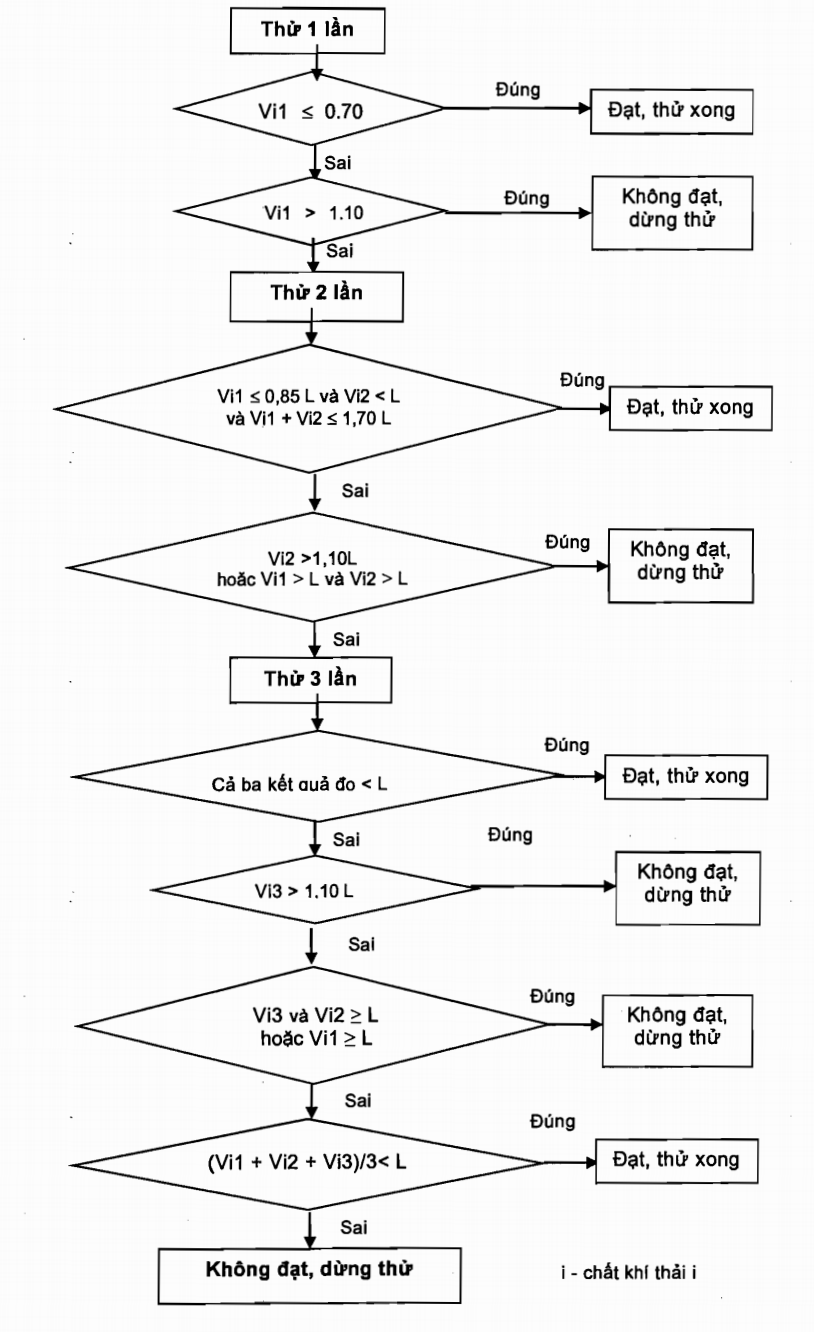
3.2.2. Type I tests shall be carried out according to the provisions of TCVN 7357. TCVN 9726 may replace TCVN 7357 for conducting Type I tests if requested by the organization or individual registering for the test. The number of repeated tests shall be three times unless the conditions set forth in points a and b below are met.
In each test, the measured mass of each exhaust gas component must be less than the corresponding limit values (L1, L2, L3) listed in Tables 1 and 2 of this Standard. However, for each exhaust gas component, one of the three measurement results from the three tests may exceed the prescribed limit value by up to 10% in Tables 1 and 2 of this Standard, provided that the average of the three measurement results still remains below the limit value.
The number of tests specified above will be reduced under the following conditions:
a) Only one test is required if all exhaust gas measurement results meet the requirement: V1 ≤ 0.70 L;
b) Only two tests are required if all exhaust gas measurement results simultaneously meet the following requirements: V1 ≤ 0.85 L, V1 + V2 ≤ 1.70 L and V2 ≤ L.
Where:
V1 is the result of the first test for each exhaust gas component;
V2 is the result of the second test for each exhaust gas component;
L (L1, L2, L3) is the emission limit in Tables 1 and 2 of this Standard.
The procedure for determining the number of tests mentioned above in Type I tests is shown in Appendix 3 of this Standard.
3.2.3. Type II tests must be performed according to the provisions of Appendix F of TCVN 7357 or according to the provisions of TCVN 9726.
The measured concentration of CO (% volume) in exhaust gases and the engine speed at two idle conditions and high idle conditions must be recorded in the test report. If TCVN 9726 is applied, the engine lubricating oil temperature and CO concentration (% volume) in the two aforementioned conditions must also be recorded.2 These results serve as the basis for inspecting vehicle types when put into use.
Evaporative fuel tests must be conducted using the methods described in Appendix G of TCVN 7357. The total measured amount of HC released must not exceed the limit value specified in Article 2.2 of this Standard.
3.2.4. 3.3. Test Fuel
The test fuel for exhaust emissions must be common fuel suitable for current fuel technical standards, with gasoline having a minimum octane rating (RON) of 95. In cases where there is agreement between the production and assembly facility or the importing organization or individual registering for exhaust emissions testing and the testing facility, standard fuel as specified in Appendix 4 of this Standard or fuel with equivalent characteristics to the standard fuel may be used.
If the engine is lubricated with a mixture of fuel and lubricating oil, the oil added to the standard fuel must match the quantity and type of lubricating oil according to the main technical specifications of the engine and vehicle in Appendix 1 of this Standard.
3.4. Test Report
The testing facility must prepare an exhaust test report which must include at least the contents specified in Appendix 2 of this Standard. Additionally, the testing facility must store related data records concerning the exhaust gas measurement process in the laboratory along with this test report.
The exhaust inspection results in the test report serve as the basis for evaluating compliance with exhaust regulations stipulated in this Standard.
3.5. Modification of Production and Assembly Vehicle Types Compared to Tested Sample Vehicles
The production and assembly facility must report to the certification authority about any modifications made to certified vehicle types compared to the tested sample vehicles. This authority must review and evaluate the modifications as follows:
If the modifications are minor and the vehicle type still meets the exhaust requirements of this Standard, the modifications will be approved.
3.5.1. If the modifications could adversely affect exhaust emissions, the testing facility that tested the sample vehicle must conduct a test on a modified vehicle and submit a new exhaust test report.
3.5.2. Based on the review and evaluation, a decision will be made to approve or disapprove the modification. If approved, the specific modifications must be clearly communicated.
3.5.3. 3.6. Extending Recognition of Exhaust Emission Test Results
The exhaust emission test results of a vehicle type that has been granted a quality certificate (hereinafter referred to as the certified vehicle type) can be extended to recognize as test results for another vehicle type with different technical specification registration forms in Appendix 1 of this Standard from the certified vehicle type as follows:
- Only differing in item 1.2 of Appendix 1; or
- Differing in item 1.2 and one of the cases complying with the provisions of Clauses 3.6.1 to 3.6.3 below:
3.6.1. Case 1:
Different in reference weight but with equivalent inertial mass higher or lower adjacent to the equivalent inertial mass of the certified vehicle type (see Table 3 below). Table 3 - Reference Weight and Equivalent Inertial Mass of Vehicles
Reference Weight
|
ref mEquivalent Inertial MassTotal Gross Vehicle Weight |
95 < m ≤ 105 mANNEX I.A[31] Total Gross Vehicle Weight |
|
105 < m ≤ 115 |
100 |
|
115 < m ≤ 125 |
110 |
|
125 < m ≤ 135 |
120 |
|
135 < m ≤ 145 |
130 |
|
145 < m ≤ 155 |
140 |
|
155 < m ≤ 165 |
150 |
|
165 < m ≤ 175 |
160 |
|
175 < m |
170 |
|
185 < m ≤ 195 ≤ 185 |
180 |
|
195 < m ≤ 205 |
190 |
|
205 < m ≤ 215 |
200 |
|
215 < m ≤ 225 |
210 |
|
225 < m ≤ 235 |
220 |
|
235 < m ≤ 245 |
230 |
|
245 < m ≤ 255 |
240 |
|
255 < m ≤ 265 |
250 |
|
265 < m ≤ 275 |
260 |
|
275 < m ≤ 285 |
270 |
|
285 < m ≤ 295 |
280 |
|
295 < m ≤ 305 |
290 |
|
305 < m ≤ 315 |
300 |
|
315 < m ≤ 325 |
310 |
|
325 < m ≤ 335 |
320 |
|
325 < m ≤ 335 |
330 |
|
335 < m ≤ 345 |
340 |
|
345 < m ≤ 355 |
350 |
|
355 < m ≤ 365 |
360 |
|
365 < m ≤ 375 |
370 |
|
375 < m ≤ 385 |
380 |
|
385 < m ≤ 395 |
390 |
|
395 < m ≤ 405 |
400 |
|
405 < m ≤ 415 |
410 |
|
415 < m ≤ 425 |
420 |
|
425 < m ≤ 435 |
430 |
|
435 < m ≤ 445 |
440 |
|
445 < m ≤ 455 |
450 |
|
455 < m ≤ 465 |
460 |
|
465 < m ≤ 475 |
470 |
|
475 < m ≤ 485 |
480 |
|
485 < m ≤ 495 |
490 |
|
495 < m ≤ 505 |
500 |
|
505 < m ≤ 515 |
510 |
|
515 < m ≤ 525 |
520 |
|
525 < m ≤ 535 |
530 |
|
535 < m ≤ 545 |
540 |
|
545 < m ≤ 550 |
550 |
3.6.2. Case 2: There are different overall transmission ratios of the powertrain system (calculated based on the gear ratios) compared to the corresponding overall transmission ratios of the certified vehicle model but satisfying the following conditions:
a) For all gear ratios used in Type I test, the ratio E must not exceed 8%, where E is calculated as follows:
Where:
BB 1.11 is the speed of the certified vehicle model when the engine speed is 1000 r/min;
BB 1.12 is the speed of the vehicle model under consideration when the engine speed is 1000 r/min;
b) If E of at least one gear ratio exceeds 8% and simultaneously E of all gear ratios does not exceed 13%, then the Type I test must be repeated. However, this test can be conducted at any testing facility approved by the certification authority, not necessarily the original testing facility for the certified vehicle model. The emission test results must comply with the emission limits specified in Tables 1 or 2 above, and this test report must also be sent to the original testing facility for the certified vehicle model.
3.6.3. Case 3: Both the standard weight and the overall transmission ratios differ from those of the certified vehicle model as stated in Cases 1 and 2 above, but satisfy all conditions set out in Clauses 3.6.1 and 3.6.2.
3.7. Monitoring emissions of vehicles during mass production
3.7.1. Vehicles produced in mass production that have been granted a certificate of conformity for the type also must meet the emission limits specified in Section 2 of this Standard.
3.7.2. The inspection according to Clause 3.7.1 shall be carried out randomly and annually to confirm the validity of the certificate issued by the certification authority.
3.7.3. The inspection must be based on the contents of the certification file and must conduct the Type I test as stipulated in Clause 3.7.2 on a vehicle selected from the batch of vehicles to be inspected. The measured values of the exhaust gas components must be lower than the corresponding limits of these components in Tables 1 and 2 of this Standard.
3.7.4. If the measured values of the exhaust gas components do not meet the requirements set out in Clause 3.7.3, the production facility may propose additional testing of some vehicles taken from that batch. The number of vehicles to be tested (n) is determined by the production facility; among them must include the vehicle selected for testing according to Clause 3.7.3 above. For each exhaust gas component, after measurement, the arithmetic mean of the measured values from the tested vehicles and the standard deviation S must be determined using the formula below. The batch will be considered compliant with this Standard if it meets the following condition:
Where:
- L is the limit for each exhaust gas component in Tables 1 or 2 of this Standard;
- is the arithmetic mean of the measured values of each exhaust gas component of all n sample vehicles;
- Standard deviation S2 = is the measured value of the exhaust gas component being considered of the i-th sample vehicle,
- k is the statistical weight depending on n in Table 4 below:
Table 4. Statistical weight k
|
n |
2 |
3 |
4 |
5 |
6 |
7 |
8 |
9 |
10 |
|
ảo |
0,973 |
0,613 |
0,489 |
0,421 |
0,376 |
0,342 |
0,317 |
0,296 |
0,279 |
|
n |
11 |
12 |
13 |
14 |
15 |
16 |
17 |
18 |
19 |
|
ảo |
0,265 |
0,253 |
0,242 |
0,233 |
0,224 |
0,216 |
0,210 |
0,203 |
0,198 |
If n ≥ 20 then:
4. IMPLEMENTATION ORGANIZATIONS
4.1. The Vietnam Vehicle Inspection Agency is responsible for implementing and guiding the application of this Standard. In case there are issues related to the provisions of this Standard, the Vietnam Vehicle Inspection Agency shall report to the Ministry of Transport for review and resolution.
4.2. In case the standards, regulations, and provisions mentioned in this Standard are amended, supplemented, or replaced, they shall be implemented according to the new standards, regulations, and provisions.
ANNEX 1
(Annex 1)
Registration document of the main technical parameters of the vehicle and engine
(Document of essential characteristics of two-wheeled motorcycle and engine)
1. Vehicle (Two-wheeled motorcycle) ……………………………………………………………………..
1.1. Make of vehicle (Mark): …………………………………………………………………………….
1.2. Vehicle model (Model number) (Vehicle type): ……………………………………………………………
1.3. Name and address of the production, assembly organization/person importing(1) (Manufacturer's/Importer's name and address): ………………………………………………………………………..
1.4. Name and address of the representative of the production, assembly organization/person importing (if applicable)(1) (If applicable, name and address of manufacturer's/importer's representative): …………….
1.5. Unladen mass of the vehicle (Unladen mass of vehicle): …(kg)
1.6. Maximum mass of the vehicle (Maximum mass of vehicle): …(kg)
1.7. Gearbox (Gearbox) ……………………………………………………………………………….
1.7.1. Control (Control): Mechanical/Automatic (Manual/Automatic/)(1)
1.7.2. Number of gear ratios (Number of gear ratios)(2): ……………………………………………
1.7.3. Gear ratio of transmission (Gear ratio(3):
First gear (First gear): ………………………………………………………………………………………
Second gear (Second gear): …………………………………………………………………………………..
Third gear (Third gear): ………………………………………………………………………………………
……………………………………………………………………………………………………………
1.8. Final drive ratio (Final drive ratio): ………………………………………………………
1.9. Tyres (Tyres)
1.9.1. Tyre size designation (Dimensions): …………………………………………………………..
1.9.2. Dynamic rolling circumference (4)(5) (Dynamic rolling circumference): ………………. (mm)
1.10. Maximum design speed specified by the manufacturer (Maximum design speed specified by the manufacturer): …(km/h)
Note to item 1:
(1) Strike out what does not apply (Strike out what does not apply).
(2) Only apply for manual gear-box (Only apply for manual gear-box).
(3) In the case of vehicles equipped with automatic-shift gear-boxes, give all pertinent technical data (In the case of vehicles equipped with automatic-shift gear-boxes, give all pertinent technical data).
(4) It is calculated from dynamic rolling radius which is the distance from the center of the wheel to road when the vehicles is in motion (It is calculated from dynamic rolling radius which is the distance from the center of the wheel to road when the vehicles is in motion).
(5) Not apply for imported motorcycle (Not apply for imported motorcycle).
2. Engine (Engine)
2.1. Description of engine (Description of engine)
2.1.1. Trade name/Brand (Make/Mark): …………………………………………………
2.1.2. Type (Type number) (Type): …………………………………………………………………….
2.1.3. Cycle (Cycle): Four-stroke/two-stroke (Four-stroke/two-stroke)(1): ………………………………………
2.1.4. Number and arrangement of cylinders (Number and arrangement of cylinders): ……………….
2.1.5. Bore (Bore): …mm
2.1.6. Stroke …mm
2.1.7. Cylinder capacity (Cylinder capacity): …cm3
2.1.8. Compression ratio (Compression ratio)(2)(3): ………………………………………………………….
2.1.9. Drawings of the combustion chamber and of the piston, including the piston rings (Drawings of the combustion chamber and of the piston, including the piston rings)(4): ………..
…………………………………………………………….………………………………………………
2.1.10. System of cooling (System of cooling): Liquid/Air (Liquid/Air)(1): …………...
2.1.11. Supercharged, if applicable (Supercharged, if applicable): Description (Description)....
2.1.12. System of lubrication (two-stroke engines - separate or by mixture) (System of lubrication (two-stroke engines - separate or by mixture)): …………………………………………….…………………………………………………
…………………………………………………………….……………………………………………..
2.1.13. Device for recycling crank-case gases (if any, description and diagrams) (Device for recycling crank-case gases (if any, description and diagrams)): ………………………………….
…………………………………………………………….………………………………………………
2.1.14. Air filter: drawings, or makes and types (Air filter: drawings, or makes and types(4): …………………………………………………………….…………………………………….
2.2. Additional anti-pollution devices (if any, and if not covered by another heading)
(Additional anti-pollution devices (if any, and if not covered by another heading))
2.2.1. Additional anti-pollution devices for tailpipe emission (Additional anti-pollution devices for tailpipe emission): Catalytic converter …
Description and diagrams (Description and diagrams): ……………………………………………………
2.2.2. Evaporative emission control system. Complete detailed description of the devices and their state of tune(5)
(Evaporative emission control system. Complete detailed description of the devices and their state of tune)
- Drawing of the evaporative control system (Drawing of the evaporative control system)
…………………………………………………………….……………………………………………
- Drawing of the carbon canister, if fitted (Drawing of the carbon canister, if fitted))
…………………………………………………………….……………………………………………
- Drawing of the fuel tank with indication of capacity and material (Drawing of the fuel tank with indication of capacity and material)
…………………………………………………………….………………………………………………
- Diagram of the fuel tank on vehicle with indication of fitting method (exposure/hidden(1)) (Diagram of the fuel tank on vehicle with indication of fitting method (exposure/hidden(1))
…………………………………………………………….……………………………………………
- Fuel hose material (Fuel hose material) …………………………………..
2.3. Air Intake and Fuel feed systems (Air Intake and Fuel feed systems)
2.3.1. Description and diagrams of air intakes and their accessories (dashpot, heating device, additional air intakes, etc.) (Description and diagrams of air intakes and their accessories (dashpot, heating device, additional air intakes, etc.))(4)
2.3.2. Fuel feed (Fuel feed)
2.3.2.1. By carburetor(s) (By carburetor(s))(1)
2.3.2.1.1. Trade name/Brand (Make/Mark): ……………………………………………..
2.3.2.1.2. Type MAXIMUM OUTPUT/RPM: …………………………………………………………………………………
2.3.2.1.3. Settings (Settings)(3)(4)
2.3.2.1.3.1. Jets (Jets): ………………………………………………………….…………………..
2.3.2.1.3.2. Venturis (Venturis): ……………………………………………………………
2.3.2.1.3.3. Float-chamber level (Float-chamber level): ………………………………….
2.3.2.1.3.4. Mass of float: ………………………………………………………
2.3.2.1.3.5. Float needle …………………………………………………………………
Or curve of fuel delivery plotted (or curve of fuel delivery plotted)(1)(3)
2.3.2.1.4. Choke (Choke): Mechanical/Automatic Control (Manual/Automatic)(1)
Butterfly Valve Closure Setting (Closure Setting)(3)(4): …………………………………………
2.3.2.1.5. Fuel Supply Pump (Feed Pump): Pressure (Pressure)(3)(4): ………………………
or Characteristic Diagram (or Characteristic Diagram)(3)(4) ……………………………………………….
2.3.2.2. By Fuel Injector (By Injector)(1)
2.3.2.2.1. Fuel Pump (Pump)
2.3.2.2.1.1. Trade name/Brand (Make/Mark): …………………………………………..
2.3.2.2.1.2. Type MAXIMUM OUTPUT/RPM: ……………………………………………………………………………...
2.3.2.2.1.3. Delivery Per Stroke (Delivery Per Stroke)(3)(4): …mm3 in (At) Pump Speed (Pump Speed) ……… r/min.
or Characteristic Diagram (Or Characteristic Diagram)(3)(4): ………………………………………………
2.3.2.2.2. Fuel Injector (Injector(s))
2.3.2.2.2.1. Trade name/Brand (Make/Mark): …………………………………………….
2.3.2.2.2.2. Type (Type): ……………………………………………………………………………….
2.3.2.2.2.3. Calibration Pressure (Calibration Pressure)(3)(4): …bar
or Characteristic Diagram (or Characteristic Diagram)(3)(4):
2.4. Valve Timing (Valve Timing)(4)
2.4.1. For Valve Distribution System (Distribution by Valves)
2.4.1.1. Timing for Mechanically Operated Valves (Timing for Mechanically Operated Valves):
2.4.1.1.1. Maximum Lift of Valves and Angles of Opening and Closing Relative to Dead Centres (Maximum Lift of Valves and Angles of Opening and Closing in Relation to Dead Centres): …….
……………………………………………………………………………………………………………
2.4.1.1.2. Reference and/or Setting Clearance (Reference and/or Setting Clearance)(1): …………………………………………………………………………………………………………….
2.4.2. For Port Distribution System (Distribution by Ports)
2.4.2.1. Volume of Crankcase Cavity With Piston at Top Dead Centre (Volume of Crankcase Cavity with Piston at TDC): …………………………………………….
2.4.2.2. Description of Reed Valves If Any (With Dimensioned Drawing): (Description of Reed Valves If Any (With Dimensioned Drawing)): ………………………………………….
2.4.2.3. Description (With Dimensioned Drawing) of Inlet Ports, Scavenging and Exhaust, With Corresponding Timing Diagram: The Drawings Include One Showing the Internal Surface of the Cylinder (Description (With Dimensioned Drawing) of Inlet Ports, Scavenging and Exhaust, With Corresponding Timing Diagram): ……………………………………………………………………
2.5. Ignition System (Ignition)
2.5.1. Distributor(s) (Distributor(s))
2.5.1.1. Trade name/Brand (Make/Mark): ………………………………………………
2.5.1.2. Type (Type): ………………………………………………………………………………….
2.5.1.3. Ignition Advance Curve (Ignition Advance Curve)(3)(4): …………………………….
2.5.1.4. Ignition Timing (Ignition Timing)(3)(4): …………………………………………………
2.5.1.5. Contact-Point Gap (Contact-Point Gap)(3)(4): ……………………………………………….
2.6. Exhaust System: Description and Diagrams (Exhaust System: Description and Diagrams)(4):
2.7. Additional Information on Test Conditions (Additional Information on Test Conditions)
2.7.1. Fuel Used (Fuel Used): ……………………………………………………………..
2.7.2. Lubricant Used (Lubricant Used)
2.7.2.1. Trade name/Brand (Make/Mark): ………………………………………………..
2.7.2.2. Type of Lubricant (Type): ……………………………………………………………………
If Lubricant and Fuel Are Mixed, State Percentage of Oil in Mixture
(State Percentage of Oil in Mixture if Lubricant and Fuel Mixed) ……………………………………
2.7.3. Spark Plugs (Sparking Plugs): …………………………………………………………….
2.7.3.1. Trade name/Brand (Make/Mark): ………………………………………………..
2.7.3.2. Type (Type): ……………………………………………..……………………………………
2.7.3.3. Spark-Gap Setting (Spark-Gap Setting): …………………………………..
2.7.4. Ignition Coil (Ignition Coil)
2.7.4.1. Trade name/Brand (Make/Mark): ………………………………………………..
2.7.4.2. Type (Type): ……………………………………………………………………………………
2.7.5. Ignition Condenser (Ignition Condenser)(4)
2.7.5.1. Trade name/Brand (Make/Mark): ………………………………………………..
2.7.5.2. Type (Type): ………………………………………………..…………………………………..
2.7.6. Spark System: Description of Setting and Relevant Requirements Prescribed by the Manufacturer (Spark System: Description of Setting and Relevant Requirements Prescribed by the Manufacturer)(4): ……………………………………………………………………
2.7.7. Carbon Monoxide Content by Volume in the Exhaust Gas, With the Engine Idling Per Cent (Manufacturer Standard) (Carbon Monoxide Content by Volume in the Exhaust Gas, With the Engine Idling Per Cent (Manufacturer Standard))(4): …% (At) …r/min(1)
2.8. Engine Performance (Engine Performance)
2.8.1. Minimum Idling Speed (Minimum Idling Speed): …r/min(3)(1)
2.8.2. Engine Speed at Maximum Power (Engine Speed at Maximum Power): …….r/min(3)(1)(4)
2.8.3. Maximum Power (Maximum Power)(4): ………………………………….. kW
We Undertake That This Declaration Complies With the Vehicle Type Applying for Approval/Inspection and We Are Fully Responsible for Problems Caused by the Wrong Contents or Not Enough Content of the Declaration (We Undertake That This Declaration Complies With the Vehicle Type Applying for Approval/Inspection and We Are Fully Responsible for Problems Caused by the Wrong Contents or Not Enough Content of the Declaration).
|
Date ….. Month ….. Year (Date) |
Note Item 2:
(1) Strike out what does not apply (Strike Out What Does Not Apply)
(2) Compression Ratio d = (Combustion Chamber Volume + Cylinder Capacity)/(Combustion Chamber Volume) (Compression Ratio d = (Volume of Combustion Chamber + Cylinder Capacity)/(Volume of Combustion Chamber))
(3) Accompanied by Tolerance Specification (Specify the Tolerance)
(4) Not apply for imported motorcycle (Not apply for imported motorcycle).
(5) Only Apply for Evaporative Emissions Test (Only Apply for Evaporative Emissions Test).
ANNEX 2
(Annex 2)
Test Report of Emission From Two-Wheeled Motorcycle
(Test Report of Emission From Two-Wheeled Motorcycle)
1. Vehicle (Two-wheeled motorcycle)
. 11. Make of vehicle (Make/Mark): …………………………………………………………………….
1.2. Vehicle model (Model number) (Vehicle Type): ……………………………………………………………
1.3. Name and address of the production, assembly organization/person importing(1) (Manufacturer's/Importer's Name and Address): ………………………………………………………………………
1.4. Vehicle Gross Weight (Unladen mass of vehicle): …kg
1.5. Reference Mass of Vehicle (Reference Mass of Vehicle): …kg
1.6. Maximum mass of the vehicle (Maximum mass of vehicle): …kg
1.7. Gearbox (Gearbox)
1.7.1. Control (Control): Mechanical/Automatic (Manual/Automatic)(1)
1.7.2. Number of gear ratios (Number of gear ratios)(2): …………………………………………..
1.7.3. Gear Ratio (Gear Ratio)(3):
First Gear (1st Gear): …
Second gear (Second gear): …………………………………………………………………………………..
Third gear (Third gear): ………………………………………………………………………………………
……………………………………………………………………………………………………………
1.8. Final drive ratio (Final drive ratio): ………………………………………………………
1.9. Tyre size designation (Dimensions of Tires): ……………………………………………………..
1.10. Maximum design speed specified by the manufacturer (Maximum design speed specified by the manufacturer): …(km/h).
2. Engine (Engine)
2.1. Trade name/Brand (Make/Mark): ……………………………………………………
2.2. Engine Type (Number of Cylinders)Type): …………………………………………………………….
2.3. Cycle (Cycle): Four-stroke/two-stroke (Four-stroke/two-stroke)(1)
2.4. Cylinder capacity 2. Report on the average annual energy consumption of each production and/or import entity:: …cm3
2.5. Number and arrangement of cylinders (Number and Arrangement of Cylinders): ………………..
2.6. Additional Anti-Pollution Devices (If Any) (Additional Anti-Pollution Devices (If Any):
- Device Type: Exhaust Gas Recirculation/Catalytic Converter/Others (Exhaust Gas Recirculation/Catalytic Converter/Others): ……………………………………………………………………….
- Description of Installation Position (Description of Installation Position): …………………………………
2.7. Air Intake and Fuel Feed Systems (Air Intake and Fuel Feed Systems)
2.7.1. By carburetor(s) By Carburetor(s)(1)
- Trade Name/Brand (Make/Mark): ………………………………………………………..
- Type (Type): …………………………………………………………………………………………..
2.7.2. By Injection System (By Injection)(1)
- Trade Name/Brand (Make/Mark): ……………………………………………………….
- Type (Type): …………………………………………………………………………………………..
2.8. Testing Fuel, Including Brand and Specifications for Fuel (Testing Fuel Including Brand and Specifications for Fuel): …………………………………………………………………….
2.9. Minimum Idling Speed Minimum Idling Speed: …r/min(1).
2.10. Engine Speed at Maximum Power (Engine Speed at Maximum Power): …r/min(1).
2.11. Maximum Power Maximum Power …kW.
3. Emission Test (Emission Test)
3.1. Applied Regulation (Applied Regulation): QCVN 77:2014/BGTVT (TCVN 7357/TCVN 9726(1)).
3.2. Inspection Results (Test Results)
3.2.1. Type I Test (Type I Test)
|
Exhaust Emissions |
N ||| Limit value |
Results (Results) |
Conclusion |
|||
|
First Promotion |
Second Promotion |
No.3 |
Computer |
|||
|
Add distilled water to make up to 1 liter of solution. (g/km) |
Pass/Fail (Pass/Failure)(1) |
|||||
|
HC (g/km) |
Pass/Fail (Pass/Failure)(1) |
|||||
|
NOx (g/km) |
Pass/Fail (Pass/Failure)(1) |
|||||
3.2.2. Type II Test (Type II Test)
Normal Idle Speed (Normal Idle Speed):
CO: …………………………………………………………. (% in Volume)
Add distilled water to make up to 1 liter of solution.2: …………………………………………………………. (% in Volume)(4)
Temperature of Engine Oil: …(0C)(4)
Engine Speed When Measuring (Engine Speed When Measuring) …r/min
High Idle Speed (High Idle Speed)
CO: …………………………………………………………. (% in Volume)
Add distilled water to make up to 1 liter of solution.2: …………………………………………………………. (% in Volume)(4)
Temperature of Engine Oil: …(0C)(4)
Engine Speed When Measuring (Engine Speed When Measuring) …r/min
3.2.3. Evaporative Fuel Test (Evaporative Fuel Test)(5)
|
Measurement (Test) |
Testing method |
N ||| Limit value |
Conclusion |
|
|
SHED (SHED) |
Carbon Canister Trap (Carbon Canister Trap) |
|||
|
Tank Breath Loss (g/Test) (Tank Breath Loss (g/Test)) |
- |
|||
|
Hot Soak Loss (g/Test) (Hot Soak Loss (g/Test)) |
- |
|||
|
Total Loss of Evaporative Fuel (g/Test) (Total Loss of Evaporative Fuel (g/Test)) |
2 |
Pass/Fail |
||
4. Note (Remark):
……………………………………………………………………………………………………………
……………………………………………………………………………………………………………
|
Date ….. Month ….. Year ….. (Date) |
Note:
(1) Strike out what does not apply (Strike out what does not apply).
(2) Only apply for manual gear-box (Only apply for manual gear-box).
(3) In the case of vehicles equipped with automatic-shift gear-boxes, give all pertinent technical data (In the case of vehicles equipped with automatic-shift gear-boxes, give all pertinent technical data).
(4) In Case Applying TCVN 9726 (In Case Applying TCVN 9726).
(5) If Not Applicable, Delete This Content or Indicate Clearly "Not Applicable" (If Apply Other Equivalent Test Method, Then Indicate Clearly Below).
ANNEX 3
Flowchart for Determining Number of Emission Measurements in Type I Test
ANNEX 4
Requirements for Reference Fuel
Technical requirements for standard fuel used to test vehicles with forced combustion engines (TCVN 7357:2010/TCVN 9726:2013)
Type: Unleaded gasoline
|
Index |
Unit |
Limit (1) |
||
|
Minimum |
Maximum |
Testing method |
||
|
Research octane number, RON |
- |
95,0 |
- |
EN 25164 |
|
Motor octane number, MON |
- |
85,0 |
- |
EN 25163 |
|
Specific gravity at 15°C |
kg.m3 |
748 |
762 |
ISO 3675 |
|
Reid vapor pressure |
kPa |
56,0 |
60,0 |
EN 12 |
|
Distillation: |
EN-ISO 3405 |
|||
|
Initial boiling point |
°C |
24 |
40 |
|
|
Evaporation at 100°C |
% volume |
49,0 |
57,0 |
|
|
Evaporation at 150°C |
% volume |
81,0 |
87,0 |
|
|
Final boiling point |
°C |
190 |
215 |
|
|
Residue |
% volume |
- |
2 |
EN-ISO 3405 |
|
Hydrocarbon analysis: |
||||
|
- Olefins |
% volume |
- |
10 |
ASTM D 1319 |
|
- Aromatics |
% volume |
28,0 |
40,0 |
|
|
- Benzene |
% volume |
- |
1,0 |
Pr. EN 12177 |
|
- Saturates |
% volume |
- |
balance |
ASTM D 1319 |
|
Carbon-to-hydrogen ratio |
- |
report |
report |
|
|
Oxidation stability (2) |
minute |
480 |
- |
EN-ISO 7536 |
|
Oxygen content |
% mass |
- |
2,3 |
EN 1601 |
|
Gum |
mg/ml |
- |
0,04 |
EN-ISO 6246 |
|
Sulphur content(3) |
mg/kg |
- |
100 |
Pr. EN ISO/DIS 14596 |
|
Copper corrosion at 50°C |
- |
1 |
EN-ISO 2160 |
|
|
Lead content |
g/l |
- |
0,005 |
EN 237 |
|
Phosphorus content |
g/l |
- |
0,0013 |
ASTM D 3231 |
(1) The values stated in the technical requirements are "Actual values." The establishment of limit values has applied the terms of ISO 4529 "Petroleum products - Determination and application of accurate data related to test methods" and in fixing a minimum value, the smallest difference considered was 2R above zero; in fixing maximum and minimum values, the smallest difference was 4R (R - repeatability).
Although this measure is necessary for technical reasons, fuel manufacturers still aim for a value of 0 where the maximum specified value is 2R and aim for an average value when citing the smallest and largest limits. It is necessary to clarify whether the fuel meets the regulatory requirements by applying the terms of ISO 4529.
(2) Fuel may contain antioxidants and metal deactivators commonly used to stabilize gasoline vapors, but shall not include powdered dispersant additives and precipitated oil additives.
(3) The actual sulfur content of the test fuel for type I must be reported.
Văn bản gốc (PDF)
Bản đồ quan hệ
Bấm vào một văn bản để mở. Viền đỏ = quan hệ làm thay đổi hiệu lực.
Bản dịch
Văn bản này có sẵn ở các ngôn ngữ sau: