
This Decision promulgates the regime for collecting Value Added Tax (VAT) to replace the current turnover tax from July 1, 1993. The regime includes provisions on the scope of application, tax rates, deadlines and methods for declaration and payment of taxes, tax exemptions and reductions, handling of violations, and rewards. Specific tax rates are set for each field of activity such as production, construction, transportation, and services at rates of 5%, 10%, and 15%. Additionally, there are special cases where taxes are reduced due to significant difficulties or operations in mountainous and island areas.
适用范围
Business establishments implement the value-added tax regime instead of the turnover tax according to the current Law on Turnover Tax.
要点
- Declarations and submission of tax returns must be made within the first five days of the following month.
- Payment of taxes shall be made periodically: every five days, ten days, fifteen days, or monthly depending on the amount of tax payable by each entity.
- Tax reduction applies in cases of significant difficulties due to natural disasters, enemy actions, unexpected accidents; operations in mountainous and island areas; newly established businesses starting operations, testing new production lines...
- Violations shall be handled in accordance with Article 19 of the Law on Turnover Tax and Decree No. 01-CP dated October 18, 1992.
- This regime takes effect from July 1, 1993.
🌐 本文件的社会影响
- Strengthen tax management to ensure state budget revenue.
- Improve the business environment for businesses complying with the law.
❓ 常见问题
When does this regime apply?
This regime takes effect from July 1, 1993.
What are the specific tax rates?
Tax rates are specifically set for each field of activity such as production, construction, transportation, and services at rates of 5%, 10%, and 15%. Details can be found in the VAT Tax Table.
Can businesses be granted tax reductions?
Businesses may be granted tax reductions in cases of significant difficulties due to natural disasters, enemy actions, unexpected accidents; operations in mountainous and island areas; newly established businesses starting operations, testing new production lines...
全文
Pursuant to …;
OF THE MINISTER OF FINANCE NUMBER 468 TC/QD/TCT DATE JULY 5, 1993
ON TRIAL COLLECTION OF VALUE ADDED TAX (VAT)
THE MINISTER OF FINANCE
Pursuant to Decision No. 155 HĐBT dated October 15, 1988 of the Council of Ministers (now the Government) on the functions, tasks, and organizational structure of the Ministry of Finance;
- Pursuant to Decree No. 196 HĐBT dated December 11, 1989 of the Council of Ministers (now the Government) on the tasks, powers, and state management responsibilities of ministries;
- Pursuant to Point 1, Section II of the Resolution on the State Budget for 1993 of the National Assembly of the Socialist Republic of Vietnam, Session IX, Second Meeting, adopted on December 23, 1992, which states "The Government shall implement a trial collection of value added tax (VAT) to draw lessons for drafting this Tax Law project," and the decision of the Prime Minister in Office of the Government's letter No. 1101/KTTH dated March 22, 1993, assigning the Ministry of Finance to prepare the content, organize and direct the selection of appropriate points to implement the trial VAT collection to draw lessons for drafting this Tax Law project;
Pursuant to …;
Article 1. Enacts the value added tax system for trial implementation attached to this decision.
Article 2. Implements a trial collection of value added tax for certain industries and enterprises instead of paying turnover tax under the current Turnover Tax Law.
Industries and enterprises implementing the trial value added tax shall be determined by the Ministry of Finance after consultation with relevant ministries, sectors, and localities.
Article 3. Every three months and six months, there will be a preliminary review of the results of the trial implementation, researching and timely amending and supplementing unreasonable aspects in the value added tax system, gradually drawing lessons towards drafting the Value Added Tax Law to submit to the Government for submission to the National Assembly to replace the current Turnover Tax Law.
Article 4. This decision takes effect from July 1, 1993.
VALUE ADDED TAX (VAT)
(Enacted together with Decision No. 468 TC/TCT/QD dated July 5, 1993
of the Minister of Finance on the trial collection of value added tax)
PART I
GENERAL PROVISIONS
Article 1. Organizations and individuals belonging to various economic sectors engaged in production, construction, transportation, and services subject to turnover tax under the current Turnover Tax Law that meet the conditions stipulated in Article 2 below may apply for the trial implementation of value added tax (abbreviated as VAT).
Article 2. Conditions for applying value added tax:
1- Have implemented accounting systems in accordance with the national accounting regulations. Fully, accurately, and promptly reflect turnover and production and business expenses;
2- Apply a system of purchase and sale invoices issued by tax authorities, and record transactions in compliance with regulations;
3- Be approved by the Minister of Finance to conduct the trial implementation of value added tax.
Article 3. The following activities will temporarily not be subject to the trial implementation of value added tax:
1- Agricultural production subject to agricultural tax or land use tax for agriculture;
2- Production of goods for export and production of items subject to special consumption tax;
3- Catering industry and some service activities;
4- Enterprises with foreign investment capital.
PART II
BASIS FOR TAXATION AND TAX RATE
Article 4. The basis for calculating tax is the added value and tax rate.
Article 5. The calculation of VAT payable must be applied using one of the two methods below:
1- The deduction method of VAT paid at the previous stage (referred to as the deduction method): The VAT payable is the difference between the VAT calculated on total taxable turnover and the VAT paid at the previous stage; formula for calculation.

2- The difference method (referred to as the difference method): The VAT payable is calculated based on the difference between taxable turnover and the cost of purchased materials and goods corresponding to the taxable turnover;
Calculation formula:
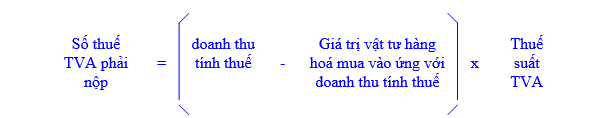
The difference method only applies to commercial, banking credit, gold and silver trading businesses, etc., with tax rates specified in the Turnover Tax Law.
Article 6. Taxable turnover is the amount of money from selling goods, income from construction, freight charges, and income from service activities consistent with the characteristics of each type of business activity (as stipulated in Article 8 of the Turnover Tax Law).
Article 7. The VAT paid at the previous stage that can be deducted is the VAT paid by the unit selling materials and goods, recorded on the sales invoice received by the purchasing unit and stored in inventory during the period for production and business purposes.
In cases where materials and goods are purchased from businesses not yet implementing the trial VAT, the VAT deductible at the previous stage is calculated based on the purchase price according to the purchase invoice for materials and goods multiplied by (x) the turnover tax rate applicable to those materials and goods; if the specific tax cannot be determined, it can be deducted up to a maximum of 5%. The specific tax deductible is determined based on the VAT payable of the taxpayer not being lower than the turnover tax payable under the current turnover tax regime. If there is no valid invoice or document, no deduction is allowed.
- Purchased materials and goods eligible for VAT deduction or deduction of previously paid turnover tax are raw materials, fuels, semi-finished products, goods, spare parts, low-cost consumables, etc., directly related to production and business operations, equivalent to the standard usage ratio for each product.
- For machinery, equipment, transport vehicles, and factory buildings purchased as fixed assets, VAT or previously paid turnover tax deductions are temporarily not applicable when calculating the VAT payable of the unit.
Article 8. The cost of purchased materials and goods corresponding to taxable turnover (under the difference method) is determined based on the purchase price recorded on the purchase invoice or actual payment vouchers.
For imported materials and goods, the CIF price plus (+) import tax (+) surcharges (if any).
Article 9. The VAT rate has three levels: 5%, 10%, and 15%. The detailed tax rate table for each type of business activity is attached to this decision.
For businesses engaged in multiple industries, they must pay VAT at the tax rate applicable to each industry. If it is not possible to account for each industry separately, then they must pay at the highest tax rate applicable to the industries in which they operate.
CHAPTER III
REGISTRATION, DECLARATION, PAYMENT OF TAX
Article 10. Businesses applying the pilot VAT system shall be responsible for:
- Registering declarations regarding capital, labor, industries, activities, products, and business locations with the tax authority;
- Strictly adhering to accounting records, vouchers, and invoices as prescribed by the State;
- Providing accounting records, vouchers, and invoices upon request by the tax authority.
In cases where there is a change in location or industry, such changes must be reported to the tax authority at least five days before the change occurs.
Article 11. Businesses have the obligation to:
- Self-declare and calculate the VAT payable for the previous month, submit the declaration form to the tax authority within the first five days of the following month. Businesses may also pay the tax simultaneously when submitting the declaration form;
- Pay VAT according to the periodic payment schedule announced by the tax authority: 5 days, 10 days, 15 days, or monthly. The payment period will be determined based on the total VAT payable for the month for each specific entity.
Article 12. The tax authority has the responsibility and authority to:
1. Guide and inspect businesses to strictly comply with registration, declaration, calculation, and payment of VAT, accounting systems, vouchers, and invoices.
2. Determine appropriate periodic tax payment deadlines based on the business situation and amount of tax payable for each entity, review the tax calculation declaration forms to determine the tax payable and notify the monthly tax payable amount to the entity.
3. Require businesses to provide complete documentation related to tax declaration, calculation, and payment.
4. Have the right to set the amount of VAT payable in cases where businesses fail to declare and provide relevant documentation for tax calculation.
In cases where businesses disagree with the determined VAT amount, they have the right to appeal to the higher-level tax authority that determined the tax amount. During the appeal process, businesses must still pay the full amount as determined.
5. Prepare records and impose administrative penalties within their jurisdiction or refer cases involving violations of VAT regulations to criminal prosecution.
6. Examine and resolve complaints and reports regarding VAT.
PART IV
TAX REDUCTION AND EXEMPTION
Article 13. The following situations qualify for reduced VAT.
1. Businesses experiencing significant difficulties due to natural disasters, enemy attacks, or unexpected accidents;
2. Businesses operating in mountainous areas, islands; conducting scientific research, applying new technology; newly established and starting operations, testing new production lines; producing goods to replace imported goods, if encountering difficulties resulting in losses, may be eligible for reduced VAT, but the maximum reduction cannot exceed 50% of the payable tax and the reduction period cannot exceed two years. For businesses operating in mountainous areas and islands, the reduction period cannot exceed three years.
In addition to the above cases, if applying the pilot VAT results in losses due to the VAT payable being higher than the income tax under the current Income Tax Law, then reduced VAT may be considered, ensuring the establishment of the three funds as stipulated and avoiding losses, but the reduction must ensure that the VAT paid equals the income tax under the current regime.
CHAPTER V
SANCTIONS AND REWARDS
Article 14. The handling of violations of the VAT system shall be governed by the provisions of Article 19 of the Income Tax Law; Decree No. 01-CP dated October 18, 1992 "Decree of the Government on the regulation of administrative penalties in the field of taxation" and Circular No. 11-TC/TCT dated February 24, 1993 issued by the Ministry of Finance "Guidelines for implementing Decree No. 01-CP dated October 18, 1992 of the Government on the regulation of administrative penalties in the field of taxation."
Article 15. The head of the tax authority directly managing the tax affairs of businesses can issue decisions to impose fines and apply the measures provided for in Article 14.
Article 16. Individuals obstructing or inciting obstruction of investigations and handling of violations of this system shall be subject to administrative penalties or criminal prosecution depending on the severity of the violation.
Tax officials and other individuals abusing their positions or powers to cover up for violators, embezzling tax money... must compensate and be subject to disciplinary action, administrative penalties, or criminal prosecution depending on the severity of the violation. The tax authority shall implement reward systems for tax officials who successfully fulfill their assigned tasks and individuals who discover violations of the VAT system.
Article 17. Businesses implementing the VAT system instead of the current Income Tax Law must comply with all provisions of this system.
Chapter VI
IMPLEMENTATION
Article 18. The Director of the General Department of Taxation is responsible for guiding the organization and inspection of the implementation of the pilot VAT system according to this system, regularly summarizing experiences and promptly proposing amendments to regulations that are inappropriate.
Article 19. The VAT system takes effect from July 1, 1993.
Article 20. VAT RATE TABLE
Issued together with the VAT collection system
(Details of Article 9)
1- A 5% tax rate applies to:
- Coal mining, mineral resource exploitation (excluding gold, silver, precious stones, oil, gas);
- Water supply production and provision;
- Wood harvesting, other forest products;
- Fishing;
- Rice milling;
- Fertilizer and pesticide production;
- Basic chemical production;
- Agricultural production not subject to agricultural tax;
- Machinery and equipment production, transportation means;
- Production of laboratory, medical, educational, musical instruments and parts;
- Intra-city and intra-town cargo and passenger transport;
- Children's toy production;
- Pharmaceutical and veterinary drug production;
- Paper pulp and paper production.
2- A 10% tax rate applies to:
- Production, construction, transportation, and service activities not specified in the 5% (Group 1) and 15% (Group 3) tax rate lists.
3- A 15% tax rate applies to:
- Oil, gas, and natural gas extraction.
- Exploiting petroleum, gas, and natural gas;
- Production of bottled water and various soft drinks;
- Production and assembly of electronic products;
- Production of cement (including clinker);
- Production of various cosmetic products;
- Printing, photography, photocopying services.
4- The tax rate applied for collecting turnover tax through the difference method for commercial activities, banking credit, gold and silver trading, foreign currency trading as prescribed in the Law on Turnover Tax.
(For salt production activities, food service industry, service activities such as science and technology, education, renting shops, household items, wedding halls, cars, conference rooms, machinery and equipment, transportation means, hotels, dancing, horse racing, lottery, ship agency, brokerage services... cultural, artistic and public service activities not yet subject to VAT and not specified in this tax rate table).
关系图
点击文件即可打开。红色边框=改变效力的关系。