
This Circular stipulates financial safety indicators and measures for handling securities trading organizations that do not meet financial safety indicators. This Circular takes effect from January 1, 2021, replacing Circular No. 87/2017/TT-BTC.
适用范围
Securities trading organization
要点
- Financial safety indicators
- Measures for handling organizations that do not meet financial safety indicators
- Responsibilities of related parties during supervision and special supervision
- Implementation clauses and effectiveness of the circular.
- Specific points on market risk coefficients take effect from January 1, 2022
🌐 本文件的社会影响
- Protecting investors' rights
- Minimizing risks in securities trading activities
- Strengthening management and oversight of the securities market
❓ 常见问题
Which circular does this circular replace?
Circular No. 87/2017/TT-BTC of the Minister of Finance.
When do specific points about market risk coefficients take effect?
These points take effect from January 1, 2022.
Can a supervised securities trading organization distribute dividends?
No, a securities trading organization under supervision may not distribute dividends to shareholders or share profits with capital contributors.
What is the responsibility of the Board of Directors when a securities trading organization is under supervision?
The Board of Directors is responsible for developing and implementing remediation plans, continuing to manage operations in accordance with the law.
When does this circular take effect?
This Circular takes effect from January 1, 2021.
全文
|
MINISTRY OF FINANCE |
SOCIALIST REPUBLIC OF VIET NAM |
|
Number: 91/2020/TT-BTC |
Hanoion 13 the 11 year 2020 |
CIRCULAR
REGULATIONS ON FINANCIAL STABILITY INDICATORS AND MEASURES FOR DEALING WITH SECURITIES COMPANIES THAT DO NOT MEET THE FINANCIAL STABILITY INDICATORS
On the basis of Securities Law November 26, 2019;
On the basis of Enterprise Law dated October 17,June 2024;2020;
Decree No. 87/2017/NĐ-CP July 26, 2017 of the State Securities Commission;"b) In addition to the lists of public services issued according to the provisions of Clause 2, Article 4 of this Decree, specialized agencies under provincial People's Committees shall report to the provincial People's Committee for decision-making on amending, supplementing, or issuing the list of public services funded by the state budget within their jurisdiction and consistent with the local budget capacity within the approved budget by the Provincial People's Assembly, and send it to the Ministry of Finance and relevant ministries and sectors for supervision during implementation."structuring the functions, tasks, powers, and organizational structure of the Ministry of Public Security;, amended and supplemented by Decree No. 109/2025/NĐ-CP and Decree No. 193/2025/NĐ-CP chức của Bộ Tài chính"b) In addition to the lists of public services issued according to the provisions of Clause 2, Article 4 of this Decree, specialized agencies under provincial People's Committees shall report to the provincial People's Committee for decision-making on amending, supplementing, or issuing the list of public services funded by the state budget within their jurisdiction and consistent with the local budget capacity within the approved budget by the Provincial People's Assembly, and send it to the Ministry of Finance and relevant ministries and sectors for supervision during implementation."c) Supplementing point c of Clause 3 as follows:
AT THE PROPOSAL OF THE CHAIRMAN OF THE STATE SECURITIES COMMISSION;June 2024;MINISTRY OF FINANCE hereby issues this Circular to stipulate financial stability indicators and measures for dealing with securities companies that do not meet the financial stability indicators.
1. Selling state property through public listing."b) In addition to the lists of public services issued according to the provisions of Clause 2, Article 4 of this Decree, specialized agencies under provincial People's Committees shall report to the provincial People's Committee for decision-making on amending, supplementing, or issuing the list of public services funded by the state budget within their jurisdiction and consistent with the local budget capacity within the approved budget by the Provincial People's Assembly, and send it to the Ministry of Finance and relevant ministries and sectors for supervision during implementation."Circular provides guidance on determining financial stability indicators, reporting requirements on financial stability ratios of securities companies, measures to be taken and responsibilities of related parties for securities companies that do not meet the financial stability indicators. This Circular does not apply to the determination of tax obligations of securities companies towards the state budget."b) In addition to the lists of public services issued according to the provisions of Clause 2, Article 4 of this Decree, specialized agencies under provincial People's Committees shall report to the provincial People's Committee for decision-making on amending, supplementing, or issuing the list of public services funded by the state budget within their jurisdiction and consistent with the local budget capacity within the approved budget by the Provincial People's Assembly, and send it to the Ministry of Finance and relevant ministries and sectors for supervision during implementation."a) Securities companies, foreign securities company branches in Vietnam (hereinafter referred to collectively as securities companies), investment fund management companies, foreign fund management company branches in Vietnam (hereinafter referred to collectively as fund management companies); lb) Relevant agencies, organizations, and individuals.No.Securities business organization"b) In addition to the lists of public services issued according to the provisions of Clause 2, Article 4 of this Decree, specialized agencies under provincial People's Committees shall report to the provincial People's Committee for decision-making on amending, supplementing, or issuing the list of public services funded by the state budget within their jurisdiction and consistent with the local budget capacity within the approved budget by the Provincial People's Assembly, and send it to the Ministry of Finance and relevant ministries and sectors for supervision during implementation."ealth.
PART I
GENERAL PROVISIONS
Article 1. Scope of Regulation and Applicability
Thông tư này quy định chi tiết khoản 4 Điều 38 Luật Thủy sản số 18/2017/QH14 đã được sửa đổi, bổ sung tại điểm c khoản 21 Điều 14 Luật số 146/2025/QH15.
refers to securities companies, foreign securities company branches in Vietnam, investment fund management companies, foreign fund management company branches in Vietnam.
Thông tư này áp dụng đối với tổ chức, cá nhân có liên quan đến hoạt động kinh doanh đối tượng thủy sản nuôi chủ lực trên lãnh thổ Việt Nam.
Market risk value
refers to the value corresponding to the potential loss that may occur when the market price of assets currently owned and expected to be owned under issuance guarantee commitments fluctuates unfavorably.
Article 2. Interpretation of Terms
In this Circular, the following terms are understood as follows:
1.Payment risk valueis the value corresponding to the potential loss that may occur when a counterparty fails to make payment or transfer assets on time according to the commitment.
2.Operational risk valueis the value corresponding to the potential loss that may occur due to technical errors, system failures, and procedural errors, human errors during operations, due to insufficient operating capital arising from operating costs and losses from investment activities, due to other objective reasons.
3. Total risk valueis the sum of market risk value, payment risk value, and operational risk value.
4. Available capitalrefers to the share capital that can be converted into cash within ninety (90) days.
5. Available capital ratiois the percentage ratio between the available capital value and the total risk value.
6.Payment guaranteerefers to the commitment to assume responsibility for fulfilling financial obligations to ensure the payment of a third party.
7. Issuance guarantee periodis the period from the date the issuance guarantee obligation arises under a firm commitment until the payment date to the issuer according to the commitment.
8. Net position with respect to a security at a point in time(hereinafter referred to as net position with respect to a security) is the quantity of securities held by the securities business organization, adjusted by reducing the number of securities lent out, the number of securities hedged by put options, futures contracts, and increasing the number of securities borrowed in compliance with the law.
9. Net settlement position with respect to a counterparty at a point in time(hereinafter referred to as net settlement position with respect to a counterparty) is the value of loans, receivables adjusted by reducing debts, payables to that counterparty.
10. Group of organizations and individuals related to an organization or an individual(hereinafter referred to as group of organizations and individuals related) is organizations and individuals as prescribed in Clause 46 Article 4 of the Securities Law.
11. Margin valueis the total of the following values:
12. a) The monetary and securities value contributed by the securities business organization to the settlement fund of the Vietnam Securities Depository and Clearing Corporation;b) The monetary and securities value pledged by the securities business organization for derivative securities trading, proprietary trading, market making;
13. c) Pledged amounts in cash and the value of payment guarantees provided by the depositary bank in the case where the securities company issues guaranteed warrants.Open interest of a derivative security at a point in time
(hereinafter referred to as open interest) is the volume of derivative securities still circulating at that time, not yet settled or liquidated.
Independent auditing organization approved by the State Securities Commission for auditing in accordance with the Securities Law and independent auditing laws.
Warrant with premium
14. is a warrant to buy with an exercise price (index) lower than the price (index) of the underlying security or a warrant to sell with an exercise price (index) higher than the price (index) of the underlying security.Exercise price
15. Approved auditing organizationis the price at which the warrant holder has the right to purchase (for call warrants) or sell (for put warrants) the underlying security (stock or ETF certificate) from the issuer, or used by the issuer to determine the amount payable to the warrant holder.
16. Conversion ratioindicates the number of warrants required to convert into one unit of the underlying security.
17. Execution price1. Securities companies are responsible for calculating financial stability indicators and are liable for the accuracy of the calculation results.
18.2. Asset and capital items used to calculate available capital value and risk values must be updated to the calculation date.3. Securities companies are not required to calculate the value of various types of risks for asset items that have been deducted from available capital as prescribed in Articles 5 and 6 of this Circular.
2. Industrial emission testing must ensure timeliness, accuracy, objectivity, compliance with procedures, and adherence to legal provisions.
4. For securities companies with subsidiaries, securities companies calculate financial stability indicators based on their own financial items.
2. The asset and capital indicators used to calculate the available capital value and risk values must be updated to the calculation date.
3. Securities trading organizations are not required to calculate the value of risks for asset indicators that have been deducted from available capital as prescribed in Article 5 and Article 6 of this Circular.
4. For securities trading organizations with subsidiaries, securities trading organizations shall calculate financial safety indicators based on their own financial items.
5. The financial safety ratio report as of June 30 must be reviewed by an auditing organization approved according to Vietnamese auditing standards for service review contracts. The financial safety ratio report as of December 31 and the financial safety ratio report used to prove that a securities business entity meets the conditions to be removed from warning, supervision, or special supervision status must be audited by an auditing organization approved according to Vietnamese auditing standards on emphasis-of-matter paragraphs when auditing financial statements prepared under the framework for the preparation and presentation of financial statements for specific purposes and other relevant auditing standards.
6. A securities business entity must establish an information system and internal control system to record, monitor, and update all financial information and detailed information necessary for the preparation and review, audit of financial safety ratio reports. The Board of Directors (management board) of the securities business entity is responsible for preparing and presenting the financial safety ratio report in accordance with the provisions of this Circular.
Chapter II
FINANCIAL SAFETY INDICATORS
Section 1
AVAILABLE CAPITAL
1. The available capital of a securities company shall be determined in accordance with the provisions set forth in Appendix VI issued together with this Circular, specifically as follows:
a) Shareholders' equity contribution, excluding redeemable preferred shares (if any);
b) Capital surplus excluding redeemable preferred shares (if any);
c) Convertible bond option - Equity component (for securities companies issuing convertible bonds);
d) Other shareholders' equity;
đ) Fair value adjustment gains;
e) Foreign exchange rate differences;
g) Additional paid-in capital reserve fund;
h) Financial risk reserve fund;
i) Other shareholders' equity reserves established in compliance with legal regulations;
k) Undistributed profits;
l) Balance of impairment loss provision;
m) Fifty percent (50%) of the additional value of fixed assets revalued in accordance with legal regulations (in case of revaluation increase), or deducted by the entire decrease in value (in case of revaluation decrease);
n) Deductions as prescribed in Article 5 of this Circular;
o) Additions as prescribed in Article 7 of this Circular;
p) Other capital (if any).
2. The available capital of a fund management company shall be determined in accordance with the provisions set forth in Appendix V issued together with this Circular, specifically as follows:
b) Capital surplus excluding redeemable preferred shares (if any);
c) Reserve fund for supplementary registered capital;
d) Development investment fund (if any);
đ) Financial risk reserve fund;
e) Other shareholders' equity reserves established in compliance with legal regulations;
g) Post-tax undistributed profits;
h) Balance of impairment loss provision;
i) Fifty percent (50%) of the additional value of fixed assets revalued in accordance with legal regulations (in case of revaluation increase), or deducted by the entire decrease in value (in case of revaluation decrease);
k) Foreign exchange rate differences;
l) Deductions as prescribed in Article 6 of this Circular;
m) Additions as prescribed in Article 7 of this Circular;
n) Other capital (if any).
3. The available capital as stipulated in Clause 1 and Clause 2 of this Article must be reduced by treasury shares (if any).
Article 5. Deductions from the available capital of securities companies
1. Margin value.
In cases where the securities company has collateral assets for the bank to guarantee payment when issuing guaranteed warrants, the deduction value shall be the smallest value among the following values: the value of the bank's payment guarantee; the value of the collateral asset determined according to Clause 6, Article 10 of this Circular.
2. The value of assets used to secure obligations of other organizations and individuals with a remaining term of more than ninety (90) days. The value of the asset is determined according to Clause 6, Article 10 of this Circular.
3. The entire portion of the reduction in value of financial assets recorded at book value, excluding securities specified in Clause 7 of this Article, based on the difference between the book value and the market value determined according to Appendix II issued together with this Circular.
4. Other deductions determined according to Appendix VI issued together with this Circular as follows:
a) Indicators in long-term assets, except for cases stipulated in Clause 6 of this Article;
b) Indicators in short-term assets as follows:
- Securities specified in Clause 7 of this Article in the indicator of short-term financial assets;
- Advance payments;
- Receivables with a remaining recovery period or payment term of more than ninety (90) days;
- Advance payments with a remaining repayment period of more than ninety (90) days;
- Other short-term assets, except for cases stipulated in Clause 5 of this Article.
c) Items excluded, with contrary opinions or refusals to provide opinions (if any) in the audited or reviewed financial statements that have not been deducted from available capital according to points a and b of this clause. If the auditing organization confirms that the exclusion has ended, the securities business organization does not need to deduct this amount.
5. The portion deducted from available capital as stipulated in point a and b of Clause 4 of this Article does not include the following indicators:
a) Assets required to determine market risk according to Clause 2, Article 9 of this Circular, except for securities as specified in Clause 7 of this Article;
b) Provisions for impairment of financial assets recorded at book value;
c) Provisions for impairment of other assets;
d) Provisions for doubtful receivables;
d) Contracts and transactions specified in point k, Clause 1, Article 10 of this Circular.
6. When determining the indicators of assets deducted from available capital as stipulated in Clause 1, Clause 2, and points a and b of Clause 4 of this Article, the securities business organization may adjust the deduction value as follows:
a) For assets used to secure the obligations of the securities business organization itself, when calculating the deduction, the smallest value among the following values can be reduced: the market value of such assets determined according to Appendix II issued together with this Circular (if applicable), the book value, the remaining obligation value;
b) For assets secured by customer assets, when calculating the deduction, the smallest value among the following values can be reduced: the value of the collateral asset determined according to Clause 6, Article 10 of this Circular, the book value.
7. The following securities in the indicator of short-term financial assets and long-term financial assets must be deducted from available capital:
a) Securities issued by related organizations with the securities business organization in the following cases:
- Being the parent company or subsidiary of the securities business organization;
- Being the subsidiary of the parent company of the securities business organization.
b) Securities with a remaining restricted transfer period of more than ninety (90) days from the calculation date.
Article 6. Deductions from the available capital of the fund management company
1. The entire portion of the decrease in value of investments, excluding securities specified in Clause 5 of this Article, based on the difference between book value and market value determined in accordance with Appendix II issued together with this Circular.
2. Other deductions determined in accordance with Appendix V issued together with this Circular as follows:
a) Indicators in long-term assets, except for cases provided for in Clause 3 of this Article;
b) Indicators in short-term assets as follows:
- Securities specified in Clause 5 of this Article at the short-term financial investment indicator;
- Advance payments;
- Receivables with a remaining recovery period or payment term of more than ninety (90) days;
- Advance payments with remaining repayment period exceeding ninety (90) days;
- Other short-term assets, except for cases provided for in Clause 3 of this Article.
c) Items excluded, with contrary opinions or refusal to issue an opinion (if any) in the audited or reviewed financial statements that have not yet been deducted from available capital as prescribed in Points a and b of this Clause. In case the auditing organization confirms that the exclusion has ended, the securities trading organization does not need to deduct this amount.
3. The deduction from available capital as prescribed in Points a and b of Clause 2 of this Article shall not include the following indicators:
a) Assets required to be risk-assessed according to Clause 2 of Article 9 of this Circular, except for securities as prescribed in Clause 5 of this Article;
b) Provision for impairment of investments;
c) Provision for doubtful debts;
d) Contracts and transactions specified in Point k of Clause 1 of Article 10 of this Circular.
4. When determining the indicators of assets subject to deduction from available capital as prescribed in Points a and b of Clause 2 of this Article, the securities trading organization may adjust the reduction in value as follows:
a) For assets used to secure the obligations of the securities trading organization itself or for third parties, when calculating the deduction, the smallest value among the following values shall be reduced: the market value of such asset determined in accordance with Appendix II issued together with this Circular (if applicable), book value, residual value of the obligation;
b) For assets secured by customer assets, when calculating the deduction, the smallest value among the following values shall be reduced: the value of the securing asset determined in accordance with Clause 6 of Article 10 of this Circular, book value.
5. The following securities in the short-term and long-term financial investment indicators must be deducted from available capital:
a) Securities issued by related organizations with the securities business organization in the following cases:
- Being the parent company or subsidiary of the securities business organization;
- Being the subsidiary of the parent company of the securities business organization.
b) Securities with a remaining restricted transfer period of more than ninety (90) days from the calculation date.
Article 7. Additions
1. The entire portion of the increase in value of investments and financial assets recorded at book value, excluding securities specified in Clause 7 of Article 5 and Clause 5 of Article 6 of this Circular, based on the difference between book value and market value determined in accordance with Appendix II issued together with this Circular.
2. Debt instruments that can be converted into equity include:
a) Convertible bonds, except where already counted as available capital in Point c of Clause 1 of Article 4 of this Circular, and preferred shares issued by the securities trading organization satisfying all of the following conditions:
- Initial term of at least five (05) years;
- Not secured by the assets of the securities trading organization;
- The securities trading organization may only repurchase before maturity upon request of the holder or on the secondary market after notifying the State Securities Commission as prescribed in Clauses 5 and 6 of this Article;
- The securities trading organization may suspend interest payments and carry forward accrued interest to the next year if paying interest results in a loss for the year;
- In the event of liquidation of the securities trading organization, the holder will only be paid after the organization has settled all secured and unsecured creditors;
- Any adjustment to increase the interest rate, including adjustments to the reference interest rate, can only be made after five (05) years from issuance and can only be adjusted once during the entire term prior to conversion into common shares;
- Registered for additional available capital as prescribed in Clause 4 of this Article.
b) Other debt instruments satisfying all of the following conditions:
- Debts where, in all circumstances, the creditor is only paid after the securities trading organization has settled all secured and unsecured creditors;
- Initial term of at least ten (10) years;
- Not secured by the assets of the securities trading organization;
- The securities trading organization may suspend interest payments and carry forward accrued interest to the next year if paying interest results in a loss for the year;
- The creditor may only be repaid early by the securities trading organization after notifying the State Securities Commission as prescribed in Clauses 5 and 6 of this Article;
- Interest rate adjustments must meet the following requirements: For fixed interest rates, any adjustment to increase the reference interest rate can only be made after five (05) years from issuance and signing of the contract, and can only be adjusted once during the entire term of the subordinated debt; For interest rates calculated using a formula, the formula cannot be changed and only the margin within the formula (if any) can be changed once after five (05) years from issuance and signing of the contract.
- Registered for additional available capital as prescribed in Clause 4 of this Article.
3. Limitations on additions to available capital:
a) The value of items specified in Points a and b of Clause 2 of this Article must be reduced gradually according to the following principle:
- During the last five (05) years before the payment due date or conversion into common shares, for each year closer to the conversion or payment date, the value of items specified in Points a and b of Clause 2 of this Article must be reduced by 20% of the initial value;
- During the last four (04) quarters before the payment due date or conversion into common shares, an additional 25% must be deducted from the remaining value after the reduction as prescribed above.
b) The total value of items specified in Clause 2 of this Article used to supplement available capital shall not exceed 50% of the equity.
4. The securities trading organization must report the debt instruments specified in Clauses 2 and 3 of this Article to the State Securities Commission for inclusion in available capital. The report directly submitted to the State Securities Commission includes:
a) A report in accordance with Appendix VII issued together with this Circular on the use of convertible bonds, preferred shares, and debts to supplement available capital;
b) Minutes of meetings, Resolutions of the Board of Directors, Board of Members, Decisions of the owner regarding the use of debts that can be converted into equity to supplement available capital;
c) A valid copy of loan contracts or equivalent documents, loan contracts or equivalent documents must include commitments from both parties with complete and appropriate contents as stipulated in Clause 2 and 3 of this Article. This provision does not apply to cases of public issuance of convertible bonds that have been granted a Registration Certificate for Offering by the Securities Commission.
5. Securities trading organizations may repurchase convertible bonds, preferred shares, or prepay debts used to supplement available capital in the following circumstances:
a) The available capital ratio after repurchasing convertible bonds, preferred shares, or prepaying debts registered for use to supplement available capital shall not fall below 180%;
b) In cases where securities trading organizations do not meet the requirements set forth in point a of this clause, securities trading organizations must have new sources of capital to ensure maintaining the minimum available capital ratio of not less than 180%.
6. Securities trading organizations must report to the Securities Commission at least fifteen (15) days before repurchasing convertible bonds, preferred shares, or prepaying debts used to supplement available capital. The report shall be sent directly to the Securities Commission and shall include:
a) A report as prescribed in point a of Clause 4 of this Article;
b) Documents as prescribed in points b and c of Clause 4 of this Article for new convertible bonds, preferred shares, and debts used to supplement available capital, replacing the convertible bonds, preferred shares to be repurchased, and debts to be prepaid (if any).
Section 2
RISK VALUES
Article 8. Operational Risk Value
1. The operational risk of a securities trading organization is determined as the highest value among the following: twenty-five percent (25%) of the operating costs of the securities trading organization over the twelve (12) months immediately preceding the calculation date, twenty percent (20%) of the minimum charter capital required for the securities trading organization's business activities as stipulated by law.
2. The operating costs of a securities company are determined by subtracting the following from the total expenses incurred during the period:
a) Depreciation expenses;
b) Expenses or reversals of impairment provisions for short-term financial assets and collateral assets;
c) Expenses or reversals of impairment provisions for long-term financial assets;
d) Expenses or reversals of impairment provisions for receivables;
e) Expenses or reversals of impairment provisions for other short-term assets;
f) Expenses due to decreases in revaluation of financial assets recognized through profit or loss;
g) Interest expense.
3. The operating costs of a fund management company are determined by subtracting the following from the total expenses incurred during the period:
a) Depreciation expenses;
b) Expenses or reversals of impairment provisions for short-term investments;
c) Expenses or reversals of impairment provisions for long-term investments;
d) Expenses or reversals of impairment provisions for doubtful receivables.
4. In cases where a securities trading organization has operated for less than one (01) year, the operational risk is determined as the highest value among the following: three (03) times the average monthly operating costs since the securities trading organization commenced operations; twenty percent (20%) of the minimum charter capital required for the securities trading organization's business activities as stipulated by law.
Article 9. Market Risk Value
1. By the end of each trading day, the securities business organization must determine the market risk value for the assets specified in Clause 2 of this Article.
2. Market risk must be determined for the following assets:
a) Securities on proprietary accounts excluding the number of guaranteed warrant certificates not fully issued (for securities companies), securities trading accounts (for fund management companies, securities companies without proprietary trading activities), entrusted securities, other investment securities. These securities include the number of securities during the process of receiving from the seller;
b) Securities supported by individuals and organizations according to the provisions of the law, including securities borrowed by the securities business organization itself, securities borrowed on behalf of other individuals and organizations;
c) Securities of customers that the securities business organization receives as collateral, which are subsequently used or lent to a third party in accordance with the provisions of the law;
d) Money, cash equivalents, transferable instruments, negotiable instruments belonging to the securities business organization;
đ) Securities for which the securities business organization guarantees issuance under a firm commitment arrangement that have not been distributed and fully paid within the guarantee period.
3. The securities and assets specified in Clause 2 of this Article do not include the following types:
a) Fund shares;
b) Securities specified in Clause 7, Article 5 and Clause 5, Article 6 of this Circular;
c) Bonds, debt instruments, negotiable instruments in the money market that have matured;
d) Securities that have been hedged against risk by put options or futures contracts; Put options and call options are used to hedge risk for underlying securities.
4. The formula for determining the market risk value for assets specified in Points a, b, c, d of Clause 2 of this Article is as follows:
Market risk value = Net position x Asset price x Market risk factor
a) The market risk factor is determined according to Appendix I attached to this Circular;
b) The asset price is determined according to Appendix II attached to this Circular.
5. The market risk value of each asset determined according to Clause 4 of this Article must be increased in cases where the securities business organization invests excessively in such assets, except for securities during the issuance guarantee period under a firm commitment arrangement, government bonds, and government-guaranteed bonds. The adjusted risk value increases according to the following principles:
a) Increase by 10% if the total value of investments in stocks and bonds of an entity exceeds 10% but does not exceed 15% of the securities business organization's equity;
b) Increase by 20% if the total value of investments in stocks and bonds of an entity exceeds 15% but does not exceed 25% of the securities business organization's equity;
c) Increase by 30% if the total value of investments in stocks and bonds of an entity exceeds 25% of the securities business organization's equity.
6. The securities business organization must increase dividends, interest payments, or the value of preferential rights if they arise (for securities), or lending interest (for deposits and cash equivalents, transferable instruments, negotiable instruments) when determining the asset price for market risk value.
7. The market risk value for unsold securities during the distribution period and with a transaction price lower than the issuance guarantee price from firm commitment issuance contracts is determined using the following formula:

Where:
Q0: is the number of securities remaining unsold or sold but not yet paid
P0: is the issuance guarantee price
Vc: is the collateral value (if any)
R: is the issuance risk factor
r: is the market risk factor
P1: is the transaction price
a) The transaction price is determined based on the type of security specified in Sections 5, 6, 7, 8, 9, 10, 11, 12, 13, 14, 15, 16, 21, 22 of Appendix II attached to this Circular. In case of initial public offering, including the first auction of share privatization, bond tender, the transaction price equals the book value per share of the issuing entity at the nearest time point, or the starting price (if the book value cannot be determined), or face value (for bonds);
b) The market risk factor is determined based on the type of security specified in Sections II, III, IV, V, VI, VII of Appendix I attached to this Circular;
c) The issuance risk factor is determined based on the remaining time until the end of the distribution period as stipulated in the contract, but not exceeding the permitted distribution period according to the law, as follows:
- Until the last day of the distribution period, if the remaining time is more than sixty (60) days: the issuance risk factor is 20%;
- Until the last day of the distribution period, if the remaining time is from thirty (30) to sixty (60) days: the issuance risk factor is 40%;
- Until the last day of the distribution period, if the remaining time is less than thirty (30) days: the issuance risk factor is 60%;
- During the period from the end of the distribution period to the payment date for the issuing entity: the issuance risk factor is 80%.
d) After the last payment date for the issuing entity, the securities business organization must determine the market risk value for unsold securities according to Clause 4 of this Article.
đ) The collateral value of customers is determined according to Clause 6, Article 10 of this Circular.
8. The securities company must calculate the market risk value for guaranteed warrant certificates that are currently circulating, which were issued by the securities company. This risk value is determined according to the following formula:
Market Risk Value = Max {((P0 x Q0/k - P1 x Q1) x r - MD), 0}
Where:
P0: is the average closing price of the underlying security over the five trading days immediately preceding the calculation date.
Q0: is the number of warrant certificates currently circulating issued by the securities company.
k: is the conversion ratio.
P1: is the price of the underlying security as specified in Appendix II attached to this Circular.
Q1: is the quantity of underlying securities that the securities company uses to guarantee its obligation to settle the guaranteed warrant certificates it has issued.
r: is the market risk factor of the warrant as specified in Appendix I attached to this Circular.
MD: is the margin value when the securities company issues guaranteed warrant certificates.
a) The underlying securities used to calculate market risk according to the above formula must satisfy all of the following conditions:
- Already included in the issuance plan or registered with the Securities Commission regarding the use of these securities on the proprietary account to hedge against risks when issuing guaranteed warrant certificates;
- Are the underlying securities of the guaranteed warrant certificates.
b) In cases where the warrant certificates issued by the securities company do not generate profit as stipulated in Clause 16, Article 2 of this Circular, the securities company does not need to calculate market risk for the issued warrant certificates but must calculate market risk for the underlying securities formed from hedging activities for the issued warrant certificates.
c) The securities company must calculate market risk for the positive difference between the value of the underlying securities used by the securities company to hedge against risks for the guaranteed warrant certificates it has issued and the necessary value of the underlying securities to hedge against risks for the guaranteed warrant certificates. The necessary value to hedge against risks for the guaranteed warrant certificates must correspond to the hedging value.
9. The market risk value for futures contracts is determined according to the following formula:
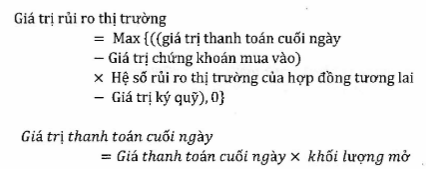
Where:
- The purchase value of the security is the value of the underlying security that the securities firm buys to guarantee its obligation under the futures contract;
- The margin value is the portion of asset value that the securities firm deposits for investment transactions, proprietary trading, and market making.
Article 10. Settlement Risk Value
1. At the end of each trading day, the securities firm must determine the settlement risk value for the following contracts and transactions:
a) Time deposits at credit institutions and deposit certificates issued by credit institutions;
b) Securities lending and borrowing contracts in compliance with the provisions of the law;
c) Sale with repurchase commitment securities contracts in compliance with the provisions of the law;
d) Purchase with resale commitment securities contracts in compliance with the provisions of the law;
đ) Margin loan contracts for purchasing listed securities in compliance with the provisions of the law;
e) Underwriting guarantee contracts signed with other entities in the underwriting syndicate in the form of a surety agreement, where the securities firm is the main underwriter;
g) Accounts receivable from customers in securities business operations;
h) Accounts receivable from matured bonds, negotiable instruments, and matured debt instruments that have not been paid;
i) Assets overdue for transfer, including securities in the securities firm's business operations and customer securities in brokerage activities.
k) Contracts, transactions, and capital usage outside those recorded in points a, b, c, d, đ, e, g of this Article; accounts receivable from buying and selling debts with counterparties who are not the Vietnam Asset Management Company (VAMC) or the Vietnam Joint Stock Company for Debt Collection (DATC).
2. For contracts as stipulated in points a, b, c, d, đ, g of Clause 1 of this Article, the pre-maturity settlement risk value before transferring securities, money, and liquidating the contract is determined as follows:
Settlement Risk Value = Potential Risk Value of Assets x Settlement Risk Factor According to Counterparty
a) The settlement risk factor according to counterparty is determined based on the creditworthiness level of the transaction counterparty according to the principle specified in Appendix III attached to this Circular;
b) The potential risk value of assets is determined according to the principle specified in Appendix IV attached to this Circular. The potential risk value of assets must be adjusted to include additional dividends, interest, and premium values if they arise (for securities), or deposit interest, loan interest, and other ancillary fees (for credit facilities).
3. For contracts as stipulated in point e of Clause 1 of this Article, the settlement risk value is determined as 30% of the remaining value of the outstanding underwriting guarantee contracts.
4. For overdue accounts receivable and securities not transferred on time as stipulated in points h, i of Clause 1 of this Article, including securities and money not received from transactions and contracts that have matured as stipulated in points a, b, c, d, đ, g of Clause 1 of this Article, the settlement risk value is determined according to the following principle:
Settlement Risk Value
= Potential Risk Value of Assets x Settlement Risk Factor According to Time Period
a) The settlement risk factor according to time period is determined based on the overdue payment period according to the principle specified in Appendix III attached to this Circular;
b) The potential risk value of assets is determined as follows:
- For securities purchase and sale transactions for customers or for the securities firm itself: it is the market value of the contract calculated according to the principles specified in Appendices II and IV attached to this Circular;
- For transactions involving margin stock loans, sale with commitment to repurchase, purchase with commitment to resell, securities lending, and securities borrowing: the value of assets at risk of payment is determined according to the principles set forth in Appendix IV issued together with this Circular.
- For accounts receivable, matured bonds, and matured debt instruments: it is the face value of the accounts receivable, plus accrued but unpaid interest, related costs, and minus any payments previously received (if any).
5. Except for transactions and contracts specified in point k, Clause 1, and point b, Clause 10 of this Article, securities trading organizations may reduce the value of collateral provided by counterparties and customers when determining the value of assets at risk of payment as stipulated in Clause 1 of this Article if these contracts and transactions meet all of the following conditions:
a) The counterparty or customer has collateral to fulfill their obligations, and the collateral is cash, equivalents of cash, negotiable instruments, transferable instruments on the money market and securities exchange, listed and traded on the Vietnam Stock Exchange and its subsidiaries (hereinafter referred to as the Stock Exchange), government bonds, and bonds guaranteed for issuance by the Ministry of Finance.
b) Securities trading organizations have the right to dispose, manage, use, and transfer the collateral in cases where the counterparty fails to fully and timely fulfill their payment obligations as agreed in the contracts.
6. The value of collateral subject to reduction as prescribed in Clause 5 of this Article shall be determined as follows:
Value of collateral
= Quantity of collateral x Price of collateral x (1 - Market risk factor)
a) The price of the collateral is determined according to the principles set forth in Appendix II issued together with this Circular;
b) The market risk factor is determined according to the principles set forth in Appendix I issued together with this Circular.
7. When determining the value of payment risk, securities trading organizations may net off the value of assets at risk of payment bilaterally in cases where the following conditions are met:
a) Payment risk relates to the same counterparty;
b) Payment risk arises from the same type of transaction as specified in Clause 1 of this Article;
c) Bilateral netting has been agreed upon in writing by both parties.
8. The value of payment risk must be increased in the following cases:
a) Increase by 10% in cases where the value of deposit agreements, deposit certificates, loan agreements, current accounts receivable, purchase agreements with commitment to resell securities, sale agreements with commitment to repurchase securities, total value of loans to an organization, individual, or related group of organizations and individuals (if any), exceeds 10% but does not exceed 15% of the equity capital;
b) Increase by 20% in cases where the value of deposit agreements, deposit certificates, loan agreements, current accounts receivable, purchase agreements with commitment to resell securities, sale agreements with commitment to repurchase securities, total value of loans to an organization, individual, or related group of organizations and individuals (if any), exceeds 15% but does not exceed 25% of the equity capital;
c) Increase by 30% in cases where the value of deposit agreements, deposit certificates, loan agreements, current accounts receivable, purchase agreements with commitment to resell securities, sale agreements with commitment to repurchase securities, total value of loans to an organization, individual, or related group of organizations and individuals (if any), or an individual and related parties (if any), exceeds 25% of the equity capital.
9. In cases where the counterparty has completely lost the ability to pay, the entire loss calculated based on the contract value must be deducted from available capital.
10. The value of payment risk for other cases is determined as follows:
a) For contracts and transactions specified in point k, Clause 1 of this Article, it is determined according to the following formula:
Settlement Risk Value
= Total value of assets at risk of payment × 100%
b) For advance payments with remaining repayment period under 90 days, it is determined according to the following formula:
|
Value of assets at risk of paymentinternational risk |
Hệ number Total value of advance payments |
Settlement Risk Value |
|
|
occupying from 0% to 5% of equity capital at the time of calculation |
Value of payment risk = Value of assets at risk of payment x Payment risk factor. |
8% |
occupying over 5% of equity capital at the time of calculation |
|
RATIO OF AVAILABLE CAPITAL AND REPORTING REGIME FOR SECURITIES TRADING ORGANIZATIONS |
100% |
||
Section 3
RATIO OF AVAILABLE CAPITAL AND REPORTING REGIME OF SECURITIES TRADING ORGANIZATIONS
Article 11. Available Capital Ratio and Warning Levels
1. The available capital ratio shall be determined based on the following principles:
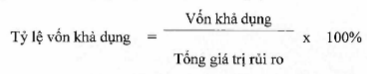
2. The State Securities Commission shall issue a decision to place a securities business organization under warning status as prescribed in Article 13 of this Circular, under control status as prescribed in Article 14 of this Circular, or special control as prescribed in Article 16 of this Circular. Within twenty-four (24) hours from the date of issuance of the decision, the State Securities Commission shall publish information about the decision on its electronic information website, and the securities business organization shall publish information about the decision on the electronic information website of the State Securities Commission, the Stock Exchange, and the securities business organization.
Article 12. Reporting System for the Available Capital Ratio
1. Regular Reporting System
a) On a monthly basis, the securities business organization must submit to the State Securities Commission a report on the financial safety ratio at the end of the month according to the form prescribed in Appendix V or Appendix VI issued together with this Circular. The report must be submitted via an electronic information file through the database system within seven (07) working days from the end of the month.
b) The securities business organization must submit to the State Securities Commission and simultaneously publish information on its electronic information website a report on the financial safety ratio on June 30 and December 31 according to the form prescribed in Appendix V or Appendix VI issued together with this Circular after being reviewed and audited by an approved auditing organization. These reports must be submitted to the State Securities Commission through the database system and published concurrently with the publication of the semi-annual reviewed financial report and the annual audited financial report.
2. Unusual Reporting System
a) From the time the available capital ratio falls below 180%, the securities business organization must report the available capital ratio to the State Securities Commission according to the reporting form prescribed in Appendix V or Appendix VI issued together with this Circular twice a month (data on the 15th and 30th of each month). The report must be submitted via an electronic information file through the database system within three (03) working days after the 15th and 30th of each month.
b) From the time the available capital ratio falls below 150%, the securities business organization must report the available capital ratio weekly once according to the reporting form prescribed in Appendix V or Appendix VI issued together with this Circular. The report must be submitted via an electronic information file through the database system before 16:00 on Friday of each week.
c) From the time the available capital ratio decreases below 120%, the securities business organization must daily report the available capital ratio to the State Securities Commission according to the reporting form prescribed in Appendix V or Appendix VI issued together with this Circular. The report must be submitted via an electronic information file through the database system before 16:00 each day.
3. When the available capital ratio reaches and exceeds 180% for three (03) consecutive months, the securities business organization may implement the regular reporting system as prescribed in Clause 1 of this Article.
Chapter III
MEASURES FOR NON-COMPLIANCE WITH FINANCIAL SAFETY CRITERIA
Section 1
WARNING
Article 13. Warning
1. The State Securities Commission shall issue a decision to place a securities business organization under warning status in the following cases:
a) The available capital ratio ranges from 150% to less than 180% in all reporting periods for three (03) consecutive months; or
b) The available capital ratio has been reviewed or audited by an approved auditing organization ranging from 150% to less than 180%; or
c) A financial safety ratio report issued by an approved auditing organization expresses disapproval (or contrary opinion), refuses to express an opinion (or cannot express an opinion), or includes an exception regarding certain indicators of the report, such that if the excluded impacts are removed from the available capital, the available capital ratio will range from 150% to less than 180%.
2. The warning period runs from the date the securities business organization is placed under warning status until the date the State Securities Commission issues a decision to remove the securities business organization from warning status.
3. The State Securities Commission shall consider removing a securities business organization from warning status when the available capital ratio reaches 180% or higher for three (03) consecutive months, with the final available capital ratio in the reporting period being audited by an approved auditing organization, and the securities business organization reports to the State Securities Commission on measures taken to address the warning status according to Appendix XI attached to this Circular.
Section 2
REPORT ON THE OPERATIONS OF CURRENCY EXCHANGE AGENTS
Article 14. Supervision
1. The State Securities Commission shall issue a decision to place a securities business organization under supervision status in the following cases:
a) The available capital ratio ranges from 120% to less than 150% in all reporting periods for three (03) consecutive months; or
b) The available capital ratio has been reviewed or audited by an approved auditing organization ranging from 120% to less than 150%; or
c) A financial safety ratio report issued by an approved auditing organization expresses disapproval (or contrary opinion), refuses to express an opinion (or cannot express an opinion), or includes an exception regarding certain indicators of the report, such that if the excluded impacts are removed from the available capital, the available capital ratio will range from 120% to less than 150%.
2. The supervision period does not exceed twelve (12) months, starting from the date the securities business organization is placed under supervision status.
3. Four (04) months after being placed under supervision status, the Stock Exchange shall suspend part of the trading activities of member securities companies that fail to address the supervision status. The suspension of trading activities of member securities companies of the Stock Exchange ends when the securities company is decided by the State Securities Commission to be removed from supervision status. The procedures and formalities for suspending trading activities of member securities companies are carried out in accordance with the regulations of the Stock Exchange.
4. The State Securities Commission shall consider removing a securities business organization from supervision status when the available capital ratio reaches 180% or higher for three (03) consecutive months, with the final available capital ratio in the reporting period being audited by an approved auditing organization, and the securities business organization reports to the State Securities Commission on measures taken to address the supervision status according to Appendix XI attached to this Circular.
Article 15. Remedial Plan for Control Measures
1. Within a maximum period of fifteen (15) days from the date the Securities Commission issues a decision to place a securities business organization under control, such organization must submit to the Securities Commission a detailed report on the remedial plan concerning its current financial status, causes, and remedial measures.
2. The remedial plan must be developed for two (02) consecutive years, with a timeline, conditions, deadlines, and detailed implementation plans down to monthly and quarterly intervals. The Securities Commission has the right to request the securities business organization to adjust the remedial plan at any time if it deems the plan unfeasible, unsuitable for market conditions, or non-compliant with legal regulations.
3. The remedial plan shall include the following measures:
a) Selling high-risk assets; limiting or ceasing purchases of treasury shares;
b) Recovering debts; reselling shares or equity contributions to creditors;
c) Reducing operating costs and management expenses; restructuring management structures, personnel, and reducing staff;
d) Narrowing the scope and geographical area of operations; closing some branches and trading offices; withdrawing certain securities business activities;
đ) Suspending dividend payments and profit distributions; implementing capital increases in accordance with legal provisions;
e) Merging or consolidating with other securities business organizations in the same industry and type as prescribed by law;
g) Other measures not contrary to legal regulations.
Section 3
SPECIAL SUPERVISION"
Article 16. Special Control
1. The Securities Commission shall issue a decision to place a securities business organization under special control in the following cases:
a) The available capital ratio calculated by the company itself or reviewed and audited by an approved auditing organization is below 120%; or
b) Unable to rectify the control situation within the twelve (12) month period stipulated in Clause 2 of Article 14 of this Circular; or
c) Failure to report the financial safety ratio in two (02) consecutive reporting periods, or failure to audit or review the financial safety ratio report, or failure to disclose information about the reviewed and audited financial safety ratio report by an approved auditing organization as prescribed in Point b of Clause 1 of Article 12 of this Circular; or
d) The financial safety ratio report where the approved auditing organization issues a non-acceptance opinion (or contradictory opinion), refuses to issue an opinion (or cannot issue an opinion), or an exception opinion on some indicators of the report, which, if excluded from the available capital, would result in the available capital ratio falling below 120%.
2. The duration of special control shall not exceed four (04) months, starting from the date the securities business organization is placed under special control.
3. Except in cases of special control as provided in Point b of Clause 1 of this Article, after one (01) month from the date of being placed under special control, the Stock Exchange shall suspend part of the activities of a member securities company that fails to rectify the special control situation. The suspension of trading by the Stock Exchange ends when the securities company is decided by the Securities Commission to be removed from the special control status. The procedures for suspending the trading of a member securities company are carried out according to the rules of the Stock Exchange.
4. The Securities Commission will consider removing a securities business organization from the special control status when the available capital ratio reaches 180% or higher for three (03) consecutive months, with the available capital ratio at the final reporting period being audited by an approved auditing organization, and the securities business organization reports to the Securities Commission on the rectification of the special control situation in accordance with Appendix XI issued together with this Circular.
5. After the expiration of the special control period as stipulated in Clause 2 of this Article, if the securities business organization still fails to rectify the special control situation, it will be suspended from operations. The procedures for suspending operations are carried out according to the regulations on the organization and operation of securities companies and fund management companies.
6. Within twenty-four (24) hours from the time the securities business organization is suspended from operations, the Securities Commission shall publish information about this on the Securities Commission's electronic information website.
7. Six (06) months after the effective date of the decision to suspend operations, the Securities Commission shall issue a decision to withdraw the securities brokerage business in the case where the securities company fails to rectify the suspended status as prescribed in Clause 5 of Article 16 of this Circular.
Article 17. Remediation Plan for Special Control Status
1. Within a maximum period of seven (07) days from the date on which the Securities Commission issues a decision to place a securities business organization under special control status, the securities business organization must submit to the Securities Commission a detailed report on its current financial situation, causes, and remediation plan.
2. The remediation plan shall be implemented in accordance with the provisions of Clause 2 and Clause 3 of Article 15 of this Circular.
Section 4
RESPONSIBILITIES OF THE RELATED PARTIES
Article 18. Responsibilities of Individuals and Securities Business Organizations Placed Under Control or Special Control Status
1. The Board of Directors, Board of Members, Chairman of the Company, General Director (Director) of the securities business organization placed under control or special control status shall have the responsibility to:
a) Develop a remediation plan and organize its implementation;
b) Continue to manage, supervise, and operate the activities and ensure the safety of assets of the securities business organization in compliance with the provisions of the law;
c) Be responsible for matters related to the organization and operation of the securities business organization before, during, and after the control or special control period;
d) Support and facilitate other organizations in fulfilling their responsibilities as prescribed in this Circular and perform other tasks as required in writing by the Securities Commission.
2. By sixteen (16) hours every Friday, the securities business organization must report to the Securities Commission on the progress of implementing the remediation plan and the results achieved.
3. During the control or special control period:
a) The securities business organization shall not pay dividends to shareholders, distribute profits to capital contributors; award bonuses to members of the Board of Directors, Board of Members, Supervisory Board members, General Director (Director), Deputy General Director (Deputy Director), Chief Accountant, employees, and persons related to the securities business organization;
b) The securities business organization shall not convert unsecured debts into secured debts guaranteed by the assets of the securities business organization;
c) The securities business organization shall not purchase treasury shares, repurchase equity contributions from capital contributors;
d) The securities business organization shall not enter into new, extend, or continue to implement margin trading contracts, stock lending contracts, buy-to-cover transactions, lend to customers without collateral; shall not enter into underwriting contracts in the form of firm commitments;
e) The securities business organization shall not establish subsidiaries through capital contribution, invest in real estate; limit investment in high-risk assets or engage in business activities that increase risk value, reduce available capital.
f) The securities business organization shall not set up additional trading offices, branches, representative offices, expand operating areas, or supplement securities business operations;
g) A securities company may only manage transaction funds according to the method where the customer opens a direct account at a commercial bank selected by the securities company to manage transaction funds.
Article 19. Responsibilities of other related organizations
1. The Securities Trading Department, Vietnam Securities Depository and Clearing Corporation, depositary members, supervisory banks, settlement banks, and other relevant organizations shall be responsible for providing the State Securities Commission with full and timely information and documents related to transactions, investment activities, and business operations of securities trading organizations placed under control or special control upon written request from the State Securities Commission.
2. The Securities Trading Department, Vietnam Securities Depository and Clearing Corporation, supervisory banks, depositary banks, and related securities trading organizations shall be responsible for guiding, supporting, and providing securities services to customers of securities trading organizations placed under control or special control upon written request from the State Securities Commission.
3. The Securities Trading Department and Vietnam Securities Depository and Clearing Corporation shall be responsible for implementing the relevant provisions of this Circular.
Chapter IV
IMPLEMENTING PROVISIONS
Article 20. Implementation Provisions
1. This Circular takes effect from January 1, 2021, except for the cases specified in Clause 2 of this Article. This Circular replaces Circular No. 87/2017/TT-BTC dated August 15, 2017, issued by the Minister of Finance, which stipulates financial safety indicators and measures for dealing with securities trading organizations that do not meet financial safety indicators.
2. Point d Clause 5 Article 5, point d Clause 3 Article 6, point k Clause 1 Article 10, Clause 10 Article 10 of this Circular, and item number 28 sub-section VII of Appendix I market risk factor ratio promulgated together with this Circular shall take effect from January 1, 2022.
3. Amendments, supplements, replacements, or revocations of this Circular shall be decided by the Minister of Finance./.
|
Place of Receipt: |
DEPUTY MINISTER |
原始文件(PDF)
关系图
点击文件即可打开。红色边框=改变效力的关系。
译本
本文件提供以下语言版本: