
This Decree stipulates the regulations for personnel of the Ministry of National Defense of Vietnam, including provisions such as: salary and allowance system, working hours and leave, compensation upon death or resignation, retirement benefits, discipline, and temporary workers. This Decree takes effect from May 1, 1949.
Đối tượng áp dụng
Personnel of the Ministry of National Defense of Vietnam
Các điểm cốt lõi
- Salary and Allowance System
- Working Hours and Leave
- Compensation Upon Death or Resignation
- Retirement Benefits
- Discipline
- Temporary Workers
🌐 Tác động xã hội từ văn bản này
- Ensuring the rights of personnel of the Ministry of National Defense
- Establishing discipline within the national defense administrative apparatus
❓ Câu hỏi thường gặp
When does this Decree take effect?
This Decree takes effect from May 1, 1949.
How many hours does personnel of the Ministry of National Defense work per day?
Personnel must work 8 hours per day; during the resistance period, the daily working hours may be increased to 9 hours.
Toàn văn
|
MINISTRY OF NATIONAL DEFENSE NUMBER: 99/NĐ |
SOCIALIST REPUBLIC OF VIET NAM Independence - Freedom - Happiness _______________________________________ HANOI, July 4, 1949 |
DECREE OF THE MINISTRY OF NATIONAL DEFENSE
Establishing the Staff System of the Ministry of National Defense
MINISTER OF NATIONAL DEFENSE
Pursuant to Decree No. 50/SL dated June 18, 1949 organizing the Ministry of National Defense;
Pursuant to Decree No. 56/NĐ dated August 19, 1947 establishing the staff system for workers of the Ministry of National Defense;
At the proposal of the Director of Military Affairs and the Director of Administrative Affairs;
DECREE:
Article 1. - Workers of the National Defense shall enjoy the system established in this Decree
PART I
Salaries and allowances
Article 2. - National Defense workers are classified into three categories:
1. Supervisory category
2. Professional worker category
3. General worker category.
Each category is divided into ten levels, each level being assigned to a grade on the main salary scale as follows:
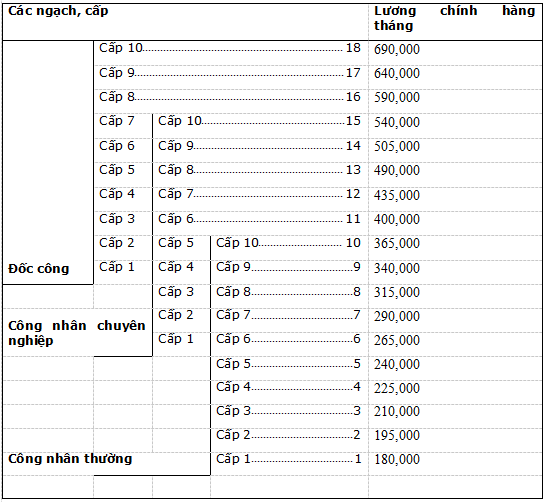
Article 3. - The monthly basic salary may be increased according to a ratio determined annually by the Decree based on the cost of living. For the year 1949, from the date of implementation of this Decree until December 31, 1949, the ratio set is 40% of the basic salary.
Article 4. - On May 1, which is Labor Day, the basic salary and the increase will be doubled.
Article 5. - In addition to the basic salary and the increase ratio, workers also receive the following allowances:
1. Family allowance: wife 50đ per month; child 40đ per month
2. Cost-of-living allowance: calculated based on the price of rice;
from 301đ to 350đ 10đ
from 351đ to 1000đ for every increase of 1đ to 50đ in the price of rice, the allowance will increase by 10đ
from 1000đ upwards for every increase of 1đ to 100đ in the price of rice, the allowance will increase by 10đ
The cost-of-living allowance for the worker's family is as follows:
Wife: half the husband's allowance
Child: one quarter the father's or mother's allowance
3. Regional allowance (calculated according to regions defined by the Joint Decree of the Ministry of Interior and Health)
Region 1 60đ.00 per month
Region 2 40đ.00 per month
Region 3 20đ.00 per month
Article 6. - Family allowances are only granted to officially recognized wives and children under 16 years old, from 16 to 18 if still attending school and not receiving maintenance from the school or if disabled and unable to work.
Children over 18 years old are no longer eligible for allowances.
In cases where a worker has multiple wives, the allowance for the wife is only given to the primary wife.
If both spouses work with salaries from the Government, the husband does not receive a family allowance for his wife, and the allowance for the child will be paid to the wife or the husband.
Article 7. - Female workers whose husbands do not hold positions that receive government salaries can claim allowances for their children. If the husband is disabled and unable to work, she can also claim allowances for her husband (calculated like the allowance for a wife for her husband).
Article 8. - Family allowances, cost-of-living allowances, and regional allowances are calculated monthly.
Article 9. - Workers who enlist will receive military personnel benefits during their service period.
PART II
1. Recruitment of workers
Article 10. - Workers in the supervisory and professional worker categories will be recruited by the Minister of National Defense's Decree.
General workers will be recruited by the decision of the Bureau Chief or Director of the Office. Within the Ministry, recruitment of general workers for administrative departments and military departments and offices will be decided by the Director of Administrative Affairs or the Director of Military Affairs respectively.
These decisions must be approved by the Minister of National Defense before implementation.
Article 11. - To be recruited as a National Defense worker, the following conditions must be met:
- Hold Vietnamese citizenship,
- Be at least 18 years old,
- Not have lost civil rights and have good conduct,
- Meet the required professional qualifications,
- Have a certificate from a government physician certifying fitness for work.
Article 12. - Recruitment and classification of workers into categories will be based on the following standards:
Article 13. - Before being officially recruited into a worker category, they must undergo a probationary period of six months to one year.
During the probationary period, workers will be placed in a lower grade than the one they were recruited for or in the lowest grade of the category.
Upon completion of the probationary period, workers will be officially classified into a category and may:
1. Be promoted to a higher grade
2. Remain in the same grade
3. Be demoted to a lower grade or category.
Article 14. - National Defense workers transferred to assist in other Ministries will be classified according to a category and grade equivalent to their previous category and grade, maintaining their seniority in the grade.
Article 15. - Drafted workers will be classified into a category and grade equivalent to those with comparable abilities during the probationary period. If the draft period exceeds one year, although they remain under the draft system, the first year will be counted as the probationary period for promotion to a higher grade.
Upon completion of the draft period, if they voluntarily join the regular workforce, they will retain their original grade under the general system.
Article 16. - War veterans wishing to be recruited will have priority if they meet the conditions and qualifications.
Article 17. - National Defense workers or workers from other Ministries who leave their jobs and wish to be re-recruited, if accepted and meeting the conditions, will be classified into a new category with a grade equivalent to their previous one based on their ability.
If recruited for a job significantly different from their previous position, the general rules apply.
2. Promotion - Transfer - Appointment - Transfer
Article 18. - The minimum tenure requirement for promotion to a higher grade is two years, except in the cases mentioned in Article 13 and 15.
Article 19. - Workers with outstanding achievements and special merits may be promoted ahead of schedule.
Article 20. - For workers who serve in the military, their service time will be counted towards their tenure in their category and grade.
If their tenure reaches two years, they will automatically be promoted to a higher grade.
Article 21. - There are two promotion periods each year, on January 6, commemorating the First General Election, and August 19, commemorating the August Revolution.
Article 22. - The promotion dossier for supervisory and professional workers will be reviewed by a Promotion Council.
The Promotion Council consists of:
1 Representative of the Minister Chairperson
1 Bureau Chief or Office Director member
1 professional worker or supervisor selected from the Bureaus and Offices member
This council is appointed by the Minister's Decree. In addition to the three official members, three alternate members will be appointed.
The Council reviews proposals, compiles a list of proposed promotions, ranks them, and submits it to the Minister for approval and issuance of the promotion decree.
Article 23. - The promotion dossier for general workers will be reviewed by a Promotion Council.
The Promotion Council in administrative departments will be appointed by the Director of Administrative Affairs and consist of:
1 representative of the Director of Administrative Affairs Chairperson
2 professional workers or supervisors member
1 general worker from the administrative departments member
The Promotion Councils in the Military Affairs Departments and Offices shall be appointed by the Chief of Military Affairs and shall consist of:
1 representative of the Chief of Military Affairs Chairperson
1 professional worker or foreman member
1 regular worker from the Military Affairs Departments or Offices member
The Promotion Councils in each Bureau or Department shall be appointed by the Bureau Director or Department Head and shall consist of:
1 representative of the Bureau Director or Department Head Chairperson
1 professional worker or foreman of the Bureau or Department member
1 regular worker of the Bureau or Department member
These decisions must be approved by the Minister.
The Council will examine proposals, compile a list of workers proposed for promotion, ranked from top to bottom. Promotion decisions will follow the recruitment procedures.
Article 24. - Workers at any grade level may apply through a professional examination to move up to a higher grade.
The method, program, and examination process will be stipulated by the Minister's Decree.
Article 25. - Workers recruited before the date this decree was signed will be transferred to new grades based on the criteria stated in Article 12.
Article 26. - The transfer files of professional workers and foremen will be reviewed by a Transfer Council.
The Transfer Council consists of:
1 representative of the Minister Chairperson
1 Department Director or Bureau Chief member
1 Ministry employee member
2 professional workers and 1 foreman selected from the Departments member
1 worker selected from the Bureaus member
This Council will be appointed by the Minister's Decree and in addition to the seven main members, seven alternate members will also be appointed.
Discussions of the Council must have at least five people present to be valid.
The Council will review the transfer files, create a list of workers ranked from top to bottom for each grade, submit it to the Minister for approval, and then issue a decree on the transfer.
Article 27. - The transfer files of regular workers will be reviewed by a Transfer Council.
The Transfer Council in the Administrative Departments shall be appointed by the Chief of Administration and shall consist of:
1 representative of the Director of Administrative Affairs Chairperson
1 person chosen among the professional workers and foremen in the Administrative Departments member
1 regular worker from the Administrative Department member
The Transfer Council in the Military Affairs Departments and Offices shall be appointed by the Chief of Military Affairs and shall consist of:
1 representative of the Chief of Military Affairs Chairperson
1 person chosen among the professional workers and foremen in the Military Affairs Departments and Offices member
1 regular worker from the Military Affairs Departments and Offices member
The Transfer Council in each Bureau or Department shall be appointed by the Bureau Director or Department Head and shall consist of:
1 representative of the Bureau Director or Department Head Chairperson
1 person chosen among the professional workers or foremen of the Bureau or Department ...member
1 regular worker of the Bureau or Department member
Appointments of these Councils must be approved by the Minister.
The Council will review the transfer files, rank the workers from top to bottom, submit them to the Chief of Administration, Chief of Military Affairs, Bureau Director, or Department Head for approval, and issue a transfer decision. The decision must be approved by the Minister to be implemented.
Article 28. - The transfer and appointment of workers are defined as follows:
Regular workers are appointed and transferred by the decision of the Bureau Director or Department Head. When transferring from one Bureau or Department to another, the Bureau Directors and Department Heads of both entities will jointly decide.
Professional workers and foremen are transferred and appointed by the decision of the Bureau Director or Department Head, except in the following cases:
- Transferring from one Bureau or Department to another will be decided jointly by the Bureau Directors and Department Heads of both entities.
- Appointing to managerial positions at or above team leader level must be decided by the Minister.
Matters decided by the Bureau Director or Department Head at the Bureau or Department level will be decided by the Chief of Administration for workers in the Administrative Departments and by the Chief of Military Affairs for workers in the Military Affairs Departments and Offices at the Ministry level.
3. Working hours - leave - resignation
Article 29. - Each worker must work 8 hours per day; during the resistance period, daily working hours may increase to 9 hours.
Article 30. - In addition to holidays and weekly rest days, if there is no hindrance to work, each worker may take 30 days of paid leave with all allowances, including travel time from the workplace to the place of leave.
Article 31. - Sick workers will be admitted to public hospitals and must pay for living expenses. However, commonly used medicines in hospitals and additional food costs, if deemed necessary by a doctor, will be covered by the public fund.
Article 32.- If sick leave is required due to illness, upon the recommendation of a doctor, workers who have worked for one year or more may take three months of paid leave with full salary, increment, and family allowance.
After three months, if further leave is needed, the worker will take an additional three months of paid leave with full salary, increment, and family allowance.
Beyond six months, if unable to return to work, the worker will be considered to be on long-term unpaid leave.
For workers who have not worked for one year, when sick, they can only take two months of paid leave with full salary, increment, and family allowance.
After two months, if still unable to return to work, they will be considered to be on long-term unpaid leave.
Article 33. - Female workers during maternity leave are entitled to two months of paid leave with all allowances.
Article 34. - If there is no hindrance to work, workers may request long-term leave once or multiple times consecutively from three months to three years (3). During long-term leave, workers do not receive wages. After three years, if the employee does not request to continue working, they will be considered to have resigned.
Long-term leave is not counted towards seniority.
Article 35. - The procedure for taking leave is the same as the recruitment procedure mentioned above.
Article 36. - When a worker dies while in service, their dependents will be assisted as follows:
If the worker has worked for one day to six months, the amount of assistance will be half a month's salary and the last month's increment, and for every additional one day to six months of work, the assistance amount will increase by half a month's salary and the last month's increment.
The maximum amount of assistance cannot exceed six months' salary and increment.
This assistance amount will only be provided to the wife (or husband). If the wife (or husband) dies, it will be provided to the child; if there is no child (or husband), it will be provided to the father or mother.
For workers who sacrifice their lives for official duties, the assistance amount for their dependents will be doubled compared to the above regulations.
Article 37. - Except in cases of criminal offenses or disciplinary violations leading to dismissal, or cases where resignation is accepted, workers who cease their employment for other reasons shall be entitled to a severance payment equivalent to one month's basic salary plus any increase ratio if they have worked for up to one year, and two months' basic salary plus any increase ratio if they have worked for more than one year.
PART III
Retirement benefit system - service period requirement
Article 38. - Workers under the Ministry of National Defense shall follow the general retirement benefit system; in cases where workers do not meet the conditions to enjoy this benefit, a decision will be made later.
Article 39. - Pending such a system, regular workers, excluding probationary and conscripted workers, shall monthly contribute to the retirement fund an amount equal to 10% of their basic salary, excluding any annual increase ratio.
Article 40. - The service period starts from September 2, 1945, the date of independence declaration, or from the date of employment if hired after September 2, 1945.
PART IV
Disciplinary Measures
Article 41. - If workers under the Ministry of National Defense leave their jobs without cause, they will be treated as deserting soldiers and prosecuted before a military court.
Article 42. - Workers violating discipline may be brought before a disciplinary board.
The composition, procedures, and powers of the disciplinary board regarding workers in various categories will be determined later.
Workers who commit offenses may review their files to present their defense.
Article 43. - Prosecuted workers may be suspended from duty.
If found guilty after trial, suspension from duty will be converted to dismissal.
If acquitted, workers may claim back their salaries and allowances from the date of suspension, except in cases where they are dismissed or subjected to disciplinary penalties despite being exempted from prosecution or declared innocent under the law.
PART V
Temporary workers
Article 44. - In cases requiring temporary assistance, temporary workers may be recruited.
The recruitment system and procedures for temporary workers will be determined later.
PART VI
Apprenticeship system
Article 45. - Besides workers, agencies may also accept apprentices.
Article 46. - The apprenticeship system will be determined later.
PART VII
General Provisions
Article 47. - This Decree takes effect from May 1, 1949.
Article 48. - Decree No. 56-NĐ/CB dated August 6, 1947, which conflicts with this Decree, is hereby abolished.
Article 49.- The Chief of Military Affairs, the Chief of Civil Affairs, the Heads of Departments, and the Directors of Offices shall implement this Decree accordingly./.
|
|
DEPUTY MINISTER |
|
|
DEPUTY MINISTER |
|
|
(Signed) |
|
|
|
|
|
Tạ Quang Bửu |
Bản đồ quan hệ
Bấm vào một văn bản để mở. Viền đỏ = quan hệ làm thay đổi hiệu lực.
Bản dịch
Văn bản này có sẵn ở các ngôn ngữ sau: