
This Circular plans frequency band allocation for fixed service in the 71-76 GHz and 81-86 GHz bands, applicable to organizations and individuals managing, using frequencies, and producing, importing, and trading radio equipment. This Circular specifies frequency band allocation based on a specific calculation formula.
Scope of application
Organizations and individuals participating in the management and use of radio frequencies; organizations and individuals producing, importing, and trading radio equipment for use in Vietnam.
Key points
- Organizations and individuals involved in the management and use of radio frequencies and production, importation, and trading of radio equipment shall be allocated frequency bands according to the formula: fn = fr + nX; fn' = fn + P.
- Frequency band allocation with a bandwidth of 250 MHz for point-to-point microwave communication systems using frequency division duplexing technology, from 71000 MHz to 86000 MHz.
- In cases where a frequency band wider than 250 MHz is required, adjacent channels with bandwidths of 500 MHz, 750 MHz, 1000 MHz, 1250 MHz, 1500 MHz, 1750 MHz, and 2000 MHz can be combined.
- This Circular takes effect from May 15, 2025.
- Agencies and units under the Ministry of Science and Technology are responsible for implementing this Circular.
🌐 Social impact of this document
- To assist organizations and individuals in managing and using radio frequencies reasonably and effectively.
- Ensure the exploitation of the 71-76 GHz and 81-86 GHz bands for point-to-point microwave communication systems.
- Enhance scientific, economical management and use of radio frequencies.
❓ Frequently asked questions
What is the formula for calculating the center frequency of a radio frequency channel?
The center frequency of radio frequency channels is calculated according to the formula: fn = fr + nX; fn' = fn + P, where fr is the reference frequency (MHz), X is the distance between two adjacent channels (MHz), and P is the frequency separation (MHz).
What is the bandwidth of the radio frequency channels planned in this Circular?
This Circular plans frequency band allocation with a bandwidth of 250 MHz, and may combine adjacent channels with larger bandwidths such as 500 MHz, 750 MHz, 1000 MHz, 1250 MHz, 1500 MHz, 1750 MHz, and 2000 MHz.
Who does this Circular apply to?
This Circular applies to organizations and individuals participating in the management and use of radio frequencies; organizations and individuals producing, importing, and trading radio equipment for use in Vietnam.
When does this Circular take effect?
This Circular takes effect from May 15, 2025.
What should agencies and units under the Ministry of Science and Technology do to implement this Circular?
The Director of the Office, the Director of the Radio Frequency Management Bureau, the Heads of agencies and units under the Ministry of Science and Technology, and related organizations and individuals are responsible for implementing this Circular.
Full text
CIRCULAR
Radio Frequency Band Plan for Fixed Services in the 71-76 GHz and 81-86 GHz Bands
frequency band 71-76 GHz and 81-86 GHz
________________________-
Pursuant to the Radio Frequency Law dated November 23, 2009; the Law Amending and Supplementing Certain Provisions of the Radio Frequency Law dated November 9, 2022;
Pursuant to Decree No. 55/2025/NĐ-CP dated March 2, 2025 of the Government stipulating the functions, tasks, powers, and organizational structure of the Ministry of Science and Technology;
Pursuant to Decision No. 71/2013/QD-TTg dated November 21, 2013 of the Prime Minister promulgating the National Radio Frequency Spectrum Plan; Decision No. 38/2021/QD-TTg dated December 29, 2021 of the Prime Minister amending and supplementing certain provisions of Decision No. 71/2013/QD-TTg dated November 21, 2013 of the Prime Minister promulgating the National Radio Frequency Spectrum Plan amended and supplemented according to Decision No. 02/2017/QD-TTg dated January 17, 2017 of the Prime Minister; Decision No. 15/2024/QD-TTg dated October 4, 2024 of the Prime Minister amending and supplementing certain provisions of Decision No. 71/2013/QD-TTg dated November 21, 2013 of the Prime Minister promulgating the National Radio Frequency Spectrum Plan amended and supplemented according to Decision No. 38/2021/QD-TTg dated December 29, 2021 of the Prime Minister;
PURSUANT TO THE PROPOSAL OF THE DIRECTOR OF THE RADIO FREQUENCY MANAGEMENT AGENCY;
The Minister of Science and Technology issues this Circular on the Radio Frequency Band Plan for Fixed Services in the 71-76 GHz and 81-86 GHz Bands.
Article 1. Scope of Regulation and Applicability
Article 1. This Circular establishes the Radio Frequency Band Plan for Fixed Services in the 71-76 GHz and 81-86 GHz Bands.
Article 2. This Circular applies to organizations and individuals involved in managing and using radio frequencies; organizations and individuals producing, importing, and trading radio equipment for use in Vietnam.
Article 2. Interpretation of Terms
In this Circular, the following terms are understood as follows:
1. Radio Frequency Band Planning is the arrangement of radio frequency channels within the same band, determined by basic parameters including central frequency, distance between adjacent channels, and transmission-reception frequency separation.
2. Full Duplex is a method of operation where transmission occurs simultaneously in both directions over a single channel.
3. Frequency Division Duplex (FDD) Full Duplex Channel Bonding is a method of full duplex bonding where uplink and downlink transmissions use separate radio frequencies.
4. Microwave System is a fixed service wireless communication system operating above 30 MHz, utilizing tropospheric scatter propagation and typically comprising one or more relay radio stations.
5. Point-to-Point Communication (applicable to microwave systems) is a communication link between two fixed radio stations located at specific points.
Article 3. Objectives of the Plan
Establishing an orderly use of radio frequency channels, standardizing criteria, ensuring rational, effective, and economical management and use of radio frequencies to meet the high-speed wireless transmission requirements in the 71-76 GHz and 81-86 GHz bands.
Article 4. Content of the Plan
The Radio Frequency Band Plan for Fixed Services in the 71-76 GHz and 81-86 GHz Bands is specified in the Appendix attached to this Circular.
Article 5. Implementation Provisions
Article 2. This Circular takes effect from May 15, 2025.
Article 3. The Director of the Office, the Director of the Radio Frequency Management Department, the Heads of agencies and units under the Ministry of Science and Technology, and related organizations and individuals are responsible for implementing this Circular.
Article 4. During implementation, if there are difficulties or obstacles, they should be promptly reported to the Ministry of Science and Technology (Radio Frequency Management Department) for consideration and resolution./.
|
THE MINISTER
(Signed)
Nguyen Manh Hung
|
ANNEX
RADIO FREQUENCY BAND PLAN FOR FIXED SERVICES IN THE 71-76 GHZ AND 81-86 GHZ BANDS
(Issued together with Circular No. 02/2025/TT-BKHCN dated March 31, 2025
of the Minister of Science and Technology)
1. Radio Frequency Band Diagram
The diagram of the radio frequency band for microwave systems using Frequency Division Duplex (FDD) technology is illustrated as follows:
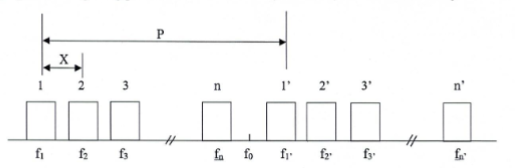
The central frequency of the receiving and transmitting radio frequency channels is calculated using the following formulas:
fn = fF + nX
fn’ = fn + P = fF + P + nX with n = 1, 2, 3...
Where:
fF is the reference frequency (MHz);
fn is the central frequency of a receiving/transmitting channel (MHz);
fn’ is the central frequency of a corresponding transmitting/receiving channel (MHz);
X is the distance between adjacent channels (MHz);
P is the transmission-reception frequency separation (MHz).
In cases requiring high-capacity microwave systems with large bandwidths, adjacent channels can be bonded with their central frequency being the midpoint of the central frequencies of those adjacent channels.
Other provisions in the radio frequency band diagram in this Appendix include:
a) Reference Documents: Relevant recommendations of the International Telecommunication Union (ITU).
b) Provisions:
Purpose of use: Specifies the type of system allowed to be used.
Formula for calculating the central frequency of radio frequency channels.
Table of central frequencies of radio frequency channels: Lists all the values of the central frequencies of corresponding radio frequency channels illustrated on the radio frequency channel allocation diagram and calculated according to the formula for calculating the central frequency.
2. Radio frequency channel allocation for Fixed Service in the 71-76 GHz and 81-86 GHz bands
2.1. Radio frequency channel allocation with a bandwidth of 250 MHz
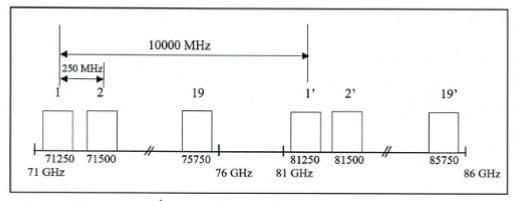
a) Reference material:
According to Appendix 2 of Recommendation ITU-R F.2006 (March 2012) of the International Telecommunication Union.
b) Provisions:
Purpose of use: point-to-point viba communication systems using frequency division duplexing technology.
Formula for calculating the central frequency of radio frequency channels:
fn = fF + 250n (MHz) fF = 71000 MHz
fn’ = fF + 10000 + 250n (MHz) n = 1, 2, 3, ... 19.
Table of central frequencies of radio frequency channels with a bandwidth of 250 MHz
|
Channel |
Receive/transmit frequency (MHz) |
Transmit/receive frequency (MHz) |
|
1 |
71250 |
81250 |
|
2 |
71500 |
81500 |
|
3 |
71750 |
81750 |
|
4 |
72000 |
82000 |
|
5 |
72250 |
82250 |
|
6 |
72500 |
82500 |
|
7 |
72750 |
82750 |
|
8 |
73000 |
83000 |
|
9 |
73250 |
83250 |
|
10 |
73500 |
83500 |
|
11 |
73750 |
83750 |
|
12 |
74000 |
84000 |
|
13 |
74250 |
84250 |
|
14 |
74500 |
84500 |
|
15 |
74750 |
84750 |
|
16 |
75000 |
85000 |
|
17 |
75250 |
85250 |
|
18 |
75500 |
85500 |
|
19 |
75750 |
85750 |
2.2. Radio frequency channel allocation with a bandwidth greater than 250 MHz
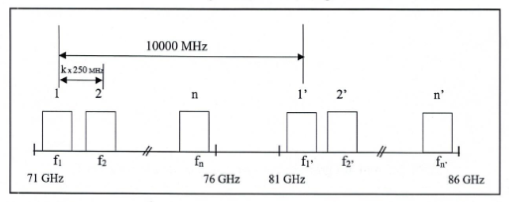
a) Reference material:
According to Appendix 2 of Recommendation ITU-R F.2006 (March 2012) of the International Telecommunication Union.
b) Provisions:
Purpose of use: point-to-point viba communication systems using frequency division duplexing technology.
In cases where radio frequency channels with a bandwidth greater than 250 MHz need to be used, adjacent 250 MHz radio frequency channels can be combined. No more than eight consecutive 250 MHz channels should be combined.
The central frequency of the combined channel is specified in the tables below:
- Table of central frequencies of radio frequency channels with a bandwidth of 500 MHz
|
Channel |
Receive/transmit frequency (MHz) |
Transmit/receive frequency (MHz) |
|
1 |
71375 |
81375 |
|
2 |
71875 |
81875 |
|
3 |
72375 |
82375 |
|
4 |
72875 |
82875 |
|
5 |
73375 |
83375 |
|
6 |
73875 |
83875 |
|
7 |
74375 |
84375 |
|
8 |
74875 |
84875 |
|
9 |
75375 |
85375 |
- Table of central frequencies of radio frequency channels with a bandwidth of 750 MHz
|
Channel |
Receive/transmit frequency (MHz) |
Transmit/receive frequency (MHz) |
|
1 |
71500 |
81500 |
|
2 |
72250 |
82250 |
|
3 |
73000 |
83000 |
|
4 |
74000 |
84000 |
|
5 |
74750 |
84750 |
|
6 |
75500 |
85500 |
- Table of central frequencies of radio frequency channels with a bandwidth of 1000 MHz
|
Channel |
Receive/transmit frequency (MHz) |
Transmit/receive frequency (MHz) |
|
1 |
71625 |
81625 |
|
2 |
72625 |
82625 |
|
3 |
74125 |
84125 |
|
4 |
75125 |
85125 |
- Table of central frequencies of radio frequency channels with a bandwidth of 1250 MHz
|
Channel |
Receive/transmit frequency (MHz) |
Transmit/receive frequency (MHz) |
|
1 |
71750 |
81750 |
|
2 |
73000 |
83000 |
|
3 |
74250 |
84250 |
- Table of central frequencies of radio frequency channels with a bandwidth of 1500 MHz
|
Channel |
Receive/transmit frequency (MHz) |
Transmit/receive frequency (MHz) |
|
1 |
71875 |
81875 |
|
2 |
74375 |
84375 |
- Table of central frequencies of radio frequency channels with a bandwidth of 1750 MHz
|
Channel |
Receive/transmit frequency (MHz) |
Transmit/receive frequency (MHz) |
|
1 |
72000 |
82000 |
|
2 |
74500 |
84500 |
- Table of central frequencies of radio frequency channels with a bandwidth of 2000 MHz
|
Channel |
Receive/transmit frequency (MHz) |
Transmit/receive frequency (MHz) |
|
1 |
72125 |
82125 |
|
2 |
74625 |
84625 |
Original document (PDF)
Download
Relations map
Click a document to open. A red border = a relation that changes validity.
Translations
This document is available in the following languages: