
This Circular issues National Technical Regulations on permissible exposure limits for 70 chemical factors in the workplace, applicable to state management agencies and organizations and individuals engaged in activities generating chemical factors at workplaces. Core provisions include TWA and STEL values, concentration determination methods, and responsibilities of relevant parties.
Scope of application
State management agencies for occupational safety and health, organizations conducting environmental monitoring, and organizations and individuals engaged in activities generating chemical factors at workplaces.
Key points
- Workers shall not be exposed beyond the permissible TWA (Time Weighted Average) and STEL (Short Term Exposure Limit) values for each chemical factor. For example: Acrolein - TWA: 0.25 mg/m3; STEL: 0.8 mg/m3.
- Methods for determining concentrations of chemical factors are specified in Table 2, including conversion factors from analysis results according to prescribed methods.
- Facilities must regularly monitor the work environment with chemical factors and implement control measures to protect workers' health.
- Electronic digital measuring devices may be used when traditional sampling is not possible, meeting the requirements of Section 2.5 Part II of the Technical Provisions.
- State management agencies will guide and supervise the implementation of these standards.
🌐 Social impact of this document
- Positive impact: Reducing occupational disease risks, protecting workers' health, enhancing workplace safety.
- Negative impact: Increased investment costs for measurement equipment and training for businesses.
❓ Frequently asked questions
What is the permissible exposure limit (TWA) for Acrolein during an 8-hour workday?
The permissible exposure limit (TWA) for Acrolein during an 8-hour workday is 0.25 mg/m3.
If the instantaneous concentration during the workday exceeds three times the TWA value, how long can workers be exposed?
Workers are not permitted to be exposed to concentrations exceeding three times the TWA (TWA x 3) for more than 30 minutes.
What is the formula for converting ppm to mg/m3?
The formula for converting the ppm concentration of a gas or vapor analyte in air to mg/m3 is specified in Section 2.2.
What is the minimum duration of measurement required to calculate the actual exposure level during an 8-hour workday?
The minimum measurement duration to calculate the actual exposure level during an 8-hour workday is 80% of the exposure time. If the total exposure time is less than or equal to 8 hours per day, this period is calculated based on 480 minutes.
Which chemical factors have a permissible exposure limit (TWA) of 1?
According to information in Table 1, chemical factors with a TWA of 1 include Acetone cyanohydrin and Dichlorvos.
Full text
|
MINISTRY OF HEALTH |
SOCIALIST REPUBLIC OF VIET NAM |
|
Number: 09/2025/TT-BYT |
Hanoi, April 28, 2025 |
CIRCULAR
ISSUING NATIONAL TECHNICAL REGULATIONS ON PERMISSIBLE EXPOSURE LIMIT VALUES FOR 70 CHEMICAL FACTORS IN THE WORKPLACE
On the basis of Law on Labor Safety and Hygiene 2015;
On the basis of Law on Standards and Technical Regulations 2006;
Decree No. Decree No. 42/2025/NĐ-CP dated February 27, 2025 of the Government stipulating functions, tasks, powers, and organizational structure of the Ministry of Health;
Decree No. Decision No. 127/2007/NĐ-CP dated August 1, 2007 of the Government detailing implementation of certain provisions of Law on Standards and Technical Regulations; Decree number 78/2018/NĐ-CP dated June 15, 2018 of the Government amending and supplementing certain articles of Decree number 127/2007/NĐ-CP dated August 1, 2007 of the Government detailing implementation of certain provisions Law on Standards and Technical Regulations;
At the proposal of the Director of the Preventive Medicine Department;
The Minister of Health issues this Circular on issuing National Technical Regulations on Permissible Exposure Limit Values for 70 Chemical Factors in the Workplace.
Article 1. National Technical Regulations on Chemical Factors
Issued together with this Circular is QCVN 01:2025/BYT - National Technical Regulations on Permissible Exposure Limit Values for 70 Chemical Factors in the Workplace.
Article 2. Effective Date
1. This Circular takes effect from October 1, 2025.
2. The occupational hygiene standards for the following factors: Acrolein, Acrylamide, Acrylonitrile, Amyl acetate, Phthalic anhydride, Antimony, ANTU, Asphalt (smoke form), Acetonitrile hydrate, Acetonitrile, Formic acid, Methacrylic acid, Nitronitrate, Trihydro phosphate, Picric acid, Trichloroacetic acid, Azinphos methyl, Silver and its soluble compounds, Benomyl (total dust), Benzidine, Benzoyl peroxide, Benzyl chloride, Beryllium and its compounds, Bromine, 1,3-Butadiene, n-Butyl acetate, Carbofuran, Calcium carbonate (total dust), Calcium hydroxide (total dust), Calcium oxide, Calcium silicate (total dust), Calcium sulfate dihydrate (total dust), Calcium cyanamide, Caprolactam (dust form), Caprolactam (vapor form), Captan, Carbaryl, Catechol, Tetraethyl lead, Inorganic lead and its compounds, Chloroacetaldehyde, Chlorine dioxide, Chloroacetophenol, Chlorobenzene, Chloroprene, Cresol, Crotonaldehyde, Cumene, Mineral oil (mist form), Petroleum (napthas), Pine oil, Vegetable oil (mist form), Stoddard solvent, Talc (respirable dust), Talc (total dust), Demeton, Diazinon, Diborane, Dibutyl phthalate, 1,1-Dichloroethane, 1,1-Dichloroethylene, Dichlorvos, Dicrotophos, Dimethylamine, Dimethylformamide, 1,1-Dimethylhydrazine, Dimethyl sulfate, Dinitrobenzene, Dinitrotoluene (DNT) in the Occupational Hygiene Standards issued together with Decision No. 3733/2002/QĐ-BYT dated October 10, 2002 of the Minister of Health shall cease to be effective from the date this Circular takes effect.
Article 3. Responsibility for Implementation
The Heads of the Ministry's Office, the Inspector General, the Directors of the Disease Control Bureau, the Heads of Departments, the Directors of the Units under the Ministry of Health, the Heads of the Agencies and Units directly under the Ministry, the Directors of Provincial Health Services, the Heads of Health Agencies of Ministries, Departments and related Organizations and Individuals are responsible for implementing this Circular.
During the implementation process, if there are difficulties or obstacles, the agencies, organizations, and individuals should report them to the Ministry of Health (Disease Control Bureau) for research and resolution./.
|
DEPUTY MINISTER |
QCVN 01 : 2025/BYT
NATIONAL TECHNICAL REGULATION ON PERMISSIBLE EXPOSURE LIMIT VALUE OF 70 CHEMICALS AT THE WORKPLACE
National Technical Regulation on Permissible Exposure Limit Value of 70 Chemicals at the Workplace
Foreword
QCVN 01 : 2025/BYT was drafted by the Drafting Team of National Technical Regulations on Occupational Hygiene, reviewed by the Disease Control Bureau, examined by the Ministry of Science and Technology, and promulgated pursuant to Circular No. 09/2025/TT-BYT dated April 28, 2025 of the Minister of Health.
NATIONAL TECHNICAL REGULATION ON PERMISSIBLE EXPOSURE LIMIT VALUE OF 70 CHEMICALS AT THE WORKPLACE
National Technical Regulation on Permissible Exposure Limit Value of 70 Chemicals at the Workplace
Chapter 1. GENERAL PROVISIONS
1.1. Scope of Application
This regulation sets forth the permissible exposure limit values for 70 chemicals in the workplace, including: Acrolein; acrylamide; acrylonitrile; amyl acetate; phthalic anhydride; antimony; ANTU; asphalt (smoke form); acetonitrile hydrate; acetonitrile; formic acid; methacrylic acid; nitronitrate; trihydro phosphate; picric acid; trichloroacetic acid; azinphos methyl; silver and its soluble compounds; benomyl (total dust); benzidine; benzoyl peroxide; benzyl chloride; beryllium and its compounds; bromine; 1,3-butadiene; n-butyl acetate; butyl acrylate; carbofuran; calcium carbonate (total dust); calcium hydroxide (total dust); calcium oxide; calcium silicate (total dust); calcium sulfate dihydrate (total dust); calcium cyanamide; caprolactam (dust form); caprolactam (vapor form); captan; carbaryl; catechol; tetraethyl lead; inorganic lead and its compounds; chloroacetaldehyde; chlorine dioxide; chloroacetophenol; chlorobenzene; chloroprene; cresol; crotonaldehyde; cumene; mineral oil (mist form); petroleum (napthas); pine oil; vegetable oil (mist form - total dust); Stoddard solvent; talc (respirable dust); talc (total dust); demeton; diazinon; diborane; dibutyl phthalate; 1,1-dichloroethane; 1,1-dichloroethylene; dichlorvos; dicrotophos; dimethylamine; dimethylformamide; 1,1-dimethylhydrazine; dimethyl sulfate; dinitrobenzene; dinitrotoluene (DNT).
1.2. Applicability
This regulation applies to state management agencies for labor environment: agencies and organizations engaged in monitoring the labor environment: organizations and individuals involved in activities that generate chemical factors in the workplace.
1.3. Definitions
In this regulation, the following terms are understood as follows:
(The names of chemical factors in Vietnamese are written according to the provisions of TCVN 5529:2010 Terminology in Chemistry - Basic Principles and TCVN 5530:2010 Terminology in Chemistry - Nomenclature of Elements and Chemical Compounds).
1.3.1Acrolein: A liquid compound, colorless, flammable, with a putrid odor. Chemical formula: CH2CHCHO. IUPAC name: 2-propenal. Other names: Acraldehyde; acrylic aldehyde; allyl aldehyde; ethylene aldehyde; acrylaldehyde.
1.3.2. Acrylamide: A solid crystalline compound, white in color, odorless, soluble in water. Chemical formula: CH2CHCONH2. IUPAC name: 2-propenamide. Other names: Acrylamide monomer; propenamide.
1.3.3. Acrylonitrile: A liquid compound, colorless or yellowish, volatile, with a pungent odor. Chemical formula: CH2CHCN. IUPAC name: 2-propenenitrile. Other names: Acrylnonitrile monomer; AN; cyanoethylene; propenenitrile; VCN.
1.3.4. Amyl acetate: An organic liquid compound, with a smell of banana and apple. Chemical formula: CH3COOC5H11. IUPAC name: Pentyl ethanoate. Other names: Acetic acid n-amyl ester; acetic acid pentyl ester; n-amyl acetate; amyl ethanoate; banana oil.
1.3.5Phthalic anhydride: An organic solid compound, colorless. Chemical formula: C6H4(CO)2O. IUPAC name: 2-benzofuran-1,3-dione. Other names: Isobenzofuran-1,3-dione.
1.3.6. Antimony: It is a metalloid, in its elemental form it is a crystalline solid with a low melting point, hard, white-silver colored, with poor electrical and thermal conductivity, and it vaporizes at low temperatures. Chemical formula: Sb. IUPAC name: Antimony. Other names: Antimony metal; antimony powder; stibium.
1.3.7. ANTU: Organic compound in the form of crystal powder, white or gray in color, odorless. Chemical formula: C10H7NHC(NH2)S. IUPAC name: Naphthalen-1-ylthiourea. Other names: 1-(1-naphthyl)-2-thiourea; dirax; 1-naphthylthiourea; anturat; rattrack; smeesana; alrato; alpha-naphthylthiourea; 1-naphthyl thiourea.
1.3.8. Asphalt (smoke form): A mixture of heavy hydrocarbons with a complex composition, brown-black in color similar to resin, non-water absorbent, softens and liquefies when heated. To date, the components and structure of asphalt have not been precisely and fully determined. The asphalt mixture blended with sand, gravel, and crushed stone is used for paving roads (asphalt is also known as road tar). Other names: Asphaltum; bitumen; petroleum asphalt; petroleum bitumen; road asphalt; roofing asphalt; road tar.
1.3.9. Aceton cyanohydrin: Organic liquid compound, colorless, almond scent. Chemical formula: CH3C(OH)CNCH3. IUPAC name: 2-hydroxy-2-methylpropanenitrile. Other names: Cyanohydrin-2-propanone; α-hydroxyisobutyronitrile; 2-hydroxy-2-methyl-propionitrile.
1.3.10. Acetonitrile: Organic liquid compound, colorless, aromatic smell. Chemical formula: CH3CN. IUPAC name: Acetonitrile. Other names: Cyanomethane; ethyl nitrile; methanecarbonitrile; methyl cyanide; MeCN.
1.3.11. Formic acid: Liquid compound, colorless, weak acid. Chemical formula: HCOOH. IUPAC name: Formic acid. Other names: Carbonous acid; formylic acid; hydrogen carboxylic acid; hydroxy(oxo)methane; metacarbonoic acid; oxocarbinic acid; oxomethanol.
1.3.12. Methacrylic acid: Organic liquid compound, viscous, colorless, unpleasant odor, soluble in warm water and can be mixed with most organic solvents. Chemical formula: CH2=C(CH3)COOH. IUPAC name: 2-methylprop-2-enoic acid. Other names: Methacrylic acid; 2-methyl-2-propenoic acid; α-methacrylic acid; 2-methylacrylic acid; 2-methylpropenoic acid.
1.3.13. Nitric acid: Inorganic liquid compound, colorless, strongly fuming in moist air. Chemical formula: HNO3. IUPAC name: Nitric acid. Other names: Aqua fortis; spirit of niter; eau forte; hydrogen nitrate; acidum nitricum.
1.3.14. Phosphoric acid: Solid crystalline compound, colorless, soluble in ethanol and water in any ratio. Chemical formula: H3PO4. IUPAC name: Phosphoric acid (phosphoric acid); trihydroxidooxidophosphorus. Other names: Orthophosphoric acid (orthophosphoric acid): trihydroxylphosphine oxide.
1.3.15. Picric acid: Compound in yellow crystal form, bitter taste, one of the strongest acids derived from phenol. Like other nitrate-containing compounds (TNT), picric acid is explosive. Chemical formula: HOC6H2(NO2)3. IUPAC name: 2,4,6-Trinitrophenol. Other names: Carbolic acid; phenoltrinitrateacid; picronitric; trinitrophenol; 2,4,6-trinitro-1-phenol; 2-hydroxy-1,3,5-trinitrobenzene; tnp; melinite.
1.3.16. Trichloroacetic acid: Solid compound, white in color, pungent smell. Chemical formula: C2HCl3O2. IUPAC name: Trichloroacetic acid.
1.3.17. Azinphos methyl: Compound existing in orange crystals, insecticide. Chemical formula: (CH3O)2P(S)SCH2(N3C7H4O). IUPAC name: O,O-dimethyl S-[(4-oxo-1,2,3-benzotriazin-3(4H)yl)methyl] phosphorodithioate. Other names: Guthion; azinphosmethyl; azinphos.
1.3.18. Silver and soluble compounds: Silver is a transition metal, white in color, soft, with high electrical and thermal conductivity. Chemical formula: Ag. IUPAC name: Silver. Soluble silver compounds: Silver acetate, silver bromate, silver bromide, silver carbonate, silver chloride, silver chromate, silver cyanide, silver dichromate, silver hydroxide, silver iodate, silver iodide, silver nitrite, silver oxalate, silver sulfate, silver sulfide, silver thiocyanate.
1.3.19. Benomyl (total dust): Compound existing in white crystals. Chemical formula: C14H18N |||4O3. IUPAC name: 1-(butylcarbamoyl)-1H-1,3-benzimidazol-2-yl methylcarbamate.
1.3.20. Benzidine: Compound existing in grayish-yellow, reddish-gray, or white crystalline powder. Chemical formula: NH2C6H4C6H4NH2. IUPAC name: 1,1'-biphenyl]-4,4'-diamine. Other names: Diphenylamine; diphenylamine; 4,4'-bianiline; 4,4'-biphenyldiamine; 1,1'-biphenyl-4,4'-diamine; 4,4'-diaminobiphenyl; p-diaminodiphenyl; p-benzidine.
1.3.21. Benzoyl peroxide: Compound existing in white granules, benzaldehyde odor, poorly soluble in water but soluble in acetone. Chemical formula: (C6H5CO)2O2. IUPAC name: Benzoic peroxyanhydride. Other names: Benzoperoxide; dibenzoyl peroxide (DBPO).
1.3.22. Benzyl chloride: Compound existing in colorless liquid form. Chemical formula: C6H5CH2Cl. IUPAC name: (chloromethyl) benzene. Other names: α-chlorotoluene.
1.3.23. Beryllium and compounds: Beryllium is an alkali earth metal element, gray in color, light and brittle. Chemical formula: Be. Some beryllium compounds: Beryllium-aluminum alloy, beryllium chloride, beryllium fluoride, beryllium hydroxide, beryllium sulfate, beryllium sulfate tetrahydrate, beryllium oxide, beryllium carbonate base, beryllium nitrate, beryllium nitrate trihydrate, beryllium nitrate tetrahydrate, beryllium phosphate, beryllium silicate, zinc beryllium silicate.
1.3.24. Bromine: Brown-red liquid, fumes at room temperature, easily volatile. Chemical formula: Br2.
1.3.25. 1,3-Butadiene: Organic compound existing in gaseous form, colorless, easily condenses into liquid form. Chemical formula: CH2CHCHCH2. IUPAC name: Buta-1,3-diene. Other names: Biethylene; erythrene; divinyl; vinylethylene; bivinyl; butadiene.
1.3.26. n-Butyl acetate: Compound existing in grayish-yellow, reddish-gray, or white crystalline powder. Chemical formula: CH3COO(CH2)3CH3. IUPAC name: 1,1'-biphenyl]-4,4'-diamine. Other names: Benzidine; diphenylamine; 4,4'-bianiline; 4,4'-biphenyldiamine; 1,1'-biphenyl-4,4'-diamine; 4,4'-diaminobiphenyl; p-diaminodiphenyl; p-benzidine.
1.3.27. Butyl acrylate: Is an organic compound existing in liquid form, colorless. Chemical formula: CH3=CHCOOC4H9.2Butyl acrylate: IUPAC name: Butyl prop-2-enoate. Other names: Butyl ester of acrylic acid; butyl-2-propenoate.4H91.3.28. Carbofuran: Is a crystalline solid compound, odorless, white or slightly grayish in color. Chemical formula: C12H13N3O3.
Carbofuran: IUPAC name: 2,2-dimethyl-2,3-dihydro-1-benzofuran-7-yl methylcarbamate. Other names: Furadan; curater; furacarb.12H15NO31.3.29. Calcium carbonate (total dust): Is a white powder compound, odorless. Chemical formula: CaCO3.
Calcium carbonate: IUPAC name: Calcium carbonate. Other names: Calcite; aragonite; chalk; lime (material); limestone; marble; oyster; pearl; whiting; atomite.31.3.30. Calcium hydroxide (total dust): Is a white or light gray powder compound, odorless. Chemical formula: Ca(OH)2.
Calcium hydroxide: IUPAC name: Calcium hydroxide. Other names: Slaked lime; milk of lime; calcium(II) hydroxide; pickling lime; hydrated lime; portlandite; calcium hydrate; calcium dihydroxide.21.3.31. Calcium oxide: Is a crystalline solid compound white in color, odorless at room temperature. Chemical formula: CaO. IUPAC name: Calcium oxide. Other names: Quicklime; burnt lime; unslaked lime; pebble lime; calcia.
1.3.32. Calcium silicate (total dust): Is a crystalline solid compound white in color, odorless at room temperature. Chemical formula: CaSiO3.
Calcium silicate: IUPAC name: Calcium silicate. Other names: Dicalcium silicate; calcium orthosilicate; belite; calcium monosilicate; calcium hydrosilicate; calcium metasilicate; calcium orthosilicate; grammite; micro-cell; silene; silicic acid calcium salt.31.3.33. Calcium sulfate dihydrate (total dust): Is a crystalline solid compound white or nearly white in color, odorless. Chemical formula: CaSO4·2H2O. IUPAC name: Calcium(II) sulfate dihydrate. Other names: Gypsum; gypsum stone; hydrated calcium sulfate; mineral white.
1.3.34. Calcium cyanamide: Is a solid compound in powder or crystal form, colorless, when contaminated with impurities it may be gray or black in color. Chemical formula: CaCN2.4.2H2Calcium cyanamide: IUPAC name: Calcium cyanamide. Other names: Calcium carbimide; cyanamide; cyanamide calcium salt; lime nitrogen; nitrogen lime; nitrolime.
1.3.35. Caprolactam: Is a compound in powder or vapor form, with an unpleasant smell. Chemical formula: C6H11NO. IUPAC name: Azepan-2-one. Other names: 1-Aza-2-cycloheptanone; 2-azacycloheptanone; ε-caprolactam; capron PK4; cyclohexanone iso-oxime; extrom 6N; hexahydro-2-azepinone; hexahydro-2H-azepin-2-one; hexanolactam; hexano-6-lactam; aminocaproic lactam.21.3.36. Captan: Is a solid compound, white in color, easily combustible. Chemical formula: C12H10Cl2S.
Captan: IUPAC name: 2-(trichloromethylsulfanyl)-3a,4,7,7a-tetrahydroisoindole-1,3-dione. Other names: n-trichloromethylmercapto-4-cyclohexene-1; 2-dicarboximide.6H111.3.37. Carbaryl: Is a crystalline solid compound, white in color, odorless, slightly soluble in water. Chemical formula: CH3NHCOOC(CH3)3.
Carbaryl: IUPAC name: Naphthalen-1-yl methylcarbamate. Other names: Sevin; α-naphthyl n-methylcarbamate; 1-naphthyl methylcarbamate.9H81.3.38. Catechol: Is a compound in crystal form, white or colorless, with a mild phenol smell. Chemical formula: C6H6O2.3NO2Catechol: IUPAC name: Benzene-1,2-diol. Other names: Pyrocatechol; 1,2-benzenediol; 2-hydroxyphenol; 1,2-dihydroxybenzene; o-benzenediol; o-dihydroxybenzene.
1.3.39. Tetraethyl lead: Is a liquid compound, colorless, with a pleasant smell. Chemical formula: Pb(C2H5)4.3Tetraethyl lead: IUPAC name: Tetraethylplumbane. Other names: Lead tetraethyl; tetraethyl lead; tetra-ethyl lead.10H71.3.40. Lead and inorganic compounds: Lead is a compound in powder or lump form, soft, gray in color, odorless. Chemical formula: Pb. IUPAC name: Lead. Other names: Lead metal; lead element; lead flake; plumbumlead. Inorganic compounds of lead: lead oxides (lead oxides), lead salts (lead salts).
1.3.41. Chloroacetaldehyde: Is an organic compound in liquid form, colorless, with a sharp bitter taste. Chemical formula: ClCH2CHO.6H6O2Chloroacetaldehyde: IUPAC name: Chloroacetaldehyde. Other names: 2-Chloroacetaldehyde; 2-chloroethanal.
1.3.42. Chlorine dioxide: Is an inorganic compound in liquid form, yellow in color. Chemical formula: ClO2.2H5)4Chlorine dioxide: IUPAC name: Chlorine dioxide. Other names: Chlorine oxide; chlorine peroxide.
1.3.43. Chloroacetophenone: Is a white crystalline compound, insoluble in water under normal conditions. Chemical formula: C9H9OCl.
Chloroacetophenone: IUPAC name: 2-chloro-1-phenylethan-1-one. Other names: 2-Chloro-1-phenylethanone; α-chloroacetophenone; 2-chloroacetophenone; chloromethyl phenyl ketone; chenyl chloromethyl ketone.21.3.44. Chlorobenzene: Is an aromatic solvent compound. Chemical formula: C6H5Cl.
Chlorobenzene: IUPAC name: Chlorobenzene. Other names: Benzene chloride; monochlorobenzene; phenyl chloride; chlorobenzol.21.3.45. Chloroprene: Is a colorless liquid compound. Chemical formula: CH2=C(CH3)CH=CHCl.
Chloroprene: IUPAC name: Chloroprene. Other names: 2-Chlorobuta-1,3-diene; 2-chloro-1,3-butadiene.6H51.3.46. Cresol: Is a group of aromatic organic compounds. Chemical formula: C7H8O.2Cresol: IUPAC name: Cresol. Other names: Sesone.
1.3.47. Crotonaldehyde: Is a group of aromatic organic compounds. Chemical formula: CH3CH=CHCHO.6H5Crotonaldehyde: IUPAC name: Crotonaldehyde. Other names: 2-Butenal; β-methyl acrolein; propylene aldehyde.
1.3.48. Cumene: Is a hydrocarbon containing an aromatic ring and a propyl substituent group, a component of crude oil and refined fuels. Chemical formula: C9H12.4H5Cumene: IUPAC name: Cumene. Other names: Cumol; isopropyl cumene; 2-phenyl propane.
1.3.49. Mineral oil (mist form): Mineral oil or paraffin oil is a colorless, odorless, light mixture of high molecular weight alkanes from mineral sources, particularly the distillate fraction of petroleum. Other names: Heavy mineral oil mist; paraffin oil mist; white mineral oil mist.3C6H4OH. IUPAC Name: Cresol. Other Names: Sesone.
1.3.47. Crotonaldehyde: Aromatic organic compound group. Chemical formula: CH3CH=CHCHO. IUPAC Name: Crotonaldehyde. Other Names: 2-Butenal; β-methyl acrolein; propylene aldehyde.31.3.48. Cumen: An aromatic hydrocarbon containing a propyl substituent group, component of crude oil and refined fuel. Chemical formula: C9H12.
1.3.49. Mineral Oil (fog form): Colorless, odorless, light mixture of high alkane from mineral sources, particularly the distillation fraction of crude oil. Other Names: Heavy mineral oil mist; paraffin oil mist; white mineral oil mist.6H51.3.64. Dimethylformamide: Liquid organic compound, colorless, flammable, with a pungent amine-like smell, soluble in water. Chemical formula: O=CHN(CH3)2.3)2b. Conduct on-site measurement
- Determine the measurement point location: The work area of employees.
1.3.50. Napthas (petroleum distillates): Is a dense liquid organic chemical mixture, predominantly consisting of hydrocarbon compounds from the alkane series, with a very diverse composition. Other names: Aliphatic petroleum naphtha; petroleum naphtha; rubber solvent.
1.3.51. Turpentine oil: Is a colorless liquid with a distinctive odor. Chemical formula: C10H16. IUPAC name: Turpentine. Other names: Gumspirits; gum turpentine; spirits of turpentine; steam distilled turpentine; sulfate wood turpentine; turps; wood turpentine.
1.3.52. Vegetable oil (mist form - full particle): Is oil extracted from plants. Other names: Vegetable mist.
1.3.53. Stoddard solvent: Is a clear liquid with a kerosene-like aromatic smell. Other names: Dry cleaning safety solvent; mineral spirits; petroleum solvent; spotting naphtha.
1.3.54. Talc stone: Is a light gray crystal without smell. Chemical formula: 3MgO.4SiO2.H2O. Other names: Massive talc; soapstone silicate; steatite.
PSOC2H5O)2SC2H4. IUPAC name: 0,0-diethyl S-[2-(ethylsulfanyl)ethyl] phosphorothioate. Other names: Demeton thiol; izosystox; bay 10756; bayer 10756; bayer 8169; demetona (Spain); demeton-O 1 demeton-S; demox; denox; diethoxy thiophosphoric acid ester of 2-ethylmercaptoethanol; O,O-diethyl-2- ethylmercaptoethyl thiophosphate; diethoxythiophosphoric acid; O,O-diethyl S-2-(ethylthio) ethyl phosphorothioate mixed with phosphorothioic acid; O,O-diethyl O-2-(ethylthio)ethyl ester; E-1059; ENT 17295; mercaptophos (former Soviet Union); phosphorothioic acid; O,O-diethyl O-2-(ethylthio)ethyl ester; mixed with O,O-diethyl S-2-(ethylthio)ethyl phosphorothioate; systemox; systox; UL demeton-S; bay 18436; bayer 18436; bayer 25/154.2H51.3.56. Diazinon: Is a viscous liquid compound, colorless to dark brown, with a mild amine smell, insoluble in water, an insecticide. Chemical formula: C
PS. IUPAC name: O,O-diethyl O-[4-methyl-6-(propan-2-yl)pyrimidin-2-yl] phosphorothioate. Other names: Diethoxy-[(2-isopropyl-6-methyl-4-pyrimidinyl)oxy]-thioxophosphorane; basudin; diazide; spectracide; dazzel; dimpylate; dipofene; diziktol; dizinon; dyzol; ENT 19,507; EPA pesticide chemical code 057801; exodin; G-24480; G 301; gardentox.12H21N |||2O31.3.57. Diborane: Is a colorless gas with a sweet distinctive smell, highly flammable. Chemical formula: B
. IUPAC name: Diborane. Other names: Boroethane; boron hydride; diborane hexanhydride; diborano (Spain); diboron hexahydride.2H61.3.58. Dibutyl phthalate: Is an organic liquid compound, colorless to yellow, with a light sweet smell. Chemical formula: C
(COOC6H4. IUPAC name: Dibutyl benzene-1,2-dicarboxylate. Other names: Di-n-butyl phthalate; butyl phthalate; n-butyl phthalate; 1,2-benzenedicarboxylic acid dibutyl ester; o-benzenedicarboxylic acid dibutyl ester; DBP; palatinol C; elaol; dibutyl 1,2-benzene-dicarboxylate; benzene-o-dicarboxylic acid di-n-butyl ester; bis-n-butyl phthalate; BUFA; genoplast B; hexaplas M/B; kodaflex dibutyl phthalate (DBP); morflex-240; NLA-10.4H9)21.3.59. 1,1-Dichloroethane: Is an organic liquid compound, colorless, with a chloroform-like smell, slightly soluble in water but can mix with most organic solvents. Chemical formula: CH
. IUPAC name: 1,1-dichloroethane. Other names: Ethylidene dichloride; ethylidene chloride; CFC-150a; 1,1-DCA; asymmetrical dichloroethane; 1,1-ethylidene dichloride; geminal dichloroethane; aethylidenchlorid (Germany); asym- dichloroethane; chlorinated hydrochloric ether; chlorure d’ethylidene (France); dichloromethylethane.3CHCl21.3.60. 1,1-Dichloroethylene: Is an organic liquid or gas compound, with a chloroform-like smell, poorly soluble in water but easily soluble in organic solvents. Chemical formula: CH
=CCl2. IUPAC name: 1,1-dichloroethene. Other names: 1,1-DCE; vinylidene chloride; vinylidene dichloride; asymmetrical dichloroethane; VDC; vinylidene chloride(II); vinylidine chloride(II); ethene; 1,1-dichloro-; ethylene; 1,1- dichloro-; NCl- 054262; sconatex; asym-dichloroethylene.21.3.61. Dichlorvos: Is an organic liquid compound, colorless to amber, with a light sweet smell, flammable, slightly soluble in water. Dichlorvos is a widely used organophosphate insecticide. Chemical formula: (CH
P(O)OCH=CCl3O)2. IUPAC name: 2,2-dichlorovinyl dimethyl phosphate. Other names: DDVP; vapona; apavap; astrobot; atgard; atgard V; bay 19149; bayer 19149; benfos; bibesol; brevinyl; brevinyl E 50; canogard; cekusan; chlorvinphos; cyanophos; cypona; DDVF; DDVP (Insecticide); dedevap; deriban; derribante; DES; devikol; dichlofos; dichlorman; 2,2-dichloroethenol dimethyl phosphate; 2,2-dichloroethenyl dimethyl phosphate.21.3.62. Dicrotophos: Is an organic liquid compound, amber in color, with an ester smell, flammable, soluble in water. Dicrotophos is an organophosphate acetylcholinesterase inhibitor used as an insecticide. Chemical formula: C
P. IUPAC name: (2E)-4- (dimethylamino)-4-oxobut-2-en-2-yl dimethyl phosphate. Other names: Bidrin; bidirl; carbicron; carbicrin; 2-dimethyl-cis-2-dimethylcarbamoyl-1-methylvinylphosphate; diapadrin; dicron; ektafos; carbomicron; ciba 709; dicroptophos; didrin; 3-(dimethoxyphosphinyloxy)-N; N-dimetyl [e] crotonamit.8H16NO51.3.63. Dimethylamine: Is an organic liquid or gas compound, with an ammonia-like pungent smell, soluble in water. Chemical formula: (CH
NH. IUPAC name: N-methylmethanamine. Other names: Al3-15638-X; N,N-dimethylamine; dimethylamine; anhydrous; DMA; methanamine; n-methyl-.3)21.3.64. Dimethylformamide: Is an organic liquid compound, colorless, flammable, with an amines-like pungent smell, soluble in water. Chemical formula: O=CHN(CH
- Insert battery into the device (if necessary). Turn on the machine to check its operational status then turn it off.3)2. IUPAC Name: N,N-dimethylformamide. Other Names: DMF; Al3-03311; N-dimethylformamide; N,N-dimethylmethanamide; dimetilformamida (Spain); DMFA; dynasolve 100; formamide; N,N-dimethyl-; formic acid; amide; N,N-dimethyl-; N-formyldimethylamine; NCl-060913; NSC-5356; U-4224; weld-on P-70 primer.
1.3.65. 1,1-Dimethylhydrazin: Is an organic liquid compound, colorless, turning yellow upon contact with air, having a fishy odor similar to that of amines, soluble in water, can be mixed with ethanol and gasoline, its vapor is flammable. Chemical formula: (CH3)2NNH2. IUPAC Name: 1,1-dimethylhydrazine. Other Names: Dimazine; dimazin; dimethylhydrazine; asym-dimethylhydrazine; N,N-dimethylhydrazine; U-dimethylhydrazine; hydrazine; 1,1-dimethyl-.
1.3.66. Dimethyl sulfat: Is an organic liquid compound, colorless, with an onion-like smell, slightly soluble in water. Chemical formula: (CH3O)2SO2. IUPAC Name: Dimethyl sulfate. Other Names: Sulfuric acid dimethyl ester; dimethyl ester of sulfuric acid; methyl sulfate: dimethyl monosulfate; DMS; methyle (sulfate de) (France); methyl sulfate: sulfate dimethylique (France); sulfate de methyle (France); sulfato de dimetilo (Spain).
1.3.67. Dinitrobenzen: Exists in three isomers (o-, m-, and p-). It is an organic crystalline solid, white to yellow in color, with a distinctive smell, soluble in organic solvents. Chemical formula: C6H4(NO2)2. IUPAC Name: 1,2-dinitrobenzene; 1,3-dinitrobenzene; 1,4-dinitrobenzene. Other Names: o-isonaer benzene; o-dinitro-; benzene; 1,2-dinitro; o-dinitrobenceno (Spain); 1,2-dinitrobenzene;1,2-dinitrobenzol; 1,2-DNB. m-isomer: Benzene; m-dinitro-; benzene; 1,3-dinitro-; m-dinitrobenceno (Spain); 1,3-dinitrobenzene; 1,3-dinitrobenzol; 1,3-DNB. p-isomer: Benzene; p-dinitro-; benzene; 1,4-dinitro-; p-dinitrobenceno (Spain); 1,4-dinitrobenzene; 1,4-dinitrobenzol; dithaneA-4; 1,4-DNB.
1.3.68. Dinitrotoluen (DNT): Exists in solid form, light yellow in color; soluble in alcohol, ethers, benzene, and acetone. Chemical formula: CH3C6H3(NO2)2. Other Names: Methyldinitrobenzene.
1.3.69. Time-Weighted Average (TWA) Exposure Limit: Is the concentration value of a substance in the workplace air environment, averaged over an 8-hour work shift, 40-hour work week, which workers should not exceed.
The TWA value is also used when a substance does not have a short-term exposure limit (STEL): If the concentration during the work shift exceeds three times the TWA value, the duration of exposure to this concentration must not exceed 30 minutes. Throughout the work shift, the concentration at any point in time must not exceed five times the TWA value, even if the average 8-hour exposure level does not exceed the TWA limit.
1.3.70. Short-Term Exposure Limit (STEL): Is the concentration value of a substance in the workplace air environment, averaged over a 15-minute period, which workers should not exceed. If the concentration of the substance in the work environment falls between the TWA limit and the STEL, workers should not be exposed for more than 15 minutes each time and no more than four times during the work shift, with at least 60 minutes between exposures.
The short-term exposure limit applies to chemical factors that may cause skin irritation, mucous membrane irritation; central nervous system depression or stimulation; non-reversible tissue damage.
1.3.71. Sampling Duration: Is the period of time for one sampling or measurement of a chemical factor during a work shift.
1.3.72. Exposure Duration: Is the period of time during which workers are exposed to a chemical factor during a work shift.
1.3.73. Point Sample: Is a measurement or sample taken at a specific point in time, within a short period, minimum 15 minutes.
1.3.74. CAS (Chemical Abstracts Service): Registration number of a chemical factor by the American Chemical Society.
1.3.75. IUPAC (International Union of Pure and Applied Chemistry): International Union of Pure and Applied Chemistry.
1.3.76. IARC (International Agency for Research on Cancer): International Agency for Research on Cancer. According to carcinogenic toxicity, IARC classifies chemicals into five groups as follows:
Group 1: Substance (or mixture) that is definitely carcinogenic to humans.
Group 2A: Substance (or mixture) that is probably carcinogenic to humans.
Group 2B: Substance (or mixture) that may be carcinogenic to humans.
Group 3: Substance (or mixture) that cannot be classified as a possible human carcinogen.
Group 4: Substance (or mixture) that is not carcinogenic to humans.
1.3.77. NIOSH (National Institute for Occupational Safety and Health): National Institute for Occupational Safety and Health - United States.
1.3.78. OSHA (Occupational Safety and Health Administration): Occupational Safety and Health Administration - United States.
Chapter 2. TECHNICAL PROVISIONS
2.1. Permissible Exposure Limits for Chemical Factors in Workplaces
Table 1. Maximum Permissible Exposure Limits for Chemical Factors in Workplaces
Unit: mg/m3
|
Serial number |
Name of Chemical Factor |
English Name |
Chemical Formula |
Molecular Weight |
CAS Number |
Time-Weighted Average (TWA) Exposure Limit |
Short-Term Exposure Limit (STEL) |
IARC Toxicity Group |
|
(1) |
(2) |
(3) |
(4) |
(5) |
(6) |
(7) |
(8) |
(9) |
|
1. |
Acrolein |
Acrolein |
CH2CHCHO |
56,0 |
107-02-8 |
0,25 |
0,8 |
3 |
|
2. |
Acrylamide |
Acrylamide |
CH2CHCONH2 |
71,1 |
79-06-1 |
0,03 |
0,2 |
2A |
|
3. |
Acrylonitrile |
Acrylonitrile |
CH2CHCN |
53,1 |
107-13-1 |
4,3 |
21,5 |
2B |
|
4. |
Amyl Acetate |
Amyl Acetate |
CH3COOC5H11 |
130,2 |
628-63-7 |
266 |
525 |
- |
|
5. |
Phthalic Anhydride |
Phthalic Anhydride |
C6H4(CO)2O |
148,1 |
85-44-9 |
2 |
3 |
- |
|
6. |
Antimony |
Antimony |
Sb |
121,8 |
7440-36-0 |
0,5 |
- |
- |
|
7. |
ANTU |
ANTU |
C10H7NHC(NH2)S |
202,3 |
86-88-4 |
0,3 |
1,5 |
- |
|
8. |
Asphalt (Fume) |
Asphalt (Fume) |
- |
- |
8052-42-4 |
5 |
10 |
- |
|
9. |
Acetone Cyanohydrin |
Acetone Cyanohydrin |
CH3C(OH)CNCH3 |
85,1 |
75-86-5 |
- |
4 |
- |
|
10. |
Acetonitrile |
Acetonitrile |
CH3CN |
41,1 |
75-05-8 |
50 |
100 |
- |
|
11. |
Formic Acid |
Formic Acid |
HCOOH |
46,0 |
64-18-6 |
9 |
18 |
- |
|
12. |
Methacrylic Acid |
Methacrylic Acid |
CH2=C(CH3)COOH |
86,1 |
79-41-4 |
70 |
- |
- |
|
13. |
Nitric Acid |
Nitric Acid |
HNO3 |
63,0 |
7697-37-2 |
5 |
10 |
- |
|
14. |
Phosphoric Acid |
Phosphoric Acid |
H3PO4 |
98,0 |
7664-38-2 |
1 |
3 |
- |
|
15. |
Picric Acid |
Picric Acid |
HOC6H2(NO2)3 |
229,1 |
88-89-1 |
0,1 |
0,2 |
- |
|
16. |
Trichloroacetic Acid |
Trichloroacetic Acid |
C2HCl3O2 |
163,3 |
76-03-9 |
7 |
- |
2B |
|
17. |
Azinphos Methyl |
Azinphos Methyl |
(CH3O)2P(S)SCH2 (N3C7H4O) |
317,3 |
86-50-0 |
0,2 |
- |
- |
|
18. |
Silver and Soluble Compounds |
Silver and Soluble Compounds |
Ag (Metal) |
107,8 |
7440-22-4 |
0,01 |
- |
- |
|
19. |
Benomyl (Inhalable Dust) |
Benomyl (Inhalable Dust) |
C14H18N |||4O3 |
290,4 |
17804-35-2 |
10 |
- |
- |
|
20. |
Benzidine |
Benzidine |
NH2C6H4C6H4NH2 |
184,3 |
92-87-5 |
0,008 |
- |
1 |
|
21. |
Benzoyl Peroxide |
Benzoyl Peroxide |
(C6H5CO)2O2 |
242,2 |
94-36-0 |
5 |
10 |
3 |
|
22. |
Benzyl Chloride |
Benzyl Chloride |
C6H5CH21.3.38. Catechol: Is a compound in crystal form, white or colorless, with a mild phenol smell. Chemical formula: C6H6O2. |
126,6 |
100-44-7 |
5 |
- |
- |
|
23. |
Beryllium and Compounds |
Beryllium and Compounds |
Be (Metal) |
9,0 |
7440-41-7 |
0,002 |
- |
1 |
|
24. |
Bromine |
Bromine |
Br2 |
159,8 |
7726-95-6 |
0,7 |
2 |
- |
|
25. |
1,3-Butadiene |
1,3-Butadiene |
CH2CHCHCH2 |
54,1 |
106-99-0 |
20 |
40 |
1 |
|
26. |
n-Butyl Acetate |
n-Butyl Acetate |
CH3COO(CH2)3CH3 |
116,2 |
123-86-4 |
710 |
950 |
- |
|
27. |
Butyl Acrylate |
Butyl Acrylate |
CH2Butyl acrylate: IUPAC name: Butyl prop-2-enoate. Other names: Butyl ester of acrylic acid; butyl-2-propenoate.4H9 |
128,2 |
141-32-2 |
55 |
- |
3 |
|
28. |
Carbofuran |
Carbofuran |
C12H15NO3 |
221,3 |
1563-66-2 |
0,1 |
- |
- |
|
29. |
Calcium Carbonate (Inhalable Dust) |
Calcium Carbonate (Inhalable Dust) |
CaCO3 |
100,0 |
471-34-1 |
10 |
- |
- |
|
30. |
Calcium Hydroxide (Inhalable Dust) |
Calcium Hydroxide (Inhalable Dust) |
Ca(OH)2 |
74,0 |
1305-62-0 |
5 |
- |
- |
|
31. |
Calcium Oxide |
Calcium Oxide |
CaO |
56,0 |
1305-78-8 |
2 |
4 |
- |
|
32. |
Calcium Silicate (Inhalable Dust) |
Calcium silicate (inhalable dust) |
CaSiO3 |
116,2 |
1344-95-2 |
10 |
- |
- |
|
33. |
Calcium sulfate dihydrate (total dust) |
Calcium sulfate dihydrate (inhalable dust) |
CaSO4.2H2O |
172,2 |
13397-24-5 |
6 |
- |
- |
|
34. |
Calcium cyanamide |
Calcium cyanamide |
CaCN2 |
80,1 |
156-62-7 |
0,5 |
1 |
- |
|
35. |
Caprolactam |
1,6-Hexanolactam |
C6H11NO |
113,1 |
105-60-2 |
1 |
3 |
3 |
|
36. |
Caprolactam |
1,6-Hexanolactam |
C6H11NO |
113,1 |
105-60-2 |
20 |
40 |
3 |
|
37. |
Captan |
Captan |
C9H81.3.38. Catechol: Is a compound in crystal form, white or colorless, with a mild phenol smell. Chemical formula: C6H6O2.3NO2Provincial People's Committees set specific prices |
300,5 |
133-06-2 |
5 |
- |
3 |
|
38. |
Carbaryl |
Carbaryl |
CH3Tetraethyl lead: IUPAC name: Tetraethylplumbane. Other names: Lead tetraethyl; tetraethyl lead; tetra-ethyl lead.10H7 |
201,2 |
63-25-2 |
5 |
- |
3 |
|
39. |
Catechol |
Catechol |
C6H6O2 |
110,1 |
120-80-9 |
20 |
45 |
2B |
|
40. |
Tetraethyl lead |
Tetraethyl lead |
Pb(C2H5)4 |
323,4 |
78-00-2 |
0,075 |
- |
3 |
|
41. |
Lead and inorganic compounds |
Lead and inorganic compounds |
Pb (metal) |
207,2 |
7439-92-1 |
0,05 |
0,1 |
2B |
|
42. |
Chloroacetaldehyde |
Chloroacetaldehyde |
ClCH2CHO |
78.5 |
107-20-0 |
3 |
- |
- |
|
43. |
Chlorine dioxide |
Chlorine dioxide |
ClO2 |
67,4 |
10049-04-4 |
0,3 |
0,9 |
- |
|
44. |
Chloroacetophenone |
Chloroacetophenone |
C6H51.3.46. Cresol: Is a group of aromatic organic compounds. Chemical formula: C7H8O.21.3.38. Catechol: Is a compound in crystal form, white or colorless, with a mild phenol smell. Chemical formula: C6H6O2. |
154,5 |
532-27-4 |
0,3 |
- |
- |
|
45. |
Chlorobenzene |
Chlorobenzene |
C6H51.3.38. Catechol: Is a compound in crystal form, white or colorless, with a mild phenol smell. Chemical formula: C6H6O2. |
112,5 |
108-90-7 |
100 |
200 |
- |
|
46. |
Chloroprene |
2-Chlorobuta-1,3-diene |
C4H51.3.38. Catechol: Is a compound in crystal form, white or colorless, with a mild phenol smell. Chemical formula: C6H6O2. |
88,5 |
126-99-8 |
36 |
- |
2B |
|
47. |
Cresols, all isomers |
Cresols, all isomers |
CH3C6H4OH |
108,1 |
1319-77-3 |
22 |
- |
- |
|
48. |
Crotonaldehyde |
Crotonaldehyde |
CH3CH=CHCHO |
70,0 |
4170-30-3 |
5 |
10 |
3 |
|
49. |
Cumene |
Cumene |
C6H51.3.64. Dimethylformamide: Liquid organic compound, colorless, flammable, with a pungent amine-like smell, soluble in water. Chemical formula: O=CHN(CH3)2.3)2 |
120,2 |
98-82-8 |
245 |
- |
2B |
|
50. |
Mineral oil |
Mineral oil (mist) |
- |
- |
8012-95-1 |
5 |
10 |
- |
|
51. |
Petroleum distillates (naphtha) |
Petroleum distillates (naphtha) |
- |
- |
8002-05-9 |
350 |
- |
3 |
|
52. |
Turpentine |
Turpentine |
C10H16 |
136,0 |
8006-64-2 |
560 |
840 |
- |
|
53. |
Vegetable oil |
Vegetable oil (mist) |
- |
- |
68956-68-3 |
10 |
- |
- |
|
54. |
Stoddard solvent |
Stoddard solvent |
- |
- |
8052-41-3 |
525 |
- |
- |
|
55. |
Soapstone (total dust) |
Soapstone |
3MgO.4SiO2.H2O |
379,3 |
- |
1 |
- |
- |
|
56. |
Soapstone (total dust) |
Soapstone |
3MgO.4SiO2.H2O |
379,3 |
- |
2 |
- |
- |
|
57. |
Demeton, all isomers |
Demeton, all isomers |
(C2H5O)2SC2H4 . IUPAC name: 0,0-diethyl S-[2-(ethylsulfanyl)ethyl] phosphorothioate. Other names: Demeton thiol; izosystox; bay 10756; bayer 10756; bayer 8169; demetona (Spain); demeton-O 1 demeton-S; demox; denox; diethoxy thiophosphoric acid ester of 2-ethylmercaptoethanol; O,O-diethyl-2- ethylmercaptoethyl thiophosphate; diethoxythiophosphoric acid; O,O-diethyl S-2-(ethylthio) ethyl phosphorothioate mixed with phosphorothioic acid; O,O-diethyl O-2-(ethylthio)ethyl ester; E-1059; ENT 17295; mercaptophos (former Soviet Union); phosphorothioic acid; O,O-diethyl O-2-(ethylthio)ethyl ester; mixed with O,O-diethyl S-2-(ethylthio)ethyl phosphorothioate; systemox; systox; UL demeton-S; bay 18436; bayer 18436; bayer 25/154.2H5 |
258,3 |
8056-48-3 |
0,1 |
0,3 |
- |
|
58. |
Diazinon |
Diazinon |
C12H21N |||2O3PS |
304,3 |
33-41-5 |
0,1 |
0,2 |
2A |
|
59. |
Diborane |
Diborane |
B2H6 |
27,6 |
9287-45-7 |
0,1 |
0,2 |
- |
|
60. |
Di-n-butyl phthalate |
Di-n-butyl phthalate |
C6H4. IUPAC name: Dibutyl benzene-1,2-dicarboxylate. Other names: Di-n-butyl phthalate; butyl phthalate; n-butyl phthalate; 1,2-benzenedicarboxylic acid dibutyl ester; o-benzenedicarboxylic acid dibutyl ester; DBP; palatinol C; elaol; dibutyl 1,2-benzene-dicarboxylate; benzene-o-dicarboxylic acid di-n-butyl ester; bis-n-butyl phthalate; BUFA; genoplast B; hexaplas M/B; kodaflex dibutyl phthalate (DBP); morflex-240; NLA-10.4H9)2 |
278,3 |
84-74-2 |
5 |
10 |
- |
|
61. |
1,1-Dichloroethane |
1,1-Dichloroethane |
CH3CHCl2 |
98,9 |
75-34-3 |
400 |
1000 |
- |
|
62. |
1,1-Dichloroethylene |
1,1-Dichloroethylene |
CH2. IUPAC name: 1,1-dichloroethene. Other names: 1,1-DCE; vinylidene chloride; vinylidene dichloride; asymmetrical dichloroethane; VDC; vinylidene chloride(II); vinylidine chloride(II); ethene; 1,1-dichloro-; ethylene; 1,1- dichloro-; NCl- 054262; sconatex; asym-dichloroethylene.2 |
96,9 |
75-35-4 |
8 |
16 |
3 |
|
63. |
Dichlorvos |
Dichlorvos |
(CH3O)2. IUPAC name: 2,2-dichlorovinyl dimethyl phosphate. Other names: DDVP; vapona; apavap; astrobot; atgard; atgard V; bay 19149; bayer 19149; benfos; bibesol; brevinyl; brevinyl E 50; canogard; cekusan; chlorvinphos; cyanophos; cypona; DDVF; DDVP (Insecticide); dedevap; deriban; derribante; DES; devikol; dichlofos; dichlorman; 2,2-dichloroethenol dimethyl phosphate; 2,2-dichloroethenyl dimethyl phosphate.2 |
220,9 |
62-73-7 |
1 |
3 |
2B |
|
64. |
Dicrotophos |
Dicrotophos |
C8H16NO5"5. The pre-tax weighted average cost of capital i (%) is determined according to the formula below: |
237,1 |
141-66-2 |
0,25 |
- |
- |
|
65. |
Dimethylamine |
Dimethylamine |
(CH3)2NH |
45,0 |
124-40-3 |
18 |
- |
- |
|
66. |
Dimethylformamide |
Dimethylformamide |
O=CHN(CH3)2 |
73,1 |
68-12-2 |
30 |
60 |
3 |
|
67. |
1,1-Dimethylhydrazine |
1,1-Dimethylhydrazine |
(CH3)2NNH2 |
60,1 |
57-14-7 |
0,2 |
0,5 |
2B |
|
68. |
Dimethyl sulfate |
Dimethyl sulfate |
(CH3O)2SO2 |
126,1 |
77-78-1 |
0.5 |
1,0 |
|
|
69. |
Dinitrobenzene |
Dinitrobenzene |
C6H4(NO2)2 |
168,1 |
528-29-0 (o-) |
1,0 |
- |
- |
|
70. |
Dinitrotoluene (DNT) |
Dinitrotoluene (DNT) |
CH3C6H3(NO2)2 |
182,2 |
25321-14-6 |
1,5 |
- |
2B; 3 |
Note: (-) Not specified or not defined
2.2. Formula to convert the concentration of the analyte (vapour, gas) in air from parts per million (ppm) to milligrams per cubic meter (mg/m3
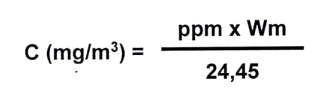
Where:
- C (mg/m3): Concentration of the analyte in air expressed in mg/m3.
- ppm: Concentration of the analyte in air measured in ppm.
- Wm: Molecular weight of the analyte.
- 24,45: Volume of one molecule of gas expressed in liters under standard conditions (25°C, 1 atm).
2.3. Adjusted exposure limit value for work shifts with exposure time exceeding 8 hours/day
Is defined according to the following formula:

Where:
- TWAn: Adjusted exposure limit value for work shifts with exposure time exceeding 8 hours/day (mg/m3).
- TWA: Exposure limit value for an 8-hour workday (mg/m3) as specified in Table 1 (Section 2.1, Part II) corresponding to each type of chemical.
- h: Actual exposure time in one day (hours > 8).
2.4. Adjusted exposure limit value for work shifts with exposure time exceeding 40 hours/week
Is defined according to the following formula:

Where:
- TWAorganize credit institutions, foreign bank branches are responsible for organizing the implementation of this Circular.: Adjusted exposure limit value for work shifts with exposure time exceeding 40 hours in one work week (mg/m3).
- TWA: Exposure limit value for an 8-hour workday and 40-hour work week (mg/m3) as specified in Table 1 (Section 2.1, Part II) corresponding to each type of chemical.
- H: Actual exposure time (H > 40) in one work week.
2.5. Method for calculating actual shift exposure values
2.5.1. Calculation of shift exposure value when the total measurement time equals the total exposure time
The shift exposure value is calculated using the following formula:
TWAtt = (C1 .T1 + C2.T2 +...+ Cn.Tn): T
Where:
- TWAtt: Actual shift exposure value (mg/m3).
- C1; C2;...;Cn: Actual concentrations (mg/m3) corresponding to measurement times T1;T2;...; Tn (minutes).
+ Sampling may be conducted once with a measurement time equal to the exposure time during the work shift if the chemical concentration is low.
+ Sampling may be conducted multiple times (2, 3, 4,..., n times), with different measurement times for each sample depending on the chemical factor concentration to avoid overload on the filter paper or sampling tool, but the total measurement time must equal the total exposure time.
- T: Total exposure time (in minutes).
+ If the total exposure time is less than or equal to 8 hours/day, it is calculated based on 8 hours and T is 480 minutes.
+ If the total exposure time exceeds 8 hours/day, T is the actual exposure time.
Sampling can be conducted with a minimum total measurement time of 80% of the exposure time. In this case, T is the total measurement time (in minutes). For the remaining time period, the exposure level is considered equivalent to the exposure level during the measured period.
Example: One (or a group) of workers works for 6 hours a day exposed to formaldehyde, with an average concentration measured over 6 hours being 0.8 mg/m3; 2 hours remaining are spent resting or working in another location without exposure to formaldehyde. In this case, the calculation of TWAtt is as follows:
TWAtt = (0.8 mg/m3 x 6x60 minutes + 0 mg/m3 x 2x60 minutes) : 480 minutes = 0.6 mg/m3
2.5.2. Calculation of shift exposure value when the total measurement time is less than the total exposure time
Due to production conditions or technical requirements for sampling, samples may be taken at specific points to assess shift exposure as follows:
Based on the production process, predict stable periods during which the release and dispersion of chemical factors are relatively constant, then take random representative samples for each period. The number and length of periods depend on the fluctuation of the release and dispersion of chemical factors during the work shift. If the release and dispersion causing pollution are predicted to be relatively uniform throughout the work shift, the number of periods could be 2 (n = 2) with each period being half the total exposure time.
The shift exposure value is calculated using the following formula:
TWAtt = (C1.K1 + C2.K2 +...+ Cn.Kn) : T
Where:
- TWAtt: Actual shift exposure value (mg/m3).
- C1; C2;...; Cn: Average concentrations (mg/m3) during periods K1; K2;...; Kn (minutes).
- K1; K2;...; Kn: Periods within the work shift (minutes). The total of periods K1 + K2 + ... + Kn equals the total work shift time.
- T: Total exposure time (in minutes).
+ If the total exposure time is less than or equal to 8 hours/day, it is calculated based on 8 hours and T is 480 minutes.
+ If the total exposure time exceeds 8 hours/day, T is the actual exposure time.
Calculate the average concentration (C1; C2;...; Cn) during work shift periods using the following formula:
Cx = (N1 + N2 +...+ Nn) : n
Where:
- Cx: Average concentration in one work shift period, period x (mg/m3).
- N1; N2;...; Nn: Concentrations measured at the first, second,..., nth points during period x (mg/m3).
- n: Total number of random samples taken during period X. (n ≥ 2).
The measurement time for point samples must be the same.
Example: In a workshop, initial surveys show that ammonia dispersion is relatively uniform during the 8-hour work shift, divided into two measurement periods (each period being 4 hours). Randomly measuring two representative time points for the first 4 hours yields two values of 14 mg/m³ and 13 mg/m³, and randomly measuring two representative time points for the second 4 hours yields two values of 17 mg/m³ and 18 mg/m³. The calculation of TWAtt in this case is as follows:3 TWAtt = {[(14+13)mg/m³ : 2] x 4x60 minutes + [(17+18)mg/m³ : 2] x 4x60 minutes} : 480 minutes = 15.5 mg/m³3 3.1. Determine the concentration of chemical factors by selecting and adhering to the methods specified in Table 2 below.3 Table 2. Determination Method3.
Conversion Factor
NIOSH 25013OSHA 523OSHA21; OSHA PV20043.
Chapter 3. METHODS FOR DETERMINATION
NIOSH 1604
OSHA 37
|
No. |
Name of Chemical Factor |
Standard number, method |
NIOSH 1450 |
|
(1) |
(2) |
(3) |
(4) |
|
1. |
Acrolein |
OSHA 90 |
- |
|
2. |
Acrylamide |
OSHA ID121; OSHA ID125G; |
- |
|
3. |
Acrylonitrile |
OSHA ID206 |
- |
|
4. |
Amyl Acetate |
NIOSH 5042 |
- |
|
5. |
Phthalic Anhydride |
NIOSH 2506 |
- |
|
6. |
Antimony |
NIOSH 1606 |
- |
|
7. |
ANTU |
NIOSH 7907 |
- |
|
8. |
Asphalt (Fume) |
OSHA ID165SG |
- |
|
9. |
Acetone Cyanohydrin |
NIOSH 7908 |
- |
|
10. |
Acetonitrile |
NIOSH S228 (II-4) |
- |
|
11. |
Formic Acid |
Trichloroacetic acid |
- |
|
12. |
Methacrylic Acid |
OSHA PV2017 |
- |
|
13. |
Nitric Acid |
NIOSH 5600 |
- |
|
14. |
Phosphoric Acid |
NIOSH 7300; NIOSH 7301; |
- |
|
15. |
Picric Acid |
NIOSH 9102 |
- |
|
16. |
OSHA ID121; OSHA ID206; |
OSHA ID125G |
- |
|
17. |
Azinphos Methyl |
NIOSH 0500; NIOSH 5601 |
- |
|
18. |
Silver and Soluble Compounds |
NIOSH 5509 |
- |
|
19. |
Benomyl (Inhalable Dust) |
NIOSH 7102; NIOSH 7300; |
- |
|
20. |
Benzidine |
NIOSH 6011 |
- |
|
21. |
Benzoyl Peroxide |
NIOSH 1024 |
- |
|
22. |
Benzyl Chloride |
OSHA 56 |
- |
|
23. |
Beryllium and Compounds |
n-Butyl acetate |
- |
|
24. |
Bromine |
NIOSH 5601 |
- |
|
25. |
1,3-Butadiene |
OSHA ID121 |
- |
|
26. |
NIOSH 0500 |
NIOSH 5042 |
- |
|
27. |
Butyl Acrylate |
Caprolactam (as dust) |
- |
|
28. |
Carbofuran |
OSHA PV2012 |
- |
|
29. |
Calcium Carbonate (Inhalable Dust) |
Caprolactam (as vapor) |
2,5 |
|
30. |
Calcium Hydroxide (Inhalable Dust) |
OSHA 63 |
1,85 |
|
31. |
Calcium Oxide |
Caprolactam (as vapor) |
1,4 |
|
32. |
Calcium Silicate (Inhalable Dust) |
OSHA 63 |
2,9 |
|
33. |
Calcium sulfate dihydrate (total dust) |
OSHA PV2014 |
- |
|
34. |
Calcium cyanamide |
OSHA PV2014 |
- |
|
35. |
NIOSH 2533 |
NIOSH 7082; NIOSH 7105; |
- |
|
36. |
NIOSH 7303; NIOSH 7700; |
NIOSH 7082; NIOSH 7105; |
- |
|
37. |
Captan |
OSHA PV2012 |
- |
|
38. |
Carbaryl |
NIOSH 7701; NIOSH 7702 |
- |
|
39. |
Catechol |
OSHA 76 |
- |
|
40. |
Tetraethyl lead |
OSHA ID126SGX; OSHA ID202 |
- |
|
41. |
Lead and inorganic compounds |
NIOSH P&CAM 291 (II-5) |
- |
|
42. |
Chloroacetaldehyde |
OSHA 112 |
- |
|
43. |
Chlorine dioxide |
OSHA 32 |
- |
|
44. |
Chloroacetophenone |
NIOSH 3516 |
- |
|
45. |
Chlorobenzene |
OSHA 56 |
- |
|
46. |
Chloroprene |
NIOSH 1501 |
- |
|
47. |
Cresols, all isomers |
Mineral oil (as mist) |
- |
|
48. |
Crotonaldehyde |
NIOSH 1550 |
- |
|
49. |
Cumene |
Vegetable oil (as mist - total dust) |
- |
|
50. |
NIOSH 0600 |
Talcum powder (total dust) |
- |
|
51. |
Petroleum distillates (naphtha) |
NIOSH 5514 |
- |
|
52. |
Turpentine |
OSHA 62 |
- |
|
53. |
NIOSH 6006 |
OSHA PV2014 |
- |
|
54. |
Stoddard solvent |
NIOSH 5514 |
- |
|
55. |
NIOSH 5020 |
OSHA 104 |
- |
|
56. |
NIOSH P&CAM295 (II-5) |
OSHA PV2014 |
- |
|
57. |
Demeton, all isomers |
OSHA PV 2099 |
- |
|
58. |
Diazinon |
NIOSH 0500; NIOSH 5601 |
- |
|
59. |
Diborane |
OSHA 34 |
- |
|
60. |
Di-n-butyl phthalate |
NIOSH 2004 |
- |
|
61. |
1,1-Dichloroethane |
OSHA 56 |
- |
|
62. |
1,1-Dichloroethylene |
OSHA 56 |
- |
|
63. |
Dichlorvos |
1,1-Dimethylhydrazine |
- |
|
64. |
Dicrotophos |
NIOSH 0500; NIOSH 5601 |
- |
|
65. |
Dimethylamine |
NIOSH 2524 |
- |
|
66. |
Dimethylformamide |
NIOSH S214 (II-4) |
- |
|
67. |
1) (-): Not specified |
2) For substances with conversion factors specified: |
- |
|
68. |
Dimethyl sulfate |
Result of Chemical Factor Concentration (Column 2) = Analysis Result According to Specified Method (Column 3) x Conversion Factor (Column 4). |
- |
|
69. |
Dinitrobenzene |
4.1. Regular monitoring of occupational environment with chemical factors listed in Table 1 of this standard must be conducted by organizations meeting the requirements and conditions regarding the capability for occupational environmental monitoring as stipulated in Decree No. 44/2016/NĐ-CP dated May 15, 2016 of the Government detailing certain provisions of the Labor Safety Law on technical safety inspection activities, labor safety training, and occupational environmental monitoring; Decree No. 140/2018/NĐ-CP dated October 8, 2018 of the Government amending and supplementing related decrees concerning investment conditions and administrative procedures under the management of the Ministry of Labor, Invalids and Social Affairs, and other laws. |
- |
|
70. |
Dinitrotoluene (DNT) |
4.2. Based on the characteristics and working conditions, the generation and dispersion of pollutants at each workplace to be monitored should be considered to select appropriate monitoring parameters. |
- |
Note:
5.1. Organizations where workers are exposed to chemical factors listed in Table 1 of this standard must regularly monitor these chemical factors in the workplace, implement measures to control harmful factors, and protect worker health in accordance with legal provisions.
5.2. Organizations conducting occupational environmental monitoring for chemical factors are responsible for the monitoring results, ensuring honesty in monitoring activities; they must conduct monitoring in accordance with the principles and procedures prescribed by law.
6.1. The Department of Disease Control, Ministry of Health shall take the lead, coordinating with relevant agencies to guide, implement, and organize the enforcement of this standard.
6.2. If national standards, international standards, or regulatory documents cited in this standard are amended, supplemented, or replaced, the new provisions shall apply.
Chapter 4. MANAGEMENT PROVISIONS
TECHNICAL DETERMINATION OF CHEMICAL FACTOR CONCENTRATION IN AIR USING DIGITAL ELECTRONIC MEASURING DEVICES
(Annexed to QCVN 01:2025/BYT dated April 28, 2025 issued by the Minister of Health)
5. RESPONSIBILITIES OF ORGANIZATIONS AND INDIVIDUALS
1. Principle
The concentration of chemical factors is determined based on the detection by various sensors (infrared, electrochemical, photoionization, etc.) of the measuring device when interacting with chemical factors present in the air. The result is displayed in units of mg/m³ or ppm.
6. IMPLEMENTATION ORGANIZATION
2. Determination Method
2.1. Equipment and Tools
ANNEX 1.
- Digital electronic measuring device.
+ Sensitivity: At least equal to 10% of the work shift exposure limit value.
+ Able to measure the average concentration of chemical factors over time.
- The measuring device must be calibrated at least once a year.3 2.2. Steps to Follow
a. Prepare equipment in the laboratory before going to the field site
- Check the battery of the device to ensure it is fully charged, prepare backup batteries.
- Check the operational status of the device.
- Calibrate the measuring device according to the manufacturer's instructions for each type of device.
b. Conduct measurements at the field site
- Identify the measurement location: The area where workers are operating.
- Insert the battery into the device if necessary. Turn on the device to check its operational status, then turn it off.
+ Place the device or sampling tube at the breathing height of the worker, typically from 1.5 to 1.8 meters above the floor, perpendicular to the source of chemical emissions. The device may be held by hand or placed on a tripod.
- Turn on the measuring device: Measure continuously for the predetermined time or as directed by the manufacturer.
+ After completing the measurement period, read and record the average value displayed on the screen, turn off the device. Record the working conditions and production status during the measurement period.
Note.
+ Position the instrument or sampling tube at the breathing height of the employee, typically between 1.5 to 1.8 meters above floor level, perpendicular to the chemical emission source. The device can be held by hand or placed on a tripod.
- Turn on the measuring device: Continuously measure over the specified time period or as per manufacturer's instructions.
+ Upon completion of the measurement period, read and record the average value displayed on the device screen, turn off the device. Record working conditions and production status during the measurement period.
Note.
- Activate the measuring device: Continuously measure according to the predetermined time or following the manufacturer's instructions.
+ At the end of the measurement period, read and record the average value displayed on the device's screen, then turn off the device. Record the working conditions and production status during the measurement period.
Note. Do not use electronic measuring devices in environments with high humidity (above 95%) or where binding substances such as paint, grease, glue, etc., are sprayed, as these can damage electronic circuits and contaminate sensors within the measurement chamber.
2.3. Measurement Results
The chemical element concentration result is the average value displayed on the device's screen.
3. Equipment Storage
- After each field measurement, the device must be cleaned both inside and outside using specialized tools provided by the manufacturer.
- Remove the battery from the device (if it uses removable batteries) when storing it in a room.
- Store the device in a room with controlled humidity between 40 - 80%. Room temperature should be maintained between 20 - 30°C.
If the device is not used for extended periods, it should be powered on and run for a check-up operation for 5-10 minutes every two weeks.
Original document (PDF)
Relations map
Click a document to open. A red border = a relation that changes validity.
Translations
This document is available in the following languages: