
This Circular stipulates the implementation of democracy at the grassroots level in the Vietnam People's Army and enterprises. It guides procedures for publicizing information, participating in opinions, decision-making, and supervising and inspecting by military personnel, workers, defense civil servants, and employees. The Circular also sets out specific responsibilities for superiors and management agencies.
Scope of application
Military personnel, workers, defense civil servants, employees, enterprises, and related organizations within the Vietnam People's Army.
Key points
- Military personnel, workers, defense civil servants, and employees have the right to be informed and participate in opinions on matters such as work plans, regulations, and collective decisions of military personnel.
- Information must be publicized within 5-10 working days from the date of the decision, except in special cases.
- Employers and enterprises must organize workplace dialogues according to regulations, with specific numbers and components of participants.
- Military personnel, workers, defense civil servants, and employees have the right to supervise and inspect, and lodge complaints and denunciations against decisions and actions violating laws on implementing democracy at the grassroots level.
- The organization and operation of the Military Personnel Council are detailed to ensure the promotion of democracy within units and offices.
🌐 Social impact of this document
- Positive impact: Enhance transparency, fairness, and accountability in management and leadership within the Army; improve relationships between superiors and subordinates.
- Negative impact: May increase organizational and management burdens on units and enterprises; require strict compliance with regulations.
❓ Frequently asked questions
What matters can military personnel and workers participate in giving opinions about?
They may give opinions on establishing, amending internal rules, salary scales, collective bargaining, and issues related to their rights.
How long after a decision must information be publicized?
Except in special cases, information must be publicized within the latest 5-10 working days from the date of the decision.
How should employers and enterprises organize workplace dialogues?
Regular dialogues at least once a year, with specific numbers and components of participants as prescribed.
What issues can military personnel and workers lodge complaints and denunciations about?
They have the right to lodge complaints and denunciations against decisions and actions violating laws on implementing democracy at the grassroots level.
What functions and tasks does the Military Personnel Council have?
The Military Personnel Council represents military personnel and workers, participates in opinions, supervises and inspects, contributes to building cadres and party members, and organizes democratic activities.
Full text
|
MINISTRY OF NATIONAL DEFENSE |
SOCIALIST REPUBLIC OF VIET NAM |
|
Number: 122/2024/TT-BQP |
Hanoi, December 31, 2024 |
CIRCULAR
Regulations on Implementing Democracy at the Grassroots Level in the Vietnam People's Army
On the basis of Labor Code dated November 20, 2019;
On the basis of The Government promulgates this Decree amending and supplementing certain articles and appendices of Decree No. 58/2021/NĐ-CP dated June 10, 2021 of the Government on the operation of credit information service provision (hereinafter referred to as Decree No. 58/2021/NĐ-CP).
On the basis of Law on Implementing Democracy at the Grassroots Level dated November 10, 2022;
Decree No. Decision No. 145/2020/NĐ-CP dated December 24, 2020 of the Government detailing and guiding the implementation of certain provisions of the Labor Code regarding labor conditions and labor relations;
Pursuant to Decree No. 01/2022/NĐ-CP dated November 30, 2022 of the Government stipulating functions, tasks, powers, and organizational structure of the Ministry of National Defense;
Pursuant to Decree No. 59/2023/NĐ-CP dated August 14, 2023 of the Government detailing certain provisions of the Law on Implementing Democracy at the Grassroots Level;
At the proposal of the Director of the General Political Department;
The Minister of National Defense issues this Circular on regulations for implementing democracy at the grassroots level in the Vietnam People's Army.
PART I
GENERAL PROVISIONS
Article 1. Scope of Regulation
This Circular stipulates the content and methods of implementing democracy at the grassroots level; rights and obligations of officers, professional soldiers, non-commissioned officers, privates (hereinafter collectively referred to as military personnel), workers, defense civil servants, and employees in implementing democracy, and responsibilities of agencies, units, organizations, enterprises in ensuring the implementation of democracy at the grassroots level.
Article 2. Applicability
This Circular applies to:
1. Military personnel, workers, defense civil servants, employees, employers, agencies, units, organizations, enterprises, and individuals related to the implementation of democracy at the grassroots level in the Vietnam People's Army.
2. Personnel engaged in confidential work, agencies, units, organizations, enterprises under the State Confidentiality Service.
Article 3. Explanation of Terms
In this Circular, the following terms are understood as follows:
1. Implementing democracy at the grassroots level in the Vietnam People's Army: Is a method of promoting citizens' right to self-governance, enabling military personnel, workers, defense civil servants, and employees to be informed, express their will, wishes, and opinions through discussions, participation in opinions, decision-making, and supervision of matters at the grassroots level according to the Constitution and laws.
2. Collective Military Personnel Conference: Is a full meeting of military personnel, workers, defense civil servants, and employees chaired by the commandant of the agency or unit.
3. Employer: Is an enterprise, agency, or organization that hires and uses employees to work for them according to an agreement (the representative of the employer is the commandant of the agency, the head of the organization, the general manager, director of the enterprise, or a person legally authorized to manage and operate the enterprise).
4. Employee: Is a person working for an employer according to an agreement, receiving wages, and being subject to management, direction, and supervision by the employer.
5. Workplace Dialogue: Is the sharing of information, consultation, discussion, and exchange of opinions between the employer and employee regarding issues related to the legitimate rights and interests and concerns of both parties at the workplace with the aim of enhancing mutual understanding, cooperation, and joint efforts towards mutually beneficial solutions.
Article 4. Principles of Implementing Democracy at the Grassroots Level
1. Ensuring the leadership of the Party Committee, management and operation by commanders and employers; all levels must promote the role and responsibility of mass organizations and Military Personnel Councils in implementing democracy at the grassroots level.
2. Adhering to the Constitution and laws of the State; military discipline; not violating social morals; protecting the interests and not hindering the normal activities of individuals, agencies, units, organizations, and enterprises.
3. Transparency in the content of implementing democracy; strengthening the accountability of agencies, units, and enterprises, ensuring the rights of citizens, military personnel, workers, defense civil servants, and employees in implementing democracy at the grassroots level.
4. Respecting, listening to opinions, promptly explaining and resolving complaints and reflections; protecting the interests of collectives, the rights and legitimate interests of military personnel, workers, defense civil servants, employees, and employers.
Article 5. Rights of military personnel, defense workers, civil servants, and laborers in implementing democracy at the grassroots level
1. To have information disclosed publicly and to request full, accurate, and timely provision of information according to the hierarchical levels, ensuring compliance with laws and regulations of the Ministry of National Defense on protecting state secrets and military secrets.
2. To participate in providing opinions and implementing democratic contents in agencies, units, organizations, and enterprises in accordance with the provisions of Chapters II and III of this Circular.
3. To inspect, supervise, reflect, propose recommendations, lodge complaints, file accusations, and initiate lawsuits against decisions and actions violating laws on implementing democracy at the grassroots level; to be recognized, respected, protected, and guaranteed their legitimate rights and interests in implementing democracy as stipulated.
4. To be ensured the rights to democracy concerning military-professional, political, economic-living aspects, and other rights related to implementing democracy at the grassroots level as prescribed by relevant laws; to benefit from the achievements of the agency, unit, organization, or enterprise where they work; to be provided conditions for participating in training, enhancing, and improving professional skills and working methods.
Article 6. Obligations of military personnel, defense workers, civil servants, and laborers in implementing democracy at the grassroots level
1. To strictly comply with the Party's policies, State laws, regulations of the Central Military Commission, the Ministry of National Defense, directives of the party committees and commanders of agencies, units, organizations, and enterprises, and collective decisions of military personnel and laborers regarding the implementation of democracy.
2. To provide opinions on matters put up for consultation as prescribed in this Circular, regulations of the Ministry of National Defense, and relevant laws.
3. To promptly reflect, propose recommendations, lodge complaints, and file accusations to competent authorities when discovering violations of laws and regulations of the Ministry of National Defense on implementing democracy.
4. To respect personal dignity, ensure stability, and protect the legitimate rights and interests of agencies, units, organizations, enterprises, and individuals.
Article 7. Measures to Ensure Implementation of Democracy at the Grassroots Level
1. To organize propaganda, education, enhance awareness, and responsibility among military personnel, defense workers, civil servants, and laborers regarding the implementation of democracy.
2. To organize suggestion boxes and publicize the telephone numbers of leading cadres of agencies, units, and enterprises to receive information from military personnel, defense workers, civil servants, and laborers.
To strictly implement regulations on democratic dialogue, address reflected issues, recommendations, complaints, and accusations. To proactively detect and severely handle acts of harassment, threats against those who provide opinions, reflect issues, and make accusations.
3. To organize citizen reception in accordance with the law, promptly resolving issues related to citizens' legitimate rights and interests.
4. To promote the role of mass organizations (youth, trade unions, women) and Military Personnel Councils in supervising and social criticism; participating in providing opinions on building the Party organization, agencies, units, and enterprises; protecting the legitimate rights and interests of military personnel, defense workers, civil servants, laborers, members, and affiliates.
5. To promptly commend and reward collectives, individuals, and organizations effectively promoting democracy; to detect and severely handle organizations and individuals violating laws and regulations of the Ministry of National Defense on implementing democracy.
6. To support and encourage the application of science, equipping technical means, and ensuring necessary conditions for organizing the implementation of democracy at the grassroots level in line with the construction and development of an electronic government and digital government within the Ministry of National Defense.
Article 8. Prohibited Acts in Implementing Democracy at the Grassroots Level
1. Preventing, creating difficulties for military personnel, workers, defense civil servants, and employees in exercising democracy, thereby causing complex issues that affect agencies, units, and enterprises.
2. Resolving complaints, suggestions, appeals, and accusations not in accordance with regulations; persecuting, disclosing, or leaking information about accusers or providers of information related to violations concerning the implementation of democracy.
3. Exploiting the implementation of democracy to infringe upon the lawful rights and interests of organizations and individuals; violating orders, rules, and discipline of the Military; causing conflicts within the organization and between military and civilian populations, resulting in losses to individuals, agencies, units, enterprises, and the Military.
4. Using tactics to distort the results of collective opinions and decisions of military personnel, workers, defense civil servants, and employees regarding tasks as stipulated in this Circular.
Article 9. Handling Violations of Law in Implementing Democracy at the Grassroots Level
1. Military personnel, workers, defense civil servants, and employees who violate laws on implementing democracy may be subject to disciplinary action, administrative penalties, or criminal prosecution depending on the nature and severity of the violation; if damage is caused, compensation must be provided according to the law.
2. Agencies, units, organizations, and enterprises that violate regulations on implementing democracy shall be handled according to Military regulations based on the nature and severity of the violation; if damage is caused, compensation must be provided according to the law.
Chapter II
IMPLEMENTING DEMOCRACY IN AGENCIES AND UNITS
Section 1
PUBLIC INFORMATION DISCLOSURE IN AGENCIES AND UNITS
Article 10. Contents That Commanders of Agencies and Units Must Disclose
Except for contents classified as secret, commanders of agencies and units must disclose the following contents in accordance with the分级管理密件的规定进行传达和贯彻:
1. The Party's guidelines and policies, state laws and policies related to the Military and agencies and units.
2. The Central Military Commission’s, Ministry of National Defense’s, party committee’s, and unit commander’s policies and solutions; the main political tasks of the agency and unit; annual, quarterly, and monthly work plans; professional rules, orders, and regulations.
3. Internal rules, systems, and regulations of the agency and unit. Financial income and expenditure figures and reports according to the level of authority. Contents related to personnel work, handling benefits and policies, evaluating and classifying the quality of officers, professional military personnel, workers, defense civil servants, and employees; rewards, punishments, retirement, discharge, and discharge from service for military personnel, workers, and defense civil servants.
4. Property and income declarations of persons required to declare under the law.
5. Results of inspections, audits, and resolution of complaints, suggestions, appeals, and accusations within the internal system.
6. Results of summarizing opinions and explanations, and adopting opinions of military personnel, workers, defense civil servants, and employees on matters they are entitled to provide opinions on as stipulated in Article 17 of this Circular.
7. Directives and operational instructions from higher-level commanders related to the activities of the agency and unit.
Article 11. Forms and timing for publicizing information
1. Forms of publicizing information:
a) Notifying in writing to organizations and all military personnel, workers, defense civil servants, and employees;
b) On internal information systems or posting on internal electronic information portals, websites, bulletin boards;
c) At military administrative meetings, command staff meetings at various levels, collective activities of military personnel, workers, defense civil servants, and employees.
2. The information must be publicized no later than five working days from the date of the decision or document issued by the Party committee, command authority of the agency or unit regarding the content to be publicized. For units stationed in remote, border, island areas, the time to publicize must be no later than ten working days.
Article 12. Responsibilities in implementing the publicizing of information
1. In cases where the agency or unit has an internal electronic information portal or internal electronic information system, the command authority of the agency or unit shall be responsible for organizing the posting of information as prescribed in Article 10 of this Circular on the internal electronic information portal or internal electronic information system for at least twenty consecutive days from the date of posting, except where otherwise provided by law.
2. In cases where the agency or unit does not have an internal electronic information portal or internal electronic information system, the command authority of the agency or unit shall be responsible for directing and organizing the posting of information as prescribed in Article 10 of this Circular within the agency or unit and at the workplaces of subordinate agencies and units for at least twenty consecutive days from the date of posting, except where notification has been made in writing to all military personnel, workers, defense civil servants, and employees under its jurisdiction.
3. In addition to publicizing information through the forms prescribed in paragraphs 1 and 2 of this Article, based on the characteristics, nature of operations, and content to be publicized, the command authority of the agency or unit may decide to choose additional forms of publicizing information as prescribed in paragraph 1 of Article 11 of this Circular that are suitable to the actual conditions of the agency or unit, ensuring accurate, complete, timely, and convenient access to information.
Section 2
MILITARY PERSONNEL, WORKERS, DEFENSE CIVIL SERVANTS, AND EMPLOYEES DISCUSS AND DECIDE
Article 13. Contents to be discussed and decided
2. Matters related to the collection, expenditure, management, and use of contributions from military personnel, workers, defense civil servants, and employees beyond the prescribed contents.
3. Content of the action program of the military personnel collective.
4. Other matters within the internal affairs that do not contravene laws and regulations of the military and are consistent with social morals.
1. Organizing collective military personnel activities to discuss and decide on the contents as prescribed in Article 13 of this Circular based on proposals from the Military Council, Trade Union (if applicable), command authority of the agency or unit, or upon request from at least one-third of the total number of military personnel, workers, defense civil servants, and employees.
2. In cases where it is impossible to organize a collective military personnel meeting due to force majeure, the command authority of the agency or unit shall direct the Military Council and coordinate with the Trade Union (if applicable) to send ballots to all military personnel, workers, defense civil servants, and employees for their opinions.
Article 15. Organizing collective military personnel meetings on implementing democratic regulations at grassroots levels
Collective military personnel meetings may be convened on an ad hoc basis when proposed by the subjects as stipulated in Clause 1, Article 14; monthly and quarterly meetings shall be conducted in accordance with the provisions of Articles 24 and 37 of this Circular.
2. Participants in collective military personnel meetings:
a) For battalion-level units and equivalent, all military personnel, workers, defense civil servants, and laborers shall attend the meeting, except for cases specified in points b and d of Clause 2 of this Article;
The meeting is considered valid when at least two-thirds of the total number of military personnel, workers, defense civil servants, and laborers, or at least two-thirds of the total number of representatives called to attend, are present. Decisions of the meeting are adopted when more than 50% of the total number of participants agree and the content does not contravene laws, regulations of the Ministry of Defense, and the agency or unit;
d) For agencies and units with subordinate units, when organizing meetings, representatives from the Party Committee, commanders, and the Military Council, as well as mass organizations of subordinate units, may be invited if deemed necessary.
3. Contents of collective military personnel meetings:
a) Reviewing the implementation of the Party's policies, State laws, and regulations of the Military related to the functions and tasks of the agency or unit;
b) Reviewing the implementation of the action program of previous collective military personnel meetings and regulations on implementing democracy at the agency or unit;
c) Discussing and deciding on contents as prescribed in Article 13 of this Circular;
d) Implementing contents related to information transparency; soliciting opinions of military personnel, workers, defense civil servants, and laborers on matters as prescribed in Article 17 of this Circular;
đ) Implementing other relevant contents as decided by the meeting.
4. Procedures for organizing collective military personnel meetings:
a) The command of the agency or unit presents reports on the contents stipulated in point a, Clause 3 of this Article and the contents stipulated in Article 13 of this Circular;
c) Military personnel, workers, defense civil servants, and laborers participate in providing opinions, proposals, and recommendations (if any);
g) Approve the minutes of the meeting.
Article 16. Responsibility in organizing for military personnel, workers, defense civil servants, and employees to participate in opinions, decisions, and implementation of collective military personnel decisions.
Clause 3. Military personnel, workers, defense civil servants, employees, Party members, Youth League members, and Association members have the responsibility to participate in opinions and decisions on matters as stipulated in Article 13 of this Circular and strictly implement collective decisions. In cases where they find that the collective military personnel decision does not comply with procedures or contains content contrary to laws, regulations of the agency or unit, they have the right to make recommendations or report to the immediate superior leadership of the agency or unit or other competent authorities.
Section 3
MILITARY PERSONNEL, WORKERS, DEFENSE CIVIL SERVANTS, AND EMPLOYEES PARTICIPATE IN OPINIONS
Article 17. Contents for military personnel, workers, defense civil servants, and employees to participate in opinions before commanders of agencies and units make decisions.
Clause 1. Solutions to implement the Party's policies, State laws, and regulations of the Ministry of National Defense related to the functions and tasks of the agency or unit.
Clause 2. Annual work plans of the agency or unit; responsibilities of commanders in performing tasks.
Clause 3. Participation in evaluating commendations in annual Quyet Thang competition movements. Participation in opinions and proposals for disciplinary measures for military personnel, workers, defense civil servants, and employees.
Clause 4. Measures to improve activities and working styles; practicing thrift, preventing corruption, waste, bureaucracy, negativity, favoritism, and militarism.
Clause 5. Implementation of systems and policies related to the rights and legitimate interests of military personnel, workers, defense civil servants, and employees.
Clause 6. Summary reports of the agency or unit.
Clause 7. Drafts of democratic implementation regulations, internal rules, and regulations of the agency or unit.
Clause 8. Other contents as prescribed by law and the Ministry of National Defense.
Article 18. Forms of participation in opinions
Depending on characteristics, nature of activities, and content of participation in opinions, military personnel, workers, defense civil servants, and employees may participate in opinions through the following forms:
Clause 1. Direct participation with the commander of the agency or unit or through their direct commander.
Clause 2. Through collective military personnel meetings and other meetings of the agency or unit.
Clause 3. Through direct opinion ballots or draft documents sent by authorized bodies.
Clause 4. Through suggestion boxes, hotlines, internal information systems, or electronic portals and websites of the agency or unit.
Clause 5. Through the Military Council and mass organizations within the agency or unit.
Clause 6. Other forms not contrary to laws and specified in the democratic implementation regulations of the agency or unit.
Article 19. Responsibility in organizing for military personnel, workers, defense officials, and employees to participate in providing opinions
Clause 1. Commanders of agencies and units shall plan to organize the collection of opinions from military personnel, workers, defense officials, and employees on contents as prescribed in Article 17 of this Circular, clearly defining the content, form, method, timeline for implementation, and responsibility for organizing the process; they shall be responsible for directing the receipt, consolidation of opinions, and feedback information from military personnel, workers, defense officials, and employees; adopting, explaining opinions and implementing public disclosure of explanations and adoption to each individual.
Clause 2. Military Councils and mass organizations' executive boards shall coordinate in implementing plans to collect opinions; monitor the opinion collection process, results of explanations and adoption, and implementation of contents proposed by military personnel, workers, defense officials, and employees; provide opinions before commanders of agencies and units decide to issue regulations on democratic implementation.
Clause 3. Military personnel, workers, defense officials, and employees within agencies and units have the responsibility to provide opinions as a basis for competent authorities to make decisions; monitor, evaluate, and supervise the consolidation, adoption, and explanations of contents put forward for opinion collection and the organization of implementation of decisions on these contents.
Section 4
MILITARY PERSONNEL, WORKERS, DEFENSE OFFICIALS, AND EMPLOYEES CHECK, SUPERVISE, AND PARTICIPATE IN DIALOGUES
Article 20. Contents subject to check and supervision
Point 1. Military personnel, workers, defense officials, and employees shall check the implementation of contents that were discussed and decided upon by the collective of military personnel as stipulated in Article 13 of this Circular.
Point 2. Military personnel, workers, defense officials, and employees shall supervise the implementation of Party policies, State laws, regulations of the Ministry of National Defense, and agencies and units; supervise the organization of democratic implementation by commanders.
Article 21. Forms of checking and supervising
Clause 1. Military personnel, workers, defense officials, and employees directly carry out checks and supervision through:
a) The learning, working, and living processes;
b) During interactions and contacts with commanders and other military personnel, workers, defense officials, and employees within agencies and units;
c) Reports from agencies and units on the implementation of contents that the collective of military personnel provided opinions on and decided;
d) Collective meetings of military personnel.
Article 22. Handling the results of checking and supervising
Clause 1. Military personnel, workers, defense officials, and employees directly contribute opinions on the political qualities, ethics, capabilities, professional qualifications, and performance results of the collective party committee, commanders, managers, and those directly responsible to address shortcomings and weaknesses.
Article 23. Responsibilities in ensuring that military personnel, workers, defense civil servants, and laborers carry out inspection and supervision
1. Responsibilities of command officers of agencies and units:
c) Proactively accept reflections and proposals from military personnel, workers, defense civil servants, and laborers; organize democratic dialogues, responses, and explanations according to the provisions of the law; incorporate the content of suggestions from military personnel, workers, defense civil servants, and laborers into the process of evaluating and classifying the quality of cadres and party members;
d) Accept, consider, and resolve complaints and denunciations from military personnel, workers, defense civil servants, and laborers; promptly report to higher levels and transfer information to competent authorities for issues outside their jurisdiction. Firmly handle acts of retaliation against those who file complaints, denunciations, proposals, and reflections according to the provisions of the law;
Article 24. Democratic Dialogue Activities
1. Democratic dialogue activities are organized by the Party Committee and command officers of agencies and units. At the grassroots level, once a month; at the upper grassroots level, once every quarter; and at the level directly under the Ministry of National Defense, once every six months.
2. Forms of democratic dialogue activities can be conducted with all participants or representatives of military personnel, workers, defense civil servants, and laborers under their authority. After the democratic dialogue, the results are reported to subordinate units; reports and requests for higher-level resolution of matters outside their jurisdiction are made. Agencies and units compile the results of their own-level dialogues and report them according to their classification to serve the dialogues of higher-level Party Committees and command officers.
3. In cases where the opinions and proposals of the Military Council are inconsistent with the explanations of individuals, agencies, or organizations with authority, or when necessary, the head of the dialogue organization will hold an urgent meeting with the Military Council or a group of military personnel to clarify the situation.
Section 5
ORGANIZATION AND ACTIVITIES OF THE MILITARY COUNCIL
Article 25. Military Council
The Military Council is an organization representing military personnel, workers, and defense officials, established at agencies and units, elected by the military congress to promote democracy in military affairs, professional matters, politics, economy, and living conditions.
Article 26. Principles of Organization and Operation of the Military Council
1. The Military Council operates under the principle of centralized democracy, elected through secret ballot by the military congress; the content, program of activities, and decisions of the Military Council are discussed and voted on by majority. The Military Council assigns committee members to handle specific tasks.
2. The organization and operation of the Military Council are under the leadership of the same-level party committee and branch; guided, directed, and supervised by higher-level party committees, commanders, and political departments at various levels.
3. For newly established or temporarily established agencies and units for over 12 months, the party committee and branch designate the Military Council to organize its activities; within three months, a new military congress must be held to elect a new Military Council. Units operating for less than 12 months have their Military Council temporarily designated by the party committee and branch and will dissolve after completing their tasks.
Article 27. Organization of the Military Council
1. The Military Council is established at the following agencies and units:
c) Bureau-level agencies and equivalent;
d) Classes, student platoons, faculties, departments, and equivalent units of academies, schools, centers, research institutes, hospitals;
đ) General warehouses, warehouses, stations, workshops, and administrative blocks of enterprises directly under the Ministry of National Defense;
e) Other agencies and units shall establish the Military Council (which may be combined) based on organizational structure, tasks, and nature of operations, in accordance with points a and b of Clause 1 of this Article.
2. Agencies and units with fewer than ten personnel do not establish a Military Council.
Article 28. Composition, Standards, and Number of Committee Members of the Military Council
1. Composition of the Military Council:
Military personnel, workers, and defense officials in agencies and units who meet the standards can participate in the election for committee members of the Military Council.
2. Standards for Committee Members of the Military Council:
a) Possess firm political resolve, good moral character, high sense of responsibility and combativeness, capability to implement assigned tasks, close contact with subordinates, and trust from military personnel;
b) The Chairman and Vice Chairmen of the Military Council must be well-versed in the activities of the agency or unit, understand the duties, powers, and operational methods of the Military Council, and possess the ability to promote democracy within the agency or unit.
3. Number of Committee Members of the Military Council:
a) Agencies and units with up to 60 personnel elect 3 to 5 committee members; more than 60 personnel elect no more than 9 committee members;
b) The Chairman and Vice Chairmen of the Military Council are elected by the military congress from among the committee members through secret ballot. The Chairman of the Military Council should not be structured as the head of the unit or the secretary of the party committee.
4. Supplementing and Removing Committee Members of the Military Council:
a) The supplementation of committee members of the Military Council is proposed by the Military Council, decided upon by the party committee or branch; in special cases, appointed by the party committee or branch;
b) If a committee member of the Military Council violates laws, breaches military discipline, has low credibility, the Military Council proposes the removal of such member by the party committee and suggests replacement candidates or organizes a collective meeting of military personnel to elect a supplementary member.
Article 29. Functions of the Military Council
The Military Council bases its guidance and organization for military personnel, workers, defense civil servants, and employees to implement and promote democracy in all aspects of work within the agency or unit on the resolutions of the Party committee, branch, the plan of the commander, and the situation of tasks of the agency or unit.
Article 30. Tasks of the Military Council
1. Propaganda and mobilize military personnel, workers, defense civil servants, and employees to implement the Party's policies, State laws, regulations, orders, rules, and tasks of the Military and the unit.
2. Coordinate with mass organizations to build unity and solidarity within the agency or unit, promoting the role of military personnel, workers, defense civil servants, and employees in implementing military-professional, political, economic-living democracy.
3. Represent to protect the rights and legitimate interests, and participate in psychological counseling and legal advice for military personnel, workers, defense civil servants, and employees within the agency or unit. Coordinate to examine and verify specific cases upon the request of military personnel, workers, defense civil servants, and employees. Check the implementation of decisions made by collective military personnel, workers, defense civil servants, and employees as stipulated in Article 13 of this Circular; supervise the implementation of the Party's policies, State laws, and laws on implementing democracy within agencies and units; propose to the Party committee and commanders of agencies and units to provide relevant information and materials for verification, inspection, and supervision purposes.
4. Participate in providing opinions to build a clean and strong cadre and Party member team, exemplary Party organizations, and comprehensive strong agencies and units that are "models and examples."
5. Implement social feedback within the scope of functions, tasks, and authorities. Attend meetings of agencies and units related to the inspection and supervision tasks of the Military Council.
6. Receive and compile suggestions and reflections from military personnel, workers, defense civil servants, and employees within the agency or unit to report to the Party committee and commanders; propose measures to address deficiencies and shortcomings discovered through inspections and supervision; ensure the rights and legitimate interests of military personnel, workers, defense civil servants, and employees; propose commendations for outstanding collectives and individuals; propose handling according to regulations when signs of violations are detected and supervise the implementation of such proposals.
7. Report to the Party committee and commanders of agencies and units on the organizational situation and results of activities of the Military Council.
Article 31. Authorities of the Military Council
1. The Military Council is informed publicly by the Party committee and commanders of agencies and units about the contents stipulated in Article 10 of this Circular.
2. Implement the contents stipulated in Articles 13, 17, 20, and 24 of this Circular.
3. The Chairman of the Military Council has the responsibility to propose to the Party committee and commanders the content and time of Military Council meetings and collective military personnel meetings, and to notify and convey these to the Military Council and collective military personnel for implementation.
Article 32. Work Relations of the Military Council
1. Relations with the Party Committee and Commanders are relations of obedience to leadership, guidance, and command regarding the organization and operation of the Military Council.
2. Relations with political agencies are relations of receiving guidance and supervision regarding the organization and operation of the Military Council.
3. Relations with the executive boards of mass organizations at the same level are relations of coordinating activities.
Article 33. Receiving and Synthesizing Opinions and Petitions from Military Personnel, Civil Servants, and Workers
1. Military personnel, civil servants, and workers may participate in providing opinions, petitions, and reflections at collective military meetings or through written submissions, letters, or telephone calls sent to the Military Council and commanders of the units.
2. Units and agencies at battalion level and above shall establish suggestion boxes placed in convenient and public locations (or electronic suggestion boxes) for everyone to reflect on democratic violations and issues requiring opinions, petitions, and reflections to the Party Committee, leading cadres of the unit, and higher levels. The suggestion box shall be managed by the Military Council; the Chairman and Vice Chairmen shall be responsible for opening it daily, with the presence of a representative of military personnel, civil servants, and workers from the unit (one person at any given time during the opening) to understand the situation of reflections. A record shall be made and timely proposals made to the Party Committee and commanders for measures to address reflected issues (if any).
3. Weekly, the Military Council shall coordinate with the executive boards of mass organizations at the same level to synthesize opinions, petitions, and reflections on the implementation of democracy; the legitimate rights and obligations of military personnel, civil servants, and workers within the unit to report to the direct Party Committee and commanders.
4. Within seven working days (fifteen working days for complex matters), the Party Committee and commanders of units have the responsibility to respond or notify in writing (for issues within the jurisdiction of higher levels) the results of addressing opinions and petitions of the collective military personnel.
Article 34. Supervisory Activities
1. The supervisory activities of the Military Council aim to promptly identify errors and shortcomings to propose corrections and improvements, while also identifying and promoting positive factors, contributing to building a clean and strong party organization, and building units that are comprehensively strong and exemplary.
2. The subjects of supervision are party organizations, commanders, key cadres, and party members. The content of supervision includes the implementation of democracy at the grassroots level and the implementation of the Party's policies, state laws, resolutions of party organizations (excluding contents related to state secrets), and plans of commanders within units.
3. The Military Council shall regularly monitor and absorb opinions through letters, reflections, petitions, complaints, and accusations from military personnel, civil servants, and workers to study and consider related issues; in cases where signs of violations or infringements upon the legitimate rights and interests of military personnel, civil servants, and workers are discovered, they shall propose to individuals, agencies, and organizations with authority to examine, resolve, amend, or suspend implementation.
4. The Party Committee and commanders of units shall be responsible for responding according to the provisions of Clause 4, Article 33 of this Circular.
5. In cases where the opinions and petitions of the Military Council with individuals, agencies, and organizations with authority are not consistent, dialogue shall be organized to clarify.
Article 35. Social Criticism Activities
1. The social criticism activities of the Military Council are activities to provide opinions on draft documents of functional agencies with the aim of protecting the rights and legitimate interests of military personnel, defense workers, civil servants, and laborers, promoting democracy, and enhancing consensus within the agency or unit.
2. Based on the nature of the content of the draft document of the functional agency and the commander of the agency or unit, the Military Council coordinates with the executive boards of mass organizations at the same level to organize collective meetings of military personnel to provide opinions or send the draft document to individuals for their opinions; compile the provided opinions and report to the Party Committee and the commander of the agency or unit for consideration and decision to submit the draft document to the main drafting agency for study and adoption.
3. The Military Council has the responsibility to monitor, urge, and announce the adoption and explanation of the main drafting agency regarding the opinions provided by the collective military personnel.
Article 36. Military Personnel Congress
1. The Military Personnel Congress is organized twice every five years:
a) The term of the Military Council is counted from when it is elected until the next congress elects a new Military Council;
b) At the end of the term, agencies and units organize a Military Personnel Congress to evaluate the results of activities during the term, propose a program for the new term, and elect a new Military Council;
c) In cases where the term ends but conditions for holding the congress have not been met, the Military Council must report to the Party Committee and branch to extend the term, but not exceeding three months.
2. Summoning and organizing the Military Personnel Congress:
a) The Military Council reports to the Party Committee and the commander of the agency or unit about summoning and organizing the congress. The Military Personnel Congress must have at least two-thirds of the total number of military personnel of the agency or unit participating;
b) Participants in the Military Personnel Congress include: military personnel, workers, defense civil servants, and laborers of the agency or unit;
c) The list of candidates for election to the Military Council is arranged alphabetically according to the first letter of their names (A, B, C); the number of candidates must be more than the number needed to be elected by 10% to 35%. Those who receive a valid number of votes exceeding half of the total number of participants are elected; if multiple candidates exceed half, they are elected starting from the highest number of votes down until the required number is filled; if there are multiple candidates tied at the end of the list and more than the required number, a runoff election is held among those tied to select the candidate with the higher number of votes, without requiring a majority. If the first round of voting does not fill the required number of Military Council members, whether to continue voting is decided by the congress;
d) The Party Committee and branch examine and issue a decision to approve the election results of the Military Council.
Article 37. Activities of the Military Council and Collective Military Personnel
1. Regularly, the Military Council convenes a meeting once a month; collective military personnel activities are conducted in accordance with the Regulations on Military Unit Management issued together with Circular No. 193/2011/TT-BQP dated November 23, 2011, by the Minister of National Defense, and the regulations of the agency or unit commander. Before conducting collective military personnel activities on democratic issues or term congresses, the Military Council must convene a meeting to prepare the agenda, assign specific tasks to each member, and report to seek approval from the leadership and commander of the agency or unit.
2. When a majority of military personnel, workers, and defense civil servants propose and the Party Committee and the agency or unit commander consider it necessary, the Military Council organizes ad hoc collective military personnel activities. The content of the activities is proposed by the Military Council or decided by the Party Committee and the agency or unit commander.
Article 38. Operating funds of the Military Council
1. For budgeted units: The operating costs for specialized activities related to mass mobilization shall be included in the annual state budget for regular defense spending.
2. For public service enterprises with financial autonomy: The operating costs shall be included in the self-financing plan approved by the competent authority.
3. For military enterprises: The operating costs shall be included in the production, business, and service expenses of the enterprise.
Chapter III
IMPLEMENTATION OF DEMOCRACY AT THE BASE LEVEL IN ORGANIZATIONS AND ENTERPRISES
Section 1
ESTABLISHING REGULATIONS FOR IMPLEMENTING DEMOCRACY AT THE BASE LEVEL
Article 39. Basis for establishing regulations on implementing democracy at the base level
Enterprises shall establish regulations on implementing democracy at the base level based on Articles 5 and 6 of the Labor Code 2019 and Articles 5 and 6 of the Law on Implementing Democracy at the Base Level 2022.
Article 40. Procedures for issuing regulations on implementing democracy at the base level
1. For enterprises without existing regulations on implementing democracy at the base level:
a) The employer establishes a drafting team to develop regulations on implementing democracy at the base level after consulting the grassroots trade union regarding the composition and number of members participating in the drafting team, with each side having at least three members participating in the drafting team;
b) The drafting team develops the content of the regulations on implementing democracy at the base level;
c) Solicit opinions from departments, divisions, workshops, teams, and production units; incorporate feedback and finalize the content of the regulations; report to the employer and the grassroots trade union of the enterprise;
d) The employer issues the regulations on implementing democracy at the base level after incorporating the opinions of the grassroots trade union. If the employer does not adopt suggestions from the grassroots trade union, the reasons must be clearly stated;
đ) Regulations on implementing democracy at the base level in enterprises must be publicly announced to employees.
2. For enterprises with existing regulations on implementing democracy at the base level:
a) The employer reviews the content of the existing regulations on implementing democracy at the base level; updates, modifies, and supplements them to comply with legal provisions and the actual organizational operations of the enterprise;
b) The procedures for amending and supplementing regulations on implementing democracy at the base level shall follow Clause 1 of this Article.
Section 2
CONTENT OF REGULATIONS ON IMPLEMENTING DEMOCRACY AT THE BASE LEVEL
Article 41. Content, form, and timing for employers to disclose information
1. Except for information classified as state secrets or military secrets, employers must disclose the following information to employees:
a) Business plans and business performance of the enterprise;
b) Labor regulations, wage scales, labor norms, internal rules, and other documents issued by the employer concerning the rights, obligations, and responsibilities of employees;
c) Collective labor agreements that the employer has signed;
d) Establishment and use of incentive funds, welfare funds, and other funds contributed by employees (if applicable);
đ) Payment of trade union fees, social insurance, health insurance, unemployment insurance;
e) Implementation of commendations, disciplinary actions, handling of complaints, petitions, and accusations related to the rights, interests, and obligations of employees;
g) Regulations on implementing democracy at the base level within the enterprise;
h) Information on financial matters, management of state assets, and personnel work;
i) Other contents as prescribed by law.
2. The contents specified in Clause 1 of this Article are subject to specific disclosure forms prescribed by law, which employers must follow. In cases where the law does not specify a specific form of disclosure, employers shall choose one of the following forms based on the characteristics of their business operations, organizational structure, and the nature of the information to be disclosed, and such forms must be reflected in the regulations on implementing democracy at the base level within the enterprise:
a) Publicly posting at the workplace;
b) Announcing at employee meetings, dialogues between employers and grassroots trade unions, and unit or departmental meetings;
c) Notifying all employees in writing;
d) Informing employees through responsible persons in units or departments of the enterprise;
đ) Notifying the Grassroots Trade Union Committee in writing so they can inform employees;
e) Announcing on the internal information system of the enterprise or publishing on the enterprise's website or online portal;
g) Other forms not prohibited by law.
3. Information required to be disclosed under Clause 1 of this Article must be made public no later than fifteen days from the date of the decision or document issued by the authorized person regarding the information to be disclosed, except as otherwise provided by law.
Article 42. Responsibility for organizing the public disclosure of information at enterprises
1. In cases where the enterprise has an internal electronic information website or an internal electronic information system, the authorized representative of the enterprise shall be responsible for organizing the posting of information as prescribed in Clause 1 of Article 41 of this Circular on the internal electronic information website or internal electronic information system for at least 20 consecutive days from the date of posting or sending the information, except where otherwise provided by law.
2. In cases where the enterprise does not have an internal electronic information website or an internal electronic information system, the authorized representative of the enterprise shall be responsible for organizing the posting of information as prescribed in Clause 1 of Article 41 of this Circular at the headquarters of the enterprise and places of work of relevant units and departments for at least 20 consecutive days from the date of posting, except where the enterprise has already used the form of written notification to all employees or where otherwise provided by law.
3. Along with implementing the public disclosure of information through the forms prescribed in Clauses 1 and 2 of this Article, based on the characteristics, nature of operations, and content to be disclosed, the employer may decide to choose additional forms of public disclosure as prescribed in Clause 2 of Article 41 of this Circular that are suitable to the actual conditions of the enterprise, ensuring that workers can access accurate, complete, timely, and convenient information.
4. The employer shall be responsible for organizing the provision of information upon request by workers for information that has not been disclosed within the disclosure period, information that has exceeded the disclosure period, or information currently being disclosed but which the requester cannot access due to force majeure.
5. The enterprise may determine additional contents of information to be disclosed, forms of information disclosure, application of disclosure forms for specific types of information, and methods of implementation, as well as the provision of information upon request, in accordance with the regulations on democratic implementation procedures consistent with the organizational structure, operational characteristics, and actual conditions of the enterprise.
Article 43. Content and Forms of Participation in Opinions by Workers
1. Workers may participate in opinions on the following matters:
a) Drafting, amending, and supplementing internal regulations, rules, and other regulatory documents of the employer related to the rights, obligations, and legitimate interests of workers;
b) Drafting, amending, and supplementing salary scales and labor norms;
c) Proposing content for dialogue and collective bargaining;
d) Proposing and implementing cost-saving measures, improving labor productivity, enhancing working conditions, safety, hygiene, environmental protection, fire prevention, and anti-corruption, anti-negligence measures;
đ) Draft proposals for internal procedures and processes regarding labor disputes resolution, disciplinary actions, material responsibilities, and other matters related to the rights and obligations of workers that the enterprise deems necessary to seek opinions;
e) Draft proposals for regulations on democratic implementation at the grassroots level within the enterprise;
g) Other matters related to the rights, obligations, and interests of workers as stipulated by law and regulations on democratic implementation at the grassroots level within the enterprise.
2. For matters specified in Clause 1 of this Article, if the law prescribes specific forms for workers' participation in opinions, such provisions shall be followed; in cases where the law does not prescribe specific forms, workers shall base their choice of form on the production and business characteristics, labor organization, content of worker participation in opinions, and regulations on democratic implementation at the grassroots level within the enterprise, as follows:
a) Participating in opinions directly or through the person directly responsible for the unit or department of the enterprise;
b) Through the enterprise-level trade union at employee meetings, regular dialogue sessions;
c) Submitting opinions and suggestions directly;
d) Participating in opinions through suggestion boxes, hotlines, internal information systems, or the enterprise's online portal or website;
đ) Other forms not prohibited by law and specified in the regulations on democratic implementation at the grassroots level within the enterprise.
Article 44. Content and form of discussion and decision-making by employees
1. Employees shall discuss and decide on the following contents:
a) Entering into, amending, supplementing, or terminating labor contracts in accordance with the provisions of the law;
b) Joining or not joining trade unions;
c) Participating in or not participating in strikes in accordance with the provisions of the law;
d) Voting on the contents of collective bargaining agreements that have been reached to sign collective labor agreements in accordance with the provisions of the law;
đ) Establishing various types of funds and collecting, spending, managing, and using amounts from income and contributions of employees;
e) Electing or dismissing members of the Employee Inspection Board;
g) Contents of the resolution of the employee assembly;
h) Self-management contents within the enterprise that do not violate the provisions of the law and are consistent with social ethics;
i) Other contents as prescribed by law or agreed upon by the parties.
2. Forms of discussion and decision-making by employees:
a) Employees shall discuss and decide on the contents specified in points e, g, h, and i of Clause 1 of Article 44 of this Circular at the employee assembly based on the proposal of the grassroots trade union or the authorized representative of the enterprise, or when at least one-third of the total number of employees of the enterprise request it;
b) In cases where it is impossible to organize an employee assembly due to force majeure or if the assembly has been convened for the second time but still does not have the required number of participants, the authorized representative of the enterprise, after reaching an agreement with the grassroots trade union, decides to organize a ballot to solicit opinions from all employees of the enterprise;
c) The discussion and decision on the contents specified in points a, b, c, and d of Clause 1 of Article 44 of this Circular shall be carried out in accordance with the provisions of the Labor Law.
Article 45. Content and form of inspection and supervision by employees
1. Employees shall inspect and supervise the following contents:
a) Implementation of labor contracts and collective labor agreements that have been signed;
b) Implementation of labor regulations, rules, and other documents issued by the employer related to the rights, obligations, and interests of employees;
c) Use of incentive funds, welfare funds, and funds contributed by employees;
d) Deduction of trade union fees, payment of social insurance, health insurance, and unemployment insurance by the employer;
đ) Implementation of competitions, awards, disciplinary actions, and handling of complaints and denunciations related to the rights, obligations, and interests of employees.
2. In addition to the contents stipulated in Clause 1 of this Article, employees shall monitor the implementation of laws on democratic practices at the grassroots level in enterprises, and the implementation of policies and laws by the authorized representatives, management boards, executives, and other authorized persons of the enterprise.
3. Forms of inspection and supervision by employees
a) Employees directly carry out inspection and supervision at the enterprise through the following forms:
- Labor activities, production and business operations, and living conditions of employees at the enterprise;
- Observing, understanding, and communicating with officials, employees, and other personnel at the enterprise;
- Accessing publicly disclosed information; information and reports of the enterprise or persons responsible for managing and implementing the contents decided by employees;
- Attending employee assemblies, workplace dialogue meetings, and other group activities.
b) Employees carry out inspection and supervision through the activities of the Employee Inspection Board at state-owned enterprises.
Section 3
IMPLEMENTATION OF DEMOCRACY AT THE GRASSROOTS LEVEL
Subsection 1
WORKPLACE DIALOGUE
Article 46. Responsibility for organizing workplace dialogue
1. Employers shall be responsible for coordinating with the grassroots trade union to organize workplace dialogue in accordance with the following provisions:
a) Organizing regular dialogue at least once every year;
b) Organizing dialogue upon request from one or both parties and organizing dialogue when there are incidents.
2. Employers shall be responsible for specifying the main contents in the regulations on implementing democracy at the grassroots level within enterprises to organize workplace dialogue in accordance with the provisions of Clause 1 of this Article:
a) Principles for workplace dialogue;
b) The number and composition of participants in dialogue from each side, carried out in accordance with the provisions of Article 38 of Decree No. 145/2020/ND-CP dated December 14, 2020 of the Government detailing and guiding the implementation of certain articles of the Labor Code on labor conditions and labor relations (hereinafter referred to as Decree No. 145/2020/ND-CP);
c) The number of times and time for organizing regular annual dialogue;
d) Methods for organizing regular dialogue, dialogue upon request from one or both parties, and dialogue when there are incidents;
đ) Responsibilities of the parties when participating in dialogue in accordance with the provisions;
e) Other contents (if any).
3. In addition to the provisions of Clauses 1 and 2 of this Article, employers shall be responsible for:
a) Appointing representatives from the employer's side to participate in workplace dialogue in accordance with the provisions;
b) Arranging locations, times, and other necessary material conditions to organize workplace dialogues;
c) Reporting on the implementation of dialogue and the regulations on implementing democracy at the grassroots level within enterprises to the competent state management agency on labor when requested.
4. Grassroots trade unions shall be responsible for:
a) Appointing members to represent participation in dialogue in accordance with the provisions;
b) Providing opinions to employers regarding the content of the regulations on implementing democracy at the grassroots level within enterprises;
c) Soliciting opinions from workers, compiling, and preparing the content for dialogue proposals;
d) Participating in dialogue with employers in accordance with the provisions and the democratic regulations at the workplace.
5. Encouraging employers and workers, grassroots trade unions to conduct dialogue outside the prescribed cases, in accordance with the organizational production and business conditions, labor organization at the workplace, and specific regulations in the regulations on implementing democracy at the grassroots level within enterprises.
Article 47. Number, Composition, Objectives, and Standards for Participation in Dialogue
1. The number and composition of representatives participating in dialogue from the employer's side and the worker's side shall be carried out in accordance with the provisions of Article 38 of Decree No. 145/2020/ND-CP.
2. Objectives for electing members to participate in dialogue representing the collective workforce
Members representing the collective workforce in dialogue include some members of the Executive Board of the grassroots trade union and members elected by the Workers' Congress. The Executive Board of the grassroots trade union selects and introduces the Chairperson, Vice-Chairperson of the grassroots trade union, departmental trade union, team leader, deputy team leader of the trade union group, or trade union member according to the standards specified in Clause 3 of this Article to be elected by the Workers' Congress as members representing the collective workforce in dialogue.
3. Standards for members representing the collective workforce in dialogue
a) Having knowledge of labor laws and trade unions, policies and benefits for workers, internal regulations, and rules of the enterprise;
b) Understanding the business operations of the enterprise, the living conditions, employment status of workers, and being trusted by workers;
c) Possessing the ability to present arguments, persuade, or rebut;
d) Having a term of employment contract of at least twelve months or more.
4. The determination of the list of representatives participating in dialogue from the employer's side and the worker's side as stipulated in Clause 1 of this Article shall be conducted regularly at least once every two years and publicly announced at the workplace. During the period between two terms, if a representative cannot continue to participate, the employer or the grassroots trade union shall consider and decide to replace the member and publicly announce it at the workplace.
5. When conducting dialogue, in addition to the members participating in dialogue as stipulated in Clause 4 of this Article, both sides agree to invite all workers or some related workers to participate in dialogue, ensuring the participation of female worker representatives when discussing issues related to the rights and interests of female workers in accordance with the provisions (seeking the opinions of female workers or their representatives when deciding matters related to women's rights and interests).
Article 48. Methods for organizing dialogue
1. Organize regular dialogues at the workplace in accordance with the provisions of Article 39 of Decree No. 145/2020/NĐ-CP.
2. Organize dialogues upon request from one or more parties in accordance with the provisions of Article 40 of Decree No. 145/2020/NĐ-CP.
3. Organize dialogues when incidents occur in accordance with the provisions of Article 41 of Decree No. 145/2020/NĐ-CP.
Subsection 2
EMPLOYEE MEETING
Article 49. Organizing employee meetings
1. Employee meetings shall be organized annually by employers in collaboration with the Trade Union Committee of the enterprise in the form of a general meeting or a representative meeting.
Employee meetings shall be held once a year after the end of the financial year of the enterprise but not later than three months into the following year, decided by the authorized representative of the enterprise after consulting with the Trade Union Committee of the enterprise.
Employee meetings may be convened irregularly upon proposal by the Trade Union Committee of the enterprise, the authorized representative of the enterprise, or when at least one-third of the total number of employees of the enterprise jointly propose.
2. Participants in employee meetings:
a) For enterprises employing fewer than 100 employees, a general meeting of all employees shall be organized, except as provided in point b of this clause;
b) For enterprises employing 100 or more employees or fewer than 100 employees working in dispersed locations or due to business reasons cannot leave their workstations, the authorized representative of the enterprise shall decide together with the Trade Union Committee on the composition of participants in the meeting, which can be either all employees or representatives of employees, depending on the specific circumstances of the enterprise;
Composition of participants in the representative meeting:
- Inclusive representatives include: Members of the board of directors or members of the board of members, or company chairman, head of the supervisory board or supervisor; general manager, director, deputy general manager, deputy director, chief accountant, Trade Union Committee, secretary of the party committee, head of the people's inspection board, secretary of the youth organization, chairwoman of the women's organization (if any);
- Elected representatives are those elected by the employee meetings of departments, divisions, workshops, teams, production units in accordance with regulations;
c) The meeting shall be organized when at least two-thirds of the total number of employees of the enterprise or at least two-thirds of the total number of representatives summoned are present. Resolutions and decisions of the meeting shall be adopted when more than half of the total number of attendees agree and the content does not contravene the provisions of the law and is consistent with social ethics.
Article 50. Election of representatives to attend the representative meeting
1. The minimum number of elected representatives is stipulated as follows:
a) For enterprises with 100 employees, at least 50 representatives must be elected;
b) For enterprises with between 101 and less than 1,000 employees, in addition to the initial number of representatives required under point a of Clause 1 of this Article, for every additional 100 employees, at least 5 additional representatives must be elected;
c) For enterprises with 1,000 employees, at least 100 representatives must be elected;
d) For enterprises with between 1,001 and less than 5,000 employees, in addition to the initial number of representatives required under point c of Clause 1 of this Article, for every additional 1,000 employees, at least 20 additional representatives must be elected;
đ) For enterprises with 5,000 employees or more, at least 200 representatives must be elected.
2. Employers and the Trade Union Committee shall jointly determine the number and structure of elected representatives attending the representative meeting and allocate the number and structure of elected representatives corresponding to the number and structure of employees in each department, division, workshop, team, and production unit.
3. Elected representatives must obtain more than 50% of valid votes; in case of occurrence during the election process, it shall be regulated as follows:
a) If multiple candidates achieve more than 50% of valid votes, they will be selected in descending order from the highest number of votes until the allocated number of representatives is filled;
b) If the first round of voting does not fill the allocated number of representatives, subsequent rounds of voting shall continue until the number of representatives is filled;
c) If multiple candidates achieve more than 50% of valid votes and have the same number of votes exceeding the allocated number of representatives, a runoff vote shall be conducted among those with the same number of votes to select the candidate with the higher number of votes until the allocated number of representatives is filled.
Article 51. Responsibility in organizing for workers to discuss, decide and implement collective decisions
1. The employer shall be responsible for leading and coordinating with the Trade Union Committee at the grassroots level to unify policies, establish regulations, plans, and organize worker meetings or distribute ballots to collect opinions from workers on matters as stipulated in Clause 1, Article 44 of this Circular.
The Trade Union Committee at the grassroots level shall be responsible for coordinating with the employer to participate in establishing regulations, plans, and organizing worker meetings; directing the People's Inspectorate to report on activities, prepare assigned contents, and introduce candidates for election and completion of dialogue representatives for the labor collective side; candidates for election and completion of members of the People's Inspectorate.
2. The employer shall be responsible for leading and coordinating with the Trade Union Committee at the grassroots level to disseminate, guide, and urge the implementation of resolutions from worker meetings, democratic practices at the grassroots level within enterprises, and other matters agreed upon and decided by workers; appointing points of contact to coordinate, monitor, and promptly propose solutions to any issues arising during the organization and implementation process.
3. Every six months, the employer shall be responsible for coordinating with the Trade Union Committee at the grassroots level to organize inspections and evaluations of the implementation of worker meeting resolutions; informing the inspection and evaluation results to all workers in the enterprise.
4. Party members, trade union members, and workers in the enterprise shall actively participate in discussing and deciding on matters as stipulated in Clause 1, Article 44 of this Circular and strictly implement collectively agreed decisions; if they find that collective worker decisions do not comply with procedures or contain content contrary to laws or social morals, they have the right to raise objections or report to the direct superior of the Trade Union Committee at the grassroots level in the enterprise or competent state management agencies.
Subsection 3
OTHER FORMS OF DEMOCRATIC IMPLEMENTATION
Article 52. Other forms of democratic implementation in enterprises
1. Providing and exchanging information at key leadership meetings or at meetings from teams to the entire enterprise or at specialized meetings of departments, divisions, workshops, production teams.
2. Publicly posting information at convenient locations within the enterprise.
3. Providing information through the enterprise's internal broadcasting system, internal communication channels, or by sending written materials to individual workers, departments, workshops, production teams.
4. Suggestion boxes.
5. The employer and the Trade Union Committee at the grassroots level in the enterprise shall organize direct opinion collection from workers.
6. Voting at meetings and conferences within the enterprise.
7. Petitioning, lodging complaints, and making accusations in accordance with the law.
Article 53. Application of democratic implementation forms in enterprises
The employer, workers, and the Trade Union Committee at the grassroots level shall base their selection of appropriate democratic implementation forms on the content of the regulations on grassroots-level democratic practices as stipulated in Section 2, Chapter III of this Circular, taking into account the actual conditions of the enterprise.
Chapter IV
ORGANIZATION AND OPERATIONS OF THE PEOPLE'S INSPECTORATE
Article 54. Establishment of the People's Inspection Board
In cases where agencies, units, or enterprises have special characteristics or operate in dispersed locations, the collective military personnel meeting (workers' meeting) may decide to increase the number of members of the People's Inspection Board to ensure effective operations.
2. Organization of the People's Inspection Board:
a) Chairman: Shall be responsible for the overall activities of the People's Inspection Board;
b) Deputy Chairman: Shall assist the Chairman in performing tasks;
c) Members: Shall perform tasks according to the assignment of the Chairman.
3. Criteria for members of the People's Inspection Board:
b) Shall understand policies and laws and voluntarily join the People's Inspection Board;
c) Shall not concurrently hold positions as heads, deputies to heads, or chief accountants of agencies, units (not concurrently serving as authorized representatives, members of leadership or management boards, or chief accountants of enterprises).
During the term, if there is a vacancy among members, or if a member fails to complete their duties, loses trust, or requests to resign, the Grassroots Trade Union Executive Committee of the agency, unit, or enterprise shall propose to the collective military personnel meeting on implementing grassroots democracy (workers' meeting) to decide on termination of duties and election of a replacement.
1. To inspect the implementation of decisions by collective military personnel, workers, defense civil servants, and employees (where trade unions are organized); supervise the implementation of Party guidelines, State policies and laws, and laws on grassroots democracy in state agencies, units, and state-owned enterprises.
2. To recommend agencies, units, enterprises, or persons with authority to handle violations discovered according to legal provisions and monitor the implementation of such recommendations.
3. To request commanding officers of agencies, units, or authorized representatives, leadership, and management boards of enterprises to provide relevant information and documents to serve verification, inspection, and supervision purposes.
4. To examine and verify specific cases upon the request of military personnel, workers, defense civil servants, or employees (where trade unions are organized) in agencies, units, or enterprises.
5. To recommend heads of agencies, units, or enterprise leadership to rectify deficiencies identified through inspections and supervision; to ensure the rights and legitimate interests of military personnel, workers, defense civil servants, or employees (where trade unions are organized); to commend outstanding collectives and individuals. In cases where illegal acts are discovered, to recommend competent authorities or organizations to consider and handle them.
6. To attend meetings of agencies, units, or enterprises related to the performance of inspection and supervision tasks of the People's Inspection Board.
7. To receive complaints and reflections from military personnel, workers, defense civil servants, or employees (where trade unions are organized) related to the scope of inspection and supervision of the People's Inspection Board.
1. The People's Inspection Board at state agencies, units, and state-owned enterprises shall be directly directed and guided in its activities by the Trade Union Executive Committee of the grassroots trade union; it must comply with the provisions of the law, fulfill assigned tasks and powers accurately, ensuring objectivity and transparency. All opinions reflected by military personnel, workers, defense civil servants, and employees must be truthfully reported to those authorized to resolve them according to the law; they may not abuse their duties and powers to incite, entice, or coerce military personnel, workers, defense civil servants, and employees to commit acts that violate the law; they must work in a collective system and decide by majority rule.
2. Based on the resolution of the meeting of military personnel regarding the implementation of democratic regulations at the grassroots level of the agency, unit (where there is a trade union organization) or the meeting of employees in state-owned enterprises, and the guidance of the Trade Union Executive Committee of the grassroots trade union, the People's Inspection Board shall develop a work program for each quarter, six months, and annually, including basic contents such as objectives, requirements, content, time, budget, organizational implementation, and other guarantee conditions; it shall build specific inspection and supervision plans and report them to the Trade Union Executive Committee of the grassroots trade union and notify the inspected and supervised entities (if any) at least five working days before conducting inspection and supervision activities.
3. Receiving information directly reflected by military personnel, workers, defense civil servants, and employees through suggestion boxes and studying related documents and materials. Conducting work with relevant units and individuals concerning suggestions and reflections to assess the authenticity of the reflected and suggested content; summarizing, analyzing, and comparing with legal regulations, rules, and working procedures of the agency, unit, and enterprise to evaluate and propose recommendations to the commander (employer) for consideration and resolution or through the Trade Union Executive Committee of the grassroots trade union of the agency, unit, and enterprise. The results of inspections and supervision are documented and sent to the agencies, organizations, and individuals who have made suggestions and reflections. In cases where violations of the law are discovered, recommendations are made to the competent agencies and organizations for examination and handling according to the law.
4. The People's Inspection Board has the responsibility to periodically report the results of its activities quarterly, semi-annually, and annually, or when required, to the Trade Union Executive Committee of the grassroots trade union of the agency, unit, and enterprise; reporting the results of annual task fulfillment at the meeting of military personnel regarding the implementation of democratic regulations at the grassroots level of the agency, unit (meeting of employees of state-owned enterprises).
5. The People's Inspection Board maintains regular contact and closely coordinates with the heads and military personnel, workers, defense civil servants, and employees (employers and employees) to promptly receive opinions and reflections; summarizing, verifying, and proposing solutions within their authority or reporting to the competent agencies, organizations, and individuals for resolution according to the law.
1. The responsibilities of the head of the agency, unit, shall be implemented according to Clause 1 of Article 63 of the Law on Implementing Democracy at the Grassroots Level.
2. Responsibilities of the Trade Union Executive Committee of the grassroots trade union:
a) Introducing candidates for the meeting of military personnel (where there is a trade union organization) to elect as members of the People's Inspection Board; recognizing the election results of the People's Inspection Board members; proposing the removal of members from the People's Inspection Board; organizing meetings of the People's Inspection Board to elect the Chairperson, Deputy Chairperson, and assign tasks to each member;
b) Guiding the People's Inspection Board in building programs, plans, and work contents; reviewing reports on the activities of the People's Inspection Board and guiding and directing its operations; participating in the activities of the People's Inspection Board when deemed necessary;
c) Considering and resolving recommendations of the People's Inspection Board; monitoring and urging the resolution of recommendations of the People's Inspection Board submitted to the head of the agency, unit, or competent authority;
d) Mobilizing military personnel, workers, defense civil servants, and employees at the agency, unit to cooperate and actively support the activities of the People's Inspection Board;
đ) Supporting funding for the activities of the People's Inspection Board;
e) Fulfilling the tasks of the People's Inspection Board at agencies and units that do not organize a People's Inspection Board as prescribed by law.
Article 58. Responsibility for Ensuring Workers' Implementation of Inspection and Supervision through the Activities of the People's Inspectorate Board at State-Owned Enterprises
1. The responsibility of the leadership board of state-owned enterprises shall be carried out in accordance with the provisions of Clause 1, Article 81 of the Law on Implementing Democracy at the Grassroots Level.
2. The responsibility of the Basic Trade Union Committee at state-owned enterprises shall be carried out in accordance with the provisions of Clause 2, Article 57 of this Circular.
3. Workers bear responsibility for the content of their complaints, reports, suggestions, and reflections; they shall actively and proactively cooperate with the People's Inspectorate Board and relevant agencies, organizations, and individuals in verifying, inspecting, and supervising the contents they have proposed.
Article 59. Handling the Results of Inspection and Supervision by Workers at State-Owned Enterprises
Implemented in accordance with the provisions of Article 80 of the Law on Implementing Democracy at the Grassroots Level.
Chapter V
IMPLEMENTING PROVISIONS
Article 60. Effective Date
1. This Circular takes effect from February 15, 2025.
2. Circular No. 165/2018/TT-BQP dated December 1, 2018 issued by the Minister of National Defense regarding the organization and operation of the Military Council in the Vietnam People's Army; Circular No. 46/2015/TT-BQP dated June 16, 2015 issued by the Minister of National Defense regarding the establishment and implementation of democratic regulations at the grassroots level in military enterprises shall cease to be effective from the date this Circular takes effect.
3. In cases where the documents cited in this Circular are amended, supplemented, or replaced, they shall be applied according to the amended, supplemented, or replaced documents.
Article 61. Responsibility for Enforcement
The Chief of General Staff, the Director of the Political Bureau, and the commanders of the agencies and units shall be responsible for enforcing this Circular./.
|
Place of Receipt: |
THE MINISTER |
ANNEX 1
PROGRAM AND DECORATION OF THE MILITARY CONVENTION
(Attached to Circular No. 122/2024/TT-BQP dated December 31, 2024 issued by the Minister of National Defense) I. PROGRAM OF THE CONVENTION
1. Hoisting the flag, singing the National Anthem.
2. Stating the reasons, introducing delegates.
3. Electing the Chairman of the Convention: Introducing the number and list (from one to three persons), the convention votes by raising hands.
4. The Chairman of the Convention appoints the Secretary of the Convention.
5. The Chairman of the Convention approves the program and time schedule of the Convention.
6. Presenting the draft report on the results of implementing democracy during the term, the direction of activities for the next term; the report on the self-assessment of the Military Council during the term; discussion, conclusion, and voting to approve.
7. Electing the new term Military Council, Chairman, and Deputy Chairmen of the Military Council.
Adhering to the standards and principles of elections; voting on the number of Military Council members and the list of candidates for the new term Military Council.
The convention elects the counting team and proceeds with the election.
8. Closing the convention, hoisting the flag, singing the National Anthem.
II. DECORATION OF THE CONVENTION
At the top is the slogan "The Communist Party of Vietnam Glorious Forever". The national flag, below the national flag is the image or portrait of President Ho Chi Minh.
Content of the Convention Title:
The slogans guiding thoughts, actions, propaganda, and encouragement of the military convention are determined by the agency or unit.
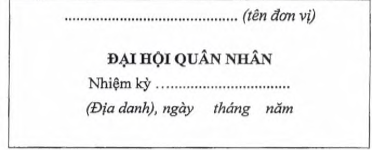
Note: The slogans guiding ideology, actions, propaganda, and encouragement at the military personnel conference shall be determined by the agency or unit.
ANNEX 2
PROGRAM AND DECORATION OF THE WORKERS' MEETING (DELEGATE)
(Pursuant to Circular No. 112/2024/TT-BQP dated December 31, 2024 issued by the Minister of National Defense) I. MEETING PROGRAM 1. Approve the meeting program.
2. State the reasons for the meeting, introduce delegates, elect the chairperson and secretary of the meeting.
3. Report on the qualifications of delegates attending the meeting (if it is a delegate meeting). The meeting organizing body is responsible for compiling and reporting on the qualifications of delegates (no election of a committee to review delegate qualifications).
4. The employer reports on the results of implementing tasks in the previous year (aspects related to employment, living conditions, income of workers; working conditions and measures to improve working conditions); directions and tasks for the upcoming year; public financial report, establishment and use of welfare funds, awards, contributions to trade union fees, social insurance, health insurance, unemployment insurance;
5. The Trade Union Committee at the grassroots level reports on the results of the workers' meetings of subordinate units within the enterprise; implementation results of the resolutions of the workers' meetings; inspection and supervision results on the implementation of labor contracts, collective labor agreements, internal regulations, rules of the enterprise related to the rights and legitimate interests of workers; dialogue results within the enterprise.
6. The People's Inspectorate reports on the work results of the People's Inspectorate in the previous year (term), direction of activities of the People's Inspectorate in the upcoming year (new term).
7. Discussion.
8. Answering proposals, concluding the discussion section.
9. Elect and complete members representing the workforce to participate in dialogue (every two years); elect and complete the People's Inspectorate (every two-year term).
10. Sign a collective labor agreement (if applicable).
11. Organize awards, launch competitions, sign competition pacts (if applicable).
12. Vote to approve the resolution of the workers' meeting.
II. MEETING DECORATION
* In addition to the main backdrop decoration as mentioned above, based on the characteristics of each enterprise's conference hall, additional slogans can be arranged on both sides, fresh flowers can be decorated, and exhibits such as projects, initiatives, topics, products... can be displayed to create a lively atmosphere for the day of the workers' festival./.
II. MAKET HỘI NGHỊ
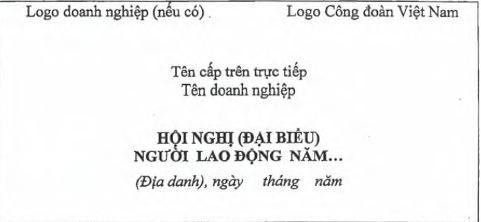
* In addition to the main backdrop decoration as mentioned above, each enterprise may arrange slogans on both sides and decorate with fresh flowers, display works, initiatives, topics, products, etc., to create a lively atmosphere for the day of the workers' conference./.
Original document (PDF)
Download
Relations map
Click a document to open. A red border = a relation that changes validity.
Translations
This document is available in the following languages: