
Article 15 and Article 16 stipulate the verification, confirmation, and handling of receivables and payables of joint-stock companies undergoing privatization. Specifically, the enterprise must recover due debts, complete documentation to continue monitoring and recovering debts that have not been proven to be recoverable. For payables, the enterprise also needs to verify, confirm, and explain clearly the related responsibilities if there are still unverified debts prior to the conversion into a joint-stock company.
Scope of application
Joint-stock company undergoing privatization
Key points
- Verify and confirm all receivables and payables
- Recover due debts
- Complete documentation to continue monitoring and recovering debts that have not been proven to be recoverable
- Explain clearly the related responsibilities if there are still unverified debts prior to the conversion into a joint-stock company
- Raise legitimate funds to settle due debts
🌐 Social impact of this document
- Strengthen financial management of the enterprise
- Minimize risks of outstanding debts
- Ensure transparency during the privatization process
❓ Frequently asked questions
The enterprise shall take what actions regarding receivables for which the debtor cannot be identified?
Determine the responsibility for compensation of relevant collectives and individuals, and the remaining losses will be handled according to current regulations on dealing with outstanding debts.
Is it necessary to verify payables that are not yet due?
It is necessary to verify all payables, including those that are not yet due, to ensure transparency and accuracy during the privatization process.
Full text
PART I
GENERAL PROVISIONS
Article 1. Scope of Regulation
2. State-owned enterprises include:
Article 2. Applicability
a) A single-member limited liability company held by the State with 100% charter capital, which is the parent company of an economic group, the parent company of a state-owned corporation (including state commercial banks), and the parent company within a parent company - subsidiary group.
c) An enterprise held by the State with 100% charter capital that has not yet been converted into a single-member limited liability company.
3. A single-member limited liability company invested in by a state-owned enterprise with 100% charter capital (hereinafter referred to as the second-level enterprise).
4. Other agencies, organizations, and individuals related to the transfer of state-owned enterprises to joint-stock companies.
1. "Enterprise undergoing shareholding reform" refers to enterprises specified in Clauses 2 and 3 of Article 2 of this Decree that implement the conversion into joint-stock companies according to this Decree.
2. "Date of decision on shareholding reform" is the date when the representative body of the owner issues the decision to carry out the shareholding reform of the enterprise.
Article 3. Explanation of Terms
In this Decree, the following terms are understood as follows:
3. "Date to determine the value of the enterprise undergoing shareholding reform" is selected by the representative body of the owner in accordance with the method for determining the enterprise's value. In cases where the enterprise's value is determined based on the asset method, the date to determine the enterprise's value is the closing date of the accounting period immediately following the decision on shareholding reform.
4. "Date to announce the value of the enterprise" is the date when the representative body of the owner issues the decision to announce the value of the enterprise undergoing shareholding reform.
5. "Date when the enterprise undergoing shareholding reform becomes a joint-stock company" is the date when the enterprise undergoing shareholding reform first obtains a business registration certificate operating under the form of a joint-stock company.
6. "Public auction of shares" is a method of selling shares of the enterprise undergoing shareholding reform publicly to competing bidders.
7. "Organization implementing public auction of shares" includes stock exchanges, securities companies, or service centers, asset auction enterprises in accordance with the law on asset auctions, as decided by the representative body of the owner.
8. "Starting price" is the initial price of a share offered for sale outside the enterprise, determined by the representative body of the owner but not lower than its nominal value (10,000 Vietnamese dong). The determination of the starting price is carried out through consulting organizations ensuring a full assessment of the actual value of the state capital at the enterprise, as re-evaluated and announced by the competent authority, and the potential of the enterprise in the future.
9. "Costs of shareholding reform" are expenses directly related to the shareholding reform process of the enterprise from the date of decision on shareholding reform to the date of handover between the enterprise undergoing shareholding reform and the joint-stock company.
10. "Representative body of the Owner" includes ministries, ministerial-level agencies, government agencies; People's Committees of provinces and centrally-administered cities, or organizations established in accordance with the law and assigned by the Government to exercise the rights and responsibilities of the state owner representative at the enterprise undergoing shareholding reform.
9. "Privatization costs" are expenses directly related to the privatization process of the enterprise from the date of the decision to privatize until the handover between the enterprise being privatized and the joint-stock company.
10. "State Capital Representative Authority" refers to ministries, ministerial-level agencies, government agencies; People's Committees of provinces and centrally governed cities, or organizations established under the provisions of law and assigned by the Government to exercise the rights and responsibilities of state capital representatives at enterprises undergoing privatization.
Article 4. Conditions for Shareholding Reform
a) Not belonging to the category where the State needs to hold 100% of the charter capital. The list of enterprises that the State needs to hold 100% of the charter capital is determined by the Prime Minister at each period.
b) Remaining state capital after financial treatment and revaluation of enterprise value.
a) For enterprises listed in the State's continued holding over 50% of the total shares during the shareholding reform as decided by the Prime Minister, the representative body of the owner shall instruct the enterprise to cooperate with Vietnam Asset Management Company and the creditors of the enterprise to develop a debt purchase plan for restructuring the enterprise.
b) For the remaining enterprises, the representative body of the owner decides to convert them into other forms as prescribed by law.
In case the debt purchase plan for enterprise restructuring is not feasible and effective, they shall be converted into other forms as prescribed by law.
3. The State will not provide additional capital for shareholding reform, including enterprises under the criteria, list, and classification of state-owned enterprises when implementing shareholding reform as stipulated by the Prime Minister, which fall within the category where the State holds 50% of the total shares.
Article 5. Forms of Shareholding Reform
1. Maintaining the current state capital in the enterprise and issuing additional shares to increase the charter capital.
2. Selling part of the current state capital in the enterprise or combining selling part of the state capital while issuing additional shares to increase the charter capital.
3. Selling all of the current state capital in the enterprise or combining selling all of the state capital while issuing additional shares to increase the charter capital.
1. Domestic investors are entitled to purchase shares of the shareholding-reformed enterprise without limitation on quantity, except for cases stipulated in Clause 4 of this Article.
2. Foreign investors are entitled to purchase shares of the shareholding-reformed enterprise according to this Decree and related legal regulations.
Foreign investors wishing to purchase shares must open an account at a credit institution in accordance with Vietnamese laws on foreign exchange.
3. Strategic investors:
a) Strategic investors are domestic and foreign investors who meet the following conditions:
- Having legal entity status as prescribed by law;
- Possessing financial capacity and having achieved positive results in production and business operations for the last two years up to the time of registering to purchase shares, without accumulated losses;
- Providing a written commitment from an authorized person when registering to become a strategic investor of the shareholding-reformed enterprise regarding the following contents:
+ Continuing to maintain the main business activities and brand of the shareholding-reformed enterprise for at least three years from the date of officially becoming a strategic investor.
For enterprises already included in the list of national brand enterprises, the representative body of the owner reports to the Prime Minister to decide specifically on the time that strategic investors must commit to maintaining the main business activities and brand of the shareholding-reformed enterprise.
+ Not transferring the purchased shares within three years from the date the joint-stock company is first issued a business registration certificate to operate according to the Enterprise Law.
+ A support plan for the enterprise after shareholding reform in terms of technology transfer; human resource training; enhancing financial capacity; corporate governance; supply of raw materials; market development for products.
+ Compensation obligations when breaching commitments, with compensation amounts determined based on actual losses and the State's right to dispose of the entire number of shares purchased by the strategic investor upon breach of signed commitments.
b) The organization of the initial public offering (IPO) for strategic investors only applies to enterprises listed in the State's continued holding over 50% of the total shares during the shareholding reform as decided by the Prime Minister.
The procedure for selecting strategic investors at shareholding-reformed enterprises is carried out according to specific steps detailed in Appendix I attached to this Decree, ensuring that the selection and organization of strategic investors' share purchases are completed before the public announcement of the IPO.
d) In case there is only one strategic investor meeting the selection criteria and registering to purchase shares, and the volume of registered purchase is less than or equal to the number of shares planned to be sold to strategic investors according to the approved shareholding reform plan, the Steering Committee reports to the representative body of the owner to decide on selling shares to the strategic investor through direct negotiation at a price not lower than the average successful bid price from the public auction; in case selling shares to other investors according to Clause 2 of Article 37 of this Decree, the negotiated price for the strategic investor should not be lower than the agreed price with the purchasing investor.
The remaining shares (the difference between the number of shares planned to be sold to strategic investors according to the approved shareholding reform plan and the number of shares registered for purchase by strategic investors), the Steering Committee reports to the representative body of the owner to decide on adjusting the shareholding reform plan, converting these shares into shares to be publicly auctioned.
đ) In case there are two or more strategic investors meeting the selection criteria and registering to purchase shares, and the total number of shares registered for purchase by strategic investors exceeds the number of shares planned to be sold to strategic investors according to the approved shareholding reform plan, the Steering Committee reports to the representative body of the owner to organize an auction among strategic investors on the stock exchange.
The auction between strategic investors shall be organized after the public auction to the general public with the starting price being the average successful bid price according to the results of the public auction to the general public (in cases where shares are sold to other investors as stipulated in Clause 2, Article 37 of this Decree, the starting price for organizing the auction between strategic investors shall be the agreed selling price to the purchasing investor) and ensuring the principle of selecting investors based on descending purchase prices until the required number of shares to be sold is met.
e) In cases where there are two or more strategic investors meeting the selection criteria and registering to purchase shares, and the total number of shares registered for purchase by strategic investors equals or is less than the number of shares planned to be sold to strategic investors according to the approved privatization plan, the Steering Board shall negotiate the number of shares to be sold and the selling price for each strategic investor and report to the competent authority for approval. The number of shares sold to each strategic investor shall be in accordance with the quantity of shares registered for purchase by each strategic investor at a selling price not lower than the average successful bid price according to the results of the public auction to the general public (in cases where shares are sold to other investors as stipulated in Clause 2, Article 37 of this Decree, the negotiated selling price for strategic investors shall not be lower than the agreed selling price to the purchasing investor).
The remaining shares (the difference between the number of shares planned to be sold to strategic investors according to the approved privatization plan and the total number of shares registered for purchase by strategic investors), the Steering Board shall report to the competent authority for ownership to decide on adjusting the privatization plan, transferring these shares to be sold through public auctions to the general public.
g) In cases where strategic investors fail to fulfill their commitments or violate share transfer regulations, they must compensate for all losses incurred in accordance with the commitment contract and current laws.
h) Strategic investors must deposit a guarantee or collateral in cash or have a guarantee from a financial institution or foreign bank branch in accordance with the law, equivalent to 20% of the value of the shares registered for purchase at the starting price decided by the competent authority in the approved privatization plan.
In cases of renouncing the right to purchase, strategic investors will not be refunded the deposit or will be penalized an amount equivalent to the deposit value if they have provided a guarantee or collateral.
The organization of selling shares to strategic investors must be completed before the first General Shareholders' Meeting to convert the enterprise into a joint-stock company.
The remaining shares (the difference between the actual number of shares sold to strategic investors and the total number of shares registered for purchase by strategic investors according to the approved privatization plan), the Steering Board shall report to the competent authority for ownership to decide on adjusting the charter capital and capital structure before organizing the first General Shareholders' Meeting.
4. Organizations and individuals that are not allowed to purchase the initial issuance of shares of the enterprise undergoing privatization include:
a) Members of the Steering Board and the Privatization Assistance Team of the enterprise (excluding members who are representatives of the enterprise).
b) Financial intermediaries and individuals belonging to such organizations involved in providing privatization advisory services, auditing financial statements, and the audit organization determining the enterprise's value (excluding organizations acting as guarantors for the purchase of undistributed shares under the guarantee contract).
c) Subsidiary companies, associated companies within the same Group, Corporation, and parent-child company complexes.
d) Organizations conducting the share auction and individuals related to such organizations involved in the auction.
đ) Persons related as defined in Clause 17, Article 4 of the Enterprise Law 2014 of the organizations and individuals specified in points a, b, and d of this clause.
Article 7. Payment Currency and Methods for Initial Public Offering of Shares
1. Domestic and foreign investors shall purchase shares of enterprises in Vietnamese currency.
2. The initial public offering of shares shall be carried out according to the methods prescribed in this Decree, specifically:
a) Public auction;
b) Underwriting;
c) Direct negotiation;
d) Book-building method.
The subjects applying the book-building method shall be determined by the Prime Minister's decision, with the Ministry of Finance guiding the specific implementation of share sales under this method.
3. Depending on the target and conditions for purchasing initial shares, the representative body of the owner shall determine the appropriate method of selling shares as stipulated in Clause 2 of this Article.
1. The costs of shareholding reform shall be decided and approved by the budget estimate and final account by the representative body of the owner. The General Director (or Director) of the enterprise undergoing shareholding reform shall decide on specific expenditure levels based on the contents already approved by the representative body of the owner and shall bear legal responsibility for their decisions. All shareholding reform expenses must ensure that there are sufficient reasonable, valid, and economical vouchers in accordance with current laws.
2. Shareholding reform costs include:
a) Direct expenses at the enterprise:
- Expenses for training on shareholding reform business;
- Expenses for inventory and valuation of assets;
- Expenses for formulating the shareholding reform plan and drafting the Articles of Association;
- Expenses for labor union meetings to implement shareholding reform;
- Expenses for promotional activities and information disclosure about the enterprise;
- Expenses for hiring auditors to audit financial reports at the time of officially becoming a joint-stock company;
- Costs for organizing the sale of shares;
- Expenses for organizing the first shareholders' meeting.
b) Fees for hiring auditing and consulting organizations (organizations providing valuation services for the enterprise, organizations determining the starting price, organizations formulating the shareholding reform plan, organizations selling shares), decided by the representative body of the owner or the Steering Committee (if authorized). Payment for consulting organizations shall be based on contracts signed between the relevant parties.
c) Remuneration for the Steering Committee and Working Group:
- Monthly remuneration for each member of the Steering Committee and Working Group shall not exceed twice the basic salary for cadres, civil servants, public officials, and armed forces personnel issued by the Government during each period.
- Payment of remuneration for each member of the Steering Committee and Working Group shall be made based on actual time but not exceeding twenty-four months from the date of establishment of the Steering Committee and Working Group.
d) Other expenses related to the shareholding reform of the enterprise.
3. The cost of hiring auditors to value the enterprise at the time of determining its value shall not be considered a shareholding reform expense; the enterprise undergoing shareholding reform shall record it as production and business expenses in the enterprise's accounting period according to regulations.
4. Shareholding reform costs shall be sourced from the proceeds of share sales as stipulated in Article 39 of this Decree.
Article 9. Shares and Share Certificates
1. The registered capital is divided into equal parts called shares. The par value of one share is ten thousand Vietnamese dong (10,000 VND).
2. A share certificate is a certificate issued by a joint-stock company, recorded in ledgers or electronic data confirming ownership of one or more shares by a shareholder in that company. Share certificates must contain the main contents as prescribed in Clause 1 of Article 120 of the Enterprise Law 2014.
Article 10. Principles of succession of rights and obligations of joint-stock companies converted from state-owned enterprises
1. The enterprise undergoing shareholding transformation shall be responsible for arranging and utilizing the maximum number of workers at the time of the decision to transform into a joint-stock company and resolving the status of workers who have stopped working according to current regulations.
The joint-stock company shall succeed all responsibilities towards workers transferred from the enterprise undergoing shareholding transformation; it has the right to select, arrange, and utilize workers and cooperate with relevant agencies to resolve the status of workers in accordance with the law.
2. The enterprise undergoing shareholding transformation shall be responsible for coordinating with relevant agencies to inspect and handle financial issues to determine the value of state capital at the time of officially becoming a joint-stock company.
3. The joint-stock company may use all assets and capital received upon transfer to organize production and business activities; it shall succeed all legitimate rights and benefits, bear responsibility for debts including taxes, labor contracts, and other obligations of the enterprise undergoing shareholding transformation.
4. Assets surplus or deficit compared to the value of the enterprise undergoing shareholding transformation, which have been decided and announced by the agency representing the owner, shall be handled as follows:
a) For enterprises still having state capital after shareholding transformation:
- For surplus assets:
In cases where the enterprise has not completed settlement at the time of officially becoming a joint-stock company, the surplus assets shall be increased in state capital at the joint-stock company (if the joint-stock company has a need to use them and a Resolution of the Shareholders' Meeting approves) or transferred to Vietnam Asset Management Corporation (if the joint-stock company does not have a need to use them).
In cases where the enterprise has completed settlement at the time of officially becoming a joint-stock company, the surplus assets shall be transferred to Vietnam Asset Management Corporation.
- For deficit assets after deducting compensation from organizations and individuals (if any), they shall be handled as follows:
In cases where the enterprise has not completed settlement at the time of officially becoming a joint-stock company, the deficit assets shall be recorded as production and business expenses from the time of determining the enterprise's value to the time of officially becoming a joint-stock company.
In cases where the enterprise has completed settlement at the time of officially becoming a joint-stock company, the deficit assets shall be reduced from state capital at the joint-stock company (if approved by a Resolution of the Shareholders' Meeting) or recorded as production and business expenses of the joint-stock company (if the Resolution of the Shareholders' Meeting does not approve).
b) For enterprises no longer having state capital after shareholding transformation:
- For surplus assets: Transfer to Vietnam Asset Management Corporation.
- For deficit assets after deducting compensation from organizations and individuals (if any), they shall be recorded as production and business expenses of the joint-stock company.
Article 11. Implementation of Transparency and Listing on the Stock Market
1. Enterprises undergoing shareholding transformation must publicly announce on the Government’s electronic portal, and simultaneously send to the Ministry of Finance and the Steering Committee for Enterprise Reform and Development for monitoring: the roadmap and progress of shareholding transformation, information about the enterprise (including the land use plan that has been approved, areas of land currently in dispute that need to continue to be resolved - if any), financial issues during the shareholding transformation process, valuation methods and results of determining the enterprise's value, shareholding transformation plans, implementation status and results of the shareholding transformation plan, management and use of land, plans for worker share purchases and arrangements, draft articles of association of the enterprise in accordance with the Law on Enterprises 2014.
3. Within a maximum period of 90 days from the end of the public offering of shares, enterprises undergoing shareholding transformation must complete the registration procedures for share depository at the Vietnam Securities Depository Center and register for trading on the Upcom trading system.
4. In cases where enterprises undergo shareholding transformation through selling part of the state capital and issuing additional shares to increase the charter capital through a public auction to offer shares to the public, if they meet the listing conditions at the Stock Exchange, enterprises undergoing shareholding transformation must submit listing applications immediately after the end of the offering and report the offering results to the State Securities Commission.
5. The agency representing the owner shall stipulate the simultaneous shareholding transformation and listing on the stock market in the shareholding transformation plan to inform investors before the first public offering.
In cases where enterprises undergo shareholding transformation and list immediately on the Stock Exchange, the agency representing the owner shall decide the minimum quantity of shares to be purchased for the shares offered to the public in the initial public offering plan so that the enterprise after shareholding transformation meets the listing conditions. The regulation on the minimum purchase quantity in the initial public offering plan does not discriminate against investors from all economic sectors.
Article 12. Consulting for Corporate Transformation
2. Enterprises undergoing corporate transformation must hire consulting organizations that meet the criteria to provide services for determining the enterprise's value.
a) For tender packages for valuation consulting with a value not exceeding VND 3 billion and only one organization registering to provide valuation consulting services, the representative body of the owner may choose the direct assignment method to select the consulting organization to determine the enterprise's value;
b) For tender packages for consulting not covered by point a of this clause, the representative body of the owner decides to organize a bidding process to select the unit to perform valuation consulting services according to the laws on bidding.
4. The consulting organization selected to determine the enterprise's value may choose appropriate methods to determine the enterprise's value, ensuring the principles stipulated in this Decree, land laws, and laws on pricing and valuation, completing within the specified time frame and fulfilling all commitments in the signed contract. The enterprise undergoing corporate transformation has the responsibility to provide complete and truthful information related to the enterprise to the consulting organization for determining the enterprise's value for use during the valuation process.
5. Domestic consulting organizations providing services to determine the enterprise's value must meet the following criteria:
b) Having at least five years (60 consecutive months up to the date of submitting the application for registration to provide valuation consulting services) of experience in one of the following fields: appraisal, auditing, accounting, financial consulting, ownership conversion consulting;
In the three most recent years prior to the submission of the application for registration to provide valuation consulting services, each year the organization must have completed at least 30 contracts providing services in the aforementioned fields;
c) Not being in the process of dissolution, bankruptcy, restructuring, or special supervision by competent state agencies;
d) Having at least three appraisers who have been issued an appraisal license by the Ministry of Finance in accordance with the law. These appraisers must be employees under an indefinite-term labor contract or a definite-term labor contract as stipulated in Point a and Point b, Clause 1, Article 22 of the Labor Code No. 10/2012/QH13 with the enterprise applying to participate in valuation consulting services;
If there are fewer than three appraisers, they must have a joint venture cooperation contract with domestic appraisal organizations meeting the legal standards;
đ) Meeting the criteria regarding the quantity and quality of staff working in the fields and industries in which the organization operates;
e) Not violating laws in their business fields and industries from administrative penalties upwards in the five years immediately preceding the year of registration to provide services;
g) Having a business process for determining the enterprise's value that complies with current laws on converting state-owned enterprises into joint-stock companies and appraisal standards.
6. Foreign consulting organizations providing services to determine the enterprise's value must meet the following criteria:
a) Being an organization operating in the fields of appraisal, auditing, accounting, financial consulting, and ownership conversion consulting according to the law of the country where its headquarters is located;
b) Having reputation, capability, brand, and at least five years (60 consecutive months up to the date of submitting the application for registration to provide valuation consulting services) of experience in one of the following fields: appraisal, auditing, accounting, financial consulting, ownership conversion consulting;
c) If there are fewer than three appraisers, they must have a joint venture cooperation contract with domestic appraisal organizations meeting the legal standards on appraisal.
7. Responsibilities of the consulting organization to determine the enterprise's value:
a) Adhering to relevant laws during the implementation of the business process to determine the enterprise's value and performing the signed contract with the client;
b) Bearing legal responsibility for the results of determining the enterprise's value;
c) Compensating for damages resulting from violations of laws during the provision of valuation consulting services or being penalized according to the law;
d) Explaining or providing information and data related to the results of determining the enterprise's value when complaints are made or upon written request from the representative body of the owner, State Audit Office, Ministry of Finance, and other competent state agencies;
đ) Protecting client information; storing files and documents about enterprises that have undergone value determination;
e) Not participating in providing valuation consulting services in the following cases:
- Management personnel of the enterprise (as defined in Clause 18, Article 4 of the Enterprise Law 2014), chief accountant (or person responsible for accounting), and appraisers of the valuation consulting organization are related parties (as defined in Clause 17, Article 4 of the Enterprise Law 2014) to the enterprise undergoing corporate transformation.
- Being an organization currently or previously providing auditing, bookkeeping, and financial reporting services for two consecutive years immediately preceding the valuation date for the enterprise undergoing corporate transformation.
Chapter II
FINANCIAL HANDLING DURING SHAREHOLDING REFORM
Clause 1. Enterprises subject to equitization according to the list of enterprises to be restructured at each stage approved by the competent authority shall be responsible for reviewing the entire area of land under their management and use to establish a land utilization plan in accordance with the laws on land, laws on restructuring and handling state-owned real estate, and submit it to the competent state agency for examination and approval before the decision on equitization is made.
The land utilization plan for the entire area of land managed and used by the equitized enterprise must ensure compliance with the laws on restructuring and handling state-owned real estate; comply with the land use planning and construction planning at the local level; and align with the enterprise's development strategy.
Clause 2. Upon receiving the decision to implement equitization from the competent authority, the enterprise shall organize the inventory, classification of assets, sources of capital, and funds under its management and use, reconcile and confirm debts at the time of determining the enterprise's value.
Clause 3. Equitized enterprises shall be responsible for conducting annual financial statement audits in accordance with the State regulations. In cases where the time point for determining the enterprise's value does not coincide with the end of the fiscal year, the equitized enterprise shall be responsible for preparing financial statements at the time of determining the enterprise's value.
When equitizing the parent company of an economic group, the parent company of a state-owned corporation, or the parent company in a holding company structure where the parent company owns 100% of the charter capital, these companies must determine the enterprise's value in accordance with this Decree. The time point for determining the value of the subsidiary must coincide with the time point for determining the value of the parent company.
Clause 4. If the time point for determining the enterprise's value coincides with the end of the fiscal year, prior to determining the enterprise's value, the equitized enterprise must submit a written request to the directly managing tax authority to settle all amounts payable to the state budget in accordance with the regulations.
If the time point for determining the enterprise's value does not coincide with the end of the fiscal year, prior to determining the enterprise's value, the equitized enterprise must submit a letter requesting the directly managing tax authority to inspect and determine all amounts payable to the state budget in accordance with the regulations.
Within thirty working days from the date of receipt of the enterprise's request, the tax authority must conduct inspections and settlements. If beyond this period, the tax authority has not conducted inspections and settled taxes, the equitized enterprise shall base its determination of the enterprise's value on the declared figures in accordance with the regulations.
Clause 5. Based on the results of the inventory, financial statement audit, and settlement of amounts payable to the state budget, the equitized enterprise shall be responsible for proactively addressing financial issues within its authority and in accordance with the law before determining the value of the equitized enterprise.
In cases where there are obstacles or issues exceeding its authority, the equitized enterprise must promptly report to the competent authority for consideration and resolution.
In cases where reports have been submitted to the competent authorities but have not been resolved, the enterprise must clearly record these issues in the Minutes of Determining the Value of the Equitized Enterprise to serve as a basis for continued resolution during the period from the determination of the enterprise's value to the formal conversion into a joint-stock company.
Article 14. Handling leased, borrowed, joint venture contribution assets, unused assets, and assets invested with Reward Fund and Welfare Fund
1. Assets leased, borrowed, received as joint venture contributions, and other assets not belonging to the enterprise shall not be included in the enterprise's value for equitization.
For other assets formed from state budget investment capital that the equitized enterprise is only assigned as the main investor but not granted management, use, and exploitation of technical infrastructure, they shall not be included in the enterprise's value for equitization. The equitized enterprise must report to the competent state agency for examination and decision on handling in accordance with the current laws on state asset management.
2. For unused, stagnant, and pending liquidation assets, the equitized enterprise is responsible for actively handling them in accordance with the current laws on liquidation and sale of assets.
By the time the enterprise's value is determined, any remaining assets not yet handled, except for cases specified in Clause 3 of this Article, the equitized enterprise shall transfer to Vietnam Asset Management Corporation for handling in accordance with the law. The remaining book value of these assets must be recorded as production and business expenses of the enterprise for the period.
3. Assets that are not allowed to be excluded include:
a) Assets such as houses, structures (including underground works, roads, fences, parking lots) that the enterprise directly or indirectly uses; machinery, equipment, and transportation means newly invested and put into use within five years or have a remaining book value of 50% or more of the original cost of the asset. The enterprise must continue to manage, monitor, and handle them definitively in accordance with the current laws until the formal transfer to a joint-stock company.
b) Assets that must be scrapped, such as chemicals, harmful substances, expired pesticides... the enterprise is responsible for coordinating with relevant agencies to process and scrap them in accordance with the current laws on environmental management before the equitized enterprise receives the first registration certificate of a joint-stock company.
After determining the cause, responsibility, and compensation according to the current laws, the enterprise's loss can be processed into business results as stipulated.
c) Assets representing unfinished construction costs of projects and works suspended by the competent authority's decision, the equitized enterprise is responsible for continuing to inherit, monitor, and handle them in accordance with the law. Specifically, for project costs not approved by the competent authority and not forming physical assets, such as feasibility study costs, survey, and design costs, the enterprise must determine the cause, responsibility, and compensation according to the current laws, and the loss can be processed into business results as stipulated.
d) Collateral assets that the enterprise has used to mortgage for loans at credit institutions.
đ) For assets of enterprises specified in Clause 2 of Article 4 of this Decree, during the period of cooperation with Vietnam Asset Management Corporation and the creditors of the enterprise to build a debt purchase plan for restructuring the enterprise to be approved by the state-owned enterprise representative body, the equitized enterprise shall not organize liquidation or sale of assets listed in the valuation value of the enterprise decided and announced by the state-owned enterprise representative body.
Housing for cadres, employees invested with the Welfare Fund of the enterprise, including housing invested with state budget funds, shall be transferred to the local land management agency for management.
5. Production and business assets invested with the Reward Fund and Welfare Fund of the equitized enterprise, if having complete documentation, will be re-evaluated and included in the enterprise's value for the joint-stock company to continue using in production and business.
6. For state-owned commercial banks, the inventory, evaluation, and classification of monetary capital assets, financial lease assets, and receivables/payables (receivables, payables) shall be carried out in accordance with specific guidelines issued by the Ministry of Finance.
7. Training and vocational education institutions and medical examination and treatment units in economic groups and state-owned corporations shall not be separated or transferred when these groups and corporations undergo equitization. These institutions shall be equitized together with the parent companies of economic groups and state-owned corporations.
8. When equitizing the parent company of an economic group, state-owned corporation, or a parent company in a parent-subsidiary combination with revenue-generating public service units (excluding training and vocational education institutions and medical examination and treatment units), the following measures shall be taken:
a) In the case where the equitized enterprise continues to inherit, it must organize valuation and include it in the value of the equitized enterprise in accordance with the current laws on converting public service units into joint-stock companies.
b) In the case where the equitized enterprise does not inherit, the Steering Committee shall report to the state-owned enterprise representative body for examination and decision or report to the Prime Minister for decision on transferring to relevant ministries, provincial people's committees, and centrally-administered city people's committees for management in accordance with the law. During the transfer period, the equitized enterprise shall continue to manage until a decision is made by the competent authority.
Article 15. Accounts Receivable Debts
a) Determining the responsibility for compensating collectives and individuals related to accounts receivable debts where the debtor cannot be identified, with the remaining losses being handled according to current State regulations on handling outstanding debts;
b) Completing documentation and continuing to monitor and handle the recovery of debts that cannot be proven to be unrecoverable.
Debts lacking legal documentation proving that the debtor still owes money or that they are unable to recover according to regulations shall not be excluded from the enterprise's value. The enterprise must clarify the reasons and handle them according to the following principle:
At the time when the joint-stock corporatized enterprise receives its first registration certificate, when preparing financial statements for transfer to the joint-stock company, debts that have undergone reconciliation procedures but remain unreconciled must be considered and dealt with regarding the responsibility for compensation of collectives and individuals involved. The remaining value of the debt (after deducting the compensation of individuals and collectives, and setting aside provisions for difficult-to-collect receivables if applicable) shall be recorded as production and business expenses of the joint-stock corporatized enterprise and transferred to the Vietnam Asset Management Company for handling according to the law.
4. For advance payments made to suppliers of goods and services (such as rent for premises, land lease payments, purchase payments, wages payable, long-term insurance premiums, and one-time industrial zone land lease payments covering the entire lease period) that have been recorded as production and business expenses, the enterprise shall reconcile with contracts and quantities of goods and services provided to reduce expenses (corresponding to unsupplied goods and services or unexecuted lease periods) and increase advance payment expenses when determining the value of the joint-stock corporatized enterprise.
Article 16. Debts Payable
In cases where some debts payable have complete documentation but have not been reconciled and confirmed at the time of determining the value of the shareholding enterprise, the Chairman of the company and the Board of Members of the shareholding enterprise must clearly explain the contents of these debts, identify the collective and individual responsibilities related to completing the reconciliation of receivables and payables before the shareholding enterprise receives its first registration certificate for a joint-stock enterprise, and report to the representative body of the owner for consideration and decision based on the value recorded in the accounting books; simultaneously, they must publicly announce this in the decision approving the enterprise's value as well as the privatization plan serving as the basis for auctioning shares.
At the time when the shareholding enterprise receives its first registration certificate for a joint-stock enterprise, when preparing financial statements for transfer from a state-owned enterprise to a joint-stock company, if these receivables and payables have completed the reconciliation procedures but the creditors cannot be confirmed, they shall be recorded as an increase in state capital with the value of the debts payable without creditor confirmation. The joint-stock company (after the conversion of the state-owned enterprise) shall be responsible for storing the files, continuing to inherit and monitor to fulfill the debt repayment obligations when requested by creditors and record the debt repayment expenses in the production and business costs of the enterprise during the period.
2. The shareholding enterprise must mobilize legitimate sources of capital to settle due debts payable before determining the value of the shareholding enterprise or agree in writing with creditors to handle them, including converting payable debts into share contributions.
The conversion of payable debts at the time of determining the enterprise's value into share contributions must be stipulated in the privatization plan, publicly announced in the prospectus for the initial public offering of shares, and implemented through the successful auction results of creditors. Accordingly, creditors participating in purchasing shares at the public auction of shares to the public will convert the number of shares corresponding to the amount of debt according to the successful auction results of creditors.
3. Tax arrears and other payments to the state budget:
a) The shareholding enterprise shall be responsible for paying taxes and other state budget payments before the conversion;
b) In cases where the shareholding enterprise has not fulfilled its obligation to pay taxes and other state budget payments, the joint-stock company shall be responsible for inheriting all such debts.
4. During the process of shareholding transformation, if the enterprise encounters difficulties in settling overdue loans from credit institutions (including the Vietnam Development Bank) due to operating losses, the debt shall be handled according to the current regulations of the State on handling outstanding debts.
Article 17. Provisions, Losses, or Profits
1. The balance of provisions for inventory write-downs, financial investments, and difficult-to-collect receivables (if any) at the time of determining the enterprise's value shall be used to offset losses according to current regulations, and the remainder shall be returned to the operating results of the shareholding enterprise.
2. For provisions for warranty of products, goods, and construction projects at the time of determining the enterprise's value, the shareholding enterprise may retain the balance already established corresponding to the warranty obligations under valid contracts.
3. For exchange rate differences arising from revaluation of monetary items denominated in foreign currencies at the time of determining the enterprise's value, the shareholding enterprise shall conduct revaluation according to regulations and shall not transfer it into the operating results. The balance of exchange rate differences at the time of determining the enterprise's value shall continue to be monitored from the time of determining the enterprise's value until the formal conversion to a joint-stock company.
4. Risk reserve funds of banks and operational reserves of insurance companies, after offsetting losses according to regulations, may be retained by the shareholding enterprise but must be included in the value of state capital at the shareholding enterprise.
5. Profits generated to offset previous year losses (if any) according to the Law on Corporate Income Tax, contributions to the Science and Technology Development Fund according to the law, payment of corporate income tax, and distribution of remaining profits according to current regulations applicable to state-owned enterprises at the time of determining the enterprise's value.
6. Losses after processing according to the above regulations up to the time of determining the enterprise's value, if there are still outstanding debts to credit institutions (including the Vietnam Development Bank), the shareholding enterprise shall be responsible for coordinating with relevant agencies to handle them according to current laws and regulations stipulated in Clause 4, Article 16 of this Decree.
Article 18. Capital of the enterprise being corporatized invested in other enterprises
1. In cases where the enterprise being corporatized inherits capital already invested in another enterprise, the entire amount of this capital shall be determined according to the principles stipulated in Article 32 of this Decree.
2. In cases where the enterprise being corporatized does not inherit investments in other enterprises, it shall report to the agency representing the owner for handling as follows:
a) Agree with the contributing parties to transfer to another state-owned enterprise as a partner.
b) Resell the share capital to the partner or other investors in accordance with the law.
c) In cases where, at the time of determining the enterprise's value, the enterprise being corporatized still cannot sell or transfer the investment to another partner, it must inherit according to the provisions of Clause 1 of this Article.
3. For the value of the investment capital of the enterprise being corporatized in foreign-invested enterprises where the Investment Contribution Contract or Investment License contains a commitment that, upon the expiration of the operating period of these enterprises, all assets of the enterprise must be transferred without compensation to the Vietnamese party, the enterprise being corporatized must continue to inherit and include this in the enterprise's value for corporatization according to the principles stipulated in Article 32 of this Decree. When the foreign-invested enterprise terminates its operating period as specified in the Investment Contribution Contract or Investment License, the joint-stock company must transfer non-compensable assets to the management of the Vietnamese State in accordance with the laws on the management and use of state assets. The enterprise being corporatized must publicly announce this information to investors and clearly specify it in the handover minutes and the articles of association of the joint-stock company.
Article 19. Balance in cash of the Reward Fund, Welfare Fund, and Management Reward Fund, and Supervisory Board Member Reward Fund
1. The balance in cash of the Reward Fund at the time of determining the value of the enterprise being corporatized shall be used to offset excess payments made to employees beyond the prescribed regulations (if any), pay employees according to the prescribed regulations for state-owned enterprises, and distribute the remaining portion among current employees based on their months of service in the enterprise being corporatized. The distribution of the balance in cash of the Reward Fund to employees must be completed before the enterprise being corporatized transitions to a joint-stock company.
2. The balance in cash of the Welfare Fund at the time of determining the value of the enterprise being corporatized shall be used to offset excess payments made to employees beyond the prescribed regulations (if any), pay employees according to the prescribed regulations for joint-stock enterprises, and distribute the remaining portion among current employees, managers, and supervisory board members based on their months of service in the enterprise being corporatized. The distribution of the balance in cash of the Welfare Fund to employees, managers, and supervisory board members must be completed before the enterprise being corporatized transitions to a joint-stock company.
3. The balance in cash of the Management Reward Fund and Supervisory Board Member Reward Fund at the time of determining the value of the enterprise being corporatized shall continue to be retained and used according to the prescribed regulations for state-owned enterprises and shall be handled according to the provisions of point e, Clause 2, Article 21 of this Decree.
4. When corporatizing the Parent Company of an Economic Group, the Parent Company of a State-Owned Holding Corporation, or the Parent Company in a parent-subsidiary group, the handling of the balances of the Funds specified in Clauses 1, 2, and 3 of this Article shall be carried out on the principle that employees and managers belonging to which enterprise (the parent company or the second-tier enterprise) will benefit from the corresponding source of that enterprise.
Article 20. Balance of the Enterprise Restructuring Support Fund at enterprises and the Science and Technology Development Fund
1. The balance of the Enterprise Restructuring Support Fund at enterprises undergoing shareholding reform (if any) shall be determined as state capital and must be remitted to the Enterprise Restructuring and Development Support Fund.
2. The balance of the Science and Technology Development Fund shall be left for the new joint-stock company to inherit and bear responsibility for managing and using the Fund in accordance with the prescribed regulations.
Article 21. Financial Treatment at the Time of Official Transition to Joint-Stock Company
1. Enterprises undergoing shareholding reform continue to implement financial management regulations for state-owned enterprises from the time of determining enterprise value until the time the enterprise officially transitions to a joint-stock company.
a) The balance of provisions for inventory write-downs, financial investments, and difficult-to-collect receivables (if any) shall be used to offset losses as stipulated currently, and the remaining amount shall be transferred to the operating results of the enterprise undergoing shareholding reform.
b) For exchange rate differences arising from revaluation of monetary items denominated in foreign currencies at the time of officially transitioning to a joint-stock company, the enterprise undergoing shareholding reform shall revalue according to the regulations and not transfer to the operating results. The balance of exchange rate differences at this point shall be transferred to the joint-stock company (after the state-owned enterprise conversion) for monitoring and handling according to the regulations.
c) For post-tax profits and dividends distributed from financial investment activities (with resolutions from the Shareholders' Meeting, Board of Directors of the receiving entity) generated from the time of determining enterprise value until the time of officially transitioning to a joint-stock company but not yet received, the enterprise undergoing shareholding reform shall record an increase in financial activity revenue while recording an increase in receivables.
d) For shares received by the enterprise undergoing shareholding reform from the time of determining enterprise value until the time of officially transitioning to a joint-stock company without payment, the enterprise undergoing shareholding reform shall record an increase in state capital value (based on the valuation principle stipulated in Article 32 of this Decree) while recording an increase in the value of financial investment.
đ) Profit distribution and reserve establishment shall be carried out in accordance with current regulations for state-owned enterprises.
e) The Management Reward Fund and Supervisor Fund at the time of officially transitioning to a joint-stock company, the enterprise undergoing shareholding reform shall manage and disburse according to the regulations. In cases where there is still a balance after processing, the enterprise undergoing shareholding reform shall report to the agency representing the owner for consideration and decision to remit to the Enterprise Restructuring and Development Support Fund.
Provisions for product warranty, goods, construction projects (for contracts already signed, warranty period still valid) shall be extracted by the enterprise undergoing shareholding reform based on the signed contract and retained to perform warranty services for products, goods, construction projects according to the contract.
The enterprise undergoing shareholding reform must prepare a detailed list for each type of product, goods, construction project attached to the privatization dossier. After the warranty period for products, goods, construction projects, if this provision is not fully utilized, the remaining balance must be remitted by the joint-stock company to the Enterprise Restructuring and Development Support Fund within 30 days from the end date of the warranty period according to the contract.
If the joint-stock company fails to make full and timely payments, it must pay additional interest as stipulated in the Management and Use Regulations of the Enterprise Restructuring and Development Support Fund.
In cases where the official transition to a joint-stock company does not coincide with the time of preparing the annual financial statement, making it impossible to classify the enterprise as the basis for establishing reserves; the enterprise undergoing shareholding reform shall establish the Management Reward Fund, Supervisor Fund, and two incentive funds, welfare fund at this time according to the following principles:
- Based on the classification result of the enterprise in the most recent year closest to the time of officially transitioning to a joint-stock company.
- Based on the profit source according to the regulations allowed to be used for establishing and distributing reserves of the enterprise.
- The level of reserve extraction equals the level of profit distribution according to the regulations for state-owned enterprises divided by twelve, multiplied by the number of months from the beginning of the year to the time of officially transitioning to a joint-stock company.
3. Within 90 days from the date of receiving the first registration certificate for a joint-stock enterprise, the enterprise undergoing shareholding reform must complete the following tasks:
a) Prepare financial statements at the time of registering as a joint-stock enterprise for the first time;
b) Conduct an audit of the financial statements;
c) Settle taxes and other amounts payable to the state budget with the tax authority;
d) After completing the requirements set forth in points a, b, and c of this clause, the enterprise undergoing shareholding reform shall request the agency representing the owner to approve the value of state capital at the time of officially transitioning to a joint-stock company and settle: proceeds from privatization, payments for surplus labor, privatization costs as prescribed.
5. Based on the approval decision of the representative body of the owner, the enterprise undergoing shareholding shall be responsible for re-preparing the financial report at the time of first registration of the joint-stock company as the basis for transferring to the joint-stock company.
The re-preparation of the financial report for transfer to the joint-stock company is based on the implementation of adjustments according to the financial handling contents prescribed in this Decree, the revenue settlement from the shareholding process, the cost settlement of the shareholding process, the settlement of support funds for redundant workers, and the decision to announce the actual value of the state capital at the official time of conversion to a joint-stock company (without adjustment according to the reassessment results).
The profit allocated to the Development Investment Fund as prescribed and the increase in state capital from the time of determining the enterprise value to the official time of conversion to a joint-stock company, after deducting the expenses as prescribed, the enterprise undergoing shareholding must remit to the Enterprise Restructuring and Development Support Fund.
7. In case there is a decrease in the value of the state capital, the enterprise undergoing shareholding shall be responsible for reporting to the representative body of the owner to coordinate with relevant agencies to organize inspections, clarify causes, determine collective and individual responsibilities, and handle as follows:
a) If it is due to objective reasons (natural disasters; enemy activities; changes in state policies or international market fluctuations and other force majeure reasons), the enterprise undergoing shareholding shall report to the representative body of the owner for consideration and decision on using the proceeds from selling shares of this enterprise to offset losses after deducting insurance compensation (if any).
In case the proceeds from selling shares are insufficient to offset the reduced state capital value, the representative body of the owner shall consider through the General Meeting of Shareholders to adjust the state capital contribution in the joint-stock company, the registered capital, and the capital structure of the joint-stock company to match reality.
b) If it is due to subjective reasons, it shall be handled as follows:
- If the loss is due to the failure to properly address financial issues according to current state regulations, the responsibility of related agencies and individuals: the enterprise, consulting organizations, auditing agencies, state auditing agencies, and the agency deciding on shareholding must be determined and material compensation must be made.
- If the loss is due to management of production and business operations causing capital and asset losses, those managing the enterprise shall be responsible for compensating for losses caused by subjective reasons according to current regulations.
- In cases where, due to force majeure, the organization or individual responsible for compensation is unable to fulfill the compensation according to the decision of the competent authority, the remaining losses shall be handled as in the case of objective reasons as stipulated in point a of this clause.
8. For assets as prescribed in clause 4 Article 10 of this Decree, within fifteen working days from the date the representative body of the owner decides to transfer the assets to the Vietnam Asset Management Company, the enterprise undergoing shareholding shall be responsible for preserving and transferring these assets to the Vietnam Asset Management Company.
Chapter III
DETERMINATION OF THE VALUE OF THE ENTERPRISE FOR SHAREHOLDING
Section 1
ORGANIZATION TO DETERMINE THE VALUE OF THE ENTERPRISE
Article 22. Method for Determining Enterprise Value
2. The enterprise value and state capital value at the enterprise must not be lower than the enterprise value and state capital value determined according to the asset method prescribed in Section 2 of this Chapter.
Article 23. Announcement of Enterprise Value
1. Based on the enterprise value determination dossier prepared by the valuation consulting organization, the Steering Committee is responsible for reviewing the procedures, formalities, and compliance with the legal provisions on determining enterprise value, submitting to the agency representing the owner for decision.
The time for financial processing and the valuation consulting organization to determine the enterprise value (from the point of determining the enterprise value to the point of announcing the enterprise value) must ensure it does not exceed 12 months; for enterprises required to undergo State Audit as stipulated in Clause 1, Article 26 of this Decree, the time must not exceed 15 months.
In cases where the enterprise value of the shareholding transformation enterprise has not been announced within the above period, the agency representing the owner decides to adjust the timing for determining the enterprise value to organize financial processing and determine the enterprise value in accordance with the regulations; simultaneously conducting a review, handling responsibility, and compensating for material costs incurred due to the extension of the announcement time by related organizations and individuals.
2. The agency representing the owner is responsible for considering, deciding, and announcing the enterprise value within a period not exceeding 15 working days from the date of receiving all necessary documents (including the conclusion of the State Audit for enterprises specified in Clause 1, Article 26 of this Decree).
3. Within 15 working days from the date the agency representing the owner makes a decision to announce the enterprise value, the shareholding transformation enterprise is responsible for preserving and transferring debts and assets excluded when determining the enterprise value as stipulated in Clause 2, Article 14, Clause 2 and Clause 3, Article 15 of this Decree to the Vietnam Debt Trading Corporation; for other assets, the shareholding transformation enterprise continues to monitor, manage, and account according to the book value at the time of determining the enterprise value.
Article 24. Utilization of Results of Determining Enterprise Value
The result of the enterprise value announcement by the agency representing the owner is an important basis for determining the starting price for the public auction sale of shares of the shareholding transformation enterprise.
Article 25. Adjustment of Enterprise Value
1. The agency representing the owner shall consider and decide to adjust the previously announced enterprise value in the following cases:
a) There are objective reasons (natural disasters, enemy attacks, changes in state policies, or other force majeure reasons) affecting the value of the enterprise's assets.
b) Discovering discrepancies in the process of determining the enterprise value by the consulting organization or the shareholding transformation enterprise.
2. The adjustment of the previously announced enterprise value as stipulated in Clause 1 of this Article only applies to shareholding transformation enterprises that have not yet publicly auctioned shares to the public (IPO).
Article 26. State Audit of Enterprises for Shareholding Reform
1. Object and Scope of Audit:
Based on the results of determining the enterprise value for shareholding reform, which have been determined by the consulting agency and the opinion of the representative body of the owner, the State Audit shall conduct an audit of the valuation results of enterprises and handle financial issues before valuation for the following enterprises:
a) A single-member limited liability company held 100% of the charter capital by the State that is the parent company of an Economic Group and the parent company of a State-owned Corporation (including State-owned Commercial Banks).
b) State-owned enterprises (including parent companies within the group of parent-child companies and single-member limited liability companies held 100% of the charter capital by the State) with state capital according to accounting records at the time of determining the enterprise value of VND 1,800 billion or more.
c) Single-member limited liability companies specified in Clause 3, Article 2 of this Decree (Class II enterprises) with owner's equity according to accounting records at the time of determining the enterprise value of VND 1,800 billion or more.
d) Other single-member limited liability companies when requested by the Prime Minister or proposed by the representative body of the owner.
2. For enterprises specified in points a, b, and c of Clause 1 of this Article, the representative body of the owner shall send a list notifying the time (schedule) for implementing the shareholding reform of the enterprises to the State Audit Agency so that the State Audit Agency can develop an audit program and plan for the valuation results of the consulting agency and handle financial issues before officially announcing the shareholding reform enterprise value.
For enterprises specified in point d of Clause 1 of this Article, within five working days from the date of receiving the request for auditing from the Prime Minister, the representative body of the owner shall notify the time (schedule) for implementing the shareholding reform of the enterprises to the State Audit Agency so that the State Audit Agency can develop an audit program and plan for the valuation results of the consulting agency and handle financial issues before officially announcing the shareholding reform enterprise value.
3. Responsibilities of the State Audit and Related Agencies:
a) After obtaining the valuation advisory results, the representative body of the owner has the responsibility to submit a document along with the application file requesting the State Audit Agency to conduct an audit of the valuation advisory results and handle financial issues before officially announcing the shareholding reform enterprise value.
b) Within ten days from the date of receiving the request from the representative body of the owner, the State Audit has the responsibility to organize the audit of the valuation advisory results and handle the financial issues of the shareholding reform enterprise. The completion and announcement of the audit results shall not exceed sixty working days from the date of conducting the audit. The State Audit is responsible for the audit results in accordance with the provisions of the law.
c) The shareholding reform enterprise and the valuation consulting organization have the responsibility to explain and provide all relevant documents related to the work of determining the enterprise value and handling financial issues before valuation upon the request of the State Audit.
4. Handling of Audit Results:
Based on the audit results of the State Audit, the representative body of the owner shall consider and decide to announce the enterprise value and proceed with subsequent steps of the shareholding reform process in accordance with regulations.
In case the representative body of the owner does not agree with the audit results announced by the State Audit, they shall organize further discussions to reach an agreement or report to the Prime Minister for consideration and decision before announcing the enterprise value within their authority.
Section 2
DETERMINATION OF ENTERPRISE VALUE
BY ASSET METHOD
Article 27. Value of the enterprise for shareholding conversion according to the asset method
The actual value of state capital at the enterprise for shareholding conversion is the total actual value of the enterprise for shareholding conversion minus the amounts of payable debts, surplus operating funds (if any), and excluding the balance of exchange rate differences due to revaluation of monetary items with foreign currency basis as stipulated in Clause 3, Article 17 of this Decree.
3. For financial and credit organizations, when determining the enterprise's value according to the asset method, the results of auditing the financial statements are used to determine the monetary capital, receivables and payables, and other types of assets, but must conduct inventory and valuation of fixed assets, financial investments in other enterprises, and land use rights value according to the regulations of the State.
4. For intangible assets (excluding land use rights) that the enterprise for shareholding conversion intends to continue using, the value of these intangible assets must be reassessed and included in the enterprise's value. The reassessment of intangible assets must comply with the legal provisions on appraisal conducted by an organization with appraisal functions.
6. For assets formed under BOT contracts, they are valued based on book value, and simultaneously publicly announced to investors that these assets will be transferred back to the competent state authority upon completion of the contract.
7. For technical infrastructure assets of industrial zones (excluding leased land use rights) that the enterprise has invested in and signed lease contracts for, with lease prices determined in the contract and immediate payment for the entire project duration, when determining the enterprise's value for shareholding conversion, the enterprise does not need to reassess the value of these assets. The joint-stock company shall pay rent for land according to current laws on land. For remaining technical infrastructure assets of industrial zones that have not yet been leased, a reassessment must be conducted according to regulations.
8. For assets that the enterprise has liquidated or sold from the time of determining the enterprise's value to the time the consulting organization conducts the valuation (no longer present at the time the consulting organization performs the valuation), the enterprise shall record according to the financial management regulations for income and expenditure during liquidation and sale. The consulting organization conducting the valuation shall base its determination of the enterprise's value on the actual recovered value of the assets during liquidation and sale, but not lower than the book value in accounting records.
Article 28. The following items shall not be included in the value of the enterprise for equitization
1. The value of assets specified in Clauses 1, 2, and 4 of Article 14 of this Decree.
2. Debts that are receivables but have no possibility of recovery.
3. Investments in other enterprises as stipulated at points a and b of Clause 2 of Article 18 of this Decree.
4. Assets of affiliated units with income when implementing equitization of the parent company of economic groups, the parent company of state-owned corporations, and the parent company within a parent company - subsidiary corporation combination (excluding training facilities, vocational education institutions, and healthcare facilities); assets for public service activities, which the equitized enterprise does not inherit and are subject to examination and decision by the agency representing the owner to transfer to relevant agencies for socialization in accordance with the law.
5. The person authorized to decide on the enterprise's value shall examine and decide not to include the items specified in Clauses 1, 2, 3, and 4 of this Article in the enterprise's value for equitization and bear legal responsibility for their decision.
Article 29. Bases for determining the actual value of the enterprise
1. Accounting records of the enterprise at the time of determining the enterprise's value.
2. Inventory, classification, and quality assessment documents of the enterprise's assets at the time of determining the enterprise's value.
3. Market price of assets at the time of determining the enterprise's value.
1. For areas of land allocated for construction of houses for sale and infrastructure construction for transfer or lease according to the land use plan of the equitized enterprise approved by the competent state authority, the value of land use rights must be reassessed and included in the enterprise's value as follows:
a) The land price for determining the value of land use rights in the equitized enterprise is the specific land price at the location of the enterprise's allocated land area, decided by the People's Committee of the province or centrally-administered city (where the enterprise has the allocated land area) in accordance with Clause 3 and point d of Clause 4 of Article 114 of the Land Law.
b) Any increase between the reassessed value of land use rights as specified in point a of this clause and the recorded value on the accounting books (if any) shall be recorded as payable to the state budget.
If the reassessed value of land use rights according to the land price specified in point a of this clause is lower than the recorded value on the accounting books, the value of land use rights for the equitized enterprise shall be determined based on the recorded value on the accounting books.
c) In cases where the land area allocated to the enterprise includes land used for production and supply of public services, welfare, and communal benefits (such as green parks, urban environment, bus parking lots, water conservancy projects...), which are exempt from payment of land use fees under the law on land, such areas shall be excluded when determining the value of land use rights for inclusion in the equitized enterprise's value. For land areas used for public works with safety protection zones as prescribed by the law on land, they shall also be excluded according to the decision of the competent authority. The equitized enterprise shall manage and use these land areas in accordance with the designated land use purpose and comply with the provisions of the law on land.
2. For the remaining land area (after excluding the land area specified in Clause 1 of this Article) according to the land use plan of the equitized enterprise approved by the competent state authority, the enterprise shall implement the form of leasing land for a term in accordance with the law on land and pay annual land rent based on the specific land price at the location of the enterprise's leased land area, decided by the People's Committee of the province or centrally-administered city (where the enterprise has the leased land area) in accordance with Clause 3 and point d of Clause 4 of Article 114 of the Land Law.
For land areas already leased by the State to the enterprise with a one-time payment for the entire lease period and land areas received by the enterprise through transfer with origins as land leased by the State with a one-time payment, the equitized enterprise may continue to lease the land for the remaining lease period. The amount paid by the enterprise for receiving the transfer of land use rights, which has not been recorded in the operating results up to the time of determining the enterprise's value, shall be considered as a prepayment and deducted from the annual land rent that the joint-stock company must pay based on the specific land price decided by the People's Committee of the province or centrally-administered city.
For land areas already allocated by the State with land use fees and land areas received by the enterprise through transfer with origins as land allocated by the State with land use fees, now subject to leasing under the Land Law of 2013, they must be converted to leasing. The amount paid by the enterprise when the State allocates land or paid for receiving the transfer of land use rights, which has not been recorded in the operating results up to the time of determining the enterprise's value, shall be considered as a prepayment and deducted from the annual land rent that the joint-stock company must pay based on the specific land price decided by the People's Committee of the province or centrally-administered city.
3. For areas of land that security and defense enterprises are implementing privatization on which are currently being used within the land use plan for national defense and security purposes but have not yet been required for such purposes, the Ministry of National Defense and the Ministry of Public Security shall coordinate with the People's Committee of the province or centrally governed city (where the enterprise has land in use) to consider and decide to allow the enterprise to continue using the land until a decision to recover it by the competent state agency is made according to Clause 3, Article 148 of the Land Law 2013.
5. The joint-stock company converted from enterprises specified in Clause 2 and Clause 3 of Article 2 of this Decree shall manage and use the land of the enterprise in accordance with its intended purpose and the approved land use plan in compliance with the laws on land.
6. Provincial People's Committees and municipal people's committees directly under the central government have the responsibility:
a) Within thirty working days from the date of receiving complete files, the People's Committee of the province or centrally governed city must provide formal opinions on the entire area of land that the enterprise will continue to use after privatization and the specific land prices stipulated herein in accordance with the laws on land.
b) In cases where the proposal for land use by the enterprise does not comply with the overall planning of the locality and is not consistent with the intended land use purpose as decided by the state agency regarding the reorganization and handling of state-owned real estate, the enterprise must return the land to the state for other uses. The People's Committee of the province or centrally governed city shall coordinate with the representative body of the owner to handle the matter in accordance with the regulations.
c) Direct relevant agencies to guide enterprises undergoing privatization to fully implement the procedures for signing land lease contracts and issuing certificates of land use rights, ownership of houses, and other assets attached to the land in accordance with current laws on land.
Article 31. Business Advantage Value of Enterprises
1. The business advantage value of enterprises undergoing privatization includes brand value and development potential.
2. The business advantage value of enterprises undergoing privatization shall be determined as follows:
a) Brand value shall be determined based on actual costs incurred for establishing and protecting trademarks and trade names during the enterprise's operations prior to five years before the valuation date of the enterprise, including costs for establishing the enterprise, training employees, advertising and promoting products and the company both domestically and internationally, and building the enterprise's website.
For certain special enterprises, the consulting agency shall determine the brand value based on historical factors and traditional depth (if any) for reporting to the representative body of the owner to make a decision.
b) Development potential value included in the valuation of the enterprise undergoing privatization is the future earning capacity of the enterprise evaluated based on the comparison of the enterprise's profit rate with the government bond interest rate as follows:
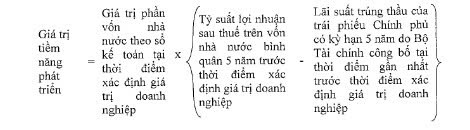
Where:
- The state capital value according to the accounting records at the time of determining the enterprise's privatization value is the total actual value recorded in the accounting books of the enterprise at the time of valuation after deducting liabilities, surplus operating funds (if any), and excluding foreign exchange differences due to revaluation of monetary items denominated in foreign currencies as stipulated in Clause 3, Article 17 of this Decree.
- State capital is determined to include the balance of: Owner investment capital - account 411; Development fund - account 414 and Basic construction investment capital - account 441 according to Circular No. 200/2014/TT-BTC dated December 22, 2014 of the Ministry of Finance on guiding enterprise accounting. The determination of state capital for credit organizations undergoing privatization shall follow the guidance of the State Bank of Vietnam.
- Post-tax profit margin is determined as follows:
|
Post-tax profit margin on average state capital over five years prior to the valuation date |
= |
Average post-tax profit over five consecutive years prior to the valuation date |
x |
100% |
|
Average post-tax profit over five consecutive years prior to the valuation date |
Average state capital according to accounting records over five years is calculated by dividing the sum of annual average state capital by five. Annual average state capital is determined based on the sum of initial and final state capital divided by two.
Article 32. Determination of the Investment Capital Value of Joint Stock Companies at Other Enterprises
1. The contribution capital value of the joint stock company undergoing shareholding reform invested in a limited liability company with one member contributed 100% by the joint stock company undergoing shareholding reform shall be determined as follows:
a) The contribution capital value of the joint stock company undergoing shareholding reform invested in the second-level enterprise must be re-evaluated according to the provisions of Chapter II and Chapter III of this Decree.
b) In cases where the second-level enterprise has contributed capital in another limited liability company with one member (hereinafter referred to as the third-level enterprise), the determination of the contribution capital value of the second-level enterprise in the third-level enterprises shall be carried out according to the provisions of point a, point b, and point c of Clause 3 of this Article.
c) In cases where the second-level enterprise is established and operates abroad, the determination of the contribution capital value in these enterprises shall be conducted as for the investment capital of the joint stock company undergoing shareholding reform in other enterprises as stipulated in point a, point b, and point c of Clause 3 of this Article.
The conversion of the contribution capital value of the joint stock company undergoing shareholding reform at the second-level and third-level enterprises operating abroad shall be carried out according to the foreign currency purchase rate of the commercial bank where the joint stock company undergoing shareholding reform regularly conducts transactions at the time of determining the enterprise value.
2. The contribution capital value of the joint stock company undergoing shareholding reform in a joint stock company listed on the securities market shall be determined based on the reference price of the shares traded on the securities market at the time of determining the enterprise value. In cases where there is no transaction at the time of determining the enterprise value, it shall be determined according to the reference price of the nearest trading session before the time of determining the enterprise value.
The contribution capital value of the joint stock company undergoing shareholding reform in a joint stock company registered for trading on the market of publicly traded companies not yet listed (UPCOM) shall be determined as the average trading price on the system at the time of determining the enterprise value. In cases where there is no transaction at the time of determining the enterprise value, it shall be determined according to the average trading price on the system of the nearest day before the time of determining the enterprise value. In cases where the shares of a joint stock company registered for trading on the UPCOM market have no transactions within 30 days prior to the time of determining the enterprise value, they shall be determined according to the provisions of point a, point b, and point c of Clause 3 of this Article.
In cases where the price on the securities market or the UPCOM market is lower than the par value (10,000 VND) but the joint stock company with the contribution capital of the joint stock company undergoing shareholding reform is profitable, the contribution capital value of the joint stock company undergoing shareholding reform in this joint stock company shall be determined according to the provisions of point a and point b of Clause 3 of this Article.
3. The contribution capital value of the joint stock company undergoing shareholding reform at other enterprises (except for the cases provided for in Clause 1 and Clause 2 of this Article) shall be determined based on the ratio of actual contribution capital multiplied (x) by the equity capital value of the other enterprise:
a) The ratio of actual contribution capital of the joint stock company undergoing shareholding reform is the percentage of the actual capital actually contributed by the joint stock company undergoing shareholding reform compared to the total actual contribution capital (capital contributions of all shareholders) of the other enterprise;
c) In cases where the investment capital value of the joint stock company undergoing shareholding reform at other enterprises when evaluated and re-evaluated has a real value lower than the value recorded in the accounting books of the joint stock company undergoing shareholding reform, it shall be determined according to the re-evaluated real value but not less than zero (0) VND;
d) The conversion of the contribution capital value of the joint stock company undergoing shareholding reform at joint stock companies, limited liability companies with two or more members operating abroad shall be carried out according to the foreign currency purchase rate of the commercial bank where the joint stock company undergoing shareholding reform regularly conducts transactions at the time of determining the enterprise value.
Chapter IV
FIRST SHARE SALE AND MANAGEMENT,
USE OF FUNDS FROM SHAREHOLDING REFORM
Article 33. Determination of Registered Capital and Initial Share Structure
a) In cases where the value of state capital according to accounting records at the enterprise exceeds the required registered capital for the operation of the enterprise, the representative body of the owner shall determine the registered capital based on actual needs. The difference between the value of state capital according to accounting records at the enterprise and the determined registered capital shall be remitted to the Enterprise Restructuring and Development Fund.
b) In cases of additional share issuance, the registered capital shall be determined by the sum of the value of state capital according to accounting records at the enterprise and the value of additional shares issued at par value.
2. On the basis of the determined registered capital, the representative body of the owner shall decide on the initial share structure, including:
a) State shares held according to the criteria for classifying state-owned enterprises published by the Prime Minister during each period.
For special enterprises with significant roles in local economic development, serving industry development strategies, and economic groups (such as: Port management and exploitation; in cases where the state holds 36% of the registered capital and other special cases), the representative body of the owner shall report to the Prime Minister to decide specifically on the number of state shares to continue holding and the number of preferential voting shares according to Clause 3, Article 113 and Article 116 of the Enterprise Law.
b) Shares sold to grassroots trade unions at the joint-stock company being restructured.
Grassroots trade unions at the joint-stock company being restructured may use the union fund at the joint-stock company (as stipulated in Article 26 of the Trade Union Law 2012; without fundraising or borrowing) to purchase shares but not exceeding 3% of the registered capital. These shares shall be held by the trade union organization but may not be transferred within three years from the date the joint-stock company is converted to a joint-stock corporation.
The price for selling shares to grassroots trade unions at the joint-stock company being restructured is equal to the par value (10,000 VND per share).
c) Shares sold to employees of the enterprise according to Clause 1 and Clause 2, Article 42 of this Decree.
d) Shares sold to strategic investors (if any) according to Clause 3, Article 6 of this Decree.
đ) Shares publicly auctioned to the public, at a minimum, equal to 20% of the registered capital.
3. In cases where the quantity of preferential shares sold to employees of the enterprise (based on the maximum preference level) exceeds the remaining quantity of shares planned for issuance (after deducting the number of state-held shares and shares sold to investors and trade unions as stipulated in Points a, b, d, and đ of Clause 2 of this Article) and the enterprise does not fall under the category of state control through shareholding, the representative body of the owner shall consider and decide to reduce the number of state-held shares to increase the quantity of preferential shares sold to employees.
Article 34. Public Auction Method
1. The public auction method shall be applied in cases where shares are sold to the general public without distinguishing between investor organizations, individuals, domestic and foreign entities.
2. The organization of public auctions shall take place at the Securities Exchange. In cases where the amount of issued shares with a nominal value under VND 10 billion of a joint-stock company undergoing shareholding reform, the representative body of the owner may consider and decide to organize auctions at securities companies or service centers, asset auction enterprises in accordance with the laws on asset auctions.
4. The selling price under the public auction method is the successful bid price of each investor. An investor who wins at a certain price buys shares at that price but not below the starting price.
Article 35. Guarantee Issuance Method
1. The guarantee issuance method is a method of issuing shares with the commitment of a guarantor organization to ensure the distribution of all issued shares outside has been approved by the competent authority.
In cases of guaranteeing the issuance for foreign investors, it must comply with the provisions of the law regarding the rights of foreign investors to purchase and contribute capital to Vietnamese enterprises.
In cases where shares are not fully sold, the guarantor organizations are responsible for purchasing the remaining shares according to the guaranteed price committed in the Guarantee Contract, following the principle of not being lower than the starting price.
2. The obligations and powers of the guarantor organization shall be implemented in accordance with the provisions of the law on securities and the securities market and the Guarantee Agreement for Share Issuance signed between the guarantor organization and the authorized representative of the joint-stock company undergoing shareholding reform.
Article 36. Direct Negotiation Method
1. The direct negotiation method is a method of selling shares to investors based on the results of negotiations between the Steering Committee or the entity authorized by the Steering Committee and each investor.
2. The selling price under the negotiation method is regulated in point d, point e Clause 3 Article 6 and Clause 2, Clause 4 Article 37 of this Decree.
1. In cases where no investor registers to buy shares, the Steering Committee implements the sale of shares to employees and trade unions within the enterprise according to the approved shareholding reform plan, while implementing procedures to convert the enterprise into a joint-stock company. The unsold shares will be adjusted to the registered capital and capital structure, and the withdrawal of capital will be carried out after the enterprise operates as a joint-stock company.
2. In cases where only one investor registers to buy shares, the Steering Committee implements the negotiation sale of shares to the registered investor at a price not lower than the starting price with the valid quantity registered to purchase. If the investor does not buy, the joint-stock company undergoes shareholding reform shall implement the provisions of Clause 1 of this Article.
3. In cases where all winning bidders in the public auction refuse to buy after the public auction, the joint-stock company undergoing shareholding reform shall implement the provisions of Clause 1 of this Article.
4. In cases where a portion of the offered shares have been sold in the public auction, the remaining unsold shares from the public auction (including the number of shares won by bidders who refused to buy) shall be handled in the following sequence:
a) The Steering Committee continues to notify eligible bidders (excluding those who won the public auction) to negotiate sales to these investors according to the registered volume and the bid price at the auction session, selecting negotiation prices from the highest bid price down to the lowest announced auction price until the required number of shares is sold.
b) If the shares are not fully sold after negotiating with the investors, the Steering Committee continues to notify the winning bidders in the public auction (excluding those who won but refused to buy) to negotiate sales to these investors at their bid prices during the auction session, selecting negotiation prices from the highest bid price down to the lowest announced auction price until the required number of shares is sold.
c) In cases where the number of unsold shares remains as stipulated in points a and b of this clause, the joint-stock company undergoing shareholding reform shall implement the provisions of Clause 1 of this Article.
Điều 38. Thời hạn hoàn thành việc bán cổ phần
Trong thời hạn 04 tháng, kể từ ngày quyết định phê duyệt phương án cổ phần hóa, doanh nghiệp phải hoàn thành việc bán cổ phần (kể cả bán cổ phần theo phương thức bảo lãnh phát hành và bán thỏa thuận trực tiếp).
Điều 39. Quản lý và sử dụng số tiền thu từ cổ phần hóa
a) Trong thời hạn 05 ngày làm việc kể từ ngày hết hạn nộp tiền của nhà đầu tư tham gia cuộc đấu giá công khai, tổ chức thực hiện bán đấu giá có trách nhiệm chuyển tiền thu từ bán cổ phần lần đầu cho doanh nghiệp cổ phần hóa để xử lý lao động dôi dư và thanh toán chi phí cổ phần hóa theo dự toán chi phí đã xác định trong phương án cổ phần hóa được cơ quan có thẩm quyền phê duyệt; phần còn lại nộp về Quỹ hỗ trợ sắp xếp và phát triển doanh nghiệp.
c) Trong thời hạn 20 ngày kể từ ngày hết hạn nộp tiền của nhà đầu tư tham gia cuộc bán đấu giá công khai, Ban Chỉ đạo chỉ đạo doanh nghiệp hoàn tất xong việc bán số cổ phần theo quy định tại khoản 4 Điều 37. Trong thời hạn 05 ngày kể từ ngày hết hạn nộp tiền, Ban Chỉ đạo chỉ đạo doanh nghiệp chuyển tiền thu từ việc bán cổ phần này nộp về Quỹ hỗ trợ sắp xếp và phát triển doanh nghiệp.
d) Trong thời hạn 30 ngày kể từ ngày hết hạn nộp tiền của nhà đầu tư tham gia cuộc bán đấu giá công khai, Ban Chỉ đạo chỉ đạo doanh nghiệp hoàn tất việc bán cổ phần theo phương thức thỏa thuận cho các nhà đầu tư chiến lược theo quy định tại Nghị định này. Số tiền thu được từ bán cổ phần này, Ban Chỉ đạo cổ phần hóa nộp về Quỹ hỗ trợ sắp xếp và phát triển doanh nghiệp trong thời hạn 05 ngày kể từ ngày hết hạn nộp tiền.
đ) Trong thời hạn 30 ngày kể từ ngày hết hạn nộp tiền của nhà đầu tư tham gia cuộc bán đấu giá công khai, Ban Chỉ đạo chỉ đạo doanh nghiệp phối hợp cùng tổ chức bán đấu giá hoàn tất việc bán đấu giá cho các nhà đầu tư chiến lược. Trong thời hạn 05 ngày kể từ ngày hết hạn nộp tiền, Ban Chỉ đạo chuyển tiền thu từ việc bán cổ phần này nộp về Quỹ hỗ trợ sắp xếp và phát triển doanh nghiệp.
e) Trường hợp tổng số tiền thu từ bán cổ phần lần đầu quy định tại điểm a, b, c, d, đ khoản 1 Điều này thấp hơn dự toán chi phí xử lý lao động dôi dư và dự toán chi phí cổ phần hóa theo phương án cổ phần hóa được phê duyệt, doanh nghiệp cổ phần hóa được giữ lại toàn bộ khoản tiền thu này để thực hiện chi trả các khoản chi theo dự toán đã được duyệt và thực hiện quyết toán chính thức tại thời điểm doanh nghiệp được cấp Giấy chứng nhận đăng ký doanh nghiệp lần đầu.
a) Trong thời hạn 90 ngày kể từ thời điểm được cấp Giấy chứng nhận đăng ký doanh nghiệp lần đầu, căn cứ báo cáo tài chính tại thời điểm doanh nghiệp được cấp Giấy chứng nhận đăng ký doanh nghiệp lần đầu hoạt động dưới hình thức công ty cổ phần và hướng dẫn xử lý tài chính tại thời điểm doanh nghiệp chính thức chuyển thành công ty cổ phần theo quy định tại Điều 21 Nghị định này, doanh nghiệp có trách nhiệm tự xác định khoản phải nộp về Quỹ hỗ trợ sắp xếp và phát triển doanh nghiệp. Trong đó các khoản được để lại doanh nghiệp gồm:
b) Trong phạm vi 05 ngày làm việc kể từ ngày có quyết định của cơ quan đại diện chủ sở hữu về các nội dung quy định tại khoản 4 Điều 21 Nghị định này, doanh nghiệp có trách nhiệm nộp tiếp khoản chênh lệch tăng thêm so với số đã nộp xác định tại điểm a khoản 2 Điều này (nếu có) về Quỹ hỗ trợ sắp xếp và phát triển doanh nghiệp.
c) Trường hợp số tiền phải nộp về Quỹ hỗ trợ sắp xếp và phát triển doanh nghiệp theo quyết toán của cơ quan đại diện chủ sở hữu thấp hơn số doanh nghiệp tự xác định và đã nộp theo quy định tại điểm a khoản 2 Điều này thì doanh nghiệp có công văn báo cáo Bộ Tài chính yêu cầu hoàn trả số tiền nộp thừa. Căn cứ văn bản đề nghị của doanh nghiệp và các hồ sơ, tài liệu theo quy định tại Quy chế quản lý và sử dụng Quỹ hỗ trợ sắp xếp và phát triển doanh nghiệp, Bộ Tài chính quyết định xuất Quỹ hoàn trả số tiền doanh nghiệp đã nộp thừa trong thời hạn 10 ngày làm việc.
d) Trường hợp số tiền thực thu từ bán cổ phần ưu đãi cho người lao động, tổ chức công đoàn, nhà đầu tư chiến lược và các nhà đầu tư khác theo kết quả IPO không đảm bảo đủ bù đắp được các chi phí liên quan (gồm chi phí cổ phần hóa, chi phí hỗ trợ lao động dôi dư, chi phí ưu đãi cho người lao động) theo quyết toán được cấp có thẩm quyền phê duyệt thì cơ quan đại diện chủ sở hữu xem xét quyết định thông qua Đại hội đồng cổ đông để điều chỉnh giảm vốn nhà nước góp trong công ty cổ phần (nếu công ty cổ phần còn vốn nhà nước), vốn điều lệ và cơ cấu vốn điều lệ của công ty cổ phần cho phù hợp với thực tế. Trường hợp sau khi điều chỉnh không còn vốn nhà nước thì doanh nghiệp báo cáo cơ quan đại diện chủ sở hữu có công văn gửi Bộ Tài chính đề nghị xuất Quỹ hỗ trợ sắp xếp và phát triển doanh nghiệp hoàn trả doanh nghiệp phần còn thiếu theo quy định tại điểm c khoản này.
- Giá trị tương ứng với số cổ phần phát hành thêm tính theo mệnh giá.
- Phần thặng dư vốn của số cổ phần phát hành thêm được sử dụng để thanh toán chi phí cổ phần hóa và giải quyết chính sách đối với lao động dôi dư (nếu thiếu thì được xử lý theo quy định tại điểm d khoản này); số tiền còn lại (nếu có) để lại cho công ty cổ phần theo tỷ lệ tương ứng với cổ phần phát hành thêm trong cơ cấu vốn điều lệ, trong đó:
|
Phần thặng dư của số cổ phần phát hành thêm |
= |
Số lượng cổ phần phát hành thêm |
x |
{Giá trúng đấu giá |
- |
Giá khởi điểm} |
4. Thủ tướng Chính phủ quyết định cơ chế quản lý và sử dụng Quỹ hỗ trợ sắp xếp và phát triển doanh nghiệp. Bộ Tài chính có trách nhiệm tổ chức bộ máy quản lý Quỹ hỗ trợ sắp xếp và phát triển doanh nghiệp theo cơ chế được Thủ tướng Chính phủ quy định.
5. Cơ quan đại diện chủ sở hữu có trách nhiệm chỉ đạo Ban Chỉ đạo và doanh nghiệp cổ phần hóa báo cáo đầy đủ, kịp thời việc quản lý và sử dụng các khoản thu từ cổ phần hóa gửi về Bộ Tài chính.
Điều 40. Điều lệ công ty cổ phần
1. Điều lệ công ty cổ phần do Ban Chỉ đạo chỉ đạo doanh nghiệp phối hợp với tổ chức tư vấn cổ phần hóa dự thảo và được công bố cho các nhà đầu tư trước khi bán cổ phần. Dự thảo Điều lệ công ty cổ phần không được trái với quy định của Luật doanh nghiệp và quy định của pháp luật liên quan.
2. Điều lệ của công ty cổ phần được Đại hội đồng cổ đông lần đầu thông qua khi được ít nhất 65% tổng số phiếu biểu quyết của các nhà đầu tư góp vốn mua cổ phần dự họp chấp thuận.
Điều 41. Đại hội đồng cổ đông và đăng ký doanh nghiệp lần đầu
1. Trong thời hạn 30 ngày làm việc, kể từ ngày hoàn thành việc bán cổ phần, doanh nghiệp cổ phần hóa phải tổ chức Đại hội đồng cổ đông lần đầu để chuyển doanh nghiệp thành công ty cổ phần và thực hiện đăng ký doanh nghiệp theo quy định của pháp luật.
2. Hồ sơ đăng ký doanh nghiệp phải bao gồm: quyết định chuyển thành công ty cổ phần của cơ quan quyết định cổ phần hóa, quyết định cử người đại diện phần vốn nhà nước tại công ty cổ phần của cơ quan đại diện chủ sở hữu (nếu có) và Điều lệ công ty cổ phần có chữ ký của người đại diện theo pháp luật của Công ty cổ phần.
Chương V
CHÍNH SÁCH ĐỐI VỚI
NGƯỜI LAO ĐỘNG KHI CỔ PHẦN HÓA
Điều 42. Chính sách bán cổ phần cho người lao động
a) Đối tượng mua cổ phần với giá ưu đãi bao gồm:
b) Các đối tượng quy định tại điểm a khoản 1 Điều này được mua tối đa 100 cổ phần cho mỗi năm thực tế làm việc tại khu vực nhà nước với giá bán bằng 60% giá trị 01 cổ phần tính theo mệnh giá (10.000 đồng/cổ phần).
c) Đối với người lao động đại diện cho hộ gia đình nhận khoán (mỗi hộ gia đình nhận khoán cử một người lao động đại diện) tại thời điểm xác định giá trị doanh nghiệp cổ phần hóa có hợp đồng nhận khoán ổn định lâu dài với công ty nông, lâm nghiệp khi chuyển sang công ty cổ phần được mua tối đa 100 cổ phần cho mỗi năm thực tế đã nhận khoán với công ty với giá bán bằng 60% giá trị 01 cổ phần tính theo mệnh giá (10.000 đồng/cổ phần).
d) Khoản chênh lệch giữa giá bán cho người lao động so với mệnh giá cổ phần theo quy định tại khoản 1 Điều này được trừ vào giá trị phần vốn nhà nước khi quyết toán tại thời điểm doanh nghiệp chính thức chuyển thành công ty cổ phần.
đ) Số cổ phần bán với giá ưu đãi theo quy định tại khoản này, người lao động phải nắm giữ và không được chuyển nhượng trong vòng 03 năm kể từ thời điểm nộp tiền mua cổ phần ưu đãi.
- Người lao động làm việc theo hợp đồng lao động và người quản lý doanh nghiệp của doanh nghiệp cổ phần hóa tại thời điểm xác định giá trị doanh nghiệp cổ phần hóa.
- Người lao động của doanh nghiệp cổ phần hóa tại thời điểm xác định giá trị doanh nghiệp cổ phần hóa đã được cử xuống làm đại diện phần vốn tại các doanh nghiệp khác chưa được hưởng chính sách mua cổ phần ưu đãi tại các doanh nghiệp khác.
- Người lao động làm việc theo hợp đồng lao động và người quản lý doanh nghiệp của doanh nghiệp cấp II (chưa được hưởng chính sách mua cổ phần ưu đãi tại các doanh nghiệp khác) tại thời điểm xác định giá trị doanh nghiệp cổ phần hóa đối với các doanh nghiệp quy định tại điểm a khoản 2 Điều 2 Nghị định này.
2. Người lao động làm việc theo hợp đồng lao động và người quản lý doanh nghiệp của doanh nghiệp cổ phần hóa tại thời điểm xác định giá trị doanh nghiệp cổ phần hóa, thuộc đối tượng doanh nghiệp cần sử dụng và có cam kết làm việc lâu dài cho doanh nghiệp trong thời hạn ít nhất là 03 năm (kể từ ngày doanh nghiệp được cấp Giấy chứng nhận đăng ký doanh nghiệp lần đầu) sẽ được mua thêm cổ phần theo quy định sau:
a) Mua thêm theo mức 200 cổ phần/01 năm cam kết làm việc tiếp trong doanh nghiệp nhưng tối đa không quá 2.000 cổ phần cho một người lao động.
Riêng người lao động là các chuyên gia giỏi, có trình độ chuyên môn nghiệp vụ cao được mua thêm theo mức 500 cổ phần/01 năm cam kết làm việc tiếp trong doanh nghiệp nhưng tối đa không quá 5.000 cổ phần cho một người lao động. Doanh nghiệp cổ phần hóa căn cứ đặc thù ngành nghề, lĩnh vực kinh doanh của mình xây dựng và quyết định các tiêu chí để xác định chuyên gia giỏi, có trình độ nghiệp vụ cao và phải được nhất trí thông qua tại Hội nghị người lao động của doanh nghiệp trước khi cổ phần hóa.
b) Giá bán cổ phần cho người lao động mua thêm quy định tại điểm a khoản này là giá khởi điểm được cơ quan đại diện chủ sở hữu phê duyệt trong phương án cổ phần hóa.
c) Mỗi một người lao động chỉ được hưởng quyền mua thêm cổ phần theo một mức xác định tại điểm a khoản này.
Trường hợp công ty cổ phần thực hiện thay đổi cơ cấu, công nghệ, di dời hoặc thu hẹp địa điểm sản xuất, kinh doanh theo yêu cầu của cơ quan nhà nước có thẩm quyền dẫn tới người lao động phải chấm dứt hợp đồng lao động, thôi việc, mất việc theo quy định của Bộ luật lao động trước thời hạn đã cam kết thì số cổ phần đã được mua thêm sẽ được chuyển đổi thành cổ phần phổ thông. Trường hợp người lao động có nhu cầu bán lại cho doanh nghiệp số cổ phần này thì công ty cổ phần có trách nhiệm mua lại với giá sát với giá giao dịch trên thị trường.
Trường hợp người lao động chấm dứt hợp đồng lao động trước thời hạn đã cam kết thì phải bán lại cho công ty cổ phần toàn bộ số cổ phần đã được mua thêm với giá sát với giá giao dịch trên thị trường nhưng không vượt quá giá đã được mua tại thời điểm cổ phần hóa.
3. Người lao động trong doanh nghiệp thực hiện tái cơ cấu chuyển thành công ty cổ phần thông qua Công ty Mua bán nợ Việt Nam theo quy định tại khoản 2 Điều 4 Nghị định này được áp dụng các chính sách quy định tại khoản 1 và khoản 2 Điều này theo điều kiện cụ thể của doanh nghiệp và phương án tái cơ cấu được cấp có thẩm quyền phê duyệt.
4. Người lao động có nhu cầu mua thêm cổ phần ngoài số cổ phần được mua theo quy định tại khoản 1 và khoản 2 Điều này thực hiện đăng ký mua đấu giá công khai theo quy định như các nhà đầu tư khác.
Điều 43. Chính sách đối với người lao động dôi dư
1. Người lao động làm việc theo hợp đồng lao động và người lao động của doanh nghiệp cổ phần hóa tại thời điểm xác định giá trị doanh nghiệp cổ phần hóa đã được cử xuống làm đại diện phần vốn tại các doanh nghiệp khác mà không bố trí được việc làm tại công ty cổ phần theo phương án sử dụng lao động sẽ được hưởng chính sách đối với người lao động dôi dư theo quy định của pháp luật.
2. Người quản lý doanh nghiệp do cơ quan đại diện chủ sở hữu xem xét, quyết định bố trí công việc. Trường hợp cơ quan đại diện chủ sở hữu đã tìm mọi biện pháp nhưng không bố trí được việc làm thì được hưởng chính sách như chính sách tinh giản biên chế đối với cán bộ, công chức theo quy định của pháp luật.
3. Người quản lý doanh nghiệp cấp II quy định tại khoản 2 Điều 2 Nghị định này do Hội đồng thành viên hoặc Chủ tịch các doanh nghiệp nhà nước xem xét, quyết định bố trí công việc. Trường hợp đã tìm mọi biện pháp nhưng không bố trí được việc làm thì giải quyết chính sách theo quy định của pháp luật về lao động.
Chương VI
TỔ CHỨC THỰC HIỆN
Điều 44. Việc chuyển đổi Công ty trách nhiệm hữu hạn một thành viên do doanh nghiệp nhà nước đầu tư 100% vốn điều lệ thành công ty cổ phần
1. Hội đồng thành viên hoặc Chủ tịch các doanh nghiệp nhà nước quy định tại khoản 2 Điều 2, căn cứ vào Nghị định này để chuyển doanh nghiệp cấp II sang công ty cổ phần.
2. Đến thời điểm xác định giá trị doanh nghiệp, những tài sản không cần dùng, tài sản ứ đọng, tài sản chờ thanh lý chưa được xử lý, ngoại trừ các trường hợp tài sản không được phép loại trừ như quy định tại khoản 3 Điều 14 Nghị định này, doanh nghiệp cấp II hạch toán giá trị còn lại theo sổ sách của các tài sản này vào chi phí sản xuất kinh doanh của doanh nghiệp và thực hiện chuyển giao các tài sản này cho Công ty mẹ để tiếp tục quản lý và thực hiện thanh lý, nhượng bán theo quy định. Khoản tiền thu được từ thanh lý, nhượng bán tài sản, Công ty mẹ hạch toán vào kết quả kinh doanh.
3. Trên cơ sở kết quả xác định giá trị doanh nghiệp để cổ phần hóa đã được cơ quan tư vấn xác định và ý kiến của cơ quan đại diện chủ sở hữu, Kiểm toán nhà nước thực hiện kiểm toán kết quả định giá doanh nghiệp và xử lý các vấn đề về tài chính trước khi định giá đối với doanh nghiệp cấp II có vốn chủ sở hữu theo sổ sách kế toán tại thời điểm xác định giá trị doanh nghiệp từ 1.800 tỷ đồng trở lên.
Trường hợp số tiền thu từ cổ phần hóa doanh nghiệp cấp II không đủ để chi các khoản chi theo quy định khi cổ phần hóa các doanh nghiệp này (chi phí cổ phần hóa, chi phí giải quyết chế độ cho người lao động dôi dư, chi phí ưu đãi cho người lao động) thì công ty mẹ có trách nhiệm chi bù đắp phần còn thiếu và được tính vào chi phí hoạt động tài chính của công ty mẹ.
Điều 45. Quyền hạn và trách nhiệm trong tổ chức thực hiện cổ phần hóa
1. Thủ tướng Chính phủ:
a) Phê duyệt danh mục các doanh nghiệp quy định tại khoản 2 và khoản 3 Điều 2 Nghị định này chuyển thành công ty cổ phần.
b) Quyết định phê duyệt phương án cổ phần hóa các tập đoàn kinh tế, tổng công ty nhà nước, doanh nghiệp có vốn nhà nước theo sổ kế toán từ 1.800 tỷ đồng trở lên và các doanh nghiệp cấp II có mức vốn chủ sở hữu theo sổ sách kế toán từ 1.800 tỷ đồng trở lên.
c) Quyết định cơ quan đại diện chủ sở hữu đối với phần vốn nhà nước sau cổ phần hóa tại các đơn vị nêu tại điểm b khoản 1 Điều này, ngoại trừ các doanh nghiệp cấp II.
d) Xem xét, quyết định xử lý các vấn đề đặc thù, các nội dung phát sinh trong quá trình cổ phần hóa tại từng doanh nghiệp chưa được quy định cụ thể trong Nghị định này trên cơ sở đề nghị của cơ quan đại diện chủ sở hữu.
2. Cơ quan đại diện chủ sở hữu căn cứ danh mục doanh nghiệp thuộc diện cổ phần hóa đã được Thủ tướng Chính phủ phê duyệt:
a) Thành lập Ban Chỉ đạo để giúp cơ quan đại diện chủ sở hữu tổ chức triển khai công tác cổ phần hóa theo quy định tại Nghị định này.
Thành lập Ban Chỉ đạo để giúp Thủ tướng Chính phủ tổ chức triển khai công tác cổ phần hóa các đơn vị quy định tại điểm b khoản 1 Điều này.
b) Hướng dẫn, kiểm tra, giám sát quá trình cổ phần hóa các đơn vị thuộc phạm vi quản lý theo các nội dung quy định tại Nghị định này.
c) Quyết định lựa chọn tổ chức tư vấn cổ phần hóa, lựa chọn tổ chức bán đấu giá cổ phần, công bố giá trị doanh nghiệp và trình Thủ tướng Chính phủ phê duyệt Phương án cổ phần hóa đơn vị quy định tại điểm b khoản 1 Điều này.
d) Quyết định lựa chọn tổ chức tư vấn cổ phần hóa, lựa chọn tổ chức bán đấu giá cổ phần; công bố giá trị doanh nghiệp, quyết định phương án cổ phần hóa các doanh nghiệp thuộc phạm vi quản lý kèm theo dự thảo Điều lệ công ty cổ phần được xây dựng phù hợp với quy định của Luật doanh nghiệp và các quy định của pháp luật liên quan.
đ) Quyết định phê duyệt phương án mua bán nợ tái cơ cấu, phương án cổ phần hóa các doanh nghiệp kinh doanh thua lỗ sau khi có thỏa thuận bằng văn bản với Công ty Mua bán nợ Việt Nam và các chủ nợ của doanh nghiệp về phương án mua bán nợ tái cơ cấu lại doanh nghiệp theo quy định tại khoản 2 Điều 4 Nghị định này.
Thời gian hoàn thành việc phê duyệt phương án mua bán nợ tái cơ cấu, phương án cổ phần hóa các doanh nghiệp kinh doanh thua lỗ quy định tại khoản 2 Điều 4 Nghị định này không vượt quá 03 tháng kể từ ngày quyết định công bố giá trị doanh nghiệp.
e) Quyết định điều chỉnh vốn nhà nước tại công ty cổ phần theo quy định; quyết định bàn giao cho Công ty Mua bán nợ Việt Nam đối với tài sản thừa (nếu có) quy định tại khoản 4 Điều 10 Nghị định này.
g) Quyết định phê duyệt phương án sử dụng lao động và giải quyết lao động dôi dư đối với doanh nghiệp cổ phần hóa.
h) Trong thời hạn quy định tại khoản 4 Điều 21 Nghị định này, cơ quan đại diện chủ sở hữu phối hợp với các cơ quan liên quan quyết định phê duyệt quyết toán tài chính; quyết toán chi phí cổ phần hóa; quyết toán kinh phí hỗ trợ cho người lao động dôi dư; quyết toán số tiền thu từ cổ phần hóa và quyết định công bố giá trị thực tế phần vốn nhà nước tại thời điểm công ty cổ phần được cấp Giấy chứng nhận đăng ký doanh nghiệp lần đầu (bao gồm cả các đơn vị quy định tại điểm b khoản 1 Điều này).
i) Giải quyết những vướng mắc, khiếu nại, tố cáo tại các doanh nghiệp cổ phần hóa theo thẩm quyền đúng quy định của pháp luật hiện hành.
k) Chỉ đạo doanh nghiệp cổ phần hóa thực hiện đăng ký, lưu ký cổ phần trúng đấu giá tại Trung tâm lưu ký chứng khoán Việt Nam và đăng ký giao dịch tại các sàn giao dịch chứng khoán theo quy định.
l) Chỉ đạo doanh nghiệp cổ phần hóa lập hồ sơ và thực hiện chuyển giao quyền đại diện chủ sở hữu phần vốn nhà nước tại công ty cổ phần (sau chuyển đổi doanh nghiệp nhà nước) cho Tổng công ty Đầu tư và Kinh doanh vốn nhà nước theo quy định.
m) Quyết định phê duyệt tiêu chí và lựa chọn nhà đầu tư chiến lược đối với các doanh nghiệp có bán cổ phần cho nhà đầu tư chiến lược, bao gồm cả các doanh nghiệp quy định tại điểm b khoản 1 Điều này.
3. Hội đồng thành viên hoặc Chủ tịch các doanh nghiệp nhà nước quy định tại khoản 2 Điều 2 Nghị định này có trách nhiệm:
a) Tổ chức thực hiện kế hoạch cổ phần hóa các doanh nghiệp cấp II theo danh mục doanh nghiệp cổ phần hóa đã được Thủ tướng Chính phủ phê duyệt.
b) Thành lập Ban Chỉ đạo để giúp Hội đồng thành viên/Chủ tịch công ty tổ chức triển khai công tác cổ phần hóa các doanh nghiệp cấp II, ngoại trừ các đơn vị quy định tại điểm b khoản 1 Điều này.
c) Quyết định lựa chọn tổ chức tư vấn, lựa chọn tổ chức bán đấu giá cổ phần, xử lý các tồn tại về tài chính, công bố giá trị doanh nghiệp, phê duyệt phương án cổ phần hóa, phê duyệt phương án sử dụng lao động, quyết định phê duyệt quyết toán tài chính, quyết toán chi phí cổ phần hóa, quyết toán kinh phí hỗ trợ cho người lao động dôi dư, quyết toán số tiền thu từ cổ phần hóa và quyết định công bố giá trị thực tế phần vốn tại thời điểm công ty cổ phần được cấp Giấy chứng nhận đăng ký doanh nghiệp cổ phần lần đầu của các doanh nghiệp cấp II theo quy định tại Nghị định này, ngoại trừ các đơn vị quy định tại điểm b khoản 1 Điều này.
d) Hướng dẫn, kiểm tra, giám sát quá trình cổ phần hóa các đơn vị thuộc phạm vi quản lý theo các nội dung quy định tại Nghị định này.
đ) Quyết định phê duyệt tiêu chí và lựa chọn nhà đầu tư chiến lược của các doanh nghiệp cấp II có bán cổ phần cho nhà đầu tư chiến lược, ngoại trừ các doanh nghiệp quy định tại điểm b khoản 1 Điều này.
4. Quyền hạn, trách nhiệm và thành phần Ban Chỉ đạo:
- Giúp cơ quan quyết định cổ phần hóa chỉ đạo và tổ chức thực hiện cổ phần hóa một hoặc một số doanh nghiệp theo quy định tại Nghị định này.
- Được sử dụng con dấu của cơ quan đại diện chủ sở hữu trong khi thực hiện nhiệm vụ.
- Thành lập Tổ giúp việc triển khai công tác cổ phần hóa tại doanh nghiệp.
- Chỉ đạo doanh nghiệp căn cứ kế hoạch cổ phần hóa đã được phê duyệt:
+ Chủ động thực hiện chuẩn bị hồ sơ, tài liệu pháp lý về tài sản của doanh nghiệp (bao gồm cả nhà cửa, đất đai); phương án sử dụng đất sau cổ phần hóa; kiểm kê tài sản, đối chiếu công nợ tại thời điểm lập báo cáo tài chính theo quy định của pháp luật.
+ Xây dựng kế hoạch tiến độ cổ phần hóa (bao gồm cả mốc thời gian cho từng bước công việc) trình cơ quan đại diện chủ sở hữu phê duyệt để thực hiện. Trường hợp không thực hiện được tiến độ cổ phần hóa thì Ban lãnh đạo doanh nghiệp được xác định là không hoàn thành nhiệm vụ.
- Chỉ đạo xử lý các vấn đề về tài chính, lao động, tổ chức xác định giá trị doanh nghiệp theo quy định tại Nghị định này.
- Báo cáo cơ quan đại diện chủ sở hữu lựa chọn phương thức bán cổ phần lần đầu.
- Chỉ đạo xây dựng phương án cổ phần hóa và dự thảo Điều lệ lần đầu của công ty cổ phần.
- Chỉ đạo xây dựng phương án sử dụng lao động trình cơ quan đại diện chủ sở hữu (đối với doanh nghiệp nhà nước) hoặc Hội đồng thành viên/Chủ tịch doanh nghiệp nhà nước (đối với doanh nghiệp cấp II, ngoại trừ các đơn vị quy định tại điểm b khoản 1 Điều này) phê duyệt.
- Thẩm tra và trình cơ quan đại diện chủ sở hữu quyết định lựa chọn tổ chức tư vấn cổ phần hóa, lựa chọn tổ chức bán đấu giá cổ phần, công bố giá trị doanh nghiệp, quyết định phê duyệt phương án cổ phần hóa.
- Chỉ đạo doanh nghiệp cổ phần hóa phối hợp với các tổ chức đấu giá bán cổ phần theo quy định.
- Chỉ đạo doanh nghiệp cổ phần hóa xác định số tiền thu về cổ phần hóa phù hợp với hình thức cổ phần hóa công ty, lập báo cáo quyết toán (quyết toán tài chính thời điểm chính thức chuyển sang công ty cổ phần, quyết toán chi phí cổ phần hóa, chi phí giải quyết chế độ cho người lao động dôi dư, chi phí ưu đãi cho người lao động và tổ chức công đoàn) báo cáo cơ quan có thẩm quyền phê duyệt.
- Tổng hợp báo cáo cơ quan đại diện chủ sở hữu kết quả bán cổ phần.
- Tổng hợp và trình cơ quan đại diện chủ sở hữu quyết định điều chỉnh phương án cổ phần hóa, quyết định điều chỉnh giá trị doanh nghiệp sau khi chuyển thành công ty cổ phần.
- Phối hợp với các cơ quan liên quan thẩm tra và trình cơ quan đại diện chủ sở hữu quyết định phê duyệt quyết toán tài chính; quyết toán chi phí cổ phần hóa; quyết toán kinh phí hỗ trợ cho người lao động dôi dư; quyết toán số tiền thu từ cổ phần hóa và công bố giá trị thực tế phần vốn nhà nước tại thời điểm công ty cổ phần được cấp Giấy chứng nhận đăng ký doanh nghiệp lần đầu các doanh nghiệp.
- Xem xét và đề xuất với cơ quan đại diện chủ sở hữu cử người đại diện phần vốn nhà nước góp tại doanh nghiệp cổ phần hóa.
- Chỉ đạo doanh nghiệp cổ phần hóa thực hiện công bố công khai kịp thời, đầy đủ quá trình cổ phần hóa trên cổng thông tin điện tử Chính phủ và gửi về Bộ Tài chính, Ban Chỉ đạo Đổi mới và Phát triển doanh nghiệp để theo dõi.
b) Thành phần Ban Chỉ đạo do Bộ trưởng, Thủ trưởng cơ quan ngang bộ, cơ quan thuộc Chính phủ, Chủ tịch Ủy ban nhân dân tỉnh, thành phố trực thuộc Trung ương, Hội đồng thành viên Công ty mẹ của Tập đoàn kinh tế, Tổng công ty nhà nước, Công ty mẹ trong tổ hợp công ty mẹ - công ty con quyết định.
Đối với các đơn vị nêu tại điểm b khoản 1 Điều này thì thành viên Ban Chỉ đạo có đại diện của Ban Chỉ đạo Đổi mới và Phát triển doanh nghiệp và Bộ Tài chính.
5. Tổ chức công đoàn tại doanh nghiệp cổ phần hóa có trách nhiệm phối hợp với Ban Chỉ đạo:
a) Tuyên truyền, vận động cán bộ, công nhân viên tại doanh nghiệp cổ phần hóa thực hiện chính sách cổ phần hóa của Nhà nước.
b) Tham gia giám sát quá trình cổ phần hóa.
c) Cử người đại diện phần vốn của tổ chức công đoàn tham gia ứng cử vào Hội đồng quản trị, Ban Kiểm soát công ty cổ phần theo quy định của pháp luật.
d) Sử dụng nguồn quỹ của công đoàn theo quy định của pháp luật mua cổ phần tại doanh nghiệp, tham gia quản lý doanh nghiệp với tư cách cổ đông và tổ chức thực hiện bảo vệ quyền lợi của người lao động trong doanh nghiệp theo quy định của pháp luật.
Điều 46. Chế độ báo cáo
Bộ trưởng, Thủ trưởng cơ quan ngang bộ, cơ quan thuộc Chính phủ, Chủ tịch Ủy ban nhân dân tỉnh, thành phố trực thuộc Trung ương, Hội đồng thành viên/Chủ tịch các Công ty mẹ của Tập đoàn kinh tế, Công ty mẹ của Tổng công ty nhà nước, Công ty mẹ trong tổ hợp công ty mẹ - công ty con có trách nhiệm báo cáo kịp thời về Ban Chỉ đạo Đổi mới và Phát triển doanh nghiệp và Bộ Tài chính các nội dung có liên quan trong quá trình cổ phần hóa như: kết quả xử lý các tồn tại về tài chính, kết quả định giá, quyết định công bố giá trị doanh nghiệp và điều chỉnh giá trị doanh nghiệp, phương án cổ phần hóa, kết quả bán cổ phần, quyết toán chi phí cổ phần hóa, quyết toán bàn giao sang công ty cổ phần, các hành vi vi phạm của tổ chức tư vấn trong quá trình cổ phần hóa. Đồng thời, chỉ đạo doanh nghiệp cổ phần hóa thực hiện công bố đầy đủ, kịp thời các nội dung quy định tại khoản 1 Điều 11 Nghị định này.
Điều 47. Trình tự cổ phần hóa
Việc tiến hành cổ phần hóa thực hiện theo trình tự các bước công việc cụ thể quy định tại Phụ lục II kèm theo Nghị định này, bao gồm các bước cơ bản sau:
1. Xây dựng Phương án cổ phần hóa
a) Thành lập Ban Chỉ đạo và tổ giúp việc.
b) Chuẩn bị các hồ sơ, tài liệu (trong đó có phương án sử dụng đất đã được cơ quan nhà nước có thẩm quyền phê duyệt).
c) Tổ chức kiểm kê, xử lý những vấn đề về tài chính và tổ chức xác định giá trị doanh nghiệp.
d) Quyết định và công bố giá trị doanh nghiệp.
đ) Hoàn tất Phương án cổ phần hóa trình cấp có thẩm quyền phê duyệt.
2. Tổ chức thực hiện phương án cổ phần hóa
3. Hoàn tất việc chuyển doanh nghiệp thành công ty cổ phần.
a) Tổ chức Đại hội đồng cổ đông lần thứ nhất và đăng ký doanh nghiệp.
b) Tổ chức quyết toán, bàn giao sang công ty cổ phần.
Chương VII
ĐIỀU KHOẢN THI HÀNH
Điều 48. Điều khoản chuyển tiếp
1. Các doanh nghiệp đã có quyết định công bố giá trị doanh nghiệp nhưng chưa được phê duyệt phương án cổ phần hóa trước ngày Nghị định này có hiệu lực thi hành thì phải xây dựng phương án cổ phần hóa và triển khai phương án theo quy định tại Nghị định này. Các doanh nghiệp thuộc đối tượng quy định tại khoản 1 Điều 26 Nghị định này phải thực hiện Kiểm toán nhà nước và điều chỉnh lại giá trị doanh nghiệp đã công bố nếu có chênh lệch.
2. Các doanh nghiệp đã có quyết định phê duyệt phương án cổ phần hóa của cấp có thẩm quyền trước ngày Nghị định này có hiệu lực thi hành thì tiếp tục thực hiện theo phương án được duyệt. Việc xử lý các vấn đề về tài chính và quyết toán số tiền thu từ cổ phần hóa tại thời điểm công ty cổ phần được cấp Giấy chứng nhận đăng ký doanh nghiệp cổ phần lần đầu thực hiện theo quy định tại Nghị định này.
3. Các doanh nghiệp đã cổ phần hóa trước ngày Nghị định số 59/2011/NĐ-CP ngày 18 tháng 7 năm 2011 của Chính phủ có hiệu lực thi hành, khi thực hiện khấu trừ giá trị lợi thế vị trí địa lý vào tiền thuê đất phải nộp hàng năm của công ty cổ phần mà có khó khăn vướng mắc thì báo cáo Thủ tướng Chính phủ xem xét, quyết định xử lý.
4. Các doanh nghiệp đã được cấp có thẩm quyền phê duyệt phương án bán cổ phần cho nhà đầu tư chiến lược trước ngày Nghị định này có hiệu lực thi hành thì tiếp tục thực hiện theo phương án được duyệt. Số cổ phần còn lại (chênh lệch giữa số cổ phần thực tế bán cho nhà đầu tư chiến lược với tổng số cổ phần dự kiến bán cho nhà đầu tư chiến lược theo phương án cổ phần hóa được duyệt), cơ quan đại diện chủ sở hữu quyết định điều chỉnh vốn điều lệ và cơ cấu vốn điều lệ trước khi tổ chức Đại hội đồng cổ đông lần đầu để tiếp tục thực hiện chuyển nhượng vốn theo quy định của pháp luật hiện hành về chuyển nhượng vốn nhà nước đầu tư tại công ty cổ phần.
5. Các doanh nghiệp cổ phần hóa đã chuyển sang hoạt động dưới hình thức công ty cổ phần trước ngày Nghị định này có hiệu lực thi hành thì không áp dụng các quy định của Nghị định này.
Trong thời hạn 90 ngày kể từ ngày Nghị định này có hiệu lực, cơ quan đại diện chủ sở hữu chịu trách nhiệm phối hợp với các cơ quan liên quan xử lý các vấn đề về tài chính, quyết định phê duyệt quyết toán tài chính; quyết toán chi phí cổ phần hóa; quyết toán kinh phí hỗ trợ cho người lao động dôi dư; quyết toán số tiền thu từ cổ phần hóa và quyết định công bố giá trị thực tế phần vốn nhà nước tại thời điểm công ty cổ phần được cấp Giấy chứng nhận đăng ký doanh nghiệp cổ phần lần đầu và chỉ đạo tổ chức bàn giao cho công ty cổ phần theo quy định tại Nghị định số 59/2011/NĐ-CP ngày 18 tháng 7 năm 2011, Nghị định số 189/2013/NĐ-CP ngày 20 tháng 11 năm 2013 và Nghị định số 116/2015/NĐ-CP ngày 11 tháng 11 năm 2015 của Chính phủ.
6. Các doanh nghiệp quy định tại khoản 1 và khoản 2 Điều này chưa được cấp có thẩm quyền phê duyệt phương án sử dụng đất theo quy định tại Nghị định số 01/2007/NĐ-CP ngày 06 tháng 01 năm 2017 của Chính phủ sửa đổi, bổ sung một số nghị định quy định chi tiết thi hành Luật đất đai thì phải hoàn thành phê duyệt phương án sử dụng đất trước thời điểm công ty cổ phần được cấp Giấy chứng nhận đăng ký doanh nghiệp cổ phần lần đầu.
Cơ quan đại diện chủ sở hữu phối hợp với Ủy ban nhân dân tỉnh, thành phố trực thuộc Trung ương (nơi doanh nghiệp có diện tích đất đề nghị được giao hoặc thuê) chỉ đạo doanh nghiệp và các cơ quan chức năng xem xét, có ý kiến để phê duyệt phương án sử dụng đất cho các doanh nghiệp cổ phần hóa theo đúng quy định.
7. Quỹ hỗ trợ sắp xếp doanh nghiệp tại các Công ty mẹ của Tập đoàn kinh tế, Công ty mẹ của Tổng công ty nhà nước, Công ty mẹ trong tổ hợp công ty mẹ - công ty con còn dư tại thời điểm ngày 31 tháng 12 năm 2017 (bao gồm cả các khoản phải thu và số dư bằng tiền) được nộp về Quỹ hỗ trợ sắp xếp và phát triển doanh nghiệp. Đối với các Công ty mẹ của Tập đoàn kinh tế, Công ty mẹ của Tổng công ty nhà nước, Công ty mẹ trong tổ hợp công ty mẹ - công ty con đã được cấp có thẩm quyền phê duyệt bổ sung vốn điều lệ từ nguồn Quỹ hỗ trợ sắp xếp doanh nghiệp trước ngày Nghị định này có hiệu lực thi hành được để lại bổ sung vốn điều lệ theo phương án đã duyệt.
Điều 49. Điều khoản thi hành
1. Nghị định này có hiệu lực thi hành từ ngày 01 tháng 01 năm 2018 và thay thế Nghị định số 59/2011/NĐ-CP ngày 18 tháng 7 năm 2011 của Chính phủ về chuyển doanh nghiệp 100% vốn nhà nước thành công ty cổ phần; Nghị định số 189/2013/NĐ-CP ngày 20 tháng 11 năm 2013 và Nghị định số 116/2015/NĐ-CP ngày 11 tháng 11 năm 2015 của Chính phủ sửa đổi, bổ sung một số điều của Nghị định số 59/2011/NĐ-CP. Các quy định trước đây về cổ phần hóa trái với Nghị định này không còn hiệu lực thi hành.
2. Các công ty trách nhiệm hữu hạn một thành viên do tổ chức chính trị, tổ chức kinh tế - xã hội, tổ chức chính trị - xã hội nắm giữ 100% vốn điều lệ được thành lập và tổ chức hoạt động theo Luật doanh nghiệp được áp dụng các nội dung quy định tại Nghị định này để thực hiện chuyển đổi sang công ty cổ phần.
Điều 50. Trách nhiệm thi hành và tổ chức thực hiện
1. Các Bộ: Tài chính, Lao động - Thương binh và Xã hội, Tài nguyên và Môi trường, Kế hoạch và Đầu tư; Ngân hàng Nhà nước Việt Nam; Bảo hiểm Xã hội Việt Nam; Kiểm toán nhà nước và cơ quan liên quan khác trong phạm vi chức năng, nhiệm vụ có trách nhiệm hướng dẫn thực hiện Nghị định này.
2. Các Bộ trưởng, Thủ trưởng cơ quan ngang Bộ, Thủ trưởng cơ quan thuộc Chính phủ, Chủ tịch Ủy ban nhân dân các tỉnh, thành phố trực thuộc Trung ương, Hội đồng thành viên các tập đoàn kinh tế, tổng công ty do Thủ tướng Chính phủ quyết định thành lập chịu trách nhiệm thi hành Nghị định này./.
THỦ TƯỚNG CHÍNH PHỦ
Original document (PDF)
Relations map
Click a document to open. A red border = a relation that changes validity.
Translations
This document is available in the following languages: