
This Circular details the implementation of Decision No. 14/2013/QĐ-TTg of the Government Chairman regarding the term-based rotation system for medical practitioners in the healthcare sector. It specifies contents such as the duration of rotation, confirmation of results and completion of the rotation system, payment methods for medical practitioners during the rotation period, and other relevant provisions.
Đối tượng áp dụng
This applies to healthcare facilities and medical practitioners in the healthcare sector.
Các điểm cốt lõi
- The duration of the term-based rotation ranges from six months to twelve months.
- Confirmation of results and completion of the term-based rotation system.
- Payment methods for medical practitioners during the rotation period, including salary, special allowances, and travel expenses.
- Contents of payments for training and technology transfer activities.
- Effective date is November 1, 2014.
🌐 Tác động xã hội từ văn bản này
- Enhance the quality of healthcare services at lower-level facilities through the dispatch of upper-level medical practitioners to provide support.
- Improve learning opportunities and enhance the qualifications of lower-level medical practitioners.
- Continue implementing the term-based rotation policy to develop healthcare human resources.
❓ Câu hỏi thường gặp
What is the minimum time required to complete the term-based rotation system?
The minimum time is six months, equivalent to 132 working days.
Can the time periods of multiple rotations be accumulated?
Accumulation is allowed to calculate the total time for completing the term-based rotation system.
Are medical practitioners dispatched from lower-level facilities to upper-level facilities for training entitled to any payment?
They are entitled to payment as stipulated in Circular No. 139/2010/TT-BTC of the Ministry of Finance.
Toàn văn
CIRCULAR
Guidelines for implementing Decision No. 14/2013/QĐ-TTg dated February 20, 2013 of the Prime Minister on the implementation of the rotation system with a fixed term for practitioners at medical examination and treatment facilities
Health Law No. 40/2009/QH12
______________________________
On the basis of dated February 20, 2013 of the Prime Minister on the implementation of the rotation system with a fixed term for practitioners at medical examination and treatment facilities; November 23, 2009;
Decree No. 63/2012/NĐ-CP dated August 31, 2012 of the Government stipulating functions, tasks, powers, and organizational structure of the Ministry of Health;
Pursuant to Decision No. Pursuant to the proposal of the Director of the Department of Medical Examination and Treatment; Based on the opinions of the Ministry of Finance in Circular No. 1654/BTC-HCSN dated February 7, 2014, the Minister of Health issues this Circular guiding the implementation of Decision No.
dated February 20, 2013 of the Prime Minister on the implementation of the rotation system with a fixed term for practitioners at medical examination and treatment facilities.
1. The process of implementing the rotation system with a fixed term for practitioners and the authority to assign practitioners to rotate under the fixed-term system; Pursuant to the proposal of the Director of the Department of Medical Examination and Treatment; 2. Methods for calculating the duration of rotation and confirming the completion of the rotation system with a fixed term for practitioners.
PART I
GENERAL PROVISIONS
Article 1. Scope of Regulation
This Circular provides guidance on:
Article 2. Levels in the rotation system with a fixed term for practitioners
1. The levels in the rotation system with a fixed term for practitioners stipulated in this Circular are the technical levels according to the provisions of Circular No. 43/2013/TT-BYT dated December 11, 2013 of the Minister of Health detailing the classification of technical levels for the medical examination and treatment facility system.
2. The rotation with a fixed term for practitioners shall be implemented from higher levels to lower levels. In cases where practitioners rotate with a fixed term from areas with less difficult socio-economic conditions to areas with more difficult socio-economic conditions, it may be carried out within the same level.
PROCEDURE FOR IMPLEMENTING THE ROTATION SYSTEM WITH A FIXED TERM FOR PRACTITIONERS
AND AUTHORITY TO ASSIGN PRACTITIONERS TO ROTATE UNDER THE FIXED-TERM SYSTEM
Chapter II
Article 3. Determining, agreeing on the content of professional support, building and submitting plans for assigning and receiving rotating practitioners for approval
1. Determining, agreeing on the content of professional support for medical examination and treatment facilities:
a) Determining the needs for support of lower-level facilities:
- The medical examination and treatment facility requiring professional support (hereinafter referred to as the lower-level medical examination and treatment facility) shall proactively determine and propose professional support from the upper-level medical examination and treatment facility within the scope of hierarchical management as prescribed by the competent health administration agency or an upper-level medical examination and treatment facility with sufficient capacity (hereinafter referred to as the upper-level medical examination and treatment facility) in accordance with the model prescribed in Annex No. 1 attached to this Circular.
- Basis for determining the need for professional support:
+ Current professional capacity, human resources, infrastructure, and equipment of the medical examination and treatment facility;
+ Demand for medical examination and treatment of people in the locality;
+ Technical level classification as prescribed in Circular No. 43/2013/TT-BYT dated December 11, 2013 of the Minister of Health detailing the classification of technical levels for the medical examination and treatment facility system;
+ Development plan and upgrading plan already approved by the competent authority.
- The upper-level medical examination and treatment facility shall base on the transfer situation of patients from the lower-level medical examination and treatment facility to propose support content for the lower-level facility.
b) Determining the ability to meet the needs of the upper-level facility: The upper-level medical examination and treatment facility shall base on its professional capacity, current human resources, and the needs proposed by the lower-level medical examination and treatment facility to determine its ability to meet the requirements of the lower-level facility, and agree with the lower-level medical examination and treatment facility on the support content in accordance with the model prescribed in Annex No. 2 attached to this Circular.
2. Building and submitting plans and budget estimates
a) Based on the agreed professional support content, the upper-level medical examination and treatment facility shall build a plan and budget estimate for sending practitioners to rotate and support the lower-level facility; the lower-level medical examination and treatment facility shall prepare a plan and budget estimate for receiving rotating practitioners.
b) Medical examination and treatment facilities directly under the Ministry of Health or under other ministries, ministerial-level agencies, or government agencies shall submit their next year's plans to the Ministry of Health, relevant ministries, or government agencies before June 30 each year, so that the Ministry of Health, relevant ministries, or government agencies can aggregate the plans and budget estimates into their annual budgets to report to the Ministry of Finance. Based on the annual budget allocated, the Minister or head of a ministerial-level agency or government agency shall approve the plans and allocate the budget for units to implement.
c) Medical examination and treatment facilities under provincial or centrally-administered city health departments (hereinafter referred to as the Provincial Health Department) shall submit their next year's plans to the Provincial Health Department before June 30 each year, so that the Provincial Health Department can aggregate them into the annual budget, report to the Provincial Finance Department for submission to the People's Committee and People's Council of the province for consideration and allocation of local budget for implementation. Based on the annual budget allocated, the Provincial Health Department shall approve the plans and allocate the budget for units to implement.
b) Medical examination and treatment facilities under the Ministry of Health or under other ministries, ministerial-level agencies, or government agencies shall submit their annual plans to the Ministry of Health, the relevant ministries, ministerial-level agencies, or government agencies before June 30 each year for the said entities to consolidate the plans and budget estimates into their annual state budget proposals to report to the Ministry of Finance. Based on the annual budget allocation, the Minister, head of a ministerial-level agency, or government agency shall approve the plan and allocate the state budget for implementation by the units.
c) Medical examination and treatment facilities under the provincial Department of Health (hereinafter referred to as the Department of Health) shall submit their annual plans to the Department of Health for reporting before June 30 each year for the Department of Health to consolidate into the annual state budget proposal, which will be reported to the Department of Finance for submission to the People's Council and People's Committee at the provincial level for consideration and allocation of local budget for implementation. Based on the annual budget allocation, the Department of Health shall approve the plan and allocate the state budget for implementation by the units.
Article 4. Rotation of Practitioners with Fixed Terms
1. The head of upper-level medical examination and treatment facilities must ensure that the number, quality, and field of specialization of practitioners participating in rotation meet the needs and plans approved by competent authorities.
2. The head of medical examination and treatment facilities organizing rotation with fixed terms shall issue a decision on the rotation of practitioners with fixed terms based on the approved plan and deliver the decision to the rotating practitioners at least ten days before the rotation begins.
3. Upper-level medical examination and treatment facilities organizing rotation shall notify lower-level medical examination and treatment facilities about the rotation plan to prepare material conditions, equipment, human resources, and working conditions for the rotating practitioners to carry out training, technology transfer, or specialized work when providing human resource support, and shall be responsible for directing, guiding, and supporting the rotating practitioners during the rotation period.
Article 5. Reporting System for Implementation of Fixed-term Rotation of Practitioners
1. Practitioners participating in rotation with fixed terms are responsible for reporting the results of each rotation period to the heads of the receiving and sending medical examination and treatment facilities according to the form prescribed in Appendix No. 3 attached to this Circular.
2. Medical examination and treatment facilities under the Ministry of Health shall report the results of sending and receiving practitioners participating in rotation with fixed terms to the Ministry of Health (Department of Medical Examination and Treatment) before December 31 each year.
3. Medical examination and treatment facilities under ministries, ministerial-level agencies, and government agencies shall report the results of sending and receiving practitioners participating in rotation with fixed terms to their respective ministries, ministerial-level agencies, and government agencies before December 31 each year.
4. Medical examination and treatment facilities under localities shall report the results of sending and receiving practitioners participating in rotation with fixed terms to the Department of Health (Medical Services Division) before December 31 each year.
5. Ministries, ministerial-level agencies, government agencies, and Departments of Health shall compile the reported data and send it to the Ministry of Health (Department of Medical Examination and Treatment) before January 15 of the following year for the Ministry of Health to compile and report to the Prime Minister.
Chapter III
CALCULATION OF ROTATION PERIOD AND COMPLETION OF FIXED-TERM ROTATION SYSTEM FOR PRACTITIONERS
OF PRACTITIONERS
Article 6. Calculation of Time for Fixed-term Rotation for Practitioners
1. The time for fixed-term rotation of practitioners shall be implemented according to the provisions of Article 5 of Decision No. 14/2013/QĐ-TTg dated February 20, 2013 of the Prime Minister: the practitioner's fixed-term rotation period with a minimum of six months is equivalent to 132 working days; a maximum of twelve months is equivalent to 264 working days.
2. The time for rotation is the actual working time at the lower-level medical examination and treatment facility of the practitioner.
3. For practitioners participating in non-continuous fixed-term rotations, the time of each period shall be accumulated to calculate the total time completed for the fixed-term rotation system, serving as the basis for resolving related systems.
Article 7. Confirmation of results for each rotation period of practitioners
Upon completion of a rotation period, the head of the medical examination and treatment facility receiving the practitioner on rotation shall issue a confirmation of the results of the rotation period for the practitioner based on the proposal of the department, ward, or unit where the practitioner directly performs their duties.
Article 8. Confirmation of completion of the rotation system with a fixed term for practitioners
The head of the medical examination and treatment facility sending practitioners on rotation with a fixed term shall issue a decision confirming the completion of the rotation system for the practitioner when the following conditions are met:
1. The total time spent on rotation with a fixed term by the practitioner reaches at least 132 working days.
2. The medical examination and treatment facility receiving the practitioner on rotation confirms that the practitioner has completed their tasks.
Article 9. Payment methods and benefits for practitioners during the rotation period
1. The salary and allowances stipulated in Clause 1, Article 7 of Decision No. 14/2013/QĐ-TTg dated February 20, 2013, of the Government Prime Minister shall be paid together with the monthly salary.
2. A special monthly allowance equal to 50% of the current rank and grade salary plus leadership position allowance and seniority allowance above the ceiling (if applicable) shall be calculated based on the actual number of working days at the medical examination and treatment facility receiving the practitioner on rotation in the month and paid together with the next month's salary.
The amount of the special allowance for one actual working day at the medical examination and treatment facility receiving the practitioner on rotation is calculated according to the following formula:
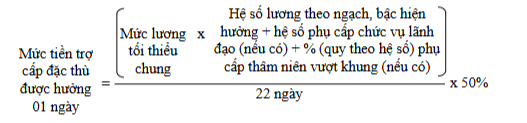
3. The contents prescribed in Point b, Clause 2, Article 7 of Decision No. 14/2013/QĐ-TTg dated February 20, 2013, shall apply the expenditure levels as stipulated in Circular No. 139/2010/TT-BTC dated September 21, 2010, of the Ministry of Finance on the establishment of budget estimates, management, and use of state budget funds for training and capacity building for civil servants and Circular No. 123/2009/TT-BTC dated June 17, 2009, of the Ministry of Finance on the content and expenditure levels for developing framework programs and compiling textbooks for university, college, and vocational high school majors. Specific expenditure items include:
a) Honorarium for lecturers teaching theoretical courses (one lecture session equals five class hours);
b) Honorarium for lecturers teaching practical courses, calculated at 50% of the honorarium for lecturers teaching theoretical courses;
c) Actual expenses serving the direct operation of classes, including:
- Renting conference halls, classrooms; renting equipment and tools for teaching purposes (if any);
- Purchasing office supplies, printing textbooks, and materials directly serving the class (excluding reference materials), printing and issuing certificates;
- Providing drinking water for the class.
d) Expenditure for developing programs and compiling transfer technology package materials (if any): only applicable to programs and teaching materials that have been reviewed and approved by the specialized review board;
đ) Other expenditures: expenditures for managing direct training activities for technology transfer.
4. Travel expenses for practitioners on rotation shall be applied according to the current regulations stipulated in Circular No. 97/2010/TT-BTC dated July 6, 2010, of the Ministry of Finance on travel expenses and expenditure for organizing conferences for government agencies and public institutions and local guidelines implementing Circular No. 97/2010/TT-BTC dated July 6, 2010, of the Ministry of Finance. Specifically, if accommodation is provided by lower-level hospitals or higher-level hospitals, then no payment for lodging will be made.
Practitioners on rotation who have continuous periods of one month or more shall be reimbursed for round-trip tickets and travel expenses once per month.
The provisions set out in Clause 3 and Clause 4 of this Article shall be paid to staff after completing one rotation period.
Article 10. Sources of funds and responsibility for payment of benefits
Implemented in accordance with the provisions of Article 8 of Decision No. 14/2013/QĐ-TTg dated February 20, 2013 of the Government Prime Minister.
For the benefit of practitioners from lower-level lines who are sent to higher-level lines for training to prepare for technology transfer, the sending unit shall pay according to the regulations stipulated in Circular No. 139/2010/TT-BTC dated September 21, 2010 of the Ministry of Finance on the preparation of budgets, management, and use of state budget funds allocated for training and capacity building for civil servants. The funds for paying the benefits of practitioners from lower-level lines who are sent to higher-level lines for training shall be consolidated into the budget for implementing the plan to receive technical support at lower-level medical facilities according to the current financial management hierarchy.
Chapter IV
IMPLEMENTING PROVISIONS
Article 11. Effective Date
This Circular takes effect from November 1, 2014.
Article 12. Transitional Provisions
In cases where practitioners have participated in rotational assignments with fixed terms as prescribed in Decision No. 1816/QĐ-BYT dated May 26, 2008 of the Minister of Health approving the Project "Rotation of Medical Staff from Higher-Level Hospitals to Support Lower-Level Hospitals to Improve Healthcare Quality," such time shall be counted towards completion of the rotational assignment term for practitioners.
Article 13. Reference Provisions
In cases where the referenced documents in this Circular are replaced or amended, the replacement or amended documents shall apply.
1. The Minister, Heads of Ministries equivalent to ministries, Heads of government agencies, Chairmen of provincial People's Committees under the central government, and related agencies, units, and individuals are responsible for implementing this Circular.
The Director of the Department of Medical Examination and Treatment, the Head of the Ministry's Office, the Inspector General of the Ministry, the Heads of Departments, Bureaus, and General Directorates under the Ministry of Health, the Directors of Provincial Health Services, the Heads of Health Services in sectors, and the Heads of relevant agencies, organizations, and units are responsible for implementing this Circular.
During implementation, if there are any difficulties, units and localities should promptly report them to the Ministry of Health (Department of Medical Examination and Treatment) for study and resolution./.
Văn bản gốc (PDF)
Tải văn bản
Bản đồ quan hệ
Bấm vào một văn bản để mở. Viền đỏ = quan hệ làm thay đổi hiệu lực.
Bản dịch
Văn bản này có sẵn ở các ngôn ngữ sau: