
Circular No. 20/2019/TT-BTNMT stipulates technical procedures for building, maintaining, and operating information systems in the natural resources and environment sector. It applies to state agencies, public service units, organizations, and individuals related to the application of information technology in this sector.
Scope of application
State agencies, public service units, organizations, and individuals related to the application of information technology in the natural resources and environment sector.
Key points
- procedure for building software supporting management and exploitation of data bases in the natural resources and environment sector (Article 1).
- Detailed procedure for building software supporting management and exploitation of data bases in the natural resources and environment sector (Articles 4-5).
- procedure for maintaining and operating information systems in the natural resources and environment sector (Articles 6-19).
- Procedure for inspecting and accepting products of information technology in the natural resources and environment sector (Sections I, II, III, IV).
- Forms and storage formats of products in the procedure (Tables 1, 2, 3).
🌐 Social impact of this document
- Establishing a legal basis for building, maintaining, and operating information systems in the natural resources and environment sector.
- Reducing risks and increasing efficiency in managing information in the sector.
- Improving the quality of public services and enhancing the competitiveness of units in the sector.
❓ Frequently asked questions
Who does this procedure apply to?
This procedure applies to state agencies, public service units, organizations, and individuals related to the application of information technology in the natural resources and environment sector.
Which entities are responsible for building software supporting management and exploitation of databases?
Entities performing tasks related to the Application of Information Technology in the Natural Resources and Environment Sector (Article 2).
What steps are included in the procedure for maintaining and operating information systems in the natural resources and environment sector?
Includes the following steps: Inspection and monitoring; Recording incidents; Incident analysis; Incident resolution; Statistical reporting, logbook; System backup and recovery; Installation of patches; User support (Articles 6-19).
Where are the forms and storage formats of products in the procedure specified?
The forms and storage formats of products in the procedure are specified in Tables 1, 2, 3.
What steps are included in the procedure for inspecting and accepting products of information technology in the natural resources and environment sector?
Includes the following steps: Receiving documents and products; Determining software requirements; Analyzing and designing software; Software quality control; Deployment of software applications; Preparing inspection and acceptance documentation (Sections I, II, III, IV).
Full text
|
MINISTRY OF NATURAL RESOURCES AND ENVIRONMENT |
SOCIALIST REPUBLIC OF VIET NAM |
|
Number: 20/2019/TT-BTNMT |
Hanoi, December 18, 2019 |
CIRCULAR
Issuing technical procedures for construction, maintenance, and operation of information systems in the natural resources and environment sector
____________________
On the basis of Decision No. 36/2017/NĐ-CP dated April 4, 2017, of the Government stipulating the functions, tasks, powers, and organizational structure of the Ministry of Natural Resources and Environment;
At the proposal of the Director of the Department of Information Technology and Environmental Resources Data, the Director of the Science and Technology Department, and the Director of the Legal Affairs Department;
The Minister of Natural Resources and Environment issues this Circular on technical procedures for construction, maintenance, and operation of information systems in the natural resources and environment sector.
Article 1. Accompanying this Circular are technical procedures for construction, maintenance, and operation of information systems in the natural resources and environment sector.
Article 2. This Circular takes effect from February 5, 2020.
This Circular abolishes certain contents of the following Circulars: Chapter II Part II of Circular No. 26/2014/TT-BTNMT dated May 28, 2014 issued by the Minister of Natural Resources and Environment on Technical Procedures and Economic Standards for Construction of Environmental Resource Databases; Article 18 of Circular No. 58/2015/TT-BTNMT dated December 8, 2015 issued by the Minister of Natural Resources and Environment on Review, Inspection, and Acceptance of Information Technology Application Projects in the Natural Resources and Environment Sector from the date this Circular takes effect.
Article 3. The Minister, Heads of Ministries at the level of ministries, agencies under the Government, Chairmen of People's Committees of provinces and centrally governed cities, Director of the Department of Information Technology and Environmental Resources Data, Heads of units under the Ministry of Natural Resources and Environment, Directors of Provincial Departments of Natural Resources and Environment of provinces and centrally governed cities, and related organizations and individuals are responsible for implementing this Circular.
In the course of implementation, if there are difficulties or obstacles, please report to the Ministry of Natural Resources and Environment for appropriate amendments and supplements.
|
Place of Receipt: |
DEPUTY MINISTER (Signed) |
TECHNICAL PROCEDURES
CONSTRUCTION, MAINTENANCE, AND OPERATION OF INFORMATION SYSTEMS IN THE NATURAL RESOURCES AND ENVIRONMENT SECTOR
(Accompanying Circular No. 20/2019/TT-BTNMT dated December 18, 2019 issued by the Minister of Natural Resources and Environment)
PART I
GENERAL PROVISIONS
Article 1Scope of Application
Technical procedures for construction, maintenance, and operation of information systems in the natural resources and environment sector specify the steps to be followed in:
a) Development of software to support management, exploitation, and operation of databases in the natural resources and environment sector;
b) Maintenance and operation of information systems in the natural resources and environment sector;
c) Testing and acceptance of supporting software; testing, maintenance, and operation of information systems in the natural resources and environment sector.
Article 2Applicability
These procedures apply to state agencies, public service organizations, organizations, and individuals involved in the application of information technology in the natural resources and environment sector.
Article 3. Definitions
In this document, the following terms are understood as follows:
1. Supporting software for managing and exploiting databases in the natural resources and environment sector: Software developed, upgraded, or modified according to specific requirements of units to meet business needs regarding the construction, management, exploitation, and operation of databases in the natural resources and environment sector.
2. Information technology hardware system: A set of physical infrastructure hardware devices including:
a) Server system
b) Network equipment system
c) Data storage and backup system
d) Network cable system
đ) Video conferencing equipment system
e) IP telephony system
3. System software: Software for managing and operating hardware infrastructure, software for user management and monitoring user access processes and other processes requiring management during exploitation, including:
a) Services such as DNS, WINS, LDAP, Directory, Proxy, Cluster, DHCP, CA, Radius, NMS, etc.
b) Network management and monitoring software
c) Network security vulnerability scanning and website scanning software
d) Backup and recovery software
đ) Wireless network monitoring software
e) User support software
g) Log collection and analysis software
h) Firewall, network attack prevention, and QoS software
i) Load balancing software
k) Denial of Service attack prevention software
l) Virtual server management software
m) Virtual Private Network (VPN) software
n) Spatial data processing software (such as ArcGIS, MapInfo, etc.)
o) Database management system software (such as Oracle, Microsoft SQL Server, etc.)
q) Open-source software.
Chapter II
TECHNICAL PROCEDURES FOR DEVELOPMENT OF SOFTWARE TO SUPPORT MANAGEMENT AND EXPLOITATION OF DATABASES IN THE NATURAL RESOURCES AND ENVIRONMENT SECTOR
Article 4. Diagram of technical procedures for development of software to support management and exploitation of databases in the natural resources and environment sector
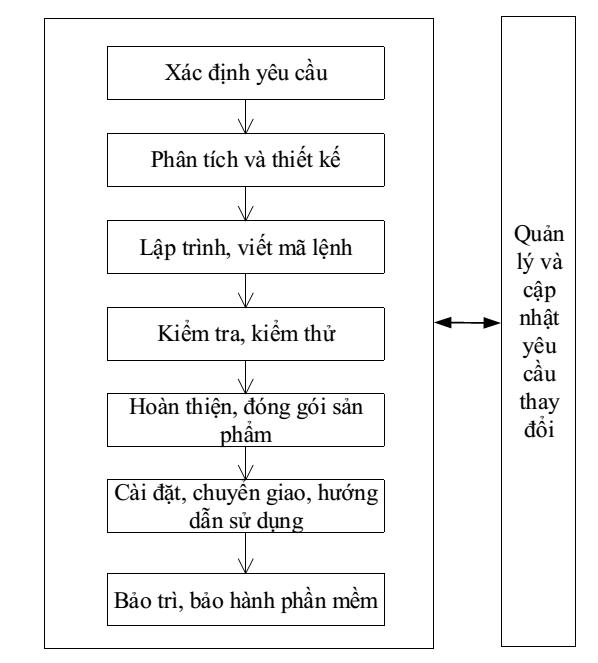
Article 5. Detailed technical procedures for development of software to support management and exploitation of databases in the natural resources and environment sector
1. Requirement determination
a) Implementation steps
Collecting business processes of the organization or unit using the system.
- Collecting information about the organizational structure of the unit.
- Detailing business processes of the organization or unit using Unified Modeling Language (UML).
Determining functional requirements
- Naming and describing each function.
- Identifying users of each function.
- Identifying information to be updated and managed.
- Providing interface illustrations (if applicable).
Data specification
- Identifying current data status.
- Specifying data management requirements.
Determining other requirements
- Determining usability requirements.
- Determining stability requirements.
- Determining processing speed requirements.
- Determining support requirements.
- Determining technological and constraint requirements.
- Determining communication requirements.
- Determining other requirements (if applicable).
b) Products
User Requirements Document (URD - User Requirements Document - according to Model XD.01).
2. Analysis and design
2.1. Requirement analysis
a) Implementation steps
Re-defining business processes to be computerized
- Redefining business processes to be computerized.
- Describing detailed steps within each process.
Listing system functions
- Listing all system functions.
- Detail each function's specific functions and set requirements for each function (if applicable).
- Identify the agents of each function. Determine the information data requirements.
- Identify the information of objects to be managed.
- Determine the relationships between managed objects.
Determine the interface requirements of the software.
- Identify user interfaces.
- Identify hardware interfaces.
- Identify software interfaces.
- Identify communication interfaces.
Determine the non-functional requirements of the software.
- Determine performance requirements.
- Determine safety and security requirements.
- Determine quality requirements.
- Determine other requirements. b) Product
Software Requirements Specification document (SRS - according to model XD.02).
2.2. System Design
a) Implementation steps
Design software architecture. Design component interaction diagrams.
Design sequence diagrams. Design class diagrams.
Design database model. Design software interface.
b) Products
Report on software architecture explanation (according to model XD.03).
Report on component interaction diagram explanation (according to model XD.04).
Report on sequence diagram explanation (according to model XD.05).
Report on class diagram explanation (according to model XD.06).
Report on database model explanation (according to model XD.07).
Report on software interface design (according to model XD.08).
2.3. Programming
a) Implementation steps
Write source code.
Integrate source code.
2.4. Testing
a) Implementation
Source code review according to programming conventions.
Component testing.
System testing.
b) Products
Report on programming convention review (according to model XD.09).
Report on system component testing (according to model XD.10).
Report on full system testing (according to model XD.11).
2.5. Completion, Packaging of Product
a) Implementation steps
Write software introduction documentation.
Write software usage guide.
Package software installation files.
Build software documentation.
b) Products
Software introduction documentation.
Software installation and usage guide.
The software has been fully packaged.
2.6. Installation, Transfer, User Guidance
a) Implementation steps
Install software on the user organization's infrastructure.
Train and guide users to use the software.
Hand over software installation and usage guide.
b) Products
Product handover record (according to model XD.12).
2.7. Maintenance, Warranty of Software
a) Implementation steps
Edit and fix errors arising during software use.
Release error patches.
Handle data-related incidents (data recovery, optimization, etc.).
Patched software or software that has been patched.
2.8. Management and Update of Change Requests
a) Implementation steps
Record change requests.
Update products to meet change requests.
b) Products
Report on updates made.
(CatalogChange request report (according to model XD.14).
SoftwareProducts of Chapter II in Table 01.).
Chapter III
MAINTENANCE AND OPERATION PROCEDURE FOR THE MINISTRY OF NATURAL RESOURCES AND ENVIRONMENT INFORMATION SYSTEM
PART I
MAINTENANCE AND OPERATION PROCEDURE FOR SOFTWARE ASSISTING MANAGEMENT AND EXPLOITATION OF THE MINISTRY OF NATURAL RESOURCES AND ENVIRONMENT DATABASE
Article 6. Diagram of maintenance and operation procedure for software assisting management and exploitation of the Ministry of Natural Resources and Environment database
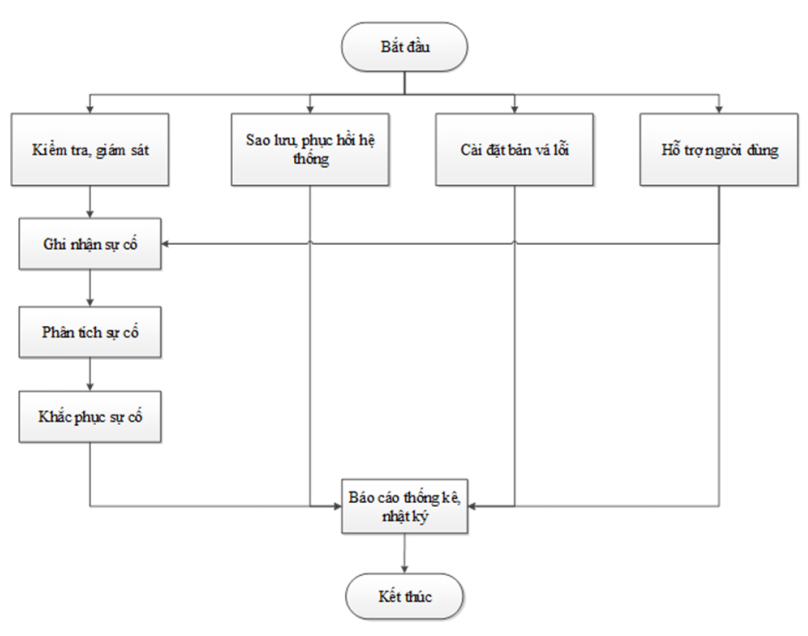
, Clause 1, Clause 2 Article 7a of this Regulation.. Detailed maintenance and operation procedure for software assisting management and exploitation of the Ministry of Natural Resources and Environment database
1. Monitoring, Supervision
a) Implementation steps
Monitor and supervise the system's operational status;
Review system activity logs;
Monitor and supervise system functions;
Monitor and supervise system services;
Monitor and track the current state of the system, perform backups.
b) Products
System maintenance and operation log (according to Model VH.01).
2. Incident Recording
a) Implementation steps
Record incidents (in case of extended functionality requests);
Verify incidents;
Update incident catalog.
a) Product
System maintenance and operation log (according to Model VH.01).
Incident catalog (according to Model VH.02).
3. Incident Analysis
a) Implementation steps
Classify and compare incident catalogs.
Analyze potential causes of incidents.
Propose solutions to resolve incidents.
b) Products
Report on incident analysis and proposed resolution solutions (according to Model VH.03).
4. Incident Resolution
a) Implementation steps
Study proposed solutions.
Implement incident resolution.
Test the system after implementing the resolution.
Update incident catalog.
b) Products
Incident resolution report (according to Model VH.04).
Incident catalog (according to Model VH.02).
5. Statistical Reports, Logs
b) Products
Maintenance and operation report (according to Model VH.05). This report serves as the basis for submitting to competent authorities for approval of upgrade and expansion tasks.
6. Backup, System Recovery
a) Implementation steps
Perform regular and ad-hoc system backups, check the integrity of backup data. Update logs.
Perform system recovery when required (according to Model VH.06).
b) Products
System maintenance and operation log (according to Model VH.01).
System recovery report (according to Model VH.06).
7. Install Patches
a) Implementation steps
Check system upgrades and patches.
Implement system upgrades and patch installations.
b) Products
System maintenance and operation log (according to Model VH.01).
System upgrade report (according to Model VH.07).
8. User Support
a) Implementation steps
Receive user requests (directly, by phone, email);
Assist with software installation;
Process user requests;
Record processing results.
b) Products
User support log (according to VH.08).
PART II.
MAINTENANCE AND OPERATION PROCEDURE FOR INFORMATION TECHNOLOGY HARDWARE SYSTEM
Article 8. Diagram of maintenance and operation procedure for information technology hardware system
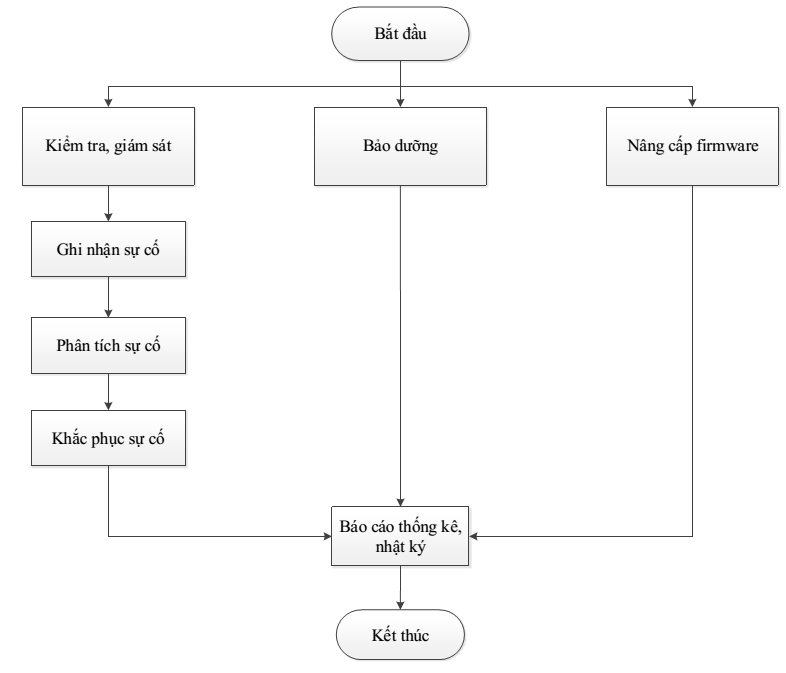
Article 9. Detailed maintenance and operation procedure for information technology hardware system
1. Monitoring, Supervision
a) Implementation steps
Monitor and supervise the system's operational status.
Review system activity logs.
Monitor and supervise system functions.
b) Products
System maintenance and operation log (according to model VH.01).
2. Incident Recording
a) Implementation steps
Record incidents.
Verify incidents.
Update incident catalog.
b) Products
System maintenance and operation log (according to model VH.01).
Incident catalog (according to model VH.02).
3. Incident Analysis
a) Implementation steps
Classify and compare incident catalogs.
Analyze potential causes of incidents.
Propose solutions to resolve incidents.
b) Products
Report on incident analysis and proposed resolution solutions (according to model VH.03).
4. Incident Resolution
a) Implementation steps
Study proposed solutions.
Implement incident resolution.
Test the system after implementing the resolution.
Update incident catalog.
b) Products
Incident resolution report (according to model VH.04).
5. Statistical Reports, Logs
a) Implementation steps
Compile and build reports during the system maintenance and operation process.
b) Products
Maintenance and operation report (according to model VH.05).
6. System Maintenance
a) Implementation steps:
Develop maintenance plans, notify relevant departments about scheduled maintenance schedules;
Clean equipment;
Check peripheral device connections, power connections, network connections, and system connections of devices;
Check the operating environment, humidity, temperature, and cooling system of the system;
Retrieve the system operation log records (data log), check warning lights;
Run performance testing programs for computers and servers to assess the operational status of the equipment;
Verify the list of software permitted to run on the server and remove unauthorized software from the computer and server;
Conduct a full system check and record the current status for future maintenance periods;
Replace/repair any faulty devices that arise during the maintenance period.
b) Products
Maintenance and replacement log (according to form VH.09).
Maintenance and replacement report (according to form VH.10).
7. Update firmware
a) Implementation steps:
Develop a plan for updates and notify relevant departments;
Perform data backup;
Check the firmware versions of the system;
Carry out upgrades and updates to the system;
Conduct post-upgrade operational testing.
b) Products
Upgrade report (according to form VH.07).
PART III
MAINTENANCE AND OPERATION PROCEDURE FOR SYSTEM SOFTWARE
Article 10. Diagram of the maintenance and operation procedure for system software
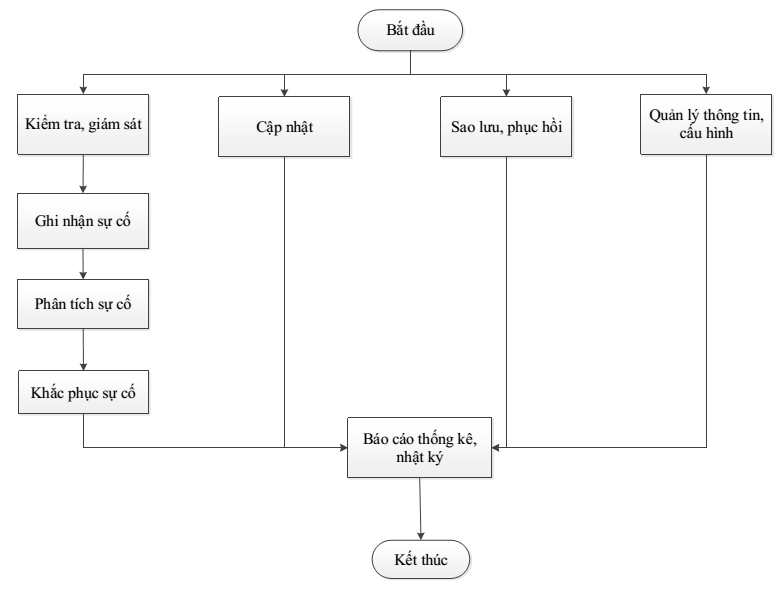
Article 11Detailed maintenance and operation procedure for system software
1. Inspection and monitoring of the system
a) Implementation steps
Check the connection ports of the software and services;
Inspect the services of the software and services on the server operating system;
Check the features of the software and services;
Review the activity logs of the software and services.
b) Products
Maintenance and operation log (according to form VH.01).
2. Incident Recording
a) Implementation steps
Record incidents. Verify incidents.
Update incident catalog.
b) Products
Incident catalog (according to model VH.02).
3. Incident Analysis
a) Implementation steps
Classify and compare incident catalogs.
Analyze potential causes of incidents.
Propose solutions to resolve incidents.
b) Products
Report on incident analysis and proposed resolution solutions (according to model VH.03).
4. Incident Resolution
a) Implementation steps
Study proposed solutions.
Implement incident resolution.
Test the system after implementing the resolution.
Update incident catalog.
b) Products
Incident resolution report (according to model VH.04).
5. Maintenance and operation report (as per the process diagram, Statistical Report, Log)
a) Implementation steps
Compile and prepare reports during the maintenance and operation of system software.
b) Products
Maintenance and operation report (according to model VH.05).
6. Updates
a) Implementation steps:
Develop a plan and notify relevant departments;
Perform necessary data backups;
Proceed with service updates;
Conduct post-update operational testing.
b) Products
System upgrade report (according to form VH.07).
7. Backup
a) Implementation steps:
Develop a backup plan;
Review and determine the contents to be backed up;
Execute the backup;
Verify the integrity and completeness of the backup copies;
b) Products
Backup report (according to form VH.11).
8. Recovery
a) Implementation steps:
Develop a recovery plan;
Check the system;
Implement recovery;
Test the service operation after recovery.
b) Products
System recovery report (according to form VH.06).
9. Information Management and Configuration
a) Implementation steps: Develop a plan;
Configure, change, and update data;
Test software operation after configuration and changes.
b) Products
Information management and configuration log (according to form VH.12).
(List of products in Chapter III at Table 2).
Chapter IV
PROCEDURE FOR INSPECTION AND ACCEPTANCE OF INFORMATION TECHNOLOGY PRODUCTS IN THE MINERAL RESOURCES AND ENVIRONMENT SECTOR
PART I
PROCEDURE FOR INSPECTION AND ACCEPTANCE OF SOFTWARE TO SUPPORT MANAGEMENT AND EXPLOITATION OF DATABASES IN THE MINERAL RESOURCES AND ENVIRONMENT SECTOR
Article 12. Diagram of the inspection and acceptance procedure for software to support management and exploitation of databases in the mineral resources and environment sector
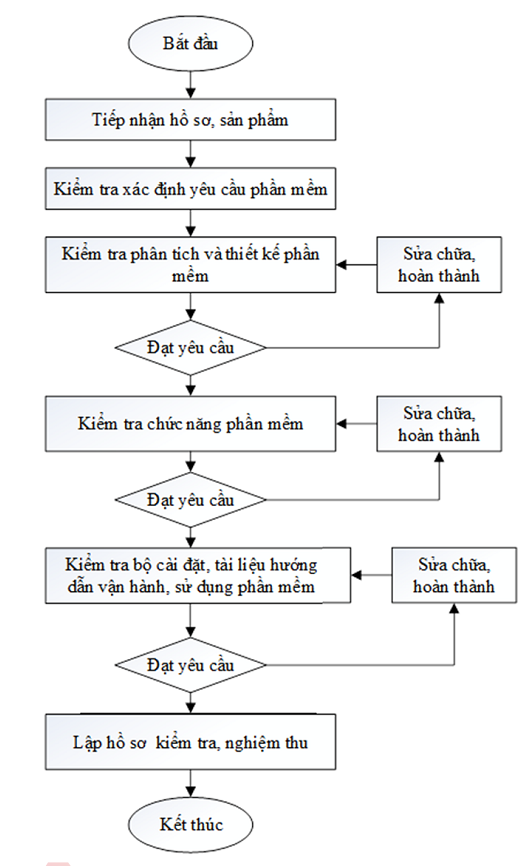
Article 13. Detailed inspection and acceptance procedure for software to support management and exploitation of databases in the mineral resources and environment sector
1. Receiving Documents and Products
a) Implementation steps:
Receive documents and products;
Check the quantity of products according to the approved technical design;
Prepare the product handover protocol;
Check the construction unit's inspection and acceptance documentation.
b) Product:
Handover document and product protocol (Form KT.06);
Inspection opinion sheet for construction unit's inspection and acceptance documentation (Form KT.01).
2. Inspection - Determine Software Requirements
a) Implementation steps:
Inspect the contents and products of the "Requirement Determination" step in the software development process;
Inspect business processes;
- Business model;
- Business process description.
Inspect user functional requirements.
b) Product:
Inspection opinion sheet for requirement determination (Form KT.02).
3. Inspection - Analyze and Design Software
a) Implementation steps:
Inspect the contents and products of the "Software Analysis and Design" step in the software development process including:
- Inspect digitized business processes (not mentioned in Form P2.1);
- Inspect the system function list;
- Inspect the managed object list and detailed information;
- Software architecture (compared to the approved overall system architecture);
- Inspect the use case diagram explanation;
- Inspect the sequence diagram explanation;
- Inspect the class diagram explanation;
- Inspect the data model design;
- Inspect the software interface design.
b) Products
Inspection opinion sheet for software analysis and design (Form KT.03).
4. Inspection - Software Functionality
a) Implementation steps:
Inspect software functionality, including:
- Inspect the Programming Rules Report;
- Inspect the System Component Testing Report;
- Inspect the Overall System Report;
- Inspect software functions.
b) Product:
Inspection opinion sheet for software quality (Form KT.04);
5. Inspection - Installation Package, Operation and Usage Documentation
a) Implementation steps:
Inspect the contents and products of the "Installation, Transfer, and Usage Guidance" step in the software development process including:
- Application installation package: Operate in actual deployment environments and conditions as approved;
- Installation and usage guidance.
b) Product:
Inspection opinion sheet for application deployment (Form KT.05).
6. Prepare Inspection and Acceptance Documentation:
a) Implementation steps:
Inspect and accept the repair and correction work done by the construction unit to fix errors during construction;
Summarize inspection opinions;
Prepare project acceptance documentation.
b) Product:
Inspection and acceptance protocol according to Form KT.15, accompanied by Inspection Opinion Sheets;
Post-inspection repair confirmation protocol between the inspection unit and the construction unit according to Form KT.16;
Quality and quantity inspection and acceptance report according to Form KT.17;
Project completion acceptance protocol according to Form KT.18;
Other related documents.
PART II
PROCEDURE FOR INSPECTION OF SYSTEM SOFTWARE AND DATABASE MAINTENANCE AND OPERATION IN THE MINERAL RESOURCES AND ENVIRONMENT SECTOR
Article 14. Diagram of the inspection procedure for system software and database maintenance and operation in the mineral resources and environment sector
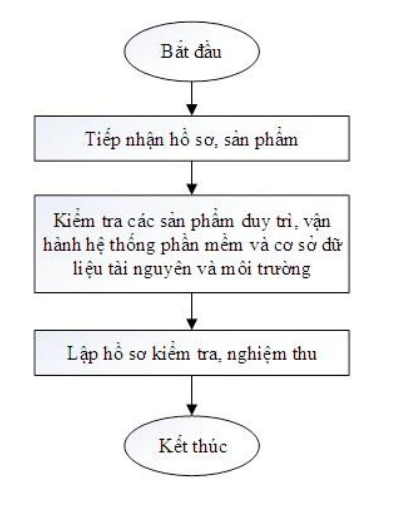
Article 15. Detailed inspection procedure for system software and database maintenance and operation in the mineral resources and environment sector
1. Receiving Documents and Products
a) Steps to implement
Receive documents and products;
Check the quantity of products according to the approved technical design;
Prepare the product handover protocol;
Check the construction unit's inspection and acceptance documentation.
b) Products
Receive construction unit's file (submitted by the construction unit);
Handover record of documents, products (according to model KT.06);
Inspection opinion form for checking construction unit's inspection and acceptance file (according to model KT.01).
2. Checking products maintaining and operating software systems and industry resource and environment databases
2.1. Checking system monitoring and supervision
a) Implementation steps
Check maintenance and operation system logbook.
b) Products
Inspection opinion form for monitoring and supervising software system maintenance and operation results (according to model KT.07).
2.2. Checking incident recording
a) Implementation steps
Check maintenance and operation system logbook;
Check incident list.
b) Products
Inspection opinion form for monitoring and supervising software system maintenance and operation results (according to model KT.07).
2.3. Checking incident analysis
a) Implementation steps
Check incident analysis report and proposed solutions.
b) Product:
Inspection opinion form for monitoring and supervising software system maintenance and operation results (according to model KT.07).
2.4. Checking incident resolution
a) Implementation steps:
Check incident resolution report;
Check incident list.
b) Product:
Inspection opinion form for monitoring and supervising software system maintenance and operation results (according to model KT.07).
2.5. Checking system backup and recovery
a) Implementation steps:
Check maintenance and operation system logbook;
Check system recovery report.
b) Products
Inspection opinion form for backup and recovery system results (KT.08).
2.6. Checking patch installation
a) Steps to implement
Check maintenance and operation system logbook;
Check system upgrade report.
b) Products
Inspection opinion form for patch installation (Model KT.09).
2.7. Checking user support
a) Implementation steps
Check user support logbook.
b) Products
Inspection opinion form for user support (according to model KT.10)
3. Establishing inspection and acceptance files
a) Steps to implement
Inspect and accept the repair and correction work done by the construction unit to fix errors during construction;
Summarize inspection opinions;
Prepare project acceptance documentation.
b) Products
Inspection and acceptance protocol according to Form KT.15, accompanied by Inspection Opinion Sheets;
Post-inspection repair confirmation protocol between the inspection unit and the construction unit according to Form KT.16;
Quality and quantity inspection and acceptance report according to Form KT.17;
Acceptance completion project record according to Model KT.18 (if applicable);
Other related documents.
PART III.
PROCEDURE FOR INSPECTING THE MAINTENANCE AND OPERATION OF HARDWARE INFORMATION TECHNOLOGY SYSTEMS
Article 16. Flowchart of the procedure for inspecting the maintenance and operation of hardware information technology systems
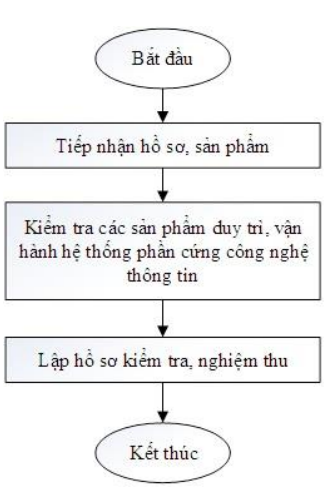
Article 17. Detailed procedure for inspecting the maintenance and operation of hardware information technology systems
1. Receiving Documents and Products
Implement as Clause 1 Article 15 on receiving files and products.
2. Checking products maintaining and operating hardware information technology systems
2.1. Checking system monitoring and supervision
Implement as Point 2.1 Clause 2 Article 15.
2.2. Checking incident recording
Implement as Point 2.2 Clause 2 Article 15.
2.3. Checking incident analysis
Implement as Point 2.3 Clause 2 Article 15.
2.4. Checking incident resolution
Implement as Point 2.4 Clause 2 Article 15.
2.5. Checking system maintenance
a) Implementation steps:
Check maintenance and replacement logbook;
Check maintenance and replacement report.
b) Product:
Inspection opinion form for hardware system maintenance and operation results (according to Model KT.11).
2.6. Checking firmware update
a) Implementation steps:
Check update report.
b) Product:
Inspection opinion form for hardware system firmware upgrade (Model KT.12).
3. Establishing inspection and acceptance files
Implement as Clause 1 Article 15 on receiving files and products.
PART IV
PROCEDURE FOR INSPECTING THE MAINTENANCE AND OPERATION OF SOFTWARE SYSTEMS
Article 18. Flowchart of the procedure for inspecting the maintenance and operation of software systems
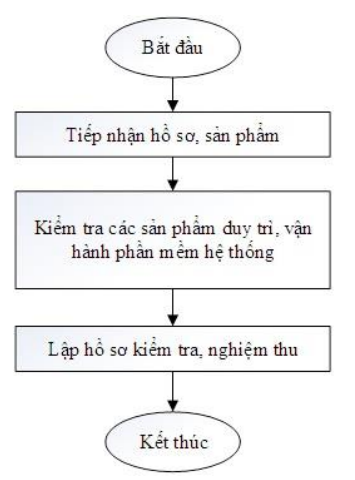
Article 19. Detailed procedure for inspecting the maintenance and operation of software systems
1. Receiving files and products
Implement as Clause 1 Article 15 on receiving files and products.
2. Checking products maintaining and operating software systems
2.1. Checking system monitoring and supervision
Implement as Point 2.1 Clause 2 Article 15.
2.2. Checking incident recording
Implement as Point 2.2 Clause 2 Article 15.
2.3. Checking incident analysis
Implement as Point 2.3 Clause 2 Article 15.
2.4. Checking incident resolution
Implement as Point 2.4 Clause 2 Article 15.
2.5. Checking software updates
a) Implementation steps:
Check update report.
b) Product:
Inspection opinion form for software update (according to Model KT.13).
2.6. Checking backup and recovery
a) Implementation steps:
Check maintenance and operation system logbook; Check system recovery report.
b) Product:
Inspection opinion form for backup and recovery system results (according to Model KT.08).
2.7. Checking configuration information management
a) Implementation steps:
Check configuration information logbook.
b) Product:
Inspection opinion form for configuration information (according to Model KT.14).
3. Establishing inspection and acceptance files
Implement as Section Clause 1 Article 15 on receiving files and products
(List of products in Chapter IV at Table No. 3).
TABLE NO. 1. Product list for building software supporting the management and exploitation of industry resource and environment databases
|
No. |
Product Name |
Form name |
Storage type Corporation. |
Model |
|
1 |
User Requirement Document (URD) |
XD.01 |
Number and paper |
XD.01.docx |
|
2 |
System Requirements Specification (SRS) |
XD.02 |
Number and paper |
XD.02.docx |
|
3 |
Software architecture explanation report |
XD.03 |
Number and paper |
XD.03.docx |
|
4 |
Explanation report of THSD diagram |
XD.04 |
Number and paper |
XD.04.docx |
|
5 |
Explanation report of sequence diagram |
XD.05 |
Number and paper |
XD.05.docx |
|
6 |
Explanation report of class diagram |
XD.06 |
Number and paper |
XD.06.docx |
|
7 |
Explanation report of database model |
XD.07 |
Number and paper |
XD.07.docx |
|
8 |
Software interface design report. |
XD.08 |
Number and paper |
XD.08.docx |
|
9 |
Code review check report |
XD.09 |
Number and paper |
XD.09.docx |
|
10 |
System component check report |
XD.10 |
Number and paper |
XD.10.docx |
|
11 |
Comprehensive system check report |
XD.11 |
Number and paper |
XD.11.docx |
|
12 |
Software installation and usage guide |
|
Number and paper |
|
|
13 |
Completed packaged software |
|
Number |
|
|
14 |
Product handover minutes |
XD.12 |
Number and paper |
XD.12.docx |
|
15 |
Software maintenance report |
XD.13 |
Number and paper |
XD.13.docx |
|
16 |
Change request report |
XD.14 |
Number and paper |
XD.14.docx |
TABLE 2. List of products for system maintenance and operation in the natural resources and environment sector
|
No. |
Product Name |
Form name |
Storage type Corporation. |
Model |
|
1 |
System maintenance and operation logbook |
VH.01 |
Number and paper |
1. System maintenance and operation logbook_ |
|
2 |
Incident list |
VH.02 |
Number and paper |
2.Incident list_VH.02.docx |
|
3 |
Report on incident analysis and proposed solutions |
VH.03 |
Number and paper |
3.Report on incident analysis and proposed solutions |
|
4 |
Incident resolution report |
VH.04 |
Number and paper |
4.Incident resolution report_VH.04.d |
|
5 |
Maintenance and operation report |
VH.05 |
Number and paper |
5.Maintenance and operation report_VH.05.do |
|
6 |
System recovery report |
VH.06 |
Number and paper |
6.System recovery report_VH.06.do |
|
7 |
System upgrade report |
VH.07 |
Number and paper |
7.System upgrade report_VH.07.do |
|
8 |
User support logbook |
VH.08 |
Number and paper |
8.User support logbook_VH.08. |
|
9 |
Maintenance and replacement logbook |
VH.09 |
Number and paper |
9.Maintenance and replacement logbook_VH |
|
10 |
Maintenance and replacement report |
VH.10 |
Number and paper |
10.Maintenance and replacement report_VH |
|
11 |
Backup report |
VH.11 |
Number and paper |
11.Backup report_VH.11.do |
|
12 |
Information and configuration management logbook |
VH.12 |
Number and paper |
12.Information and configuration management logbook_ |
TABLE 3. List of products for product testing and acceptance in the natural resources and environment sector
|
No. |
Product Name |
Form name |
Storage type Corporation. |
Model |
|
1 |
Construction unit's inspection and acceptance opinion form |
KT.01 |
Number and paper |
KT.01-InspectionOpinionForm-File.docx |
|
2 |
Inspection opinion form to determine software requirements |
KT.02 |
Number and paper |
KT.02_InspectionOpinionForm_SoftwareRequirements.docx |
|
|
|
|
|
|
|
3 |
Inspection opinion form for software analysis and design |
KT.03 |
Number and paper |
KT.03-InspectionOpinionForm_AnalysisDesign.docx |
|
4 |
Inspection opinion form for software quality |
KT.04 |
Number and paper |
KT.04-InspectionOpinionForm_QualitySoftware.docx |
|
5 |
Inspection opinion form for software application deployment |
KT.05 |
Number and paper |
KT.05-InspectionOpinionForm_Deployment.docx |
|
6 |
Documentation and product handover minutes |
KT.06 |
Number and paper |
KT.06_TransferMinutes.docx |
|
7 |
Inspection opinion form for monitoring and supervision test results |
KT.07 |
Number and paper |
KT.07_InspectionOpinionForm_MonitoringSupervision.docx |
|
8 |
Inspection opinion form for backup and system recovery test results |
KT.08 |
Number and paper |
KT.08.InspectionOpinionForm_Backup_Recovery.docx |
|
9 |
Inspection opinion form for patch installation |
KT.09 |
Number and paper |
KT.09.InspectionOpinionForm_PatchInstallation.docx |
|
10 |
Inspection opinion form for user support |
KT.10 |
Number and paper |
KT.10.InspectionOpinionForm_UserSupport.doc |
|
11 |
Maintenance and hardware system support report |
KT.11 |
Number and paper |
KT.11_InspOpnForm_MaintBdng.docx |
|
12 |
Inspection opinion form for firmware system upgrade |
KT.12 |
Number and paper |
KT.12_InspOpnForm_FirmwareUpgrade.docx |
|
13 |
Inspection opinion form for software update |
KT.13 |
Number and paper |
KT.13_InspOpnForm_SoftwareUpdate.docx |
|
14 |
Inspection opinion form for configuration information |
KT.14 |
Number and paper |
KT.14_InspOpnForm_ConfigInfo.docx |
|
15 |
Inspection and acceptance minutes |
KT.15 |
Number and paper |
KT.15_MinutesInspectionAcceptance.docx |
|
16 |
Minutes of confirmation of repair between the inspection unit and the construction unit after inspection |
KT.16 |
Number and paper |
KT.16_RepairConfirmationMinutes.docx |
|
17 |
Quality and quantity inspection and acceptance report |
KT.17 |
Number and paper |
KT.17_ReportInspectionAcceptanceQualityQuantity.docx |
|
18 |
Project completion acceptance minutes |
KT.18 |
Number and paper |
KT.18_ProjectCompletionAcceptanceMinutes.docx |
Original document (PDF)
Relations map
Click a document to open. A red border = a relation that changes validity.
Translations
This document is available in the following languages: