
This is a report template on healthcare waste management for healthcare facilities and Health Departments. The report includes sections such as an overview of the number of healthcare facilities, training and legal communication results, inspection and supervision activities, statistics on generated and treated waste, operational status of waste treatment facilities serving clusters of healthcare facilities, waste management personnel and waste treatment infrastructure. Finally, it includes a plan for waste management in the following year.
Đối tượng áp dụng
Healthcare facilities and Health Departments
Các điểm cốt lõi
- Overview of the number of healthcare facilities, hospital beds
- Training and legal communication results
- Inspection and supervision activities
- Statistics on generated and treated waste
- Operational status of waste treatment facilities serving clusters of healthcare facilities
- Waste management personnel
- Waste treatment infrastructure
- Plan for waste management in the following year
🌐 Tác động xã hội từ văn bản này
- Enhance awareness of healthcare waste management
- Ensure a clean and safe environment for the community
- Conserve resources through recycling of plastic waste
❓ Câu hỏi thường gặp
Who is this report for?
For healthcare facilities and Health Departments
What are the main parts of the report?
Overview, training and communication results, inspection and supervision activities, statistics on generated and treated waste, waste management personnel, waste treatment infrastructure, and next year's plan
What are the benefits of this report?
Enhance awareness of healthcare waste management, ensure a clean and safe environment for the community
Toàn văn
|
MINISTRY OF HEALTH |
SOCIALIST REPUBLIC OF VIET NAM |
|
Number: 20/2021/TT-BYT |
Hanoi, November 26, 2021 |
CIRCULAR
REGULATIONS ON THE MANAGEMENT OF HEALTHCARE WASTE WITHIN THE PREMISES OF HEALTHCARE FACILITIES
On the basis of Law on Environmental Protection No. 72/2020/QH14 dated November 17, 2020;
Decree No. Decree No. 75/2017/NĐ-CP dated June 20, 2017 of the Government stipulating the functions, tasks, powers, and organizational structure of the Ministry of Health;
At the proposal of the Director of the Medical Environment Management Department;
The Minister of Health issues this Circular to regulate the management of healthcare waste within the premises of healthcare facilities.
Chapter 1
GENERAL PROVISIONS
Article 1. Scope of Regulation
1. This Circular details the classification, collection, storage, and management of healthcare waste within the premises of healthcare facilities.
2. This Circular does not regulate the management of radioactive waste generated from healthcare activities. The management of radioactive waste generated from healthcare activities shall be carried out in accordance with the regulations of the Ministry of Science and Technology on the management of radioactive waste and used radiation sources.
Article 2. Applicability
This Circular applies to healthcare facilities including medical and healthcare establishments licensed for operation under the laws on medical examination and treatment, preventive healthcare facilities, educational institutions in the health sector, research, testing, inspection, and trial facilities in the medical and pharmaceutical fields that generate healthcare waste; domestic and foreign agencies, organizations, and individuals involved in the management of healthcare waste within the territory of Vietnam.
Article 3. Explanation of Terms
In this Circular, the following terms are understood as follows:
1. Healthcare waste means waste generated from the operations of healthcare facilities, including hazardous healthcare waste, general solid waste, exhaust gases, non-hazardous liquid waste, and medical wastewater.
2. Infectious waste means waste that is soaked, stained, containing blood from the body or containing pathogenic microorganisms.
3. Collection of healthcare waste means the process of gathering healthcare waste from the point of generation to temporary storage areas for healthcare waste or to the location for processing healthcare waste within the premises of healthcare facilities.
Chapter 2
IDENTIFICATION, CLASSIFICATION, COLLECTION, STORAGE, REDUCTION, RECYCLING, AND HANDOVER OF HEALTHCARE WASTE
Article 4. Identification of healthcare waste
1. Hazardous healthcare waste includes infectious waste and non-infectious hazardous waste.
2. Infectious waste includes:
a) Sharp infectious waste including needles, syringes with attached needles, sharp ends of infusion sets, biopsy needles, acupuncture needles, surgical blades, nails, saws used in surgery, syringe tubes, broken glass pieces, other sharp objects discarded after use and contaminated with blood from the body or containing pathogenic microorganisms;
b) Non-sharp infectious waste including cotton wool, bandages, gauze, gloves, other non-sharp waste contaminated with blood from the body or containing pathogenic microorganisms; empty vaccine vials belonging to inactivated or attenuated vaccines discarded; infectious liquid waste (including post-surgical drainage, medical procedure fluids, discarded liquids containing blood from the human body or containing pathogenic microorganisms);
c) Highly infectious waste including patient samples, containers holding patient samples, discarded sample-contaminated waste from laboratories equivalent to biosafety level II or higher; waste generated from isolation wards, isolation treatment areas, sampling areas for patients with dangerous group A and B infectious diseases;
d) Anatomical waste including discarded human tissues, organs, animal carcasses used for experiments;
3. Non-infectious hazardous waste includes:
a) Discarded chemicals exceeding the threshold for hazardous waste or having hazard warnings on packaging provided by the manufacturer;
b) Discarded pharmaceuticals belonging to cytotoxic groups or having hazard warnings on packaging provided by the manufacturer;
c) Empty bottles, jars containing drugs or chemicals, equipment contaminated with drugs or chemicals belonging to cytotoxic groups or having hazard warnings on packaging provided by the manufacturer;
d) Broken, defective, discarded medical devices containing mercury, cadmium (Cd); discarded batteries, accumulators; lead-lined materials used in radiation shielding discarded;
đ) X-ray film washing solutions, effluents from testing and analytical equipment, discarded solutions exceeding the threshold for hazardous waste;
e) Other healthcare waste exceeding the threshold for hazardous waste or having hazard warnings from the manufacturer.
4. General solid waste includes:
a) Domestic solid waste generated from daily living activities of healthcare staff, patients, family members of patients, students, visitors, and external waste within healthcare facilities (excluding domestic waste generated from isolation areas for treating dangerous infectious disease patients);
b) Discarded chemicals not exceeding the threshold for hazardous waste;
c) Empty bottles, jars containing drugs or chemicals, equipment contaminated with drugs or chemicals not belonging to cytotoxic groups or not having hazard warnings on packaging provided by the manufacturer;
d) Discarded vaccine vials not belonging to inactivated or attenuated vaccines;
đ) Non-infectious sharp waste not exceeding the threshold for hazardous waste;
e) Infectious waste treated to meet national technical standards for environmental protection;
g) Sludge from wastewater treatment systems not exceeding the threshold for hazardous waste; ash and slag from incineration of solid healthcare waste not exceeding the threshold for hazardous waste;
h) Other general solid waste;
i) The list of general solid waste permitted for collection for recycling purposes as specified in Appendix No. 01 accompanying this Circular.
5. Exhaust gases include emissions from laboratories handling dangerous infectious agents transmitted through the air; emissions from biosafety level III or higher laboratories.
6. Non-hazardous liquid waste includes discarded pharmaceuticals and chemicals not belonging to cytotoxic groups, without hazard warnings from the manufacturer, not containing elements exceeding the threshold, and not containing pathogenic microorganisms.
7. Medical wastewater includes wastewater generated from specialized activities within healthcare facilities. In cases where domestic wastewater is discharged into the medical wastewater collection system, it shall be managed as medical wastewater.
Article 5. Packaging, tools, equipment for storing medical waste
1. Packaging (bags), tools (boxes, containers, cans), equipment for storing medical waste must ensure safe storage of waste, be leak-proof, spill-proof, and have appropriate sizes for the amount of stored waste. On packaging, tools, and equipment for storing medical waste, there must be the name of the type of stored waste and symbols as prescribed in Appendix No. 02 issued together with this Circular.
2. The color of packaging, tools, and equipment for storing medical waste shall comply with the provisions of Clauses 3, 4, 5, and 6 of Article 6 of this Circular.
3. Tools and equipment for storing medical waste must have convenient lids for opening and closing during use, and may be reused after being cleaned and disinfected.
4. Containers for sharp medical waste must have hard sides and bottom, puncture-resistant, and be designed safely to prevent spills and leaks of waste.
5. Tools and equipment for storing infectious medical waste must have tightly sealed lids and be resistant to animal intrusion.
6. Tools and equipment for storing chemical waste must be made of materials that do not react with the stored waste and are resistant to corrosion if the stored waste is corrosive.
7. Containers for storing liquid hazardous waste must have tightly sealed lids to prevent evaporation and spills.
8. Packaging and containers for incinerated medical waste must not be made of PVC plastic material.
Article 6. Classification of Medical Waste
1. Principles for classifying medical waste:
a) Medical waste must be classified for management immediately at the point of generation and at the time of generation;
b) Each type of medical waste must be separately classified into packaging, tools, and equipment for storing waste as prescribed in Article 5 of this Circular. In cases where hazardous medical waste does not have the ability to react or interact with each other and can be treated using the same method, they may be classified together in the same packaging, tool, or equipment (except for sharp infectious medical waste);
c) In cases where infectious waste is mixed with other types of waste, the mixed waste must be collected, stored, and treated as infectious waste and continue to be managed according to the characteristics of the waste after treatment.
2. Placement of packaging, tools for classifying waste:
a) In departments, rooms, units: arrange suitable and safe locations to place packaging, tools, and equipment for storing medical waste;
b) At the location where packaging, tools, and equipment for storing waste are placed, there must be instructions on how to classify and collect waste.
3. Classification of infectious waste:
a) Sharp infectious waste: put into puncture-resistant boxes or containers and colored yellow;
b) Non-sharp infectious waste: put into boxes lined with bags and colored yellow;
c) Highly infectious waste: put into boxes lined with bags and colored yellow;
d) Surgical waste: put into double-layered bags or boxes lined with bags and colored yellow;
e) Liquid infectious waste: contained in sealed bags or liquid storage tools with tightly sealed lids.
4. Classification of non-infectious hazardous waste:
a) Hazardous waste must be classified according to hazardous waste codes and stored in appropriate packaging, tools, and equipment. Common packaging, tools, and equipment may be used for hazardous waste with similar properties, which do not have the ability to react or interact with each other and can be treated using the same method;
b) Non-infectious hazardous waste in solid form: stored in bags or boxes or boxes lined with bags and colored black;
c) Non-infectious hazardous waste in liquid form: contained in liquid storage tools with tightly sealed lids, marked with the code and name of the stored waste type.
5. Classification of general solid waste:
a) General solid waste not intended for recycling: stored in bags or boxes or boxes lined with bags and colored blue. Sharp waste is stored in puncture-resistant tools;
b) General solid waste intended for recycling: stored in bags or boxes or boxes lined with bags and colored white.
6. Classification of non-hazardous liquid waste: contained in liquid storage tools with tightly sealed lids, marked with the name of the stored waste type.
Article 7. Collection of Medical Waste
1. Collection of infectious waste:
a) Medical facilities shall specify routes and collection times for infectious waste to minimize impact on patient care areas and other areas within the facility;
b) Collection equipment must be sealed to prevent leakage of waste fluids during the collection process;
c) Infectious waste must be collected separately from the point of generation to the temporary storage area within the medical facility. Before collection, waste bags must be securely closed at the mouth, and waste containers must have tightly sealed lids;
d) Highly infectious waste must be preliminarily treated near the point of generation using disinfection equipment to eliminate pathogens. For medical facilities without such equipment, highly infectious waste bags must be securely closed at the mouth before collection, then placed in a second infectious waste bag which is also securely closed, and finally placed in an infectious waste collection container with the label "HIGHLY INFECTION WASTE" affixed to the outside, to be collected, stored separately in the infectious waste storage area for treatment or transferred to a competent entity for processing as prescribed;
đ) Liquid infectious waste must be collected into the medical facility's wastewater collection system and managed according to regulations governing medical wastewater management;
e) The frequency of collecting infectious waste from the point of generation to the temporary storage area within the medical facility must be at least once a day. For medical facilities generating less than 05 kg of infectious waste per day, the minimum collection frequency is once a day, and sharp infectious waste must be collected at least once a month;
2. Collection of non-infectious hazardous waste:
a) Non-infectious hazardous waste must be collected and stored separately in the waste storage area within the medical facility;
b) Broken, damaged, or discarded medical equipment containing mercury must be collected and stored separately in plastic boxes or suitable materials to ensure no leakage or release of mercury vapor into the environment;
3. Collection of general solid waste: general solid waste intended for recycling and general solid waste not intended for recycling must be collected separately;
4. Collection of non-hazardous liquid waste: non-hazardous liquid waste must be collected into the medical facility's wastewater collection system and managed according to regulations governing medical wastewater management;
5. Emissions must be treated to remove pathogenic microorganisms before being discharged into the surrounding environment;
6. Collection of wastewater:
a) The wastewater collection system must be a closed system ensuring the collection of all wastewater generated within the medical facility;
b) Medical wastewater must be collected and treated in accordance with current laws governing wastewater management;
Article 8. Storage of Medical Waste
1. Medical facilities must arrange a waste storage area within their premises that meets the following requirements:
a) Hospitals and medical facilities treating medical waste under a cluster model must have a waste storage area meeting technical requirements as specified in Section A of Appendix No. 03 issued together with this Circular;
b) Medical facilities not falling under the category specified in Point a Clause of this Article must store medical waste meeting technical requirements as specified in Section B of Appendix No. 03 issued together with this Circular;
2. Each type of waste must be stored separately in the temporary waste storage area within the medical facility's premises, except where these types of waste share similar characteristics, do not react or interact with each other, and can be processed using the same method;
3. Storage time for infectious waste:
a) For infectious waste generated within the medical facility, the storage time must not exceed 02 days under normal conditions. In cases where infectious waste is stored in cold preservation equipment at temperatures below 8°C, the maximum storage time must not exceed 07 days;
b) For infectious waste transported from another medical facility for cluster or centralized processing, it must be processed immediately on the same day. If immediate processing is not possible, it must be stored at temperatures below 20°C, with a maximum storage time not exceeding 02 days;
c) For medical facilities generating less than 05 kg of infectious waste per day, the storage time must not exceed 03 days under normal conditions and must be stored in securely sealed packaging or tightly sealed containment devices;
4. Storage time for non-infectious hazardous waste: the storage time must not exceed 01 year from the date of waste generation. If storage exceeds 01 year due to lack of transportation or processing plans or inability to find a suitable waste disposal facility, the medical facility must report in writing separately or combined in the annual medical waste management report to the competent authority as stipulated in Article 13 of this Circular and other relevant authorities as prescribed by law;
5. For medical facilities in remote, mountainous, island, or difficult regions lacking appropriate disposal methods, sterilized sharp infectious waste must be safely stored in concrete tanks within the facility's premises, with warning signs posted in the storage area.
Article 9. Minimizing Medical Waste
Healthcare facilities must implement measures to minimize the generation of medical waste as follows:
1. Procuring, installing, and using materials, equipment, tools, medicines, chemicals, and other raw materials suitable for usage needs.
2. Updating equipment, procedures in professional healthcare activities, and other measures to minimize the generation of medical waste.
3. Implementing measures, timelines, and limiting the use of single-use plastic products and non-biodegradable plastic bags to reduce the generation of plastic waste.
4. Sorting plastic waste for recycling or disposal in accordance with the provisions of the law.
Article 10. Management of General Solid Waste for Recycling Purposes
1. Based on the List of General Solid Wastes Permitted for Collection for Recycling Purposes as stipulated in Appendix No. 01 issued together with this Circular, healthcare facilities shall issue a list of general solid wastes permitted for collection for recycling purposes that is appropriate to the situation of waste generation at their units.
2. Infectious waste, after treatment to meet national technical standards for the environment, shall be managed as general solid waste and permitted for collection for recycling. When transferring waste, healthcare facilities must ensure that the waste storage containers are securely sealed, have the recycling waste symbol as prescribed in Appendix No. 02 issued together with this Circular, and fully record information in the Waste Transfer Register for Disinfected Waste Meeting National Technical Standards for Environmental Purposes according to the model prescribed in Appendix No. 04 issued together with this Circular.
3. Plastic waste shall be sorted and collected for recycling or disposal in accordance with the provisions of the law.
Article 11. Management and Operation of Facilities, Equipment, and Systems for Treating Medical Waste
1. Healthcare facilities that self-treat medical waste or treat it through a cluster model must operate facilities, equipment, and systems for treating medical waste continuously in accordance with the manufacturer's instructions, ensuring that waste treatment meets environmental technical standards and complies with legal regulations on environmental monitoring and surveillance.
2. Facilities, equipment, and systems for treating medical waste must be maintained and serviced regularly in accordance with the manufacturer's instructions and fully recorded in the Operation Logbook of Facilities, Equipment, and Systems for Treating Medical Waste as prescribed in Appendix No. 05 issued together with this Circular.
Article 12. Transfer of Medical Waste
1. Healthcare facilities that do not self-treat medical waste must transfer medical waste in accordance with the following regulations:
a) Hazardous medical waste must be transferred to units with appropriate permits as required by law, the quantity of waste after each transfer must be fully recorded in the Waste Transfer and Receipt Register according to the model prescribed in Appendix No. 06 issued together with this Circular, and hazardous waste certificates must be used as required;
b) General solid waste may be transferred to units with appropriate functions for transportation and disposal in accordance with current laws.
3. Units receiving the transfer of medical waste must transport it in accordance with regulations, preventing the loss of medical waste outside. Medical waste must be treated to meet environmental technical standards.
4. Healthcare facilities that treat hazardous medical waste through a cluster model approved by the People's Committee of the province or centrally-administered city must record the transfer of medical waste for treatment in the Hazardous Medical Waste Transfer and Receipt Register according to the model prescribed in Appendix No. 06 issued together with this Circular.
Chapter 3
REPORTING REGIME AND RECORDS FOR MANAGEMENT OF MEDICAL WASTE
Article 13. Reporting regime
1. Reporting Frequency: The report on the management of medical waste is prepared once a year, from December 15 of the previous reporting period to December 14 of the reporting year.
2. Reporting Format: The report on the management of medical waste can be submitted in paper form, electronic form, or via reporting software.
3. Content and Sequence of Reporting:
a) Healthcare facilities shall report the results of managing medical waste at their facilities according to the model prescribed in Section A of Appendix No. 07 issued together with this Circular, and submit it to the Department of Health of the province or centrally-administered city (hereinafter referred to as the Department of Health) within their jurisdiction or the Ministry of Health (Health Environment Management Department) for healthcare facilities under the Ministry of Health before December 16 of the reporting period;
b) The Department of Health shall compile and report the results of managing medical waste in its jurisdiction according to the model prescribed in Section B of Appendix No. 07 issued together with this Circular, and submit it to the Ministry of Health (Health Environment Management Department) before December 20 of the reporting period.
Article 14. Medical Waste Management Records
Healthcare facilities must retain the following records at their premises:
1. Environmental permits and related environmental documents, records, and materials as prescribed (for healthcare facilities required to obtain an environmental permit).
2. Medical waste transfer logs; hazardous waste certificates (if applicable).
3. Operation logbooks for medical waste treatment facilities, equipment, and systems (for healthcare facilities that treat their own waste).
4. Inspection and audit reports (if applicable).
5. Annual periodic reports on medical waste management results; periodic monitoring reports on medical waste (if applicable).
6. Other relevant documents.
Chapter 4
IMPLEMENTING PROVISIONS
Article 15. Responsibility for Implementation
1. Responsibilities of the Health Environment Management Department
a) Directing, guiding, and inspecting the implementation of this Circular's provisions;
b) Issuing technical guidance on medical waste management within healthcare facility premises;
c) Training, instructing, disseminating, and communicating the regulations on medical waste management to provincial health departments and healthcare facilities under its jurisdiction.
2. Responsibilities of Provincial Health Departments
a) Directing, guiding, and inspecting the implementation of this Circular's provisions within their administrative areas;
b) Organizing training, dissemination, and communication of the regulations on medical waste management stipulated in this Circular to healthcare facilities under their management;
c) Directing subordinate healthcare facilities to develop medical waste management plans;
d) Coordinating with the Finance Department to propose budget allocation for investment, upgrading, and operation of medical waste treatment facilities, equipment, and systems for healthcare facilities under their jurisdiction;
đ) Reporting medical waste management results as prescribed in Article 13 of this Circular.
3. Responsibilities of Healthcare Facilities
a) Implementing medical waste management according to this Circular and other relevant legal documents;
b) Assigning healthcare facility leaders responsible for medical waste management tasks; appointing dedicated staff for medical waste management; assigning duties to the Infection Control Department or other departments, units responsible for medical waste management; arranging personnel from the healthcare facility or collaborating with external units to operate medical waste treatment facilities, equipment, and systems in accordance with job requirements (for healthcare facilities that treat their own waste);
c) Developing a medical waste management plan or integrating it into the annual operational plan of the healthcare facility; allocating funds for medical waste management;
d) Identifying types of waste generated from healthcare activities to apply appropriate management measures as prescribed in this Circular;
đ) Implementing requirements regarding prevention and response plans for environmental incidents caused by medical waste as prescribed by law (including contingency plans for increased hazardous medical waste due to epidemics or force majeure);
e) Organizing training, instruction, communication, and dissemination of medical waste management regulations to employees, workers, and related parties;
g) Reporting medical waste management results as prescribed in Article 13 of this Circular.
Article 16. Implementation Provisions
1. Effective date
a) This Circular takes effect from January 10, 2022;
b) Circular Joint Circular No. 58/2015/TTLT-BYT-BTNMT dated December 31, 2015 of the Ministry of Health and the Ministry of Natural Resources and Environment on medical waste management shall be repealed from the date this Circular takes effect.
2. Implementation Organization:
a) The Director of the Health Environment Management Department, the Head of the Ministry of Health’s Office, the Inspector General of the Ministry of Health, Heads of Departments, Directors of Bureaus, and General Directors of Bureaus, General Bureaus under the Ministry of Health, and related agencies, organizations, and individuals are responsible for implementing this Circular;
b) During implementation, if there are difficulties or obstacles, please report to the Ministry of Health (Health Environment Management Department) for review and resolution./.
|
Place of Receipt: |
DEPUTY MINISTER |
ANNEX NO. 01
LIST OF PERMITTED SOLID WASTE TYPES FOR RECYCLING PURPOSES
(Annexed to Circular No. 20/2021/TT-BYT dated November 26, 2021 of the Minister of Health)
|
No. |
Type of Waste |
Specific requirements |
|
I |
Paper-based waste |
|
|
1 |
Paper, newspapers, cardboard, cartons, medicine boxes, and paper-based materials |
Not soaked, stained, containing blood, pathogenic microorganisms, or other harmful factors exceeding hazardous waste thresholds |
|
II |
Plastic-based waste |
|
|
1 |
Plastic bottles containing non-cytotoxic drugs or chemicals without manufacturer hazard warnings |
Not soaked, stained, containing blood, or pathogenic microorganisms |
|
2 |
Plastic beverage bottles and other plastic products used in daily activities |
Not generated from isolation or treatment areas for dangerous infectious diseases groups A and B |
|
3 |
Plastic intravenous fluid bottles, infusion sets, plastic syringes (excluding sharp tips), and other plastic materials |
Not soaked, stained, containing blood, pathogenic microorganisms, or harmful factors |
|
4 |
Plastic intravenous fluid bottles, infusion sets, plastic syringes (excluding sharp tips), and other plastic materials processed to meet national environmental standards |
Free of harmful factors |
|
III |
Metal-based waste |
|
|
1 |
Beverage cans and other metal products used in daily activities |
Not generated from isolation or treatment areas for dangerous infectious diseases groups A and B |
|
IV |
Glass-based waste |
|
|
Discarded glass bottles, jars, and medicine containers |
Not contaminated with cytotoxic drugs or chemicals with manufacturer hazard warnings; not soaked, stained, containing blood, or pathogenic microorganisms |
APPENDIX NO. 02
SYMBOLS ON THE PACKAGING, CONTAINERS, AND EQUIPMENT FOR MEDICAL WASTE
(Annexed to Circular No. 20/2021/TT-BYT dated November 26, 2021 of the Minister of Health)
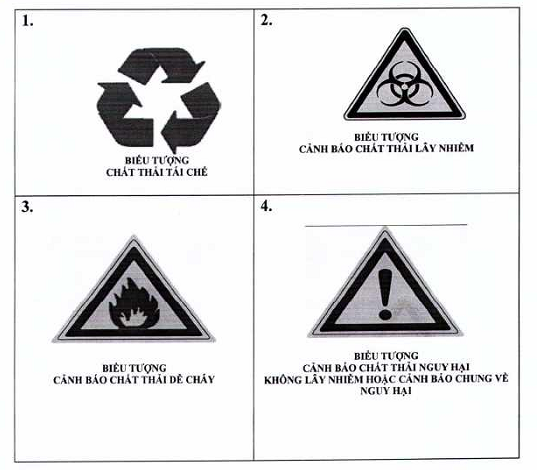
Note:
The design, presentation, and color of hazardous medical waste warning symbols shall comply with the provisions of TCVN 5053:19901
ANNEX NUMBER 03
TECHNICAL REQUIREMENTS FOR WASTE STORAGE AREAS AT HEALTHCARE FACILITIES
(Annexed to Circular No. 20/2021/TT-BYT dated November 26, 2021 of the Minister of Health)
A. For the form of organization of medical facilities in hospitals and healthcare facilities implementing medical waste management according to the cluster model:
1. The storage area has warning signs; it is covered with a roof for the storage area; the floor must ensure that it does not flood, prevent rainwater from overflowing from outside, and avoid liquid leakage or overflow when there is a leak or spill; it must have a wastewater collection system.
2. Within the storage area, compartments or containers for each type or group of similar medical waste must be separated, labeled with the type of waste, hazardous waste code (for hazardous medical waste), and symbols as specified in Appendix No. 02 issued together with the Circular, with appropriate size and easy to identify. Different types of waste that apply the same treatment method can be stored in the same container or storage equipment.
3. There must be absorbent materials (such as dry sand or wood shavings) and shovels to use in case of leakage or spillage of liquid hazardous medical waste.
4. Fire-fighting equipment must be provided according to the guidelines of the competent authority on fire prevention and fighting.
5. Containers and storage equipment for waste must be regularly cleaned and disinfected.
6. There must be water taps, cleaning solutions, and disinfectants.
B. For other healthcare facilities:
1. The waste storage location must have warning signs; separate containers with lids for each type of waste generated or group of similar waste must be provided, labeled with the type of waste, hazardous waste code (for hazardous medical waste), and symbols as specified in Appendix No. 02 issued together with the Circular, with appropriate size and easy to identify.
2. Different types of waste that apply the same treatment method can be stored in the same container or storage equipment.
3. Containers and storage equipment for waste must be regularly cleaned and disinfected.
ANNEX NO. 04
MODEL OF THE BOOK FOR HANDOVER OF DISINFECTED MEDICAL WASTE MEETING NATIONAL TECHNICAL QUALITY STANDARDS FOR ENVIRONMENTAL PURPOSES
(Annexed to Circular No. 20/2021/TT-BYT dated November 26, 2021 of the Minister of Health)
I. Book Cover
|
NAME OF THE ADMINISTRATIVE AUTHORITY BOOK FOR HANDOVER OF DISINFECTED MEDICAL WASTE MEETING NATIONAL TECHNICAL QUALITY STANDARDS FOR ENVIRONMENTAL PURPOSES ...,day...month...year... |
II. Content Recorded in the Book
|
Date of Handover of Waste |
Quantity of Waste Handover (kg) |
Total (kg) |
Person handing over (sign and write full name) |
Person receiving (sign and write full name) |
|||
|
Unit of Measurement |
Quantity |
Weight/Bag, Box, Drum, Unit |
Batch Number |
||||
|
(1) |
(2) |
(3) |
(4) |
(5) |
(6)=(3)x(4) |
(7) |
(8) |
|
(*) The basis for budgeting expenses is based on the current regulations of the Ministry of Finance regarding travel expenses for civil servants and employees of the State going on short-term business trips abroad funded by the state budget. |
|||||||
Note:
(2) Unit of measurement is bag or box or drum or unit.
ANNEX NO. 05
MODEL OF OPERATING LOG FOR WASTE TREATMENT FACILITIES, EQUIPMENT, AND SYSTEMS
(Annexed to Circular No. 20/2021/TT-BYT dated November 26, 2021 of the Minister of Health)
I. Operating Log for Incinerator
|
No. |
Start Time (hour/day/month/year) |
Record of temperature and any abnormalities during incineration |
End Time (hour/day/month/year) |
Quantity of Waste Incinerated (kg) |
Remarks on Incineration Process and Results |
Operator |
|
1 |
Batch Number... |
|||||
|
2 |
Batch Number... |
|||||
|
Daily Total |
II. Operating Log for Non-Incineration Technology Solid Waste Treatment Equipment
|
(Major Technical Specifications and Other Information) |
Information |
Disinfection Time |
Disinfection Mode |
Quantity of Waste/Batch (kg) |
Operator Staff (Signature, full name) |
|
|
Temperature (°C) |
Duration (minutes) |
|||||
|
(3) |
(4) |
(5) |
(6) |
(7) |
||
|
Batch Number... |
||||||
|
Batch Number... |
||||||
|
Daily Total |
||||||
III. Operating Log for Wastewater Treatment System
|
(Major Technical Specifications and Other Information) |
Start Time of System Operation |
Record of System Operation Status and Any Abnormal Indicators |
Stop Time of System Operation |
Wastewater Disinfection |
Maintenance/Repair/Replacement |
Wastewater Flow Rate Treated |
Operator |
|
(1) |
(2) |
(3) |
(4) |
(5) |
(6) |
(7) |
(8) |
Note:
- Columns (2), (4) Do not need to record if the system operates automatically.
- Column (5): If chemical disinfection is applied, the type and amount of chemicals used must be clearly recorded. If another method is used, the name of the method applied must be recorded.
- Column (6): Clearly record maintenance, repair, or replacement of which part; individual or entity performing the work.
- In cases where the facility has two or more medical waste treatment facilities, each facility must maintain its own logbook.
ANNEX NO. 06
MODEL OF BOOK FOR HANDOVER AND RECEIPT OF HAZARDOUS MEDICAL WASTE
(Annexed to Circular No. 20/2021/TT-BYT dated November 26, 2021 of the Minister of Health)
I. Book Cover Model
|
NAME OF THE ADMINISTRATIVE AUTHORITY BOOK FOR HANDOVER AND RECEIPT OF HAZARDOUS MEDICAL WASTE ..., day..... month..... year... |
II. Content Recorded in the Book
|
(Major Technical Specifications and Other Information) |
Quantity of Waste Handover (kg) |
Person Handing Over Waste (Signature, full name) |
Person Receiving Waste (Sign Full Name) |
|||||||
|
Infectious waste |
Non-Infectious Hazardous Waste |
(thousand dong/year) |
||||||||
|
Sharp Objects |
Non-Sharp Objects |
High Risk of Infection |
Surgical Waste |
Medical Waste … |
Medical Waste … |
… |
||||
|
… |
||||||||||
|
Monthly Total... |
||||||||||
Note:
- This handover book replaces the hazardous waste certificate for healthcare facilities managing medical waste according to the cluster model when handing over waste; for healthcare facilities hiring units with appropriate hazardous waste disposal permits to manage medical waste according to the centralized model, it is used to monitor the quantity of waste handed over monthly as the basis for issuing monthly hazardous waste certificates.
- The handover book is established by the Waste Source Owner in two copies, the Waste Source Owner retains one copy and the Waste Treatment Facility retains one copy. Each time waste is handed over between both parties, full information must be filled out and signed by both parties in both books for tracking, verification, and management.
- Information in the book cannot be erased or altered.
ANNEX NO. 07
MODEL OF REPORT ON WASTE MANAGEMENT RESULTS
(Annexed to Circular No. 20/2021/TT-BYT dated November 26, 2021 of the Minister of Health)
A. Model of Periodic Report on Waste Management Results of Healthcare Facilities
|
MANAGING UNIT |
SOCIALIST REPUBLIC OF VIET NAM |
|
No.: ....../..... |
..., day... month... year... |
|
REPORT ON WASTE MANAGEMENT RESULTS |
(Reporting Period: From December 15, 20.... to December 14, 20....)
Respected: Department of Health...
Part 1. General Information
1.1. Name of Healthcare Facility (Waste Source Owner): ...
Fax:
|
Email/Website: |
2. Intellectual Property Rights Owner: |
Hazardous Waste Management Code (ID card number for individuals);
Name of Unit Leader Responsible:...; Position: ...
Name of Main Department/Section/Unit: ...
Name of Report Compiler: ...
Phone:...; Email: ...
1.2. Healthcare Facility Generating Hazardous Waste (Applicable to healthcare facilities with two or more affiliated facilities and presenting each facility separately)
Name of Facility (if applicable)
Fax:
|
Email/Website: |
2. Intellectual Property Rights Owner: |
Email: |
1.3. Planned Number of Hospital Beds (if applicable):...; Actual Number of Hospital Beds: ...
1.4. Total Number of Healthcare Facility Employees:...; Number of Intern Students: ...
1.5. Total Number of Patients Visited:...; Among them: Outpatient:..., Inpatient: ....
1.6. Total Water Usage During Reporting Period:...m3.
Part 2. Results of Medical Waste Management at Healthcare Facilities During the Reporting Period
2.1. General Situation Regarding Medical Waste Management at Healthcare Facilities During the Reporting Period:
2.1.1. Results of Training, Training Sessions, Communication, and Dissemination of Laws on Medical Waste Management
a) Training and Training Sessions Activities
|
No. |
Target Groups for Training and Training Sessions |
Number of People Trained |
Number of Training Sessions |
|
1 |
Leadership/Management Staff |
||
|
2 |
Specialized Staff for Medical Waste Management |
||
|
3 |
Healthcare Personnel |
||
|
4 |
Personnel for Collecting and Storing Medical Waste |
||
|
5 |
Personnel Operating Medical Waste Treatment Systems |
Comments and Evaluations:
b) Results of Communication and Dissemination of Regulations on Medical Waste Management
|
No. |
Target Groups for Communication and Legal Dissemination |
Content |
Forms |
|
1 |
|||
|
2 |
Comments and Evaluations:
2.1.2. Results of Inspection and Supervision Activities
a) Inspection and Supervision Activities by Higher Authorities
- Number of Inspections and Supervisions Conducted During the Reporting Period:...times.
- Results of Inspections and Supervisions and Administrative Violation Handling:
|
No. |
Name of the Authority Conducting Inspections and Supervisions |
Reprimand (if applicable, specify clearly) |
Results of Violation Rectification |
|
|
Rectified |
Not Rectified |
|||
|
I |
Inspection |
|||
|
... |
||||
|
II |
Inspection |
|||
|
... |
||||
|
III |
Administrative Violation Handling |
|||
|
... |
||||
b) Supervision and Monitoring Activities by the Unit
|
No. |
Name of the Unit or Department Conducting Supervision and Monitoring |
Reprimand (if applicable, specify clearly) |
Results of Violation Rectification |
|
|
Rectified |
Not Rectified |
|||
|
I |
Inspection and supervision |
|||
|
… |
||||
|
III |
Handling Violations |
|||
|
... |
||||
Comments and Evaluations:
2.1.3. Environmental Monitoring Results
|
No. |
Content of Monitoring |
Actual Number of Monitoring Sessions/Specified Number |
Non-Conformity Indicators |
Scanned Copies of Monitoring Results Attached |
|
… |
||||
Comments and Evaluations:
2.2. Statistics on Generated and Treated Medical Waste at Healthcare Facilities During the Reporting Period:
(In cases where there are subordinate facilities, statistics should be provided separately for each subordinate healthcare facility according to the table below)
|
No. |
Type of Medical Waste |
Hazardous Waste Code |
Unit of Measurement |
Quantity of Generated Waste |
Quantity of Treated Waste Meeting Technical Standards |
Medical Waste Treatment |
|||
|
Transfer to Another Unit for Treatment |
Self-Treatment at Healthcare Facility |
||||||||
|
Quantity |
Name of Transferring Unit |
Quantity |
Treatment Method/Procedure(*) |
||||||
|
I |
Total Quantity of Hazardous Medical Waste |
kg/year |
|||||||
|
1 |
Total Quantity of Infectious Waste: |
kg/year |
|||||||
|
1.1 |
Sharps Infectious Waste |
kg/year |
|||||||
|
1.2 |
Non-Sharps Infectious Waste |
kg/year |
|||||||
|
1.3 |
Highly Infectious Waste |
kg/year |
|||||||
|
1.4 |
Surgical Waste |
kg/year |
|||||||
|
2 |
Total Quantity of Non-Infectious Hazardous Waste, Including: |
kg/year |
|||||||
|
2.1 |
Discarded Chemicals Containing Harmful Components Exceeding Threshold Levels |
kg/year |
|||||||
|
2.2 |
Discarded Pharmaceuticals Belonging to Cell-Damaging Groups or with Manufacturer's Hazard Warnings |
kg/year |
|||||||
|
2.3 |
Containers, Bottles, and Equipment Contaminated with Cell-Damaging Pharmaceuticals or Chemicals with Manufacturer's Hazard Warnings |
kg/year |
|||||||
|
2.4 |
Discarded Medical Equipment Containing Mercury or Cadmium |
kg/year |
|||||||
|
2.5 |
Non-Infectious Liquid Hazardous Waste |
kg/year |
|||||||
|
2.6 |
Other Hazardous Waste |
kg/year |
|||||||
|
II |
Total Quantity of Ordinary Solid Waste |
kg/year |
|||||||
|
III |
Total Effluent Flow Rate |
Granite, gabbro, decorative stone...3/year |
|||||||
|
4.1 |
Medical Effluent |
Granite, gabbro, decorative stone...3/year |
|||||||
|
4.2 |
Domestic Effluent |
Granite, gabbro, decorative stone...3/year |
|||||||
Note: (*) Treatment Methods/Procedures for Self-Treatment of Medical Waste at Healthcare Facilities:
- Hazardous Medical Waste: KD (wet incineration, microwave), C (landfill), LD (two-chamber incinerator), TC (one-chamber incineration or manual incineration), K (other methods);
- In cases where a type of waste is simultaneously treated both by outsourcing and self-treatment during the reporting period, specific treatment methods and procedures for each case must be clearly recorded.
- Effluent: HTXLNT (treated through wastewater treatment system), KT (no wastewater treatment system, only disinfection before discharge), KXL (no treatment, discharged directly into the environment).
2.3. Statistics on Medical Waste Treatment According to Cluster Healthcare Facility Model During the Reporting Period (only applicable to healthcare facilities treating medical waste for clusters of healthcare facilities):
|
No. |
Type of Medical Waste |
Quantity of Medical Waste Received from Healthcare Facilities in the Cluster (kg/year) |
Scope of Treatment (list names of healthcare facilities in the cluster) |
|
... |
2.4. Statistics on Plastic Waste Generated in the Year
|
No. |
Type of Plastic Waste |
Quantity Generated (kg/year) |
Quantity Transferred for Recycling (kg/year) |
Name of Unit Receiving Transferred Waste for Recycling |
|
1 |
Infectious waste |
|||
|
2 |
Non-Infectious Hazardous Waste |
|||
|
3 |
Ordinary Solid Waste: |
|||
|
- |
Ordinary Solid Waste from Daily Life |
|||
|
- |
Ordinary Solid Waste from Professional Medical Activities |
|||
|
Total (1+2+3) |
Specialized in Environmental Management with Training
|
No. |
Full Name |
Year of Birth |
Professional Qualification |
Involved in Medical Waste Management |
Training Certificate in Medical Waste Management/Operation System |
Full-Time |
|||
|
Part-Time |
Target Group for Training |
Issuing Authority of Certificate |
Specialized Staff for Medical Waste Management |
||||||
|
I |
Personnel Operating Medical Waste Treatment Systems (Wastewater, Solid Waste, Exhaust Gas) |
||||||||
|
… |
|||||||||
|
II |
2.6. Statistics on Treatment Facilities/Equipment for Medical Waste |
||||||||
|
… |
|||||||||
Name of Facility/Equipment
|
No. |
Treatment Technology |
Year of Operation |
Current Operational Status |
Design Capacity |
Actual Capacity |
Operating Well |
||
|
Unstable Operation, Overloaded |
Out of Order or Not in Operation |
Medical Solid Waste Treatment Equipment |
||||||
|
I |
Wastewater Treatment System for Medical Waste |
|||||||
|
… |
||||||||
|
II. |
Engineering works, wastewater treatment systems for healthcare facilities |
|||||||
|
… |
||||||||
Part 3. Plan for managing medical waste in the following year
Part 4. Other issues
Part 5. Conclusions and recommendations
|
|
HEAD OF THE INSTITUTION |
B. Template for Periodic Report on Results of Medical Waste Management by the Department of Health
|
PROVINCE PEOPLE'S COMMITTEE, CITY... |
SOCIALIST REPUBLIC OF VIET NAM |
|
No.: ....../..... |
…., day … month … year … |
REPORT ON THE RESULTS OF MEDICAL WASTE MANAGEMENT IN YEAR …
(Reporting period: from December 15, 20... to December 14, 20...)
Respectfully submitted to: Department of Environmental Management in Healthcare, Ministry of Health;
Part 1. General Information
1.1. Name of reporting unit: …
|
Fax: |
Email/Website: |
Name of health department leader responsible: …; position: …
Name of main office: …
Name of Report Compiler: ...
Phone:...; Email: ...
Part 2. Results of management activities and directive control
1. Development of annual plans for medical waste management, training, instruction, communication, dissemination of laws, inspection, supervision (list document codes, date of signature, key points of the document).
2. Directive work, guidance, inspection, and supervision of healthcare facilities in implementing laws on medical waste management (list document codes, date of signature, key points of the document).
Part 3. Results of medical waste management activities during the reporting period
3.1. General situation regarding medical waste management activities during the reporting period:
a) Information on the number of healthcare facilities currently existing, number of hospital beds, number of facilities with complete environmental-related procedures and medical waste management-related files:
|
No. |
Type of healthcare facility |
Total number of healthcare facilities in the area |
Total number of hospital beds - Column (7): Land area in land allocation decisions, lease decisions, or documents of the competent authority or actual land area managed and used (applicable to assets that are buildings and land). |
|
I |
Public healthcare facilities: |
||
|
1 |
District hospitals/health centers with functions of diagnosis and treatment |
||
|
2 |
Commune health stations |
||
|
3 |
Other diagnostic and treatment facilities |
||
|
4 |
Preventive healthcare facilities |
||
|
5 |
Educational, research, testing, inspection, certification, and trial facilities in healthcare and pharmaceuticals |
||
|
II |
Non-public healthcare facilities: |
||
|
1 |
Hospital |
||
|
2 |
Other private healthcare facilities |
||
Remarks and evaluation: …
b) Results of training, communication, and dissemination of laws on medical waste management:
|
No. |
Type of healthcare facility |
Number of facilities trained and instructed |
Number of facilities conducting communication activities |
Number of facilities disseminating laws |
|
I |
Public healthcare facilities: |
|||
|
1 |
District hospitals/health centers with functions of diagnosis and treatment |
|||
|
2 |
Commune health stations |
|||
|
3 |
Other diagnostic and treatment facilities |
|||
|
4 |
Preventive healthcare facilities |
|||
|
5 |
Educational, research, testing, inspection, certification, and trial facilities in healthcare and pharmaceuticals |
|||
|
II |
Non-public healthcare facilities: |
|||
|
1 |
Hospital |
|||
|
2 |
Other private healthcare facilities |
|||
|
Total |
||||
Remarks: …
c) Results of inspections and audits
- Number of inspections and audits conducted during the reporting period: … times.
- Results of Inspections and Supervisions and Administrative Violation Handling:
|
No. |
Type of healthcare facility |
Number of facilities inspected and audited |
Number of facilities with violations |
Results of rectifying violations |
|
|
Number of facilities that have rectified |
Number of facilities that have not rectified |
||||
|
I |
Public healthcare facilities: |
||||
|
1 |
District hospitals/health centers with functions of diagnosis and treatment |
||||
|
2 |
Commune health stations |
||||
|
3 |
Other diagnostic and treatment facilities |
||||
|
4 |
Preventive healthcare facilities |
||||
|
5 |
Educational, research, testing, inspection, certification, and trial facilities in healthcare and pharmaceuticals |
||||
|
II |
Non-public healthcare facilities: |
||||
|
1 |
Hospital |
||||
|
2 |
Other facilities |
||||
d) Results of environmental monitoring
|
No. |
Type of healthcare facility |
Monitoring of wastewater |
Monitoring of exhaust gases |
Supervision of the effectiveness of medical waste treatment equipment |
||||||
|
Total number of facilities implementing |
Number of facilities implementing according to regulations |
Number of facilities achieving standard monitoring results |
Total number of facilities implementing |
Number of facilities implementing according to regulations |
Number of facilities achieving standard monitoring results |
Total number of facilities implementing |
Number of facilities implementing according to regulations |
Number of facilities achieving standard supervision results |
||
|
I |
Public healthcare facilities: |
|||||||||
|
1 |
District hospitals/health centers with functions of diagnosis and treatment |
|||||||||
|
2 |
Other facilities (specify name) |
|||||||||
|
II |
Non-public healthcare facilities: |
|||||||||
|
1 |
Hospital |
|||||||||
|
2 |
Other facilities (specify name) |
|||||||||
|
Total |
||||||||||
Remarks: Please specify the following contents clearly:
- Evaluation of compliance with frequency, content, and results of monitoring;
- Specify the names of units that do not fully implement monitoring as required. Why?
3.2. Statistics on medical waste generated and treated during the reporting period:
|
No. |
Type of healthcare facility |
Total number of reports submitted |
Infectious waste (kg/year) |
Non-infectious hazardous waste (kg/year) |
General solid waste (kg/year) |
Medical wastewater (m3/year) |
||||
|
Total quantity generated |
Quantity treated to standards |
Total quantity generated |
Quantity treated to standards |
Total quantity generated |
Quantity treated |
Total flow generated |
Flow treated to standards |
|||
|
I |
Public healthcare facilities: |
|||||||||
|
1 |
District hospitals/health centers with functions of diagnosis and treatment |
|||||||||
|
2 |
Commune health stations |
|||||||||
|
3 |
Other diagnostic and treatment facilities |
|||||||||
|
4 |
Preventive healthcare facilities |
|||||||||
|
5 |
Educational, research, testing, inspection, certification, and trial facilities in healthcare and pharmaceuticals |
|||||||||
|
II |
Non-public healthcare facilities: |
|||||||||
|
1 |
Hospital |
|||||||||
|
2 |
Other facilities |
|||||||||
Remarks and evaluation: …
3.3. Operation status of medical waste treatment facilities serving clusters of healthcare facilities - Column (7): Land area in land allocation decisions, lease decisions, or documents of the competent authority or actual land area managed and used (applicable to assets that are buildings and land).
|
No. |
Content |
Location of Execution |
Treatment capacity (kg/h) |
Scope of implementation |
Collection and transportation unit |
|
1 |
Cluster... |
||||
|
2 |
Cluster... |
Remarks and evaluation: …
3.4. Statistics on plastic waste generation
|
No. |
Type of healthcare facility |
Plastic waste generated from daily activities |
Plastic waste generated from medical activities |
||
|
Total quantity generated (kg/year) |
Quantity Transferred for Recycling (kg/year) |
Total quantity generated (kg/year) |
Quantity Transferred for Recycling (kg/year) |
||
|
I |
Public healthcare facilities: |
||||
|
1 |
District hospitals/health centers with functions of diagnosis and treatment |
||||
|
2 |
Commune health stations |
||||
|
3 |
Other diagnostic and treatment facilities |
||||
|
4 |
Preventive healthcare facilities |
||||
|
5 |
Educational, research, testing, inspection, certification, and trial facilities in healthcare and pharmaceuticals |
||||
|
II |
Non-public healthcare facilities: |
||||
|
1 |
Hospital |
||||
|
2 |
Other facilities |
||||
|
Total (I+II) |
|||||
3.5. Statistics on personnel managing medical waste
|
No. |
Type of healthcare facility |
Specialized Staff for Medical Waste Management |
Staff operating medical waste treatment equipment and systems |
||||||
|
Quantity |
With specialized training in environmental science or certified in medical waste management training |
Working hours |
Quantity |
With specialized training in environmental science and trained in operating medical waste treatment equipment and facilities |
Working hours |
||||
|
Part-Time |
Target Group for Training |
Part-Time |
Target Group for Training |
||||||
|
I |
Public healthcare facilities: |
||||||||
|
1 |
District hospitals/health centers with functions of diagnosis and treatment |
||||||||
|
2 |
Other facilities |
||||||||
|
II |
Non-public healthcare facilities: |
||||||||
|
1 |
Hospital |
||||||||
|
2 |
Other facilities |
||||||||
3.5. Statistics on medical waste treatment facilities, systems, and equipment
|
No. |
Type of healthcare facility |
Wastewater treatment system |
Wastewater Treatment System for Medical Waste |
||||||
|
Quantity |
Design Capacity |
Quantity |
Design Capacity |
||||||
|
Unstable Operation, Overloaded |
Out of Order or Not in Operation |
Medical Solid Waste Treatment Equipment |
Unstable Operation, Overloaded |
Out of Order or Not in Operation |
Medical Solid Waste Treatment Equipment |
||||
|
I |
Public healthcare facilities: |
||||||||
|
1 |
District hospitals/health centers with functions of diagnosis and treatment |
||||||||
|
2 |
Commune health stations |
||||||||
|
3 |
Other diagnostic and treatment facilities |
||||||||
|
4 |
Preventive healthcare facilities |
||||||||
|
5 |
Educational, research, testing, inspection, certification, and trial facilities in healthcare and pharmaceuticals |
||||||||
|
II |
Non-public healthcare facilities: |
||||||||
|
1 |
Hospital |
||||||||
|
2 |
Other facilities |
||||||||
Part 4. Plan for the Management of Medical Waste in the Following Year
Part 5. Other Issues
Part 6. Conclusions and Recommendations
|
|
DIRECTOR OF HEALTH DEPARTMENT |
Văn bản gốc (PDF)
Tải văn bản
Bản đồ quan hệ
Bấm vào một văn bản để mở. Viền đỏ = quan hệ làm thay đổi hiệu lực.