
Circular No. 26/2013/TT-BTTTT on the planning for the use of frequency channels for terrestrial UHF band (470-806) MHz television broadcasting until 2020 applies to organizations and individuals participating in the management and use of terrestrial television frequency channels. This Circular allocates priority frequency channels for terrestrial digital television transmission units according to geographical regions and the requirements of the Digitalization Project.
적용 범위
Organizations and individuals participating in the management and use of terrestrial television frequency channels.
핵심 사항
- Terrestrial digital television transmission and broadcasting units are allocated priority frequency bands B1 (channels 25-27), B2 (channels 29-31), B3 (channels 43-45) and C1 (channels 33, 34) according to geographical regions.
- Frequency channels 24, 32, 42 are prioritized for allocation to national terrestrial digital television transmission and broadcasting units to increase broadcasting capacity.
- Terrestrial analog television transmission and broadcasting units in Southern and Northern regions must switch to using priority frequency channels after these channels are released.
- Terrestrial analog television transmission and broadcasting units must cease broadcasting according to the Digitalization Plan to be used for terrestrial digital television broadcasting.
- This Circular takes effect from February 12, 2014 to December 31, 2020.
🌐 이 문서의 사회적 영향
- Positive impact: Supports the development of terrestrial digital television services, meeting the information needs of citizens.
- Negative impact: Causes difficulties for units currently using terrestrial analog television frequency channels to switch to digital television.
- Beneficiaries: National terrestrial digital television transmission and broadcasting units.
- Affected parties: Terrestrial analog television transmission and broadcasting units.
❓ 자주 묻는 질문
Which units are prioritized for frequency channel allocation?
National terrestrial digital television transmission and broadcasting units are prioritized for allocation of frequency bands B1 (channels 25-27), B2 (channels 29-31), B3 (channels 43-45) and C1 (channels 33, 34).
When must terrestrial analog television transmission and broadcasting units stop using frequency channels?
Terrestrial analog television transmission and broadcasting units must cease using frequency channels according to the Digitalization Plan to switch to terrestrial digital television broadcasting.
Until when does this Circular take effect?
This Circular takes effect from February 12, 2014 to December 31, 2020.
What must terrestrial analog television transmission and broadcasting units in Southern and Northern regions do?
Terrestrial analog television transmission and broadcasting units in Southern and Northern regions must switch to using priority frequency channels after these channels are released.
Can temporary permits for other frequency channels be issued when it is not possible to use the priority frequency channels?
Yes, in cases where it is not possible to use the priority frequency channels, consideration can be given to issuing temporary permits for other frequency channels.
전문
CIRCULAR
Article 24Plan for the use of frequency channels for terrestrial television broadcasting
UHF band(470-806) MHzz by 2020
Pursuant to the Law on Radio Frequency Wavelengths dated November 23, 2009;No. Pursuant to Decision No. 78/2018/NĐ-CP dated May 16, 2018 of the Government amending and supplementing certain articles of Decision No.
Pursuant to DecreeNo. Decision No. 132/2013/NĐ-CP dated October 16, 2013 of the Government stipulating functions, tasks, powers, and organizational structure of the Ministry of Information and Communications structure 71/2013/QĐ-TTg dated November 21, 2013 of the Prime Minister on the Radio Frequency Allocation Planon的规定;
/2013/QĐ-TTgNo. Citing Decision No. 22/2009/QĐ-TTg dated February 16, 2009 of the Prime Minister approving the plan for television transmission and broadcasting until 2020;"b) In addition to the lists of public services issued according to the provisions of Clause 2, Article 4 of this Decree, specialized agencies under provincial People's Committees shall report to the provincial People's Committee for decision-making on amending, supplementing, or issuing the list of public services funded by the state budget within their jurisdiction and consistent with the local budget capacity within the approved budget by the Provincial People's Assembly, and send it to the Ministry of Finance and relevant ministries and sectors for supervision during implementation."Implementing Decision No. 2451/QĐ-TTg dated December 27, 2011 of the Prime Minister approving the Digitalization Plan for television transmission and broadcasting until 2020;No.ational;
The Minister of Information and Communications issues this Circular on the plan for the use of frequency channels for terrestrial digital television and analog television broadcasting using the UHF band (470-806) MHz until 2020.FUNCTIONS, DUTIES, POWERS, ORGANIZATIONAL STRUCTURE, OPERATIONAL REGULATIONS, AND RELATIONSHIPS OF MANAGEMENT BOARDS; DUTIES, POWERS OF THE CHAIRPERSON, VICE CHAIRPERSON (IF ANY), SECRETARY, AND MEMBERS OF MANAGEMENT BOARDSArticle 1. This Circular plans the use of frequency channels for terrestrial digital television and analog television broadcasting using the UHF band (470-806) MHz, including the allocation and conditions for the use of frequency channels for terrestrial digital television and analog television broadcasting systems until 2020.
Article 2. This Circular applies to organizations and individuals involved in managing and using frequency channels for terrestrial television broadcasting.on A terrestrial digital television transmission and broadcasting unit is an organization or enterprise licensed to establish networks and provide services for terrestrial digital television transmission and broadcasting.No. A terrestrial analog television transmission and broadcasting unit is an organization or enterprise licensed to broadcast terrestrial analog television.FUNCTIONS, DUTIES, POWERS, ORGANIZATIONAL STRUCTURE, OPERATIONAL REGULATIONS, AND RELATIONSHIPS OF MANAGEMENT BOARDS; DUTIES, POWERS OF THE CHAIRPERSON, VICE CHAIRPERSON (IF ANY), SECRETARY, AND MEMBERS OF MANAGEMENT BOARDSPriority frequency channel is a frequency channel prioritized for allocation to terrestrial digital television transmission and broadcasting units.onNorthern Region refers to the area comprising the provinces and cities of Hanoi, Vinh Phuc, Thai Nguyen, Phu Tho, Bac Ninh, Hung Yen, Hai Duong, Haiphong, Quang Ninh, Thai Binh, Ninh Binh, Ha Nam, Bac Giang.
PURSUANT TO THE PROPOSAL OF THE DIRECTOR OF THE RADIO FREQUENCY MANAGEMENT AGENCY;
Northwest Region refers to the area comprising the provinces of Ha Giang, Lao Cai, Cao Bang, Dien Bien, Lai Chau, Tuyen Quang, Yen Bai, Son La, Bac Kan, Lang Son, Hoa Binh.
Article 1. Scope of Regulation and Applicability
Central Region refers to the area comprising the provinces and city of Thanh Hoa, Nghe An, Ha Tinh, Quang Binh, Quang Tri, Thua Thien Hue, Da Nang, Quang Nam, Quang Ngai, Binh Dinh, Phu Yen, Khanh Hoa, Ninh Thuan.
Central Highlands Region refers to the area comprising the provinces of Lam Dong, Dak Nong, Dak Lak, Gia Lai, Kon Tum.
Article 2. Interpretation of Terms
1. Southern Region refers to the area comprising the provinces and city of Ho Chi Minh City, Binh Thuan, Dong Nai, Ba Ria-Vung Tau, Binh Duong, Long An, Tien Giang, Ben Tre, Binh Phuoc, Tay Ninh, Can Tho, Dong Thap, Vinh Long, An Giang, Hau Giang, Tra Vinh, Soc Trang, Kien Giang, Bac Lieu, Ca Mau. Clause 1. Allocation of frequency channels to terrestrial digital television transmission and broadcasting units.
2. Clause 2. Regulations on the use of frequency channels for terrestrial analog television broadcasting according to the Digitalization Plan stipulated in Decision No. 2451/QĐ-TTg dated December 27, 2011 (hereinafter referred to as the Digitalization Plan). Clause 3. Release part of the UHF band (470-806) MHz for the development of mobile information services IMT and other wireless information services, harmonizing with regional and global trends.
3. Prioritized frequency channel is the frequency channel prioritized for allocation to terrestrial digital television transmission and broadcasting units.
4. Northern Region includes the provinces and cities of Hanoi, Vinh Phuc, Thai Nguyen, Phu Tho, Bac Ninh, Hung Yen, Hai Duong, Haiphong, Quang Ninh, Thai Binh, Ninh Binh, Ha Nam, Bac Ninh, Bac Giang.
5. Northwest Region includes the provinces of Ha Giang, Lao Cai, Cao Bang, Dien Bien, Lai Chau, Tuyen Quang, Yen Bai, Son La, Bac Kan, Lang Son, Hoa Binh.
6. Central Region includes the provinces and city of Thanh Hoa, Nghe An, Ha Tinh, Quang Binh, Quang Tri, Thua Thien Hue, Da Nang, Quang Nam, Quang Ngai, Binh Dinh, Phu Yen, Khanh Hoa, Ninh Thuan.
7. Central Highlands Region includes the provinces of Lam Dong, Dak Nong, Dak Lak, Gia Lai, Kon Tum.
8. Southern Region includes the provinces and city of Ho Chi Minh City, Binh Thuan, Dong Nai, Ba Ria-Vung Tau, Binh Duong, Long An, Tien Giang, Ben Tre, Binh Phuoc, Tay Ninh, Can Tho, Dong Thap, Vinh Long, An Giang, Hau Giang, Tra Vinh, Soc Trang, Kien Giang, Bac Lieu, Ca Mau.
Article 3. Objectives of the Plan
1. Allocation of frequency channels to terrestrial digital television transmission and broadcasting units.
2. Regulations on the use of frequency channels for analog terrestrial television broadcasting according to the Digitalization Plan stipulated in the Digital Terrestrial Television Transmission and Broadcasting Project until 2020 issued pursuant to Decision No. 2451/QD-TTg dated December 27, 2011 (hereinafter referred to as the Digitalization Project).
3. Release part of the UHF band (470-806 MHz) for the development of mobile IMT services and other wireless communication services, harmonizing with regional and global development trends.
Article 4. Requirements for planning
1. Meet the frequency demand to broadcast terrestrial digital television channels serving political tasks and essential information dissemination of central and local authorities according to the Digitalization Plan (hereinafter referred to as the Digitalization Plan).
2. Maximize the utilization of existing television infrastructure investments, share the transmission and broadcasting infrastructure among central and local television transmission and broadcasting units.
3. Allocate frequency channels to terrestrial digital television transmission and broadcasting units on the basis of ensuring efficient frequency resource usage and investment effectiveness; prioritize single-frequency networks, with multi-frequency networks being considered when necessary.
Article 5. Allocation of UHF band (470-806) MHz channels for terrestrial television
1. The allocation of UHF band (470-806) MHz channels for terrestrial television is specified in the Appendix attached to this Circular.
2. The allocation of UHF band (470-806) MHz channels for terrestrial television is as follows:
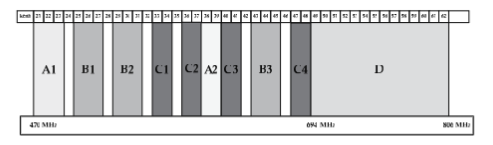
a) Three frequency bands B1 (channels 25, 26, 27), B2 (channels 29, 30, 31), B3 (channels 43, 44, 45) are prioritized for allocation to three national terrestrial digital television transmission and broadcasting units. National terrestrial digital television transmission and broadcasting units temporarily use channels 57, 58, 59 in band B3 and must switch to using band B3 before July 1, 2017.
b) Frequency channels 24, 32, 42 are additionally prioritized for allocation to national terrestrial digital television transmission and broadcasting units, using corresponding bands B1, B2, B3 respectively, to meet actual needs for increasing terrestrial digital television broadcasting capacity. In cases where these frequency channels cannot be utilized, temporary licensing of other frequency channels may be considered; national terrestrial digital television transmission and broadcasting units must switch to using the prioritized frequency channel after it becomes available.
c) Frequency band C1 (channels 33, 34) is prioritized for allocation to regional terrestrial digital television transmission and broadcasting units in the Southern region. In other regions, analog terrestrial television uses this frequency band and must cease broadcasting according to the Digitalization Plan to make way for terrestrial digital television.
d) Frequency band C4 (channels 47, 48) is prioritized for allocation to regional terrestrial digital television transmission and broadcasting units in the Northern region. In other regions, analog terrestrial television uses this frequency band and must cease broadcasting according to the Digitalization Plan to make way for terrestrial digital television.
đ) Frequency channels 35, 46 are additionally prioritized for allocation to regional terrestrial digital television transmission and broadcasting units in the Southern and Northern regions respectively, to meet actual needs for increasing terrestrial digital television broadcasting capacity. In cases where these frequency channels cannot be utilized, temporary licensing of other frequency channels may be considered; regional terrestrial digital television transmission and broadcasting units must switch to using the prioritized frequency channel after it becomes available. In other regions, analog terrestrial television uses channels 35, 46 and must cease broadcasting according to the Digitalization Plan to make way for terrestrial digital television.
e) Frequency band C2 (channels 36, 37) is prioritized for allocation to regional terrestrial digital television transmission and broadcasting units in the Central Highlands and Northwest regions. In other regions, analog terrestrial television uses this frequency band and must cease broadcasting according to the Digitalization Plan to make way for terrestrial digital television.
g) Frequency band C3 (channels 40, 41) is prioritized for allocation to regional terrestrial digital television transmission and broadcasting units in the Central region. In other regions, analog terrestrial television uses this frequency band and must cease broadcasting according to the Digitalization Plan to make way for terrestrial digital television.
h) Frequency channels within frequency bands A1 (channels 21, 22, 23), A2 (channels 38, 39) and channel 28 are used for analog terrestrial television systems and must cease broadcasting according to the Digitalization Plan to make way for terrestrial digital television.
i) Frequency band D (694-806) MHz is temporarily used for both terrestrial digital television and analog terrestrial television. This frequency band will be reserved for mobile IMT and other wireless telecommunications services after analog terrestrial television broadcasting ceases according to the Digitalization Plan.
Article 6. Implementation Organization
1. Based on the results of implementing the Digitalization Plan and the current status of terrestrial television frequency channel usage, the Ministry of Information and Communications announces the plan for switching terrestrial television UHF band (470-806) MHz frequency channels to implement this planning.
2. The Radio Frequency Management Department shall be responsible for:
a) Promulgating and guiding the implementation of this Circular;
b) Based on this Circular, the Radio Frequency Management Department issues frequency use permits and radio equipment licenses based on the suitability between the frequency use requirements and the actual terrestrial digital television broadcasting capacity of terrestrial digital television transmission and broadcasting units.
c) Taking the lead and coordinating with provincial-level Information and Communications Departments to inspect and supervise the use of frequencies and radio equipment for terrestrial television systems within their respective jurisdictions.
3. Terrestrial analog television transmission and broadcasting units shall be responsible for:
a) Ceasing the use of frequency channels for analog terrestrial television broadcasting according to the Digitalization Plan;
b) Implementing the switch from analog terrestrial television frequency channels to suitable frequency channels when the current frequency channel usage affects the prioritized frequency channels allocated to terrestrial digital television transmission and broadcasting units.
4. Terrestrial digital television transmission and broadcasting units shall be responsible for:
a) Implementing the planning accurately, applying maximum technical solutions, combining adjacent frequency channels to share antenna towers and broadcasting antennas, thereby enhancing the efficiency of infrastructure and radio frequency usage; deploying single-frequency network terrestrial digital television broadcasting in the Red River Delta and Southern regions.
b) Coordinate with terrestrial analog television transmission and broadcasting units to release analog television frequency channels according to the digitalization plan;
c) Develop and implement plans to transition frequencies to prioritized frequency channels, releasing frequency channels that have been allocated preferentially for other terrestrial digital television transmission and broadcasting units;
d) Take measures to handle and limit harmful interference from currently licensed analog television channels during the simulcast period of analog and terrestrial digital television;
đ) In areas where regional terrestrial digital television transmission and broadcasting units have not been established or are yet to be established, national terrestrial digital television transmission and broadcasting units must allocate part of their capacity to carry television program channels serving political tasks and essential information dissemination of localities in those areas as assigned by the Ministry of Information and Communications. In this case, frequency channels allocated for regional terrestrial digital television broadcasting may temporarily be permitted for national terrestrial digital television transmission and broadcasting units to prioritize broadcasting channels serving political tasks and essential information dissemination of localities within those regions;
5. The People's Committees of provinces and centrally governed cities shall direct the Departments of Information and Communications, Television Stations, Radio and Television Stations, authorities at all levels, and related units in their localities to coordinate with the Radio Frequency Management Agency to implement this Circular;
Article 7. Implementation Provisions
1. This Circular takes effect from February 12, 2014 until December 31, 2020;
2. The Director of the Office, the Director of the Radio Frequency Management Agency, heads of agencies and units under the Ministry of Information and Communications, terrestrial digital television transmission and broadcasting units, terrestrial analog television transmission and broadcasting units, Vietnam Television, Voice of Vietnam, provincial and centrally governed city radio and television stations are responsible for implementing this Circular;
3. Any difficulties encountered during implementation should be reported to the Ministry of Information and Communications for consideration and resolution./.
원본 문서(PDF)
관계도
문서를 클릭하면 열립니다. 빨간 테두리=효력을 변경하는 관계.