
This Circular stipulates the labeling methods for goods in commerce, including mandatory and non-mandatory contents to be marked on labels. The mandatory contents include production date, expiration date, composition, main quality indicators, usage and storage instructions (if necessary), origin, and name of the manufacturer or importer. This Circular takes effect from March 1, 2000.
Đối tượng áp dụng
Types of goods in the field of commerce
Các điểm cốt lõi
- Mandatory contents to be marked on product labels
- Optional contents that may be marked on product labels
- Violations of labeling regulations for goods
- Conditions for implementation and effectiveness of this Circular
- Requesting relevant Ministries to provide detailed guidance on labeling for specific types of goods
🌐 Tác động xã hội từ văn bản này
- Ensuring product quality, safety, and transparency in commerce
- Preventing the unauthorized use of trademarks protected by law
- Protecting consumer rights through full product information disclosure
❓ Câu hỏi thường gặp
What are the mandatory contents to be marked on product labels?
The mandatory contents include production date, expiration date, composition, main quality indicators, usage and storage instructions (if necessary), origin, and name of the manufacturer or importer.
When does this Circular take effect?
This Circular takes effect from March 1, 2000.
What responsibilities do the relevant Ministries have in implementing this Circular?
Relevant Ministries must provide detailed guidance on labeling for specific types of goods under their jurisdiction.
Toàn văn
|
MINISTRY OF TRADE |
SOCIALIST REPUBLIC OF VIET NAM |
|
Number:34/1999/TT-BTM |
Hanoi; date December 15, 1999 |
CIRCULAR
Guidelines for Implementing Decision
number 178/1999/QĐ-TTg dated August 30, 1999 of the Prime Minister
Issuing the Labeling Regulation for Goods Circulating
in Domestic Markets and Exported and Imported Goods
Pursuant to Decision number 178/1999/QĐ-TTg dated August 30, 1999 of the Prime Minister issuing the Labeling Regulation for goods circulating in domestic markets and exported and imported goods (hereinafter referred to as the Regulation), the Ministry of Trade provides specific guidelines for uniform implementation as follows:
I. EXPLANATION OF SOME GENERAL PROVISIONS
1. Scope of Application:
All goods circulating in domestic markets and all exported and imported goods must have labels and comply with labeling requirements under the Regulation, except for temporarily imported goods for re-export, goods processed for foreign countries, and other types of goods listed in Clause 2, Article 1 of the Regulation.
2. Distinction between Product Labels and Trademarks
a) According to Clause 1, Article 3 of the Regulation, a product label is a written, printed, drawn, or imprinted image or symbol directly applied or affixed securely on the product or its packaging to convey essential information about the product.
b) According to Article 785 of the Civil Code, a trademark is a distinctive sign used to differentiate goods or services of different business entities. A trademark can be a word, an image, or a combination of elements expressed in one or more colors.
Such signs are selected by traders to serve as symbols for registering industrial property protection for their products according to detailed regulations on Industrial Property (at Article 6 of Decree No. 63/CP dated October 24, 1996 of the Government).
3. Language for Presenting Trademarks
a) According to Point a, Clause 3, Article 5 of the Regulation, for imported goods intended for circulation and consumption in the Vietnamese market, when signing import contracts, traders should request suppliers to include additional mandatory information in the original label in Vietnamese to facilitate Vietnamese consumers' selection and use of the goods.
b) The supplementary label specified in Point b, Clause 3, Article 5 refers not to the original label in a foreign language but to a label in Vietnamese containing eight mandatory contents that are affixed, attached, or provided to buyers before or after completing customs clearance procedures.
+ Supplementary labels are used when importers cannot agree with foreign suppliers to include mandatory information in Vietnamese on the original label.
+ Supplementary labels must not obscure the original foreign-language label; complex goods requiring safety and accompanied by user instructions in a foreign language must also provide a Vietnamese translation along with the original foreign-language version for buyers.
+ Supplementary labels must also be affixed, attached, or provided at the point of sale for unpackaged goods.
+ The name of chemical components on supplementary labels must be in Vietnamese or in Latin or chemical formula.
II. LABEL CONTENT
A. MANDATORY CONTENT
1. Product Name
- The product name chosen for labeling as prescribed in Clauses 1, 2, 3, and 4 of Article 6 is based on the primary function and natural characteristics of the product. Naming products according to Clause 4 of Article 6 of the Regulation should avoid confusion with the manufacturer's brand name or the type of product. For example, laundry detergent (product name) VISO, OMO... (manufacturer's brand name); cold medicine (product name) Aspirin, Decolgen... (type of product)...
- Choosing the product name within the Harmonized System (HS) classification system for labeling as prescribed in Clause 3 of Article 6 means only the product name is labeled, not the HS classification code.
2. Name and Address of the Responsible Trader
- According to Article 7 of the Regulation, the name and address of the responsible trader are those registered for business operations.
- According to Clause 2 of Article 7 of the Regulation, recording the name and address of the responsible trader who assembles the product applies to repackaging for sale. The name and address of the repackaging entity may be recorded as "repackaging entity..." or "repacked at..."
3. Quantity of Goods
- Recording the quantity of goods on the product label according to the International System of Units (SI) at Clause 2 of Article 8 of the Regulation is done using certain units of measurement as shown in Table 1 below.
Unit of measurement: Percentage (%).
|
Serial Number |
Certain units of measurement used for labeling the quantity of goods |
Unit Symbol |
Usage of Unit |
|
1 |
Units of mass used: - Kilogram - gram - milligram |
kg g mg |
- Below 1 kg, use g (e.g., write 500g instead of 0.5 kg); below g, use mg (e.g., write 500 mg instead of 0.5g). - From 1 kg upwards, use kg and the decimal part should not exceed three digits (e.g., write 1.5 kg instead of 1500g). |
|
2 |
Units of volume used: * For liquid goods - Liter - Milliliter * For solid goods in cubic form - Cubic meter - Decimeter cubed - Centimeter cubed |
mL, ml Granite, gabbro, decorative stone...3 dm³3 cm3 |
- From 1 liter upwards, use liters and the decimal part should not exceed three digits (e.g., 1.75 liters instead of 1750 ml).
- From 1m³3 upwards, use m³3 and the decimal part should not exceed three digits. |
|
3 |
Units of area used: - Square meter - Decimeter squared - Centimeter squared - Millimeter squared |
Granite, gabbro, decorative stone...2 dm³2 cm2 mm2 |
- Below 1 m²2 use dm³2 and the decimal part of dm²2 or cm³2 and the decimal part of cm²2 or mm²2 - From 1 m²2 upwards, use m².2 and the decimal part should not exceed three digits. |
|
4 |
Units of length used: - Meter - Centimeter - Millimeter |
Granite, gabbro, decorative stone... cm mm |
- For lengths under 1 meter, centimeters or millimeters shall be used. - For lengths of 1 meter or more, meters shall be used with decimal parts not exceeding three digits. |
- In cases where goods produced in Vietnam for export require it, units of measurement from other systems may be used according to agreements made with importing countries.
- According to Clause 1, Article 8 of the Regulation, the recording of quantity on product labels depends on the nature of the goods contained in the packaging and the condition of the packaging, specifically:
+ Recording of "Net Weight" applies to the following situations:
* Goods in solid form, paste-like, viscous, mixed solid and liquid forms, compressed gas products (such as oxygen, ammonia, carbon dioxide, flammable gases...) contained in pressure-resistant containers. Units of measurement for net weight are mg, g, kg.
* For goods in mixed solid and liquid forms, both the weight of the solid component and the total weight of the mixture including both solid and liquid components must be recorded.
* For viscous goods in spray cans containing propellant, the total weight of the goods including the viscous substance and the propellant must be recorded.
* For compressed gas products in pressure-resistant containers, the recorded quantity on the label includes the weight of the compressed gas and the total weight of the gas and container.
+ Recording of "Actual Volume" applies to the following situations:
* Liquid goods in various shaped containers. Units of measurement for volume are ml, l at 20°C or a specific temperature depending on the characteristics of the goods.0* For liquids in spray cans containing propellant, the actual volume of the goods recorded on the label includes the total volume of the liquid and the propellant.
* If the goods have a cubic shape (cube, rectangular prism), the quantity is expressed by the product of three dimensions (length x width x height). Units of measurement for volume are cm, dm.
+ Recording of "Actual Size" applies to the following situations:3* Sheet or roll goods, the quantity recorded on the label is expressed by the length of the sheet or roll; or by the product of two dimensions (length x width) of the sheet or roll using units of measurement cm, m; if expressed by area, it is calculated by the product of two dimensions (length x width) and uses units of measurement cm.3, m3.
* Cylindrical roll goods, the quantity recorded on the label is expressed by the length and diameter of the fiber. Units of measurement used are mm, m.
+ For goods in a package containing multiple units of the same name and quantity, the quantity recorded on the label is expressed by the product of the number of units (count) and the weight of one unit (for example: 20 pieces x 10 g/piece); or by the number of units (count) and the total weight of the goods in the package (for example: 20 pieces - 200 g).2* Sheet or roll goods, the quantity recorded on the label is expressed by the length of the sheet or roll; or by the product of two dimensions (length x width) of the sheet or roll using units of measurement cm, m; if expressed by area, it is calculated by the product of two dimensions (length x width) and uses units of measurement cm.2, m2.
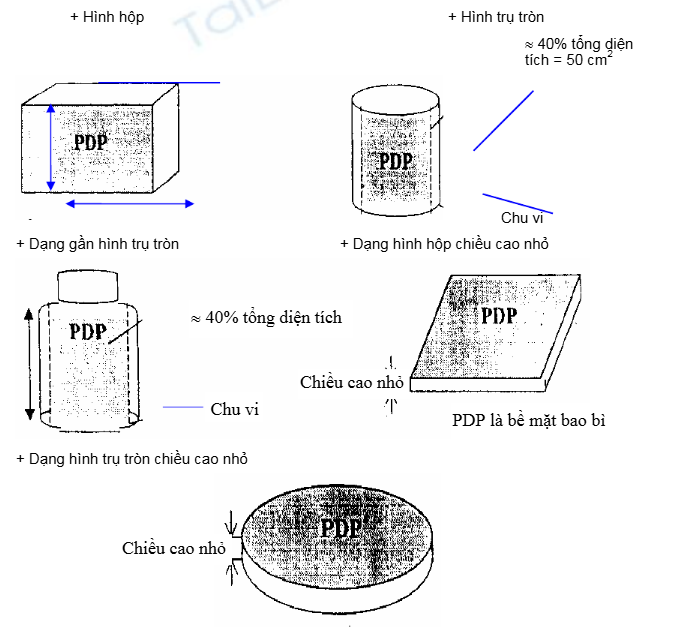
- At Clause 3, Article 8 of the Regulation, the size of letters and numbers presenting the quantity of goods is designed according to the main part of the label (PDP) as shown in Table 2 below:
Main Part of the Label (PDP)
(in cm²)
Unit of measurement: %
|
Minimum Height of Letters and Numbers |
> 32 to ≤ 258 |
|
£ 32 |
1,6 |
|
> 645 to ≤ 2580 |
2,3 |
|
Note: The symbol ≤ means less than or equal to; the symbol > means greater than. |
6,4 |
|
- At Clause 3, Article 8 of the Regulation, the calculation of the main part of the label (PDP) for different packaging shapes is illustrated by the following examples: |
9,5 |
|
> 2580 |
12,7 |
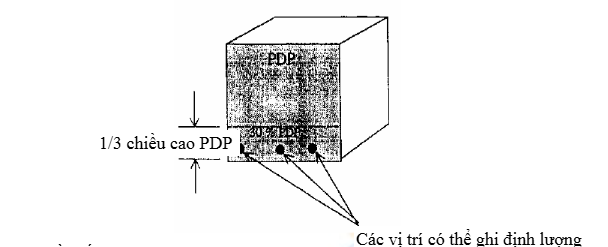
- At Clause 4, Article 8 of the Regulation, the position of the quantity recording is located at the bottom of the main part of the label (PDP) occupying 30% of the PDP area and a height approximately 1/3 of the PDP height. Example:
4. Composition
- The composition of goods recorded on the product label according to Article 9 of the Regulation includes components used in the production process and forming the value of the goods.
- For groups of goods requiring high safety during use such as food, beverages, cosmetics, pharmaceuticals, as stipulated in Clause 1, Article 9 of the Regulation, all components of the goods must be fully recorded on the product label.
- At Clause 2, Article 9 of the Regulation, this only applies to types of materials, equipment, machinery, and household items outside the groups specified in Clause 1, Article 9. Only necessary components that determine the value of the goods should be recorded, such as the ratio of natural and synthetic fibers in woven fabric; the ratio of pigments, fillers, alkyd resin, solvent, and drying agent in alkyd paint; detailed parts and accessories in the construction of equipment and machinery.
5. Key Quality Indicators
- The selection of key quality indicators for products to be recorded on the label depends on the nature, inherent properties, and the direct relationship between quality indicators and the primary function and necessary safety of the product.
- When it is necessary to distinguish grades, types, and application ranges of goods, traders must record technical specifications and quantities of key quality indicators on the label.
- To ensure high accuracy of key quality indicators, the label must include the standard test method code when recording key quality indicators.
- In addition to mandatory key quality indicators required to be recorded on the label according to regulations, traders can also record additional quality indicators if deemed necessary.
6. Production Date, Expiry Date, Storage Period
- The recording of production date, expiry date, and storage period is regulated in Clause 1 and 2, Article 11 of the Regulation.
- The way of recording the production date, expiry date, and storage period in Clause 3, Article 11 of the Regulation requires attention:
* Before the numbers indicating day, month, year, there must be a line of text:
- Regarding the recording of production date, period of use, and storage period as stipulated in Clause 3, Article 11 of the Regulation, attention should be paid to:
* The phrase preceding the numbers indicating day, month, and year must be:
+ "Date of manufacture" or abbreviated as "DM". Example: DM 021099 (manufactured on October 2, 1999)
+ "Expiry date" or abbreviated as "ED". Example: ED 310700 (valid until July 31, 2000)
+ "Storage period" or abbreviated as "SP". Example: SP 251201 (storage period until December 25, 2001)
+ Between the numbers indicating day, month, and year may be written consecutively or separated by a dot or a slash to clearly distinguish day, month, and year.
* In cases where production equipment and technology have not yet been able to overcome, it is acceptable to record the date of manufacture, expiry date, or storage period at the bottom of the packaging.
7. Instructions for use and storage
- Clause 1 Article 12 of the Regulation
+ Goods with simple and common usage characteristics do not require instructions for use and storage.
+ The accompanying description applies only to goods such as materials, machinery, and equipment that have complex usage requirements, high accuracy demands, or apply to goods requiring high safety and usage effectiveness such as medicines, medical supplies for human and animal health care, plant protection chemicals for industrial use, etc.
- Clause 2 Article 12 of the Regulation, in cases where the product label does not have sufficient space to record usage and storage instructions, this information shall be provided in an accompanying document given to the buyer.
8. Country of origin
On export product labels or imported product labels, the name of the country of origin must be recorded.
B. NON-MANDATORY CONTENTS
1. Non-mandatory contents that can be recorded on product labels are stipulated in Article 14 of the Regulation.
2. Merchants may record on product labels (if applicable) such as: national organization-issued product codes and barcodes; registered trademarks; awarded medals; international quality standards certifications; batch numbers; international symbols for transportation, use, and storage; etc.
III. VIOLATIONS:
Clause 8 Article 17 of the Regulation means: "Using a trademark protected by law without the owner's consent."
IV. IMPLEMENTATION PROVISIONS
1. This Circular takes effect from March 1, 2000.
Products labeled contrary to Decision 178/1999/QĐ-TTg and this Circular after the aforementioned date will be considered administrative violations in commercial activities.
For products labeled before the effective date of Decision 178/1999/QĐ-TTg and this Circular and still within their validity period, they may continue to circulate until their expiration date.
2. Detailed guidance on labeling specific types of goods falls under the responsibility of relevant ministries based on specific usage and storage requirements.
Contents of detailed guidance should pay attention to:
a) Groups and types of goods requiring high safety and usage effectiveness, complex usage characteristics, and mandatory usage instructions. Specifically:
- The Ministry of Health provides guidance on labeling for medicines, medical supplies for human health care, food, cosmetics, etc., related to safety, health, and usage methods.
- The Ministry of Agriculture and Rural Development, the Ministry of Fisheries provide guidance on labeling for medicines and supplies used in animal and plant production and disease prevention.
- Relevant ministries such as Industry, Construction, Transportation, Posts and Telecommunications, Science and Technology & Environment, Culture and Education, etc., provide guidance on labeling for chemicals, materials, machinery, and equipment under their jurisdiction.
b) Detailed guidance on labeling for specific types of goods includes: composition, key quality indicators, usage instructions, and storage instructions./.
|
|
Lương Văn Tự (Signed) |
Bản đồ quan hệ
Bấm vào một văn bản để mở. Viền đỏ = quan hệ làm thay đổi hiệu lực.
Bản dịch
Văn bản này có sẵn ở các ngôn ngữ sau: