
This proposal describes the detailed procedures for seven cases within the mobile service management system (MNP) in Vietnam, including: Registration for network transfer service, Post-transfer verification, Returning subscriptions to the transferring company, etc. Each case involves specific steps related to receiving and processing information from the transferring company, the Mobile Number Portability Center (MNPC), and the receiving company.
Scope of application
Mobile terrestrial telecommunications companies in Vietnam
Key points
- The registration procedure for the network transfer service includes receiving requests from subscribers, checking the format of the message, and processing the request.
- Post-transfer verification ensures that subscribers have fulfilled their obligations to the transferring company within the specified period.
- In cases where commitments are not met, subscribers may be returned to the transferring company for resolution.
- All steps require checking the format of the message and processing information from the MNPC.
- This process ensures transparency and efficiency in managing mobile services among telecommunications companies.
🌐 Social impact of this document
- Enhance customer satisfaction with the quality of network transfer services.
- Minimize disputes related to post-transfer obligations.
- Improve management efficiency and cooperation among telecommunications companies.
❓ Frequently asked questions
What steps are included in the registration procedure for the network transfer service?
It includes receiving requests from subscribers, checking the format of the message, and processing the request from the Mobile Number Portability Center (MNPC).
How can it be ensured that subscribers have completed their obligations after transferring networks?
Through the post-transfer verification process, the transferring company will review and report the completion status of each subscriber to the MNPC.
In which situations will subscribers be returned to the transferring company?
When subscribers fail to fulfill their committed obligations within the specified period, the transferring company may request the return of the subscribers.
Full text
|
MINISTRY OF INFORMATION AND COMMUNICATION ------- |
SOCIALIST REPUBLIC OF VIET NAM Independence - Freedom - Happiness --------------- |
| No.: 35/2017/TT-BTTTT | Hanoi, November 23, 2017 |
CIRCULAR
REGULATIONS ON THE TRANSFER OF MOBILE TELECOMMUNICATION NETWORKS WHILE RETAINING THE SAME NUMBER
Pursuant to the Law on Telecommunications dated November 23, 2009;
Pursuant to Decree No. 17/2017/NĐ-CP dated February 17, 2017, issued by the Government, on the functions, tasks, powers, and organizational structure of the Ministry of Information and Communications;
Pursuant to Decree No. 25/2011/NĐ-CP dated April 6, 2011 of the Government detailing and guiding the implementation of certain provisions of the Telecommunications Law, amended and supplemented by Decree No. 81/2016/NĐ-CP dated July 1, 2016 of the Government amending and supplementing certain provisions of Decree No. 25/2011/NĐ-CP dated April 6, 2011 of the Government detailing and guiding the implementation of certain provisions of the Telecommunications Law and Decree No. 49/2017/NĐ-CP dated April 24, 2017 of the Government amending and supplementing Article 15 of Decree No. 25/2011/NĐ-CP dated April 6, 2011 of the Government detailing and guiding the implementation of certain provisions of the Telecommunications Law and Article 30 of Decree No. 174/2013/NĐ-CP dated November 13, 2013 of the Government on administrative penalties for violations in the postal, telecommunications, information technology, and radio frequency sectors;, amended and supplemented by Decree No. 109/2025/NĐ-CP and Decree No. 193/2025/NĐ-CP The Minister of Information and Communications issues this Circular regulating the transfer of mobile terrestrial telecommunications networks while retaining the same number.y This Circular governs activities related to the provision and use of services for transferring mobile terrestrial telecommunications networks while retaining the same number.No. This Circular applies to enterprises licensed to operate mobile terrestrial telecommunications services, fixed telephone services (local, domestic long-distance, and international), enterprises providing content services on mobile terrestrial telecommunications networks, and relevant agencies, organizations, and individuals.
At the proposal of the Director of the Telecommunications Administration,
Transferring mobile terrestrial telecommunications networks while retaining the same number (transfer) refers to the process where a mobile subscriber of one enterprise providing mobile terrestrial telecommunications services becomes a mobile subscriber of another such enterprise while retaining the same number (including network code and subscriber number).
PART I
GENERAL PROVISIONS
Article 1. Scope of Regulation
Mobile terrestrial telecommunications network transfer service while retaining the same number (transfer service) is a commercial activity between mobile subscribers and the transferring enterprise combined with other enterprises providing mobile terrestrial telecommunications services and the Network Development Support Center under the Telecommunications Department.
Article 2. Applicability
A pre-transfer mobile subscriber is a mobile subscriber who has completed the registration procedures for the transfer service but has not yet been provided with mobile terrestrial telecommunications services by the transferring enterprise.
Article 3. Explanation of Terms
1. A successfully transferred mobile subscriber is a mobile subscriber whose transfer has been successfully completed.The original enterprise is the enterprise currently providing mobile terrestrial telecommunications services to a subscriber who has registered for the transfer service up until the time the service is cut off.
2. The receiving enterprise is the enterprise that will provide mobile terrestrial telecommunications services to a subscriber who has registered for the transfer service from the time the service is activated for that subscriber. The original enterprise of a transferring mobile subscriber (original enterprise) is the enterprise providing mobile terrestrial telecommunications services that has been allocated a block of numbers containing the number of the transferring mobile subscriber.
3. Subscriber registering for number portability service Transfer plan refers to the schedule regarding the time of service termination at the transferring enterprise and activation of service at the receiving enterprise for a subscriber who has registered for the transfer service.
4. Ported subscriber Transfer database refers to the collection of information related to all mobile subscribers who have used the transfer service stored at the Transfer Center.
5. Departing enterprise Transfer center is a system of equipment managed, operated, and utilized by the Network Development Support Center under the Telecommunications Department to implement the transfer process according to regulations.
6. Receiving enterprise 1. Transfer services shall be provided equally by enterprises providing mobile terrestrial telecommunications services without discrimination against mobile subscribers.
7. 2. Transfer services shall be provided based on a commercial contract between the enterprise providing mobile terrestrial telecommunications services and the mobile subscriber. 3. Transfer services do not include the continued provision of value-added services and telecommunications application services that the transferring subscriber is using at the transferring enterprise. The transferring enterprise must ensure that no charges arise for any value-added services or telecommunications application services from the time the transferring subscriber's service is terminated.
8. Porting schedule 4. Enterprises providing mobile terrestrial telecommunications services shall be responsible for unifying, publicly announcing, and applying common rates and terms for the use of transfer services. The rate for transfer services shall be calculated based on the following principles:
9. Database of ported subscribers a) Revenue covering costs, ensuring compensation for a portion of the costs incurred by the transferring enterprise, the receiving enterprise, and the Network Development Support Center in coordinating the provision of transfer services;
10. b) Periodically, the rate for transfer services may be adjusted to suit actual conditions to ensure that transfers do not have a negative impact on the mobile terrestrial telecommunications service market. 5. The rate for transfer services shall not be refunded except in cases where the transfer fails due to technical faults in the transfer system. Enterprises providing mobile terrestrial telecommunications services and the Transfer Center must unify and publicly announce technical faults in the transfer system. The Transfer Center shall notify the transferring subscriber about the reasons for the unsuccessful transfer.
Article 4. General Provisions
6. The rate for transfer services shall be used to pay the transferring enterprise, the receiving enterprise, and the Network Development Support Center. The payment for the Network Development Support Center from the rate for transfer services shall be used to offset a portion of the costs for operating, maintaining, and upgrading the Transfer Center's equipment to support transfers.
7. The number of a transferring mobile subscriber, which is reclaimed according to regulations on managing and using telecommunications number pools or regulations on the use of telecommunications services by the enterprise providing mobile terrestrial telecommunications services currently serving that subscriber, shall be returned to the original enterprise.
3. The mobile number portability service does not include the continued provision of value-added services and telecommunications application services that the subscriber of the mobile number portability service is using at the transferring enterprise. The transferring enterprise must ensure that no charges for any value-added services and telecommunications application services arise from the disconnection time of the subscriber's mobile number portability service.
4. Enterprises providing terrestrial mobile telecommunications services have the responsibility to unify, announce, publicly post, and uniformly apply the rates and terms of use for the mobile number portability service. The rate for the mobile number portability service shall be calculated based on the following principles:
a) Revenue should cover costs, ensuring that it compensates for a portion of the expenses of the transferring enterprise, the receiving enterprise, and the Network Development and Service Support Center in coordinating the provision of the mobile number portability service;
b) Periodically, the rate for the mobile number portability service may be adjusted to suit actual conditions to ensure that the mobile number portability process does not have a negative impact on the terrestrial mobile telecommunications service market.
5. The rate for the mobile number portability service shall not be refunded except in cases where the mobile number portability is unsuccessful due to technical system errors. Enterprises providing terrestrial mobile telecommunications services and the Mobile Number Portability Center must unify and publicly announce technical system errors. The Mobile Number Portability Center shall notify the subscriber of the mobile number portability service about the reason for the unsuccessful mobile number portability.
6. The rate for the mobile number portability service is used to pay the transferring enterprise, the receiving enterprise, and the Network Development and Service Support Center. The rate for the mobile number portability service paid to the Network Development and Service Support Center is used to compensate for a portion of the operating, maintenance, operation, maintenance, upgrade costs of the equipment system of the Mobile Number Portability Center to serve the mobile number portability process.
7. The number of the mobile number portability subscriber, which is reclaimed according to the regulations on managing and using telecommunications number pools or the regulations on the use of telecommunications services by enterprises providing terrestrial mobile telecommunications services currently providing services to such subscribers, shall be returned to the original enterprise.
8. A mobile terrestrial telecommunications service provider may only develop new subscribers from the blocks of subscriber numbers allocated to that enterprise.
9. Subscribers registering for number portability services must complete all related obligations and commitments and terminate their contracts with the transferring enterprise within a specified period not exceeding sixty days from the date of successful number porting. Beyond this time limit, subscribers who have not completed their related obligations or commitments or have not terminated their contracts with the transferring enterprise shall be returned to the transferring enterprise.
10. The parties involved in providing number portability services and using the subscriber database for number portability must ensure the confidentiality of subscriber information in accordance with Article 6 of the Telecommunications Law.
11. Short message service number 1441 is used to serve number portability transactions. Mobile subscribers are exempted from charges when sending/receiving messages to/from number 1441.
12. Mobile terrestrial information services provided to subscribers registering for number portability services follow the principle that the transferring enterprise suspends the service, then the receiving enterprise activates the service.
13. Enterprises providing mobile terrestrial telecommunications services reconcile the discrepancies in the number of ported subscribers periodically on a quarterly basis from the official provision of number portability services until the reconciliation date.
Chapter II
IMPLEMENTATION, REFUSAL AND CANCELLATION OF MOBILE TERRITORIAL TELECOMMUNICATIONS NUMBER PORTABILITY
Article 5. Implementation of Number Portability
1. The call and message routing mechanism originating from mobile subscribers to ported subscribers is applied in the form of "Full Query" - All Calls Query (ACQ).
2. The call and message routing mechanism originating from fixed telephone subscribers of fixed telecommunications networks and dedicated telecommunications networks serving Party and State agencies, defense, security to ported subscribers; from the equipment system of enterprises providing information content services on mobile terrestrial telecommunications networks to ported subscribers is applied in one of the following forms:
a) "Full Query" - All Calls Query;
b) "Forward Routing" - Onward Routing;
c) "Call Forward."
3. The transferring enterprise, the receiving enterprise, and the Telecommunications Department coordinate to implement the technical procedures for number portability according to the flowchart stipulated in the Appendix issued together with this Circular.
Article 6. Refusal of Number Portability
The transferring enterprise may only refuse to implement number portability for subscribers registering for number portability services under one of the following circumstances:
1. Subscriber information registered for number portability at the receiving enterprise is inaccurate compared to the information of that subscriber at the transferring enterprise, including basic information such as:
a) For individual subscriber information: Information on personal identification documents of individuals as prescribed in point a, Clause 3, Article 15 of Decree No. 25/2011/ND-CP amended and supplemented by Decree No. 49/2017/ND-CP, including: full name, date of birth, nationality, ID number/date of issuance/issuing authority or place of issuance of personal identification documents, place of permanent household registration (for Vietnamese citizens); payment method for service fees.
b) For organizational subscriber information: Information on legal entity certificates of organizations as prescribed in point b, Clause 3, Article 15 of Decree No. 25/2011/ND-CP amended and supplemented by Decree No. 49/2017/ND-CP, including: organization name, business address, decision number/date of issuance/issuing authority or place of issuance of establishment decision or business registration certificate and tax registration or investment permit or business registration certificate; list of phone numbers belonging to the organization registering for number portability services; payment method for service fees.
2. Violation of acts prescribed in Article 12 of the Telecommunications Law or at the request of competent state authorities;
3. Currently having complaints or disputes regarding the use of services with the transferring enterprise;
4. Violation of telecommunications service supply and usage contracts or general terms of trade with the transferring enterprise.
Article 7. Cancellation of Number Portability Service
1. From the date of registration for the number portability service to before receiving the schedule for the number portability process from the Number Porting Center, the subscriber may cancel the number portability service through one of the following methods:
a) Requesting the Receiving Enterprise. The Receiving Enterprise specifies the forms of accepting cancellation requests from subscribers (at sales outlets, via phone calls, SMS messages, etc.);
b) Sending an SMS directly to the number 1441.
2. The Sending Enterprise and the Receiving Enterprise shall only stop implementing the number portability process upon receipt of a cancellation request from the Number Porting Center.
Chapter III
RIGHTS AND OBLIGATIONS OF THE PARTIES INVOLVED
Article 8. Rights and Obligations of Enterprises Providing Mobile Telecommunication Services
1. Cooperate with the Telecommunications Administration and other enterprises providing mobile telecommunication services to develop the Business Process for Number Portability and the Service Provision Agreement for Number Portability.
2. Ensure the transmission lines connecting to the Number Porting Center to carry out the number portability process.
3. Update information from the Subscriber Database for Number Porting to maintain the provision of telecommunication services and telecommunication application services.
4. Negotiate, agree upon, and sign contracts with other mobile telecommunication enterprises, the Network Development and Service Support Center to provide number portability services. The minimum contents to be negotiated, agreed upon, and signed for the provision of number portability services include:
a) The status of the mobile subscriber at the time of registering for the number portability service;
b) Handling the account balance of the subscriber when registering for the number portability service (retention, non-retention, restoration, etc.);
c) The minimum period between two consecutive number portability processes;
d) The deadline from the successful completion of the number portability process for the subscriber to fulfill all related obligations and terminate the contract with the Sending Enterprise as stipulated in Clause 9, Article 4 of this Circular;
đ) Tariffs and tariff distribution ratios for the number portability service;
e) Reconciliation of discrepancies in the number of subscribers ported according to Clause 13, Article 4 of this Circular;
g) The minimum period during which the subscriber does not use international roaming services prior to registering for the number portability process;
h) Suspension of international roaming services when the subscriber registers for the number portability process;
i) Application form for using the number portability service and related documents;
k) Technical error code table of the number porting system.
5. Coordinate with management agencies and organizations operating private telecommunications networks serving Party and State agencies, defense, and security; enterprises providing local telephone, long-distance domestic and international services; and enterprises providing content services on mobile telecommunications networks to develop technical solutions, connections, and routing schemes as stipulated in Clause 2, Article 5 of this Circular based on ensuring the interests of all parties involved.
6. Ensure telecommunications infrastructure to meet the connection needs of management agencies and organizations operating and exploiting private telecommunications networks serving Party and State agencies, defense, and security.
Article 9. Rights and Obligations of the Sending Enterprise
1. Complete all relevant procedures for mobile subscribers transferring out after the completion of the number porting process and during post-audit.
2. Coordinate with the Receiving Enterprise, the Network Development and Service Support Center, and other relevant parties to resolve customer complaints related to the number portability service.
Article 10. Rights and Obligations of the Receiving Enterprise
1. Accept requests for service registration and cancellation of number portability from mobile subscribers at its telecommunications service provision points.
2. Collect charges for number portability services from subscribers registering for such services and pay to the Sending Enterprise and the Network Development and Service Support Center in accordance with Clause 6, Article 4 of this Circular.
3. Take the lead and coordinate with the Sending Enterprise, the Network Development and Service Support Center, and related parties to resolve customer complaints related to number portability services.
4. Only provide terrestrial mobile telecommunications services to subscribers who have registered for number portability services after completing the review, inspection, ensuring that subscriber information has been compared, entered, retained, and managed in compliance with current regulations.
Article 11. Responsibilities of the Telecommunications Authority
1. Ensure the telecommunications infrastructure of the Number Portability Center for enterprises to connect to.
2. Take the lead and coordinate with terrestrial mobile telecommunications service providers to develop and issue the operational procedures for number portability.
3. Direct the Network Development and Service Support Center to provide routing information in the number portability subscriber database for telecommunications enterprises requiring routing to provide telecommunications services and telecommunications application services.
4. Inspect and urge enterprises to provide number portability services in accordance with regulations.
5. Advise, build, and submit to the Ministry of Information and Communications for issuance mechanisms and methods for cooperation between terrestrial mobile telecommunications service providers based on creating conditions and promoting enterprises to negotiate, unify, and synchronously implement the provision of number portability services.
6. Based on the actual situation of trial implementation at terrestrial mobile telecommunications service providers, propose the method and timing for officially providing number portability services.
7. Direct the Network Development and Service Support Center to coordinate with the Sending Enterprise and the Receiving Enterprise to resolve customer complaints related to number portability services when requested.
Article 12. Rights and Obligations of Enterprises Providing Intra-City, Long-Distance Domestic and International Telephone Services and Content Services on Terrestrial Mobile Telecommunications Networks
1. Develop technical plans, negotiate with other telecommunications enterprises to ensure uninterrupted provision of telecommunications services when officially implementing the provision of number portability services to route calls and messages initiated from their own telecommunications networks to number portability subscribers in accordance with Clause 2, Article 5 of this Circular, and ensure stable and smooth provision of their own telecommunications services and telecommunications application services after terrestrial mobile telecommunications service providers officially provide number portability services.
2. Organizations and enterprises applying the "Full Query" routing mechanism must ensure the following contents:
a) Update information from the number portability subscriber database to maintain the provision of telecommunications services and telecommunications application services and shall not provide the number portability subscriber database to third parties in any form;
b) Data related to number portability subscribers may only be used for the purpose of providing telecommunications services and telecommunications application services.
3. Enterprises providing intra-city, long-distance domestic and international telephone services ensure telecommunications infrastructure to meet the connection needs of agencies, organizations managing, operating, and exploiting dedicated telecommunications networks serving Party and State agencies, defense, and security.
4. Coordinate with related parties to resolve customer complaints related to number portability services.
Chapter IV
IMPLEMENTATION
Article 13. Implementation Organization
1. The Director of the Office, the Director of the Telecommunications Authority, the Heads of Ministries and Units under the Ministry; terrestrial mobile telecommunications service providers; enterprises providing intra-city, long-distance domestic and international telephone services; enterprises providing content services on terrestrial mobile telecommunications networks, and relevant organizations and individuals are responsible for implementing this Circular.
2. During the implementation process, if there are any difficulties arising, relevant agencies, organizations, and individuals need to promptly reflect them to the Ministry of Information and Communications (Telecommunications Authority) for consideration and resolution.
Article 14. Implementation clause
1. This Circular takes effect from January 8, 2018.
2. Terrestrial mobile telecommunications service providers cooperate with the Telecommunications Authority to ensure the provision of number portability services./.
|
|
THE MINISTER |
ANNEX:
PROCEDURE FOR NUMBER PORTABILITY ON TERRESTRIAL MOBILE TELECOMMUNICATIONS NETWORKS RETAINING THE SAME NUMBER
(Annexed to Circular No. 35/TT-BTTTT date 23 the 11 NAME OF ORGANIZATION/UNIT/
1. General number portability flowchart
a. Procedure (1) - Initiate Number Portability
This process performs the following tasks:
- Subscriber performs registration for number portability service;
- Receiving Enterprise initiates the request for number portability of the Subscriber;
- Sending Enterprise checks the fulfillment of the terms for using number portability services and returns the result of Approval or Denial to the Subscriber requesting number portability.
b. Procedure (2) - Cancel Number Portability Request
Before receiving the Porting Schedule, a Subscriber who has registered for number portability may cancel the previously registered request for number portability in accordance with Clause 1, Article 7 of this Circular. The Subscriber's request will be stopped processing from the time the Subscriber receives a message confirming successful cancellation of the number portability request.
c. Procedure (3) - Activate Number Portability
A subscriber who has been approved for number portability and has not canceled their request will be:
- Schedule number portability and notify the schedule;
- At the time of number portability processing: the Sending Enterprise will terminate services, then the Receiving Enterprise will activate services for the Subscriber;
- Routing information of the Subscriber after successful number portability processing is updated and notified to enterprises requiring it to serve routing of telecommunications services and telecommunications application services for the Subscriber.
d. Procedure (4) - Post-Porting Verification
A mobile subscriber who has not fulfilled their obligations and commitments with the transferring enterprise will be included in the Post-Transfer Review Process. The post-transfer review process involves checking whether the mobile subscriber has fulfilled their obligations and commitments to the transferring enterprise.
d. Flowchart (5) - Return Subscriber to Transferring Enterprise
A mobile subscriber who has not completed their obligations and commitments with the transferring enterprise shall be processed for return to the transferring enterprise.
e. Flowchart (6) - Return Number to Original Enterprise
The number of a mobile subscriber that is reclaimed according to regulations on the management and use of telecommunications number pools or service usage regulations of the mobile terrestrial telecommunications operator providing services to such subscriber must be returned to the original enterprise.
2. Initiation Transfer Flowchart
TTCM: b) Periodically, the rate for transfer services may be adjusted to suit actual conditions to ensure that transfers do not have a negative impact on the mobile terrestrial telecommunications service market.
- Step (1): Mobile subscribers or groups of mobile subscribers (referred to as Subscribers) register the transfer service at the receiving enterprise's telecommunications service provision points in accordance with Clause 1, Article 10 of this Circular.
- Step (2): The receiving enterprise will accept the subscriber's transfer request through the registration procedures for the transfer service. Then, the receiving enterprise will initiate the transfer request on its Mobile Number Portability (MNP) system and send it to the MNP system of the Transfer Service Center (TTCM).
- Step (3): TTCM will check the format of the transfer request message sent from the receiving enterprise's MNP system against the technical specifications agreed upon between the transferring enterprise, the receiving enterprise, and TTCM (Correct/Incorrect).
- Step (4): If the message format is Correct, TTCM will forward the transfer request to the transferring enterprise for the transferring enterprise to verify the information content according to the terms of the transfer service agreement with the Subscriber.
- Step (5): If the message format is Incorrect, TTCM will not forward the transfer request message and will send an error notification to the receiving enterprise (error in the transfer request message format). The receiving enterprise must resend the transfer request message in the correct format as specified.
- Step (6): The transferring enterprise will accept the transfer request forwarded from TTCM, then perform verification of the information content according to the terms of the transfer service agreement with the Subscriber on its MNP system and related management systems. After completing the verification, the transferring enterprise will send the verification result to TTCM via its MNP system, confirming either Approval or Rejection for the Subscriber to proceed with the transfer.
- Step (7): TTCM will check the format of the response message received from the transferring enterprise against the agreed technical specifications (Correct/Incorrect).
- Step (8): If the message format is Correct, TTCM will forward the verification result according to the terms of the transfer service agreement with the Subscriber received from the transferring enterprise to the receiving enterprise.
At the same time, TTCM will send an SMS notification of the verification result according to the terms of the transfer service agreement to the Subscriber who registered for the transfer service.
- Step (9): If the message format is Incorrect, TTCM will not forward this message to the receiving enterprise, but will send an error notification to the transferring enterprise. The transferring enterprise must resend the verification result according to the terms of the transfer service agreement to TTCM.
- Step (10): The receiving enterprise will accept the verification results of the terms of the transfer service agreement with the Subscriber on its MNP system.
The Subscriber receives an SMS notification of the verification result according to the terms of the transfer service agreement.
3. Activation Transfer Flowchart
TTCM: b) Periodically, the rate for transfer services may be adjusted to suit actual conditions to ensure that transfers do not have a negative impact on the mobile terrestrial telecommunications service market.
- Step (1): If the transferring enterprise decides to Approve the Subscriber's transfer, TTCM will schedule the transfer for the Subscriber. After scheduling, TTCM will notify the transferring enterprise, the receiving enterprise, and the Subscriber of the transfer schedule.
- Step (2): Prior to the scheduled transfer processing time, both the transferring enterprise and the receiving enterprise must inform TTCM of their readiness to process the transfer according to the schedule.
- Step (3): Based on the transfer schedule, the transferring enterprise will process the service termination for the Subscriber on its mobile terrestrial telecommunications network. Upon completion of the processing, the transferring enterprise will notify TTCM that the service termination has been completed.
- Step (4): TTCM will accept the notification of the completed service termination processing from the transferring enterprise and forward this notification to the receiving enterprise.
- Step (5): The receiving enterprise will accept the notification of the completed service termination processing from the transferring enterprise through TTCM, then process the service activation for the Subscriber on its mobile terrestrial telecommunications network. Upon completion of the processing, the receiving enterprise will notify TTCM that the service activation has been completed.
- Step (6): TTCM will accept the notification of the completed service activation processing from the receiving enterprise.
After completing the transfer request processing, TTCM will broadcast a notification of the completed transfer processing to all connected parties and update the transferred Subscriber's information in the transfer database.
- Step (7): All participating parties must update their respective transfer query databases and send confirmation notifications of receipt of the broadcast message to TTCM within the specified period to ensure proper routing of telecommunications services.
4. Cancellation Transfer Flowchart.
TTCM: b) Periodically, the rate for transfer services may be adjusted to suit actual conditions to ensure that transfers do not have a negative impact on the mobile terrestrial telecommunications service market.
- Step (1): The Subscriber registers to cancel their transfer request by sending a message to the channels designated by the receiving enterprise or through TTCM.
- Step (2.1): The receiving enterprise accepts the Subscriber's network transfer cancellation request through the reception methods it specifies.
- Step (2.2): The National Switch Center (TTCM) receives the request to Cancel number porting via a text message from the Subscriber. Then proceed to Step (4) - checking the syntax of the text message.
- Step (3): After receiving the request from the Subscriber, the Enterprise initiates the creation of a cancellation notice for the number porting request on its MNP system, then sends the request to the National Switch Center (TTCM).
- Step (4): The National Switch Center (TTCM) checks the format of the cancellation notice for the number porting request sent by the Enterprise according to specified technical parameters (Correct/Incorrect); or checks the syntax of the Subscriber's cancellation request text message.
- Step (5): In case the format check of the notice or the syntax check of the text message is Correct, the National Switch Center (TTCM) will stop processing the Subscriber's number porting request according to the prescribed number porting procedure. Subsequently, all requests related to the number porting transaction of the Subscriber who requested cancellation will not be processed. The National Switch Center (TTCM) will then send a successful cancellation notification to the Receiving Enterprise, the Sending Enterprise, and send an SMS notification to the Subscriber about the successful cancellation of their number porting request.
- Step (6): In case the format check of the notice or the syntax check of the text message is Incorrect, the National Switch Center (TTCM) will not execute the cancellation request for the Subscriber.
o In case the format of the cancellation request notice from the Receiving Enterprise is Incorrect, the National Switch Center (TTCM) will send an error notification to the Receiving Enterprise. The Receiving Enterprise must resend the cancellation request notice for the Subscriber to the National Switch Center (TTCM).
o In case the syntax of the Subscriber's cancellation request text message is incorrect, the National Switch Center (TTCM) will not process the Subscriber's cancellation request. The National Switch Center (TTCM) will send an SMS response to the Subscriber regarding the incorrect syntax. To cancel the number porting request, the Subscriber must resend a correctly formatted cancellation request text message to the National Switch Center (TTCM).
- Step (7): The Receiving Enterprise, the Sending Enterprise, and the Subscriber receive the successful cancellation notification from the National Switch Center (TTCM).
5. Flowchart for Returning Numbers to the Original Enterprise
TTCM: b) Periodically, the rate for transfer services may be adjusted to suit actual conditions to ensure that transfers do not have a negative impact on the mobile terrestrial telecommunications service market.
- Step (1): The Receiving Enterprise periodically checks its relevant management systems each month and identifies mobile numbers of Subscribers whose number porting violated regulations leading to the need for number recovery. For Subscribers whose numbers have been recovered due to number porting violations, the Receiving Enterprise will initiate a request for returning numbers to the Original Enterprise on its MNP system and send the request to the National Switch Center (TTCM).
- Step (2): The National Switch Center (TTCM) receives the request for returning numbers from the Receiving Enterprise, and checks the format of the notice of the request for returning numbers from the Receiving Enterprise according to specified technical parameters (Correct/Incorrect).
- Step (3): If the format of the notice is Correct, the National Switch Center (TTCM) broadcasts a public announcement notice for returning numbers to the Original Enterprise to all connected parties and updates the information in the number porting database.
- Step (4): If the format of the notice is Incorrect, the National Switch Center (TTCM) will not execute the request for returning numbers from the Receiving Enterprise and sends an error notification to the Receiving Enterprise. The Receiving Enterprise must resubmit the request for returning numbers to the National Switch Center (TTCM).
- Step (5): All terrestrial mobile telecommunications enterprises and other related parties are responsible for sending confirmation of receipt of the public announcement notice for returning numbers to the Original Enterprise to the National Switch Center (TTCM). All terrestrial mobile telecommunications enterprises and other related parties must update their respective number porting query databases and send completion notices to the National Switch Center (TTCM) within the specified timeframe.
6. Post-Porting Proceduresồ - Post-PortingdevelopmentProceduresdevelopment- Step (1): After successfully completing the number porting process, the Ported Subscriber has a defined period to fulfill related obligations and terminate the contract with the Sending Enterprise (these are commitments made by the Subscriber when registering for the number porting service).
TTCM: b) Periodically, the rate for transfer services may be adjusted to suit actual conditions to ensure that transfers do not have a negative impact on the mobile terrestrial telecommunications service market.
After this period, the Sending Enterprise reviews its relevant management systems and determines the status of fulfillment of obligations and commitments by the Ported Subscribers as stipulated in Clause 9, Article 4 of the Circular. It then initiates Post-Porting Inspection Requests for those Subscribers who have not fulfilled their obligations and commitments with the Sending Enterprise and reports the completion of post-porting inspections for those who have fulfilled their obligations and commitments with the Sending Enterprise. These inspection notices are then sent to the National Switch Center (TTCM).
Before the deadline for completing post-porting procedures by the Subscriber after successful number porting:
o The Sending Enterprise can send a report of completed post-porting procedures for Subscribers who have fulfilled their obligations and commitments with the Sending Enterprise to the National Switch Center (TTCM).
o The National Switch Center (TTCM) will not process Post-Porting Inspection Requests for Subscribers who have not fulfilled their obligations and commitments with the Sending Enterprise during this time.
- Step (2): The National Switch Center (TTCM) receives the Post-Porting Inspection notices from the Sending Enterprise, and checks the format of these notices according to specified technical parameters (Correct/Incorrect).
- Step (3): If the format of the notices is Correct, the National Switch Center (TTCM) forwards the Post-Porting Inspection notices to the Receiving Enterprise.
For Subscribers who have completed post-porting procedures, the National Switch Center (TTCM) updates its MNP system;
- Step (4): If the format of the notice is Incorrect, the National Switch Center (TTCM) will not forward the Post-Porting Inspection notices from the Sending Enterprise and sends an error notification to the Sending Enterprise. The Sending Enterprise must resubmit the Post-Porting Inspection notices in the correct format to the National Switch Center (TTCM).
- Step (5): The Receiving Enterprise receives the Post-Porting Inspection notices from the National Switch Center (TTCM).
o For Subscribers who have completed post-porting procedures, the Receiving Enterprise updates its MNP system.
o For subscribers who have completed post-inspection, the receiving enterprise shall update its MNP system.
o For Subscribers who have not completed post-migration verification, the transferring company shall transfer to the receiving company for re-verification with the Subscriber regarding the status of fulfilling their obligations and commitments to the transferring company. If the Subscriber has fulfilled their obligations and commitments within the prescribed time limit but the transferring company has not updated its relevant management systems, the receiving company will collect evidence from the Subscriber. Thereafter, the receiving company will send evidence of the Subscriber's fulfillment of obligations and commitments to the National Interconnection Center (NCC).
- Step (6): The NCC receives evidence of the Subscriber's fulfillment of obligations and commitments to the transferring company from the receiving company. Then it forwards this evidence to the transferring company.
- Step (7): The transferring company receives evidence of the Subscriber's fulfillment of commitments after successful network migration from the NCC and verifies the accuracy of such evidence.
o If the evidence is correct, the transferring company updates its relevant management systems and sends a notification of post-migration verification completion for Subscribers who have fulfilled their obligations and commitments to the NCC for updating.
o If the evidence is incorrect, proceed to Step (9).
- Step (8): For Subscribers who have not truly fulfilled their commitments to the transferring company after successful network migration and lack verification evidence, they will be returned to the transferring company.
- Step (9): The transferring company and the Subscriber jointly handle and resolve incorrect evidence of obligation and commitment fulfillment provided by the Subscriber to the receiving company outside the Mobile Number Portability (MNP) process. After reaching an agreement on handling, the transferring company continues the post-migration verification process to update the post-migration verification status.
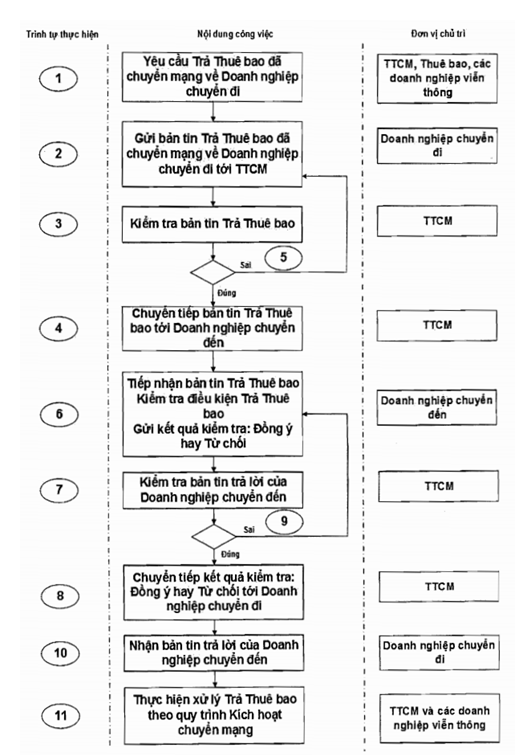
7. Flowchart for Returning Subscribers to the Transferring Company
TTCM: b) Periodically, the rate for transfer services may be adjusted to suit actual conditions to ensure that transfers do not have a negative impact on the mobile terrestrial telecommunications service market.
- Step (1): Subscribers who fail to complete their obligations and commitments to the transferring company within a specified period will be returned to the transferring company.
The transferring enterprise compiles subscriptions that have not completed their commitments when registering for number portability services on its related management systems.
- Step (2): The transferring company then initiates a request for returning the Subscriber to the transferring company (return Subscriber notice) on its MNP system and sends this request to the NCC.
- Step (3): The NCC receives the return Subscriber notice from the transferring company and checks the format of the notice according to the technical specifications (Correct/Incorrect).
- Step (4): In case the format of the notice is Correct, the NCC forwards the return Subscriber notice to the receiving company.
- Step (5): In case the format of the notice is Incorrect, the NCC does not forward the return Subscriber notice from the transferring company and sends an error notification to the transferring company. The transferring company must resend a new return Subscriber notice to the NCC.
- Step (6): The receiving company receives the return Subscriber notice and checks the return Subscriber request according to Clause 9, Article 4 on its relevant management systems. It then sends a reply notice of Agreement or Rejection of the return Subscriber request back to the transferring company.
- Step (7): The NCC receives the reply notice of the return Subscriber request from the receiving company and checks the format of the notice according to the technical specifications (Correct/Incorrect).
- Step (8): In case the format of the notice is Correct, the NCC forwards the reply notice of the receiving company to the transferring company.
- Step (9): In case the format of the notice is Incorrect, the NCC does not forward the reply notice of the receiving company and sends an error notification to the receiving company. The receiving company must resend a new reply notice of the return Subscriber request to the NCC.
- Step (10): The transferring company receives the reply notice of the return Subscriber request from the NCC.
o For return Subscriber requests that the receiving company agrees to, the transferring company prepares its MNP system to process the return Subscriber network migration.
o For return Subscriber requests that the receiving company rejects, the transferring company reviews, negotiates, and reaches an agreement with the receiving company and the NCC (if necessary).
- Step (11): The NCC and all terrestrial mobile telecommunications companies and other related parties implement the return Subscriber process according to the Network Migration Activation Flowchart.
Original document (PDF)
Relations map
Click a document to open. A red border = a relation that changes validity.
Translations
This document is available in the following languages: