
Circular No. 48/1998/TT-BTC amends and supplements regulations on income tax for enterprises and economic organizations. This Circular takes effect from 1997 and abolishes previous regulations that conflict with it.
Scope of application
State-owned enterprises, non-state enterprises, joint-stock companies, private households, and other economic organizations.
Key points
- Gross revenue for calculating income tax includes proceeds from sales, commissions, services, and agricultural lease revenues.
- Depreciation expenses of fixed assets are deducted according to the decision of the Ministry of Finance, not for assets that have been fully utilized but are still in use.
- The income tax rate is 25%, 35%, and 45% depending on the business sector.
- Enterprises with income exceeding the specified level must pay additional income tax at a rate of 30%-40%. The additional tax rate is determined by the business sector.
- Joint-stock companies and private households with average monthly income over 10 million VND must pay additional income tax at a rate of 25%.
🌐 Social impact of this document
- Positive impact: Establishes clear legal basis for calculating income tax.
- Negative impact: Financial burden on enterprises with high profits, especially in trade and service sectors.
❓ Frequently asked questions
How is the income tax rate applied?
The income tax rate is 25%, 35%, or 45% depending on the business sector. Enterprises with income exceeding the specified level must pay additional income tax at a rate of 30%-40%. The specific additional tax rate is determined by the business sector.
Which enterprises must pay additional income tax?
Enterprises with higher taxable income than the specified level, particularly those in resource extraction, production, construction, and transportation sectors. Joint-stock companies and private households must also pay additional income tax if their average monthly income exceeds 10 million VND.
What costs are deductible for depreciation?
Enterprises must register with the tax authority a list of fixed assets, usage period, and depreciation period. Repair costs of fixed assets can only be included or allocated gradually as reasonable expenses.
What is the additional income tax rate?
The additional income tax rate is 30%-40% depending on the business sector. The specific rate is determined by the sector with the highest taxable income.
Which companies must pay income tax?
All enterprises, joint-stock companies, private households, and other economic organizations must pay income tax in accordance with the provisions of this Circular.
Full text
|
MINISTRY OF FINANCE |
SOCIALIST REPUBLIC OF VIETNAM |
|
Number: 48/1998/TT-BTC |
Hanoi, April 11, 1998 |
CIRCULAR
Of the Ministry of Finance number 48/1998/TT-BTC dated April 11, 1998 amending and supplementing Circular No. 75A/TC-TCT dated August 31, 1993 of the Ministry of Finance guiding the implementation of Decree No. 57/CP dated August 28, 1993 of the Government detailing the implementation of the Law on Corporate Income Tax and the Law Amending and Supplementing Certain Provisions of the Law on Corporate Income Tax.
Pursuant to the Law on Corporate Income Tax adopted by the National Assembly, eighth session, on June 30, 1990; the Law Amending and Supplementing Certain Provisions of the Law on Corporate Income Tax adopted by the National Assembly, ninth session, on July 6, 1993;
Pursuant to Decree No. 57/CP dated August 28, 1993 of the Government detailing the implementation of the Law on Corporate Income Tax and the Law Amending and Supplementing Certain Provisions of the Law on Corporate Income Tax;
Pursuant to Decree No. 59/CP dated October 3, 1996 of the Government promulgating financial management regulations and business accounting for state-owned enterprises;
Pursuant to Decree No. 114/1997/NĐ-CP dated December 16, 1997 of the Government amending Decree No. 57/CP dated August 28, 1993;
The Ministry of Finance supplements and amends Circular No. 75A/TC-TCT dated August 31, 1993 as follows:
1. Amend the basis for calculating tax of this Circular as follows:
- Section II.2 - Regarding revenue for calculating taxable income.
Revenue for calculating taxable income is the total amount from sales, processing fees, commissions, service charges (including surcharges and subsidies that the enterprise enjoys if any), and other receipts not yet deducted any cost of the business entity arising during the tax period. For agricultural production contracting activities, revenue is the money received through various forms of contracting with employees (including receipt in kind) at agricultural and forestry enterprises.
Revenue from goods subject to special consumption tax for calculating taxable income includes the sale price including special consumption tax.
Revenue from advance payment for several years of rental activities of real estate and fixed assets is the amount of advance payment for several years.
Section II.3.a - Depreciation expenses of fixed assets
Enterprises must register with the direct tax authority managing the list of fixed assets, their useful life, and depreciation periods for each type of fixed asset to calculate depreciation.
Original value of fixed assets, useful life of fixed assets, and methods of depreciation of fixed assets shall be implemented according to Decision No. 1062/TC/QD-CSTC dated November 14, 1996 of the Ministry of Finance on the management, use, and depreciation of fixed assets.
- Fixed assets from all sources that have been fully depreciated but are still in use shall not be included in the cost of production and business operations.
- Expenses incurred by enterprises to upgrade fixed assets shall be reflected as an increase in the original value of those fixed assets, and these expenses shall not be recorded as business expenses in the current period.
- Repair costs of fixed assets are calculated or allocated gradually to reasonable expenses as the actual reasonable repair costs of fixed assets incurred in the period:
+ Repair costs of leased fixed assets are calculated based on the actual payment made under the contract with the contractor.
+ Repair costs of self-repaired fixed assets are calculated based on the actual reasonable expenses incurred.
For some specific industries where repair costs of fixed assets occur unevenly between periods and years, if enterprises want to pre-allocate repair costs of fixed assets into business expenses, they must prepare a plan for pre-allocating repair costs of fixed assets and submit it to the Ministry of Finance for consideration and decision. The enterprise must notify the direct tax authority managing them after receiving a written opinion from the Ministry of Finance.
Enterprises must settle the actual repair costs incurred with the pre-allocated repair costs. If the actual repair costs exceed the pre-allocated repair costs, the difference shall be recorded or allocated gradually to business expenses in the period. If the actual repair costs are less than the pre-allocated repair costs, the difference shall be recorded to reduce business expenses in the period.
For enterprises in specific industries applying the method of allocating repair costs of fixed assets over subsequent business periods, enterprises must also prepare a plan for allocating repair costs of fixed assets and notify the direct tax authority managing them.
- Section II.3.c - Wages and salaries expenses
Wages and salaries expenses are calculated based on the number of workers of the enterprise and wage grades, salary allowances (if any) according to the current system linked to the results of production and business operations of the enterprise, specifically:
- For state-owned enterprises, based on Decree No. 28/CP dated March 28, 1997 of the Government on reforming wage and income management in state-owned enterprises, Circular No. 13/LĐ-TBXH-TT dated April 10, 1997 of the Ministry of Labor, Invalids and Social Affairs guiding the implementation of the method of building unit prices for wages and wage management in state-owned enterprises and other guidance documents implementing this Decree.
- For non-state-owned enterprises, they must register the unit price of wages with the direct tax management authority as stipulated in Circular No. 20/LB-TT dated June 2, 1993 of the Joint Circular of the Ministry of Labor, Invalids and Social Affairs and the Ministry of Finance guiding the management of wages and bonuses in enterprises, specifically, they must have the following documents:
+ Unit price of wages (according to the form prescribed in Circular No. 20/LB-TT dated June 2, 1993 of the Joint Circular of the Ministry of Labor, Invalids and Social Affairs and the Ministry of Finance) and detailed explanation of the calculation method.
+ Total number of workers currently employed, including those who have signed labor contracts; Report on the wage fund, bonus fund, and other income with the nature of wages (according to the form prescribed in the Joint Circular No. 20/LB-TT dated June 2, 1993).
In case enterprises do not register the unit price of wages, the tax authority is permitted to determine the wage expenses according to the provisions of Decree No. 26/CP dated May 23, 1993 of the Government to serve as the basis for determining taxable income.
- For non-state economic organizations (cooperatives, production groups, private enterprises, individual households, joint-stock companies), the wages and salaries of workers are calculated into expenses based on the unit price of labor, product-based wages, and agreements between workers and enterprises.
To ensure fairness and reasonableness, the Provincial Tax Bureau may base on the wage system applied to state-owned enterprises and market conditions to determine wage standards for each industry and profession, which shall be submitted to the People's Committee of the province or city for decision during specific periods.
- The determination of deductible wage and salary expenses for taxable income must be based on the registered wage unit price with the tax authority to exclude factors due to objective reasons. It must also ensure that the ratio of actual wages paid to registered wages does not exceed the ratio of realized profits to registered profits when establishing the wage unit price.
- Individual business households enjoy all income from their business operations after deducting reasonable and legitimate expenses and paying taxes as prescribed (including income tax). Therefore, wages and salaries for individual business households cannot be considered as deductible expenses when determining taxable income.
2. Supplement the provisions regarding deductible costs in the Circular as follows:
Section II.3.d:
- Provisions for reserve expenses
For state-owned enterprises, reserve expenses can be deducted according to the provisions of Circular No. 64 TC/TCDN dated September 15, 1997, issued by the Ministry of Finance, concerning the rules for setting up and using reserves for inventory depreciation, doubtful debts, and securities write-downs at SOEs. For non-state economic organizations, they do not pre-deduct reserve expenses, but can record uncollectible debt expenses in the following cases:
+ For corporate debtors:
. Court decisions on bankruptcy proceedings of enterprises under the Bankruptcy Law.
. Decisions of competent authorities on the dissolution of enterprises as stipulated in Government Decree No. 50/CP dated June 28, 1996, on the establishment, restructuring, dissolution, and bankruptcy of SOEs, and Circular No. 25 TC/TCDN dated May 1997, issued by the Ministry of Finance, guiding the above decree.
. Other decisions of competent authorities as provided by law.
+ For individual debtors:
. The debtor still exists but there is sufficient evidence proving the absence of personal assets to repay the debt.
. Warrants for arrest or confirmation by law enforcement agencies for debtors who have fled or are serving sentences.
. The debtor has died and is unable to repay the debt, confirmed by local authorities.
- Educational, training, scientific research, and healthcare expenses according to prescribed regulations.
3. Amend the provisions regarding tax rates in the Circular as follows:
Section II.6.a - Corporate Income Tax Rate:
The stable corporate income tax rate prescribed in Clause 3, Article 1 of Government Decree No. 114/1997/NĐ-CP dated December 16, 1997, amending Government Decree No. 57/CP dated August 28, 1993, detailing the implementation of the Corporate Income Tax Law and amendments to certain articles of the Corporate Income Tax Law, shall be applied as follows:
Taxpayers subject to a stable tax rate on annual taxable income for each group of industries and professions include business establishments that can determine their taxable income (excluding small-scale traders and itinerant traders). Specifically:
- A tax rate of 25% applies to the following industries:
+ Electricity production;
+ Mining, mineral extraction, forestry, fisheries, water extraction for production and daily use;
+ Metallurgy;
+ Machinery manufacturing: machinery, equipment, transportation means, and transmission devices;
+ Basic chemical production, fertilizer production, pesticide production;
+ Building materials production;
+ Construction including surveying, design, and construction supervision services;
+ Infrastructure construction for lease in industrial zones, export processing zones, and high-tech parks;
+ Water conservancy;
+ Transportation including cargo handling at ports and waste collection transport;
+ Newspaper publishing: Advertising activities on newspapers must be accounted for separately to pay a 45% corporate income tax on advertising revenue. If newspaper publishing activities incur losses, the taxable income from advertising activities can offset such losses and the remaining taxable income will be taxed at 45%;
+ Education and vocational training;
+ Agricultural products produced and directly processed by central farms, forest farms, stations, and camps such as sugarcane processing into sugar, cotton processing into cottonseed, coffee peeling and roasting into powder, latex processing from latex into various types of dried latex;
+ Bond and treasury bill interest;
- A tax rate of 35% applies to consumer goods manufacturing, food processing, grain processing, and other production industries;
- A tax rate of 45% applies to trade, catering, and various service industries;
Repair activities involving industrial work such as vehicle and machinery repair should be classified according to the nature of the activity into corresponding industrial sectors.
Example: Marine vessel and automobile repairs are classified under the 25% tax rate for transportation equipment manufacturing.
Repair activities serving consumption needs such as household electrical repairs, electronic appliance repairs, bicycle and motorcycle repairs apply a 45% service tax rate.
Other income is taxed at the tax rate applicable to the main business activity. In cases where multiple tax rates apply to the main business activity, other income is taxed at the rate of the industry with the highest proportion of taxable income.
Business establishments operating in multiple industries with different tax rates must separately account for the taxable income of each industry and apply the corporate income tax rate according to each industry. If a business establishment cannot separately account for the taxable income of each industry, the highest tax rate applicable to the industry with the highest proportion of its business activities shall be applied to the total taxable income of the establishment.
Section II.6.b - Additional Income Tax Rate:
According to Article 6 of Decree 57/CP dated August 28, 1993 of the Government, as stipulated in Clause 4 of Article 1 of Decree No. 114/1997/NĐ-CP dated December 16, 1997 of the Government, business entities, in addition to paying income tax at a fixed rate as mentioned above, must also pay additional income tax if their taxable income exceeds the prescribed limit, as follows:
- State-owned enterprises with high taxable income must pay additional income tax. The additional income tax is calculated on the remaining profit after paying income tax at the fixed rate for the industry and setting aside three funds of the enterprise (development incentive fund, welfare fund, reward fund).
+ The additional income tax rates are applied as follows:
* A rate of 30% for industries such as resource extraction, production, construction, and transportation.
* A rate of 40% for trade, catering, and various service sectors.
+ Business entities apply the additional income tax at a single rate. In cases where a business entity operates multiple industries, the additional income tax rate is determined based on the industry with the highest taxable income.
Basis for determining additional income tax:
|
Additional income tax |
= |
Additional taxable income |
x |
Additional tax rate |
|
Additional taxable income |
= |
Taxable income |
- |
Income tax payable at the fixed rate |
- |
Three enterprise funds |
The level of setting aside three enterprise funds as the basis for determining additional taxable income is specified as follows:
The development incentive fund is calculated as 50% of the remaining taxable income after deducting the income tax paid at the fixed rate.
Welfare and reward funds: calculated as three months' actual salary of the enterprise based on the government's wage system established in Decree No. 28/CP dated March 28, 1997 on wage management reform in state-owned enterprises and other guiding documents for this decree. In cases where business entities set aside special-purpose funds such as capital reserve fund, financial reserve fund..., the source of deduction is from the remaining profit after paying income tax and additional income tax.
Dividend distribution is taken from the remaining profit after paying income tax at the fixed rate and additional income tax rate.
Example: Enterprise X has taxable income as follows:
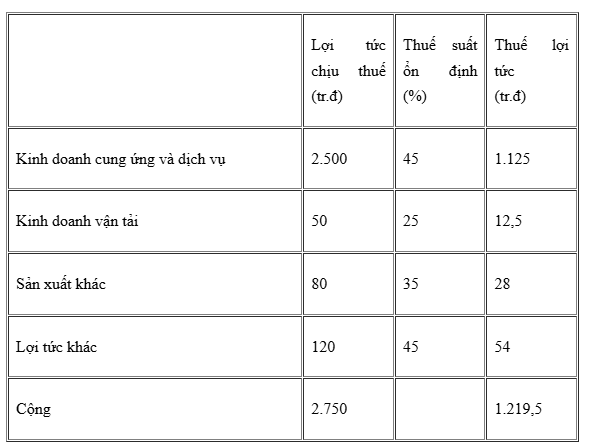
Total reasonable annual wage fund: 864 million
-
Income tax at the fixed rate: 1,219.5 million
Enterprise funds
|
|
|
864 million x 3 |
|
|
|
[(2,750 million - 1,219.5 million) x 50%] |
+ |
|
= |
981.2 million. |
|
|
|
12 |
|
|
Additional income tax payable (at the rate for trade and services).
(2,750 million - 1,219.5 million - 981.2 million) x 40% = 219.7 million
Total income tax payable:
1,219.5 million + 219.7 million = 1,439.2 million
Economic organizations outside the state sector such as joint-stock companies, limited liability companies, and collective economic units that raise capital contributions from individuals, business organizations, representatives of organizational or collective capital, and state-owned enterprises, if the average monthly taxable income per capita contribution exceeds 10 million dong, shall pay additional income tax according to the following regulations:
Additional income tax is determined based on additional taxable income and the tax rate. Additional taxable income is the remaining profit after paying income tax at the fixed rate minus the investment fund equal to 50% of the remaining profit after paying income tax. The additional income tax rate is 25%.
Example: Joint Stock Commercial Bank A has 15 shareholders, including 10 private shareholders and 5 shareholders representing organizations or state-owned enterprises, with taxable income of 2 billion dong in 1997, the calculation of income tax and additional income tax is as follows:
1. Income tax at the fixed rate:
2 billion dong x 45% = 900 million dong
2. Additional income tax:
The average monthly taxable income per capita contribution is over 11 million (2 billion dong divided by 15 shareholders multiplied by 12 months). Therefore, additional income tax must be paid as follows:
Remaining profit after paying income tax:
2 billion dong - 900 million dong = 1.1 billion dong
Investment fund deductible when calculating additional income tax:
1.1 billion dong x 50% = 550 million dong
Additional income tax:
(1.1 billion - 550 million) x 25% = 137.5 million dong
Total tax payable:
900 million dong + 137.5 million dong = 1,037.5 million dong
The method of determining the amount of income tax payable as described above only applies to calculating additional income tax for non-state economic organizations.
Private companies and individual households engaged in business activities, if their average monthly taxable income exceeds 10 million dong, the portion of taxable income exceeding 10 million dong must pay additional income tax at a rate of 25%.
4. Add the following to the end of Point 4 of Section IV on declaration, payment, and collection of taxes in the Circular:
Declaration and payment of income tax for independent accounting units: Independent accounting units with branches or dependent units that have already paid income tax at the branch or dependent unit level, when finalizing tax payments, consolidate the results into the overall business results of the independent accounting unit. In cases where the branch or dependent unit incurs losses due to external factors, the losses can be offset against the income of the main office. If there are still losses, they can be carried forward to the next year as stipulated by the Income Tax Law.
Enterprises engaged in basic construction activities that undertake repair, construction work within the unit, including planting new trees and caring for long-term orchards, during the period of basic construction, each year may set aside a certain amount as a standard or a percentage (%) of the value of the construction project as a profit to establish a reward and welfare fund. The income is determined as profit and must be subject to income tax before being distributed to employees.
For enterprises engaged in asset leasing activities such as renting houses, offices, or infrastructure businesses that collect rent in advance for several years, the enterprise must account separately, and the taxable income of the enterprise is determined as follows:
|
Taxable income from advance rental revenue |
|
Total advance rental revenue |
|
Revenue tax payable on advance rental revenue |
|
|
Related costs for forming taxable revenue are determined as follows:
Construction costs for infrastructure or construction costs for houses and offices for enterprises engaged in house and office leasing or infrastructure businesses:
For business operations involving infrastructure development or rental of housing or offices, the construction costs for infrastructure or construction costs related to housing or office areas directly associated with one-time rental income are considered. In cases where rent is collected in advance for lease terms shorter than the minimum usage period within the asset utilization timeframe set out in Appendix 1 issued along with Decision No. 1062 TC/QĐ/CSTC dated November 14, 1996 by the Minister of Finance, construction costs shall be allocated based on the actual lease term. Enterprises may register the useful life of fixed assets in accordance with the provisions of Decision No. 1062 TC/QĐ/CSTC dated November 14, 1996.
Example:
Enterprise A, which has the function of renting offices, rented 1,000 square meters of office space to Enterprise B for ten years in 1996 for a total rent of 1,000,000 USD, rented 1,000 square meters to Enterprise C for thirty years for a total rent of 3,000,000 USD, and rented 1,000 square meters to Enterprise D for thirty years for a total rent of 3,000,000 USD. Assuming that the construction cost for each square meter of rented office space is 1,250 USD, and the minimum usage period for durable buildings according to Appendix 1 issued along with Decision No. 1062 TC/QĐ/CSTC is twenty-five years, the allocation of construction costs for these cases is determined as follows (assuming that Enterprise A registers the depreciation period for buildings at twenty-five years):
For revenue from renting office space to Enterprise B, the construction cost allocated to determine taxable income in 1996 is:
|
Cost |
|
1,250 USD/square meter x 1,000 square meters |
|
|
|
|
|
of foundation engineering techniques |
= |
|
x |
10 years |
= |
500,000 USD |
|
thiết lập |
|
Twenty-five years |
|
|
|
|
For revenue from renting office space to Enterprises C and D, the construction cost allocated to determine taxable income is:
Construction Cost = (1,250 USD/square meter x 1,000 square meters) x 2 = 2,500,000 USD
In the tax year when certain project items have not yet been able to identify actual construction costs, the costs of these items are temporarily determined based on budgeted costs according to economic and technical explanations and allocated to the area of one-time rental income. When the final settlement of the project is completed, the actual construction costs will be recalculated, and any differences between the actual construction costs and the budgeted costs will be adjusted to the financial results of the following fiscal year after the completion of the project.
Other expenses incurred during the year are allocated to the portion of revenue collected in advance, specifically:
|
Expenses incurred during the year allocated |
|
Total other expenses incurred during the tax year |
|
|
|
for revenue |
= |
|
x |
received |
|
received in advance |
|
Total revenue generated during the year |
|
received in advance |
In cases where enterprises engaged in infrastructure development or leasing of houses and offices are currently enjoying tax incentives, the taxable income from revenue collected in advance is determined as follows:
|
Taxable income of the enterprise |
|
Taxable income from revenue received in advance |
|
|
|
Number of years exempted |
|
received in advance |
= |
|
x |
received in advance |
- |
exempted |
|
of the |
|
Number of years receiving revenue in advance |
|
of the |
|
dated November 29, 2006 and the Law amending and supplementing several articles of the Law on Tax Administration |
Where:
|
Number of years exempted from tax |
= |
Number of years exempted from tax according to the investment permit |
- |
Number of years starting from the year the enterprise makes a profit |
Two years of reduced tax are equivalent to one year of tax exemption.
This Circular takes effect fifteen days after its issuance date and applies to the settlement of corporate income tax from 1997 onwards. All previous regulations contrary to this Circular are hereby repealed./.
|
|
DEPUTY MINISTER
(Signed)
Vu Mong Giao
|
Relations map
Click a document to open. A red border = a relation that changes validity.
Translations
This document is available in the following languages: