
Circular No. 62/2014/TT-BTNMT stipulates National Technical Regulations on Quality Control of Geological and Mineral Sample Analysis Results. This Circular applies to state agencies, laboratories, organizations, and individuals conducting basic geological surveys and mineral exploration. These regulations provide detailed provisions on quality control, error assessment of analysis results, processing of analysis results, and suitability evaluation.
Scope of application
State agencies, laboratories, organizations, and individuals conducting basic geological surveys and mineral exploration.
Key points
- The agency receiving sample analysis must provide standard samples, blank samples meeting the specified quality requirements; duplicate samples and repeat samples are also required for quality control purposes.
- For basic geological survey projects involving minerals with less than 30 basic analysis samples, error assessment is not conducted, but for larger quantities, error assessment must be carried out according to the prescribed regulations.
- Error is calculated for pairs of basic samples and duplicate or repeat samples; if |S| ≤ 8, the analysis results are accepted; otherwise, they are not accepted.
- Error assessment of standard samples and blank samples, processing of analysis results is carried out according to specific regulations.
- Conclusions regarding the quality of sample analysis results must comply with evaluation criteria and error handling procedures.
🌐 Social impact of this document
- Positive impact: Helps improve the reliability of analysis results, ensuring accuracy in mineral management.
- Negative impact: May cause difficulties for organizations and individuals lacking the necessary conditions to implement quality control.
❓ Frequently asked questions
Which agency is responsible for providing standard samples and blank samples?
The agency receiving sample analysis is responsible for providing standard samples and blank samples meeting the specified quality requirements.
For basic geological survey projects involving minerals with less than 30 basic analysis samples, is error assessment required?
Error assessment is not conducted for these projects.
How is error calculated?
Error is calculated using the formula: S = (Xcb - Xks) / Xks, where Xcb is the result of basic sample analysis and Xks is the result of duplicate or repeat sample analysis.
When are analysis results accepted?
If |S| ≤ 8, the analysis results are accepted; otherwise, they are not accepted.
What actions should organizations and individuals take when errors are detected during sample analysis?
The party sending the samples must notify the laboratory in writing, establish a record for the cancellation of the batch of samples containing errors.
Full text
CIRCULAR
Issuing National Technical Regulations on quality control of analytical results of geological and mineral samples
the results of geological and mineral sample analysis
_____________________
Pursuant to the Law on Standards and Technical Regulations dated June 29, 2006;
Pursuant to the Law on Legislative Acts of 03 June 2008;
Pursuant to the Law on Minerals dated November 17, 2010;
Pursuant to Decree No. 21/2013/NĐ-CP dated March 4, 2013, promulgated by the Government, stipulating the functions, tasks, powers, and organizational structure of the Ministry of Natural Resources and Environment;
At the proposal of the Director General of the Vietnam Geological and Mineral Resources Administration, Heads of the Departments of Science and Technology, Legal Affairs;
The Minister of Natural Resources and Environment issues the National Technical Regulations on quality control of analytical results of geological and mineral samples.
Article 1. Attached to this Circular are the National Technical Regulations on quality control of analytical results of geological and mineral samples.
Code: QCVN 53:2014/BTNMT.
Article 2. This Circular takes effect from June 10, 2015, and replaces Circular No. 06/2011/TT-BTNMT dated January 29, 2011, issued by the Minister of Natural Resources and Environment regarding quality control of analytical results of geological and mineral samples.
Article 3. The Director General of the Vietnam Geological and Mineral Resources Administration, Heads of units under the Ministry of Natural Resources and Environment, Directors of Provincial and Central City Natural Resources and Environment Departments, and related organizations and individuals are responsible for implementing this Circular.
|
DEPUTY MINISTER DEPUTY MINISTER (Signed) TRAN HONG HA |

SOCIALIST REPUBLIC OF VIETNAM
QCVN 53:2014/BTNMT
NATIONAL TECHNICAL REGULATION ON QUALITY CONTROL FOR ANALYTICAL RESULTS OF GEOLOGICAL AND MINERAL SAMPLES
National Technical Regulation on Quality Control for Analytical Results of Geological and Mineral Samples
HANOI - 2014
Foreword
QCVN 53:2014/BTNMT was compiled by the Vietnam Geological and Mineral Resources Administration, reviewed by the Department of Legal Affairs, and issued by the Ministry of Natural Resources and Environment pursuant to Circular No. 62/2014/TT-BTNMT dated December 9, 2014.
NATIONAL TECHNICAL REGULATION ON QUALITY CONTROL FOR ANALYTICAL RESULTS OF GEOLOGICAL AND MINERAL SAMPLES
National Technical Regulation on Quality Control for Analytical Results of Geological and Mineral Samples
PART I. GENERAL PROVISIONS
1.1. Scope of Application
This regulation specifies the quality control and reliability assessment of quantitative analytical results of various types of samples used for resource estimation and reserves in basic geological surveys and mineral exploration projects.
1.2. Applicability
1.2.1. This regulation applies to state agencies, laboratories, organizations, and individuals when conducting basic geological surveys and mineral exploration tasks.
1.2.2. All basic geological survey and mineral exploration projects that involve quantitative analysis to determine the quality of soil, rock, and minerals.
1.3. Explanation of Terms
The following terms are understood as follows:
1.3.1. Basic sample is a processed sample taken out as a representative portion for analysis according to the requirements of the organization or individual sending the sample.
1.3.2. Retained analytical sample is the remaining portion of the sample with physical characteristics and material composition identical to the basic sample, stored and preserved in accordance with current regulations.
1.3.3. Quality control samples include standard samples, blank samples, duplicate samples, and repeat samples.
1.3.4. Standard sample is a type of sample defined in the National Technical Regulation on the use of standard samples in geological and mineral sample analysis (QCVN48:2012/BTNMT).
1.3.5. Blank sample is a sample whose components to be analyzed are known to be below the detection limit of the method.
1.3.6. Duplicate sample is a sample taken from the processed sample by the sample sender and sent together with the basic sample, with the same analysis requirements as the basic sample.
1.3.7. Repeat sample is a sample taken from the retained analytical sample and sent for re-analysis. A repeat sample may be re-analyzed for one or more requirements in the basic sample analysis.
1.3.8. Defined resources in this regulation refer to mineral resources and reserves that have been evaluated and explored with reliability levels of class 333 or higher.
1.3.9. Sample batch is a collection of basic samples sent in one submission and analyzed at the same time and under the same conditions (method, equipment, one expert or a group of experts performing the analysis). The number of samples in one batch for error evaluation is specified as 30 + 560 samples.
PART II. TECHNICAL PROVISIONS
2.1. GENERAL PROVISIONS ON QUALITY CONTROL OF ANALYSIS RESULTS
2.1.1. Quality control of analysis results shall be conducted independently from the inspection work carried out by laboratories themselves.
2.1.2. Quality control shall be performed for each batch of samples sent for analysis as specified in Table 1.
Table 1. Minimum Quantity of Quality Control Samples in One Batch
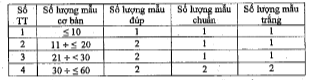
2.1.3. The concentration of analytical indicators in the standard sample shall have values within the range of the submitted samples.
2.1.4. The laboratory receiving samples for analysis shall provide standard samples, blank samples meeting quality requirements. The unit sending samples for analysis shall classify batches, code standard samples, blank samples, duplicate samples, and prepared samples according to Clause 2.1.2 of this Standard.
2.1.5. All types of quality control samples must be processed to conditions that meet the requirements for basic analysis samples.
2.1.6. For basic geological surveys on minerals and mineral exploration projects with less than 30 basic analysis samples, error assessment shall not be conducted. For projects with 30 or more basic analysis samples, error assessment must be conducted as stipulated in Clause 2.2 of this Standard.
2.2. PROVISIONS ON ERROR ASSESSMENT AND HANDLING OF ANALYSIS RESULTS
2.2.1. CALCULATION OF ERROR
The formula for calculating error is used for pairs of basic samples and duplicate or repeat samples.
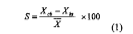
The average value 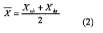
Where:
S is the calculated error.
Xcb is the analysis result of the basic sample.
Xks is the analysis result of the duplicate or repeat sample.
2.2.2. EVALUATION OF ANALYSIS RESULTS
Compare the calculated error (S) with the permissible error (8) at the corresponding concentration level as specified in Appendix 1. Permissible errors issued together with this Standard. If |S| ≤ 8: The analysis result is accepted.
If (S) > 8: The analysis result is not accepted.
2.3. PROVISIONS ON ERROR ASSESSMENT OF STANDARD SAMPLE ANALYSIS
2.3.1. CALCULATION OF ERROR IN STANDARD SAMPLE ANALYSIS
The analysis results of element or component concentrations in standard samples, expressed in consistent units, are processed as follows:
+ Calculate the precision for each analytical requirement using the formula:
-k Cc0.8495 (3)
Cpt is the reported concentration of the element or component in the standard sample certificate.
Where:
The coefficient k is applied to the laboratory with the following values: k = 0.02 for concentrations Cc ≥ 1%; k = 0.08 for concentrations Cc < 1%.
The value 0.8495 is a statistical value derived from experiments.
+ Calculate the Z-score (Z):
C is the concentration value of the element or component of repeated analysis results in a batch of samples, expressed in consistent units with the laboratory's unit.
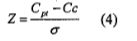
Where:
σ is the precision calculated by formula (3).
2.3.2. EVALUATION AND HANDLING OF ANALYSIS RESULTS OF STANDARD SAMPLES IN THE SAME BATCH
2.3.2.1. In case the analysis result Cpt of the standard sample falls within the confidence interval and the absolute value of Z is less than or equal to 2 (Z < 2), the analysis quality is considered good and the batch analysis result is accepted.
2.3.2.2. Otherwise, the organization or individual sending the sample for analysis shall notify the laboratory to handle according to regulations.
2.4. ERROR ASSESSMENT OF BLANK SAMPLE ANALYSIS
The analysis result of the blank sample (Ctr) is compared with the method detection limit.
2.4.1. If the analysis result of the blank sample is lower than the method detection limit, the basic analysis result is considered reliable.
2.4.2. If the analysis result of the blank sample is greater than or equal to the method detection limit, the basic analysis result is not considered reliable.
2.5. HANDLING OF ANALYSIS RESULTS
2.5.1. Prepare statistical tables of analysis results according to Model 1, Model 2, Appendix II issued together with this Standard. The quality control report of sample analysis is part of the final project report.
Analysis results should be presented according to the significant figure rules, including reliable digits along with the first uncertain digit. Generally, data should be recorded such that the last digit is uncertain.
2.5.2. Evaluate errors according to Sections 2.2, 2.3, and 2.4.
2.5.3. Handle and evaluate quality control sample errors as shown in the table below.
Table 2: Handling Results
2.5.3.1. Conclusion 1: The analysis result is reliable enough for use.
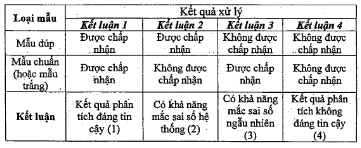
2.5.3.2. Conclusion 2: Systematic error occurred, the sender must notify the laboratory in writing, record the cancellation of the erroneous batch result.
2.5.3.3. Conclusion 3: Random error occurred, the sender must notify the laboratory in writing, record the cancellation of the erroneous batch result.
2.5.3.4. Conclusion 4: The analysis result is not reliable enough for use, the sender must notify the laboratory in writing, record the cancellation of all analysis results; stop sending samples to the laboratory, report to the competent authority for review and resolution.
2.6. ASSESSMENT OF COMPLIANCE
2.6.1. Organizations implementing basic geological surveys on minerals and individuals or organizations conducting mineral exploration are responsible for assessing the quality of geological and mineral sample analysis results in reports on basic geological surveys on minerals and mineral exploration results.
2.6.2. State authorities with jurisdiction are responsible for supervising, assessing, and rechecking geological and mineral sample analysis results during the supervision and monitoring of basic geological survey projects on minerals and mineral exploration projects or during the review of reports on basic geological surveys on minerals; mineral exploration results.
2.6.2. The competent state agency shall be responsible for supervising, evaluating, and rechecking the results of geological and mineral sample analysis during the inspection and supervision of the basic geological investigation project on minerals, the exploration project on minerals, or during the review of the report on the results of basic geological investigations on minerals; the report on mineral exploration results.
PART III. IMPLEMENTATION ORGANIZATION
3.1. The state management agency for minerals shall be responsible for guiding, inspecting, and supervising the implementation of this Standard in accordance with its authority to approve the results of basic geological surveys on minerals and mineral exploration.
3.2. In case of difficulties during the implementation process, organizations and individuals shall promptly reflect such issues in writing to the Ministry of Natural Resources and Environment for consideration and resolution./.
Original document (PDF)
Download
Relations map
Click a document to open. A red border = a relation that changes validity.
Translations
This document is available in the following languages: