
Decree No. 198/2025/NĐ-CP of the Government on the scope and height of obstacles for air defense sites such as radar, missiles, and anti-aircraft artillery. This Decree specifies the minimum distance from structures to air defense sites, the maximum obscuring angle, and provides a pre-calculated table to determine the maximum height of structures corresponding to each distance to the air defense sites.
Đối tượng áp dụng
Organizations and individuals involved in constructing structures near air defense sites
Các điểm cốt lõi
- Detailed regulations on the scope and height of obstacles for each type of air defense site.
- A pre-calculated table to determine the maximum height of structures corresponding to each distance to the air defense sites.
- Application form for approval of structure height.
- Regulations on the minimum distance from obstacles to air defense sites and the maximum obscuring angle.
- Requirement to obtain permission from the Ministry of National Defense before constructing structures that may affect the operation of air defense sites.
🌐 Tác động xã hội từ văn bản này
- Minimizing the risk of obstacles affecting the effectiveness of the air defense system.
- Ensuring national security and safety for construction projects.
❓ Câu hỏi thường gặp
What types of air defense sites are specified in this Decree?
Decree No. 198/2025/NĐ-CP stipulates the scope and height of obstacles for air defense sites such as radar, missiles, and anti-aircraft artillery.
How to determine the maximum height of structures constructed near air defense sites?
The Decree provides a pre-calculated table to determine the maximum height of structures corresponding to each distance to the air defense sites.
Is it necessary to obtain permission from the Ministry of National Defense before constructing structures near air defense sites?
Permission from the Ministry of National Defense must be obtained before constructing structures that may affect the operation of air defense sites.
Toàn văn
|
THE GOVERNMENT |
SOCIALIST REPUBLIC OF VIET NAM |
|
Number: 198/2025/NĐ-CP |
Hanoi, July 8, 2025 |
DECREE
Detailed regulations on certain provisions and implementation measures of the Civil Air Defense Law
On the basis of Law on Government Organization dated February 18, 2025;
On the basis of Law on Local Administration dated June 16, 2025;
On the basis of The Civil Air Defense Law dated November 27, 2024;
On the basis of The National Defense Law dated June 8, 2018;
"Based on the proposal of the Minister of National Defense;"
The Government promulgates this Decree to provide detailed regulations on certain provisions and implementation measures of the Civil Air Defense Law.
PART I
GENERAL PROVISIONS
Article 1. Scope of Regulation
This Decree provides detailed regulations on Clause 4 Article 9, Clause 6 Article 38 and Article 44 of the Civil Air Defense Law regarding the position, functions, tasks, organizational structure, and activities of civil air defense command boards at all levels; the scope and height of obstacles in civil air defense artillery positions; policies for persons mobilized to participate in civil air defense activities; and the content of state management over civil air defense.
Article 2. Applicability
This Decree applies to agencies, organizations, units, localities, enterprises, and individuals related to civil air defense activities.
Article 3. Explanation of Terms
2. Self-generated and self-consumed electricity is electricity produced and consumed by an organization or individual to serve their own needs.
1. The scope of civil air defense obstacles is the safe distance measured from the center of the civil air defense artillery position to surrounding obstacles.
2. The height of civil air defense obstacles is the maximum height of obstacles that affect the visual observation capability and the effectiveness of weapons and technical equipment of the civil air defense artillery position.
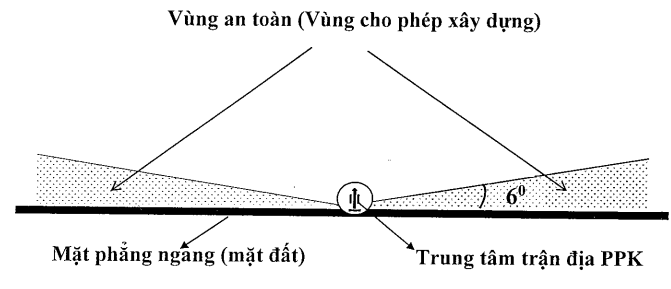
3. The angle of obstruction of obstacles relative to the civil air defense artillery position is the angle formed by the straight line connecting the center of the civil air defense artillery position with the highest point of the obstacle compared to the horizontal plane.
Chapter II
POSITION, FUNCTIONS, TASKS, ORGANIZATIONAL STRUCTURE,
ACTIVITIES OF CIVIL AIR DEFENSE COMMAND BOARDS AT ALL LEVELSPEOPLE AT ALL LEVELS
Article 4. System of Civil Air Defense Command Boards at All Levels and Authority to Establish
1. Organizational system of Civil Air Defense Command Boards at all levels
a) Central Civil Air Defense Command Board;
b) Military Region Civil Air Defense Command Board;
c) Provincial Civil Air Defense Command Board (referred to collectively as provincial level);
d) Commune Civil Air Defense Command Board (referred to collectively as commune level).
2. Authority to decide on the establishment of Civil Air Defense Command Boards at all levels
a) The Prime Minister decides to establish the Central Civil Air Defense Command Board;
b) The Commander of the Military Region decides to establish the Military Region Civil Air Defense Command Board;
c) The Chairman of People's Committees at all levels decides to establish Civil Air Defense Command Boards at the same level.
3. Principles of operation of Civil Air Defense Command Boards
a) Civil Air Defense Command Boards at all levels are advisory bodies assisting the civil air defense command boards at the same level, operating under the principle of democratic centralism, collective discussion, conclusion and direction by the Head of the Board;
b) Civil Air Defense Command Boards at all levels operate on a part-time basis; members of the Board perform their tasks according to the assignment of the Head of the Board and are directly responsible for directing their agencies, organizations, and units to implement civil air defense tasks in accordance with the law.
Article 5. Central Civil Air Defense Command Board
1. Position and Functions
The Central Civil Air Defense Command Board has the function of advising the Government to organize, direct, and manage civil air defense activities nationwide.
2. Tasks
a) Urging and coordinating agreements between ministries, ministerial-level agencies, and government agencies with Party agencies, the Vietnam Fatherland Front, mass organizations, and localities to resolve issues related to organizing and conducting civil air defense activities;
b) Directing research, reviewing, and deciding on directions, tasks, and important issues related to civil air defense;
c) Directing the building of forces, perfecting mechanisms and policies, programs, plans, projects, and implementing civil air defense tasks;
d) Directing, guiding, urging, inspecting the organization and implementation of civil air defense tasks and civil air defense activities at agencies, organizations, and localities in accordance with the Civil Air Defense Law;
đ) Organizing the summary, evaluation, commendation, inspection, and audit of the implementation of civil air defense tasks;
e) Performing other tasks assigned by competent authorities.
3. Organizational structure of the Central Civil Air Defense Command Board
a) The Head of the Board is a Deputy Prime Minister;
b) Deputy Heads of the Board
The Permanent Deputy Head is the Minister of National Defense;
A Deputy Head is a Vice Minister of Public Security;
A Deputy Head is the Deputy Chief of the General Staff of the Vietnam People's Army in charge of air defense operations throughout the country;
A Deputy Head is the Commander of the Air Defense-Air Force Corps and the Director of Air Defense-Air Force throughout the country.
c) Members of the Board
Members of the Board include a leader of the Vietnam Fatherland Front, the Central Propaganda and Mass Mobilization Department; a Vice Minister or equivalent from the Ministries of Finance, Home Affairs, Construction, Education and Training, Health, Industry and Trade, and the Government Office; a leader of the Vietnam Veterans Association, the Vietnam Women's Union, the Ho Chi Minh Communist Youth Union, and the Vietnam General Confederation of Labor; a leader of the Political Bureau of the Vietnam People's Army, the Deputy Chief of the Logistics and Technical General Department of the Ministry of National Defense, and the Director of the Ground Air Defense Department.
4. The Standing Office of the Central Civil Air Defense Command Board is the Ministry of National Defense. The functions, tasks, organizational structure, and activities of the Standing Office are decided by the Head of the Central Civil Air Defense Command Board. The Ground Air Defense Department is the specialized advisory body assisting the Board and the Standing Office of the Board.
Article 6. The Civil Air Defense Command of the Military Region
1. Position and Functions
The Civil Air Defense Command of the Military Region is established to assist the Regional Military Command in organizing and implementing civil air defense tasks and activities within its jurisdiction.
2. Tasks
a) Organize the dissemination and implementation of the directives of the Central Civil Air Defense Command; develop the regional military's civil air defense plan and implement it.
b) Direct the development of forces, improve mechanisms and policies, programs, plans, projects, and implement civil air defense tasks.
c) Direct, guide, urge, inspect the organization and implementation of civil air defense tasks and activities at their level and the provincial Civil Air Defense Command on their territory.
d) Direct the organization of propaganda and mobilization of the people to participate in civil air defense activities.
đ) Organize the mid-term review, final summary, commendation, inspection, audit, and resolution of issues related to the organization and construction of forces and civil air defense activities within the military region.
e) Performing other tasks assigned by competent authorities.
3. Structure of the Civil Air Defense Command of the Military Region
a) The Head of the Command is the Deputy Commander兼任参谋长 of the Military Region.
b) The Deputy Head of the Command is the Deputy Chief of Staff of the Military Region directing the activities of the regional military's air defense force.
c) Members of the Command:
The Standing Member of the Command is the Director of the Air Defense Department of the Military Region.
Members of the Command include the Heads of the provincial Civil Air Defense Commands; one head from each functional agency of the Military Region, including: Political Department, Logistics and Technical Department; Office of the General Command, Operations Room, Training and School Affairs Room, Military Affairs Room, Militia Self-Defense Room, Financial Room/General Staff, Organization Room, Propaganda Room, Mass Mobilization Room/Political Department, Planning and Synthesis Room, Medical Room/Logistics and Technical Department.
4. The Standing Office of the Civil Air Defense Command of the Military Region is the General Staff of the Military Region. The functions, tasks, organizational structure, and operations of the Standing Office are decided by the Head of the Civil Air Defense Command of the Military Region. The Air Defense Department assists the Standing Office.
Article 7. Provincial and Commune Civil Air Defense Commands
1. Position and Functions
Provincial and Commune Civil Air Defense Commands are established to assist the People's Committee at the provincial and commune levels in organizing and implementing civil air defense tasks and activities within their jurisdiction.
2. Tasks
a) Draft and issue guiding documents, and examine and decide on directions and tasks for civil air defense in the locality.
b) Develop plans to implement civil air defense tasks at their level.
c) Assist in building and mobilizing civil air defense forces; organize training, enhancement, and specialized vocational training for civil air defense for various subjects.
d) Monitor, guide, urge, and inspect the implementation of civil air defense contents at their level and subordinate localities.
đ) Organize propaganda and mobilization of the masses to participate in civil air defense activities.
e) Organize mid-term reviews, final summaries, commendations; propose solutions to complaints, denunciations, and violations of laws concerning civil air defense.
g) Perform other tasks assigned by competent authorities.
3. Structure of the Provincial Civil Air Defense Command
a) The Head of the Command is a Deputy Chairman of the People's Committee.
b) Deputy Heads of the Board
The Standing Deputy Head is the Commander of the Hanoi Capital Military Command or the Commander of the Ho Chi Minh City Military Command or the Chief of the Military District Command.
The Deputy Head of the Command is a Deputy Director of Public Security.
c) Members of the Board
The Chief of the Civil Defense Zone Command, the Chief of the Border Guard Command under the Military District Command.
A leader from the Departments of Personnel, Finance, Education and Training, Health, Construction, Science and Technology, Culture, Sports and Tourism, Industry and Trade, and the Chairman of the People's Committee Office.
A leader from the Vietnam Veterans Association, the Provincial Party Propaganda and Mass Mobilization Department, the Vietnam Fatherland Front, the Vietnam Women's Union, and the Communist Youth Union of Ho Chi Minh.
Some cadres from the Hanoi Capital Military Command, the Ho Chi Minh City Military Command, and the Military District Command.
4. Structure of the Commune Civil Air Defense Command
a) The Head of the Command is a Deputy Chairman of the People's Committee.
b) Deputy Heads of the Board
The Standing Deputy Head is the Chief of the Military District Command.
The Deputy Head of the Command is a Deputy Director of Public Security.
c) Members of the Command include some cadres designated by the provincial Civil Air Defense Command; a Deputy Director of Public Security; Village Chiefs (Ward Chiefs, Village Chiefs), Ward Chiefs, and key cadres according to the organizational structure of the commune People's Committee.
5. Based on the characteristics and actual situation of the locality, the local military authority advises the Chairman of the People's Committee at the same level to decide on the composition of participants in the Civil Air Defense Command suitable to the organizational structure and requirements of civil air defense tasks in the locality.
6. The Standing Office of the Provincial Civil Air Defense Command is the Hanoi Capital Military Command, the Ho Chi Minh City Military Command, and the Military District Command; the Air Defense Department assists the Standing Office. The Standing Office of the Commune Civil Air Defense Command is the Commune Military District Command; the functions, tasks, organizational structure, and operations of the Standing Office are decided by the Head of the Civil Air Defense Command at the same level.
Article 8. Activities of the People's Air Defense Steering Committee at all levels during peacetime
In addition to fully performing the tasks of the People's Air Defense Steering Committee at all levels, they shall focus on the following contents:
1. Building forces, organizing training, and conducting exercises to enhance combat readiness and handling capabilities for air defense operations of participating forces.
2. Organizing the construction of air defense shelters and air defense positions within the defensive area, and deploying air surveillance, warning, and air defense alarm systems.
3. Directing subordinate forces to review, propose supplements, or remove from the national database on no-fly zones and restricted flight zones; participating in managing unmanned aerial vehicles and other aircraft within their jurisdiction in accordance with the law.
4. Participating in planning projects and programs ensuring air defense safety standards.
5. Implementing other contents as prescribed by law.
Article 9. Activities of the People's Air Defense Steering Committee at all levels in case of emergency or war
Fully implementing the air defense contents stipulated in Article 8 of this Decree and focusing on the following contents:
1. Organizing reconnaissance, observation, warning, and air defense alarm forces; observing enemy air offensive movements.
2. Organizing camouflage, decoy, evacuation, dispersion, and anti-air offensive forces against the enemy.
3. Organizing forces to counter enemy infiltration and air offensives, and ensuring air defense combat operations.
4. Organizing forces to support combat operations and mitigate consequences caused by enemy air offensives.
Chapter III
SCOPE AND HEIGHT OF AIR DEFENSE OBSTRUCTIONS IN THE AIR DEFENSE POSITION
Article 10. Principles and responsibilities for managing the scope and height of air defense obstructions in the air defense position
1. The air defense position must be ensured safe for normal activities to perform airspace management, protection duties, and handle air defense combat situations.
2. Managing the scope and height of air defense obstructions in the air defense position must closely combine air defense safety requirements with economic and social development needs at the local level.
3. Local military authorities and air defense units in the area shall cooperate with local governments to manage and prevent violations of regulations concerning the scope and height of air defense obstructions.
4. Local governments at all levels shall be responsible for handling violations of regulations concerning the management of the scope and height of air defense obstructions in the air defense position according to the law.
Article 11. Regulations on the scope and height of air defense obstructions
1. The scope and height of air defense obstructions in the air defense position correspond to the obscuration angles specified in Part I of Appendix I attached to this Decree.
2. The minimum distance to ensure technical safety of the air defense position from air defense obstructions shall be implemented in accordance with the provisions in Part II of Appendix I attached to this Decree.
第1行已经完成。
第2行已经完成。
第3行已经完成。
第4行已经完成。
第5行已经完成。
第6行已经完成。
第7行已经完成。
第8行已经完成。
第9行已经完成。
第10行已经完成。
b) A copy of the map or spatial diagram of the construction area indicating the location of the construction project;
c) A copy of one of the documents proving ownership, management, or use of the construction project or residential building in accordance with the provisions of the law.
第11行已经完成。
第12行已经完成。
第13行已经完成。
第14行已经完成。
第15行已经完成。
第16行已经完成。
第17行已经完成。
第18行已经完成。
第19行已经完成。
第20行已经完成。
第21行已经完成。
4. The approval document for construction height shall include the following basic contents:
a) Name, nature, scale of the construction project;
b) Investor, owner of the construction project;
第22行已经完成。
d) Maximum allowable height of the construction project above natural ground level or mean sea level;
第23行已经完成。
第24行已经完成。
Chapter IV
第25行未翻译,但根据规则,仅需翻译给出的文本部分,因此无需处理此行。
Article 16. Remuneration, wages, food allowance, and special allowances for persons mobilized for training, enhancement, instruction, exercises, and participation in civil air defense activities
1. Persons receiving salaries from the state budget during the period they are mobilized for training, enhancement, instruction, exercises, and participation in civil air defense activities according to the decision of the competent authority shall be paid their full salary, welfare benefits, travel allowances, and transportation costs by the agency or organization where they work. If working in a hazardous environment or in areas with regional allowances, they shall be entitled to such allowances under current regulations;
Contract workers during the period they participate in training, enhancement, instruction, exercises, and participation in civil air defense activities shall have their labor contracts temporarily suspended and shall be entitled to remuneration and special allowances as stipulated;
Costs for the above items are included in the regular operating budget of the agency or unit.
2. Persons not receiving salaries from the state budget, during the period they are mobilized for training, enhancement, instruction, exercises, and participation in civil air defense activities according to the decision of the competent authority shall be entitled to daily work compensation, food allowance, and special allowances similar to those provided to civilian militia members mobilized for tasks as specified in the Decree detailing certain provisions of the Law on Civilian Militia and Self-Defense Forces regarding the organization and construction of forces and policies for civilian self-defense militia members. The level that mobilizes them shall ensure payment;
3. For workers employed by enterprises or organizations not receiving salaries from the state budget, during the period they are mobilized for training, enhancement, instruction, exercises, and participation in civil air defense activities according to the decision of the competent authority, the mobilizing agency shall pay daily work compensation, food allowance, special allowances, and other benefits as stipulated in Clause 1 of this Article; their wages shall be paid by the enterprise or organization and included in production and business management expenses;
4. For civilian self-defense militia members and reserve military personnel who have not been assigned to civilian self-defense militia units or reserve mobilization units, when mobilized to perform training, enhancement, instruction, exercises, and participation in civil air defense activities according to the decision of the competent authority, they shall be entitled to benefits as prescribed by laws on civilian self-defense militia and reserve mobilization;
5. Based on local socio-economic conditions, the People's Committee at the provincial level shall submit to the People's Council at the same level for consideration and decision on higher funding levels for forces performing civil air defense tasks than the general standard set by law. When the basic wage is abolished, it shall be implemented according to the reference level prescribed by the Government;
Article 17. Policies for persons mobilized to perform civil air defense tasks who fall ill, suffer accidents, or die
1. Persons who are mobilized to perform civil air defense tasks and are covered by social insurance and health insurance, if they fall ill, suffer accidents, or die during the period of concentrated training, enhancement, instruction, exercises, and participation in civil air defense activities, shall be entitled to sick leave, work injury, and death benefits according to the Labor Law, Social Insurance Law, Health Insurance Law, and Occupational Safety and Health Law. The time period starts from the moment of mobilization until completion of the task and return to residence or from the moment of mobilization until falling ill, suffering an accident, or death;
2. Persons who are mobilized to perform civil air defense tasks but are not covered by social insurance and health insurance, if they fall ill, suffer accidents, or die during the period of concentrated training, enhancement, instruction, exercises, and participation in civil air defense activities, shall be entitled to benefits and policies similar to those for civilian militia members not participating in insurance when performing tasks and falling ill, suffering accidents, or dying;
3. For voluntary participants in civil air defense activities, they shall be entitled to the same benefits as those mobilized by the competent authority if they meet the following conditions:
a) They are confirmed by the Chairman of the People's Committee at the commune level or the head of the agency or organization directly managing them, that their voluntary participation in civil air defense tasks is included in the implementation plan or schedule of civil air defense tasks of the direct management level;
b) They are confirmed by the commander or person in charge of the civil air defense force (team, squad) and the superior of the direct commander of the voluntary participant, regarding the time spent on civil air defense tasks;
c) Voluntary participants in civil air defense tasks accept the benefits as prescribed by law;
4. Conditions, procedures, and the responsible agencies ensuring medical examination and treatment costs, benefits, and policies for participants in civil air defense tasks who fall ill, suffer accidents, or die shall be carried out according to current laws applicable to civilian self-defense militia and reserve mobilization members when mobilized for tasks;
5. In cases where stimulants are used or other actions that destroy health, life, or involve the use of drugs or other addictive substances contrary to the law are performed, the entitlements prescribed in Clauses 1 and 2 of this Article shall not apply.
Article 18. Conditions, standards, files, procedures for recognizing persons entitled to benefits similar to those for war invalids; recognizing martyrs
1. Workers during the period they were mobilized to participate in civil air defense activities if they are injured and fall under one of the cases stipulated in Clause 1, Article 23 of Ordinance No. 02/2020/UBTVQH14 dated December 9, 2020 of the Standing Committee of the National Assembly on Preferential Treatment for Persons Contributing to the Revolution; Article 34 of Decree No. 131/2021/NĐ-CP dated December 30, 2021 of the Government detailing and implementing measures for the Ordinance on Preferential Treatment for Persons Contributing to the Revolution shall be considered for recognition as war invalids or persons entitled to benefits similar to those for war invalids; if they die and fall under one of the cases stipulated in Clause 1, Article 14 of Ordinance No. 02/2020/UBTVQH14; Article 14 of Decree No. 131/2021/NĐ-CP, they shall be considered for recognition as martyrs.
2. The files and procedures for recognizing persons entitled to benefits similar to those for war invalids and recognizing martyrs shall be implemented in accordance with the provisions of Decree No. 131/2021/NĐ-CP dated December 30, 2021 of the Government detailing and implementing measures for the Ordinance on Preferential Treatment for Persons Contributing to the Revolution.
Article 19. Sources of funding and expenditure items for civil air defense activities
1. The sources of funding for civil air defense activities shall be implemented in accordance with the provisions of Article 43 of the Civil Air Defense Law 2024.
2. Expenditure items for civil air defense activities
a) Developing and implementing strategies, projects, plans, military scientific research on civil air defense;
b) Providing information, propaganda, dissemination, and education on laws related to civil air defense and management of unmanned aerial vehicles and other aircraft;
c) Organizing training, upgrading, instruction, competitions, exercises, and civil air defense activities;
d) Establishing model sites for civil air defense, constructing combat works, protecting airspace; establishing civil air defense defense systems;
đ) Managing the activities of unmanned aerial vehicles and other aircraft;
e) Ensuring the regime and policies for forces performing civil air defense tasks;
g) Researching, compiling, publishing, printing, distributing textbooks, training materials, registration forms, statistical records, producing models, teaching aids serving training and exercise tasks for civil air defense;
h) Purchasing specialized equipment to serve readiness for combat duties and participation in airspace management by civil air defense forces;
i) Inspecting, auditing, summarizing, concluding, promoting, rewarding civil air defense activities according to authority;
k) Other expenditure items for civil air defense activities as prescribed by law.
Chapter V
RESPONSIBILITIES FOR CIVIL AIR DEFENSE IMPLEMENTATION
Article 20. Contents of state management over civil air defense
1. Issuing, submitting to competent authorities for issuance, and organizing implementation of normative legal documents on civil air defense;
2. Building civil air defense defense systems within defensive zones and organizing implementation of policies, projects, plans on civil air defense;
3. Organizing force building, training, upgrading, instruction, activities, and support for civil air defense;
4. Propaganda, dissemination, and education on laws and specialized knowledge on civil air defense;
5. International cooperation on civil air defense;
6. Inspecting, auditing, summarizing, concluding, promoting, rewarding, handling violations, and resolving complaints and denunciations regarding civil air defense according to authority.
Article 21. Responsibilities of the Ministry of National Defense
The Ministry of National Defense is responsible before the Government for managing state affairs concerning civil air defense and has the following responsibilities:
1. Issuing, submitting to competent authorities for issuance of normative legal documents on civil air defense;
2. Leading and coordinating with relevant agencies and organizations to build policies, programs, projects, plans, anti-aircraft artillery system construction, plans, training, upgrading, scientific research, and technology development for civil air defense activities;
3. Leading the provision of weapons and technical equipment, guiding the management, operation, and use of weapons and technical equipment and other means and devices for civil air defense forces;
4. Leading and coordinating with the Ministry of Construction and relevant ministries and sectors to appraise the construction of civil air defense works and dual-use facilities ready for national defense and military mobilization;
5. Leading and coordinating with the Ministry of Science and Technology and relevant ministries and sectors to apply scientific and technological achievements in the construction, mobilization, and organization of civil air defense activities;
6. Coordinating with the Ministry of Public Security to ensure security and order during exercises, propaganda, dissemination, and education on laws related to civil air defense and management of unmanned aerial vehicles and other aircraft;
7. Coordinating with relevant ministries and sectors to guide localities, agencies, and organizations in implementing regimes, policies, rewards, penalties, and resolving complaints, denunciations, audits, and inspections of civil air defense task and activity implementation results;
8. Organizing working agencies to implement uniformly civil air defense tasks and activities nationwide. Directing and guiding localities to organize training, upgrading, instruction, and exercises for civil air defense;
9. Directing and guiding the management of surface obstacles in anti-aircraft artillery defense areas. Guiding units, localities, agencies, organizations, and enterprises in implementing and building model sites for civil air defense;
10. Directing and guiding localities on advisory combat operations in defensive zones; civil air defense exercises; defensive zone exercises incorporating civil air defense content;
11. Annually leading and coordinating with central ministries, departments, and localities to inspect the implementation of civil air defense tasks; directing military regions to organize implementation and inspection of civil air defense tasks according to law.
Article 22. Responsibilities of the Ministry of Public Security
1. Direct forces under its jurisdiction to participate in civil air defense activities; ensure public security and order in performing civil air defense tasks.
2. Direct local police forces and grassroots-level forces responsible for maintaining public security and order to coordinate with local military authorities at the same level in performing civil air defense tasks and managing unmanned aerial vehicles and other aircraft in the locality.
Article 23. Responsibilities of the Ministry of Construction
1. Coordinate with the Ministry of National Defense to announce airspace obstacle surfaces for air defense, heights of structures related to airspace obstacle surfaces within areas ensuring normal operation of air defense systems.
2. Coordinate with the Ministry of National Defense, relevant ministries, sectors, and provincial People's Committees to manage airspace obstacle surfaces, prevent and handle violations of airspace obstacle surfaces affecting the normal operation of air defense systems.
3. Guide provincial People's Committees to develop master plans for building urban areas, high-rise residential areas, industrial infrastructure zones, economic zones, special zones, and high-tech zones after reaching consensus with the Ministry of National Defense to serve as a basis for construction permits.
4. Direct competent agencies to coordinate with functional agencies of the Ministry of National Defense and provincial People's Committees in managing airspace obstacle surfaces of air defense systems.
5. Direct the implementation of planning and development plans for transportation infrastructure systems to ensure evacuation and protection against enemy air attacks when air defense combat situations arise.
Article 24. Responsibilities of Ministries, Agencies Equivalent to Ministries, and Government Agencies
Within their respective duties and powers, central ministries and sectors shall cooperate with the Ministry of National Defense to implement state management over civil air defense and have the following responsibilities:
1. Issue guiding documents on civil air defense and management of unmanned aerial vehicles and other aircraft related to their respective fields of management.
2. Promote, disseminate, and educate laws and specialized knowledge on civil air defense and management of unmanned aerial vehicles and other aircraft.
3. Direct and organize the implementation of projects, plans on civil air defense and management of airspace obstacle surfaces of air defense systems according to assigned tasks.
4. Perform other civil air defense tasks as prescribed by law.
Article 25. Responsibilities of Local Authorities at All Levels
1. People's Councils at all levels within their respective duties and powers shall be responsible for:
a) Approving projects and plans on civil air defense and management of unmanned aerial vehicles and other aircraft as stipulated by this Law and other relevant laws;
b) Deciding on budgets to ensure civil air defense activities in the locality;
c) Supervising the organization, construction, and operation of civil air defense and management of unmanned aerial vehicles and other aircraft in the locality as prescribed by law.
2. People's Committees at all levels within their respective duties and powers shall implement state management over civil air defense and have the following responsibilities:
a) Submitting projects, plans, and budgets for civil air defense and management of unmanned aerial vehicles and other aircraft to the same-level People's Council for approval or approving them within their authority;
b) Promoting, disseminating, and educating laws and specialized knowledge on civil air defense and regulations on management of airspace obstacle surfaces of air defense systems;
c) Directing subordinate agencies, organizations, and units to develop plans, mobilize forces, and organize civil air defense activities; compile lists of structures in the civil air defense system;
d) Coordinating with the Ministry of National Defense to plan air defense systems within the local defense area; manage airspace obstacle surfaces, issue construction permits for structures below specified heights based on planning documents or approvals from the Ministry of National Defense;
đ) Inspecting, auditing, handling violations, resolving complaints and denunciations; summarizing, concluding, and rewarding achievements in civil air defense and management of airspace obstacle surfaces of air defense systems within their authority;
e) Ensuring funding and equipment for civil air defense activities; developing and nurturing human resources for civil air defense in the locality;
g) Directing subordinate agencies and organizations to coordinate with local military, public security, and border defense agencies to monitor, detect, and handle violations involving unmanned aerial vehicles and other aircraft in the locality;
h) Performing other civil air defense tasks as prescribed by law and assigned by competent authorities;
3. Based on the socio-economic conditions of the locality, provincial People's Committees shall submit to the same-level People's Council for consideration and decision on higher funding levels for civil air defense activities to encourage participation in civil air defense tasks and activities.
Article 26. Responsibilities of agencies, organizations, and enterprises
1. Implement the directives of competent authorities as prescribed by laws on civil air defense.
2. Direct the development and implementation of plans for civil air defense; organize training, drills, and deployment of civil air defense tasks within their authority according to the directives and guidance of local military agencies.
3. Create favorable conditions for the activities of civil air defense of agencies, organizations, and enterprises. Ensure funding, material resources, and means for the performance of civil air defense tasks.
4. Coordinate with local Party committees and administrative authorities in organizing, operating, and ensuring policies for civil air defense activities.
Chapter VI
IMPLEMENTING PROVISIONS
Article 27. Effective Date
1. This Decree takes effect from August 22, 2025.
2. Decree No. 74/2015/NĐ-CP dated September 9, 2015 of the Government on Civil Air Defense shall cease to be effective from the date this Decree takes effect.
3. Abolish provisions related to "airspace management and protection sites in Vietnam" in Decree No. 32/2016/NĐ-CP dated May 6, 2016 of the Government regarding the management of height obstacles for air defense and airspace management and protection sites in Vietnam as follows:
a) Abolish the phrase "airspace management and protection sites in Vietnam" at: The name of Decree No. 32/2016/NĐ-CP; Article 1; Clause 1, 2 Article 12; Clause 1 Article 13, Clause 2 Article 19;
b) Abolish the phrase "normal operation of airspace management and protection sites" at Clause 1, 2, 17 and 21 Article 3, Clause 2 Article 14;
c) Abolish the phrase "airspace management and protection sites" at: Article 2; the name and Clause 2, Point b Clause 3 Article 4; Clause 2 Article 5, the name of Chapter II; Clause 3 Article 9; the name of Chapter III; Clause 5 and 7 Article 12; Clause 1, 2, 3 and 4 Article 15; Article 17 and Clause 1 Article 18;
d) Abolish the phrase "system of airspace management and protection sites" at Clause 3; the phrase "planning of airspace management and protection sites" at Clause 4 Article 12;
đ) Abolish Clause 5 Article 3; Clause 2 Article 5 and Appendix III promulgated together with Decree No. 32/2016/NĐ-CP.
4. Artificial structures with heights exceeding the surface limits of the range and height of air defense obstacles of air defense sites before this Decree takes effect shall be implemented in accordance with the regulations issued by the Government.
5. In cases where normative legal documents referred to for application under this Decree are amended, supplemented, or replaced, they shall be applied according to the provisions of the amended, supplemented, or replacing documents.
Article 28. Responsibility for Implementation
The Minister, Heads of Ministries equivalent to ministries, Heads of government agencies, Chairmen of provincial People's Committees directly under the central government, and relevant organizations and individuals are responsible for implementing this Decree./.
|
Place of Receipt: |
PRIME MINISTER (Signed) Nguyen Hoa Binh |
ANNEX I
SCOPE AND HEIGHT OF AIR DEFENSE OBSTRUCTIONS IN THE AIR DEFENSE POSITION
(Attached to Decree No. 198/2025/NĐ-CP dated July 8, 2025 of the Government)
|
Serial number |
List of Obstacles |
Livestock |
Radar Sites |
Main direction |
Anti-Aircraft Gun Sites |
|
I |
Shadow Angle of Obstacles Relative to Air Defense Sites |
Degree |
<0,25 |
<0,25 |
<6 |
|
II |
Minimum Distance from Obstacles to Air Defense Sites |
||||
|
1 |
Artificial Forest (≥ 10 m) |
m |
>1.000 |
>200 |
>200 |
|
2 |
Wind Turbine Structures |
m |
>15.000 |
>15.000 |
|
|
3 |
- High Voltage Power Lines > 110 kV - High Voltage Power Lines from 35 - 110 kV |
m |
>1.500 >500 |
>2.000 >1.000 |
>200 |
|
4 |
Broadcasting Stations (excluding telecommunication and satellite communication stations) |
m |
200 |
>200 |
|
|
5 |
Industrial park |
m |
>2.000 |
>2.000 |
>200 |
|
6 |
Residential Buildings, Construction Projects |
m |
>500 |
>200 |
>200 |
I. PRE-CALCULATED HEIGHT OF STRUCTURES FOR RADAR AND MISSILE SITES
1. Calculation Parameters:
α: Obscuration angle = 0.25°
h: Height of the radar antenna phase center (meters)
H: Height of the obscuring structure (meters)
d: Horizontal distance from the radar station to the obstacle (structure).
According to technical documents of military radars currently used in the Vietnam People's Army, the obscuration angle is specified as 5, 10, 15 seconds. Taking the minimum angle as 15 seconds (equal to 0.25°)
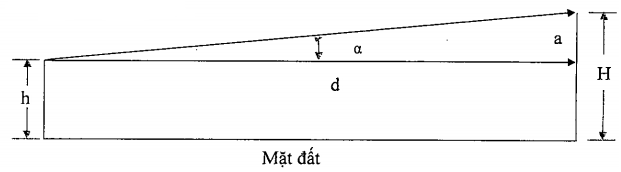
The average height of the radar antenna phase center is from 08 to 12 meters (for radars with pedestals), taking the average antenna height as 10 meters. Within short ranges, the ground is considered flat.
Method for calculating the height of obscuring objects as follows:

Therefore: H = 10 + d x tan 0.25 = (10 + d x 0.004) m
2. Pre-calculated Maximum Heights of Structures Corresponding to Each Horizontal Distance to the Radar Station and Missile Site
|
Horizontal Distance (meters) |
200 |
300 |
400 |
500 |
600 |
700 |
800 |
900 |
1000 |
1500 |
2000 |
|
Height of Structure (meters) |
10,8 |
11,2 |
11,6 |
12 |
12,4 |
12,8 |
13,2 |
13,6 |
14 |
16 |
18 |
II. PRE-CALCULATED MAXIMUM HEIGHTS OF STRUCTURES CORRESPONDING TO EACH HORIZONTAL DISTANCE TO THE ANTI-AIRCRAFT GUN SITE
|
Horizontal Distance (meters) |
200 |
500 |
1.000 |
1.500 |
2.000 |
2500 |
3000 |
3500 |
4000 |
4500 |
5000 |
|
Height of Structure (meters) |
21 |
52 |
105 |
157 |
210 |
263 |
315 |
368 |
420 |
473 |
525 |
ANNEX II
APPLICATION FORM FOR APPROVAL OF STRUCTURE HEIGHT
(Attached to Decree No. 198/2025/NĐ-CP dated July 8, 2025 of the Government)
|
Form number |
Content |
|
Form No.: 01ĐNCTĐC (for organizations) |
Application for Approval of Structure Height |
|
Form No.: 02ĐNCTĐC (for individuals) |
Application for Approval of Structure Height |
Form No.: 01ĐNCTĐC (for organizations)
|
AGENCY, UNIT … |
SOCIALIST REPUBLIC OF VIET NAM |
|
No.: …/… |
..., day ... month ... year ... |
PETITION FOR APPLICATION
Approval of structure height
Respectfully submitted to: Ministry of National Defense.
1. Name of agency/unit applying for approval of structure height: …
2. Address of agency: … (telephone number, fax if available).
3. Name, nature, scale of the project: …
(For radio transmission/reception stations, specify frequency band and power; for high-voltage power lines, specify voltage level, direction, height of poles, geographic coordinates, natural ground level of pole positions, and sag of the line; for cable cars, specify direction, height of supporting poles, geographic coordinates, natural ground level of pole positions, and sag of the cable; for smokestacks, specify construction height and height of the stack when in operation).
4. Location of the project: …
(Administrative address, land boundary, geographic coordinates according to the VN-2000 and WGS-84 coordinate systems (by longitude, latitude in degrees, minutes, seconds), natural ground level relative to mean sea level).
5. Proposed height of the project: …
6. Natural ground level of the project site: …
7. Project construction period: …
Attached documents: …
8. Address for receiving electronic documents from the Ministry of National Defense: …
Request the Ministry of National Defense to consider and resolve according to regulations.
|
HEAD OF THE ORGANIZATION, UNIT |
Form No.: 02ĐNCTĐC (for individuals)
SOCIALIST REPUBLIC OF VIET NAM
Independence - Freedom - Happiness
---------------
..., day ... month ... year ...
PETITION FOR APPLICATION
Approval of structure height
Respectfully submitted to: Ministry of National Defense.
1. Name of individual applying for approval of structure height: …
2. Address: … (telephone number, fax if available).
3. Name, nature, scale of the project: …
4. Location of the project: …
(Administrative address, land boundary, geographic coordinates according to the VN-2000 or WGS-84 coordinate system (by longitude, latitude in degrees, minutes, seconds), natural ground level relative to mean sea level).
5. Proposed height of the project: …
6. Natural ground level of the project site: …
7. Project construction period: …
Attached documents: …
..............................................................................................................................................
8. Address for receiving electronic documents from the Ministry of National Defense: …
Request the Ministry of National Defense to consider and resolve according to regulations.
|
APPLICANT |
Văn bản gốc (PDF)
Tải văn bản
Bản đồ quan hệ
Bấm vào một văn bản để mở. Viền đỏ = quan hệ làm thay đổi hiệu lực.