
The course 'Revolutionary Line of the Communist Party of Vietnam' includes nine lectures with the aim of helping students understand the formation and development history of the Communist Party of Vietnam, important documents, Ho Chi Minh's thoughts, as well as the Party’s policies and guidelines in each stage. This course is designed to foster students' understanding of the revolutionary line of the Communist Party of Vietnam, including nine chapters aimed at helping students understand the formation and development history of the Communist Party of Vietnam, important documents, Ho Chi Minh's thoughts, and the Party’s policies and guidelines in each stage. The course design takes into account the needs for teaching facilities and equipment, and specifies assessment methods. Additionally, reference materials are provided for further study. The following is a summary of the main contents:
Đối tượng áp dụng
The course targets teachers and students of intermediate vocational schools and college-level vocational schools.
Các điểm cốt lõi
- Chapter One: Formation and Development of the Communist Party's Revolutionary Line
- Chapter Two: Important Documents and Historical Background
- Chapter Three: Ho Chi Minh's Thoughts and Their Influence
- Chapter Four: Policies and Guidelines in Each Stage
- Chapter Five: Party Building and Development
- Chapter Six: Economic Construction and Reform
- Chapter Seven: Political Construction and Democratization
- Chapter Eight: National Defense Security and Social Stability
- Chapter Nine: Foreign Relations and International Cooperation
🌐 Tác động xã hội từ văn bản này
- Enhance students' understanding and recognition of the Communist Party of Vietnam.
- increase students' understanding and recognition of the Vietnamese Communist Party.
- Foster students' understanding and recognition of the Communist Party of Vietnam and its revolutionary line.
❓ Câu hỏi thường gặp
What are the main objectives of this course?
Help students understand the history, important documents, Ho Chi Minh's thoughts, and the policies and guidelines in each stage of the Communist Party of Vietnam, thereby enhancing their understanding and recognition of the Party and its revolutionary line.
What teaching facilities are required to implement this course?
Classrooms equipped with computers, projectors, and other necessary teaching devices are required.
Toàn văn
CIRCULAR
ISSUING THE CURRICULUM OF POLITICAL EDUCATION SUBJECT IN THE COMMON COURSE GROUP IN THE TRAINING PROGRAM FOR VOCATIONAL COLLEGE LEVEL AND ASSOCIATE DEGREE LEVEL
Pursuant to the Law on Vocational Education dated November 27, 2014;
Pursuant to Decree No. 14/2017/ND-CP dated February 17, 2017 of the GovernmentGovernment stipulating the functions, tasks, powers, and organizational structure of the Ministry of Labour - War Invalids and Social Affairs;
At the proposal of the Director General of the General Department of Vocational Education;
The Minister of Labour - War Invalids and Social Affairs issues this Circular on the Curriculum of Political Education subject in the common course group in the training program for vocational college level and associate degree level.This Circular annexes the Curriculum of Political Education subject in the common course group in the training program for vocational college level and associate degree level (not applicable to fields and trades under the management of the Ministry of Education and Training).
Article 1. For training programs of fields and trades in the security and defense sector, depending on actual requirements, the Ministry of National Defense and the Ministry of Public Security shall coordinate with the Ministry of Labour - War Invalids and Social Affairs to examine and unify adjustments to the subjects to meet training requirements, ensuring that the volume of knowledge and class hours after adjustment are equal to or greater than those specified in this Circular.
This Circular takes effect from January 21, 2019. Vocational education institutions and universities with vocational education registration that are currently teaching political theory subjects in the common course group in the training program for vocational college level and associate degree level before the effective date of this Circular shall continue to teach according to current regulations until the end of the academic year.
Article 2. Ministries, ministerial-level agencies, government agencies, political-social organizations, provincial people's committees, vocational education institutions, universities with vocational education registration, and other related organizations and individuals are responsible for implementing this Circular.
Article 3. During implementation, if there are any difficulties, organizations and individuals are requested to promptly reflect them to the Ministry of Labour - War Invalids and Social Affairs for guidance or supplementation and adjustment as appropriate./.
SOCIALIST REPUBLIC OF VIET NAM
|
DEPUTY MINISTER DEPUTY MINISTER (Signed) Le Quan |
(Annexed to Circular No. 24/2018/TT-LDTBXH, dated December 6, 2018 of the Minister of Labour - War Invalids and Social Affairs)
Subject Name: Political Education
Time for the subject:
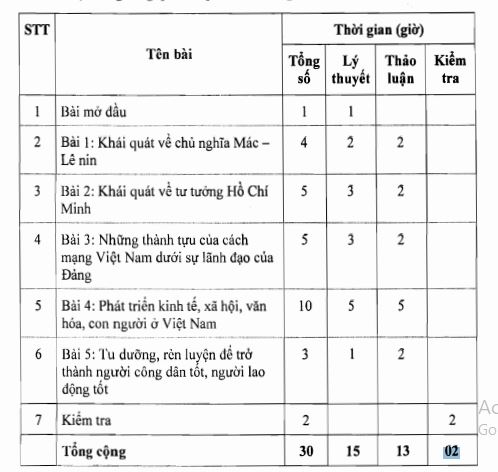
30 hours (theory: 15 hours; discussion: 13 hours; examination: 2 hours)
I. Position and Nature of the Subject Political Education subject is a compulsory subject in the common course group in the training program for vocational college level.
2. Nature
The curriculum includes an overview of Marxism-Leninism, Ho Chi Minh Thought, the revolutionary line of the Communist Party of Vietnam; emphasizing civic morality and professional ethics; contributing to educating workers to develop comprehensively, meeting the requirements of the cause of building and defending the socialist Fatherland.
1. Position
II. Objectives of the Subject
After completing the subject, students will achieve the following:
1. Knowledge
Being able to present some general contents about Marxism-Leninism, Ho Chi Minh Thought; the viewpoints, policies, and laws of the Party and State; requirements and contents for learning and practicing to become good citizens and good workers.
2. Skills
Being able to apply the general knowledge learned about the Party's viewpoints, policies, and State laws to study, practice, build morality and lifestyle to become good citizens and good workers and participate in building and defending the Fatherland.
3. Autonomous capacity and responsibility
Having the ability to apply the contents learned to cultivate political qualities, morality, and lifestyle; implement well the Party's viewpoints and policies; and State laws.
III. Content of the Subject
1. General content and time distribution
2. Detailed content
INTRODUCTION
After completing this section, students will be able to:
Present the position, nature, objectives, main contents, teaching methods, and assessment of the subject.
2.1. Position and nature of the subject
2.2. Objectives of the subject
2.3. Main contents
2.4. Teaching methods and assessment of the subject
Lesson 1:
OVERVIEW OF MARXISM-LENINISM
- Being able to present the concept, main contents, and value of Marxism-Leninism in social development;
- Affirming that Marxism-Leninism is the ideological foundation of the Party.
2.1. Concept of Marxism-Leninism
2.2. Components of Marxism-Leninism
2.2.1. Marxist-Leninist philosophy
2.2.2. Marxist-Leninist political economy
2.2.3. Scientific socialism
2.3. Role as the ideological and theoretical foundation of Marxism-Leninism
1. Objectives
Lesson 2:
OVERVIEW OF HO CHI MINH THOUGHT
- Being able to present the concept, basic contents, value of Ho Chi Minh Thought; the necessity, contents of studying and following Ho Chi Minh Thought, morality, and style;
2. Content
- Having a correct understanding and initially applying the knowledge learned to personal moral cultivation and style.
2.1. Concept of Ho Chi Minh Thought
2.2. Basic contents of Ho Chi Minh Thought
2.3. Role of Ho Chi Minh Thought in the Vietnamese revolution
2.4. Studying and following Ho Chi Minh Thought, morality, and style in the current period
2.4.1. The necessity of studying and following Ho Chi Minh Thought, morality, and style
1. Objectives
Lesson 2:
2.4.2. Main contents of studying and following Ho Chi Minh Thought, morality, and style
Lesson 3:
ACHIEVEMENTS OF THE VIETNAMESE REVOLUTION UNDER THE LEADERSHIP OF THE PARTY
- Being able to present the process of formation and achievements of the Vietnamese revolution led by the Communist Party of Vietnam;
2. Content
Affirming, trusting, and being proud of the Party's correct leadership in the revolutionary cause in the country.
2.1. Formation and leadership of the Communist Party of Vietnam in the Vietnamese revolution
2.1.1. Formation of the Communist Party of Vietnam
2.2.2. Marxist-Leninist Political Economy
2.2.3. Scientific Socialism
2.3. The Foundational Role of Marxist-Leninist Thought and Theory
Chapter 2:
OVERVIEW OF HO CHI MINH'S IDEOLOGY
1. Objectives:
Lesson 2:
- Present the concept, some basic contents, and value of Ho Chi Minh's ideology; the necessity, content of study, and implementation of Ho Chi Minh's ideology, morality, and style;
- Have a correct understanding and initially apply knowledge learned to personal moral cultivation and style refinement.
Ho Chi Minh;
- Have a correct understanding and initially apply knowledge learned to
self-cultivation, moral training, and personal style development.
2. Content
2.1. Concept of Ho Chi Minh's Ideology
2.2. Basic Content of Ho Chi Minh's Ideology
2.3. The Role of Ho Chi Minh's Ideology in Vietnam's Revolution
2.4. Studying and Implementing Ho Chi Minh's Ideology, Morality, and Style in the Current Period
2.4.1. The Necessity of Studying and Implementing Ho Chi Minh's Ideology, Morality, and Style
2.4.2. Main Content of Studying and Implementing Ho Chi Minh's Ideology, Morality, and Style
Ho Chi Minh's style
2.4.2. Main contents of learning and following Ho Chi Minh's thought, morality,
Ho Chi Minh's style
Chapter 3:
ACHIEVEMENTS OF THE VIETNAMESE REVOLUTION UNDER THE LEADERSHIP OF THE PARTY
- Present the process of formation and achievements of the Vietnamese revolution under the leadership of the Communist Party of Vietnam;
1. Objectives
Lesson 2:
Affirm, trust, and take pride in the Party's correct leadership over the revolutionary cause in the country.
Vietnam under the leadership of the Communist Party of Vietnam;
Affirm, trust, and take pride in the Party's correct leadership over the revolutionary cause in our country.
IN VIETNAM
2. Content
2.1. The Formation and Leadership of the Communist Party of Vietnam in the Vietnamese Revolution
2.1.1. The Formation of the Communist Party of Vietnam in Vietnam
IMPLEMENTING DIRECTIVE NUMBER 05-CT/TW OF THE POLITICAL BUREAU ON AUGUST 15, 2016 TO PROMOTE STUDY AND IMPLEMENTATION OF HO CHI MINH'S IDEOLOGY, MORALITY, AND STYLE, NATIONAL POLITICAL PUBLISHING HOUSE TRUTH.
2.1.2. The leading role of the Party in various revolutionary stages
2.2. Achievements of the Vietnamese revolution under the Party's leadership
2.2.1. Victory in the struggle for and protection of national independence
2.2.2. Victory in the renewal process
Chapter 4:
ECONOMIC, SOCIAL, CULTURAL, AND HUMAN DEVELOPMENT IN VIETNAM
learning and practicing Ho Chi Minh's thought, morality, and style, Publisher
1. Objectives
Lesson 2:
- Present some basic viewpoints and solutions for building and developing
economic, social, cultural, and human development in Vietnam at present;
- Recognize that the policy on economic, social, cultural, and human
development in our country at this stage is appropriate and actively implement
2. Content
such policies.
2.1. Content of the policy on economic, social, cultural, and human development
in Vietnam at present
2.2. Solutions for economic, social, cultural, and human development in Vietnam
at present
2.2.1. Content of economic and social development
2.2.2. Content of cultural and human development
Chapter 5:
SELF-CULTIVATION AND TRAINING TO BECOME A GOOD CITIZEN AND A GOOD WORKER
1. Objectives
Lesson 2:
- Briefly present the concept, content of self-cultivation and training to become
a good citizen and a good worker;
- Actively study and train to become a good citizen and a good worker.
2.1. Concept of a good citizen and a good worker
2. Content
2.1.1. Good Citizen
2.1.2. Good Worker
2.2. Content of self-cultivation and training to become a good citizen and a good worker
2.2.1. Promote the tradition of patriotism and loyalty to the people's revolutionary cause
of Vietnam
2.2.2. Strive to study, improve capabilities, and cultivate virtues
IV. Conditions for Implementing the Course
- Classroom, computers, projector, and other teaching equipment;
Clause 1. Individuals awarded the Commendation Medal shall receive the Decision and Certificate of Recognition for the "Commendation Medal for the Development of Vietnam's Transport Industry" and be recorded in the traditional golden book of the Vietnam Transport Industry.
- Course program, textbooks, reference materials, lesson plans, films, and related materials;
Encourage vocational education institutions and higher education institutions with registered
vocational education activities to invest in classrooms and other conditions to be able to organize
online teaching of the course.
V. Evaluation Method
The evaluation of students' learning outcomes is carried out according to the provisions
stipulated in Circular No. 09/2017/TT-BLDTBXH dated March 13, 2017 of the Ministry of Labor,
Invalids and Social Affairs regarding the organization and implementation of training programs
at intermediate level and advanced level under the annual system or modular or credit-based methods;
examination regulations, graduation examination, and recognition.
VI. Exemption and Credit Transfer
Exemption and credit transfer for the course are implemented according to
Circular No. 09/2017/TT-BLDTBXH.
Students who are compulsory secondary school graduates must study the entire course program.
Students who have a high school diploma, the principal of the school shall consider and decide
whether the student can be exempted from studying the contents already covered in the general education program.
VII. Other Guidelines
Encourage schools in the list of prioritized investment schools to organize pilot
online teaching of this course according to the criteria of quality vocational schools as approved
by Decision No. 761/QD-TTg dated May 23, 2014 of the Prime Minister approving the "Proposal for the Development of High-Quality Vocational Schools until 2020". For other schools, organize online teaching of the course only after receiving guidance documents from the Ministry of Labor.
Trade and Social Affairs.
1. Central Committee of the Communist Party of Vietnam (2014), Conclusion No. 94-KL/TW dated March 28, 2014 of the Central Committee of the Communist Party of Vietnam on continuing to innovate and study political theory in the national education system.
2. Central Propaganda Department (2014), Directive No. 127-HD/BTGTW dated June 30, 2014 of the Central Propaganda Department on implementing Conclusion No. 94-KL/TW dated March 28, 2014 of the Central Committee of the Communist Party of Vietnam on continuing to innovate and study political theory in the national education system.
3. Central Propaganda Department (2016), New points in the documents of the 12th National Congress of the Communist Party, National Political Publishing House.
4. Central Propaganda Department (2018), Handbook of documents guiding the implementation of Directive No. 05-CT/TW dated May 15, 2016 of the Politburo on promoting the study and practice of Ho Chi Minh's thoughts, morality, and style, National Political Publishing House.
5. Politburo (2016), Directive No. 05-CT/TW dated May 15, 2016 of the Politburo on promoting the study and practice of Ho Chi Minh's thoughts, morality, and style.
6. Ministry of Labor, Invalids and Social Affairs (2008), Decision No. 03/2008/QD-BLDTBXH dated February 18, 2008 of the Ministry of Labor, Invalids and Social Affairs promulgating the curriculum for Political Education courses for vocational secondary schools and vocational colleges.
7. Ministry of Education and Training (2008), Decision No. 52/2008/QD-BGDĐT dated September 18, 2008 of the Ministry of Education and Training on issuing the curriculum for political theory courses at university and college levels for non-major students in Marxism-Leninism and Ho Chi Minh Thought.
Reference materials
8. Ministry of Education and Training (2012), Circular No. 11/2012/TT-BGDĐT dated March 7, 2012 of the Ministry of Education and Training promulgating the curriculum for Political Education courses in vocational secondary education.
9. Ministry of Education and Training (2017), Textbook on the Revolutionary Line of the Communist Party of Vietnam, National Political Publishing House, Hanoi.
10. Ministry of Education and Training (2017), Textbook on Ho Chi Minh Thought, National Political Publishing House, Hanoi.
11. Ministry of Education and Training (2018), Textbook on Basic Principles of Marxism-Leninism, National Political Publishing House, Hanoi.
12. Communist Party of Vietnam, Documents of the 12th National Congress of the Communist Party.
13. Communist Party of Vietnam (2017), Charter of the Communist Party of Vietnam, National Political Publishing House, Hanoi.
14. Ho Chi Minh National Academy of Politics (2017), Intermediate Level Theory and Administration Textbook: Basic Issues on State Management, Political Theory Publishing House, Hanoi.
15. Ho Chi Minh National Academy of Politics (2017), Intermediate Level Theory and Administration Textbook: Basic Issues on Marxism-Leninism and Ho Chi Minh Thought, Political Theory Publishing House, Hanoi.
16. Ho Chi Minh National Academy of Politics (2017), Intermediate Level Theory and Administration Textbook: Party and State Policies of Vietnam, Political Theory Publishing House, Hanoi.
5. The Political Bureau (2016), Directive Number 05-CT/TW dated May 15, 2016 of the Political Bureau on Promoting Study and Implementation of Ho Chi Minh's Ideology, Morality, and Style.
5. The Politburo (2016), Directive No. 05-CT/TW dated May 15, 2016 of the
6. Ministry of Labor, Invalids, and Social Affairs (2008), Decision Number 03/2008/QD-BLDTBXH dated February 18, 2008 of the Ministry of Labor, Invalids, and Social Affairs on Issuing the Curriculum for Political Courses for Secondary Vocational Schools and Higher Vocational Colleges.
Ho Chi Minh.
7. Ministry of Education and Training (2008), Decision Number 52/2008/QD-BGDĐT dated September 18, 2008 of the Ministry of Education and Training on Issuing the Curriculum for Political Theory Courses at University and College Levels for Non-Marxism-Leninism and Ho Chi Minh Thought Majors.
Decision No. 03/2008/QID-LDTBXH dated February 18, 2008 of the Ministry of Labor, Invalids and Social Affairs, vocational school, college-level vocational school.
8. Ministry of Education and Training (2012), Circular Number 11/2012/TT-BGDĐT dated March 7, 2012 of the Ministry of Education and Training on Issuing the Curriculum for Political Education Courses for Intermediate Vocational Education.
dated September 18, 2008 of the Ministry of Education and Training on issuing the curriculum for subjects
9. Ministry of Education and Training (2017), Textbook on the Revolutionary Line of the Communist Party of Vietnam, National Political Publishing House Truth, Hanoi.
specialized in Marxism-Leninism, Ho Chi Minh Thought.
10. Ministry of Education and Training (2017), Textbook on Ho Chi Minh's Ideology, National Political Publishing House Truth, Hanoi.
dated March 7, 2012 of the Ministry of Education and Training promulgating the course program
11. Ministry of Education and Training (2018), Textbook on Basic Principles of Marxism-Leninism, National Political Publishing House Truth, Hanoi.
9. The Ministry of Education and Training (2017), Textbook on Revolutionary Line
12. Communist Party of Vietnam, Documents of the Twelfth National Congress of the Party.
10. The Ministry of Education and Training (2017), Textbook on Ho Chi Minh Thought,
13. Communist Party of Vietnam (2017), Charter of the Communist Party of Vietnam, National Political Publishing House Truth, Hanoi.
11. The Ministry of Education and Training (2018), Textbook on Basic Principles
14. Ho Chi Minh National Academy of Politics (2017), Intermediate Theory-Administrative Textbook: Basic Issues on State Administration, Political Theory Publishing House, Hanoi.
2.1.5. People have a prosperous, free, happy life with conditions for comprehensive development
15. Ho Chi Minh National Academy of Politics (2017), Intermediate Theory-Administrative Textbook: Basic Issues on Marxism-Leninism and Ho Chi Minh Thought, Political Theory Publishing House, Hanoi.
2.1.6. Ethnic groups in the Vietnamese community are equal, united, respect each other, and help each other develop
16. Ho Chi Minh National Academy of Politics (2017), Intermediate Theory-Administrative Textbook: Party and State Policies of Vietnam, Political Theory Publishing House, Hanoi.
CHARACTERISTICS AND DIRECTION FOR BUILDING SOCIALISM IN VIETNAM
- Present characteristics and directions for building socialism in Vietnam;
- Have a correct understanding and confidence in building socialism in the country today.
2.1. Characteristics of Socialism in Vietnam
2.1.1. Rich People, Strong Country, Democracy, Equity, Civilization
2.1.2. By the People
2.1.3. An economy based on advanced productive forces and progressive production relations
2.1.4. Advanced culture with strong national identity
2.1.5. People living comfortably, freely, happily, with conditions for comprehensive development
2.1.6. Ethnic groups in the Vietnamese community are equal, united, respect each other, and help each other develop
2.1.7. A socialist rule-of-law state of the people, by the people, for the people led by the Communist Party
2.1.8. Friendly relations and cooperation with countries around the world
on various aspects of social life, Theoretical Politics Publishing House, Hanoi.
17. National Academy of Political Theory (2017), Intermediate Course on Theory and Administration: Party Work at the Grassroots Level, Theoretical Politics Publishing House, Hanoi.
18. National Academy of Political Theory (2017), Intermediate Course on Theory and Administration: Basic Issues Regarding the Communist Party and the History of the Communist Party of Vietnam, Theoretical Politics Publishing House, Hanoi;
19. Central Theoretical Council (2017), Criticizing Incorrect Views and Defending the Ideological Foundation, Program, and Policies of the Communist Party of Vietnam, Political Publishing House of the Truth.
20. National Assembly (2013), Constitution of the Socialist Republic of Vietnam, 2013.
Other related documents./.
SOCIALIST REPUBLIC OF VIETNAM
The Political Education course belongs to the common subjects in the training program for associate degree level.
12 years 2018 of the Minister of Labor, Invalids, and Social Affairs).
Course Name:
Political Education
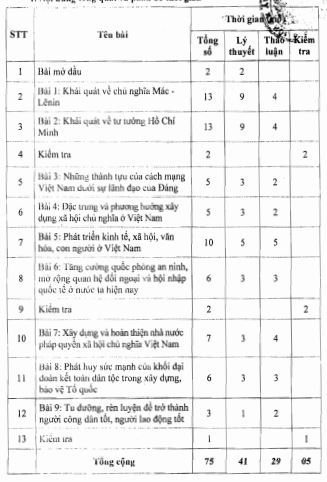
75 hours (theory: 41 hours; discussion: 29 hours; examination: 05 hours)
PROGRAM
The course covers an overview of Marxism-Leninism, Ho Chi Minh Thought, the revolutionary line of the Communist Party of Vietnam; forming a scientific and revolutionary worldview and life philosophy for young Vietnamese; contributing to the comprehensive development of workers to meet the requirements of socialist construction and defense.
II. Course Objectives
Subject Name: Political Education
Presenting basic contents of Marxism-Leninism, Ho Chi Minh Thought; viewpoints, policies of the Communist Party of Vietnam and current political tasks of the country; learning and practicing to become good citizens and good workers.
Applying knowledge about viewpoints, policies, and state regulations learned to solve personal, social issues, and other problems during study, work, daily activities, and participation in national construction and defense. Upholding politics, ethics, lifestyle; implementing the Party's viewpoints and policies; state policies effectively.
I. Position and Nature of the Subject III. Course Content
1. General Content and Time Distribution
The curriculum includes an overview of Marxism-Leninism, Ho Chi Minh Thought, the revolutionary line of the Communist Party of Vietnam; emphasizing civic morality and professional ethics; contributing to educating workers to develop comprehensively, meeting the requirements of the cause of building and defending the socialist Fatherland.
1. Position
II. Objectives of the Subject
INTRODUCTION
1. Knowledge
- Presenting the position, nature, objectives, main content, teaching methods, and evaluation of the course.
2.4. Teaching Methods and Evaluation
OVERVIEW OF MARXISM-LENINISM
- Presenting the concept, basic content, role of Marxism-Leninism in understanding and practical life;
- Initially applying the worldview and methodology of Marxism-Leninism to solve individual and social issues.
2.2. Some Basic Contents of Marxism-Leninism
1. General content and time distribution
2. Detailed content
2.2.3. Scientific Socialism
2.3. Role of the Ideological and Theoretical Foundation of Marxism-Leninism
OVERVIEW OF HO CHI MINH THOUGHT
- Presenting some basic points about the origin, formation process, basic content, value of Ho Chi Minh Thought; necessity, learning content, and following Ho Chi Minh Thought, ethics, and style;
2.2. Objectives of the subject
- Having correct understanding and effectively applying learned knowledge to personal moral cultivation and style improvement.
2.1. Concept, Origin, and Formation Process of Ho Chi Minh Thought
2.1.1. Concept
- Being able to present the concept, main contents, and value of Marxism-Leninism in social development;
- Affirming that Marxism-Leninism is the ideological foundation of the Party.
2.1.2. Origin
2.2. Components of Marxism-Leninism
2.1.3. Formation Process
2.2. Some Basic Contents of Ho Chi Minh Thought
2.2.3. Scientific socialism
2.2.1. Thought on National Independence Linked with Socialism, Combining National Strength with Contemporary Strength
1. Objectives
Lesson 2:
2.2.2. Thought on People's Sovereignty, Building a Truly People's State
2. Content
- Having a correct understanding and initially applying the knowledge learned to personal moral cultivation and style.
2.1. Concept of Ho Chi Minh Thought
2.2. Basic contents of Ho Chi Minh Thought
2.2.3. Thought on Great National Unity
2.4. Studying and following Ho Chi Minh Thought, morality, and style in the current period
2.2.4. Thought on Economic and Cultural Development, Continuously Improving Material and Spiritual Life of the People
1. Objectives
Lesson 2:
2.2.5. Thought on Revolutionary Morality, Thrift, Integrity, Selflessness
2.2.6. Thought on Cultivating the Revolutionary Generation for Future Generations
2. Content
Affirming, trusting, and being proud of the Party's correct leadership in the revolutionary cause in the country.
2.3. Role of Ho Chi Minh Thought in the Vietnamese Revolution
2.1.1. Formation of the Communist Party of Vietnam
2.2.2. Marxist-Leninist Political Economy
2.4. Learning and Practicing Ho Chi Minh Thought, Ethics, and Style in the Current Period
2.4.1. The Necessity of Learning and Practicing Ho Chi Minh Thought, Ethics, and Style
Chapter 2:
2.4.2. Main Content of Learning and Practicing Ho Chi Minh Thought, Ethics, and Style
1. Objectives
Lesson 2:
- Presenting the birth process and achievements of the Vietnamese revolution;
- Affirming, trusting, and being proud of the Party's correct leadership in the revolutionary cause in our country.
2. Content
2.1. Birth and Leadership of the Communist Party of Vietnam in the Vietnamese Revolution
2.1.1. Birth of the Communist Party of Vietnam
2.1.2. Leadership Role of the Party in Various Stages of the Revolution
CHARACTERISTICS AND DIRECTION OF SOCIALIST CONSTRUCTION IN VIETNAM
- Presenting characteristics and direction of socialist construction in Vietnam;
- Having correct understanding and confidence in socialist construction in Vietnam today.
2.1. Characteristics of Socialism in Vietnam
2.1.1. Rich People, Strong Country, Democracy, Equity, Civilization
2.1.2. By the People, For the People
2.1.3. An Economically Developed Society Based on Advanced Productive Forces and Progressive Production Relations
2.1.4. A Modern Culture with Distinct National Characteristics
2.1.5. People Enjoying Warm, Free, Happy Lives with Conditions for Comprehensive Development
2.1.6. Ethnic Groups in the Vietnamese Community Are Equal, United, Respectful, and Support Each Other in Development
2.1.7. A Socialist Rule-of-Law State of the People, By the People, For the People Led by the Communist Party
2.1.8. Friendly and Cooperative Relations with Countries Around the World
Chapter 3:
ACHIEVEMENTS OF THE VIETNAMESE REVOLUTION UNDER THE LEADERSHIP OF THE PARTY
- Present the process of formation and achievements of the Vietnamese revolution under the leadership of the Communist Party of Vietnam;
1. Objectives
Lesson 2:
2.2. Direction of Socialist Construction in Vietnam
Vietnam under the leadership of the Communist Party of Vietnam;
2.2.1. Strengthening Industrialization and Modernization of the Country Linked with Knowledge Economy Development, Resource Protection, and Environmental Conservation
2. Content
2.2.2. Developing a Market Economy Oriented Toward Socialism
2.2.3. Building a Modern Culture with Distinct National Characteristics; Building People, Enhancing People's Livelihood, Achieving Progress and Equity in Society
2.2.4. Safeguarding National Defense, Security, Order, and Social Safety Solidly
2.2. Achievements of the Vietnamese revolution under the Party's leadership
2.2.1. Victory in the struggle for and protection of national independence
2.2.2. Victory in the renewal process
Chapter 4:
2.2. Directions for Building Socialism in Vietnam
2.2.1. Strengthen industrialization and modernization of the country, linked with the development of a knowledge-based economy, protection of natural resources, and the environment
1. Objectives
Lesson 2:
2.2.2. Develop a market economy oriented towards socialism
2.2.3. Build a modern, distinctive national culture; build people, improve the people's livelihood, implement social progress and equity
2. Content
2.2.4. Safeguard national defense, security, public order, and social safety firmly
Graduation requirements.
Exemption and retention of learning results are implemented according to Circular Number 09/2017/TT-BLDTBXH. Students who have already graduated from secondary school, the principal of the school will review and decide to exempt them from studying the content they have already learned in the secondary education program.
Encourage schools listed in the priority investment list for high-quality vocational schools according to Decision Number 761/QD-TTg dated May 23, 2014 of the Prime Minister approving "The Program for Developing High-Quality Vocational Schools until 2020" to pilot direct teaching of courses. For other schools, organize direct teaching of courses only after receiving guidance documents from the Ministry of Labor, Invalids, and Social Affairs.
1. Central Committee of the Communist Party of Vietnam (2014), Conclusion Number 94-KL/TW dated March 28, 2014 of the Central Committee of the Communist Party of Vietnam on "Continuing Reform and Studying Political Theory in the National Education System".
2.1.7. There is a socialist rule-of-law state of the people, by the people, for the people led by the Communist Party
2.1.8. Maintain friendly relations and cooperation with countries around the world
2.2. Direction for building socialism in Vietnam
2.2.1. Strengthen industrialization, modernization of the country linked with the development of a knowledge-based economy, protecting natural resources, and the environment
2.2.2. Develop a market economy with a socialist orientation
2.2.3. Build a progressive culture deeply imbued with national characteristics; build human beings, improve the people's living standards, implement social progress and equity
2.2.4. Safeguard national defense, security, social order, and safety firmly
graduation.
Exemption and retention of study results shall be implemented in accordance with Circular No. 09/2017/TT-BLDTBXH. A person who has already obtained a secondary education diploma, the school principal shall review and decide to exempt the student from studying those parts of the course that were covered in the secondary education training program.
2.2.5. Implementing an independent, autonomous foreign policy of peace, friendship, cooperation, and development; actively and positively integrating into the international community.
2.2.6. Building a socialist democratic foundation; realizing national solidarity; strengthening and expanding the united front.
2.2.7. Building a socialist rule-of-law state of the people, by the people, for the people.
2.2.8. Building a clean and strong Party.
2.2.2. Content of cultural and human development
ECONOMIC, SOCIAL, CULTURAL, AND HUMAN DEVELOPMENT
learning and practicing Ho Chi Minh's thought, morality, and style, Publisher
1. Objectives
Lesson 2:
- Presenting some viewpoints and solutions for building and developing the economy, society, culture, and human resources in Vietnam at present.
- Recognizing that the current economic, social, cultural, and human development policies of the country are appropriate and actively implementing those policies.
2. Content
2.1. The content of the policy on economic, social, cultural, and human development in Vietnam at present.
2.2. Solutions for economic, social, cultural, and human development in Vietnam at present.
2.2.1. Content of economic and social development.
2.2.2. Content of cultural and human development.
Chapter 6:
STRENGTHENING NATIONAL DEFENSE AND SECURITY, EXPANDING FOREIGN RELATIONS, AND INTERNATIONAL INTEGRATION IN THE CURRENT PERIOD
- Presenting basic viewpoints on the policies of national defense, security, and foreign relations of the Party at present.
1. Objectives
Lesson 2:
- Trusting and actively implementing well the current policies of national defense, security, and foreign relations.
2.1. Domestic and international context.
2. Content
2.2. Viewpoints and main tasks of the policies on national defense and security.
2.2.1. The Party's viewpoint on the policies on national defense and security.
2.2.2. Main tasks of the policies on national defense and security.
2.3. Viewpoints and main tasks of the policies on foreign relations.
2.3.1. The Party's viewpoint on the policies on foreign relations.
2.3.2. Main tasks of the policies on foreign relations.
Chapter 7:
BUILDING AND PERFECTING A RULE-OF-LAW STATE
- Presenting the nature, characteristics, directions, and tasks of building and perfecting a socialist rule-of-law state of Vietnam.
Respectfully submitted to: Hanoi Stock Exchange
1. Objectives
Lesson 2:
- Affirming the superiority of a socialist rule-of-law state of Vietnam compared to other types of states and determining the tasks of oneself in building and protecting a socialist Vietnam.
2.1. Nature and characteristics of a socialist rule-of-law state of Vietnam.
2. Content
2.1.1. Nature of a socialist rule-of-law state of Vietnam.
2.1.2. Characteristics of a socialist rule-of-law state of Vietnam.
2.2. Directions, tasks of building and perfecting a socialist rule-of-law state of Vietnam.
2.2.1. Directions for building and perfecting a socialist rule-of-law state of Vietnam.
2.2.2. Tasks and solutions for building and perfecting a socialist rule-of-law state of Vietnam.
Chapter 8:
MAXIMIZING THE POWER OF NATIONAL SOLIDARITY IN CONSTRUCTION AND DEFENSE
- Presenting the importance and content of maximizing the power of national solidarity in construction and defense.
- Affirming the importance and actively performing the role of individuals in building national solidarity for construction and defense.
1. Objectives
Lesson 2:
2.1. Importance of national solidarity in construction and defense.
2.1.1. Theoretical basis of the policies and strategies of national solidarity in construction and defense.
2. Content
2.1.2. Practical basis of the policies and strategies of national solidarity in construction and defense.
2.2. The Party's viewpoints and directions on maximizing the power of national solidarity in construction and defense.
2.2.1. The Party's viewpoint on national solidarity in construction and defense.
2.2.2. Directions and solutions for maximizing the power of national solidarity in construction and defense.
Chapter 9:
SELF-CULTIVATION AND TRAINING TO BECOME A GOOD CITIZEN AND A GOOD WORKER
- Presenting the concept, content of self-cultivation and training to become a good citizen and a good worker.
- Actively studying and training to become a good citizen and a good worker.
2.1.1. Good citizen.
1. Objectives
Lesson 2:
2.1.2. Good worker.
2.2. Content of self-cultivation and training to become a good citizen and a good worker.
2. Content
2.1.1. Good Citizen
2.2.1. Promoting the tradition of patriotism and loyalty to the revolutionary cause of the Vietnamese people.
2.2.2. Striving to study and improve personal capabilities and qualities.
- Course program, textbooks, reference materials, lesson plans, films, and related documents.
V. EVALUATION METHODS
The evaluation of students' learning outcomes shall be carried out in accordance with the provisions of Circular No. 09/2017/TT-BLDTBXH dated March 13, 2017, issued by the Minister of Labor, Invalids, and Social Affairs, regarding the organization and implementation of secondary vocational education programs and higher vocational education programs under the academic year system or modular or credit accumulation system; examination regulations, assessment, and graduation certification rules.
- Course program, textbooks, reference materials, lesson plans, films, and related materials;
Encourage vocational education institutions and higher education institutions with registered
Exemptions and retention of learning outcomes shall be implemented according to Circular No. 09/2017/TT-BLDTBXH. Students who have already obtained a secondary diploma will be exempted from courses they have already studied in the secondary education program upon approval by the school principal.
Encouraging schools listed in the priority investment list for quality vocational schools according to Decision No. 761/QĐ-TTg dated May 23, 2014, approved by the Prime Minister "Plan for Developing High-Quality Vocational Schools until 2020," to pilot direct teaching of subjects. For other schools, direct teaching of subjects can only be organized after receiving guidance documents from the Ministry of Labor, Invalids, and Social Affairs.
Central Committee Secretariat of the Communist Party of Vietnam (2014), Conclusion No. 94-KL/TW dated March 28, 2014, of the Central Committee Secretariat on "Continuing to innovate and study political theory in the national education system."
Encourage schools listed in the priority investment list for integrated, synchronized high-quality vocational schools according to Decision No. 761/QD-TTg dated May 23, 2014 of the Prime Minister approving the "High-Quality Vocational School Development Program until 2020" to pilot direct teaching of courses. For other schools, organize direct teaching of courses only after receiving guidance documents from the Ministry of Labor, Invalids and Social Affairs.
Students who are compulsory secondary school graduates must study the entire course program.
1. The Central Committee Secretariat (2014), Conclusion No. 94-KL/TW dated March 28, 2014 of the Central Committee Secretariat "on continuing to innovate and study political theory in the national education system".
Trade and Social Affairs.
Khuyến khích các trường trong danh sách trường nghề được ưu tiên đầu tư tập trung, đồng bộ theo tiêu chí trường nghề chất lượng theo Quyết định số 761/QĐ-TTg ngày 23 tháng 5 năm 2014 của Thủ tướng Chính phủ phê duyệt "Đề án phát triển trường nghề chất lượng cao đến năm 2020" tổ chức thí điểm giảng dạy trực tuyển môn học. Đối với các trường khác, chỉ tổ chức giảng dạy trực tuyên môn học sau khỉ có văn bản hướng dẫn của Bộ Lao động -Thương binh và Xã hội.
Reference materials
1. Ban Bí thư Trung ương Đảng (2014), Kết luận số 94-KL/TW, ngày 28/3/2014 của Ban Bi thư Trung ương Đảng “về tiếp tục đổi mới, học tập lý luận chính trị trong hệ thống giáo dục quốc dân”.
2. Central Propaganda Department (2014), Guidance No. 127-HD/BTGTW dated June 30, 2014 of the Central Propaganda Department on implementing Conclusion No. 94-KL/TW dated March 28, 2014 of the Central Party Secretariat regarding continued reform and learning political theory in the national education system.
3. Central Propaganda Department (2016), New points in the documents of the 12th National Congress of the Party, National Political Publishing House.
4. Central Propaganda Department (2018), Handbook for Implementing Directive No. 05-CT/TW dated May 15, 2016 of the Politburo on Promoting Learning and Following the Thought, Morality, and Style of President Ho Chi Minh, National Political Publishing House.
5. Politburo (2016), Directive No. 05-CT/TW dated May 15, 2016 of the Politburo on Promoting Learning and Following the Thought, Morality, and Style of President Ho Chi Minh.
6. Ministry of Labor, Invalids, and Social Affairs (2008), Decision No. 03/2008/QD-BLDTBXH dated February 18, 2008 of the Ministry of Labor, Invalids, and Social Affairs promulgating the curriculum for Political Education courses for vocational secondary schools and vocational college programs.
7. Ministry of Education and Training (2008), Decision No. 52/2008/QD-BGDĐT dated September 18, 2008 of the Ministry of Education and Training on Issuing the Curriculum for Theory of Politics Courses at the University and College Levels for Students Not Specializing in Marxism-Leninism and Ho Chi Minh Thought.
8. Ministry of Education and Training (2012), Circular No. 11/2012/TT-BGDĐT dated March 7, 2012 of the Ministry of Education and Training promulgating the curriculum for Political Education courses used in training for intermediate professional levels.
9. Ministry of Education and Training (2017), Textbook on the Revolutionary Line of the Communist Party of Vietnam, National Political Publishing House, Hanoi.
10. Ministry of Education and Training (2017), Textbook on Ho Chi Minh Thought, National Political Publishing House, Hanoi.
11. Ministry of Education and Training (2018), Textbook on Basic Principles of Marxism-Leninism, National Political Publishing House, Hanoi.
12. Communist Party of Vietnam, Documents of the 12th National Congress of the Party.
13. Communist Party of Vietnam (2017), Charter of the Communist Party of Vietnam, National Political Publishing House, Hanoi.
14. Ho Chi Minh National Academy of Politics (2017), Intermediate Level Textbook on Theory and Administration: Basic Issues on State Management, Political Theory Publishing House, Hanoi.
15. Ho Chi Minh National Academy of Politics (2017), Intermediate Level Textbook on Theory and Administration: Basic Issues on Marxism-Leninism and Ho Chi Minh Thought, Political Theory Publishing House, Hanoi.
16. Ho Chi Minh National Academy of Politics (2017), Intermediate Level Textbook on Theory and Administration: Party and State Policies on Various Aspects of Social Life, Political Theory Publishing House, Hanoi.
17. Ho Chi Minh National Academy of Politics (2017), Intermediate Level Textbook on Theory and Administration: Party Work Techniques at the Grassroots Level, Political Theory Publishing House, Hanoi.
18. Ho Chi Minh National Academy of Politics (2017), Intermediate Level Textbook on Theory and Administration: Basic Issues on the Communist Party and the History of the Communist Party of Vietnam, Political Theory Publishing House, Hanoi.
19. Central Theoretical Council (2017), Criticizing Incorrect Views and Defending the Ideological Foundation, Program, and Policy Line of the Communist Party of Vietnam, National Political Publishing House.
20. National Assembly (2013), Constitution of the Socialist Republic of Vietnam, 2013.
75 hours (theory: 41 hours; discussion: 29 hours; examination: 05 hours)
Văn bản gốc (PDF)
Tải văn bản
Bản đồ quan hệ
Bấm vào một văn bản để mở. Viền đỏ = quan hệ làm thay đổi hiệu lực.
Bản dịch
Văn bản này có sẵn ở các ngôn ngữ sau: