
This Circular stipulates the Rules of Origin for goods under the ASEAN-Australia-New Zealand Free Trade Agreement (AANZFTA). It includes provisions on scope of application, basic concepts, general principles, specific rules for each type of goods, origin certification, record keeping, and minor discrepancies handling. This Circular takes effect from August 22, 2025.
적용 범위
Authorities, organizations issuing Certificates of Origin (C/O), and Customs authorities in implementing the Rules of Origin for goods under the AANZFTA Agreement.
핵심 사항
- Provisions on the scope of application of the Rules of Origin
- Basic concepts related to the Rules of Origin
- General principles and specific rules for each type of goods
- Origin certification and record keeping
- Handling minor discrepancies in documentation
🌐 이 문서의 사회적 영향
- Enhancing free trade among AANZFTA member countries
- Assisting businesses to better understand the Rules of Origin to take advantage of preferential tariffs
- Improving management and supervision of imported and exported goods
❓ 자주 묻는 질문
Which consolidated documents does this Circular replace?
This Circular replaces Circular No. 31/2015/TT-BCT, Circular No. 07/2020/TT-BCT, and Circular No. 02/2024/TT-BCT.
When does this Circular take effect?
This Circular takes effect from August 22, 2025.
전문
CIRCULAR
Regulations on Rules of Origin for Goods in the Establishment of the ASEAN-Australia-New Zealand Free Trade Area
the Agreement establish the ASEAN-Australia-New Zealand Free Trade Area
__________________
Pursuant to Decree No. 40/2025/NĐ-CP dated February 26, 2025 of the Government stipulating the functions, tasks, powers, and organizational structure of the Ministry of Industry and Trade;
Decree No. 31/2018/NĐ-CP dated 08 the 3 Pursuant to Decree No. 32/2019/NĐ-CP dated April 10, 2019 of the Government on assigning tasks, procurement or tendering for the supply of products and services using state budget from regular operating expenses;18 of the Government detailing the Law on Foreign Trade Management on the origin of goods; concerning origin of goods;
Implementing the Agreement Establishing the ASEAN-Australia-New Zealand Free Trade Area signed on February 27, 2009 at the 14th Summit Conference in Thailand between the Member States of the Association of Southeast Asian Nations and Australia and New Zealand; and the Second Protocol Amending the Agreement Establishing the ASEAN-Australia-New Zealand Free Trade Area concluded in Semarang, Indonesia on February 14, 2024;
At the proposal of the Director of the Department of Import-Export;
The Minister of Industry and Trade promulgates Circular Providing Rules of Origin for Goods in the Agreement Establishing the ASEAN-Australia-New Zealand Free Trade Area.
PART I
GENERAL PROVISIONS
Article 1. Scope of Regulation
This Circular provides Rules of Origin for Goods in the Agreement Establishing the ASEAN-Australia-New Zealand Free Trade Area (hereinafter referred to as the AANZFTA), amended by the Second Protocol Amending the Agreement Establishing the ASEAN-Australia-New Zealand Free Trade Area (hereinafter referred to as Protocol 2).
Article 2. Applicability
This Circular applies to:
2. Business entities.
CIF
is the value of imported goods including freight and insurance charges up to the port or customs frontier of the importing country.
Article 3. Explanation of Terms
According to this Circular, the following terms are understood as follows:
1. Aquaculture means the rearing of aquatic living organisms including fish, molluscs, crustaceans, other aquatic invertebrates, and aquatic plants from eggs, fry, fingerlings, and larvae through human intervention in the breeding or growth processes to promote reproduction such as cultivation, feeding, or protection from predators.
2. Back-to-back Certificate of Origin means a Certificate of Origin issued by an issuing authority, organization, or exporter qualified to issue a C/O, or an intermediary member state exporter based on one or more previously issued Certificates of Origin by the first exporting member state.
3. is the value of goods delivered alongside ship, including transportation costs from the manufacturer to the port or final destination before the cargo-carrying vessel departs. means the customs value of imported goods inclusive of freight and insurance charges up to the port or place of entry of the importing country. This value is calculated according to Article VII of the General Agreement on Tariffs and Trade (GATT 1994) and the Customs Valuation Agreement.
4. FOB means the value of goods delivered alongside ship inclusive of transportation costs to the port or final destination before the cargo ship departs. This value is calculated according to Article VII of GATT 1994 and the Customs Valuation Agreement.
5. RVC means the regional value content criterion.
6. CTC means the tariff classification change criterion.
7. Generally accepted accounting principles means principles that have been generally recognized or applied in a member state regarding the recording of revenues, expenses, surcharges, assets, and liabilities; information retrieval; and financial reporting. These principles may include general guidelines as well as specific standards, practices, and procedures.
8. Goods means any merchandise, product, item, or raw material.
9. Similar materials capable of substitution means materials of the same type, quality, and physical and technical characteristics, such that once these raw materials are incorporated into a finished product, their origin cannot be distinguished through labeling or visual inspection.
10. Intermediate materials means goods used in the production, testing, or inspection of goods but not physically incorporated into those goods, or goods used for maintenance of facilities or operation of equipment related to the production of goods, including:
a) Fuel and energy.
b) Tools, molds, and casting dies.
c) Spare parts and materials used for maintaining equipment and facilities.
d) Lubricants, compounds, and other materials used in the production process or for operating equipment and facilities.
đ) Gloves, goggles, footwear, protective clothing, and labor protection supplies.
e) Equipment, tools, and supplies used for testing or inspecting goods.
g) Catalysts and solvents.
h) Any other materials that are no longer part of the goods but whose use must be justified as necessary in the production process.
11. includes cultivation, extraction, harvesting, breeding, propagation, extraction, gathering, collection, hunting, fishing, trapping, shooting, processing, producing, manufacturing, or assembling goods. means a member state of ASEAN, Australia, or New Zealand.
12. includes cultivation, extraction, harvesting, breeding, propagation, extraction, gathering, collection, hunting, fishing, trapping, shooting, processing, producing, manufacturing, or assembling goods. intermediary means a member state through which goods are transported, neither the exporting member state nor the importing member state.
13. Raw Materials includes materials, substances used or consumed in the production of goods or combined into another type of good or participating in a production process for another good.
14. Goods or materials without origin means goods or materials that do not meet the origin criteria set forth in this Circular.
15. Goods or materials with origin means goods or materials that meet the origin criteria set forth in this Circular.
16. Packaging and packing materials for transport means goods used to protect a product during transport that are not retail packaging or packing materials.
17. is an individual or legal entity established in the territory of a Member State where the goods are imported by that person. means a person who cultivates, extracts, harvests, farms, breeds, extracts, collects, gathers, hunts, catches, traps, shoots, manufactures, produces, processes, or assembles a good.
18. Manufacturing means methods to obtain goods including cultivation, extraction, harvesting, farming, breeding, extraction, collection, gathering, hunting, catching, trapping, shooting, manufacturing, producing, processing, or assembling.
19. Specific product rule means the rules set out in Appendix I attached hereto stipulating that the materials used to produce goods must undergo a tariff classification change, or a specific processing stage, or meet the regional value content criterion, or a combination of the above criteria.
20. Certificate of Origin means a Certificate of Origin as prescribed in Article 20 of this Circular.
Article 4. Certification and verification of origin of goods in Vietnam
1. The Circular hereby promulgates the following Appendices:
a) Appendix I: Specific product rules.
b) Appendix II: Minimum Information List for the Certificate of Origin.
c) Appendix III: Model AANZ C/O Form.
d) Appendix IV: Supplementary Declaration Form for AANZ C/O.
đ) Appendix V: Exporter's Declaration of FOB Value.
2. The agencies and organizations issuing AANZ C/Os in Vietnam are the Department of Import-Export (Ministry of Industry and Trade) and organizations assigned tasks by provincial People's Committees. The registration of signature samples and stamp samples and the updating of these samples by agencies and organizations issuing AANZ C/Os shall be carried out in accordance with the guidance of the Department of Import-Export (Ministry of Industry and Trade). The list of agencies and organizations issuing AANZ C/Os in Vietnam is updated through the Ministry of Industry and Trade’s Electronic Origin Management and Certification System (eCoSys) at the website www.ecosys.gov.vn.
3. The certification and origin verification process for goods shall be implemented in accordance with the detailed regulations on the Law on Foreign Trade Management regarding the origin of goods stipulated in Decree No. 31/2018/NĐ-CP dated March 8, 2018 of the Government, the relevant laws on the origin of goods, and the provisions of this Circular.
Chapter II
RULES ON THE ORIGIN OF GOODS
Article 5. Goods with origin
1. Goods shall be considered to have origin if they meet the other provisions of this Circular and one of the following provisions:
a) They have pure origin or are entirely produced in a Member State as provided for in Article 6 of this Circular.
b) They have non-pure origin or are not entirely produced in a Member State but meet the requirements set forth in Article 7 of this Circular.
c) They are produced in a Member State solely from materials having origin in one or more Member States.
2. Goods that satisfy the origin requirements under Clause 1 of this Article shall enjoy preferential customs duties when exported to a Member State and subsequently re-exported to another Member State.
Article 6. Goods with pure origin
1. According to point a, Clause 1 of Article 5 of this Circular, goods shall be considered to have pure origin or be entirely produced in a Member State in the following cases:
a) Plants and plant products including fruits, flowers, vegetables, trees, seaweed, mushrooms, and living plants grown, harvested, picked, or gathered in a Member State.
b) Live animals born and raised in a Member State.
c) Products obtained from live animals in a Member State.
d) Products obtained from hunting, trapping, fishing, aquaculture, gathering, or harvesting in a Member State.
đ) Minerals and other naturally occurring substances extracted or mined from land, sea, seabed, or subsoil of a Member State.
e) Fishing products and other marine products caught from the high seas in compliance with international law, by vessels registered or recorded in a Member State and flying its flag.
g) Products processed or produced directly on processing vessels registered or recorded in a Member State and flying its flag, from the products mentioned in point e of this Clause.
h) Products extracted from the seabed or subsoil outside the exclusive economic zone and continental shelf of a Member State and beyond such areas where other countries have rights to exploit in accordance with international law.
i) Waste and scrap originating from production and consumption processes in a Member State, provided that the product is only suitable for raw material recycling purposes; or used products collected in a Member State, provided that the product is only suitable for raw material recycling purposes.
k) Goods obtained or produced in a Member State from goods specified from point a to point i of this Clause or from their derivative products.
2. In this Article, "in a Member State" includes the territory, territorial waters, exclusive economic zone, and continental shelf under the sovereignty, sovereign rights, and jurisdiction of the Member State, as applicable, in accordance with international law.
3. "International law" as stipulated in Clause 2 of this Article refers to widely accepted international law, such as the United Nations Convention on the Law of the Sea.
Article 7. Goods with Non-Pure Origin
1. According to point b, Clause 1 of Article 5 of this Circular, goods shall be considered to have non-pure origin in a Member State if they meet the criteria set forth in Appendix I attached to this Circular.
2. In the case where Appendix I attached to this Circular allows choosing between RVC, CTC, specific processing operations, or a combination of these criteria to determine the origin of a specific good, the producer or exporter may choose the appropriate criterion to determine the origin of the goods.
Article 8. Calculation of Regional Value Content (RVC)
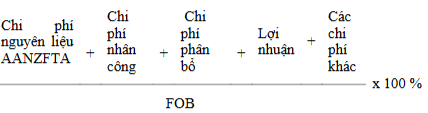
1. The RVC prescribed in Clause 2, Article 7 of this Circular shall be calculated based on one of the following two formulas:
a) Direct formula:
b) Indirect formula:
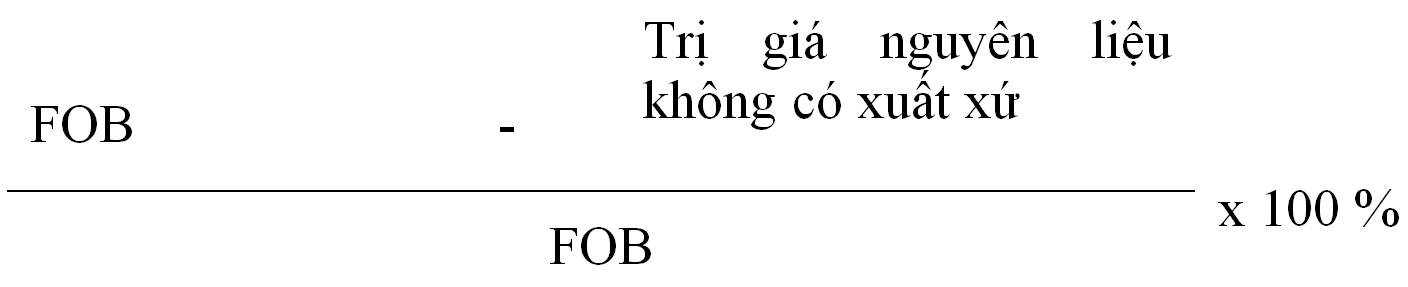
Of which
Cost of AANZFTA materials is the value of raw materials, parts, or products with origin purchased or self-produced by the manufacturer.
Labor costs including wages, remuneration, and other benefits for workers.
Allocated costs are all common costs allocated to the production process.
Other costs are costs incurred during the loading of goods onto ships or other means of transportation for export, including but not limited to domestic transportation costs, storage costs, port handling costs, brokerage fees, service fees.
Value of non-origin materials is the CIF value at the time of importation or the first purchase price of non-origin raw materials, components, or products paid by the manufacturer. Non-origin materials include those whose origin cannot be determined but do not include materials obtained through self-production.
2. The value of goods as stipulated in this Circular shall be determined according to Article VII of the GATT 1994 and the Customs Valuation Agreement.
Article 9. Cumulation
1. Goods and materials meeting the provisions of Article 5 of this Circular and used as raw materials in another Member State to produce other goods or materials shall be considered to have origin from the Member State where the final goods or materials were produced or processed.
2. In addition to the provisions of Clause 1 of this Article, cumulation also applies to all production stages and added value of non-origin materials in one Member State when such materials are used in another Member State to produce other goods or materials. Production stages or added value of non-origin materials within the territory of one or more Member States shall be included in the origin component of the final goods or materials when determining their origin in the territory of a Member State, regardless of whether the production process or added value is sufficient to determine the origin of the materials themselves.
3. The origin of goods and materials under Clause 2 of this Article shall be determined as follows:
a) For non-origin materials produced in a Member State that does not participate in cumulation under this Clause, production stages or added value shall not be counted when assessing the origin of the final goods or materials produced in a Member State participating in cumulation under this Clause.
b) For non-origin materials produced in a Member State participating in cumulation under this Clause, production stages or added value shall not be counted when assessing the origin of the final goods or materials produced in a Member State that does not participate in cumulation under this Clause.
c) For non-origin materials produced in a Member State that does not participate in cumulation under this Clause, production stages or added value shall not be counted when assessing the origin of the final goods or materials produced in a Member State that does not participate in cumulation under this Clause.
4. The Ministry of Industry and Trade (through the Import-Export Department) shall announce the list of Member States participating in cumulation under Clause 2 of this Article and the date of participation on the eCoSys System and the Ministry of Industry and Trade's Electronic Information Portal.
Article 10. Simple Processing Operations
In cases where the determination of origin of goods is based on the RVC criterion, processing operations, when carried out separately or in combination, are considered simple and are not taken into account when determining the origin of goods, including:
1. Ensuring the preservation of goods in good condition during transportation or storage.
2. Assisting in the shipment or transportation of goods.
3. Packaging (excluding packaging in the electronics industry) or displaying goods for transportation or sale.
4. Simple operations, including sieving, sorting, cleaning, cutting, separating, bending, rolling, unrolling, and similar operations.
5. Labeling products or their packaging with labels, tags, or similar distinguishing marks.
6. Dilution with water or other substances without fundamentally altering the characteristics of the goods.
Article 11. De Minimis Rate of Non-Originating Materials
Article 11. De Minimis Rate of Non-Originating Materials
1. Goods that do not meet the CTC criteria specified in Appendix I issued together with this Circular shall still be considered as originating goods if they comply with other provisions of this Circular and fall under one of the following cases:
a) For goods not falling within Chapters 50 to 63 of the Harmonized System of Description and Coding of Goods, the value of all non-originating materials used to produce goods that do not meet the CTC criteria does not exceed ten percent (10%) of the FOB value of the goods.
b) For goods falling within Chapters 50 to 63 of the Harmonized System of Description and Coding of Goods, the weight of all non-originating materials used to produce goods that do not meet the CTC criteria does not exceed ten percent (10%) of the total weight of the goods or the value of all non-originating materials used to produce goods that do not meet the CTC criteria does not exceed ten percent (10%) of the FOB value of the goods.
2. The value of non-originating materials as stipulated in Clause 1 of this Article shall be included in the value of non-originating materials when goods apply the RVC criterion.
1. Accessories, spare parts, tools, and accompanying documentation or informational materials that are considered part of the goods shall not be taken into account when determining whether all non-originating materials used in the production of the goods meet the Regional Value Content criteria, provided that:
Article 12. Accessories, Spare Parts, Tools, and Informational Documents
1. Accessories, spare parts, tools, and informational documents accompanying goods are considered part of the goods and are not taken into account when determining whether all non-originating materials used to produce goods meet the CTC criteria, provided that:
a) Accessories, spare parts, tools, and informational documents accompanying goods are not invoiced separately from the goods.
b) The quantity and value of accessories, spare parts, tools, and informational documents accompanying goods are customary for the goods.
Article 13. Similar Raw Materials and Substitutable Raw Materials
The determination of similar raw materials and substitutable raw materials as originating materials shall be carried out through actual separation of each material or by applying generally accepted inventory management accounting principles, or inventory management practices in the exporting Member State.
Article 14. Provisions on Packaging Materials
1. Packaging materials for transportation and carriage of goods shall not be considered when determining the origin of goods.
2. Retail packaging materials, when classified together with packaged goods, shall be excluded from non-originating materials used in the production of goods when determining origin under the CTC criterion.
3. In cases where the RVC criterion is applied, the value of retail packaging materials shall be considered as either originating or non-originating materials depending on the circumstances when calculating the RVC content.
Article 15. Intermediate Materials
Intermediate materials shall be deemed as originating materials without regard to their place of production. The value of intermediate materials is the cost recorded in the producer's accounting records.
Article 16. Recording Costs
All costs shall be recorded and retained in accordance with generally accepted accounting principles in the territory of the Member State where the goods are produced.
Article 17. Direct Transport, Transit, and Transshipment
Goods shall be considered to maintain their origin as stipulated in Article 5 of this Circular if they meet one of the following conditions:
1. Goods are transported to the importing Member State without transiting through any non-member country.
2. Goods transit through one or more non-member countries, subject to the following conditions:
a) Goods do not undergo any production process or other activities outside the territory of the Member States, except for unloading, reloading, warehousing, or any necessary steps to preserve the goods in good condition or to transport them to the importing Member State.
b) Goods do not participate in commercial transactions or free circulation in non-member countries.
Article 18. Certificates of Origin for Goods
To enjoy preferential customs duties, goods must have a certificate of origin for goods as prescribed in Chapter III of this Circular.
Article 19. Refusal to Grant Preferential Treatment
The Customs Authority shall refuse to grant preferential customs duties in either of the following cases:
1. Goods do not comply with the provisions of this Circular.
2. The importer, exporter, or producer of the goods cannot prove that the goods comply with the provisions of this Circular to be eligible for preferential customs duties.
Chapter III
CERTIFICATION AND INSPECTION OF ORIGIN
Article 20. General Provisions on the Mechanism for Issuing Certificates of Origin
1. Goods of Vietnamese origin exported to Member States shall be considered for preferential customs duties within the framework of the AANZFTA Agreement when accompanied by a Certificate of Origin issued in accordance with this Circular.
2. Goods of Member State origin imported into Vietnam shall be considered for preferential customs duties within the framework of the AANZFTA Agreement when submitting one of the following certificates of origin for goods:
a) A Certificate of Origin issued by the authority or organization authorized to issue Certificates of Origin pursuant to Articles 24 and 25 of this Circular.
b) A self-certified certificate of origin issued by an eligible exporter in accordance with Articles 21 and 25 of this Circular.
3. Self-certified certificates of origin as provided for in point b, Clause 2 of this Article:
a) Shall be issued in paper form or other forms including electronic format according to the model notified by the importing Member State.
b) Shall identify the goods as originating and comply with the provisions of this Circular.
c) Shall include the minimum information specified in Section II of Appendix II promulgated together with this Circular.
d) Shall be in English, signed and dated by the person issuing the self-certification and the date of issuance.
đ) Shall be valid for twelve months from the date of issuance.
Article 21. Qualified Exporters
1. The competent authority of the exporting Member State shall apply the self-certification mechanism for origin of goods to qualified exporters in accordance with the provisions of that exporting Member State. A qualified exporter must meet the following conditions:
a) Register in accordance with the regulations of the exporting Member State.
b) Have knowledge of the rules of origin of goods as prescribed in this Circular.
c) Have export experience as stipulated by the exporting Member State.
d) Comply with the documentation retention system for exports under the risk management system of the competent authority of the exporting Member State.
đ) In the case where a qualified exporter is a trader, it must have information on the declaration of origin from the manufacturer to ensure the origin of the goods and provide such information when verifying the origin of the goods according to the regulations.
e) Maintain accounting records and store information in accordance with the regulations of the exporting Member State.
2. The competent authority of the exporting Member State shall issue a written approval to qualified exporters in paper form or electronically, provide a code number to qualified exporters, and notify the information of qualified exporters as prescribed in Clause 4 of this Article.
3. Qualified exporters may issue self-certification documents for the origin of goods for those products permitted for self-certification and provide related documents for the exported consignment.
4. The competent authority of the exporting Member State shall report information about qualified exporters into a database, including:
a) The name and legal address of the qualified exporter.
b) The code number of the qualified exporter.
c) The issuance date, if applicable, and expiration date of the code number.
d) A list of products permitted for self-certification of origin, at least at the Chapter level.
5. Any changes specified from point a to point d of Clause 4 of this Article, or revocation or suspension of the authority of a qualified exporter to self-certify origin, must be immediately reported to the database. If the competent authority of the exporting Member State has a secure website allowing other Member States to access, there is no need to report in the above manner.
6. The competent authority of the exporting Member State shall supervise qualified exporters, including checking and verifying self-certification documents for the origin of goods issued by qualified exporters, and revoke the authority of qualified exporters if they no longer meet the conditions set out in Clause 1 of this Article.
7. Qualified exporters shall be responsible for implementing the verification process of the origin of goods by the Customs Authority of the importing Member State, providing related documents to prove the origin of the goods, including supplier or manufacturer information as required by the importing Member State as well as complying with the provisions of this Circular.
8. This provision applies to qualified exporters who self-certify the origin of goods imported from other Member States into Vietnam.
Article 22. Pre-export inspection
The manufacturer, exporter, or authorized representative may submit a written application or electronic application to the issuing authority for pre-export origin inspection of goods before export. The results of such inspections, conducted periodically or when necessary, serve as the basis for issuing Certificates of Origin (C/O) for exported goods subsequently. Pre-export inspection may not be required for goods whose origin can easily be determined through their inherent characteristics.
Article 23. Inspection of Application for Certificate of Origin
The issuing authority shall conduct individual inspections of applications for C/Os to ensure:
1. The application for C/O and the C/O are fully completed and signed by an authorized person.
2. The goods have origin as prescribed in Article 5 of this Circular.
3. Other contents declared on the C/O are consistent with submitted documents and related information.
4. Information declared for exported goods is consistent with the requirements specified in Section I of Appendix II issued together with this Circular.
Article 24. Issuance of Certificate of Origin
1. A C/O includes one original and two copies.
2. A C/O must meet the following conditions:
a) Issued in paper form or other forms including electronic format according to the model notified by the Importing Member State.
b) Has a unique reference number.
c) Is expressed in English.
d) Contains the official signature and seal of the issuing authority. The signature and seal may be in electronic form.
đ) Identifies goods with origin and complies with the provisions of this Circular.
e) Includes the minimum information specified in Section I of Appendix II issued together with this Circular.
g) On the C/O, there must be recorded relevant origin criteria.
3. The original C/O is sent by the exporter to the importer for submission to the Customs Authority of the Importing Member State. Two copies are retained by the issuing authority and the exporter.
4. Multiple items may be declared on a single C/O provided that each item is of origin.
5. In case the C/O contains inaccurate information, the issuing authority shall consider one of the following two cases:
a) Issue a new C/O within twelve months from the date of issuance of the original C/O and cancel the original C/O. The reissued C/O remains valid for no more than twelve months from the date of reissuance.
b) Amend the information on the C/O by striking out incorrect entries and supplementing necessary information or corrections. All changes must be approved by the authorized signatory of the C/O and certified by the issuing authority. The amended C/O retains its original validity.
6. In case the C/O is not issued prior to or at the time of delivery due to unintentional error, oversight, or legitimate reasons, or if it replaces a C/O containing inaccurate information, the C/O may be issued later but not more than twelve months from the date of delivery. In this case, the C/O must be marked with the phrase "ISSUED RETROACTIVELY".ISSUED RETROACTIVELY".
7. In case the C/O is stolen, lost, or damaged, the manufacturer, exporter, or authorized representative may request in writing from the issuing authority of the Exporting Member State to issue a certified true copy of the original C/O. Such copy must meet the following conditions:
a) Based on export documents kept by the issuing authority.
b) Carries the wording "CERTIFIED TRUE COPY"CERTIFIED TRUE COPY".
c) Includes the reference number and issuance date of the original C/O.
d) Issued within twelve months from the date of issuance of the original C/O.
8. The C/O is valid for twelve months from the date of issuance.
Article 25. Back-to-back Certificate of Origin
The issuing authority, organization, or qualified exporter of an Intermediate Member State may issue a back-to-back Certificate of Origin under the following conditions:
1. One or more original Certificates of Origin or certified true copies of the original Certificate of Origin that remain valid must be presented.
2. The validity period of the back-to-back Certificate of Origin shall not exceed the validity period of the original Certificate of Origin.
3. For partial shipments, the quantity of each partial shipment must be indicated on the back-to-back Certificate of Origin instead of the total quantity of all shipments on the original Certificate of Origin.
4. For consolidated shipments, the back-to-back Certificate of Origin must be issued by the Intermediate Member State and presented to the Final Importing Member State within the earliest validity period of one of the original Certificates of Origin.
5. When issuing a back-to-back Certificate of Origin to the exporter, the Intermediate Member State must ensure that the total quantity of partial re-exported goods or the quantity of consolidated shipments does not exceed the total quantity recorded on the original Certificates of Origin imported from the Exporting Member State.
6. Re-exported goods using a back-to-back Certificate of Origin shall not undergo any further processing in the Intermediate Member State except for repackaging, logistical activities such as unloading, loading, warehousing, consolidation, or separation of shipments, or merely affixing labels as required by the Final Importing Member State, or other necessary activities to maintain the condition of the goods or transport them to the Final Importing Member State.
7. The back-to-back Certificate of Origin must include information related to the original Certificates of Origin consistent with the minimum information set forth in Appendix II attached hereto.
8. The procedures for checking and verifying the back-to-back Certificate of Origin shall be carried out in accordance with Articles 29 and 30 of this Circular.
Article 26. Third Country Invoice
1. The Final Importing Member State shall not refuse to grant preferential customs duties if the commercial invoice is issued by a company based in a third country outside the Exporting Member State or the Final Importing Member State, provided that the goods comply with the provisions of this Circular.
2. The Certificate of Origin must contain the phrase "SUBJECT OF THIRD COUNTRY INVOICE"SUBJECT OF THIRD COUNTRY INVOICE (name of the first company issuing the third-country invoice)".
Article 27. Submission of Certificate of Origin to Enjoy Preferential Customs Duties
1. The Final Importing Member State grants preferential customs duties if the goods have origin based on a Certificate of Origin.
2. To enjoy preferential customs duties, the Final Importing Member State requires the importer to:
a) Declare the goods of origin on the customs declaration form.
b) Present a valid Certificate of Origin at the time of declaration as stipulated in point a of this clause.
c) Provide the original or certified true copy of the Certificate of Origin to the Final Importing Member State upon request at the time of import declaration.
3. The Final Importing Member State may not require the presentation of a Certificate of Origin for the purpose of claiming preferential customs duties in either of the following cases:
a) The customs value of the imported consignment does not exceed 200 (two hundred) US dollars or an equivalent amount in the currency of the Final Importing Member State or any higher amount specified by the Final Importing Member State based on its laws or practices.
b) Goods are exempt from submitting a Certificate of Origin, provided that the importation is not part of a continuous series or planned sequence aimed at circumventing the regulations of the Final Importing Member State to claim preferential customs duties under the AANZFTA Agreement.
4. In case of necessity, the customs authority of the Final Importing Member State may require the importer to provide documents to prove that the goods meet the requirements for origin as stipulated in this Circular.
5. In case of direct shipment, transit, and transshipment, the importer must demonstrate that the goods comply with the provisions of Article 17 of this Circular and provide the required documents to the customs authority of the Final Importing Member State.
6. The submission deadlines for the Certificate of Origin are as follows:
a) The Certificate of Origin must be submitted to the customs authority of the Final Importing Member State within its validity period.
b) If the Certificate of Origin is submitted to the customs authority of the Final Importing Member State beyond the prescribed deadline due to force majeure or other legitimate reasons beyond the control of the importer or exporter, the Certificate of Origin will still be accepted according to the regulations of the Final Importing Member State.
c) The customs authority of the Final Importing Member State may accept the Certificate of Origin provided that the goods were imported before the expiration of the validity period of the Certificate of Origin.
Article 28. Enjoyment of Post-Importation Preferential Tariff Treatment
1. After goods with origin have been imported into a Member State, the importer may request a refund of any excess duties paid, deposits, or guarantees due to the goods not enjoying preferential tariff treatment according to the importing Member State's regulations, upon presenting the following documents to the customs authority of that Member State:
a) Certificates of Origin for the goods and other documents proving the origin of the goods.
b) Import-related documents requested by the customs authority to prove that the goods enjoy preferential tariff treatment.
2. The importer must notify the customs authority of the importing Member State at the time of importation regarding the request for preferential tariff treatment.
Article 29. Verification of Goods' Origin
1. In cases where the customs authority of the importing Member State has reasonable grounds to doubt the authenticity or accuracy of information on the Certificate of Origin or other documents, the customs authority:
a) Shall take measures to verify the validity of the Certificate of Origin or other origin documents. If necessary, verification shall be conducted in accordance with Article 30 of this Circular.
b) Shall request the importer to provide information about goods that have enjoyed preferential tariff treatment.
c) Shall formally request the issuing authority or organization of the Certificate of Origin in the exporting Member State to verify the information provided by the exporter and producer. The customs authority of the importing Member State may also directly request information from eligible exporters, exporters, or producers in Australia and New Zealand.
2. The entity required to provide information as stipulated in Clause 1 must provide such information within ninety days from the date of the formal request.
3. The customs authority of the importing Member State must issue a formal notice stating whether the goods qualify for preferential tariff treatment to the relevant parties within sixty days from the date of receipt of the necessary information to make a decision.
Article 30. Verification at the Exporting Member State
1. Where verification needs to be conducted at the exporting Member State, the customs authority of the importing Member State shall send a formal notice to the issuing authority or organization of the Certificate of Origin in the exporting Member State at least thirty days before the planned inspection date. The customs authority of the importing Member State may also directly request information from eligible exporters, exporters, or producers in Australia and New Zealand.
2. Where the issuing authority or organization of the Certificate of Origin in the exporting Member State is not a government agency, the customs authority of the importing Member State shall send a formal notice to the customs authority of the exporting Member State requesting verification.
3. The formal notice referred to in Clauses 1 and 2 of this Article shall include the following contents:
a) Information of the customs authority issuing the notice.
b) Name of the exporter or producer in the exporting Member State whose goods require verification.
c) Date of issuance of the notice.
d) Proposed date and location for verification.
e) Scope and anticipated objectives of the verification including specific information related to the goods requiring verification.
f) Names and positions of officers from the customs authority or relevant competent authorities of the importing Member State participating in the inspection team.
4. The issuing authority or organization of the Certificate of Origin in the exporting Member State must inform the exporter or producer of the inspection plan initiated by the customs authority or another relevant competent authority of the importing Member State and request the exporter or producer's consent for the customs authority or other relevant authorities of the importing Member State to inspect the production facility and provide information related to the origin of the goods.
5. The issuing authority or organization must inform the exporter or producer that the customs authority of the importing Member State may refuse preferential tariff treatment if the exporter or producer does not respond within the prescribed period.
6. The issuing authority or organization of the Certificate of Origin in the exporting Member State must notify the customs authority of the importing Member State within thirty days from the date of the formal request of the customs authority of the importing Member State regarding whether the exporter or producer has agreed to the proposed inspection.
7. The customs authority of the importing Member State shall not conduct inspections of the production facilities of the exporter or producer in the territory of the exporting Member State without written consent from the exporter or producer.
8. The customs authority of the importing Member State must complete all origin verification work and issue a decision within one hundred and fifty days from the date of notification to the issuing authority or organization referred to in Clause 1 of this Article. The customs authority of the importing Member State must issue a formal notice concluding whether the goods meet the conditions for preferential tariff treatment to the relevant parties within ten days from the date of the decision.
9. Member States must keep confidential any information considered to be confidential obtained during verification and protect such information from disclosure to avoid causing competitive harm to the provider of the information. Confidential information can only be provided to competent authorities responsible for managing and enforcing the determination of origin.
Article 31. Suspension of Preferential Tariff Treatment
1. The Customs Authority of the Importing Member may temporarily suspend preferential tariff treatment for goods subject to origin verification under this Circular throughout the entire verification period or at any stage thereof.
2. The Importing Member may release the goods to the importer upon application of necessary administrative measures provided that the goods are not prohibited or restricted from importation and there is no suspicion of fraud.
3. In case the Customs Authority of the Importing Member determines that the goods meet the conditions for being originating goods, such goods shall be entitled to preferential tariff treatment.
4. Where there is a change in the destination after the shipment has been exported from the Exporting Member but before clearance in the Importing Member, the exporter, producer, or authorized representative must request issuance of a new CO for the said shipment. The application for issuance of a new CO shall include the original CO issued for the shipment.
5. In cases where goods are transported through the territory of a non-member country as stipulated in point b, Clause 2, Article 17 of this Circular, the importer must submit the following documents to the Customs Authority of the Importing Member:
a) Certificate of Origin.
b) Commercial Invoice.
c) Transport Documents.
d) Detailed List of Goods.
đ) Customs or warehouse documents in case of warehousing.
Article 32. Minor Differences and Errors
The Customs Authority of the Importing Member shall disregard minor differences or errors, such as minor discrepancies between documents, missing information, typographical errors, or misalignment of boxes on the Certificate of Origin, provided that these minor differences or errors do not raise doubts about the origin of the goods.
Article 33. Record Keeping
1. The issuing authority or organization, producer, exporter, importer, and authorized representative must retain all relevant documents for at least three years from the date of export or import, as applicable, to prove that the goods meet the requirements for preferential tariff treatment. Such documents may be in electronic form.
2. Information related to the validity of the Certificate of Origin must be provided upon request of the Importing Member by the officer or authorized person signing the Certificate of Origin and certified by the issuing authority or organization, exporter, or producer, as appropriate.
3. Information exchanged between Members must be kept confidential and used solely for the purpose of verifying the Certificate of Origin.
Article 34. Goods in Transit or Temporary Storage
Goods with originating status in transit from the Exporting Member to the Importing Member, or temporarily stored in a duty-free zone of the Importing Member, shall be entitled to preferential tariff treatment if they are imported into the Importing Member from the date the AANZFTA Agreement enters into force, provided that a subsequently issued CO is submitted to the Customs Authority of the Importing Member and in accordance with the laws, regulations, or administrative practices of the Importing Member.
Chapter IV
IMPLEMENTATION PROVISIONS
Article 35. Implementation
1. Guidelines and uniform interpretations related to the implementation of the Chapter on Rules of Origin under the AANZFTA Agreement, which are agreed upon alternately or unanimously by the Members in reports of the Sub-Committee on Rules of Origin (SC-ROO), the Goods Committee (CTG), and the Joint Committee (FJC) within the framework of implementing the AANZFTA Agreement, serve as the basis for the issuing authorities or organizations and the Customs Authorities to implement.
2. The contents specified in Clause 1 of this Article shall be notified to the issuing authorities or organizations and the Customs Authorities.
Article 36. Implementation Provisions
1. This Circular takes effect from August 22, 2025.
2. The following Circulars shall cease to be effective from the date this Circular takes effect, except as provided in Clauses 3 and 4 of this Article:
a) Circular No. 31/2015/TT-BCT dated September 24, 2015, of the Ministry of Industry and Trade implementing the Rules of Origin in the Agreement Establishing the ASEAN-Australia-New Zealand Free Trade Area.
b) Circular No. 07/2020/TT-BCT dated March 30, 2020, of the Minister of Industry and Trade amending and supplementing certain provisions of Circular No. 31/2015/TT-BCT dated September 24, 2015, of the Ministry of Industry and Trade regarding the implementation of the Rules of Origin in the Agreement Establishing the ASEAN-Australia-New Zealand Free Trade Area.
c) Circular No. 02/2024/TT-BCT dated January 15, 2024, of the Minister of Industry and Trade amending and supplementing certain provisions of Circular No. 31/2015/TT-BCT dated September 24, 2015, of the Minister of Industry and Trade regarding the implementation of the Rules of Origin in the Agreement Establishing the ASEAN-Australia-New Zealand Free Trade Area.
3. The issuing authorities or organizations and the Customs Authorities shall continue to apply the Circulars mentioned in points a, b, and c of Clause 2 of this Article for goods traded with Members for which Protocol 2 has not yet entered into force until a notification is made by the Ministry of Industry and Trade pursuant to Clause 4 of this Article. The list of Members to which Protocol 2 has been applied is published by the Ministry of Industry and Trade pursuant to Clause 4 of this Article.
4. The Ministry of Industry and Trade (through the Department of Import-Export) shall notify the list of Members and the effective date of Protocol 2 amendments for those Members on the eCoSys System and the Ministry of Industry and Trade's Electronic Portal.
5. In cases where the legal instruments referred to in this Circular are amended, supplemented, or replaced, they shall be implemented according to the new amended, supplemented, or replaced legal instruments.
|
Place of Receipt: - Office of the General Secretary; - President's Office; - National Assembly's Office; - Standing Committee of the National Assembly; - Ethnic Council and Committees of the National Assembly; - Government Office; - Prime Minister, Deputy Prime Ministers; - Ministries, ministerial-level agencies, agencies under the Government; - Supreme People's Procuracy; - Supreme People's Court; - State Audit Office; - Vietnam Fatherland Front Central Committee; - Provincial People's Committees and Municipal People's Councils directly under the Central Government; - Department of Legal Review and Administrative Violation Management - Ministry of Justice; - Administrative Procedure Control Bureau - Government Office; - Departments of Industry and Trade of provinces and cities directly under the Central Government; - Government Portal, Ministry of Industry and Trade Portal; - Official Gazette; - Heads of Ministries; - Units under the Ministry of Industry and Trade; - Import-Export Management Rooms (18). - File: VT, XNK (3).
|
DEPUTY MINISTER
DEPUTY MINISTER
(Signed)
Nguyen Sinh Nhat Tan
|
원본 문서(PDF)
다운로드
관계도
문서를 클릭하면 열립니다. 빨간 테두리=효력을 변경하는 관계.