
This technical regulation sets out requirements regarding size, material, structure, and testing for non-electric delay detonator MS to ensure safety in use and circulation in the market.
Scope of application
Applies to organizations producing, importing, and trading non-electric delay detonator MS in Vietnam.
Key points
- Size: The size of the detonator must comply with the specified standards.
- Material: High-quality materials must be used to ensure safety and effective use.
- Structure: A robust design must be employed to withstand harsh environmental conditions.
- Testing: Conduct tests on size, material, structure, and functional testing to ensure product quality.
- thutuchanhchienhieuquyvacongbohiequy
🌐 Social impact of this document
- Ensuring user safety.
- Facilitating control over the quality of imported and domestically produced goods.
- Providing a legal basis for managing and monitoring the market for non-electric delay detonator MS.
❓ Frequently asked questions
When does this technical regulation take effect?
From July 1, 2023.
Which organizations must comply with this standard?
Organizations producing, importing, and trading non-electric delay detonator MS in Vietnam.
Full text
|
MINISTRY OF INDUSTRY AND TRADE
Number: 18/2022/TT-BCT |
SOCIALIST REPUBLIC OF VIET NAM Independence - Freedom - Happiness Hanoi, October 31, 2022 |
CIRCULAR
Issuing National Technical Regulations on Safety of Industrial Explosive Materials - Nonelectric Millisecond Delay Detonators MS - nonelectric millisecond delay detonators MS
____________
Pursuant to the Law on Standards and Technical Regulations dated June 29, 2006;
Pursuant to the Law on Management and Use of Weapons, Explosives, and Supporting Tools dated June 20, 2017;
Pursuant to the Law on Product Quality and Commodities dated November 21, 2007;
Pursuant to Decree No. 98/2017/NĐ-CP dated August 18, 2017, of the Government stipulating the functions, tasks, powers, and organizational structure of the Ministry of Industry and Trade;
Pursuant to Decree No. 127/2007/NĐ-CP dated August 1, 2007 of the Government detailing implementation of certain provisions of the Law on Standards and Technical Regulations; Decree No. 78/2018/NĐ-CP dated May 16, 2018 of the Government amending and supplementing certain articles of Decree No. 127/2007/NĐ-CP dated August 1, 2007 of the Government detailing implementation of certain provisions of the Law on Standards and Technical Regulations;
Pursuant to Decree No. 132/2008/NĐ-CP dated December 31, 2008 of the Government detailing implementation of certain provisions of the Law on Product Quality; Decree No. 74/2018/NĐ-CP dated May 15, 2018 of the Government amending and supplementing certain articles of Decree No. 132/2008/NĐ-CP dated December 31, 2008 of the Government detailing implementation of certain provisions of the Law on Product Quality;
At the proposal of the Director of the Department of Safety Technology and Industrial Environment;
The Minister of Industry and Trade issues this Circular on issuing National Technical Regulations on Safety of Industrial Explosive Materials - Nonelectric Millisecond Delay Detonators MS.
Article 1. Accompanying this Circular are National Technical Regulations on Safety of Industrial Explosive Materials - Nonelectric Millisecond Delay Detonators MS.
Code: QCVN 12 - 5:2022/BCT.
Article 2. Effective Date
This Circular takes effect from July 1, 2023.
Article 3. Implementation Organization
The Heads of the Ministry's Office, Directors of the Departments of Technical Safety and Environmental Protection, Chemicals; Heads of the Science and Technology Department; Directors of Provincial Departments of Industry and Trade under central cities; Heads of relevant agencies, organizations, and individuals are responsible for implementing this Circular./.
|
Place of Receipt: - National Assembly's Office; - Ministries, agencies equivalent to ministries, and agencies under the Government; - Leadership of the Ministry of Industry and Trade; - Units under the Ministry of Industry and Trade; - People's Committees of provinces and centrally governed cities; - Departments of Industry and Trade of provinces and centrally-administered cities; - State Council for Education and Human Resource Development; - Official Gazette; - Government Portal, Ministry of Industry and Trade; - To be filed: VT, ATMT. |
DEPUTY MINISTER DEPUTY MINISTER (Signed) Nguyen Sinh Nhat Tan |
SOCIALIST REPUBLIC OF VIET NAM
QCVN 12 - 5:2022/BCT
NATIONAL TECHNICAL REGULATION
ON SAFETY OF INDUSTRIAL EXPLOSIVE MATERIALS - NONELECTRIC MILISECOND DELAY DETONATOR MS
National technical regulation on safety of industrial explosive materials - Nonelectric milisecond delay Detonator MS
HANOI – 2022
PREAMBLE
QCVN 12 - 5:2022/BCT was drafted by the Drafting Team of National Technical Regulations on Safety of Industrial Explosive Materials - Nonelectric Millisecond Delay Detonators MS, reviewed by the Department of Technical Safety and Environmental Protection, appraised by the Ministry of Science and Technology, and issued by the Minister of Industry and Trade pursuant to Circular No. 18/2022/TT-BCT dated October 31, 2022.
NATIONAL TECHNICAL REGULATION ON SAFETY OF INDUSTRIAL EXPLOSIVE MATERIALS - NONELECTRIC MILISECOND DELAY DETONATOR MS
National technical regulation on safety of industrial explosive materials - Nonelectric milisecond delay Detonator MS
I. GENERAL PROVISIONS
Thông tư này quy định chi tiết khoản 4 Điều 38 Luật Thủy sản số 18/2017/QH14 đã được sửa đổi, bổ sung tại điểm c khoản 21 Điều 14 Luật số 146/2025/QH15.
This technical regulation specifies technical requirements, testing methods, and management regulations for nonelectric millisecond delay detonators MS with HS code 3603.40.00.
Thông tư này áp dụng đối với tổ chức, cá nhân có liên quan đến hoạt động kinh doanh đối tượng thủy sản nuôi chủ lực trên lãnh thổ Việt Nam.
This technical regulation applies to organizations and individuals involved in nonelectric millisecond delay detonators MS activities within the territory of Vietnam and other related organizations and individuals.
In this technical regulation, the following terms are understood as follows:
In this technical regulation, the following terms are understood as follows:
3.1. Delay Detonator: A detonator with a predetermined delay time.
3.2. Detonation Cord (also known as Signal Cord): A means used to transmit shock waves to cause the detonator to explode.
3.3. Nonelectric Millisecond Delay Detonator MS: A type of delay detonator with a predetermined delay time measured in milliseconds (ms) and triggered by a detonation cord.
3.4. Detonation Power: The ability to blast of the detonator.
3.5. Detonation Speed (detonation speed of the detonation cord): The burning speed of the explosive material layer inside the detonation cord tube when ignited at a specific temperature.
II. TECHNICAL REQUIREMENTS
4. Referenced Documents
The referenced documents in this technical regulation apply the versions listed below. In cases where these documents have been revised, supplemented, or replaced, the latest version shall be applied.
- QCVN 01:2019/BCT - National Technical Regulation on Safety in Production, Testing, Acceptance, Storage, Transportation, Use, and Disposal of Industrial Explosives and Storage of Explosive Precursors.
- TCVN 7460:2005 - Electric Detonators Safe for Use in Coal Mines with Methane Gas and Dust Explosions - Method for Determining Detonation Power.
5. Technical Requirements
The technical requirements for nonelectric millisecond delay detonators MS are specified in Table 1.
Table 1. Technical Requirements for Nonelectric Millisecond Delay Detonators MS
No.
Name of Index
Unit of Measurement
Index
1
Detonation Power
Penetrating a lead plate 6 mm thick, diameter of the hole ≥ outer diameter of the detonator
2
Diameter of Detonation Cord
mm
3,0 ±0,2
3
Detonation Speed
m/s
Not less than 1,600
4
Joint End Strength (static tensile strength over 1 minute, detonation cord does not visibly move or slip off the rubber plug at the end of the detonator tube)
kg
2,0
5
Length of Detonation Cord
t s
From 2.4 to 6.1 or as ordered
6
Outer Diameter of Detonator
mm
From 7.0 to 7.5
7
Water Resistance, Depth 20.0 m (equivalent to 2.0 atm)
h
8
8
Delay Time
ms
25; 50; 75; 100; 125; 150; 175; 200; 225; 250; 275; 300; 325; 350; 375 or as ordered
9
Shock Resistance
Detonator does not explode, structure is not damaged when tested on a dedicated shock test machine
6. Packaging
Detonators are packaged in cardboard boxes, PE bags, and stored in wooden crates or corrugated boxes according to QCVN 01:2019/BCT and current laws regarding packaging of industrial explosives.
7. Testing Methods
7.1. Determining Detonation Power
7.1.1 Equipment and Tools
- Specialized equipment for determining detonation power: See Figure 1, Point 5.1, TCVN 7460:2005;
- Round lead plate cast and then cold-worked, dimensions of the lead plate as follows: diameter 30 mm ± 1 mm, thickness 6 mm ± 0.1 mm. Lead used for casting must meet quality criteria: Lead content ≥ 99.5%, impurities ≤ 0.5%;
- Ignition device used to ignite the detonation cord;
7.1.2 Sample Preparation
- Number of samples: 05 detonators;
- Allow taking detonators that have passed shock tests and met requirements;
7.1.3 Conducting Test
- Firmly place the lead plate in the designated position in specialized equipment for determining detonation power. Place the detonator vertically, bottom of the detonator touching the center of the lead plate. Secure the detonator firmly and stably with positioning tools, ensuring the detonator and lead plate do not shift before ignition;
- Install the protective cover of the testing equipment. Then connect the detonator to the ignition device used to ignite the detonation cord;
- Ignite the fuse with a fire starter used to ignite the detonation cord. After the fuse explodes, wait for 2 minutes before checking the condition of the test sample and the lead plate.
- Conduct the test sequentially on all fuses that need to be tested.
7.1.4. Evaluation of Results
The test sample meets the requirements when it penetrates through the lead plate, with the diameter of the hole in the lead plate being equal to or larger than the outer diameter of the fuse.
A batch of fuses is considered to meet the requirements if all test samples meet the requirements. In case one fuse does not meet the requirements during testing, a second round of testing must be conducted with twice the number of fuses required for the first round. The batch of fuses is considered to meet the requirements if all test samples meet the requirements. If one fuse does not meet the requirements during the second round of testing, the conclusion is that the batch does not meet the requirements.
7.2. Determining the Diameter, Length of Detonation Cord, and Outer Diameter of the Fuse
7.2.1. Tools
- Vernier calipers with an accuracy of ± 0.02 mm;
- A length measuring tool with markings every 1 mm.
7.2.2. Procedure
- Randomly select 20 fuses from the batch to be inspected, measure the outer diameter of the fuse casing and the diameter of the detonation cord using vernier calipers, and measure the length of the detonation cord using the length measuring tool;
- During inspection, only hold one fuse at a time, avoid dropping or impacting the fuse, and do not twist the detonation cord excessively to prevent breakage or detachment.
7.2.3. Evaluation of Results
The test sample meets the size requirements specified in Article 5 of this Technical Standard.
7.3. Determining the Detonation Speed
7.3.1. Principle
The light signal of the shock wave inside the tube is recorded by a visual sensor and converted into an electrical signal via a converter, which starts and stops the time measurement device. From the measured time and the distance between the two markers (targets), the detonation speed can be calculated.
7.3.2. Preparation of Test Samples
Samples are randomly selected to represent a batch of non-electric delay fuses, each test sample cut to a length of 2.0 meters. Number of test samples: 05 samples.
7.3.3. Equipment:
- Time measurement device with an error of 10^-6 seconds;
- Optical signal receiver or optical signal cable;
- Fire starter used to ignite the detonation cord.
7.3.4. Conducting the Test
- Insert the detonation cord into the start and stop optical signal receivers or optical signal cables. Pull the detonation cord straight. The distance from the start optical signal receiver to the end causing the explosion should not be less than 0.3 meters. The distance between the start and stop optical signal receivers or optical signal cables is measured during the test;
- Set the test time, press the prepare for test button on the time measurement device;
- Ignite the detonation cord at the start end using the fire starter;
- Read the measured result on the time measurement device (Δt).
The difference between the measured results must not exceed ± 200 m/s. The result is the average value of the tests, rounded to the nearest whole number.
7.3.5. Calculating the Result
The detonation speed D, expressed in m/s, is calculated according to the formula:
|
|
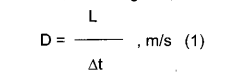
Where:
- Δt is the time read on the time measurement device, in seconds;
- L is the distance between the start optical signal receiver and the stop optical signal receiver, in meters.
7.3.6. Evaluation of Results
The test sample meets the requirements when the measured detonation speed meets the requirements specified in Article 5 of this Technical Standard.
7.4. Determining the Joint Endurance
7.4.1. Equipment and Tools
- Fuse hanging rod;
- Weight set with a mass of 2.0 kg;
- Stopwatch;
- Length measuring tool with markings every 1 mm.
7.4.2. Test Sample
Quantity: 05 fuses.
7.4.3. Conducting the Test
Securely attach the fuse to the hanging rod, hang the other end (detonation cord end) with a weight of 2.0 kg for 1 minute;
7.4.4. Evaluation of Results
- The requirement is that the detonation cord does not slip off the rubber plug or move visibly;
- In case at least one test sample does not meet the requirements, conduct a second round of testing with twice the number of test samples required for the first round. All test samples in this round must meet the requirements. If one sample does not meet the requirements during the second round of testing, conclude that the batch does not meet the requirements.
7.5. Determining Water Resistance
7.5.1. Equipment and Tools
- Special water immersion equipment capable of increasing internal water pressure above 0.2 MPa (2.0 bar);
- Special detonation strength testing equipment for fuses;
- Special time measurement device with a resolution of 10^-6 seconds;
7.5.2. Preparation of Test Samples
- Quantity: 10 fuses;
- Samples that have been checked for size and meet the requirements specified in Article 5 of this Technical Standard.
7.5.3. Conducting the Test
- Gently roll the detonation cord of the test sample into a coil, suitable for the size of the water tank, secure it with a string. Place the test samples sequentially into the tank until all are placed, cover the tank and tighten the lid. Use an air pump to inflate the sealed tank to a pressure of 0.2 MPa (2.0 bar), then start timing;
- When the time reaches 8 hours, remove the samples from the water tank and dry them.
7.5.3.3. Conducting the Measurement of Slow Burn Time.
7.5.4. Evaluation of Results
The test sample meets the requirements when all fuses explode and the slow burn time measurement meets the requirements specified in Article 5 of this Technical Standard.
In case at least one fuse does not meet the requirements, conduct a second round of testing with twice the number of test samples required for the first round. All test samples in this round must meet the requirements. If one fuse does not meet the requirements during the second round of testing, conclude that the batch's water resistance does not meet the requirements.
7.6. Determining Slow Burn Time
7.6.1. Principle
Determine the slow burn time based on the principle of measuring the delay time from when the fuse is ignited to when it explodes.
7.6.2. Equipment and Tools
- Special time measurement device with a resolution of 10^-6 seconds.
It is permissible to use time measurement devices that can measure the time from pressing the ignition button (Start) to the fuse exploding (Stop);
- Steel tank or pressure-resistant steel box.
7.6.3. Preparation of Test Samples
Number of test samples: 05 fuses for one batch.
7.6.4. Conducting the Test
- Place the fuse in a steel tank or pressure-resistant steel box, run the electric wire out, and close the safety door;
- Connect both ends of the fuse's wires to the Start and Stop terminals of the time measurement device;
- Press the ignition button. Read the slow burn time on the time measurement device;
- Test one fuse at a time, sequentially testing all fuses that need to be tested.
The result is the average value of the tests, rounded to 1 ms.
7.6.5. Evaluation of Results
The corresponding delay time for each number of differential units of the device meets the requirements specified in Table 2.
Table 2: Provisions on Delay Time and Tolerance of Delay Time
Delay Time (ms)
Delay Time (ms)
Nominal Value
Level
Nominal Value
Level
25
From 17 to 33
225
From 215 to 235
50
From 42 to 58
250
From 240 to 260
75
From 67 to 83
275
From 265 to 285
100
From 92 to 108
300
From 290 to 310
125
From 115 to 135
325
From 315 to 335
150
From 140 to 160
350
From 340 to 360
175
From 165 to 185
375
From 365 to 385
200
From 190 to 210
A batch of devices is considered to meet the requirements if all samples meet the requirements. In case at least one device does not meet the delay time requirement as stipulated, a second sample test must be conducted with twice the number of samples required in the first test. All samples must meet the delay time requirement. If during the second test, at least one device does not meet the delay time requirement as stipulated in Article 5 of this technical standard, then the conclusion is that the batch does not meet the requirements.
7.7. Determination of Shock Resistance Capability
7.7.1. Equipment and Tools
- Special shock testing machine with amplitude of 150 ± 2 mm, frequency of 60 ± 1 times per minute;
- Stop watch.
- A length measuring tool with markings every 1 mm.
7.7.2. Sample Preparation
Number of samples: 10 devices.
7.7.3. Conducting Test
- Arrange the devices in a specialized paper box in two rows, five per row, alternating heads. Place the box containing the devices in the wooden cabinet of the shock testing machine, secure with cardboard and paper. Close the lid tightly and lock the shock cabinet;
- Set the machine to ready mode. Turn on the power to start the shock machine operation while recording the start time of the shock;
- When the shock duration reaches 5 minutes, turn off the machine switch, check the external appearance and structure of the samples.
7.7.4. Evaluation of Results
Samples meet the requirements when they do not explode and their structures are not damaged.
In case at least one device does not meet the requirements, a second sample test must be conducted with twice the number of samples required in the first test. All devices must meet the requirements in this test. If during the second test, at least one device does not meet the requirements, then the conclusion is that the batch does not meet the requirements.
7.8. Safety Regulations During Testing
Must comply with safety regulations for the storage, use, and disposal of industrial explosives as stipulated in Technical Standard QCVN 01:2019/BCT during the testing and disposal of non-conforming samples.
7.9. Regulations on Measurement Instruments
Measurement instruments must be calibrated and verified according to the provisions of the law on measurement. Throughout the entire period of the verification cycle, the metrological characteristics of the measurement instruments must be maintained throughout the usage period.
III. MANAGEMENT REGULATIONS
8. Management Regulations
8.1. Differential non-electric MS devices must be declared compliant with the technical requirements set forth in Article 5 of this technical standard, affixed with the compliance mark (CR mark), and labeled before being circulated in the market.
8.2. Domestic produced differential non-electric MS devices must comply with the declaration of conformity regulations as stipulated in Circular No. 28/2012/TT-BKHCN dated December 12, 2012 issued by the Minister of Science and Technology regarding the declaration of conformity and compliance and methods of conformity assessment with standards and technical regulations (hereinafter referred to as Circular No. 28/2012/TT-BKHCN), Circular No. 02/2017/TT-BKHCN dated March 31, 2017 issued by the Minister of Science and Technology amending and supplementing some articles of Circular No. 28/2012/TT-BKHCN dated December 12, 2012 issued by the Minister of Science and Technology regarding the declaration of conformity and compliance and methods of conformity assessment with standards and technical regulations (hereinafter referred to as Circular No. 02/2017/TT-BKHCN), and Circular No. 06/2020/TT-BKHCN dated December 10, 2020 issued by the Minister of Science and Technology detailing and implementing certain provisions of Decree No. 132/2008/NĐ-CP dated December 31, 2008, Decree No. 74/2018/NĐ-CP dated May 15, 2018, Decree No. 154/2018/NĐ-CP dated November 9, 2018, and Decree No. 119/2017/NĐ-CP dated November 1, 2017 of the Government (hereinafter referred to as Circular No. 06/2020/TT-BKHCN).
8.3. Imported differential non-electric MS devices must undergo state quality inspection of imported goods according to the regulations stipulated in Circular No. 36/2019/TT-BCT dated November 29, 2019 issued by the Minister of Industry and Trade regarding the management of product and commodity quality under the responsibility of the Ministry of Industry and Trade (hereinafter referred to as Circular No. 36/2019/TT-BCT).
9. Declaration of Conformity
9.1. The declaration of conformity for domestically produced differential non-electric MS devices must be based on the certification results of certification organizations registered for activities according to the provisions of Decree No. 107/2016/NĐ-CP dated July 1, 2016 of the Government regulating the business of conformity assessment services (hereinafter referred to as Decree No. 107/2016/NĐ-CP); Decree No. 154/2018/NĐ-CP dated November 9, 2018 of the Government amending and supplementing, abolishing some provisions on investment and business conditions in the field of state management of the Ministry of Science and Technology and some provisions on specialized inspections (hereinafter referred to as Decree No. 154/2018/NĐ-CP) or recognized according to the provisions of Circular No. 27/2007/TT-BKHCN dated October 31, 2007 issued by the Minister of Science and Technology guiding the signing and implementation of Mutual Recognition Agreements and Mutual Acceptance Arrangements on Conformity Assessment Results (hereinafter referred to as Circular No. 27/2007/TT-BKHCN).
9.2. The declaration of conformity for imported differential non-electric MS devices must be based on the certification results of certification organizations designated by the Ministry of Industry and Trade according to the provisions of Circular No. 36/2019/TT-BCT or recognized according to the provisions of Circular No. 27/2007/TT-BKHCN.
9.3. Certification of Conformity
Certification of conformity for domestically produced and imported differential non-electric MS devices shall be carried out according to Method 5 "Typical sample testing and production process evaluation; monitoring through sampling and testing at the place of production or on the market or import consignment combined with production process evaluation" or Method 7 "Product and commodity testing and evaluation" at the production facility according to Clause 1 of Article 5 of Circular No. 28/2012/TT-BKHCN.
9.4. Testing for conformity assessment must be conducted by one of the following organizations:
9.4.1. Testing for domestically produced non-electric micrometer MS shall be carried out by an organization in accordance with Decree No. 107/2016/ND-CP, Decree No. 154/2018/ND-CP, or an organization designated by the Ministry of Industry and Trade pursuant to Circular No. 36/2019/TT-BCT, or an organization recognized in accordance with Circular No. 27/2007/TT-BKHCN.
9.4.2. Testing for imported non-electric micrometer MS shall be carried out by an organization designated by the Ministry of Industry and Trade pursuant to Circular No. 36/2019/TT-BCT, or an organization recognized in accordance with Circular No. 27/2007/TT-BKHCN.
9.5. Procedures, formalities, and documentation for conformity declaration
The procedures, formalities, and documentation for conformity declaration for domestically produced and imported non-electric micrometer MS shall be implemented in accordance with Circular No. 36/2019/TT-BCT.
10. Use of conformity mark
The conformity mark must comply with Clause 2, Article 4 of the regulations on standard conformity certification, conformity assessment, and standard declaration, conformity declaration issued together with Circular No. 28/2012/TT-BKHCN.
IV. RESPONSIBILITIES OF ORGANIZATIONS AND INDIVIDUALS
11. Responsibilities of organizations and individuals
11.1. Responsibilities of organizations producing, trading, and importing non-electric micrometer MS
11.1.1. Organizations producing and trading non-electric micrometer MS must ensure compliance with the requirements stipulated in Part II, implement the provisions of Part III of this Technical Regulation, and ensure quality in accordance with the Product Quality Law.
11.1.2. Organizations producing and importing non-electric micrometer MS must register their conformity declarations with the Department of Industry and Trade at the place of business registration in accordance with Circular No. 36/2019/TT-BCT.
11.2. Responsibilities of state management agencies
11.2.1. The Industrial Safety and Environmental Protection Agency shall take the lead in coordinating with the Science and Technology Department under the Ministry of Industry and Trade, and relevant units to guide and inspect the implementation of this Technical Regulation.
11.2.2. Departments of Industry and Trade of provinces and centrally-administered cities shall inspect and urge the implementation of conformity declaration procedures in accordance with this Technical Regulation.
V. IMPLEMENTATION
12. Effective date
12.1. This Technical Regulation shall take effect from July 1, 2023.
12.2. During the implementation of this Technical Regulation, if organizations and individuals encounter difficulties or obstacles, they should report to the Ministry of Industry and Trade for consideration and resolution.
12.3. In case the legal normative documents or standards cited in this Technical Regulation are amended, supplemented, or replaced, they shall be implemented in accordance with the current regulations./.
Download
The original file of this document is being updated. Please read the full text and check back later.
Relations map
Click a document to open. A red border = a relation that changes validity.
Translations
This document is available in the following languages: