
Circular No. 26/2014/TT-BTNMT stipulates the construction of databases and software applications in the information field. This document includes detailed inspection and acceptance procedures for both types of projects, from environmental preparation to final result reporting.
적용 범위
Units constructing databases and developing software applications in the information field
핵심 사항
- Detailed inspection and acceptance procedures for information technology infrastructure, commercial software, databases, and software applications.
- Standard forms for recording inspection and acceptance results such as minutes, quality reports, product quantities.
- Requirements for compiling and storing inspection and acceptance records as prescribed.
- Specific provisions regarding the preparation of testing environments for software applications and requirements for source code and business modeling documentation.
- Final result report including determination of product quantity and quality and project completion acceptance.
🌐 이 문서의 사회적 영향
- Ensuring the quality of constructed databases and software applications.
- Creating a clear inspection and acceptance process to save time and reduce errors.
- Providing standard forms for recording inspection and acceptance results.
❓ 자주 묻는 질문
What special provisions does Circular No. 26/2014/TT-BTNMT have regarding software application quality inspection?
The circular specifies the steps for preparing testing environments, requirements for source code and business modeling documentation. It also includes reporting on the results of software quality inspections.
How should inspection and acceptance records be compiled according to Circular No. 26/2014/TT-BTNMT?
Records must be compiled and bound into volumes according to sections such as legal basis, inspection, and acceptance. Each type of project has specific requirements for records and forms.
To whom does Circular No. 26/2014/TT-BTNMT apply?
This circular applies to units constructing databases and developing software applications in the information field.
전문
|
MINISTRY OF NATURAL RESOURCES AND ENVIRONMENT |
SOCIALIST REPUBLIC OF VIET NAM |
|
Number: 58/2015/TT-BTNMT |
Hanoi, December 8, 2015 |
CIRCULAR
REGULATIONS ON REVIEW, INSPECTION AND ACCEPTANCE OF PROJECTS APPLYING INFORMATION TECHNOLOGY FOR NATURAL RESOURCES AND ENVIRONMENT
Pursuant to the Law on Information Technology No. 67/2006/QH11 dated June 29, 2006;
Pursuant to Decree No. 21/2013/NĐ-CP dated March 4, 2013, promulgated by the Government, stipulating the functions, tasks, powers, and organizational structure of the Ministry of Natural Resources and Environment;
Pursuant to Decree No. 64/2007/NĐ-CP dated April 10, 2007 of the Government on the application of information technology in state agency activities;
Pursuant to Decree No. 102/2009/NĐ-CP dated November 6, 2009 of the Government on Management of Investment in Information Technology Applications Using State Budget Funds;
Pursuant to the Government Decree No. 102/2008/NĐ-CP, September 15, 2008, on the collection, management, exploitation, and utilization of data on natural resources and the environment;
Pursuant to Decision No. 179/2004/QĐ-TTg dated October 6, 2004 of the Prime Minister approving the Strategy for Application and Development of Information Technology for Natural Resources and Environment until 2015 and orientations until 2020;
At the proposal of the Director of the Department of Information Technology and the Head of the Legal Department;
The Minister of Natural Resources and Environment issues this Circular stipulating the review of content, inspection of quality and acceptance of quantity of products of programs, projects, tasks, works (hereinafter referred to as projects) having components applying information technology for natural resources and environment (partially or entirely) using state budget funds or mixed with various sources of funding where the state budget funds account for 30% or more or are the largest proportion in the total amount, including:
PART I
GENERAL PROVISIONS
Article 1. Scope of Regulation and Applicability
Thông tư này quy định chi tiết khoản 4 Điều 38 Luật Thủy sản số 18/2017/QH14 đã được sửa đổi, bổ sung tại điểm c khoản 21 Điều 14 Luật số 146/2025/QH15.
a) Information technology infrastructure and commercial software;
b) Applications software for natural resources and environment;
c) Databases for natural resources and environment, for this content, accuracy and completeness checks and acceptances shall not be conducted for:
- Databases formed from measurement, monitoring, and direct field data collection results (which have been inspected and accepted according to their respective construction procedures);
- Original data for constructing databases for natural resources and environment (which have been inspected and accepted when implementing such data construction).
This Circular applies to state management agencies, specialized agencies on natural resources and environment, and organizations and individuals related to the implementation of projects that fully or partially apply information technology for natural resources and environment.
Thông tư này áp dụng đối với tổ chức, cá nhân có liên quan đến hoạt động kinh doanh đối tượng thủy sản nuôi chủ lực trên lãnh thổ Việt Nam.
Article 2. Explanation of Terms
1. Projects and tasks applying information technology for natural resources and environment refer to a set of proposals related to establishing, expanding, or upgrading information technology infrastructure, databases, and software to achieve technical performance, operational speed, efficiency, and improved service quality to meet requirements for collecting, processing, storing, updating, and providing natural resources and environment information.
2. Information technology infrastructure refers to a set of computing devices (servers, workstations), network connection devices, security devices, peripheral devices, auxiliary devices, internal networks, wide area networks.
3. Projects on databases for natural resources and environment include: Standardization, organization, integration of information and data for access, exploitation, management, and updating without including investigation, assessment, acquisition, and measurement of information and data.
4. Applications software for natural resources and environment is a computer program described by a system of symbols, codes, or machine language to control information technology equipment to perform functions in state management and professional activities in the natural resources and environment sector.
5. Commercial software includes: System software, application software, utility software, tool software, embedded software; developed completely, registered under a brand name, and mass-produced for market supply.
5. Commercial software includes: System software, application software, utility software, tool software, embedded software; it is fully developed, registered with trademarks, and mass-produced for market supply.
Article 3. Classification and scale of projects
1. Information technology resource and environment application projects using development investment funds or investment-type public expenditure funds include: New investments in information technology infrastructure; construction of information systems and databases; application of information technology; development of information technology human resources... serving state management and professional tasks (hereinafter referred to as investment projects).
2. Tasks, items, activities applying information technology resources and environment using public expenditure funds (hereinafter referred to as public service projects) include:
a) Renovation, repair, and upgrading of previously invested information technology projects;
b) Maintenance, upkeep, and enhancement of the efficiency and performance of information technology systems (including expenditures for purchasing hardware, software, physical facility renovations, and related services);
c) Construction and deployment of information technology applications serving professional tasks of resource and environmental management... (specialized electronic information; construction and exploitation of specialized databases; construction of information systems serving administrative reform and provision of environmental resource public services...);
d) Training and development of information technology human resources for resource and environmental management.
3. Scale of projects: Information technology application projects are classified into groups as specified in Appendix I of Decree No. 102/2009/ND-CP dated November 6, 2009 of the Government on managing investment in information technology applications using state budget funds (hereinafter referred to as Decree No. 102/2009/ND-CP).
Chapter II
REVIEW OF INFORMATION TECHNOLOGY APPLICATION PROJECTS
Article 4. Purpose and principles of review
1. Objective
a) For state management agencies
- Determining the appropriateness of the project with respect to overall development programs and plans regarding objectives, scale, products, and benefits of the project;
- Ensuring consistency, synchronization, and enhanced effectiveness in the application of information technology resources and environment;
- Evaluating the rationality of the project through determining its effectiveness, feasibility, and limitations;
- Controlling project quality from the planning and investment decision-making stages.
b) For implementing units
Selecting economically and technically feasible and optimal implementation methods suitable to current conditions.
2. Principles of review
a) Consistent with the strategy and planning for development in various fields of natural resources and environment; programs and plans of the Ministry of Natural Resources and Environment and local authorities responsible for natural resources and environment management;
b) Compliance with the architecture, procedures, standards, and technical regulations of information technology and specialized fields within natural resources and environment sectors, ensuring system integrity and meeting socio-economic development requirements, ensuring national security and defense. For contents without established standards and technical regulations, technical solutions must be developed based on technical and operational requirements and working conditions, and must be clearly explained;
b) Adhere to the architecture, procedures, standards, technical regulations of information technology and specialized fields of natural resources and environment, ensuring system integrity and meeting requirements for socio-economic development, national security, and defense. For contents without technical standards and regulations, base on technical requirements, technology conditions, and working conditions to develop technical solutions and must provide clear explanations.
technical solutions and must provide clear explanations.
technical solutions and must provide clear explanations.
Items and contents of the project must have sufficient conditions to determine volume and cost estimates.
Cost estimates must comply with current economic and technical norms and unit prices;
Items and contents of the project must not overlap with other projects.
Article 5. Procedure and Content of Review
1. Procedure for reviewing investment projects
a) For investment projects (must prepare preliminary design - total investment estimate; construction design - total budget estimate)
- Investment preparation stage:
+ Review preliminary design;
+ Review total investment estimate;
+ General review of the project to serve approval of the project.
- Implementation stage:
+ Review construction design;
+ Review budget estimate, total budget estimate.
b) For public service projects (only need to prepare outline and detailed budget estimate)
- Review outline;
- Review budget estimate and general review to serve approval of the project.
2. Content of review for investment projects
a) Review of preliminary design
Is a specialized content on the application of information technology including:
- The suitability of the preliminary design with technical standards for information technology as stipulated in Circular No. 22/2013/TT-BTTTT dated December 23, 2013 issued by the Ministry of Information and Communications on the list of technical standards for the application of information technology in state agencies; basic requirements regarding functions, technical features, data connection and sharing with technical infrastructure systems of the unit, the Ministry, and the province;
- For information systems with scale and scope from central to local levels ensuring connectivity, interoperability, and data sharing with related technical infrastructure systems, software, and databases for projects with scale and scope from central to local levels as prescribed in Circular No. 25/2014/TT-BTTTT dated December 30, 2014 issued by the Ministry of Information and Communications on the implementation of information systems with scale and scope from central to local levels;
- Ensuring the requirements of the natural resources and environment sector as stipulated in relevant documents on technical standards and regulations;
- Applying technical and technological standards, ensuring fire prevention, safe operation, and security;
- The qualifications of the consulting organization, the professional capacity of the individual responsible for the preliminary design.
b) Review of total investment estimate
- The appropriateness of the method for determining the total investment estimate with the characteristics, technical nature, technology, and requirements of the project;
- The completeness, rationality, and appropriateness of cost items in the total investment estimate in relation to practical requirements;
- Calculations on the effectiveness of information technology application, risk factors, financial plans, and the ability to recover investment capital (if there is a requirement to recover investment capital);
- Determining the value of the total investment estimate to ensure the efficiency of the project.
c) General review of the project
- Considering factors to ensure the effectiveness of the project, including: The necessity of investment; input factors of the project; scale, technology, total investment, time, and progress of the project implementation; financial analysis, economic and social benefits of the project;
- Considering factors to ensure the feasibility of the project, including: Management experience of the unit entrusted with managing and using funds to implement the project (hereinafter referred to as the Project Owner); results of the preliminary design review; the ability to recover investment capital (if there is a requirement to recover investment capital); factors affecting the project such as national defense and security; opinions in writing from relevant agencies.
3. Content of review for public service projects
The content of the review is carried out according to Article 8 of Circular No. 21/2010/TT-BTTTT dated September 8, 2010 issued by the Ministry of Information and Communications on the preparation of outlines and detailed budget estimates for activities applying information technology using state budget funds but not requiring the preparation of a project (hereinafter referred to as Circular No. 21/2010/TT-BTTTT), including:
a) Review of outline:
- The appropriateness of economic and technical indicators, technical standards applied;
- The reasonableness of the proposed information technology expenditure content with the existing technical infrastructure system and the expected effectiveness achieved.
b) Review of budget estimate and general review of the project:
Based on the above review steps, the content of the review (to serve the decision to implement the project) includes:
- The accuracy of the norms and unit prices and their application, relevant systems and policies and cost items according to the State's regulations related to the costs mentioned in the detailed budget estimate;
- The consistency between the volume described in the outline and the detailed budget estimate already prepared.
Article 6. Competent authority for reviewing information technology application projects under the Ministry of Natural Resources and Environment
Environment
1. Reviewing organization
a) The investment decision-making agency (hereinafter referred to as the Investment Management Authority) shall be responsible for assigning the lead unit to organize the review of information technology application projects related to natural resources and environment before approval;
b) The lead unit shall organize and compile all review contents, opinions from relevant agencies; prepare a comprehensive review report on the project and bear responsibility for the content of the Report; prepare the dossier for submission to the Investment Management Authority for approval. To ensure technical expertise, the lead unit may seek the review opinion of the state management agency in the specialized field of natural resources and environment related to information technology application.
2. Competent authority for reviewing investment projects
a) Lead reviewing unit
- The Minister of Natural Resources and Environment assigns the state management unit to act as the lead reviewing unit according to the source of funds (development investment, economic public service, scientific public service...) or the unit with the function of managing information technology;
- The heads of units assigned as the Investment Management Authority assign the Lead Reviewing Unit according to their functions and tasks.
b) Preliminary design reviewing unit
The Department of Information Technology under the Ministry of Natural Resources and Environment.
3. Competent authority for reviewing public service projects
a) The Investment Management Authority organizes or assigns the lead unit to organize the review of the project;
b) The Department of Information Technology under the Ministry of Natural Resources and Environment reviews the outline as the basis for approving the project decided by the Minister of Natural Resources and Environment;
c) Specialized units in information technology of subordinate units under the Ministry of Natural Resources and Environment review the outline as the basis for approving the project delegated to subordinate units under the Ministry.
4. For information technology application projects in Group A, the lead unit is responsible for submitting the preliminary design for comments from the Department of Information Technology before submitting to the Ministry of Natural Resources and Environment for comments from the Ministry of Information and Communications.
Article 7. Review of information technology application projects related to natural resources and environment at local level
The competent authority for organizing the review of projects is the People's Committee at the level authorized, the lead reviewing unit is the specialized unit assisting according to the delegation or authorization. The content and procedure of the review follow the regulations of the locality.
To ensure professional factors, the Investment Management Authority or the Lead Reviewing Unit at the local level, if necessary, may submit the dossier for comments from the Department of Natural Resources and Environment or state management units in the specialized fields under the jurisdiction of the Ministry of Natural Resources and Environment including: the Department of Information Technology; state management units in related specialized fields.
Article 8. Dossier for reviewing projects
1. Components of the dossier
a) For investment projects
- Request for review according to Model 1.01 - Appendix 1 accompanying this Circular (hereinafter abbreviated as
Model 1.01 - Appendix 1);
- Certified copies of relevant documents related to the investment policy: agreement documents of the competent authority; budget allocation decisions of the competent authority...;
- Project survey result report, acceptance record of the project survey results;
- Preliminary design description - total investment amount;
- Acceptance record of the preliminary design dossier - total investment amount;
- Consulting firm's capability dossier;
- Diagrams and design drawings (if any);
- Power of attorney document of the unit entrusted as the project investor (if there is a power of attorney);
- Opinion contribution documents of related units (if any);
- Explanation and adoption of opinion contribution documents of the unit entrusted as the main organizer, project investor (if any) according to Model 1.07 - Appendix 1;
- Other related documents (if any);
- Digital dossier, including: Project survey result report; Preliminary design description - total investment amount; Diagrams and design drawings (if any);
In case of adjusted projects, additional documents need to be provided: Decision approving the adjustment of the investment policy (certified copy); Preliminary design description - total investment amount (according to the adjusted content), Supplementary survey result report (if needed).
b) For public service projects (only establish outline and detailed budget estimate)
- Request for review according to Model 1.04 - Appendix 1;
- Outline - detailed budget estimate;
- Decision appointing consulting unit to prepare outline - detailed budget estimate (if hiring consultants);
- Explanation and adoption of opinion contribution documents of the unit entrusted as the project investor (if any) according to Model 1.07 - Appendix 1;
- Digital dossier, including: Outline - detailed budget estimate.
1. Number of dossiers
02 (two) sets.
2. Method of submitting dossiers
- Explanation and adoption of opinion contribution documents of the unit entrusted as the main organizer, project investor (if any) according to Model 1.07 - Appendix 1;
Submit directly or through postal service.
Model 1.07 - Appendix 1;
In case of adjusted projects, additional documents need to be provided: Decision approving the adjustment of the investment policy (certified copy); Preliminary design description - total investment amount (according to the adjusted content), Supplementary survey result report (if needed).
- Digital dossier, including: Outline - detailed budget estimate.
1. Number of dossiers
02 (two) sets.
2. Method of submitting dossiers
Submit directly or via postal service.
Article 9. Procedures for project appraisal
1. Appraisal of preliminary design and project outline
a) The Project Owner or the Lead Appraisal Unit shall submit two sets of documents (as stipulated in Points a and b, Clause 1, Article 8) either directly or through postal service to the appraisal unit. In case the submitted documents are incomplete or invalid according to regulations, within five working days from the date of receiving the documents, the appraisal authority shall notify in writing to request the Project Owner to supplement and complete the documents.
b) Within five working days from the date of receiving all valid documents, the appraisal authority shall establish an Appraisal Board, technical team, or assign a subordinate unit with sufficient capacity to conduct the appraisal as prescribed.
c) Within thirty working days (for Group A projects), fifteen working days (for Group B projects), or ten working days (for Group C projects) from the date of receiving valid documents, the appraisal authority shall notify the results of the appraisal. If the requirements are not met, the appraisal authority shall notify and request the Project Owner to explain, modify, and supplement the project content. If the requirements are met, the appraisal unit shall prepare a Report on the Results of Preliminary Design Appraisal according to Form 1.02 - Appendix 1 or a Report on the Results of Project Outline Appraisal according to Form 1.05 - Appendix 1 to be sent to the Project Owner or the Lead Appraisal Unit.
2. General project appraisal
Based on the results of the appraisal under Clause 1 of this Article, the Project Owner or the Lead Unit shall organize a general project appraisal and prepare a Report on the Results of General Project Appraisal according to Form 1.03 - Appendix 1 or a Report on the Results of Project Appraisal according to Form 1.06 - Appendix 1 to submit for approval by the competent authority.
Article 10. Construction design and total budget estimate appraisal
1. The contents of construction design and total budget estimate appraisal are specified in Article 37 of Decree No. 102/2009/NĐ-CP. The construction design and total budget estimate must ensure that the construction design and project budget comply fully with the preliminary design and total investment ceiling, ensuring connectivity and system integrity across the industry.
2. The unit entrusted by the Project Owner has the responsibility to organize the appraisal of construction design and total budget estimate. The Project Owner may select an appraisal unit with sufficient capacity as the basis for approving the construction design and total budget estimate; assign a subordinate unit with sufficient capacity to appraise or hire consultants to review the construction design and total budget estimate as the basis for submitting for approval of the construction design and total budget estimate.
3. The results of the construction design and total budget estimate appraisal of the project shall be prepared according to Form 1.08 - Appendix 1.
4. The results of the construction design and total budget estimate review by the consultant shall be prepared according to Form 1.09 - Appendix 1.
Chapter III
INSPECTION AND COMMISSIONING OF INFORMATION TECHNOLOGY APPLICATION PROJECTS FOR NATURAL RESOURCES AND ENVIRONMENT
Section 1. GENERAL ISSUES
Article 1. Scope, Requirements for Inspection and Commissioning
1. Scope
The inspection and commissioning work of information technology application projects shall be carried out throughout the implementation phase of the project based on the achieved results.
2. Requirements
a) Ensuring compliance with standards, specifications, procedures, economic and technical regulations, and other relevant legal documents;
b) Ensuring the systematic and integrated nature of each component and content in the project according to the approved technical design; ensuring that the project achieves the set goals and effectiveness;
c) Identifying technical errors and mistakes at each stage of the construction process to ensure the overall quality of the entire project;
d) Controlling the construction progress, confirming the quality and quantity of each phase, component, or the entire project.
Article 12. Legal basis for inspection and acceptance
1. Standards, technical regulations, procedures, technical specifications, economic and technical norms, and other regulatory documents related to inspection and acceptance issued by competent state agencies that remain valid at the time of inspection and acceptance.
2. Decision approving the project; Decision approving the construction design - total budget estimate by the competent authority.
3. Technical solutions and measures for handling issues arising during construction by the competent authority.
Article 13. Principles and levels of inspection and acceptance
1. Quality and quantity inspections must be conducted regularly throughout the construction process according to the steps of the approved technological process to promptly identify and rectify errors, ensuring the progress and quality of the project.
2. Construction units must self-inspect and accept the quality and quantity of all components and contents of the project as a basis for the principal investor's inspection and acceptance.
3. The principal investor shall conduct progress inspections; inspect quality and accept quantities of each stage, component, and the entire project.
4. The project management investor shall review inspection and acceptance files to approve settlement documents for the project.
Article 14. Responsibilities for Inspection and Acceptance
1. Responsibilities of the Project Management Investor
a) Organize reviews or authorize competent agencies to conduct reviews on the quality and quantity of project products;
b) Organize reviews or authorize competent agencies to conduct reviews and audits of project completion acceptance documents;
c) Decide on resolving technical and technological issues not covered by existing regulations and changes within their authority;
d) Approve final settlement based on the results of quality inspections and quantity acceptance.
2. Responsibilities of the Principal Investor
a) Be responsible for the progress, quality, and quantity of project components and products. Based on conditions,
the principal investor may establish advisory boards, technical teams, or designate subordinate units, hire legal entities (hereinafter referred to as inspection units) to carry out inspections and acceptances and notify the construction unit in writing;
b) Decide on resolving changes and difficulties regarding construction conditions, technical designs, and construction volumes compared to approvals;
c) Suspend or change construction units partially or entirely when construction does not comply with content, volume, product quality, does not meet the approved construction schedule, or seriously violates standards, technical regulations, and specifications;
d) Submit to the project management investor for approval of final settlement for completed projects.
3. Responsibilities of Construction Units
a) Utilize specialized personnel or hire consultants (organizations or individuals) with sufficient capacity to conduct inspections and acceptances of all components and contents to ensure the progress, quality, and volume of the project;
b) In cases where there are changes in work volume, difficulty level, construction conditions, and technical issues arising from the technical design - budget estimate affecting construction progress, written consent from the principal investor must be obtained before implementation.
4. Responsibilities and Authorities of Inspection and Acceptance Units
a) Be subject to supervision and direction by the principal investor;
b) Closely cooperate with construction units to follow procedures and formalities; be responsible for inspecting construction progress, quality, and accepting quantities of components, products, and projects;
c) Compile and prepare principal investor-level acceptance documents;
d) Be entitled to payment for inspection and acceptance costs according to economic and technical norms for information technology industry natural resources and environment projects.
4. Responsibilities and authorities of the inspection and acceptance unit
a) Subject to supervision and management by the Project Owner;
b) Closely coordinate with the construction unit to implement according to the prescribed procedures and formalities; responsible for monitoring the progress, quality, and quantity acceptance of the project components, products, and projects;
c) Compile and prepare the project owner's acceptance dossier;
d) Be entitled to payment according to the economic-technical norms for inspection and acceptance of information technology projects in the natural resources and environment sector.
+ Relationships within the database;
+ Spatial data constraints (topology).
Article 15. Conditions for Capacity to Participate in Inspection and Acceptance Activities
1. For Information Technology Infrastructure Projects
Organizations shall comply with the provisions of Article 69 and individuals with those of Article 71 of Decree No. 102/2009/NĐ-CP.
2. For Application Software and Natural Resources and Environment Database Projects
The conditions include information technology capacity and natural resources and environment expertise:
a) Information technology capacity conditions: Organizations shall comply with the provisions of Article 69 of Decree No. 102/2009/NĐ-CP; individuals participating in inspection and acceptance activities shall comply with the provisions of Article 71 of Decree No. 102/2009/NĐ-CP;
b) Organizational capacity conditions in terms of natural resources and environment expertise: At least two individuals with a bachelor's degree or higher in a related field and at least three years of work experience.
Section 2. CONTENT OF INSPECTION AND ACCEPTANCE
Article 16. Technical Infrastructure and Commercial Software
The procedures and contents shall be carried out according to the regulations for network installation, equipment, technical infrastructure, and commercial software as stipulated in Circular No. 28/2010/TT-BTTTT dated December 13, 2010, issued by the Ministry of Information and Communications on the supervision of construction projects applying information technology using state budget funds (hereinafter referred to as Circular No. 28/2010/TT-BTTTT).
Article 17. Natural Resources and Environment Databases
1. Database Construction Process
The general process for constructing natural resources and environment databases is specified in Chapter I, Part II of Circular No. 26/2014/TT-BTNMT dated May 28, 2014, issued by the Ministry of Natural Resources and Environment on Procedures and Economic-Tech Standards for Constructing Natural Resources and Environment Databases (hereinafter referred to as Circular No. 26/2014/TT-BTNMT). In addition to the general provisions above, the construction of databases must comply with specialized database regulatory documents concerning procedures, standards, norms, data models; data content, quality, and related matters.
2. Flowchart of Inspection and Acceptance Steps
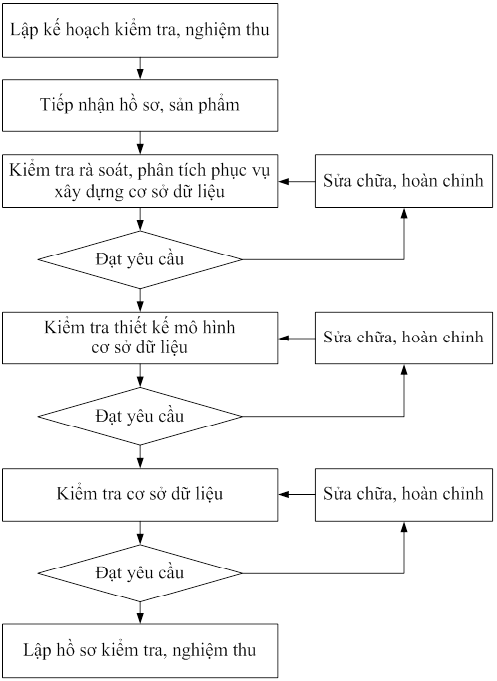
Depending on the specific technical design of each project, all or some steps may be implemented or skipped.
3. Details of Inspection and Acceptance Steps
If the database construction complies strictly with the technical regulations on databases issued by the competent authority, only the implementation details not yet specified will be inspected. The detailed steps are as follows:
a) Develop Inspection and Acceptance Plan
a.1. Requirement: Develop a detailed inspection plan for each item of work.
a.2. Implementation Steps:
- Review the technological process and construction plan of the contractor (approved by the Project Owner);
- Develop an inspection and acceptance plan (consistent with each step of the work and construction schedule), submit it to the Project Owner for approval, and notify the contractor to coordinate the implementation.
a.3. Result: Inspection and acceptance plan table according to Model 3.02 - Appendix 3.
b) Receive Documents and Products
b.1. Requirement: Receive and inspect the documents and quantity of products from the contractor.
b.2. Implementation Steps:
- Receive documents and products;
- Inspect the quantity of products according to the approved technical design;
- Prepare a handover record;
- Inspect the contractor’s inspection and acceptance documents.
b.3. Results:
- Receive documents from the contractor (submitted by the contractor);
- Handover record of documents and products according to Model 3.03 - Appendix 3;
- Inspection opinion sheet on the contractor’s inspection and acceptance documents according to Model 2.01 - Appendix 2.
c) Review, Analyze Data for Database Construction
c.1. Requirement: Inspect the results of reviewing, classifying, and evaluating information and data for database construction in accordance with the requirements of the task and project.
c.2. Implementation Steps:
Inspect the contents and products of the "Review, Analyze Content Information Data" step at Point 2.1, Clause 2, Chapter I, Part II of Circular No. 26/2014/TT-BTNMT, including:
- Review, classification, and evaluation report of information and data (prepared according to Model M1.1 of Circular No. 26/2014/TT-BTNMT) and sample data set.
- List of managed objects and detailed information (prepared according to Model M1.2 of Circular No. 26/2014/TT-BTNMT).
- Detailed list of scanned documents and papers to be entered into the database (prepared according to Model M1.3 of Circular No. 26/2014/TT-BTNMT).
- Report on defining the data catalog framework and metadata (prepared according to Model M1.4 of Circular No. 26/2014/TT-BTNMT).
- Report on converting managed objects (prepared according to Model M1.5 of Circular No. 26/2014/TT-BTNMT).
c.3. Result: Inspection opinion sheet on the review and analysis of information and data results according to Model 2.02 - Appendix 2.
d) Inspect Data Model Design
d.1. Requirement:
- Ensure that the data catalog model, metadata model, and data model design are consistent with the results of reviewing, classifying, and evaluating information and data;
- Inspect the database design model (including metadata).
d.2. Implementation Steps:
d.1. Requirement:
Inspect the contents and products of the "Design Database Model" step at Point 2.2, Clause 2, Chapter I, Part II of Circular No. 26/2014/TT-BTNMT, including:
- Inspect the data catalog model, metadata model, and explanatory report on the data catalog model and metadata (prepared according to Model M2.1 of Circular No. 26/2014/TT-BTNMT).
2.
- Inspect the data model (XML format) and explanatory report on the database model (prepared according to Model M2.2 of Circular No. 26/2014/TT-BTNMT). Specific inspection contents include:
+ Database model;
+ List of data tables;
+ Volume of data fields;
+ Data type of fields;
+ Relationships within the database;
+ Spatial data topology constraints.
d.3. Result:
Inspection opinion sheet on the database model design according to Model 2.03 - Appendix 2.
đ) Inspect the Database:
đ.1. Requirement: Inspect each item of work throughout the process of creating and building the database.
đ.2. Implementation Steps:
Inspect the contents and products of the steps at Points 2.3, 2.4, 2.5, 2.6, 2.7, Clause 2, Chapter I, Part II of Circular No. 26/2014/TT-BTNMT, including:
- Inspect the content of the data catalog and metadata;
- Inspect the spatial database content:
d.3. Results:
The Design Database Model Inspection Opinion Form according to Model 2.03 - Appendix 2.
d) Database inspection:
d.1. Requirement: Inspect each work item throughout the process of establishing and building the database.
d.2. Implementation steps:
Inspect the contents and products of the stages specified at Points 2.3, 2.4, 2.5, 2.6, 2.7 Clause 2, Chapter I, Part II Circular No. 26/2014/TT-BTNMT, including:
- Inspect the content of the data and metadata catalog;
- Inspect the content of the spatial database:
- Spatial specialty database;
- Spatial object database;
in case of completing 100% of the implementation volume.
+ Check based on referencing standards and regulations regarding the quality of geographic base data, specialized spatial data;
construction;
+ Check mathematical foundations;
+ Check the number of spatial data layers in the database;
+ Check the number of structured data fields;
+ Check the completeness of content, positional accuracy, and editorial presentation factors of spatial objects;
- Other related documents.
+ Check the spatial relationships of data;
+ Check the content and quantity of data associated with spatial objects;
- Check the content of attribute databases:
+ Check the volume of tables and data fields;
+ Check the content of the database (records);
+ Check the quantity and content of unstructured data;
+ Check the relationships and links of attribute databases;
- Check the content of scanned image data:
+ Count the volume of scanned images;
+ Check the quality of scanned images;
+ Check the format and organization of the database;
- For the entire database:
+ Check the organization, relationships, and related factors within the database;
+ Check the completeness and accuracy of integrated information in the database;
+ Check the security and safety level of the database;
d.3. Results:
The database inspection opinion form according to Form 2.04 - Appendix 2;
e) Prepare inspection and acceptance documentation
e.1. Requirements:
- Ensure quality and volume after receiving inspection opinions;
- Summarize all inspection opinions from each stage of database construction;
- Prepare inspection and acceptance documentation for each stage or the entire project of database construction when 100% of the workload is completed;
The completed project acceptance dossier shall be prepared in four (04) sets, with one (01) set retained by the Project Manager, two (02) sets by the Project Owner, and one (01) set kept with the product.
e.2. Implementation steps:
- Inspect and accept the work of repairing and completing errors during the construction process by the contractor;
construction;
- Summarize inspection opinions;
- Prepare the completion acceptance record;
e.3. Results:
- Inspection and acceptance minutes according to Form 3.10 - Appendix 3, accompanied by Inspection Opinion Forms;
- Confirmation repair minutes between the inspection unit and the construction unit according to Form 3.11 - Appendix 3;
- Quantity and quality determination minutes according to Form 3.12 - Appendix 3;
- Quality and quantity acceptance minutes according to Form 3.13 - Appendix 3;
- Quality and quantity inspection report according to Form 3.14 - Appendix 3;
- Project completion acceptance minutes according to Form 3.16 - Appendix 3;
- Related documents;
- Other related documents.
1. Software development process
The process of developing and implementing application software for natural resources and environment is regulated in Chapter II, Part II, Circular No. 26/2014/TT-BTNMT;
2. Diagram of inspection and acceptance steps for application software
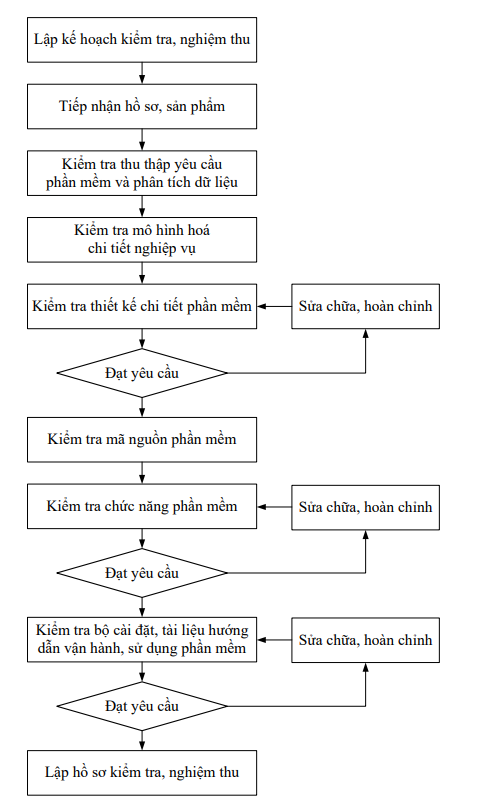
3. Details of inspection and acceptance steps for application software for natural resources and environment
a) Develop inspection and acceptance plan
Implement similarly to the "Develop inspection and acceptance plan" step at Point a, Clause 3, Article 17 of this Circular;
In cases where the project includes both categories of constructing natural resource and environmental databases and building application software to support management and exploitation of these databases, this step shall only be implemented once for both categories;
b.2. Implementation Steps:
Implement similarly to the "Receive documentation and products" step at Point b, Clause 3, Article 17 of this Circular;
In cases where the project includes both categories of constructing natural resource and environmental databases and building application software to support management and exploitation of these databases, this step shall only be implemented once for both categories;
c.2. Implementation Steps:
c.1. Requirements: Ensure that products from the "Gather software requirements and analyze data" step meet quality requirements according to the approved technical design of the project;
c.2. Implementation steps
Check contents and products of the "Gather software requirements and analyze data content" step at Point 2.1, Clause 2, Chapter II, Part II of Circular No. 26/2014/TT-BTNMT including:
- Check software requirement gathering:
+ Check functional requirements;
+ Check non-functional requirements;
+ Check the compatibility between non-functional requirements and functional requirements;
+ Check software agents;
+ Check usage scenarios;
+ Check usage scenario catalog;
+ Check usage scenario conversion method;
- Check results of data content analysis:
Implement similarly to the "Review and analyze for database construction" step at Point c, Clause 3, Article 17 of this Circular;
In cases where the project includes both categories of constructing natural resource and environmental databases and building application software to support management and exploitation of these databases, this step shall only be implemented once for both categories;
c.3. Results
- Software requirement gathering inspection opinion form according to Form 2.05 - Appendix 2;
- Data content review and analysis inspection opinion form according to Form 2.02 - Appendix 2 (if applicable);
d) Check detailed business modeling
d.1. Requirements: Ensure that products from the detailed business modeling step meet quality requirements according to the Technical Design and Software Requirement Report (if applicable);
+ Relationships within the database;
Check contents and products of the "Detailed Business Modeling" step at Point 2.2, Clause 2, Chapter II, Part II of Circular No. 26/2014/TT-BTNMT including:
- Check detailed business process modeling documentation:
+ List and description of business processes;
+ Detailed business model;
- Check business usage scenario diagram documentation:
+ List of system agents;
+ List of business usage scenarios and descriptive information;
+ Business usage scenario diagram;
+ Detailed business usage scenarios;
d) Database inspection:
- Detailed business modeling inspection opinion form according to Form 2.06 - Appendix 2;
đ) Check detailed software design
đ.1. Requirements: Ensure that software design products comply with approved objectives and technical requirements;
- Inspect the content of the data and metadata catalog;
Check contents and products of the "Design" step at Point 2.3, Clause 2, Chapter II, Part II of Circular No. 26/2014/TT-BTNMT including:
- Check software architecture description:
+ Software architecture (compared to the overall system architecture already approved);
+ Application architecture (layered model of the software; functions of each layer and methods of data exchange between layers);
+ Data architecture;
+ Information technology infrastructure architecture (technical infrastructure, security, and safety requirements for operating the software);
- Check usage scenario diagram description;
+ Number of agents in the documentation (number of agents compared to the technical design and previous documents);
+ Count the quantity, check the information of use-cases in the document against the technical design;
+ Review the use-case diagram according to the Unified Modeling Language (UML) design standard;
- Check the explanation of activity diagrams and sequence diagrams:
+ Number of use-cases;
+ Activity diagram;
+ Sequence diagram.
- Check the explanation of class diagrams:
+ Class diagram according to the UML design standard;
+ Details of classes (redundant classes; attributes and methods of classes).
- Check the data model design: Carry out the "Check the data model design" step under the "Check the database model design" step at Point d, Clause 3, Article 17 of this Circular. In cases where the project includes both building a resource and environment database and developing application software to support management and exploitation of the database, this step shall only be carried out once for both categories.
- Software interface design:
+ Interface suitable for functions and business operations;
+ Completeness and reasonable presentation of interface components...
d.3. Results
The Software Design Description Review Form according to Model 2.07 - Appendix 2.
e) Source code review
e.1. Requirement: Ensure that the source code is built in accordance with the design and approved programming standards and technical specifications of the project.
e.2. Implementation steps:
Review the contents and products of the "Programming" step at Point 2.4, Clause 2, Chapter II, Part II of Circular No. 26/2014/TT-BTNMT including:
- Source code review:
+ Using development technology (.Net, Java...) as approved;
+ Programming in accordance with the approved software architecture;
+ Presenting source code in compliance with programming rules stipulated in technical standards and approved technical solutions;
+ Number of classes (in object-oriented programming based on design documentation).
- Detailed review of classes (object-oriented programming) in the source code:
+ Declaration and definition of classes (name, data components, attributes, functions...);
+ Programming member functions, methods of classes;
+ Relationships between classes.
e.3. Results:
The Source Code Review Opinion Form according to Model 2.08 - Appendix 2.
g) Functionality testing of software
g.1. Requirement: Ensure that the software meets the quality requirements of the technical design.
g.2. Implementation steps:
Review the contents and products of the "Testing" step at Point 2.5, Clause 2, Chapter II, Part II of Circular No. 26/2014/TT-BTNMT including:
- Preparation and installation of the testing and acceptance environment;
- Review the report on programming rules;
- Review the system component testing report;
- Review the overall system testing report;
- Review software functionality.
g.3. Results:
- Report on preparation of the testing and acceptance environment for software according to Model 2.09 - Appendix 2;
- Quality Product Review Opinion Form for software according to Model 2.10 - Appendix 2;
h) Installation package, operation and usage guide review
h.1. Requirement: Ensure completeness, meet requirements, and suitability for user proficiency and actual deployment conditions of the application software.
h.2. Implementation steps:
Review the contents and products of the "Deployment" step at Point 2.6, Clause 2, Chapter II, Part II of Circular No. 26/2014/TT-BTNMT including:
- Application installation package: Operate on actual deployment environments and conditions as approved.
- Installation and usage guide: Completeness, level of detail, and suitability for actual user proficiency.
h.3. Results:
The Application Deployment Review Opinion Form according to Model 2.11 - Appendix 2.
i) Prepare inspection and acceptance documents:
Follow the "Prepare Inspection and Acceptance Documents" step at Point e, Clause 3, Article 17 of this Circular.
In cases where the project includes both categories of constructing natural resource and environmental databases and building application software to support management and exploitation of these databases, this step shall only be implemented once for both categories;
Section 3. PROCEDURES, FORMALITIES, FILES FOR QUALITY CONTROL AND COMMISSIONING
Article 19. Plan and Time Limit for Quality Control and Commissioning
1. Establishment and Adjustment of Plans
a) The construction unit shall establish a construction plan including the content of quality control and quantity commissioning of project components and products (hereinafter referred to as the construction plan) according to technological procedures and construction plans, report to the Project Owner for approval before commencement of work and organize implementation strictly in accordance with such plan.
b) The Project Owner shall instruct the inspection unit to complete the quality control and commissioning plan consistent with the construction plan of the construction unit that has been approved within no more than 15 working days.
c) The inspection unit shall notify the construction unit and organize strict implementation of the quality control and commissioning plan that has been approved by the Project Owner.
d) In cases where adjustments to the quality control and commissioning plan are necessary due to force majeure reasons, the construction unit and the inspection unit may only implement the adjusted plan upon approval by the Project Owner.
2. Time Limits for Completion of Quality Control and Commissioning Files According to Fiscal Year and End of Project
a) The construction unit shall complete the quality control and commissioning files of project components, products, or the entire project and submit them to the Project Owner or the inspection unit (authorized by the Project Owner) before December 1st each year;
b) The inspection unit shall complete the establishment of quality control and commissioning files for project components, products, and compile the final commissioning files for the Project Owner to submit to the Project Owner before December 15th of the planning year.
c) Time limits for completion of quality control and commissioning files according to project components and stages: As required by the Project Owner.
Article 20. Levels of Quality Control and Commissioning
The level of quality control and commissioning by the construction unit is 100% of the product combined during the construction process.
The level of quality control and commissioning by the Project Owner for checking the quality and quantity of project components and products using information technology is detailed in Table 3.01 - Appendix 3.
Article 21. Contents of Commissioning
Based on the results of inspections during the construction of project components and products, the following contents shall be commissioned:
1. Construction Unit
a) Determine the total volume completed and meeting technical quality requirements of the assigned work;
b) Evaluate, report, and explain changes in the difficulty level, construction conditions, volume, and technical design of project components and products in reality (if any).
c) Assess the degree of completion compared to the assigned work.
2. Project Owner
a) Determine the total volume completed and meeting quality standards compared to the approved figures;
b) Evaluate and take measures to address changes in the difficulty level, construction conditions, technical design - general estimate, volume, and progress of project components and products compared to the approved figures (if any). If there are changes, the quality control and commissioning of project components, products, and projects shall be carried out as follows:
- If there is a written agreement from the competent authority allowing such changes, then normal quality control and commissioning shall be conducted according to the adjusted content.
- If there is no written permission from the competent authority for such changes, then it must be resolved within the scope of authority or reported to the investment decision-making agency (investment management agency) for resolution.
3. Investment Management Agency
Based on the results of commissioning, proceed with the final settlement commissioning of the project.
Article 22. Procedures and processes for inspection and acceptance
1. Inspection and acceptance at the construction unit level shall be continuously carried out throughout the construction process with respect to all works, items, and products of the project.
2. Inspection and acceptance at the project owner level shall be conducted in accordance with the construction procedures and the completion progress of the items and products of the project by the construction unit.
3. The investment management authority may organize reviews and audits of the acceptance documentation for projects and products, including verification of completeness, rationality, and accuracy, depending on specific circumstances.
4. The specific procedures for inspection and acceptance steps are stipulated in Section 2 of Chapter III of this Circular.
Article 23. Components of the inspection and acceptance documentation
1. Documentation for inspection and acceptance at the construction unit level
2. Documentation for inspection and acceptance at the project owner level
The project owner may organize and direct the inspection and acceptance units to prepare inspection and acceptance documentation according to the fiscal year and upon completion of the project. In cases where it is necessary to conduct acceptance of completed stages of one or more parts of an item or product (for interim payment purposes), corresponding documentation for inspection and acceptance should be prepared for the completed work volume. The documentation for inspection and acceptance of the project owner includes:
a) Documentation for inspection and acceptance by the inspection unit;
b) Documentation for acceptance by the project owner.
3. Final settlement documentation for the project by the investment management authority
Based on the acceptance documentation of the project owner, the investment management authority shall organize the preparation of final settlement documentation for the project.
Article 24. Documentation for inspection and acceptance at the construction unit level
The construction unit shall proactively carry out inspection and acceptance of the entire volume of work at the construction level. The documentation for inspection and acceptance of the construction unit for each item or product according to the schedule or the entire project shall be compiled into four (04) sets, two (02) of which shall be sent to the project owner, one (01) set to the inspection unit, and one (01) set retained by the construction unit, including:
1. Legal document section:
- Decision approving the technical design and general estimate; Decision approving the detailed outline and budget (including any adjustments and supplements - if applicable) and related legal documents;
- Contract signed with the project owner or document assigning construction tasks;
- Request for project owner's acceptance of the project, item, or product according to Model 3.04 - Appendix 3;
- Report on changes during the construction process (regarding difficulties, construction conditions, technical design changes, budget, quantity, schedule, and other issues compared to the approval) according to Model 3.05 - Appendix 3 (if applicable);
- Approval documents for changes, occurrences, and resolution of issues by the competent authority (if applicable);
2. Inspection and acceptance section:
a) For information technology infrastructure and commercial software:
As prescribed in Circular No. 28/2010/TT-BTTTT.
b) For database construction:
- Reports as specified in Point 2.6, Clause 2, Chapter I, Part II of Circular No. 26/2014/TT-BTNMT; Product testing result report;
- Quality inspection record of the construction unit according to Model 3.08 - Appendix 3 (if applicable);
- Record confirming repairs according to Model 3.09 - Appendix 3 (if applicable);
c) For application software construction:
- Reports as specified in Point 2.5, Clause 2, Chapter I, Part II of Circular No. 26/2014/TT-BTNMT:
+ Programming rule compliance check report.
+ System component compliance check report.
+ Comprehensive system compliance check report.
- Quality inspection record of the construction unit according to Model 3.08 - Appendix 3 (if applicable);
- Record confirming repairs according to Model 3.09 - Appendix 3 (if applicable);
3. General report section:
- Technical summary report according to Model 3.06 - Appendix 3;
- Quality and quantity inspection and acceptance report according to Model 3.07 - Appendix 3;
d) Other related documents (if applicable).
4. Appendices on statistics and products (if applicable).
Article 25. Inspection and Acceptance Documents
1. Inspection and Acceptance Documents of the Inspection Unit
The inspection unit shall conduct inspections and prepare inspection and acceptance reports in accordance with Articles 16, 17, and 18 of this Circular. In cases where the inspection unit identifies numerous errors (over 25% of the inspected volume), it may return all inspection and acceptance documents and products to the construction unit for completion before continuing with the inspection and acceptance process. The results of the inspection and acceptance by the inspection unit shall be compiled into a set of inspection and acceptance documents and prepared in four (04) copies, of which three (03) copies shall be sent to the Project Owner, one (01) copy retained at the inspection unit, including:
a) Legal Basis Section:
- Decision approving the Technical Design - Preliminary Estimate; Decision approving the Detailed Estimate (including any adjustments and supplements) and related legal documents;
- Contract signed with the Project Owner or document assigning inspection and acceptance tasks (if applicable);
- Inspection and Acceptance Plan according to Model 3.02 - Appendix 3;
- Product Handover Minutes (for inspection - acceptance) according to Model 3.03 - Appendix 3;
b) Inspection Section:
- For Information Technology Infrastructure and Commercial Software:
As stipulated in Circular No. 28/2010/TT-BTTTT, including:
+ Construction Supervision Log;
+ Material and Equipment Acceptance Minutes for Information Technology;
+ Trial Operation Equipment Acceptance Minutes for Information Technology;
+ Installation Equipment Acceptance Minutes for Information Technology;
+ Site Minutes (if applicable).
- For Database Construction:
- Inspection Opinion Form on Construction Inspection and Acceptance Documents according to Model 2.01 - Appendix 2;
- Inspection Opinion Form on Review and Classification of Information Data Results according to Model 2.02 - Appendix 2;
- Inspection Opinion Form on Database Design Model according to Model 2.03 - Appendix 2;
- Inspection Opinion Form on Database according to Model 2.04 - Appendix 2;
- Inspection and Acceptance Minutes according to Model 3.10 - Appendix 3.
- Repair Confirmation Minutes (if applicable) according to Model 3.11 - Appendix 3.
- For Application Software Construction:
- Inspection Opinion Form on Construction Inspection and Acceptance Documents according to Model 2.01 - Appendix 2;
- Inspection Opinion Form on Requirements Collection Report according to Model 2.05 - Appendix 2;
- Inspection Opinion Form on Detailed Business Process Modeling Documentation according to Model 2.06 - Appendix 2;
- Inspection Opinion Form on Application Software Design according to Model 2.07 - Appendix 2;
- Inspection Opinion Form on Source Code according to Model 2.08 - Appendix 2;
- Report on Preparation Work for Testing and Acceptance Environment for Software according to Model 2.09 - Appendix 2;
- Inspection Opinion Form on Software Quality according to Model 2.10 - Appendix 2;
- Deployment Software Inspection Form according to Model 2.11 - Appendix 2;
- Inspection and Acceptance Minutes according to Model 3.10 - Appendix 3.
- Repair Confirmation Minutes (if applicable) according to Model 3.11 - Appendix 3.
- c) Acceptance Section:
- For Information Technology Infrastructure and Commercial Software:
- As stipulated in Circular No. 28/2010/TT-BTTTT, including:
+ Construction Supervision Result Report;
+ Product Handover Acceptance Minutes for Information Technology Application Projects;
+ Overall Acceptance Minutes for All Products of the Project;
- For Database and Application Software Construction:
+ Quantity and Quality Product Determination Minutes according to Model 3.12 - Appendix 3.
+ Quality and Quantity Acceptance Minutes according to Model 3.13 - Appendix 3.
+ Quality and Quantity Inspection and Acceptance Report according to Model - Appendix 3;
- Final Project Acceptance Minutes (Project Completion) according to Model 3.16 - Appendix 3.
- Other Related Documents (if applicable).
- Relevant Appendices (if applicable).
- 2. Project Owner's Acceptance Documents
- Acceptance documents for projects, products by fiscal year, entire project, or stages based on the inspection and acceptance results of each component, product, and project by the inspection unit.
- The inspection unit shall compile and bind the Project Owner's Acceptance Documents by fiscal year and the entire project into six (06) sets, of which one (01) set shall be retained by the Project Management Owner, two (02) sets by the Project Owner, one (01) set by the Construction Unit, one (01) set by the Inspection Unit, and one (01) set submitted together with the product, including:
- a) Legal Documents:
- Project Approval Decision; Technical Design - Preliminary Estimate Approval Decision (including any adjustments and supplements if applicable).
- Construction Contract or document assigning tasks to the construction unit.
- Inspection Contract or document assigning tasks to the inspection unit.
- b) Construction Unit's Inspection and Acceptance Documents Section:
- Product/Delivery Handover Minutes according to Model 3.15 - Appendix 3.
- Technical summary report according to Model 3.06 - Appendix 3;
- Quality and quantity inspection and acceptance report according to Model 3.07 - Appendix 3;
- c) Inspection Unit's Inspection and Acceptance Documents Section:
- Quality and Quantity Acceptance Minutes according to Model 3.13 - Appendix 3.
- Quality and Quantity Inspection and Acceptance Report according to Model 3.14 - Appendix 3;
- d) Project Owner's Acceptance Documents Section:
- Final Project Acceptance Minutes (Project Completion) according to Model 3.16 - Appendix 3;
- Construction Supervision and Quality Management Report according to Model 3.17 - Appendix 3;
- Product Handover Minutes for the Project (for final project documents) as stipulated in Article 26 of this Circular;
- 3. Completed Project Acceptance Documents
- The Project Owner is responsible for preparing the Completed Project Acceptance Documents for settlement in accordance with regulations, including:
- Project Settlement Request Letter according to Model 3.19 - Appendix 3;
- Completed Volume Confirmation Certificate according to Model 3.18 - Appendix 3; Product Handover Minutes for the Project as stipulated in Article 26 of this Circular;
- Construction Supervision and Quality Management Report according to Model 3.17 - Appendix 3;
- Inspection and Acceptance Document Audit Minutes by the Project Management Owner (if applicable);
Completed Project Acceptance Documents shall be prepared in four (04) sets, with one (01) set retained by the Project Management Owner, two (02) sets by the Project Owner, and one (01) set retained with the product.
The project completion acceptance dossier shall be established in four (04) sets, with one (01) set retained by the Project Controlling Investor, two (02) sets retained by the Project Investor, and one (01) set retained together with the product.
Article 26. Submission of Products
1. The submitted products include all products of the project's items (as approved) that have been inspected and accepted (with confirmation from the inspection unit), accompanied by the overall project acceptance file at the location specified in the project.
2. For natural resource and environmental databases, the database (in digital form) and analysis and design documents for the database (both paper and digital) must be submitted with confirmation from the inspection and acceptance unit (to ensure quality and quantity) to relevant functional units to serve common tasks, specifically as follows:
a) National natural resource and environmental databases shall be submitted to the Information Technology Department of the Ministry of Natural Resources and Environment to ensure service for the Ministry's general management and operation.
b) Component databases on natural resources and environment shall be submitted to specialized units responsible for information technology and storage within their respective fields to ensure service for professional management and business operations.
c) Local natural resource and environmental databases shall be submitted to specialized units responsible for information technology and storage of the Provincial Departments of Natural Resources and Environment to serve local tasks.
The submission of databases shall be recorded in a handover record according to Model 3.15 - Appendix 3. The handover record of data is one of the bases for determining the completion of the project.
Chapter IV
IMPLEMENTING PROVISIONS
Article 27. Effective Date
This Circular takes effect from January 23, 2015.
Any previous guidance on the assessment, inspection, and acceptance of natural resource and environmental information technology applications that contradicts this Circular are hereby abolished.
Article 28. Responsibilities for Implementation
1. The Minister, Heads of Ministries equivalent to Ministries, agencies under the Government, Chairmen of People's Committees of provinces and centrally governed cities, Director of the Information Technology Department under the Ministry of Natural Resources and Environment, Heads of units under the Ministry of Natural Resources and Environment, Directors of Provincial Departments of Natural Resources and Environment of provinces and centrally governed cities, and related organizations and individuals are responsible for implementing this Circular.
2. The Information Technology Department under the Ministry of Natural Resources and Environment is responsible for guiding and supervising the implementation of this Circular.
3. During the implementation process, if there are difficulties or obstacles, the relevant agencies, organizations, and individuals are requested to report to the Ministry of Natural Resources and Environment for review and adjustment to make it suitable.
|
Place of Receipt: |
DEPUTY MINISTER Nguyen Linh Ngoc |
관계도
문서를 클릭하면 열립니다. 빨간 테두리=효력을 변경하는 관계.