
This Circular guides the implementation of Government Decree No. 38/2006/NĐ-CP on the Protection of Citizens, specifying tasks, authorities, organizational activities, and welfare policies for the Protection of Citizens force. Readers need to be aware of authorities such as apprehending offenders, seizing weapons, requesting cessation of violations, participating in the pursuit of criminals; as well as obligations regarding information dissemination, propaganda, coordination with competent agencies, and organizing mass movements for security and public order.
Đối tượng áp dụng
Vietnamese residents and foreigners residing in Vietnam, Citizen Protection Teams (including Team Leaders, Deputy Team Leaders, members), and Citizen Protection Committees at each ward or town.
Các điểm cốt lõi
- The Team Leader, Deputy Team Leader, Team Head, Deputy Team Head, and Team Members of the Citizen Protection Team shall receive monthly allowances from the Ward People's Committee, with allowance levels determined by local authorities.
- The Citizen Protection Team has the authority to arrest offenders caught in the act, seize weapons, and escort the suspect to the Police Station according to the law.
- Citizen Protection Teams must participate in information dissemination, propaganda, coordination with competent agencies to maintain public order, prevent fires, and participate in mass movements for security and public order.
- The Citizen Protection Team may use simple weapons and support tools as prescribed by law.
- Organizations and individuals who have outstanding achievements in building, guiding, and directing the work of the Citizen Protection Team will be rewarded.
🌐 Tác động xã hội từ văn bản này
- Establishing a grassroots security and public order force to reduce crime and social evils.
- Promoting the role of the community in maintaining security and public order, enhancing citizens' legal awareness.
- Reducing the workload of regular police forces through support from the Citizen Protection Team.
❓ Câu hỏi thường gặp
What monthly allowances does the Citizen Protection Team receive?
The level of allowance is decided and approved by the Provincial or Municipal People's Committee for each position: Team Leader, Deputy Team Leader, Team Head, Deputy Team Head, and Team Members of the Citizen Protection Team.
Does the Citizen Protection Team have the authority to arrest offenders caught in the act?
Yes, but only when it is confirmed that the person is committing a crime in the act or is under a warrant issued by the police. Seizing weapons must be done simultaneously with the arrest and immediate escort of the suspect to the Police Station for handling.
When can the Citizen Protection Team use simple weapons?
When using simple weapons and support tools, they must ensure safety and compliance with the purpose as prescribed by law. Permission is required when carrying simple weapons and support tools.
Can the Citizen Protection Team arbitrarily inspect documents, goods, vehicles, or enter the residence of citizens?
No, the Citizen Protection Team can only exercise this right in coordination with functional forces such as Traffic Police, Community Police, Public Order Police, Fire Prevention and Control Police...
What is the term of operation for the Citizen Protection Team?
The term of operation for the Citizen Protection Committee is five years. During the term, changes, dismissals, and additions to positions within the Citizen Protection Team are carried out according to regulations.
Toàn văn
|
MINISTRY OF PUBLIC SECURITY - MINISTRY OF LABOR INVALIDS AND SOCIAL AFFAIRS - MINISTRY OF FINANCE No.: 02/2007/TTLT-BCA-BLDTBXH-BTC |
SOCIALIST REPUBLIC OF VIET NAM Independence - Freedom - Happiness Hanoi, March 1, 2007 |
JOINT CIRCULAR
Guidelines for Implementing Decree No. 38/2006/NĐ-CP on Civil Defense
On April 17, 2006, the Government issued Decree No. 38/2006/NĐ-CP on Civil Defense. The Ministry of Public Security, the Ministry of Labor, Invalids and Social Affairs, and the Ministry of Finance hereby provide guidelines for implementation as follows:
I. SCOPE AND APPLICABILITY:
These Circulars provide guidance on the tasks, authorities, organization of activities, and policies for Civil Defense.
Organizations and individuals within Vietnam, including foreign organizations and individuals residing or operating within the territory of the Socialist Republic of Vietnam, must comply with the provisions of Decree No. 38/2006/NĐ-CP and these Circulars, except where international treaties to which Vietnam is a party provide otherwise.
II. TASKS OF CIVIL DEFENSE:
1. Monitor public security conditions, identify conflicts and disputes among residents, administrative violations, and social disorder incidents within the precinct, report to the police and the People's Committee of the ward to take preventive measures, stop such incidents, participate in mediation, and resolve issues promptly to prevent adverse consequences. Specifically:
1.1. The activities of suspects and defendants released on bail; persons who have completed their prison sentences; those sentenced to imprisonment but without execution decisions or suspended, temporarily halted execution of imprisonment; those sentenced to suspended imprisonment; those undergoing non-custodial reform; those undergoing community-based education; those subject to educational institutions, medical facilities, juvenile correctional schools but whose execution has been suspended or temporarily halted; those mentioned above who have completed court judgments or decisions from competent authorities but have not had their criminal records expunged or have not yet reached the period when they are no longer considered to have committed administrative offenses under the law.
1.2. Signs of corruption, negative phenomena, gatherings causing public order disturbances, mass complaints, internal division among residents, incitement of the masses against Party policies and state laws; incidents related to public security, social evils, and other legal violations occurring within the precinct.
1.3. Conditions related to public security in agencies, units, schools, hospitals, political-social organizations, occupational social organizations, and among residents; promptly report and reflect to the Party branch, local government, community police, or the Party committee, People's Committee, and police station to take preventive measures.
1.4. Population dynamics, especially people from elsewhere coming to work and live without registering permanent or temporary residence. Promote and mobilize residents to declare temporary residence and absence. Gather information about household registration and individuals related to public security and report to the community police or report to the police station commander.
1.5. Monitor the residence, movement, and relations with foreigners within the area, promptly detect illegal activities to coordinate and take measures to prevent and handle them according to the directives and guidance of higher-level police.
2. Popularize and promote awareness of crime prevention, social evils, and other legal violations concerning public security to mobilize residents in the precinct to voluntarily comply with Party policies, state laws, rules, and regulations on public security protection; participate in building safe precincts, residential clusters, and households free from crime and social evils.
Through various forms (bulletins, individual meetings, leaflets...), Civil Defense personnel regularly popularize and promote awareness of crime prevention, social evils, and other legal violations concerning public security. Based on the actual situation in the area, Civil Defense personnel regularly propose to the Party committee, local government, and community police on the content, form, and methods of launching, maintaining, and promoting mass movements for public security protection; combine launching movements with timely resolution of urgent issues raised by residents within their responsibilities and authorities.
3. Urge and remind residents in the precinct to comply with legal provisions on population registration and management, identity card usage and management, and regulations on business registration for industries and trades with public security conditions; manage weapons, explosives, and auxiliary tools, and participate in maintaining public order, traffic safety, and fire prevention.
3.1. Implement regulations on population registration and management, particularly those regarding temporary residence and absence:
a. Regularly arrange personnel at the Civil Defense office to receive declarations of temporary residence and absence and reports on public security conditions from residents;
b. Coordinate with community police to check permanent and temporary residence registers, understand temporary absence situations, and inspect identification documents of people working and living in the area to serve preventive and anti-crime efforts and other legal violations.
3.2. For registration and management of industries and trades with public security conditions, and management of weapons, explosives, and auxiliary tools: It is necessary to be familiar with public security regulations for industries and trades with public security conditions to urge and remind businesses and individuals engaged in these trades to strictly comply. Mobilize residents to surrender weapons, explosives, and auxiliary tools. Timely detect and coordinate with community police and precinct police to prevent and handle violations according to state regulations.
3.3. For maintaining public order, traffic safety, and fire prevention:
3.3. With respect to public order maintenance work, traffic order and safety, fire prevention and firefighting:
a. Pursuant to the directives of the People's Committee and the guidance of the Police Station, the People's Security Guard has plans to participate in maintaining public order, traffic safety, fire prevention, and firefighting. Organizing mass forces to participate in maintaining public order, traffic safety, fire prevention, and firefighting;
b. Reminding cases of encroachment on road pavements, sidewalks, and other violations to ensure order, safety, and smoothness on streets and paths within the area; coordinating with relevant forces to handle violations according to regulations. When there is traffic congestion, gatherings causing public disorder, or illegal motorbike racing, proactive measures or coordination with police forces must be taken to resolve congestion, disperse crowds, prevent excessive behavior, and avoid negative consequences;
c. Regularly inspecting, urging, and reminding residents in the area to comply with fire prevention and firefighting regulations; having plans and schemes to proactively prevent fires and explosions within the area.
4. Mobilizing the people to participate in reforming, educating, assisting, and managing individuals who have completed their prison sentences, completed decisions to send them to educational centers, educational facilities, medical institutions, drug rehabilitation centers, juvenile offenders, and those currently serving non-custodial sentences. Coordinating with agencies responsible for managing and educating these individuals in the commune. Mobilizing and persuading relatives of fugitives, those evading execution of sentences, and criminals hiding to encourage them to surrender to the authorities to enjoy leniency from the state.
4.1. The People's Security Guard must know the number, background, and circumstances of each individual in the area to mobilize the people to participate in reforming and directly engage in education.
4.2. Coordinating with Community Police Officers and mass organizations to effectively carry out work to mobilize, persuade, and reform individuals so that they comply with laws and state regulations.
4.3. Persuading relatives of fugitives, those evading execution of sentences, and hidden criminals to encourage them to influence their relatives to surrender to the authorities to benefit from state leniency.
5. When complex security incidents occur in the area, they must promptly arrive and find ways to immediately report to the Police Station; protect the scene, provide initial aid to victims, rescue hostages, apprehend lawbreakers in the act, participate in firefighting, save property, and perform other tasks as assigned and directed by the People's Committee and the Police Station.
5.1. When security incidents occur in the area or residential clusters, the People's Security Guard must promptly arrive and, depending on the nature and severity of the incident, mobilize the people to support resolution; immediately report to the Police Station and fulfill the duty of protecting the scene; provide emergency care to victims; arrest, seize weapons, collect evidence from lawbreakers and perpetrators; escort suspects to the Police Station for handling.
5.2. When participating in resolving incidents, they must raise vigilance, sense of responsibility, and initiative in their work; while paying attention to protecting themselves, actively preventing attacks and stopping further actions by suspects...
6. Cooperating with civilian defense forces and specialized security personnel of agencies, units, and enterprises located in the area to maintain security and public order according to the directives of the People's Committee and the Police Station. Organizing patrols, inspections, and participating in preventive activities, detecting, combating crime, social evils, and other violations related to social order and safety as prescribed by law.
6.1. The People's Security Guard needs to proactively plan cooperation with civilian defense forces and security personnel of agencies, units, and enterprises in the commune to advise and propose the People's Committee to develop joint action plans against crime, social evils, and other legal violations related to social order and safety.
6.2. Establishing and implementing cooperation regulations between the People's Security Guard and civilian defense forces and security personnel of agencies, units, and enterprises in the area to detect, prevent, combat, and reduce crime and social evils at the grassroots level. Building healthy communes and residential clusters free from crime and social evils.
III. RIGHTS AND LIMITS OF THE PEOPLE'S SECURITY GUARD:
1. Arresting, seizing weapons, and escorting lawbreakers caught in the act, fugitives, and those evading prison sentences to the Police Station according to the provisions of the law:
The People's Security Guard may only arrest individuals when it is confirmed that they are committing a crime in the act or are under a warrant issued by the police. Seizing weapons must accompany the arrest if the suspect is using weapons, and the suspect must be immediately escorted to the Police Station for handling.
2. Requesting immediate cessation of violations and reporting to the People's Committee and the Police Station to take appropriate measures according to the law against individuals violating public order, construction order, traffic safety, fire safety regulations, and other violations related to social order and safety.
When exercising this right, the People's Security Guard must coordinate with functional forces such as Traffic Police, Community Police, Public Order Police, Fire Prevention and Control Police, Traffic Inspection, Construction Inspection, Health Inspection... If these forces are not available, the People's Security Guard has the right to remind and request individuals or organizations committing violations to stop immediately and promptly report to the competent authority to take appropriate measures according to the law.
3. Participating with police forces or functional forces to pursue and arrest criminals, fugitives, and those evading sentences; inspect temporary residence, check identity cards or other personal documents of temporary residents and suspicious individuals in the assigned area.
3.1. Pursuant to the division of guidance by the police force or other competent authorities, People's Security Guards may participate in apprehending criminals, persons being sought, persons evading execution of sentences, or inspecting temporary residence, temporary absence, and checking identity cards or other personal documents of residents showing suspicious behavior within their jurisdiction.
3.2. It is strictly prohibited for People's Security Guards to arbitrarily check documents, goods, means of transportation, or enter citizens' residences for inspection or control contrary to the provisions of the law.
4. In addition to the rights stipulated in Article 6 of the Decree, People's Security Guards are also permitted to use simple weapons and auxiliary tools as provided for in Point 1, Clause 12 of the Decree.
When exercising this right, People's Security Guards must pay attention to ensuring that the use of simple weapons and auxiliary tools is safe and in accordance with the intended purpose as prescribed by law. Permission must be obtained when carrying simple weapons and auxiliary tools.
IV. ORGANIZATION OF PEOPLE'S SECURITY GUARDS:
1. Each residential cluster (based on the working area of the Ward Police) establishes a People's Security Guard Team headed by a team leader. Depending on the characteristics of the situation and the number of residents, each People's Security Guard Team consists of from three to seven members. For teams with five or more members, an additional deputy team leader can be elected to assist.
The Ward Police is responsible for coordinating with the street party branch committee and the Residential Cluster Management Board to select and introduce individuals into the People's Security Guard Teams, propose team leaders and deputies, and organize a meeting including grassroots cadres and representatives of households in the area to elect through voting. Based on the voting results, the Ward Police reports to the head of the ward police station who then reports to the Chairman of the People's Committee of the ward to issue a decision recognizing the election.
2. Each commune or town establishes a People's Security Guard Board consisting of: A Chairperson, one to two Deputy Chairpersons, and members. Members of the People's Security Guard Board concurrently serve as team leaders of the People's Security Guard Teams in residential clusters. The number of members of the People's Security Guard Board depends on the number of People's Security Guard Teams. The Chairperson and Deputy Chairpersons of the People's Security Guard Board are elected by secret ballot by the entire Board.
The Head of the Ward Police has the responsibility to convene a meeting of the People's Security Guard Board to elect the Chairperson and Deputy Chairpersons; propose candidates for the Chairperson and Deputy Chairpersons for the People's Security Guard Board meeting to elect. Based on the election results, the Head of the Ward Police prepares a report recommending the Chairman of the People's Committee of the ward to issue a decision recognizing the election.
3. Based on the election results and the recommendation report of the Head of the Ward Police, the Chairman of the People's Committee of the ward issues a decision establishing the People's Security Guard Board, recognizing the Chairperson, Deputy Chairpersons, members, and People's Security Guard Teams, team leaders, deputies, and team members.
4. The term of operation of the People's Security Guard Board is five years. During the term, changes, removals, and supplements to the positions of People's Security Guards are carried out as follows:
4.1. If the Chairperson, Deputy Chairpersons, and members of the People's Security Guard Board are vacant (due to death, no longer able to ensure health, resignation...) or fail to complete tasks, lose the trust of the Board and the people, or violate discipline and laws..., the Head of the Ward Police reports and proposes to the Chairman of the People's Committee of the ward to convene a meeting of the entire People's Security Guard Board to elect replacements or seek opinions to remove and elect new individuals.
4.2. If the team leaders, deputies, and members of the People's Security Guard Teams are vacant or fail to complete tasks, lose the trust of the people, or violate discipline and laws, the Ward Police together with the Chairperson of the People's Security Guard Board report and propose to the Head of the Ward Police to convene a meeting including grassroots cadres and representatives of households in the residential cluster to elect replacements or seek opinions to remove and elect new individuals.
4.3. Recognition and removal of the Chairperson, Deputy Chairpersons, team leaders, and members of the People's Security Guard must be decided in writing by the Chairman of the People's Committee of the ward.
V. CONDITIONS AND STANDARDS FOR PARTICIPATING IN THE PEOPLE'S SECURITY GUARD FORCE:
The conditions and criteria for joining the People's Security Force shall be implemented in accordance with Article 8 of Decree No. 38/2006/NĐ-CP. Note the following points:
1. Residing stably in the area, being registered as a permanent resident or having a temporary residence permit for at least one year and living regularly at the registered place.
2. Not having criminal records or prior offenses, including those who have had their sentences expunged or are automatically expunged; those who have completed the term of administrative violation decisions.
3. For the position of Head of the People's Security Force, in addition to the general criteria prescribed for the People's Security Force, there must also be the ability to organize and implement mass movement activities to maintain national security at the grassroots level.
4. Priority should be given to selecting members of the People's Security Force from those who have served in the military, police, or returned to their hometowns after working elsewhere. Individuals without sufficient capacity for behavior shall not be included in the People's Security Force.
VI. WORKING PROCEDURES AND COOPERATION RELATIONS OF THE PEOPLE'S SECURITY FORCE:
1. Working procedures:
As stipulated in Article 9 of the Decree. When implementing, note the following:
1.1. Monthly, the heads of People's Security Force teams must collect information on security and public order work and the activities of the People's Security Force team to report to the People's Security Force Board for guidance and direction.
1.2. Weekly, the People's Security Force team organizes meetings to evaluate results and deploy security and public order maintenance work in the area, with the participation of the Party cell committee, community management board, and local police officers to coordinate implementation.
1.3. Daily, the People's Security Force Board and the People's Security Force team must arrange personnel to be present at the workplace to handle tasks according to regulations.
2. Cooperation relations:
As stipulated in Article 10 of the Decree. Note the following:
2.1. With respect to the Party cell committee and the community management board: The People's Security Force team is subject to the overall leadership and coordination of the Party cell committee and works in conjunction with the community management board to ensure security and public order and build a civilized and safe community in all aspects, preventing social evils.
2.2. With respect to local police officers, the People's Security Force receives guidance and direction on security and public order work while also cooperating and assisting the local police force in their duties.
VII. REGIME, POLICIES, EQUIPMENT, AND FUNDS TO ENSURE THE ACTIVITIES OF THE PEOPLE'S SECURITY FORCE:
1. Regime and policies for the People's Security Force
1.1. Members of the People's Security Force receive monthly allowances paid by the People's Committee of the ward. The allowance amount is determined by the People's Committee of the province or centrally-administered city based on specific conditions and financial capabilities of each locality, and submitted to the People's Council at the same level for approval. The monthly allowance for the People's Security Force is set according to different positions: Head of the Board, Deputy Head of the Board, Team Leader, Deputy Team Leader, and members of the People's Security Force team. In cases where a member holds multiple positions, the allowance will be based on the highest position held.
1.2. If a member of the People's Security Force is injured or killed during duty as specified in Article 3 and Article 11 of Decree No. 54/2006/NĐ-CP dated May 26, 2006, guiding the implementation of certain provisions of the Ordinance on Preferential Treatment for Persons Contributing to the Revolution, they will be considered eligible for benefits equivalent to those provided to war invalids or martyrs. The procedures and documentation for confirmation follow the guidelines in Section II and Section V, Part I of Circular No. 07/2006/TT-BLDTBXH dated July 26, 2006, issued by the Ministry of Labor, Invalids, and Social Affairs.
1.3. Members of the People's Security Force are entitled to legal knowledge and professional training on security and public order work. During concentrated training periods, members of the People's Security Force receive travel and accommodation allowances as prescribed for village police.
1.4. Organizations and individuals with outstanding achievements in building, guiding, and directing the work of the People's Security Force are rewarded according to state regulations. Organizations and individuals within the People's Security Force are eligible for annual commendation and rewards; if there are exceptional achievements, they may be considered for rewards under the Law on Commendation and Reward.
2. Equipment for the People's Security Force
2.1. Simple weapons and auxiliary tools provided to the People's Security Force include: batons, rubber truncheons, electric whips, electric batons...
The Ministry of Public Security (General Police Department) leads and coordinates with relevant units to guide the provision, management, and use of simple weapons and auxiliary tools for the People's Security Force in accordance with legal regulations.
2.2. Certificates, signs, and insignia of the People's Security Force:
2.2.1. Certificates, signs, and insignia of the People's Security Force are printed locally according to the following unified model:
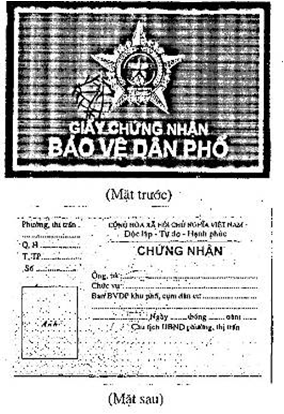
a. Certificate of the People's Security Force (attached sample): rectangular shape, size 6 x 9 cm. Front side: red background, surrounded by a yellow border, border width 0.1 cm, and 0.5 cm away from the edge of the paper. In the middle, above: the emblem "For National Security" is printed, below, the first line reads "CERTIFICATE", capitalized letters, font size 0.1 cm, height 0.4 cm. Second line: "PEOPLE'S SECURITY FORCE", capitalized letters, bold font size 0.2 cm, height 0.5 cm. Back side: white background, with protective patterns, the emblem "For National Security" and a light blue border, thin inner line, thick outer line. On the upper right corner of the certificate, the name of the locality is printed in sequence: ward, town; district, county; province, city; Certificate number (starting from 001 for each ward, town; the certificate number matches the sign number); Below is a frame, size 3 cm x 4 cm for attaching a photo. To the left, in order from top to bottom: National Emblem; "CERTIFIED" in red, capitalized bold font size 0.1 cm, height 0.3 cm; "Mr./Ms." for full name, middle name of the People's Security Force member; followed by "Position..." to specify: head, deputy head, member...; next line: "People's Security Force Board, street, community": to specify the street or community name of the People's Security Force Board (Example: Street I or Community 15); next line: location of issuance (ward, town) and date of issuance; finally: Chairman of the People's Committee of the ward, town, reserved for the Chairman of the People's Committee to sign, stamp, and write full name.
Sample Certificate of Neighborhood Watch Protection:
b. Neighborhood Watch Protection Badge (attached sample): rectangular shape, white color, size 5cm x 8cm, printed on one side, with a red border 0.1cm thick around the edge, 0.3cm away from the outer edge of the badge; the top third has two lines of text, the first line printed People's Committee of Ward, Town to record the name of the ward or town of the Neighborhood Watch Protection member. The second line prints the text NEIGHBORHOOD WATCH PROTECTION, in red, capital letters, bold font, height: 0.6cm. In the bottom two-thirds, on the right side, there is a frame for attaching a 3x4 photo; On the left, the top line is blank for recording the surname and name of the Neighborhood Watch Protection member, accompanied by the number (matching the number on the certificate), for example: NGUYEN VAN HAI – 135, capital letters, bold font, height 0.3cm; the second line records the position of the Neighborhood Watch Protection member such as head of department, deputy head of department, member...; the next line prints: Neighborhood Watch Protection Team of Ward, Community... to record the name of the ward or community of that Neighborhood Watch Protection member.
Sample Neighborhood Watch Protection Badge:
|
PEOPLE'S COMMITTEE OF WARD, TOWN... NEIGHBORHOOD WATCH PROTECTION |
|
|
…………………………… Position:… Neighborhood Watch Protection Team of Ward, Community... |
|
c. Red title band for Neighborhood Watch Protection, width 10cm, length 40cm sewn in a circle to fit into the sleeve, the upper edge has a clip band to attach to the shirt when in use. Above and below the band have yellow borders, 0.5cm thick, running the full length of the band; in the center of the surface of the band, print or emboss the text: "NEIGHBORHOOD WATCH PROTECTION" in yellow, capital letters, bold font 0.5cm high, character height 4cm; character width 1.5cm, spacing between characters within a word is 0.2cm, spacing between words is 0.6cm.
2.2.2. Certificates and badges are issued to Neighborhood Watch Protection members. When no longer serving as a Neighborhood Watch Protection member, the person who received the Certificate and Badge must return them to the Team or Board of Neighborhood Watch Protection to be returned to the People's Committee of the ward. If lost or damaged, report to the team or board to search for and request the People's Committee of the ward to consider reissuing if not found. The title band is kept at the workplace of the Team or Board of Neighborhood Watch Protection. When performing duties, Neighborhood Watch Protection members must wear the Certificate, Badge, and Neighborhood Watch Protection title band and are responsible for their preservation. Absolutely do not lend or allow others to use the Certificate, Badge, or Neighborhood Watch Protection title band.
2.2.3. The Certificate, Badge, and Neighborhood Watch Protection title band can only be used while performing duties. When using, the Badge is worn on the left chest, the top edge of the badge level with the first button from the top. The title band is worn on the upper elbow of the left arm, with the text "NEIGHBORHOOD WATCH PROTECTION" facing outward toward the arm.
2.3. In addition to the Certificate, Badge, and title band, Neighborhood Watch Protection members are equipped with other necessary means such as: uniforms, whistles, flashlights, notebooks.
2.4. The Chairman of the People's Committee at the ward level is responsible for arranging work locations for Neighborhood Watch Protection members; issuing and managing the issuance and recovery of Certificates, badges, and title bands for Neighborhood Watch Protection members; based on the number of Neighborhood Watch Protection members and equipment needs, compile data on the provision of simple weapons, support tools, Certificates, identification numbers, title bands, and other necessary means, report to the Chairman of the People's Committee at the district level to report to the Chairman of the People's Committee at the provincial level for approval of funding for the provision of simple weapons, support tools, printing Certificates, badges, title bands, and other necessary means to serve the work of Neighborhood Watch Protection members.
2.5. The Director of the Provincial Public Security Department is responsible for advising and assisting the Chairman of the People's Committee at the provincial level in the provision of simple weapons, support tools, organizing printing, issuing Certificates, badges, title bands, uniforms, and other necessary means for Neighborhood Watch Protection members according to the provisions of this Decree and Circular.
2.6. The Ministry of Public Security (General Logistics Department of the People's Public Security) is responsible for researching and guiding the model of uniforms for Neighborhood Watch Protection members to implement uniformly nationwide.
3. Funding to ensure the operation of Neighborhood Watch Protection
3.1. Sources of funding to ensure the operation of Neighborhood Watch Protection include:
a. Local budget as prescribed by the State Budget Law;
b. Local security and order fund;
c. Contributions and support from organizations and individuals as prescribed by law.
3.2. Management and use of funds:
a. The provision of working equipment, distribution of uniforms, and payment of allowances for Neighborhood Watch Protection members must comply with established standards, quotas, and expenditure limits decided by authorized authorities.
b. The establishment, implementation, and settlement of funds to ensure the operation of Neighborhood Watch Protection shall be carried out in accordance with the State Budget Law; Decree No. 60/2003/ND-CP dated June 6, 2003 of the Government detailing and guiding the implementation of the State Budget Law; Decree No. 10/2004/ND-CP dated January 7, 2004 of the Government on management and use of state budget and assets for certain activities in the field of national defense and security; and Circular No. 60/2003/TT-BTC dated June 23, 2003 of the Ministry of Finance on management of village budgets and other financial activities of villages, wards, towns.
Annually, the Director of the Provincial Public Security Department, the Public Security Department of centrally-administered cities has the responsibility to plan, report to the Chairman of the same-level People's Committee for approval of funding for the provision of simple weapons and support tools according to regulations of the Ministry of Public Security to serve the work of Neighborhood Watch Protection.
c. Based on the economic and social development situation, the tasks of ensuring national defense and security and public order and safety during each period, the People's Committee of the province, centrally-administered cities shall stipulate the mobilization, management, and use of the security and order fund or the National Defense and Security Fund (according to the Militia Self-Defense Law) in the locality.
The management and use of the Fund and contributions from organizations and individuals must be conducted openly in accordance with current financial regulations.
VIII. IMPLEMENTATION
1. The Ministry of Public Security is responsible for directing and guiding units and localities to organize the implementation of the contents prescribed in this Circular.
2. Ministries, agencies equivalent to ministries, agencies under the Government, other central agencies, and People's Committees at all levels are responsible for implementing this Circular.
3. This Circular takes effect 15 days after its publication in the Official Gazette. All previous regulations contrary to this Circular are abolished.
In the process of organizing and implementing, if there are any difficulties, please reflect them to the Ministry of Public Security, the Ministry of Labor, Invalids and Social Affairs, and the Ministry of Finance for research and guidance./.
|
DEPUTY MINISTER MINISTRY OF FINANCE DEPUTY MINISTER (Signed) Tran Van Ta |
Deputy Minister of MINISTRY OF TRANSPORT LABOR INVALIDS AND SOCIAL AFFAIRS DEPUTY MINISTER (Signed) Huynh Thi Nhan |
DEPUTY MINISTER MINISTRY OF PUBLIC SECURITY DEPUTY MINISTER (Signed) Huynh Thi Nhan |
Bản đồ quan hệ
Bấm vào một văn bản để mở. Viền đỏ = quan hệ làm thay đổi hiệu lực.
Bản dịch
Văn bản này có sẵn ở các ngôn ngữ sau: