
This Decree details the collection of fees and charges under the Law on Fees and Charges, including service provision methods, rates, fee payers, exemptions, budget estimates, retention ratios, and the effectiveness of fee collection. It also stipulates the responsibilities of organizations collecting fees, specialized management agencies, and provincial People's Committees in developing and appraising fee and charge plans.
Scope of application
Ministries, ministerial-level agencies, government-affiliated agencies, provincial People's Committees, and cities directly under the central government, and organizations collecting fees and charges.
Key points
- Detailed regulations on the collection of fees and charges under the Law on Fees and Charges
- Responsibilities of fee-collecting organizations in developing fee and charge plans
- The authority of provincial People's Committees to appraise fee and charge plans within the jurisdiction of the provincial People's Councils.
- Effective from January 1, 2017, and abolishing previous decrees on fees and charges.
- Regulations on finalizing revenue from fees and charges for the year 2016 according to the Ordinance on Fees and Charges and laws governing tax administration.
- Transition to pricing mechanisms for fees listed in the Fee and Charge List attached to Decree No. 24/2006/NĐ-CP dated March 6, 2006, issued by the Government.
🌐 Social impact of this document
- Enhancing the effectiveness of fee and charge collection
- Strengthening the management and rational use of fees and charges
❓ Frequently asked questions
When does this Decree take effect?
This Decree takes effect from January 1, 2017.
How are the items in the list of fees and charges defined?
Fees and charges listed in the list may only be collected if there is a document specifying the collection rate.
Which previous decrees on fees and charges does this Decree abolish?
Abolishes Decree No. 57/2002/NĐ-CP dated June 3, 2002, Decree No. 24/2006/NĐ-CP dated March 6, 2006, and related amendments.
What must fee-collecting organizations do before collecting fees?
Fee-collecting organizations must develop fee and charge plans to be submitted to specialized management ministries or departments for appraisal and obtain a document specifying the collection rate.
Full text
|
THE GOVERNMENT |
SOCIALIST REPUBLIC OF VIET NAM |
|
Number: 120/2016/NĐ-CP |
Hanoi, August 23, 2016 |
DECREE
DETAILING AND GUIDING THE IMPLEMENTATION OF CERTAIN PROVISIONS OF THE LAW ON FEES AND CHARGES
On the basis of Law on Government Organization dated June 19, 2015;
On the basis of the Law on Fees and Charges dated November 25, 2015;
On the basis of Article 1. This Decree regulates the use of state assets to pay investors when implementing construction projects under the Build-Transfer Contract form (hereinafter referred to as BT Project) in accordance with the provisions of the law. June 25, 2015;
At the proposal of the Minister of Finance;
The Government promulgates this Decree detailing and guiding the implementation of certain provisions of Law on Fees and Charges.
PART I
GENERAL PROVISIONS
Article 1. Scope of Regulation
This Decree stipulates the declaration, collection, payment of fees and charges; management and use of fees; settlement of fees and charges; responsibilities of state agencies and organizations in collecting, paying, managing, and using fees and charges.
Article 2. Applicability
This Decree applies to:
1. Persons paying fees and charges include organizations and individuals receiving public services and serving state administrative management tasks as prescribed by the Law on Fees and Charges.
2. Organizations collecting fees and charges include state agencies, Vietnamese representative offices abroad, public service units, and organizations entrusted by competent state authorities to provide public services and serve state administrative management tasks that can collect fees and charges as prescribed by the Law on Fees and Charges.
3. State agencies, organizations, and other individuals related to the declaration, collection, payment, management, and use of fees and charges.
Chapter II
DECLARATION, COLLECTION, PAYMENT, MANAGEMENT AND USE OF FEES AND CHARGES
Article 3. Declaration, Collection, Payment, and Settlement of Fees and Charges
1. Persons paying fees and charges shall declare, pay fees and charges monthly, quarterly, annually, or each time they occur. Based on the nature and characteristics of each fee or charge, the competent state authority prescribed in Clause 2, Article 4 of the Law on Fees and Charges shall specify the declaration and payment periods for fees and charges accordingly.
2. Collecting organizations shall declare and pay collected fees and charges as follows:
a) Organizations collecting charges shall remit all collected charge amounts into the State budget. These organizations shall declare and pay charges monthly and settle charges annually in accordance with tax management laws.
b) On a daily, weekly, or monthly basis, organizations collecting fees must deposit the collected fee amounts into the Fee Account awaiting transfer to the State budget opened at the Treasury. Depending on the amount of fees collected and the distance from the Treasury, the competent state authority prescribed in Clause 2, Article 4 of the Law on Fees and Charges shall determine the frequency of depositing collected fees into the Fee Account awaiting transfer to the State budget.
Organizations collecting fees shall declare the collected fee amounts monthly and settle them annually in accordance with tax management laws, and remit the fees payable to the State budget after deducting the retained amounts.
c) Organizations collecting road usage fees and Vietnamese representative offices abroad collecting fees and charges shall declare, collect, and pay according to the guidance of the Ministry of Finance.
3. Organizations collecting fees and charges shall issue and provide fee and charge receipts in accordance with the guidance of the Ministry of Finance.
4. Currency for the collection and payment of fees and charges
a) Fees and charges collected in Vietnam shall be in Vietnamese dong, except where laws permit their collection in freely convertible foreign currencies. In cases where collection in freely convertible foreign currencies is allowed, they may be collected in such currencies or converted into Vietnamese dong based on the exchange rate as follows:
- When paying fees and charges at commercial banks or other financial institutions, the buying rate of the commercial bank or financial institution where the payer has an account at the time of payment shall apply.
- For direct payment of fees and charges at the State Treasury, the accounting exchange rate for foreign currencies at the time of payment announced by the Ministry of Finance shall apply.
- When paying fees and charges directly in cash or through other methods to the fee and charge collecting organization, the buying rate of the head office of Vietcombank for foreign currency transfers at the time of payment or the end of the working day immediately preceding a holiday or weekend shall apply.
b) Fees or taxes collected abroad shall be collected in the local currency or in freely convertible foreign currencies.
Article 4. Principles for managing and using fees
1. Fees collected from service activities carried out by state agencies must be paid into the State budget. If state agencies are allocated costs from fee revenues, they may deduct according to the ratio specified in Article 5 of this Decree; the remainder (if any) shall be paid into the State budget.
State agencies allocated costs include:
a) Agencies implementing financial mechanisms as prescribed by the Government or the Prime Minister regarding self-management and self-responsibility in the use of staff positions and administrative management funds for state agencies.
b) Vietnamese representative offices abroad.
c) Public security and defense agencies entrusted to provide services and serve state administrative management tasks and collect fees as prescribed by the Law on Fees and Charges.
2. Fees collected from service activities carried out by public service units may retain part or all of the collected fee amounts to cover service provision and fee collection costs according to the ratio specified in Article 5 of this Decree; the remainder (if any) shall be paid into the State budget.
3. Fees collected from service activities carried out by organizations entrusted by competent state authorities may retain part or all of the collected fee amounts to cover service provision and fee collection costs as determined in Article 5 of this Decree; the remainder (if any) shall be paid into the State budget, except where the Government has provided otherwise, which shall be implemented according to the Government's regulations. The retained fee amount is the revenue of the fee-collecting organization.
Article 5. Determination of Retention Ratio and Management and Use of Fees
1. The amount of fees deductible or retained by fee-collecting organizations prescribed in Article 4 of this Decree shall be determined as follows:
a) Amount of fees deducted or retained = Amount of fees collected x Retention ratio.
b) The retention ratio shall be determined as follows:
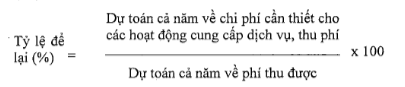
Where:
- The annual budget for necessary expenses for service provision and fee collection activities shall be prepared based on the expenditure items in Clause 2 of this Article and in accordance with established standards and norms.
- The annual budget estimate of fees collected by the fee-collecting organization is based on the anticipated fee levels and the number of services provided in the year.
- In cases where the retention ratio and budget estimates need adjustment, the previous year's actual revenue and expenditure data will also serve as a basis.
- The maximum retention ratio shall not exceed 100%.
c) Based on the nature and characteristics of the fees and the expenditure items in Clause 2 of this Article, fee-collecting organizations shall prepare the budget for income and expenditure and the retention ratio in the Fee Collection Plan and submit it to the competent authority as prescribed in Article 6 of this Decree.
d) The competent state authority prescribed in Clause 2, Article 4 of the Law on Fees and Charges shall decide the retention ratio for fee-collecting organizations. For similar types of fees, the competent authority may consider and decide on a unified retention ratio applicable across the board.
In cases where state policies change, the retained fee amount is insufficient to cover the operational costs of fee-collecting organizations, or there is surplus unused and transferred over to subsequent years, the competent authority shall adjust the retention ratio appropriately.
2. The amount of fees retained by fee-collecting organizations prescribed in Clause 1 and Clause 2 of Article 4 of this Decree shall be used for the following purposes:
a) Expenditure to implement the self-management regime (for state agencies), regular expenditure (for public service units).
- Expenditure for paying individuals performing work, services, and collecting fees: salaries, wages, allowances, contributions calculated based on salary (excluding salary costs for officials and civil servants already receiving salaries from the state budget according to prescribed regulations).
- Costs serving the implementation of work, services, and fee collection such as office supplies, office materials, communication, electricity, water, travel expenses according to current standards and norms.
- Regular maintenance expenses for assets, machinery, and equipment directly serving the performance of work, services, and fee collection.
- Purchase expenses for materials and raw materials related to the performance of work, services, and fee collection.
- Depreciation of fixed assets to implement work, services, and fee collection for public service units that self-fund regular expenditure and investment from fee revenue.
- Other expenses related to the performance of work, services, and fee collection.
b) Expenditure not implementing the self-management regime (for state agencies), non-regular mission expenditure (for public service units).
- Expenditure for purchasing, major repairs of assets, machinery, equipment serving the implementation of work, services, and fee collection (except for public service units that self-fund regular expenditure and investment from fee revenue according to the Law on Fees and Charges).
- Other non-regular expenditure related to the implementation of work, services, and fee collection.
3. In addition to the expenditure items specified in Clause 2 of this Article, if a fee-collecting organization is a public service unit permitted by the Government or the Prime Minister to use retained fees for other purposes, it shall implement expenditure according to the Government's regulations or the Prime Minister's decision. In cases where state agencies operate under a financial mechanism prescribed separately by the Government or the Prime Minister, retained fees shall be used according to the Government's or the Prime Minister's regulations.
4. The amount of retained fees for fee-collecting organizations to cover the expenditure items specified in Clause 2 of this Article, for state agencies operating under the Government's or the Prime Minister's regulations on the self-management and self-responsibility system in using personnel quotas and administrative management funds; for public service units operating under the Government's regulations on the self-management mechanism.
5. Annually, fee-collecting organizations must settle accounts for income and expenditure according to regulations. After settling accounts in accordance with the regulations, the unspent retained fee amount in the year shall be transferred to the next year for continued expenditure according to the prescribed regulations.
Chapter III
IMPLEMENTING PROVISIONS
Article 6. Implementation Organization
Ministries, ministerial-level agencies, government agencies, provincial People's Committees, and fee and charge collecting organizations shall perform their responsibilities as stipulated in the Law on Fees and Charges. At the same time, they shall implement the following provisions:
1. Organizations collecting fees and charges have the responsibility to:
a) Develop plans for fee and charge collection; submit to the specialized management ministry (for fees and charges within the Ministry of Finance's jurisdiction), specialized management department (for fees and charges within the provincial People's Council's jurisdiction). In cases where fees and charges are collected by multiple organizations, without issuing separate documents for each fee and charge collecting organization, the specialized management ministry shall lead in developing the plan (for fees and charges within the Ministry of Finance's jurisdiction) in accordance with Clause 3 of this Article, the provincial People's Committee shall direct the specialized management department to lead in developing the plan (for fees and charges within the provincial People's Council's jurisdiction).
b) The fee collection plan includes: Service provision method, fee collection method; estimated rate, basis for setting the rate; liable parties; exemptions and reductions; budgeted income and expenditure; retention ratio; assessment of contributors' ability to pay; effectiveness of fee collection.
c) The charge collection plan includes: Service provision method, charge collection method; estimated rate and basis for setting the rate; liable parties; exemptions and reductions; assessment of contributors' ability to pay; effectiveness of charge collection.
2. The provincial people's committee shall direct the development and review of plans for collecting fees and surcharges for those fees and surcharges within the decision-making jurisdiction of the Provincial People's Councils.
3. Ministries, ministerial-level agencies, and government agencies have the responsibility:
a) To receive proposals from fee and charge collecting organizations under their sectoral or field management; review and issue documents requesting the Ministry of Finance to promulgate regulations on fee and charge collection.
b) In cases where fees and charges are collected by multiple organizations or local agencies (without issuing separate documents for each fee and charge collecting organization), they shall assign functional units to develop plans, submit them for ministry review, and issue documents requesting the Ministry of Finance to promulgate regulations on fee and charge collection.
Fees and charges listed in the Fee and Charge List attached to the Law on Fees and Charges may only be collected when there is a document specifying the collection rate.
Article 7. Transitional Provisions
1. Fee and charge collecting organizations shall settle accounts for the 2016 fee and charge income according to the Regulations on Fees and Charges and tax management laws. After settlement, the unspent retained fee and charge amounts in the year shall be transferred to the next year for continued expenditure according to the prescribed regulations until January 1, 2018, and any remaining charge revenue must be fully remitted to the state budget.
2. Fees in the Fee and Charge List attached to Decree No. 24/2006/ND-CP dated March 6, 2006, of the Government detailing the implementation of the Law on Fees and Charges shall be converted to pricing mechanisms according to the Law on Fees and Charges and implemented according to laws on pricing.
Article 8. Effective Date
1. This Decree takes effect from January 1, 2017.
2. From the date this Decree takes effect, the following provisions cease to be effective:
a) Decree No. 57/2002/ND-CP dated June 3, 2002, of the Government detailing the implementation of the Law on Fees and Charges; Decree No. 24/2006/ND-CP dated March 6, 2006, of the Government amending and supplementing certain articles of Decree No. 57/2002/ND-CP dated June 3, 2002; Decree No. 115/2011/ND-CP dated December 14, 2011, of the Government amending and supplementing Point 2, Section IV, Part B of the Detailed List of Fees and Charges issued together with Decree No. 24/2006/ND-CP dated March 6, 2006.
b) Articles 46, 47, 48, and other relevant contents regarding civil enforcement fees in Decree No. 62/2015/ND-CP dated July 18, 2015, of the Government detailing and guiding the implementation of certain articles of the Civil Enforcement Law.
c) Provisions on competition case processing fees and examination fees for exemption application files under Articles 51, 52, 53, 54, 55, 56, and Article 57 of Decree No. 116/2005/NĐ-CP dated September 15, 2005, detailing certain provisions of the Competition Law.
3. Repeal the content regarding fees and examination fees in Directive No. 24/2007/CT-TTg dated November 1, 2007, of the Prime Minister on strengthening the enforcement of legal provisions on fees, examination fees, and policies for mobilizing and utilizing people's contributions.
4. The Minister, the head of a ministerial-level agency, the head of an agency under the Government, and the Chairman of the People's Committees of provinces and centrally governed cities are responsible for implementing this Decree./.
|
Place of Receipt: |
PRIME MINISTER |
Original document (PDF)
Download
Relations map
Click a document to open. A red border = a relation that changes validity.
Translations
This document is available in the following languages: